INTRODUCTION
In recent decades, religious discourse in politics in the United States has increased to a degree not seen before in the latter half of the 20th century. Religious rhetoric in presidential high-stake speeches reached a high point with George W. Bush's administration. In 2004, Catholic Democratic presidential candidate, John Kerry, had to prove he was “Catholic enough” in the face of pro-life criticisms of his abortion stance, while in 2008 Barack Obama negotiated controversial comments from his former pastor, Jeremiah Wright, as well as unfounded suspicions that Obama was Muslim. How does the United States stand comparatively in the use of religious rhetoric in politics? Anecdotal evidence suggests that such rhetoric has become more important in Australia, and less so in Canada.
The 2004 electoral defeat of the Australian Labor party, which was led by an avowed agnostic in that election, influenced Labor leader, Kevin Rudd, a former Catholic, now an Anglican, to embrace religious rhetoric. He has described Australia as a “Christian country” stemming from a “strong Catholic-Protestant Christian tradition” and has held strategy meetings among Labor Prime Ministers to deal with the Liberal-National coalition's attempt to monopolize religion.Footnote 1 He has also published a 5,000 word essay, “Faith in Politics,” upholding as a model for balancing religious conviction and politics the Lutheran theologian Dietrich Bonhoeffer, who opposed the persecution of Jews in Nazi Germany and worked to undermine the regime. In concluding his discussion of Bonhoeffer, Rudd labeled him “the Protestant Thomas More,” the Catholic saint venerated by the Catholic Church for refusing to support the regime of Henry VIII, who had broken with the Roman Catholic Church (Rudd Reference Rudd2006). By likening Bonhoeffer to More, Rudd deftly suggested that a single Christian tradition was essential to politics.
In Canada, the newly reorganized Conservative Party under Stephen Harper has been much more public about its religiosity and the importance of the Christian tradition to Canada's history. However, the response on the left, unlike the response on the left in Australia, has been more tepid. Liberal Catholic Prime Minister, Jean Chretien, several times affirmed that religion and politics shouldn't mix. In his biography, Straight from the Heart (Chretien Reference Chretien1994, 12), he recounted with much distaste the story of one Catholic bishop who attempted to deny his father communion because his father was a Liberal. After September 11, 2001, Chretien also claimed that one of his best decisions was not to have a minister speak at the memorial service for the victims of the attack.Footnote 2 Chretien's successor, Paul Martin, also emphasized the separation of religion and politics, and few articles appeared in the media associating Stephane Dion, the Catholic leader of the Liberals from 2006 to 2008, with religious rhetoric.Footnote 3 Michael Ignatieff (Reference Ignatieff2008), the leader of the Liberals from 2008 to 2011, has written an essay entitled “Keeping Faith in Politics,” which sounds surprisingly close to the essay Rudd wrote in Australia, but which conveys a very different message. In Ignatieff's essay, the faith that needs to be kept in politics is faith in the capacity of humans to understand and change the world, not religious faith. “Politicians cannot allow themselves the privilege of claiming to know what God has in store for us,” Ignatieff wrote. “We separate religion and politics … and because we do Canada has escaped the religious and ethnic strife that defaces other countries.”
These differences among the three countries suggest that a modification needs to be made to a claim by the religious sociologist Peter Berger, who once said that if India is the most religious country and Sweden the least, then the United States is a nation of Indians ruled by Swedes.Footnote 4 Looking only at political elites in Australia, Canada, and the United States in the 1990s and the early 2000s, the United States comes closest to being a nation of Indians ruled by Indians, while Australia a nation of Swedes ruled by “Swindians.” Canada comes closer to being a nation of “Swindians” ruled by Swedes. What this reinterpretation of Berger's metaphor reveals is cross-country variations between the apparent religiosity of political elites and the levels of belief in a society.
These descriptive claims will be backed by analysis of political speeches and policy favorable to religious interests in the three countries. In particular, the article compares presidential high-state speeches in the United States with throne speeches and governor general speeches in Canada and Australia. The article also looks at the relatively well established tradition of maiden speeches of parliamentarians in Canada and Australia to explore in more fine detail the differences between these two countries.
The variations experienced by the three countries allow the article to rule out two potential explanations for the high salience of religion to politicians: the size of the religious population and backlash to activist judges and the rights revolution. While these factors may explain conservative religious mobilization, they are not sufficient to explain whether politicians in the three countries actively seek to employ religious discourse in their speeches. Politicians in countries with low levels of religious belief or not very activist judges, as in Australia, may still resort to religious appeals to sort the electorate.
The article explores whether the divergences are correlated with differences in coalition-building incentives. The logic and opportunity of building conservative Christian coalitions helps explain why there is a political incentive to adopt religious discourse and policy favorable to religious interests.
VARIATIONS IN THE USE OF RELIGIOUS RHETORIC: HOW RELIGIOUS ARE THE RULED AND THE RULERS?
The first claim this article makes is that there is significant variation in the levels of religious belief in the three societies (what Berger called the religiosity of the ruled) and the level of religious discourse deployed by politicians (interpreting narrowly what Berger called the religiosity of the rulers). The article looks at the use of religious rhetoric by politicians in presidential, throne, governor-general, and maiden speeches to show that there is no neat correspondence with the general levels of religiosity in society.
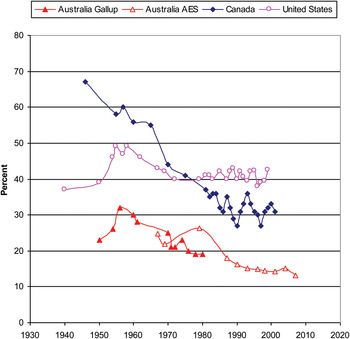
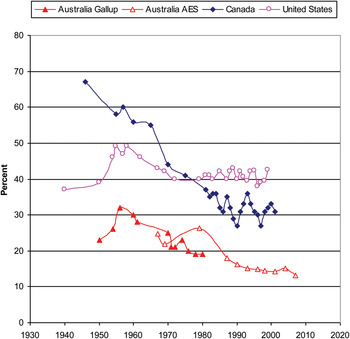
Single-country measures of weekly churchgoing, such as the Gallup polls, show that Australia lags behind Canada and the United States over the last half of the 20th century (see Figure 1). Comparing Canada and the United States demonstrates that up until about the 1960s, weekly churchgoing in Canada exceeded that of the United States. Since the 1980s, weekly churchgoing in the United States has exceeded that of Canada. Surveys with cross-country designs, such as the World Values Survey, also show that in the contemporary period, Canada lies between Australia and the United States in terms of monthly or better churchgoing. Other measures of religiosity besides churchgoing, such as having born-again experiences and belief in the Bible as the literal word of God, confirm that Canada is typically somewhere in between the United States and Australia in terms of religious belief and practices.Footnote 5 Hence, in terms of the “ruled,” the United States is closer to India, Australia to the Swedes, while Canada might be described as in between, or “Swindian.”
(Color online) Weekly church attendance in the United States, Canada, and Australia. Source: Australian Election Studies; Australian Gallup; Canadian Election Studies; American National Election Studies.
How about the religiosity of the rulers — the elite of political representatives? Analysis of religious rhetoric in United States presidential speeches shows a significant increase since the 1980s. Domke and Coe (Reference Domke and Coe2007, 34) have shown that the average number of references to God in Inaugural and State of the Union addresses averaged about two from Franklin Roosevelt to Jimmy Carter, then reached nearly six with Ronald Reagan, about four with George H.W. Bush, three with Bill Clinton, and five with George W. Bush. Barack Obama's inaugural speech contained five references to God, while his 2010 state of the union address included two. Based on a small sample size, Obama's use of religious rhetoric seems close to that of Clinton.
The use of religious discourse by politicians is not as prominent in Australia and Canada. Throne speeches in Canada and addresses by the governor general in Australia are given at the beginning of every session of parliament. Typically delivered by the governor general in both countries, the speech is crafted by the governing party, outlining that party's legislative agenda.Footnote 6 In terms of frequency, the throne speech is more frequent than inaugural addresses but less frequent than state-of-the-union addresses. Between 1950 and 2008, there have been 51 throne speeches in Canada. In the same time period there were 13 inaugural addresses and 58 state-of-the-union addresses in the United States. In Australia, there were 28 governor general's speeches from 1956 to 2008.
There are some differences between throne/governor-general speeches and presidential high-stake speeches. Because the president cannot assume the party in power in Congress will enact his agenda, the president may be more inclined to use the speech as a means of pressuring Congress to enact the president's policy agenda. By contrast, the parliamentary system in Canada and Australia ensures that the prime minister typically has a governing majority, or at least a plurality, in parliament. Still, throne speeches and governor general's addresses contain more than a dry list of policy goals. They also often include invocations of peoplehood and the unique character of Canada and Australia. Conservative and liberal platforms often diverge in their emphases, so that they can be considered political documents that are intended to attract support for their programs. Differences between the parties are often magnified in the debates that follow the speeches. Soroka (Reference Soroka2002, 64–66) has also noted that issues change over time in throne speeches, so the throne speeches are picking up some transformations in politics. Throne speeches are often not comprehensive, and controversial policies that a party may intend to enact may be left out of the throne speech. However, presidential state-of-the-union addresses also are not comprehensive and often policies are sketched in broad, nonspecific strokes.
From 1950 to 2008, Canadian throne speeches contain very little religious rhetoric. Of the 51 throne speeches between 1950 and 2008, 15 of those were given when the Progressive Conservative/Conservative party was in control of parliament, 36 when the Liberal party was in control. Each speech does end with “May divine providence guide your deliberations,” but the use seems more a matter of custom. In Australia, as with the Canadian throne speeches, there is no use of religious rhetoric in the speeches except for the variation of the phrase, “May divine providence guide your deliberations” used to close each speech. The one difference is that this phrase disappears in the 1973, 1974, and 1977 speeches, and then disappears permanently after 1983.
The use of religious rhetoric in political speeches may appear to be greater in Canada than Australia, but only if great importance is set to the disappearance of the phrase “May divine providence guide your deliberations” in Australia. However, it is debatable whether the continued use of the phrase in the Canadian context reflects a commitment to religion or simply a commitment to tradition. What seems more important is that in the body of the texts of throne and governor general speeches, there is no mention of religious rhetoric at all, whereas such rhetoric exists in the body of United States presidential speeches.
A more fine-grained look at religious rhetoric can be found by looking at maiden speeches of parliamentarians — the speech they make when they elected for the first time. Although there is no comparability with the United States, where the tradition is not nearly as strong, comparing Australian and Canadian maiden speeches reveals differences between those two countries.
The convention surrounding maiden speeches are roughly similar in Australia and Canada. Members typically congratulate the Speaker, mention previous holders of their seat, describe their electorate, and try to keep their comments somewhat non-controversial, since maiden speeches are not to be interrupted by other members.Footnote 7 Still, significant philosophical differences often appear in the maiden speeches, especially since many are direct responses to throne speeches and governor general's speeches, which set the overall legislative agenda. That questions of religion and politics can become important in maiden speeches is reflected in this quote by Senator John Herron of Queensland: “Religion wasn't a reason for my entering Parliament, but [preparing for] the maiden speech makes you think, ‘What will be the basis for my actions while I'm here?”’ (Maddox Reference Maddox2005, 37).
Electronic versions of maiden speeches from the lower legislative chambers in Australia and Canada were collected, and keywords were searched for using standard word processing software. A representative was coded as using faith-based rhetoric under two conditions: (1) the speech contained the word “God” (or a close correlate, such as a reference to “the Creator”); or (2) the speech contained two or more of the following words: bible, pray, church, Christ, Christian, religious, religion, Catholic, spiritual, divine, or bless. Although each speech was not read in its entirety, each sentence and/or paragraph in which a keyword appeared was read to make sure that the usage was not colloquial.Footnote 8 The criterion of two or more of the non-God keywords is also meant to screen out colloquial usage.
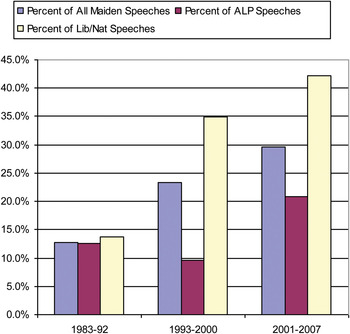
Among all freshmen parliamentarians in the House of Representatives in Australia, religious rhetoric has increased in the past few decades (see Figure 2). Liberal and National party members have been more willing to use religious rhetoric than the Labor party, but the use of religious rhetoric has increased in Labor as well. As Labor Prime Minister Maria Vamvakinou, a Greek Orthodox, put it, “I'd hate to think people thought the Labor Party was bereft of faith and that we weren't interested in religion at all. I don't think the Liberal Party should be seen to have a monopoly on God … Religion and faith are mainly private matters, but if I see an opportunity, in parliament or in public, I will speak more openly about my Christian beliefs.”Footnote 9
(Color online) Percent of Australian House maiden speeches with religious rhetoric. Source: Australian House Hansard. On the x-axis, each time period consists of three parliamentary sessions. There is substantial variation within each session, partially driven by the fact that some sessions have relatively fewer numbers of freshmen parliamentarians, which is why it makes sense to group sessions into blocks.
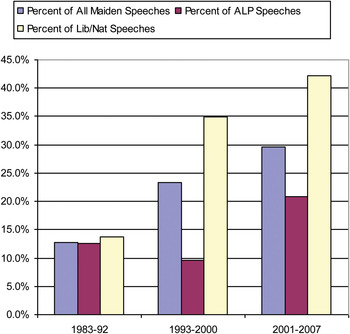
One sees a particularly sharp increase in 1996, when the conservative John Howard assumed control of the Australian government. In that year, 10 out of 52 maiden speeches in the Australian House mentioned “God.”Footnote 10 When the analysis is broadened so that speeches that contain two or more religiously inflected words (i.e., use of the words “bible,” “pray,” “church,” “religion,” “Catholic,” “spiritual,” “Jesuits,” “divine,” or “bless”), 19 out of 52 maiden speeches contained such rhetoric. As numerous commentators have pointed out, appealing to religious conservatives was a major strategy of the Howard government. Maddox believes that in prime ministerial utterances, this was largely achieved through use of “coded” rhetoric and appeals to imagery of a 1950s Australia of “white picket fences” and family values. George W. Bush also used “coded” religious rhetoric, as when his speechwriters included phrases like “wonder making power,” which has resonance with scriptural language (Kuo Reference Kuo2006, 61). Yet in the maiden speeches of parliamentarians, one finds a great deal of direct use of religious rhetoric.
It is useful to compare 1996 in Australia with 2006 in Canada. This year can be considered crucial in that the Conservative party in Canada was led by Stephen Harper, who emphasized both his belief and promised to revisit the issue of homosexual marriage, which the Canadian federal parliament had declared was legal. One important comparative consideration is that there is less adherence to the maiden speech as a tradition in Canada, as not all freshmen parliamentarians give a formal maiden speech. Of the 74 freshmen parliamentarians in the 39th parliament, only 51 were identified with maiden speeches. Another consideration is that the Canadian House is significantly larger, so the maiden speeches are shorter. The speeches in the 1996–1998 Australian parliament averaged approximately 3,000 words per speech, whereas the Canadian maiden speeches averaged roughly 1,250 words. With these caveats in mind, only three out of 51 freshmen parliamentarians in the 39th parliament mentioned God at all, and there were no other parliamentarians who included two or more uses of religious rhetorical words beyond “God.” The lack of religious rhetoric compared to Australia is surprising not only because of the media attention given to the connections between Harper and politicized religion, but also because Canadian weekly churchgoing rates in 2006 are higher than that of Australia.
The lack of use of religious rhetoric in maiden speeches in 2006 in Canada reflects a more consistent pattern. When one looks at maiden speeches from the 35th Parliament through the 40th Parliament (1994 to 2008), two things stand out. First, the overall use of religious rhetoric is low, ranging between three and seven percent of all speeches. Second, there is not as steep a pattern of increase from the 1990s to the 2000s, as there is in Australia. In 2006, when one might have expected an increase in use of religious rhetoric with the victory of Stephen Harper, use of religious rhetoric in maiden speeches increased from about an average of 3 to 4 percent from 1994 to 2005, to a little over 6 percent from 2006 to 2008.
What does it mean that parliamentarian freshmen are resorting to religious rhetoric to a greater degree in Australia than Canada? It could be that the longer form of the speech in Australia allows for greater opportunity to use religious rhetoric, especially given the greater latitude in the Australian speeches for members to talk of their personal biography. Still, it should be noted that six of the references to “God” in the 1996 Australian speeches came in simple and short references of thanks to God for being allowed to serve, whereas only one of the references to God in the Canadian speeches in 2006 is a similar expression of gratitude (the other two are a blessing to Canadian troops and a quote from a Native American chief saying they used to pray to a God they didn't believe in under British rule). Various expressions of thanks are common in maiden speeches in both countries, so it does not seem likely that it is the length of the speech alone that is driving the usage of religious rhetoric.
Data on policy in Australia and Canada complement trends in use of religious rhetoric. Since 1963 federal funding has been available to all denominational schools in Australia. In 1996, Australia abolished the Commonwealth Employment Service and embraced principles of faith-based social provision by redirecting $700 million in contracts to churches performing job placement services. This was followed in 2004 with another $365 million over 4 years to churches for programs for early intervention for at-risk children (Maddox Reference Maddox2005, 235). In 2004, Australia affirmed that marriage is between a man and a woman. By contrast, in Canada, state funding for religious schools is still primarily limited to Catholic schools. Moreover, Canada has affirmed gay marriage rights.
Berger's metaphor can thus be reinterpreted to describe Australia as coming comparatively closer to a nation of Swedes ruled by “Swindians.” Of the three countries, the United States looks more like a nation of Indians ruled by Indians. Canada is better described as a nation of “Swindians” ruled by Swedes. These characterizations can be used to evaluate whether size of the religious population and degree of judicial activism are related to the adoption of religious rhetoric by politicians.
SIZE OF THE RELIGIOUS POPULATION?
Is high salience of religion to politicians a result of the size of the religious population?Footnote 11 If size of the religious population were the most important determinant of use of religious rhetoric by politicians, then one would only find nations of “Indians ruled by Indians,” and “Swedes ruled by Swedes.” The fact that there are mixed categories (“Indians ruled by Swedes,” “Swedes ruled by Swindians,” and “Swindians ruled by Swedes”) shows that size of the religious population is not a decisive factor.
The inter-country comparisons are also supported by inter-temporal comparisons. Inter-temporal comparisons do not show a relationship between use of religious rhetoric and size of the population that goes to church on a weekly basis. The size of the United States population that claims to go to church on a weekly basis has not changed significantly since World War II. If anything, the number of regular churchgoers has slightly dropped from a high in the late 1950s, yet religious rhetoric in political discourse has increased. Moreover, Canada and Australia had higher proportions of their populations going to church around mid-century (around 50 to 60 percent in Canada) yet the Throne and Governor General's speeches do not pick up any increase in religious rhetoric at those times.
JUDICIAL ACTIVISM AND THE RIGHTS REVOLUTION?
The descriptive characterizations of the three countries also throw into question the sufficiency of the “rights revolution” and religious backlash thesis in explaining use of religious rhetoric in politics. Several scholars have suggested that it is primarily court decisions and a new emphasis on rights that has mobilized religion in the United States and increased the use of religious political rhetoric. Gary Wills, for instance, has argued that the religious right has mobilized in response to a rights revolution initiated by court cases. Wills (Reference Wills2007, 482–483) writes, “Between 1961 and 1971, ten cases hit the Evangelicals blow after blow … This concentration of cases, suddenly accepted and ruled on by a Court that had not been much interested in the subject before, convinced Evangelicals that the Court was now waging a war on God.”Footnote 12 These include decisions on school prayer, sabbatarianism, contraception, and abortion.
Other scholars however have suggested that there have been triggers besides the rights revolution that mobilized the religious right.Footnote 13 The data on religious rhetoric in political speeches in Canada, the United States, and Australia supports the notion that the rights revolution is not as crucial in whether politicians begin to incorporate religion in their rhetoric to appeal to disaffected religious believers. Canada, compared to Australia, has come much closer to the United States in experiencing a “rights revolution,” yet in comparing throne/governor general speeches, the amount of religious rhetoric in both countries is about the same, while in comparing maiden speeches, the amount of religious rhetoric in Australia exceeds that of Canada.
The rights revolution can be construed broadly (as led by social movements, legislatures, and courts) or narrowly (as led by high courts). In Epps' (Reference Epps1998) original formulation, the “rights revolution” was seen as primarily a judicially led phenomenon that sparks social movements to take their case at the judicial level. Other commentators have argued that a rights revolution can be promoted by other institutional venues, such as legislatures (Galligan and Morton Reference Galligan, Morton, Campbell, Goldsworthy and Stone2001, 17–18). The section looks at both the narrow and the broader conception of the rights revolution to see how they affected religious interests. When the rights revolution is construed narrowly as a court-led phenomenon, Canada appears to have experienced a deeper rights revolution. When the rights revolution is considered more broadly, then Canada and Australia appear similar in this regard. Either way, then, the rights revolution cannot explain why it is in Australia that politicians have resorted to religious rhetoric to a greater degree. Although a rights revolution may spark conservative religious mobilization, this does not necessarily translate into politicians adopting religious rhetoric.
The rights revolution in relation to religion in the United States has been well documented in the academic literature, so this section will focus primarily on the Canadian and Australian cases. Although not as sweeping as in the United States, the Canadian rights revolution has put religious groups, which once enjoyed a privileged position in the public sphere, on the defensive. Canadian Confederation in 1867 did not include a bill of rights as in the United States founding. A bill of rights was adopted in 1960 under the Diefenbaker government, but these rights only applied at the federal level, and its terms were ambiguous enough that its provisions seemed useless to legal observers (Vaughan Reference Vaughan, Howe and Russell2001). The idea for a Canadian Charter of Rights and Freedoms stems back in origins to the late 1960s. Negotiation over the proposed package of rights was difficult, and settled only by the inclusion of the “notwithstanding clause,” an ambiguous provision that could allow provincial and federal legislatures to override the terms of the charter after the first five years of its existence. Since the Canadian Charter of Rights and Freedom came into effect in 1982, the notwithstanding clause has rarely been invoked. The historian Mark Noll (Reference Noll2006, 258) writes, “The most consequential long-term effect of the new Charter was to push Canadian jurisprudence into an increasingly American pattern where activistic judges become the promoters of social change.”
From 1984 to 2001 the Supreme Court of Canada issued over 350 decisions related to the Charter, and there have been a number of decisions at the provincial level based on the Charter (Manfredi Reference Manfredi2001, ix). Many of these decisions have affected religious interests, particularly with regard to religious education in schools, abortion, and gay marriage.Footnote 14
In terms of schools, the Ontario appeals court ruled in Zylberberg v. Sudbury Board of Education (1988) that school prayer in Ontario was unconstitutional even if there were opt-out provisions for the nonreligious, because school-led prayer placed an undue burden on the children who would be stigmatized for opting out. In 1989, in Russow and Lambert v. Attorney General of British Columbia, the British Columbia Supreme Court followed Ontario in striking down a similar prayer and Bible reading act with an opt-out provision. In the Elgin County ruling in Ontario in 1990, the Ontario appeals court also struck down a provincial law that allowed fundamentalist Christians to teach in Ontario public schools. One judge later noted that Elgin represented “the end of an era of majoritarian Christian influence, and marks the beginning of a period of secularism in education, based on an awareness of a changing societal fabric and Charter protection for minority rights to freedom of religion.”Footnote 15
Equally, if not more, harmful to conservative religious interests was the Canadian Supreme Court decision to strike down federal regulation of abortion in the 1988 Morgentaler decision. The Canadian parliament in 1969 had passed a law allowing abortions if deemed medically necessary by a hospital's Therapeutic Abortion Committee. This allowed substantial variations in access to abortion across Canadian communities, as access to a hospital was not easy, particularly in rural communities, and hospitals were not required to have such committees — only 15 percent of hospitals had such committees.Footnote 16 Four separate opinions were issued in Morgentaler, with two mainly focusing on the unconstitutionality of the committees, which were deemed to unduly limit women's ability to protect their health if they needed to perform an abortion for that reason. Another opinion affirmed a fundamental right to an abortion for women, while the last opinion dissented. Unlike the United States Supreme Court's decision in Roe v. Wade, which imposed a trimester approach to the legality of abortion, the Canadian Supreme Court left it open to the legislature to devise abortion regulations absent the need for abortion committees. Since Morgentaler, there has only been one attempt to pass a law regulating abortion. The bill passed in the House but failed in a tie vote in the Senate, an unelected body in Canada. Pro-life politicians joined with abortion supporters to oppose the bill because the bill would have allowed abortions for health considerations, including mental health. Since then, the federal government has largely avoided the abortion issue, which has meant in practice that there is no legal regulation of abortion access throughout Canada beyond a requirement that a doctor perform the abortion. Access of women to clinics and hospitals can be restricted by provincial decisions to limit funding of such clinics and hospitals, but provincial governments have not sought to deny such funding, although efforts to cut costs in healthcare in general may lead to deprioritization of such funding. Following Morgentaler, the number of abortions in Canada has increased, with a slight dip in the late 1990s, perhaps because of funding decisions.
Finally, Canadian courts have also been active in protecting gay marriage rights. In 1999, the House passed a bill overwhelmingly supporting a definition of marriage as between a man and a woman. A mere six years later, on June 28, 2005, parliament defined marriage to include same-sex couples. What happened in between these two votes was that in the provinces, nine provincial courts supported gay marriage based on the Charter, leading to Prime Minister Paul Martin's decision to draft legislation at the federal level to affirm the legality of homosexual marriage.
In Australia the rights revolution has not received as much attention because the Australian constitution lacks an enumerated bill of rights. Attempts to create a bill of rights failed in the 1970s and 1980s, and there has been a renewed push to secure a bill of rights with the recent report by the National Human Rights Consultation Committee, chaired by Father Frank Brennan (Goldsworthy Reference Goldsworthy, Campbell, Goldsworthy and Stone2006, 3). However, there are some “rights” clauses in the constitution, such as Section 116, which contains a guarantee of the freedom of religion. Moreover, rights have been granted through legislative and administrative means. Even with these caveats in mind, restricting examination of the rights revolution with regard to religious matters shows no significant activism among the courts in comparison with Canada and the United States.
After the passage of state aid to denominational schools in 1963, the courts refused to read into the Constitution's religious freedom clause any notion that this violated separation of church and state. In Ex rel Black v. Commonwealth (1981), the High Court rejected the idea that the religious freedom clause in Section 116 of the constitution contained an implicit separation of church and state preventing state funding of private schools. Moreover, specifically religious teaching continues to take place in all of the Australian states for those children in state schools who wish to attend them. School-led prayer has been deemed acceptable in state schools in New South Wales and Western Australia.Footnote 17
Comparing abortion policy the difference between Australia and Canada emerges more starkly. In Australia, each state has its own separate abortion laws. State courts played a part in determining the scope of abortion rights in Victoria, New South Wales, and Queensland.Footnote 18 Legislatures have led abortion reform in the other states in South Australia, Northern Territory, Western Australia, and the Australian Capital Territory.Footnote 19 At the federal level, there has been no significant legislation. The Australian Labor party introduced a bill to liberalize abortion in 1972, which failed, and an attempt to restrict payments for abortion from Medibank, the Australian national health insurance system, in 1979 also failed (Petersen Reference Petersen1984).
To summarize, in Australia some state-level courts did interpret existing statutory law in a liberalizing manner in the late 1960s and early 1970s, although in other provinces abortion liberalization was led by legislatures. From 1970 to 1988, one could argue that abortion was liberalized to a greater degree in Australia, because of the limited access in Canada to therapeutic abortion committees. Since 1988, abortion has become completely decriminalized in Canada, and abortion rates in that country have narrowed the gap with Australia and the United States.Footnote 20 Yet abortion has not become a defining issue in Canadian party politics, and the mobilization of religion has not translated into a heavy use of religious rhetoric in political speeches.
Finally, with regard to gay marriage rights, there has been no decision on the part of courts in Australia. The federal parliament has gone in the reverse direction of Canada, restricting the definition of marriage to one man and one woman. Civil unions have been recognized in the states of New South Wales, Victoria, Tasmania, and the Australian Capital Territory, with those civil unions recognized at the federal level for the purposes of federal benefits.
In summary, neither a narrow nor a broad interpretation of the rights revolution can explain the increase in religious rhetoric in Australia and the relative lack in Canada in the 1990s and early 2000s.
INVOKING GOD: COALITION POLITICS
The varying patterns in use of religious rhetoric are more closely correlated with different capacities in building conservative Christian coalitions in the three countries. The difference in the success of these coalitions helps explain why religious rhetoric has not fully permeated both sides of the political spectrum in Canada. Figure 2 show that the Liberal/National coalition in Australia increased their use of religious rhetoric in the 1990s. After the Liberal/National coalition won government, the Labor party in Australia also began to increase their religious rhetoric, further increasing the overall levels of religious rhetoric in political speeches. Although the Conservative party in Canada has emphasized conservative religious issues, the Conservative party's success came later (2006, with Stephen Harper) than similar efforts by the Republican party in the United States and the Liberal/National coalition in Australia, prompting less of a response by the Liberal party in Canada to respond with their own religious appeals.
Wuthnow (Reference Wuthnow1988) has argued that over the course of the 20th century, differences between religious denominations have become less important, while the difference between liberal and conservative strands of religion within denominations have become more important. What is striking in comparing the three countries is that there is great variation in the emergence of this liberal-conservative split, when measured by the timing of the appearance of the split, and by which church groups have been most affected by the split. In particular, Canadian Catholics have not been as quick to join conservative Christian coalitions as Catholics in the United States and Australia. In Canada, Catholics are particularly important, because they are the largest religious group, at about 45 percent of the population, with roughly half residing in Quebec and half outside of Quebec. By contrast, Catholics constitute about a quarter of the population in both the United States and Australia. In 1988, the last time the Canadian Election Studies asked about weekly church attendance, Catholics constituted 61 percent of those who claimed to go to church at least weekly, and in 2000 Catholics constituted 43 percent of those who considered religion very important, and 51 percent of those who considered religion somewhat important.
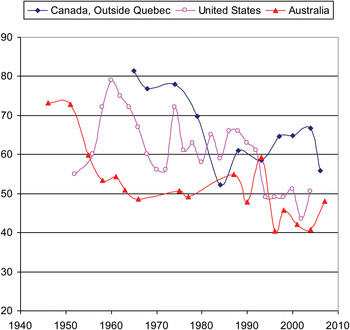
Figure 3 shows data for the Catholic partisan vote for the House of Representatives in Australia, the House of Representatives in the United States, and the House of Commons in Canada. In the United States, only those Catholics who identify as whites are analyzed to minimize the extent to which Latino Catholics are biasing the comparison, because Latino Catholics are more likely to vote Democratic than white Catholics.Footnote 21 For the purposes of this comparison, the Liberal, New Democratic, Bloc Quebecois, and Green parties in Canada are considered left-leaning.Footnote 22 In the 1990s in Australia and the United States, the Catholic vote for left-leaning parties decreased, whereas in the 1990s, Catholics outside of Quebec continued to vote heavily for the Liberal and New Democratic Parties. Although not depicted, the pattern for Catholic voting in Quebec is roughly similar to Catholic voting outside Quebec, although more extreme (i.e., greater defection from left-leaning parties in 1984, and greater support for left-leaning parties, especially the Bloc Quebecois, in the 1990s and early 2000s).
(Color online) Catholic vote for left-leaning parties. For the United States, only the votes of white Catholics shown. Source: American National Election Studies; Australian Election Studies; Canadian Election Studies.
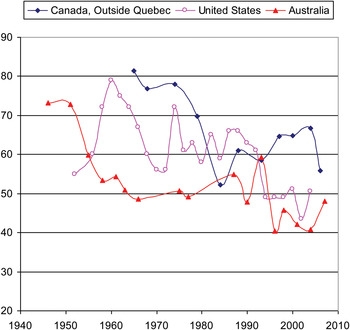
Canadian Catholics did vote in strong numbers for the Canadian Progressive Conservative party in the 1980s. The basis of this appeal, however, was not to Catholics qua Catholics.Footnote 23 Trudeau and the Liberal party's attempts to engineer constitutional change to promote greater centralization of power and protect French language rights primarily through a Charter of Rights and courts greatly disaffected French Quebec voters, and the constitution was patriated in 1982 with the support of all the provinces except Quebec. This left Quebec open to appeals from Brian Mulroney and the Progressive Conservative Party to find a constitutional formula that Quebec would like (Courtney Reference Courtney and Penniman1988, 193–194; Val Sears Reference Sears, Frizzell and Westell1985, 30–31). The Conservatives were able to win over 75 percent of the seats in Quebec. As a sign of how unusual this election was, Conservatives had captured a majority of the Quebec vote only once before, in 1958, since the end of World War I. The Progressive Conservative coalition did not last, as French Quebeckers moved their support to the Bloc Quebecois and disaffection with Mulroney's strategy of appeasing Quebec led to the birth of the Reform party in the western provinces. These developments led to the demise of the Progressive Conservative party and paved the way for Liberal victories in the 1990s.
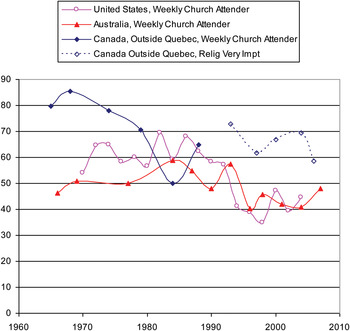
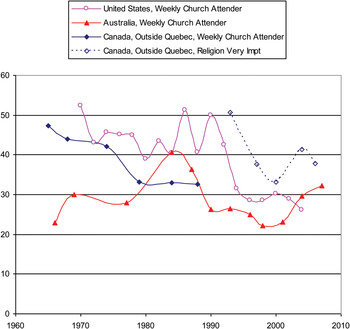
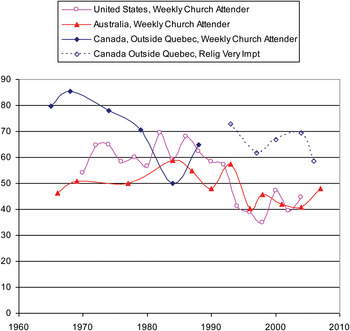
The difference in voting behavior of Canadian Catholics from other Catholics is not being driven by distinctions between regular churchgoing Catholics and “cultural Catholics” without strong ties to the organized church. Figure 4 show that the same patterns in Figure 3 exist for Catholics who are weekly church attendees and/or who consider religion an important part of their life. As in Figure 3, only those Catholics who identify as whites are analyzed in the United States. Figure 4 shows that for weekly churchgoing Catholics, votes for left-leaning parties' declines in the 1990s in both Australia and the United States. Because the Canadian election studies stopped asking questions about weekly church attendance in 1988, comparison requires including responses to questions on the importance of religion to the respondent's life, which both the Canadian and American election studies include (but not the Australian election studies). Data for Canadian Catholics who consider religion “very important” is depicted in Figure 4. Although the trend for United States Catholics who consider religion “important” is not depicted, it is similar to the weekly attendee line, and explicit comparison would show Canadian Catholics who consider religion “very important” are more willing to vote for left-leaning parties in the 1990s and early 2000s than United States Catholics who consider religion “important.”Footnote 23
(Color online) Catholic vote for left-leaning parties, weekly church attendees. For the United States, only the votes of white Catholics shown. Source: ANES, AES, CES. The CES stopped asking respondents about church attendance in 1993, and started asking a question about the importance of religion. The broken line represents Catholics outside of Quebec who considered religion “very important.” Although the responses of weekly churchgoers with those who consider religion very important is not directly comparable, if one were to compare Canadian Catholics who consider religion “very important” with United States Catholics who consider religion “important” in the same time period, there is still an inter-country gap.
By comparison, the voting behavior of Protestants who go to church weekly or better is depicted in Figure 5. The movement of Protestant weekly church attendees to the right is particularly visible beginning in 1996 in Australia and in 1994 in the United States. The Protestant vote has fluctuated in Canada. When looking at Protestants who consider religion “very important,” Protestant votes for left-leaning parties' declines in 1997 and 2000, perhaps in response to the increasing prominence of conservative religious morals to right-leaning parties. Although not depicted in Figure 5, if one were to look at Canadian Protestants who consider religion “very important” and compare them to United States Protestants who consider religion “important,” there is little gap in their votes for left-leaning parties in the 1990s and early 2000s. There is more of a gap if one compares Canadian Protestants who consider religion “somewhat important” to United States Protestants who consider religion “important,” so it is possible that Canadian Protestants have also been more reluctant to move to the right, and have contributed to the relative lack of salience of religion to Canadian politics.
(Color online) Protestants, weekly or better churchgoers, vote for left-leaning parties. For the United States, only the votes of white Protestants shown. Source: ANES, AES, CES. The broken line represents Protestants outside of Quebec who considered religion “very important.” Although the responses of weekly churchgoers with those who consider religion very important are not directly comparable, if one were to compare Canadian Protestants who consider religion “very important” with United States Protestants who consider religion “important” in the same time period, there is little inter-country gap.

The composition of Catholic candidates and representation in the United States and Australia also strongly points to a pattern of the left increasing its appearance of religiosity in response to success on the right in constructing conservative religious coalitions. In the United States, Catholics are over-represented across a broad range of political offices. Catholics, representing about 22 percent of the population of the United States, have exceeded their population percentages in Congress, the Supreme Court, and state governorships. In the 109th Congress (2005–2006) Catholics represented nearly 30 percent of representatives of the House. After Sonia Sotomayor's successful nomination to the Supreme Court, Catholics constitute six of nine justices. Catholics have been over-represented among state governors since at least 2000 and were particularly well represented in 2004, when they constituted 40 percent of all governors.Footnote 24 In recent years, most of this over-representation among governors has been concentrated on the Democratic side. In 2004, Catholics constituted eight of 28 Republican governors (28 percent) and 14 out of 21 Democratic governors (63 percent), a proportion that exceeds the percentage of Catholic Democratic party identifiers. By comparison, in 2000, the proportion of Democratic governors that were Catholic was a little over 20 percent, while the proportion of Republican governors that were Catholic was near 40 percent. Catholicity became more important among Democratic governors after Republicans were successful in attracting Catholic candidates and votes.
Australia is also experiencing Catholic over-representation, although not as widespread. In recent years, especially with the Liberal-National John Howard government from 1996 to 2007, there has an increase in the profile of Catholics. In 2007, with the Catholic proportion of the population at about 27 percent, the ministerial cabinet of the last Howard government included eight Catholics out of 18 (44 percent), an increase from six out of 18 in the previous Howard government (33 percent).Footnote 25 In addition, at the provincial level, Catholics have become over-represented among Liberal leaders in New South Wales in recent decades, with five of the last six being Catholics.Footnote 26 There have been eight Australian Candidate Studies conducted in the past few decades, which survey a sample of candidates running in the major parties for both Senate and House offices. Data on both party and religious affiliation are available from 1993 to 2007. These data show stability in the number of Catholic candidates running for the Liberal and National parties, from 23.6 percent in 1993 to about 25.6 percent in 2001, roughly the proportion of the Catholic population in Australia. In comparison, the number of Catholic candidates running for the Australian Labor Party was about proportional to population in 1993 and 1996 (27.6 and 26.9 percent) but jumped to 39.1 percent in 2001, 36 percent in 2004, and 34.1 percent in 2007, which exceeds the percentage that Catholic voters constitute in the Labor coalition.Footnote 27 The jump in Catholic representation in Labor party candidates corresponds with the Howard government's deployment of religion to attract Catholic voters to the Liberal-National coalition as well as the increase in religious rhetoric used in the maiden speeches of Labor members from 2001 to 2007 (Figure 2).Footnote 28
CONCLUSION
The varying patterns in the use of religious rhetoric by politicians cannot be explained fully by the size of the religious population, nor by the “rights revolution” and a transformation in the role of religion in public life stemming from the 1970s. Such factors may help mobilize conservative religionists into social movements. However, politicians may not necessarily respond strongly to this mobilization, as in the case of Canada. Moreover, even in the absence of triggers such as a large religious population, or highly activist judges and court decisions, politicians may still resort to religious rhetoric, as in the case of Australia.
The article argues that politicians will respond when there are coalition-building incentives to do so. In the Canadian case, the delay in the solidification of the Conservative party around both a small-government ideology and a conservative moral values platform, as well as Catholic and perhaps some Protestant reluctance to move away from left-leaning parties, has meant that the Liberal party has not had to compete as heavily around religious issues. Further investigation needs to be conducted to figure out why appeals to Catholics have been successfully made in the United States and Australia but not in Canada (Blais Reference Blais2005). Regression analysis may show that that the demographic composition of Catholics (ethnic, income, and regional differences) explains why Catholics in Canada have been slower to move into coalitions with conservative Protestants. Institutional factors may matter, such as the presence of strong regional identities that pose serious issues of governance and the building of cross-national Christian alliances. Quebec poses problems for potential Christian alliances because the Quebec/non-Quebec divide can occupy issue space and “crowd out” other issues. Regardless of whether demographic factors or institutional differences better explain conservative Catholic movement to right parties, context plays a large role in whether or not politicians resort to religious rhetoric.
Various authors have argued that conservative evangelicals are either losing or stand to lose numbers in the United States (Wuthnow Reference Wuthnow2007; Wicker Reference Wicker2008). Even if this is true, this may not spell the decline of the salience of religion to politicians, as such salience is not necessarily related to the size of the religious population, as seen in Australia, where religious belief and use of religious rhetoric by politicians have been moving in opposite directions. Moreover, those scholars who are concerned about a conservative religious backlash to activist judges should also take into account that even in the case of mild activist judges and court decisions, as in Australia, political entrepreneurs will still be tempted to invoke religion as a political tool to court conservative values-oriented religious voters, and that some conservative religious voters will sort themselves into parties based on these religious appeals. Future evaluations of the potential “backlash” from activist judges need to take into account this alternative source of movement of conservative religious into right-leaning parties, if the effect of backlash is to be isolated.