Introduction
In tropical regions, the irregular distribution of rainfalls is one of the main abiotic stressors on the phenotypic changes of forage plants. Forage accumulation is strongly influenced by the environment, especially the reduction of water availability in the soil (Maranhão et al., Reference Maranhão, Cândido, Lopes, Pompeu, Carneiro, Furtado, Silva and Silveira2018). Management strategies to reduce the impacts of the dry season and droughts aim to increase forage productivity and food supply (Pinheiro and Nair, Reference Pinheiro and Nair2018). Among these strategies, the cultivation of highly productive forage species in cut-and-carry systems, either for hay production, silage, haylage or supplied green are suggestions (Oliveira et al., Reference Oliveira, Daher, Ponciano, Gravina, Sant'ana, Silva, Gottardo, Rocha, Menezes, Silva Novo, Souza and Souza2015). These cut-and-carry systems can be kept with the use of irrigation, especially in the regions where water is available, and where there are no limitations regarding temperature and light. These management strategies can reduce the effects of seasonality on forage production (Daher et al., Reference Daher, Rodrigues, Araújo, Pinheiro, Gravina, Lédo and Pereira2017).
Among the desirable characteristics of forage species for use in cut-and-carry systems can be included high productivity, persistence and adaptability to harvesting management (regrowth strength), adaptation to broad soil types and climate ranges and good nutritive value (Pereira et al., Reference Pereira, Lédo and Machado2017). In this scenario, elephant grass (Cenchrus purpureus [Schumach.] Morrone) has a prominent position, as it is recognized as a forage specie with a high potential for dry matter production (Daher et al., Reference Daher, Rodrigues, Araújo, Pinheiro, Gravina, Lédo and Pereira2017), broad adaptation to a diversity of edaphoclimatic conditions, combined with a satisfactory nutritive value (Lima et al., Reference Lima, Silva, Vásquez, Andrade, Deminicis, Morais, Costa and Araújo2010).
The vast majority of cut-and-carry systems in Brazil use tall-sized (>2.0 m) elephant grass cultivars (Pereira et al., Reference Pereira, Lédo and Machado2017). Most tall-sized genotypes are known for displaying superior productivity (Silva et al., Reference Silva, Lira, Santos, Dubeux, Freitas and Araújo2011). However, they have a high proportion of stems, which partially compromises the nutritional value of the forage produced (Souza et al., Reference Souza, Santos, Cunha, Gonçalves, Silva, Mello, Muir, Ribeiro and Dubeux2021). Thus, the use of shorter cultivars (dwarf genotypes) is an alternative to produce forage with a higher leaf/stem ratio and nutritional quality. Dwarf genotypes have been reported to have better nutritive quality in comparison with tall genotypes. The main traits that are critical include higher leaf/stem ratio, less fibrous compounds and higher digestibility (Silva et al., Reference Silva, Santos, Lira, Dubeux, Freitas and Ferreira2009, Reference Silva, Cunha, Santos, Magalhães, Mello, Silva, Rocha Souza, Carvalho and Souza2021; Viana et al., Reference Viana, Mello, Guim, Lira, Dubeux, Santos and Cunha2018).
In a previous study associated with this trial Ribeiro et al. (Reference Ribeiro, Mello, Cunha, Costa, Coelho, Souza and Santos2022, Reference Ribeiro, Mello, Cunha, Costa, Coelho, Souza and Santos2023), showed that irrigation could attenuate the negative effects of the dry season on the morphological development of tall and dwarf-sized elephant grass, these responses were dependent on the genotype. In this current trial, which is the second part, we compared the productive efficiency of these different elephant grass genotypes when irrigated. This study hypothesized that tall-sized elephant grass genotypes display greater productive responses than dwarf genotypes under irrigation. The objective of this study was to evaluate the effects of irrigation, genotypes and plant size on productive traits and water use efficiency of C. purpureus, during the dry and rainy seasons in a two-year trial.
Materials and methods
The site description, experimental design and part of the methodology described in this section are the same as found in a previous publication by the authors, where it was investigated the effects of irrigation on elephant grass morphology (Ribeiro et al., Reference Ribeiro, Mello, Cunha, Costa, Coelho, Souza and Santos2022, Reference Ribeiro, Mello, Cunha, Costa, Coelho, Souza and Santos2023).
Site characterization
The trial was carried out in Universidade Federal Rural de Pernambuco (UFRPE), Brazil (08°53′25″S latitude and 36°29′34″W longitude), at 896 m a.s.l, and under tropical wet and dry (type Aw in the climatic classification of Köppen-Geiger) climate, during 22 months (from December 2016 to October 2018). Figure 1 displays the weather and irrigation conditions. The annual precipitation is around 866 mm (Barbosa et al., Reference Barbosa, Souza, Galvíncio and Costa2016).
Climatic variables, crop total evapotranspiration (ETc) and total irrigation from December 2016 to November 2018, collected in the INMET and experimental farm UFRPE.

The soil of the site was Yellow Argisol according to Santos et al. (Reference Santos, Jacomine, Anjos, Oliveira, Lumbreras, Coelho and Cunha2018). Soil fertilization practices were calculated according to the results of the chemical analysis, which showed the following features: pH in water = 5.4; K+ = 0.2 cmolc/dm3 (Mehlich-1); Ca+2 = 0.9 cmolc/dm3, Mg+2 = 0.9 cmolc/dm3; P = 2.0 mg/dm3 (Mehlich-1); H + Al = 5.52 cmolc/dm3, V = 27% and cations exchange capacity (CEC) = 7.6 cmolc/dm3.
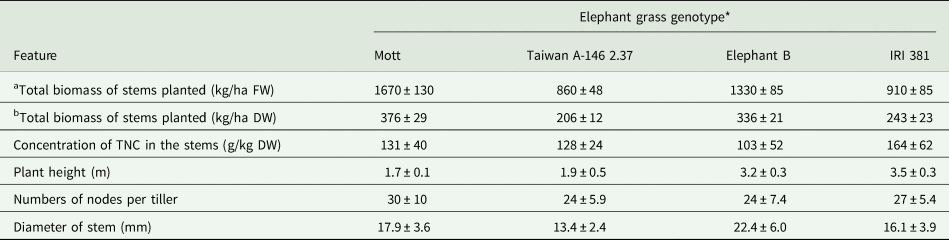
The soil correction aimed to increase base saturation (V% = 70). Before planting the elephant grass stems (April 2016), dolomitic limestone (total neutralization relative power [TNRP] = 90%) was applied and incorporated into the soil (20 cm depth), aiming to raise the base saturation to 70%. Potassium chloride (K2O) and single superphosphate (P2O5) were applied in the furrows at the planting rate of 80 and 100 kg/ha, respectively. The total biomass of the elephant grass stems used to establish the plantation is shown in (Table 1). Prior to the beginning of the experiment, the elephant grass genotypes were harvested (5 cm) stubble height as a standard cut.
Total biomass of stems planted, total non-structural carbohydrates (TNC) and morphological features of the elephantgrass stems used for the establishment of the experiment

DW, dry weight; FW, fresh weight ± standard deviation (n = 9). *All stems were from genotypes had approximately 10 months old.
a Fresh biomass of stems used to plant one hectare.
b Biomass of stems planted in equivalents in dry weight.
Experimental design and treatments
The trial was set in a randomized block design in a split-plot, with four replicates, totalling 32 experimental units. Irrigation or not defined in the main plot, and the subplots were composed of the elephant grass genotypes, two tall-sized (IRI 381 [from IBEC Research Institute] and Elephant B [Merker, came to Brazil via EMBRAPA]), and two as dwarf types (Taiwan A-146 2.37 [from a partnership programme of plant breeding between UFRPE and the Instituto Agronômico de Pernambuco-IPA] and Mott [Tifton, GA, United States] (Sollenberger et al., Reference Sollenberger, Prine, Ocumpaugh, Hanna, Jones, Schank and Kalmbacher1989)) (Supplemental Fig. 1 and Table 1). Each plot had 24 m2, and a sampling/utile area of 15 m2.
Irrigation and fertilization management
We used a drip irrigation system (Supplemental Fig. 2), with approximately 95% of water distribution uniformity. The irrigation followed the methodology proposed by Allen et al. (Reference Allen, Pereira, Raes and Smith1998), and used the standardized Penman-Monteith method FAO/56, it aimed to restore 100% of the actual crop evapotranspiration (ETc) (Fig. 1). Detailed information regarding irrigation can be found in (Ribeiro et al., Reference Ribeiro, Mello, Cunha, Costa, Coelho, Souza and Santos2022, Reference Ribeiro, Mello, Cunha, Costa, Coelho, Souza and Santos2023). Surface fertilizer application was performed during the rainy seasons: 80 kg of K2O/ha and 100 kg of N/ha ([NH4]2SO4). The fertilizations took place after each harvesting. 30 kg of P2O5/ha were applied 2017, and 80 kg P2O5/ha in 2018.
Measurements of plant productivity and water use efficiency
The productive variables evaluated were: water use efficiency; total forage accumulation, by year (2017 and 2018) and harvest, forage accumulation rate, and forage density (kg/cm/ha). The genotypes were subjected to successive harvestings, with 60 days interval. The trial was conducted for two years (January/2017 to October/2018). Grass stubble height was settled at 5 cm. The total forage accumulation was calculated based on all 12 evaluated cycles, regardless of the season. To calculate water use efficiency the following equation was used:

where WUE = Water use efficiency (kg of DM/ha/mm of water); FAC = Forage accumulation per cycle (kg DM/ha); VWU = Volume of water used per cycle (mm/cycle/ha).
To calculate the volume of water used (VWU) per cycle, we used the following equation:

where IT = Irrigation time (hours); ef = emitter flow (L/hour); ne = Number of emitters/ha.
Statistical analysis
The data were checked for normality (Shapiro–Wilk and Kolmogorov–Smirnov) and homoscedasticity (Hatley test). ANOVA considered block design with split plots. We used PROCMIXED (SAS 9.4 software), where the seasons (dry and rainy) were considered as repeated measures, and the effect of the blocks was considered random. The isolated effects of the irrigation, genotype and plant size, as also season were evaluated. For a comparison of the mean, the Tukey test was used (P < 0.05).
Results
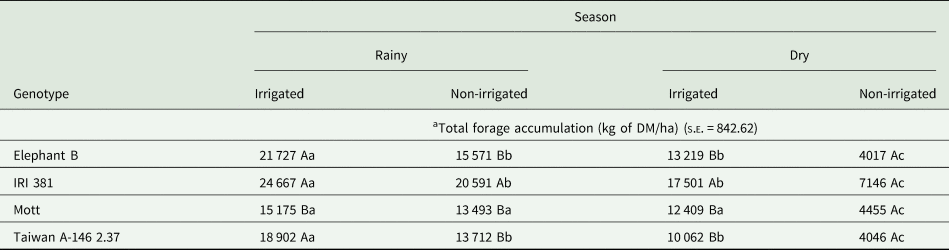
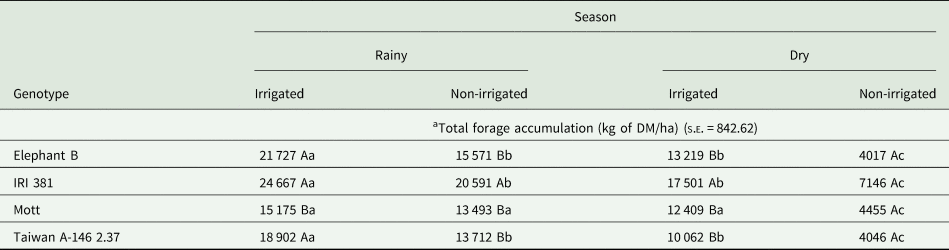
A triple interaction between season, irrigation and genotype was observed for the total forage accumulation (Table 2). There was a difference (P < 0.05) between genotypes in terms of total forage accumulation, except in non-irrigated plots during the dry season. Analysing each genotype within seasons and irrigation, there was an effect of irrigation (P < 0.05) within each season. The genotype IRI 381 showed the greatest total forage accumulation (42 168 kg of DM/ha in the two years) in the irrigated plots, it accounted for both seasons rainy and dry. During the rainy seasons, IRI 381 showed greater forage accumulated (24 667 kg of DM/ha) together with Elephant B and Taiwan A-146 2.37 (P > 0.05), Mott showed less forage accumulated (15 175 kg of DM/ha). All genotypes showed comparable productions during the dry season under no irrigation (P > 0.05), and in general, the production was reduced by 50–70% compared to the plants under irrigation. Even for the irrigated plots, the dry season usually reduced the total forage accumulated.
Total forage accumulation of different elephant grass genotypes in two seasons (rainy and dry) during a two-years trial
s.e., Standard error.
Different capital letters in the column for comparison of genotypes within season and irrigation. Different lowercase letters in the row for comparison of irrigation systems in dry and rainy seasons. Means differ by Tukey's test at 5% probability.
a Sum of 12 harvests from 2017 and 2018.
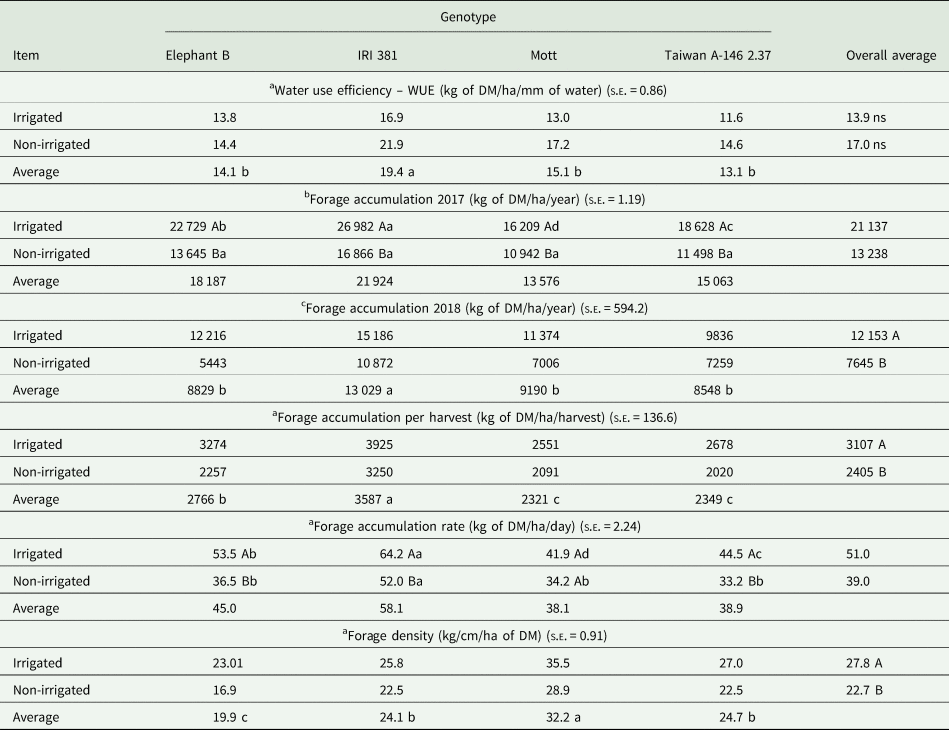
There was a genotype × irrigation interaction (P < 0.05) for the forage accumulation in 2017, and forage accumulation rate (Table 3). In irrigated systems, IRI 381 showed the highest forage accumulation, followed by Elephant B, Taiwan A-146 2.37 and Mott. There was no difference (P < 0.05) between genotypes for the forage accumulation in non-irrigated plots in 2017 (Table 3). The forage accumulation rate was greater in IRI 381 in irrigated and non-irrigated plots. There was an isolated effect (P < 0.05) of genotypes on the WUE. IRI 381 showed the highest WUE (19.40 kg of DM/ha/mm), on average 37.5% higher compared to the average of the other genotypes. Forage mass per harvest was affected by genotype and was higher in IRI 381 (P < 0.05). In 2018, forage production in the irrigated system was approximately 59% higher than in the non-irrigated system (Table 3). Mott genotype displayed the greatest forage density (P < 0.05) when compared to the other genotypes (Table 3).
Productive variables of elephant grass genotypes, under harvesting, with and without irrigation

s.e., Standard error.
Different uppercase letters in the column and different lowercase letters in the row, the means differ from each other by Tukey's test at 5% probability.
a Average of 12 harvests in 2017 and 2018.
b Sum of six harvests referring to 2017.
c Sum of five harvests referring to 2018.
There was a difference (P < 0.05) between plant sizes (tall v. dwarf) and irrigation on the WUE variable. The tall genotypes were 19% more efficient in terms of WUE (Fig. 2b). Forage accumulation per year (2017 and 2018), by harvest, total forage accumulation, forage accumulation rate, and forage density displayed higher averages (P < 0.05) in irrigated plots (Figs 2b–g). Considering the effect of irrigation on the annual forage accumulation in both elephant sizes, the irrigated plots produced an average of two years 59% more forage compared to the non-irrigated area (Figs 2b and c).
Productive responses in elephant grass of different sizes (tall size = TS and Dwarf = DW) under harvesting, in irrigated and non-irrigated plots. Different lowercase letters within the bars for each factor (Irrigation or Elephant Size), the means differed at the Tukey test at 5% probability; WUE, Water use efficiency; ns, not significant; s.e., Standard error.

There was a difference in the annual forage accumulation between tall and dwarf genotypes. The tall genotypes accumulated on average 40 and 23% more forage in 2017 and 2018, respectively. This behaviour was repeated in terms of total forage accumulation (Figs 2b and c). The superiority of the tall genotypes in terms of forage accumulation rate was also observed, which displayed 13.1 kg of DM/ha/day more than the dwarf genotypes (Fig. 2e). For forage density, superiority was observed for the dwarf-sized genotypes, which showed on average 6.4 kg/cm/ha of DM more than tall-sized genotypes (Fig. 2g).
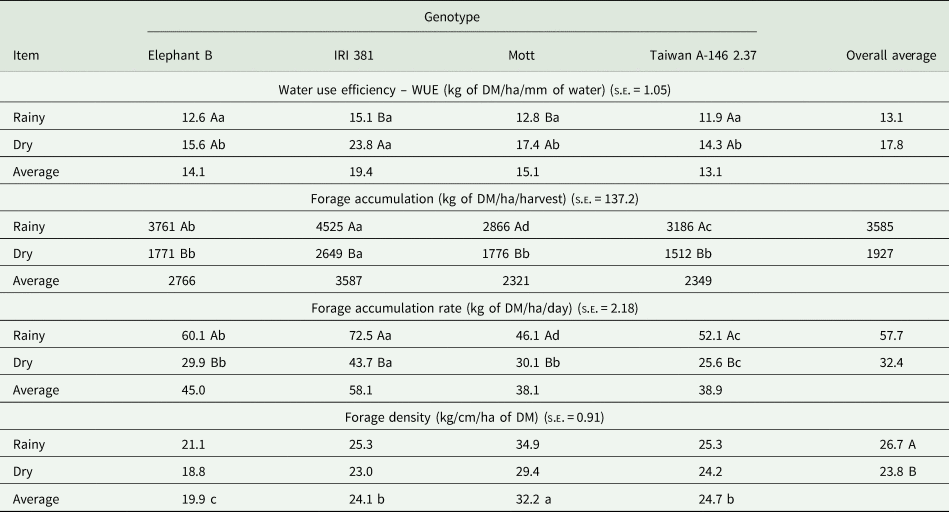
There was an interaction (P < 0.05) between genotype and season in terms of WUE, forage mass per harvest, and forage accumulation rate, while isolated effects of genotype and season were observed for forage density (Table 4). WUE was higher (P < 0.05) during the dry season, with WUE being 57 and 36% higher in IRI 381 and Mott, respectively, compared to the rainy season. IRI 381 stood out compared to the other genotypes in both seasons, with 42% higher accumulation per harvest compared to Mott, which had the lowest average accumulation in the rainy season. Forage density was 12% higher in the rainy season than in the dry season, and Mott showed greater forage density compared to the other genotypes (Table 4).
Productive variables of different elephant grass genotypes under harvesting, during the rainy and dry season

s.e., Standard error.
Different uppercase letters in the column and different lowercase letters in the row, the means differed from each other by Tukey's test at 5% probability; Averages of 12 harvests in 2017 and 2018.
An interaction (P < 0.05) was observed between plant size and season for the total forage accumulation and per harvest, and forage accumulation rate (Figs 3b–d). For WUE, forage density and leaf/stem ratio, there was a difference (P < 0.05) for each factor (plant size and season) individually (Figs 3a and e). The WUE was 30% lower in the rainy season, and tall genotypes displayed 16% more WUE than the dwarf ones.
Productive responses in elephant grass of different sizes (tall size = TS and Dwarf = DW) under harvesting, in the rainy and dry seasons. Different lowercase letters within the bars for each factor (Season, Elephant Size) and uppercase letter for weather (rainy and dry), the means differed at the Tukey test at 5% probability; WUE, Water use efficiency; s.e., Standard error.

The highest total forage accumulation was observed in tall genotypes during the rainy season. During this season, total forage accumulation in tall and dwarf genotypes was 97 and 98%, respectively, greater than in the dry season (Fig. 3b). The average values of forage mass per harvest obtained during the rainy season were 4.14 and 3.03 tons of DM/ha, for tall and dwarf sizes, respectively (Fig. 3c). The forage mass per harvest and forage accumulation rate showed the same pattern as total forage accumulation with greater values during the rainy season and tall-sized genotypes (Fig. 3d).
Discussion
Accumulation and rate of forage accumulation
Elephant grass production is influenced by several factors, including edaphoclimatic conditions, planting spacing, genotype and crop management (Sirait, Reference Sirait2017). Under water deficit occurs cellular dehydration reducing the turgor pressure, resulting in stomatal closure and photosynthetic inhibition, consequently reducing plant growth and forage accumulation (Koetz et al., Reference Koetz, Lemes, Pacheco, Castro, Crisostomo and Silva2017). This may be the reason for the smaller productivity for non-irrigated plants.
The greater forage accumulation observed in the IRI 381 genotype probably was associated with its genetic potential to produce longer, heavier and thicker stems, in addition to having higher DM contents and a greater proportion of stems (Ribeiro et al., Reference Ribeiro, Mello, Cunha, Costa, Coelho, Souza and Santos2022, Reference Ribeiro, Mello, Cunha, Costa, Coelho, Souza and Santos2023). In elephant grass plantations, stem thickness is directly associated with higher dry matter production (Oliveira et al., Reference Oliveira, Daher, Silva Menezes, Amaral Gravina, Sousa, Silva Gonçalves and Oliveira2013). According to recent results from breeding programmes, IRI 381 has been recommended for planting in cut-and-carry systems in the state of Pernambuco, where the current trial was conducted (Freitas, Reference Freitas and Galdino2009), due to its adaptation and high productivity. These factors possibly contributed to the results found.
In this context, in regions that do not display limitations related to low temperatures and short photoperiods, the seasonality in forage production caused by low rainfall can be minimized by irrigation. In the present study, irrigation provided greater forage accumulation in all genotypes compared to the non-irrigated system, especially during the dry season. Similar results were reported by different authors that investigated the productivity of different genotypes of elephant grass, proving that the available water content in the soil is one of the most limiting factors in the production of this species (Ribeiro et al., Reference Ribeiro, Fontes, Palieraqui, Cóser, Martins and Silva2009; Carvalho et al., Reference Carvalho, Arruda, Abreu, Souza, Rodrigues, Lima, Cabral and Neto2018).
Total forage accumulation during the rainy season in irrigated plots was 51% higher compared to the dry season. This result emphasizes the importance of irrigation even during the rainy season, as there were intervals between precipitations (summer periods), which reduced the plant growth rate. In the plots without irrigation, the plant growth was reduced. The total forage accumulation during the rainy season was 3.22 times greater when compared to the dry season. This difference reaffirms the importance of irrigation for the forage production of elephant grass. Despite the harvesting interval being fixed (60-day interval) during the trial, the availability of water in the soil (irrigation and rainy season) was fundamental to providing greater growth rates of the genotypes.
The greater productivity of the tall genotypes can be explained by the greater stem elongation, and plant height, consequently, the greater proportion of stems in the forage produced (Ribeiro et al., Reference Ribeiro, Mello, Cunha, Costa, Coelho, Souza and Santos2022, Reference Ribeiro, Mello, Cunha, Costa, Coelho, Souza and Santos2023). As already mentioned, the total forage accumulation was substantially greater in tall genotypes during the rainy season, reaching 97% superiority compared to the dry season, a higher proportion than that observed by Rengsirikul et al. (Reference Rengsirikul, Ishii, Kangvansaichol, Sripichitt, Punsuvon, Vaithanomsat, Nakamanee and Tudsri2013), who found a DM accumulation of 53% greater during the rainy season. These results were expected, since the literature already demonstrates that tall genotypes produce more forage, in addition to the benefit of the rainy season for plant growth and development (Tekletsadik et al., Reference Tekletsadik, Tudsri, Juntakool and Prasanpanich2004; Maranhão et al., Reference Maranhão, Cândido, Lopes, Pompeu, Carneiro, Furtado, Silva and Silveira2018).
In addition to the effects of genotypes and irrigation, it is also worth discussing the importance of nutrient replacement via fertilization. Since the extraction of soil nutrients in cultivations of elephant grass genotypes is quite high (Na et al., Reference Na, Sollenberger, Erickson, Woodard, Vendramini and Silveira2015; Oliveira et al., Reference Oliveira, Daher, Ponciano, Gravina, Sant'ana, Silva, Gottardo, Rocha, Menezes, Silva Novo, Souza and Souza2015; Martuscello et al., Reference Martuscello, Majerowicz, Cunha, Amorim and Braz2016). Zailan et al. (Reference Zailan, Yaakub and Jusoh2016) evaluating the productivity and nutritional value of elephant grass cultivars harvested at different ages reported results superior to those observed in the present study, with average values of forage accumulation at 56 days regrowth of 6000 and 3870 kg of DM/ha for tall and dwarf genotypes, respectively. These differences between studies might be linked to fertilization level, pattern and intervals of application. The variability in forage accumulation throughout the harvests was marked, and worth to point that only two fertilizations were carried out per year during the rainy season. High nutrient-demanding crops such as elephant grass might require fertiliser application after each harvest, especially during the exponential phase of the growth curve.
Water use efficiency and forage density
The highest WUE during the dry season demonstrates the persistence of elephant grass under dry conditions. Also, it can be associated with the improvement of light use efficiency during this period, especially in the irrigated plots (Schoo et al., Reference Schoo, Kage and Schittenhelm2017). Irrigation during the dry season can have a pronounced impact on WUE (Payero et al., Reference Payero, Tarkalson, Irmak, Davison and Petersen2008). Regardless of plant size, there was a lower WUE during the rainy season, around 1.3 times less efficient compared to the dry season. This might be linked to less sunlight and lower temperatures during the rainy season. The fact that the tall-size genotypes displayed higher WUE was mostly associated with the greater forage accumulation observed in the IRI 381 genotype. As previously mentioned, this genotype accumulated more stems, in denser and thicker bunches.
The highest average values of forage density of the dwarf genotype Mott can be associated with the high proportion of leaves and tiller density population, as also the smaller size compared to the other genotypes (Ribeiro et al., Reference Ribeiro, Mello, Cunha, Costa, Coelho, Souza and Santos2022, Reference Ribeiro, Mello, Cunha, Costa, Coelho, Souza and Santos2023). Higher forage densities might be considered a positive factor in terms of forage quality since higher densities might be associated with a greater forage mass per bite during grazing (Hodgson, Reference Hodgson1990; Jimoh et al., Reference Jimoh, Adeleye and Olanite2010), which is common for dwarfs genotypes (e.g. Mott), which is known for its high leaf/stem ratio (Souza et al., Reference Souza, Santos, Cunha, Gonçalves, Silva, Mello, Muir, Ribeiro and Dubeux2021). It is worth to point that a high forage density associated with a low leaf/stem ratio is not desirable in terms of forage intake. The interaction between plant size and season showed that forage density was significantly higher in dwarf-size genotypes. This occurred because the dwarf genotypes have smaller heights, which influenced the ratio between forage mass per height.
Conclusions
Irrigation and plant size influence the productivity and water use efficiency in elephant grass genotypes under harvesting. The use of irrigation, tall genotypes and the rainy season favoured forage accumulation and forage production. Tall genotypes and Taiwan A-146 2.37 (dwarf size) stood out in most of the productive traits, while the genotype Mott was characterised by greater forage density.
Supplementary material
The supplementary material for this article can be found at https://doi.org/10.1017/S0021859623000461.
Data
The data that support the findings of this study are available on request from the corresponding author.
Acknowledgements
Fundaçao de Amparo à Ciência e Tecnologia do Estado de Pernambuco (FACEPE).
Authors’ contributions
R. E. P. Ribeiro, A. C. L. de Mello, V. J. da Silva, M. V. da Cunha, M. V. F. dos Santos, conceived and designed the study. R. E. P. Ribeiro1, S. B. M. Costa2, R. O. de Carvalho2, conducted data gathering. R. E. P. Ribeiro1 and J. J. Coelho2*, performed statistical analyses. R. E. P. Ribeiro, J. J. Coêlho and M. V. Cunha wrote the article.
Funding statement
This work was funded by and had institutional support from the ‘Universidade Federal Rural de Pernambuco (UFRPE)’. Conselho Nacional de Desenvolvimento Científico e Tecnologico (CNPq), researcher scholarships granted to Mércia Virginia Ferreira dos Santos and Alexandre Carneiro Leão de Mello. Postdoctoral scholarship of the Fundaçao de Amparo à Ciência e Tecnologiã do Estado de Pernambuco (FACEPE), grant number BFP0126-5.04/19.
Competing interest
None.
Ethical standards
Not applicable.