The relationship between religious beliefs and practices and political preferences is well established in the United States (Deckman et al. Reference Deckman, Crawford, Olson and Green2003; Djupe and Gilbert Reference Djupe and Gilbert2009; Grose Reference Grose2018; Whitehead Reference Whitehead2010). In recent decades, political and social changes have cemented this relationship, particularly on social issues like abortion, gay rights, and health care (Barnes and Cassese Reference Barnes and Cassese2017; Deckman and McTague Reference Deckman and McTague2015; Putnam and Campbell Reference Putnam and Campbell2012; Wong Reference Wong2018a). As religious and political attitudes have become increasingly intertwined, the impact of gendered and racialized social identities (Cassese and Barnes Reference Cassese and Barnes2018; Ondercin Reference Ondercin2017; Tesler Reference Tesler2016; Whitehead, Perry, and Baker Reference Whitehead, Perry and Baker2018) have become more visible as they interact with religiosity to shape and reinforce political preferences (Cassese and Holman Reference Cassese and Holman2017; Margolis Reference Margolis2018; McKenzie and Rouse Reference McKenzie and Rouse2013).
Abortion attitudes represent a core differentiation between religious and non-religious individuals and Democrats and Republicans (Campbell et al. Reference Campbell, Layman, Green and Sumaktoyo2018; Lizotte Reference Lizotte2015), driving voter preferences and turnout (Zigerell and Barker Reference Zigerell and Barker2011) and contributing to polarization (Carsey and Layman Reference Carsey and Layman2006). Given the gendered nature of abortion policy (Kreitzer Reference Kreitzer2015; Schroedel Reference Schroedel2000), the apparent absence of a gender gap surrounding the abortion issue has surprised scholars and pundits (Lizotte Reference Lizotte2015; Sapiro Reference Sapiro, Sears, Huddy and Jervis2003; Strickler and Danigelis Reference Strickler and Danigelis2002). The most common explanation for the absence of a gender gap in attitudes about abortion policy holds that, because women are more religious than men (e.g., Holman and Podrazik Reference Holman and Podrazik2018) and religious beliefs differentially shape men's and women's political views (Cassese and Holman Reference Cassese and Holman2016; Kaufmann and Petrocik Reference Kaufmann and Petrocik1999), religious women are more likely to adopt an anti-abortion stance. In breaking with the wider female population—which supports abortion rights at higher rates than men—religiously conservative women disguise the presence of gendered trends of support for legal abortion (Lizotte Reference Lizotte2015).
The U.S. Latino populationFootnote 1 represents an important opportunity to explore how gender and religiosity interact to shape abortion attitudes, as their gendered and racialized religious experiences contribute to attitudinal patterns that differ from the aggregate population.
As in the general population, high levels of religiosity and denominational affiliation have contributed to Latinos’ conservative views on abortion (Bartowski et al. Reference Bartowski, Ramos, Ellison and Acevedo2012). Conventional thought suggests that since Latinas, like women generally, report higher levels of religiosity than their male counterparts (Peña and Frehill Reference Peña and Frehill1998), they should also hold more conservative views on abortion than Latino men. And yet, our findings suggest, conventional thought is insufficiently nuanced to explain how gender and religion shape abortion attitudes within the Latino population.
While certain religious denominations link to conservative political views, religion itself is more than just denomination. To better understand the consequences of different dimensions of religion on political attitudes, we draw on existing research that demonstrates the three “Bs” of religiosity—belonging, believing, and behaving (Layman Reference Layman2001)—may each contribute to this relationship between religion and political attitudes (Friesen and Wagner Reference Friesen and Wagner2012; Layman Reference Layman2001; Smidt, Kellstedt, and Guth Reference Smidt, Kellstedt, Guth, Guth, Kellstedt and Smidt2009). We test each mechanism separately to help explain how gender, religion, and abortion attitudes relate among Latinos. First, it may be that belonging to certain Catholic or Evangelical communities influences Latinas less uniformly than Latino men, causing Latinas to develop an attitudinal gap among themselves. Previous scholarship has found that the patriarchal nature of both Catholicism and Evangelicalism often shapes women's (more than men's) experiences (Cassese and Holman Reference Cassese and Holman2016; Kraybill Reference Kraybill2016), which guides us to an expectation that Latina Evangelicals and Catholics will oppose abortion rights at higher rates than same-denomination Latino men. Second, theologically reinforced gender roles may shape differences in the beliefs that Latinas and Latino men hold, thereby indirectly contributing to attitudinal differences between the genders. Specifically, Latinas with religious beliefs like a literal view of the Bible could be more opposed to abortion rights than Latino men with the same attitudes. Finally, religious behaviors like frequency of church attendance and prayer may have differential effects on women as compared to men. In particular, research on White mainline Protestants suggests that men are more likely to become embedded in diverse social and political networks within their religious communities (Djupe, Sokhey, and Gilbert Reference Djupe, Sokhey and Gilbert2007). Likewise, we anticipate that public behavior such as church attendance should be particularly impactful on the beliefs of Latino men, but not necessarily Latinas. We test these hypotheses using data from two national surveys: the 2006 Latino National Survey and the 2014 Pew Religious Landscape Survey.
Examining attitudes about the legality of abortion across these studies, we find significant evidence that the differing effects of religious behaving and belonging—not believing—are the key to understanding gender and abortion preferences in the Latino community. Moreover, in contrast to existing research on the general population, the religion variables seem to have a stronger effect on Latino men when we find gender differences. For instance, while Evangelicalism correlates with opposition to the legality of abortion, these effects are driven by denominational differences among Latino men, not Latinas. Compared to Latinas, church attendance generally exerts a stronger influence on the abortion attitudes of Latino men, particularly Evangelical Latino men. This distinction suggests that the ways in which Latinos engage in their respective religious communities produce differences in how they perceive and engage with political issues. We find little evidence that belief—measured by Biblical literalism—is the primary driver of the differential impacts of religion on Latino abortion attitudes. However, belief may spillover into behavior as the patriarchal nature of the church may define the social networks in which congregants are embedded, contributing to the importance of religious behaviors in shaping the political views of Latino men in particular.
Our research illustrates the need for a more robust evaluation of the relationship between gender, religion, and abortion attitudes in terms of the complexities of race and ethnicity. Variation in religiosity and gender norms across racial and ethnic groups provide opportunities to better understand how individuals form policy preferences (Barton Reference Barton2006; Hunt Reference Hunt1999). Moreover, by engaging in an intersectional approach that views identity formation as complex and multifaceted (Crenshaw Reference Crenshaw, Fineman and Mykitiuk1994; Hancock Reference Hancock2007; Wong Reference Wong2018b) we provide new ways of understanding how categories of difference shape individual identities and political behavior (Brown and Gershon Reference Brown and Gershon2016). In doing so, our findings speak to how individuals develop and maintain political preferences and how religious communities contribute to politics in the United States.
What Drives Abortion Attitudes?
Beliefs about abortion are among the culture war's most divisive political issues, with abortion attitudes exemplifying the various ways in which religious traditions influence political opinions (Kellstedt et al. Reference Kellstedt, Green, Smidt, Guth, Kellstedt, Guth, Green and Smidt1996; Layman and Green Reference Layman and Green2006; Wald and Calhoun-Brown Reference Wald and Calhoun-Brown2014). Abortion attitudes constitute a form of morality politics in which values and beliefs influence policy views (Heidt-Forsythe Reference Heidt-Forsythe2018; Schroedel Reference Schroedel2000; Silber Mohamed Reference Silber Mohamed2018; Tatalovich and Daynes Reference Tatalovich and Daynes2011).
As among White Americans, Latino religiosity and denominational choice are strongly correlated with conservative abortion attitudes (Bartowski et al. Reference Bartowski, Ramos, Ellison and Acevedo2012; Higgins Reference Higgins2014), exhibited by greater opposition to abortion among Evangelicals compared to Catholics or mainline Protestants (Bartowski et al. Reference Bartowski, Ramos, Ellison and Acevedo2012; Ellison, Echevarría, and Smith Reference Ellison, Echevarría and Smith2005; Wong Reference Wong2018a). And yet religiosity, particularly American Catholicism and Evangelicalism, is both gendered and racialized; indeed, religious behavior and denominational influence have differential effects on Anglo and Black men's and women's political attitudes and behaviors (Cassese and Holman Reference Cassese and Holman2016, Reference Cassese and Holman2017; Lizotte, Carey, and Meikle Reference Lizotte, Carey and Meikle2017; Farris and Holman Reference Farris and Holman2014). Religious traditions operate distinctly within immigrant communities; religiosity may have different political implications among Latinos than among non-Hispanic Whites (Wong Reference Wong2018a). Indeed, within the Latino population religious views do not always translate into political conservatism, nor even necessarily drive political behavior (Gershon, Pantoja, and Taylor Reference Gershon, Pantoja and Taylor2016; Kelly and Morgan Reference Kelly and Morgan2008; Leal Reference Leal, Wolfe and Katznelson2010). How gender interacts with Latino religiosity is still unclear, and yet there are reasons to believe that there may be gendered patterns in the ways that religion shapes Latino policy views. Our research provides a path towards understanding intersectionality, religion, and policy attitudes among the Latino population.
Gender and Abortion Attitudes
Attitudes about the legality of abortion are thought to have gendered roots and consequences (Kreitzer Reference Kreitzer2015; Lizotte Reference Lizotte2015; Pacheco and Kreitzer Reference Pacheco and Kreitzer2016; Sapiro Reference Sapiro, Sears, Huddy and Jervis2003; Schroedel Reference Schroedel2000). As Kaufmann (Reference Kaufmann2002, 296) argues, “There is strong evidence that the culture wars—in particular partisan polarization over abortion and homosexual rights—may have recruited additional women to the ranks of the Democrats.” Although this argument is widely accepted, there is little evidence of a relationship between gender and abortion attitudes; some studies even find an inverse relationship, with men having slightly more liberal views than women (Barnes and Cassese Reference Barnes and Cassese2017; Huddy, Cassese, and Lizotte Reference Huddy, Cassese, Lizotte, Wolbrecht, Beckwith and Baldez2008; Jelen Reference Jelen2014; Jelen and Wilcox Reference Jelen and Wilcox2003; Silber Mohamed Reference Silber Mohamed2018).
Closer examination of the relationship between gender, religiosity, and abortion attitudes within the Latino community offers scholars an opportunity to examine the foundations of attitudinal formation. The existing literature creates the basis for this exploration, yet prior research on Latino abortion attitudes does not examine gendered differences between religious denominations. Gibson and Hare's (Reference Gibson and Hare2012) study of the competing influences of denomination and religiosity find that Latinas have more liberal attitudes about abortion. Latinas may support abortion rights because of interest in access: while abortion rates have dropped substantially across all demographics over time, the rate of abortion among Latinas (18.1% in 2014) has been well above that of non-Hispanic Whites (10%) (Guttmacher Institute 2017), with the potential for undercounting (Amaro Reference Amaro1988).
H1 Our gender hypothesis expects that Latinas will generally have more polarized views on abortion than Latino men.
Discussions of the role of religiosity in shaping Latino abortion attitudes have not spent significant time deconstructing the varying components of religiosity: believing, behaving, and belonging (Layman Reference Layman2001). And yet, each of these components operate via a different track in terms of shaping how religion interacts with politics (Friesen and Wagner Reference Friesen and Wagner2012; Smidt, Kellstedt, and Guth Reference Smidt, Kellstedt, Guth, Guth, Kellstedt and Smidt2009). We build on this research, which emphasizes the importance of exploring each of these dimensions as independent factors. We anticipate that these factors will be shaped by one's gendered experiences and, in turn, shape that individual's political attitudes.
We start with denomination, or the belonging component of religiosity. Both the Catholic Church and Evangelical churches are outspoken in opposition to abortion on the grounds that life begins at the moment of conception (Ellison, Echevarría, and Smith Reference Ellison, Echevarría and Smith2005). Curiously, however, several decades of research indicate a shifting attitudinal gap between the two denominations. In the 1980s, research suggested that Catholics held stronger attitudes about abortion than fundamentalist Protestants (Scott Reference Scott1989; Scott and Schuman Reference Scott and Schuman1988). Over time, the effects of denominational affiliation reversed: the relationship between Catholicism and abortion attitudes weakened, while religious fundamentalism became a stronger predictor of opposition to abortion (Strickler and Danigelis Reference Strickler and Danigelis2002). Indeed, Evangelicals have now surpassed Catholics as the group most likely to oppose abortion as well as other procedures involving human embryos (McTague and Pearson-Merkowitz Reference McTague and Pearson-Merkowitz2013; Silber Mohamed Reference Silber Mohamed2018). In the general population, both of these denominations are thought to influence the experiences of women more so than men (Cassese and Holman Reference Cassese and Holman2016; Kraybill Reference Kraybill2016). Yet, these denominational effects and gendered trends are not necessarily generalizable to the Latino community, particularly given that racial and gender experiences and beliefs may distinctly impact one's engagement with their religious community (Wong Reference Wong2018a). Gibson and Hare's (Reference Gibson and Hare2012) study of the competing influences of Evangelicalism, Catholicism, and secularism on Latinos does find that Evangelicalism is associated with the most conservative abortion attitudes (see also Bartowski et al. Reference Bartowski, Ramos, Ellison and Acevedo2012; Wong Reference Wong2018a) and secularism with more liberal views. Yet while they demonstrate that Latinas have more liberal attitudes about abortion, they do not explore gendered religious differences. Our research provides a first look at how gender and denomination shape abortion attitudes among the Latino population.
While most identities are generally thought to be static, identity may be more fluid among immigrant groups (Silber Mohamed Reference Silber Mohamed2017). Religious denomination also serves as a form of identity that could potentially shift over time. For some Latinos, conversion from Catholicism to Evangelicalism constitutes an evolution of their ethnoreligious identity; Evangelical churches are, “without a doubt the largest, fastest-growing” Latino organizations in the United States (Wong Reference Wong2018a; Reference Wong2018b, p. 5). But we know very little about which immigrants convert to Evangelicalism, whether gendered patterns exist, and whether there is a Latino gender gap in political behavior based on religious identity. Drawing on this research, we develop the following hypothesis:
H2a Our belonging hypothesis anticipates that Evangelicals will have the highest support for anti-abortion policies (as compared to Mainline Protestants, Catholics, and the non-religious).
H2b We anticipate that denomination will be more influential on the abortion attitudes of Latinas than Latino men, such that Evangelicalism will be more strongly associated with anti-abortion attitudes for Latinas than for Latino men.
In the general population, research shows that religious beliefs and participation shape women's social attitudes more so than men's. Lizotte (Reference Lizotte2015) contends that religion acts as an intervening variable between gender and abortion attitudes; church attendance and belief in the Bible as the literal word of God are stronger predictors of women's abortion attitudes than men's (see also Cassese and Holman Reference Cassese and Holman2017). These differences emerge from varying denominations’ theologically-reinforced gender roles, which produce distinct frames though which members understand the social world (Cassese and Holman Reference Cassese and Holman2016; Whitehead Reference Whitehead2012). In particular, Evangelical Protestants’ adherence to Biblical literalism motivates their advocacy for “pro-family” issues, framing opposition to abortion as a key aspect of this literalism, with abortion rights positions contrary to Biblical law (Bartowski et al. Reference Bartowski, Ramos, Ellison and Acevedo2012). Religious beliefs interact with gender to differentially shape endorsement of traditional gender roles, resulting in distinct policy views. Women are more likely than men to endorse a view of the Bible as the literal word of God (Denton Reference Denton2004), with differential effects on women's political engagement (Cassese and Holman Reference Cassese and Holman2016).
The degree to which these gendered findings apply to the Latino population is unclear. We know that Latina respondents consistently hold more liberal attitudes than Latino men on issues of birth control access, equal pay, and women in politics (Bejarano, Manzano, and Montoya Reference Bejarano, Manzano and Montoya2011), but the gendered nature of religious beliefs has not been studied. And, Biblical literalism has contributed to Latino membership in the Republican Party over time and was associated with more conservative attitudes about abortion (McDaniel and Ellison Reference McDaniel and Ellison2008), although gender differences remain unexplored. Given the extensive scholarship that suggests the importance of Biblical literalism, gender role orientations, and religion, we develop the following hypothesis:
H3a According to our beliefs hypothesis, we expect that endorsement of Biblical literalism will be associated with stronger support for anti-abortion policies.
H3b We expect that this relationship will be stronger among Latinas than Latino men.
Alternative explanations for the attitudinal gap between Latinas and Latino men leads us to explore the behaving component of religiosity, focusing on the social and cultural functions of religiosity within the Latino community. Both private acts of religious devotion, such as prayer, and more public activities, such as church attendance, may influence political attitudes (Leege, Wald, and Kellstedt Reference Leege, Wald and Kellstedt1993). Drawing on evidence of distinctly gendered roles and social networks within congregations, we anticipate that public (rather than private) devotional activities will have gendered consequences for abortion attitudes. Djupe, Sokhey, and Gilbert (Reference Djupe, Sokhey and Gilbert2007) demonstrate that compared to men, White Mainline Protestant women respond differently to both social cues and clergy cues. They argue that “(w)omen do not receive the same returns on their organizational investments” (p. 907); men are more likely to develop civic skills through their church involvement, engaging in political activities within distinct social networks. Similarly, we anticipate that gendered differences in church networks and participation are also likely to persist within Latino communities. Consistent with this emphasis, we expect that religious belonging behaviors (and particularly communal behaviors such as church attendance) will be more impactful on abortion attitudes among Latino men as compared to Latinas.
H4a Our behaving hypothesis anticipates that public religious behavior will be associated with greater support for anti-abortion policies, with strongest effects among Latino men.
H4b But private religious behavior will be equally likely to shape Latino men's and women's attitudes about abortion, as this behavior is less related to the highly gendered patterns of church participation and social networks.
Finally, research suggests that while belonging, believing, and behaving are all separate components of religiosity, they also interact to shape individuals’ religious experiences. For example, church attendance may intensify the effects of denomination on political attitudes. Friesen and Wagner (Reference Friesen and Wagner2012) emphasize that the “Three Bs” may operate distinctly across denominations and demonstrate the importance of analyzing these variables separately within different religious traditions. Thus, we supplement our analysis by examining differences in the effects of church attendance within denominations. Given that Evangelicalism is generally associated with the greatest opposition to abortion, we anticipate that the effects of attendance will be strongest among Evangelical men.
Data and Analysis
To better understand how gender and religious beliefs impact Latino attitudes toward abortion, we draw on two major national surveys of the Latino population: the 2006 Latino National Survey (LNS) and the 2014 Pew Religious Landscape Survey (Pew). We utilize two sets of survey data because it is rare to find a single study that has both a sufficient number of Latino respondents and questions about religious participation and abortion attitudes.
Methodological Approach
We use generalized linear models (GLMs) (link logit) with supplied survey weights.Footnote 2 For the initial models, we present results for the full sample, plus split samples for Latinas and Latino men and post-hoc evaluations. We use interactive models to examine the effects of church attendance, prayer, and Biblical literalism by gender, presenting these results graphically, with full results available in the online appendix. Finally, we estimate the effects of church attendance for Latinas and Latino men among Evangelicals and Catholics, splitting the sample by denomination and interacting church attendance with gender.
LNS Our analysis incorporates data from Phase 1 of the 2006 LNS (Fraga et al. Reference Fraga, Garcia, Hero, Jones-Correa, Martinez-Ebers and Segura2006), which includes 8,634 respondents from across fifteen states and the Washington, DC, metropolitan area. The survey was conducted on the phone in both Spanish and English.
Pew We use the Pew Research Center's 2014 Religious Landscape Study (Pew 2014), a nationally representative telephone survey using landline and cell phone contacts, conducted among a sample of 35,071 U.S. adults June 4–September 30, 2014. The survey was conducted in English and Spanish, and had 3,814 respondents who self-identified as Hispanic. We examine the attitudes of this sub-group of respondents. The survey does not include information about national origin/ancestry.
Notably, during the 8 years between the LNS and the Pew surveys, the proportion of Latinos in the United States who identify as Evangelical Protestant increased steadily, rising from 12% to 16% between 2010 and 2013 alone (Pew Research Center 2014). Using the raw data, we see a similar pattern across the two surveys, with 10.8% of respondents identifying as Evangelical in the 2006 LNS compared to 18.8% of respondents in the 2014 Pew Survey. At the same time, however, other differences emerge between the LNS and Pew samples. Most notably, many more respondents completed the survey in Spanish in the LNS (62.5%) as compared to Pew (34.6%).Footnote 3 As language preference is a key measure of acculturation, and acculturation is strongly associated with political attitudes (Branton et al. Reference Branton, Cassese, Jones and Westerland2011), we expect that some differences will be evident when comparing responses across the surveys. In light of the demographic differences between the samples, to the extent that there are overlapping findings in our analyses, these results are particularly useful in understanding broad trends across different segments of the Latino population.
Variables of Interest
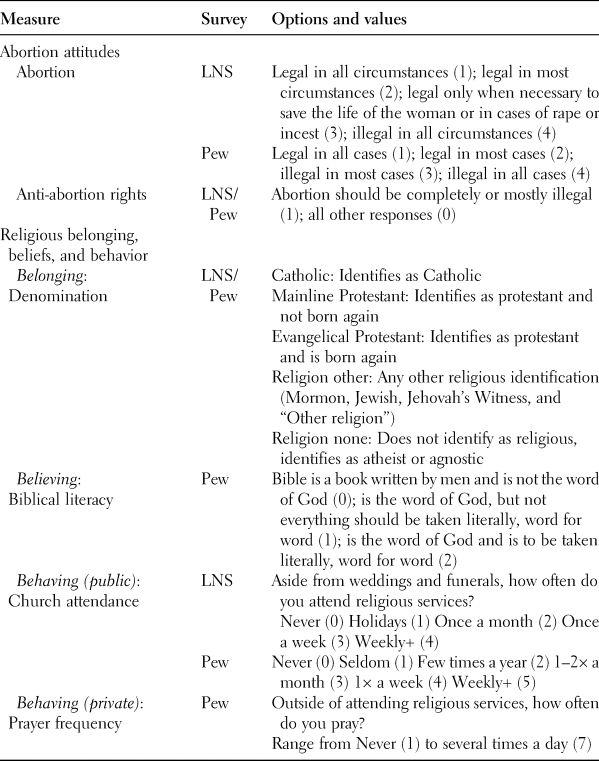
Given that we are interested in examining abortion attitudes among Latinos, we explore respondents’ beliefs about whether abortion should be legal or not. As we report in Table 1, the LNS and Pew both offer abortion attitudes as a set of alternative choices to respondents. Across the surveys, we also generate a dummy variable of whether the respondent supports any anti-abortion policy (abortion should be all or mostly illegal).
Abortion, religiosity, and gender role measures

We look at belonging by using the same approach of measuring denomination across the three measures. Consistent with this approach, we categorize Evangelical as respondents who self-identify as Born-Again Protestants. This categorization is one of two frequently used measures of Evangelicalism, with the other being a denominational classification (RELTRAD) (Steensland et al. Reference Steensland, Robinson, Wilcox, Park, Regnerus and Woodberry2000; Stetzer and Burge Reference Stetzer and Burge2016). Recent work by Burge and Lewis (Reference Burge and Lewis2018) looks across years of the CCES and GSS datasets, finding that “either the affiliation measure or the self-identification approach provides a theoretically and statistically sound measurement of evangelical Protestants in the United States” (755). Our approach is consistent with this research, and the coefficient size and direction is nearly identical when the alternative measure of Evangelical is used (see online appendix).
Religious belief is measured using the Pew survey's measure of Biblical literalism. We divide behaving into two categories: public and private. We include measures of public religious behaving via church attendance (both surveys) and participation in prayer groups (Pew) because the LNS lacks measures of private religious behaving.
Demographic Controls
We also include variables for other demographic characteristics, including age, income, and level of education. As in the general population, Latinos with higher levels of education and income typically hold more liberal views about abortion (Bartowski et al. Reference Bartowski, Ramos, Ellison and Acevedo2012; Bolks et al. Reference Bolks, Evans, Polinard and Wrinkle2000; Ellison, Echevarría, and Smith Reference Ellison, Echevarría and Smith2005). Interestingly, most scholars find no relationship between age and abortion attitudes (Bartowski et al. Reference Bartowski, Ramos, Ellison and Acevedo2012; Bolks et al. Reference Bolks, Evans, Polinard and Wrinkle2000; Ellison, Echevarría, and Smith Reference Ellison, Echevarría and Smith2005), although Sanchez (Reference Sanchez2006) finds that older respondents hold more liberal views. And Bejarano, Manzano, and Montoya (Reference Bejarano, Manzano and Montoya2011) note the importance of generational effects in shaping gendered attitudes (Bejarano Reference Bejarano2014), while Silber Mohamed (Reference Silber Mohamed2015) finds gender differences in incorporation patterns. As a result, we include controls for education, income, age, preference for Spanish language, and generation in the United States. Given evidence that country of origin/ancestry also plays a role in influencing intersectional policy attitudes within the Latino population (García Bedolla, Lavariega Monforti, and Pantoja Reference García Bedolla, Lavariega Monforti and Pantoja2007; Silber Mohamed Reference Silber Mohamed2017), we include control variables for country of origin in our analysis of the LNS, which has large numbers of respondents from different national origin groups.
Gender and Abortion Attitudes
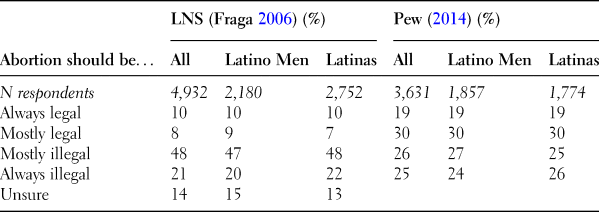
While we are interested in understanding whether gender and religion intersect to distinctly influence Latino views about abortion, we begin by looking at gender and religion separately. Although some research (Bolks et al. Reference Bolks, Evans, Polinard and Wrinkle2000; Gibson and Hare Reference Gibson and Hare2012) finds that women are slightly more likely to support abortion rights, our preliminary results are consistent with the greater body of research that finds no gender differences in abortion attitudes within the Latino population (Bartowski et al. Reference Bartowski, Ramos, Ellison and Acevedo2012; Bejarano Reference Bejarano2014; Ellison, Echevarría, and Smith Reference Ellison, Echevarría and Smith2005; Sanchez Reference Sanchez2006). Table 2 presents descriptive data that suggests Latinas and Latino men are equally likely to support or oppose abortion rights. In contrast to our first hypothesis, we find no evidence that Latina attitudes about abortion are more polarized than those of Latino men. Rather, we see strikingly similar patterns in abortion policy views among Latinas and Latino men.
Distribution of abortion attitudes among Latinos by gender

Note: LNS and Pew options are asked on the same scale, with the “unsure” option only available on the LNS.
Comparing across the surveys, however, respondents to the 2014 Pew survey appear to have more liberal views than those in the 2006 LNS, with 49% of Pew respondents saying abortion should be “always” or “mostly” legal, compared to 18% of LNS respondents; 51% of Pew respondents think abortion should be “always” or “mostly” illegal, compared to 69% of LNS respondents. Notably, LNS includes an “unsure” category while Pew does not. This middle category seems to primarily draw support from the “mostly” legal and illegal options, with the percentage of respondents in the “always” categories more comparable across surveys. These statistics suggest that if religiosity plays a differential role for Latinas as compared to Latino men, it operates at both ends of the spectrum. As noted above, nearly twice as many respondents completed the survey in Spanish in the LNS, as compared to Pew. This distinction likely contributes to the more conservative views espoused by LNS respondents; multivariate analysis below confirms the relationship between acculturation and holding more liberal abortion attitudes.
Gender, Religiosity, and Abortion Attitudes
We next examine whether belonging, believing, and behaving have differential effects on the abortion attitudes of Latinas and Latino men. To refresh, we expect that Evangelicals will hold more conservative attitudes and that the difference between Evangelicals and Catholics may be larger in the later survey given the rapid growth of Evangelicalism among Latinos (Wong Reference Wong2018a; Reference Wong2018b). Given research on the general population demonstrating that Catholicism and Evangelicalism are more likely to influence the experiences of women congregants (Cassese and Holman Reference Cassese and Holman2016; Kraybill Reference Kraybill2016), we similarly anticipate that belonging will be more impactful for Latinas. We expect that Biblical literalism (beliefs) will exert a stronger effect on Latinas’ attitudes compared to Latino men. While we do not expect a difference in the effects of private religious behavior, given gendered patterns of involvement in church activities and social networks, we anticipate that public religious behavior will be more strongly associated with conservative abortion attitudes among Latino men compared to Latinas. Moreover, we anticipate effects across these behaviors, such that church attendance among Evangelicals will be associated with particularly high levels of opposition to abortion rights among Latino men, compared to Latina Evangelicals and Catholics, and Latino men of other denominations.
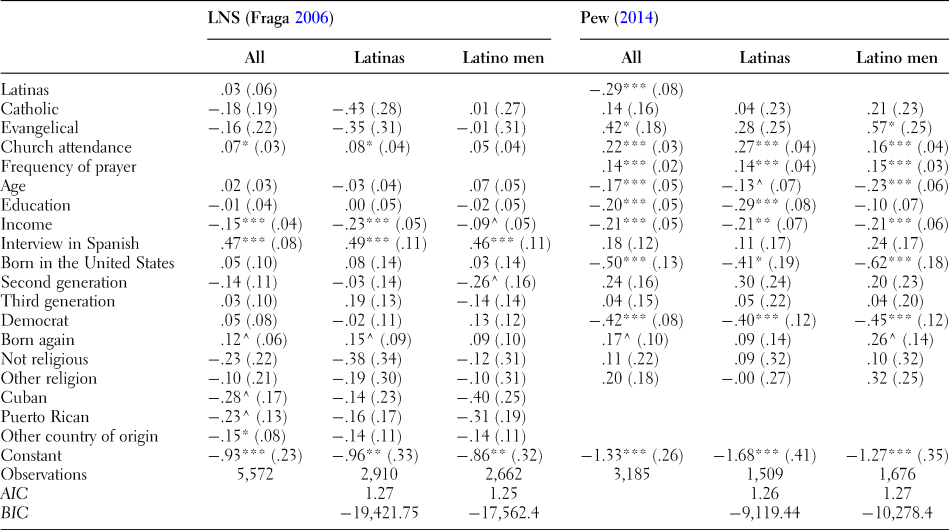
To examine these questions, in Table 3 we estimate the models three times: once for all Latino respondents and separately to capture the abortion attitudes of Latinas and Latino men. Our usage of split samples is consistent with standard methodological practice to examine whether the same independent variables have differential effects on men and women (Djupe, Sokhey, and Gilbert Reference Djupe, Sokhey and Gilbert2007; Silber Mohamed Reference Silber Mohamed2017; Verba, Schlozman, and Brady Reference Verba, Lehman Schlozman and Brady1995; Welch Reference Welch1977). We then do post-hoc comparisons of coefficients to understand whether the effects significantly differ by gender (results with interactions are available in the online appendix). Initial models look at denomination, church attendance, and private religious behavior. We then supplement with additional models that take beliefs into account. To appropriately compare across the models, we first estimate support for any position opposing abortion rights.
Gender, religiosity, and opposition to abortion

All results are produced using GLMs (link: logit) with survey weights. Standard errors are given in parentheses. Dependent variable is support for making abortion “all” or “mostly” illegal (see Table 1). ^p < .10, *p < .05, **p < .01, ***p < .001. Baseline denominational category is Mainline Protestant. Baseline immigration category is first-generation immigrant. Baseline national origin category is Mexican.
We begin by revisiting our hypothesis that Latinas will have more polarized abortion attitudes than Latino men. As noted above, in bivariate analysis we find no gender differences in attitudes about abortion policy. However, in multivariate analysis (Table 3) the results are mixed. While there is no gender variation in the LNS, in the Pew survey (2014) Latinas are more supportive of liberal policy options. Thus, while Latina abortion attitudes do not appear to be more polarized, they do appear to be distinct than those of Latino men in the more recent survey.
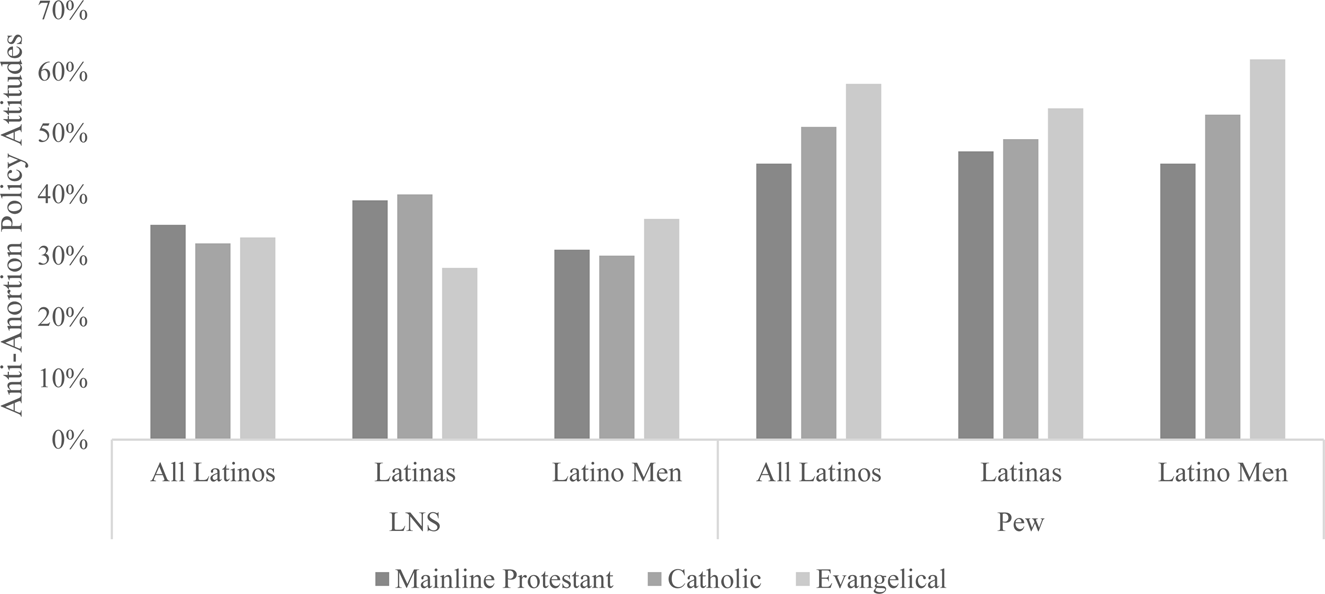
We next ask: what effect does denomination have on the abortion attitudes of Latinas as compared to Latino men? In the Pew survey, Evangelicals are more likely to oppose the legality of abortion than Catholics or Mainline Protestants, which is consistent with previous scholarship. While our results suggest highly gendered patterns in the effect of denomination on abortion attitudes among Latinos, these effects work in the opposite direction of our hypothesis (H2b) that Evangelical belonging would be more influential for Latinas. Indeed, our results suggest that Evangelicals’ propensity to support anti-abortion policies is an effect largely driven by Latino men. If we look at the predicted probability (calculated post-hoc, with full battery of controls for all models) of holding these attitudes by survey for Mainline Protestants, Catholics, and Evangelicals (presented in Figure 1), we see that in comparison to Latina Evangelicals, their male counterparts are consistently more likely to oppose the legality of abortion. Notably, our hypothesis was based on differences observed in the general population. However, little is known about gendered practices or gendered patterns of conversion within Latino congregations. Our unexpected finding underscores the need for more research on both of these fronts and the importance of considering differing patterns of gendered religiosity across racial and ethnic groups.
Predicted probability of anti-abortion policy attitudes by gender and denomination

Comparing across denominations provides additional evidence counter to hypothesis 2b. Across all surveys, Evangelical Latinas are not significantly more likely to oppose abortion than Catholics or Mainline Protestants. In our analysis of the Pew data, Evangelical Latinas appear to hold slightly more conservative views on abortion than their Catholic and Mainline Protestant counterparts (Figure 1), but these results fail to meet statistical significance; in LNS, the results appear to move in the opposite direction, with Latina Evangelicals holding slightly more liberal views about abortion policy, but again the difference is not statistically significant. At the same time, Latino men who identify as Evangelicals report more committed opposition to abortion rights than Catholics or Mainline Protestants in the Pew data. While the denominational difference is not directly significant in the LNS data, post-hoc calculations indicate significant substantive differences between Evangelical Latinas and Latino men (see Figure 1). These findings demonstrate the importance of considering not just where people belong, but who belongs.
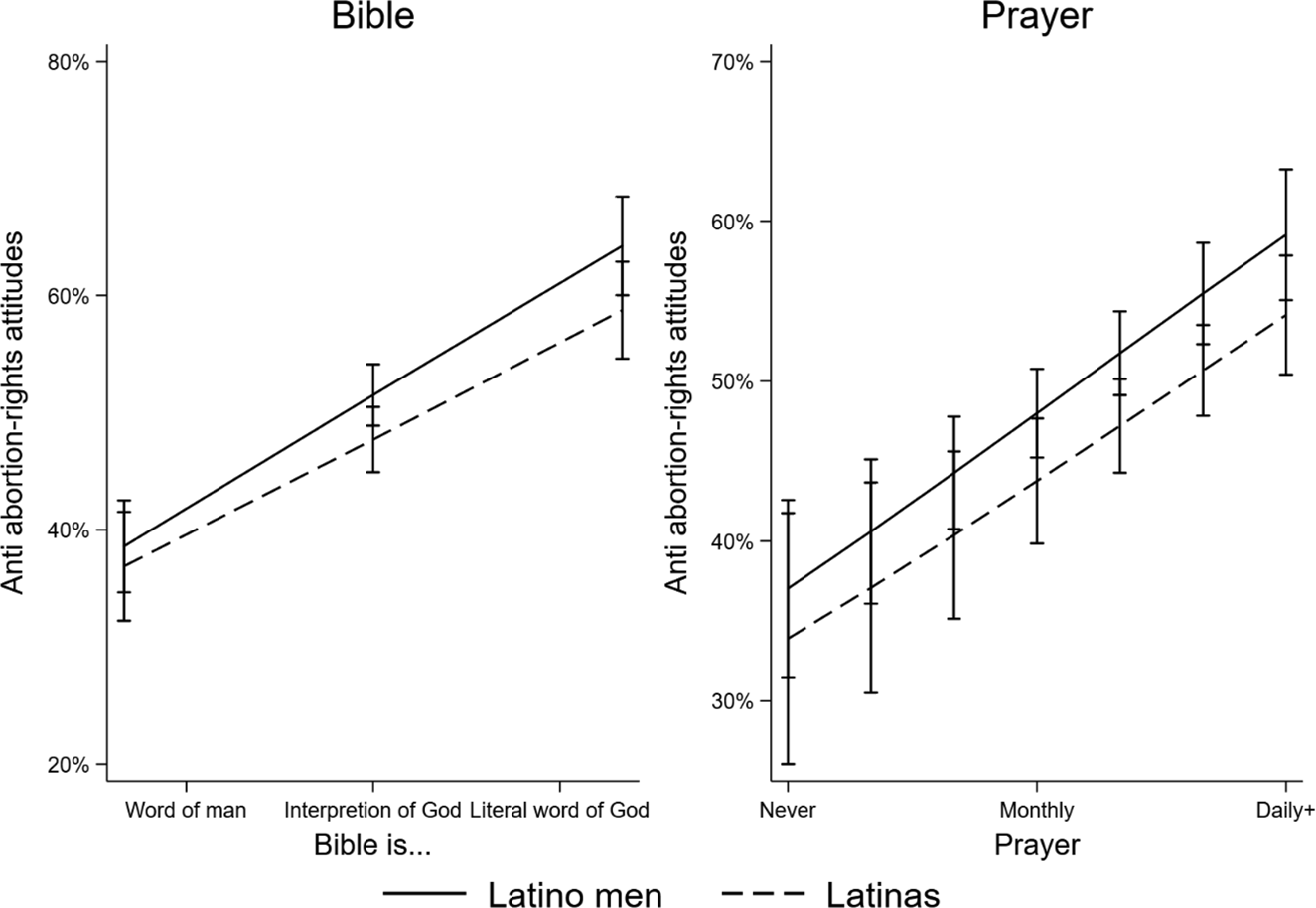
We next consider the effect of believing. Biblical literalism has been associated with conservative gender attitudes and Republican Party affiliation, with differential effects among men and women. Given these findings, we expect that Biblical literalism will be associated overall with greater opposition to abortion, but more impactful on Latinas’ abortion attitudes than those of their male counterparts. We estimate these models by interacting gender and Biblical attitudes, presenting the results visually for ease of interpretation (see online appendix for full results). We estimate these models separately from Table 3 because of the correlation between these variables and our church attendance measure. The left panel of Figure 2 illustrates the relationship between beliefs of Biblical literalism (whether the Bible is the word of man, the interpreted word of God, or the literal word of God) with support for anti-abortion policies (see online appendix for full results).
Biblical literacy (left) and prayer frequency (right), gender, and abortion attitudes (Pew data)

Consistent with H3a, Biblical literalism is associated with greater opposition to abortion. But there are no significant gender differences in the effect of this specific belief. Instead, when we control for denomination, church attendance, and demographic characteristics, approximately 40% of Latinas and Latino men who endorse a “man's word” view of the Bible oppose the legality of abortion. In contrast, among those who endorse a literal view of the Bible, 60% of respondents of both genders support this position. Thus, we find little support for our hypothesis (H3b) that religious beliefs would have disparate effects by gender within the Latino population.
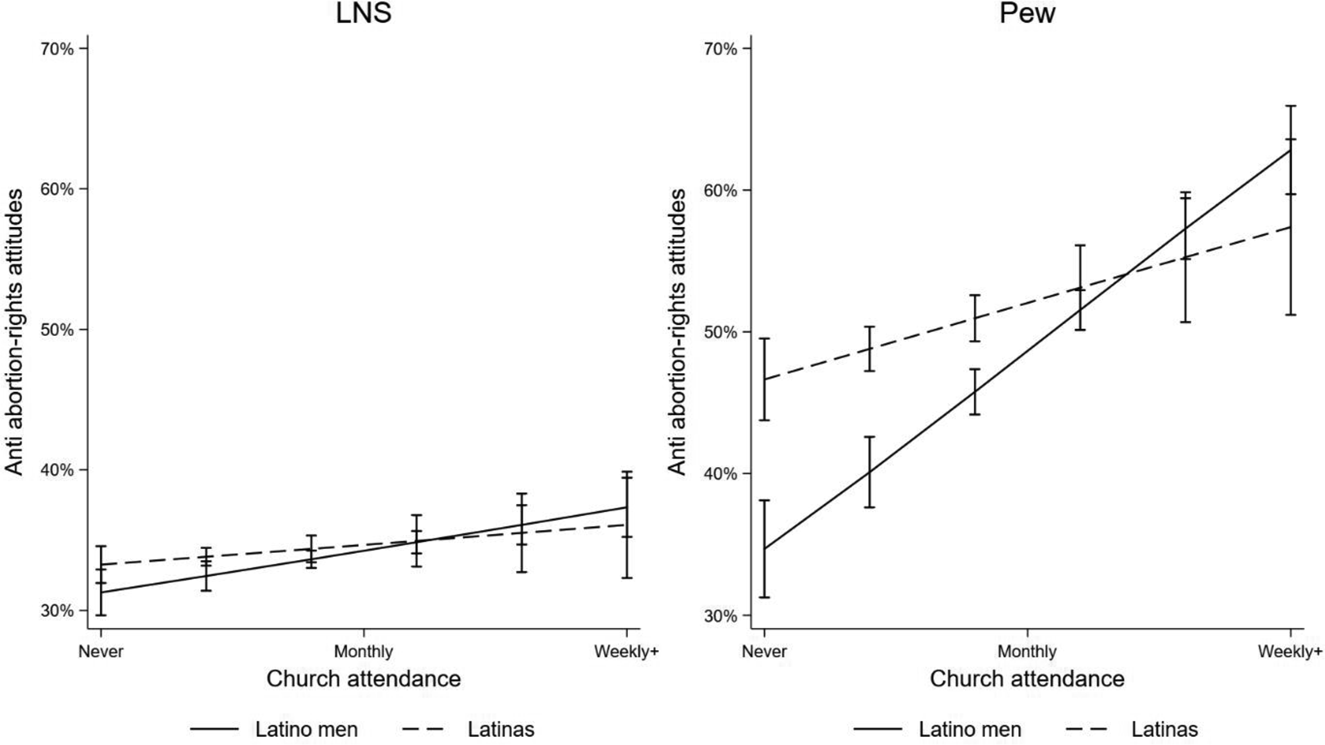
We next evaluate the degree to which the behaving component of religiosity shapes Latino abortion attitudes, looking both at the results presented in Table 3 and post-hoc evaluations. We focus on evaluating the extent to which church attendance (public behavior) and prayer frequency (private behavior) may exert a stronger effect on Latinas’ abortion attitudes. As noted above, we do not expect a gendered impact of private religious behavior on abortion attitudes. But because churches operate as sites of cultural reinforcement and political learning, and given the distinct social networks and gendered types of engagement that occur within religious congregations, we expect that public behavior will be more impactful on the attitudes of Latino men as compared to Latinas. Our analysis confirms our expectations about both private (see right panel of Figure 2) and public religious behavior (see Figure 3). With respect to private behavior, while more frequent prayer is associated with higher levels of opposition to the legality of abortion there are no significantly different effects for Latinas and Latino men.
Church attendance, gender, and anti-abortion attitudes

Looking back at Table 3, in the LNS data, church attendance is significant and positive in the Latina model but not for Latino men. But, in the Pew data, the church attendance coefficient is significantly larger for Latino men than for Latinas, using a post-hoc Hausman test. We also present the results visually for the LNS and Pew data in Figure 3.
The Pew data indicate gendered differences in how church attendance shapes abortion attitudes, demonstrating that Latino men who irregularly attend church are less likely than Latinas to oppose abortion. This difference disappears among more religious Latinas and Latino men. In both models, the slope for Latinas is less steep than for Latino men, suggesting a stronger effect for men. These results seem to indicate somewhat mixed support for our hypothesis (H4a) that public behavior will be more likely to influence abortion views of Latino men than Latinas.
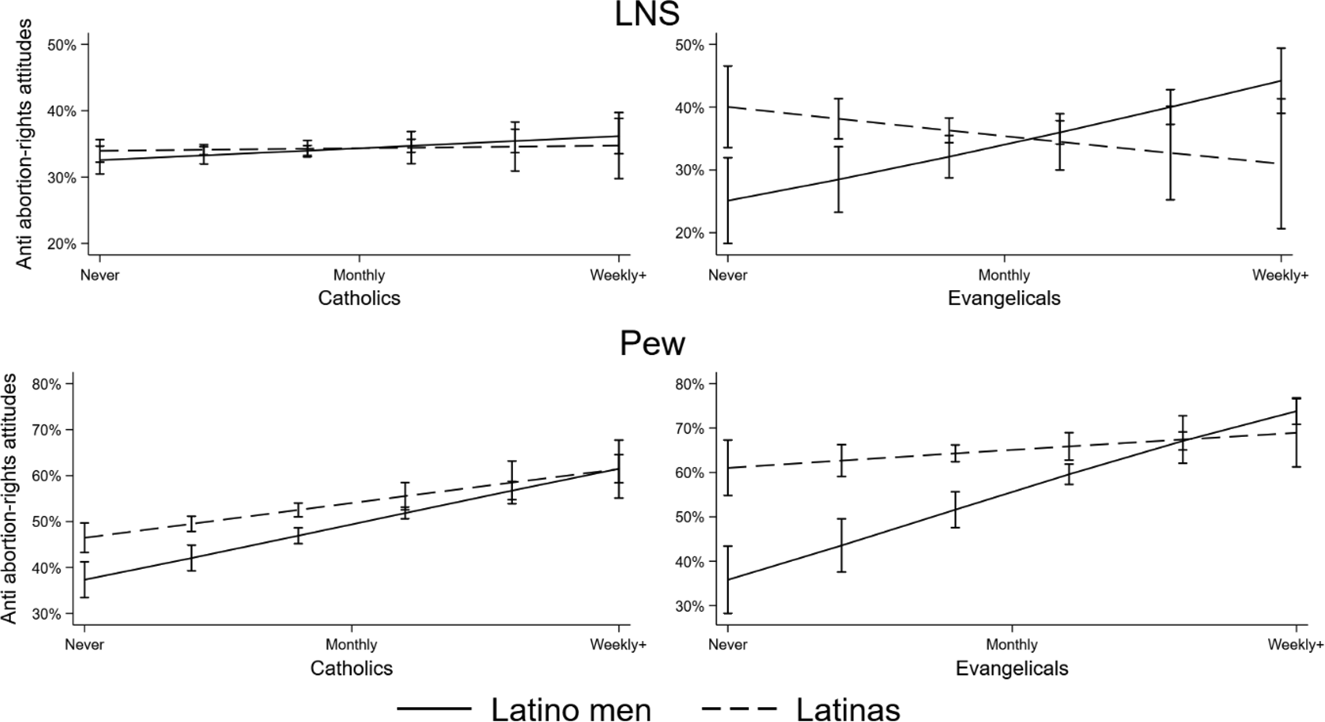
To further refine our understanding of this relationship, we disaggregate the data by denomination and gender. People of faith are more likely to discuss political issues with others in their church communities (Djupe and Gilbert Reference Djupe and Gilbert2009). Consistent with our expectation that Evangelicals are more likely to oppose abortion, we anticipate that attendance will be most strongly associated with political attitudes within this community. As Figure 4 shows, the relationship between public behavior and conservative abortion attitudes is strongest among Evangelical Latino men. Indeed, Latina Evangelicals’ anti-abortion attitudes are either not correlated at all with church attendance (Pew) or are negatively correlated with church attendance (LNS). For Catholics, church attendance is uncorrelated with abortion attitudes for both Latinas and Latino men in the LNS and weakly positive for both genders in Pew, albeit a stronger slope for Latino men. Overall, examining behaving and belonging in conjunction with each other illustrates how Latino men's attitudes are shaped by participation in particularly religious environments, while Latinas' attitudes are far more stable.
Church attendance, gender, and denomination

Unfortunately, given the data available in both surveys, we are unable to test the directionality behind this relationship. In the general population, a growing body of research suggests that a process of religious “sorting” occurs, in which Americans make religious decisions based on their politics (Djupe, Neiheisel, and Sokhey Reference Djupe, Neiheisel and Sokhey2018; Margolis Reference Margolis2018). Even as an increasing number of Latinos convert from Catholicism to Evangelicalism (Pew Research Center 2014), the role of politics in this process remains unclear, although research suggests the inverse relationship may occur (Weaver Reference Weaver2015). Within immigrant communities generally and among Latino immigrants specifically, religious institutions play an important role in the incorporation process, providing English classes and other resources for economic and social mobility (Ebaugh and Chafetz Reference Ebaugh and Chafetz2002; Hirschman Reference Hirschman2004; Wong Reference Wong2018a). Our results underscore the need for future research on the factors that motivate conversions within the Latino community, and whether there are gendered patterns in this process. Importantly, the effects of public and private behavior can vary across racial/ethnic groups (Leege, Wald, and Kellstedt Reference Leege, Wald and Kellstedt1993). Building on the work of Djupe, Sokhey, and Gilbert (Reference Djupe, Sokhey and Gilbert2007), our findings also suggest the need for further research on gender dynamics within different Latino congregations (particularly within Evangelical congregations) to better understand the mechanisms that make church involvement more influential on abortion views for Latino men.
Finally, we turn briefly to the control variables. Compared to most other racial/ethnic groups, Latinos tend to have weaker partisan attachments (Carlos Reference Carlos2018), although group members have become more partisan since 2006 (Huddy, Mason, and Horwitz Reference Huddy, Mason and Horwitz2016). In line with this increased polarization, we find strong ties between partisanship and abortion attitudes in the 2014 Pew survey but, interestingly, not in the 2006 LNS. We also identify links between increased socioeconomic status and more liberal abortion attitudes, with income a significant correlate across all groups in both surveys, and education significant particularly among Latinas in the more recent survey. Notably, while Spanish-speakers hold much more conservative abortion attitudes in the LNS, no such language differences are evident in the Pew data. However, compared to those born elsewhere, being born in the United States is associated with a decreased likelihood of opposing abortion in Pew but not LNS, suggesting that birthplace may be capturing acculturation in the later survey (see online appendix). With respect to national origin, while earlier research finds national origin differences in abortion attitudes (Bolks et al. Reference Bolks, Evans, Polinard and Wrinkle2000; Ellison, Echevarría, and Smith Reference Ellison, Echevarría and Smith2005), the results are not always consistent. We took advantage of the large and diverse sample of the LNS by including dummy variables for Mexicans (omitted category), Puerto Ricans, Cubans, and a fourth category including a wide range of respondents who indicated another country of origin or ancestry. While Cubans and Puerto Ricans seemed to have more liberal abortion attitudes than Mexicans, these results were marginally significant; the only statistically significant difference that appeared in our analysis is between Mexican respondents and the “other” group.
Conclusion
To better understand the interaction between gender and religion in influencing Latino abortion attitudes, we examined whether gendered patterns emerge in the extent to which the three “Bs” of religiosity—belonging, belief, and behavior (Friesen and Wagner Reference Friesen and Wagner2012)—are associated with opposition to abortion. Testing our hypotheses across two major national surveys, we find that two of these three factors distinctly influence the abortion attitudes of Latino men as compared to Latinas. With belonging, which we measure by religious denomination, we find that Latino Evangelicals are more likely to oppose abortion and that affiliation with this denomination is most impactful on the abortion attitudes of Latino men. Our results are consistent with other scholarship finding that identity is more influential in the political behavior of Latino men, as compared to Latinas (Silber Mohamed Reference Silber Mohamed2015). With respect to behavior, we find that church attendance—public behavior—is much more strongly associated with support for anti-abortion policies, particularly among Evangelical men, as compared to their female counterparts. These results contrast with research on the general population that finds religion has a stronger influence on the abortion attitudes of women as compared to men (Lizotte Reference Lizotte2015).
Finally, we find that believing the Bible is the word of God is strongly associated with more conservative abortion attitudes for all respondents, regardless of gender. Given substantial research demonstrating that such beliefs are associated with gender gaps in moral attitudes among Anglos (Cassese and Holman Reference Cassese and Holman2017) and also distinctly influence women's political engagement (Cassese and Holman Reference Cassese and Holman2016), we were surprised by these results, which contrasted with our expectations.
The consistency of our results across both of these national surveys demonstrates the importance of exploring beneath the surface to better understand the gendered patterns that underlie the ways in which religion and religiosity distinctly influence Latino political behavior. More generally, our research contributes to a broader dialog underscoring the need for an intersectional approach to understanding gendered differences in Latino attitudes (Garcia Bedolla et al. Reference García Bedolla, Lavariega Monforti and Pantoja2007). We find that religion—and specifically, religious identity and public practice—represent important elements that add to our understanding of the complex ways in which intersecting identities can differentially influence political behavior. Moreover, a growing body of research is beginning to explore the unique role of Evangelicalism in shaping the political behavior of immigrants (Melkonian-Hoover and Kellstedt Reference Melkonian-Hoover and Kellstedt2019; Wong Reference Wong2018a; Reference Wong2018b). Our results also call attention to the need for including gender in future research on the nature of these fast-growing and highly influential religious communities.
ACKNOWLEDGMENTS
We are grateful to Johanna Monge for her research assistance and to the reviewers for their helpful feedback. A previous version of this paper was presented at the 2018 Western Political Science Association Annual Meeting.
SUPPLEMENTARY MATERIAL
The supplementary material for this article can be found at https://doi.org/10.1017/rep.2019.51