INTRODUCTION
Over the last twenty years the issue of early vocabulary composition has inspired many studies that have attempted to verify, in a cross-linguistic perspective, the hypothesis that there is an initial predominance of nouns over verbs and other lexical items. The first theoretical explanations regarding the particular facility of acquisition of nouns in comparison with other lexical items were proposed by Gentner (Reference Gentner and Kuczaj1982), who suggested that early predominance of nouns is universal and language-independent because perceptual and semantic factors favor nouns over verbs in the process of language acquisition. In fact, while nouns often refer to concrete objects and have hierarchically organized semantic structures, verbs refer to actions and events and have more complex organizing principles. Hence concepts coded by verbs may be less easily identifiable than those coded by nouns.
According to Markman (Reference Markman1989), the fact that nouns are acquired earlier than other lexical forms could also be due to the innate tendency of children to assume that a new word refers to a whole object, and not to any of its parts, or to actions or changes of state that involve the object. In a more linguistically oriented perspective, Maratsos (Reference Maratsos, Krasnegor, Rumbaugh, Schiefelbusch and Studdert-Kennedy1991) proposed that the core of the noun category involves semantic properties, while the core of the verb category lies in its shared morphological properties (i.e. tense or negation markers). This asymmetry is reflected in acquisition: for nouns, the initial analysis is centered on the semantic core (i.e. concrete object reference), while for the acquisition of verbs the semantic core (i.e. action) is less important; so children acquire verbs as members of a category that share certain morphological features. An alternative approach was proposed by Gillette, Gleitman, Gleitman & Lederer (Reference Gillette, Gleitman, Gleitman and Lederer1999): while information from an extralinguistic context is sufficient to identify nouns correctly (noun–object matching), additional information is necessary for the identification of verbs, i.e. the analysis of the extralinguistic context in which the verb is used (sentence–action matching). This hypothesis has been tested successfully with a human simulation of ‘cross-situational observative vocabulary learning’.
Empirical studies initially conducted in English, and in more recent years also in other languages, have produced controversial results. The largest study performed by Bates et al. (Reference Bates, Marchman, Thal, Fenson, Dale, Reznick, Reilly and Hartung1994) on children acquiring English analyzed the MacArthur Communicative Development Inventory (CDI, Fenson et al. (Reference Fenson, Dale, Reznick, Thal, Bates, Hartung, Pethick and Reilly1993), drawn up by the parents of 1,803 English-speaking children aged between 0 ; 8 and 2 ; 6 years and with a vocabulary size between 50 and 600 words. Data confirmed that nouns were largely predominant and comprised approximately 55% of the lexicon of children with vocabularies between 100 and 200 words, while predicates comprised less than 15%. An earlier acquisition of nouns with respect to verbs has been found also in children acquiring Spanish (Jackson-Maldonado, Thal, Marchman, Bates & Gutierrez-Clellen, Reference Jackson-Maldonado, Thal, Marchman, Bates and Gutierrez-Clellen1993), Hebrew (Maitel, Dromi, Sagi & Bornstein, Reference Maitel, Dromi, Sagi and Bornstein2000), Finnish (Lyytinen, Lari, Lausvaara & Poikkeus, Reference Lyytinen, Lari, Lausvaara and Poikkeus1994), German (Kauschke & Hofmeister, Reference Kauschke and Hofmeister2002) and French (Bassano, Reference Bassano2000; Poulin-Dubois, Grahman & Sippola, Reference Poulin-Dubois, Grahman and Sippola1995).
However, evidence against the predominance of nouns in early vocabulary acquisition has also been found. Choi & Gopnik (Reference Choi and Gopnik1995) studied linguistic communication development in nine Korean-speaking children longitudinally, from 1 ; 2 to 2 ; 0, analyzing spontaneous production and data deriving from interviews with parents. The results obtained demonstrated that six of the nine subjects showed an earlier spurt for verbs than for nouns. When their vocabulary reached 50 words in size, it contained 31% more verbs than observed in children acquiring English, in spite of the fact that nouns were more frequent on a percentage basis. When analyzing spontaneous speech in ten Mandarin-speaking children aged 1 ; 10, Tardif (Reference Tardif1996) found that they produced more verbs than nouns, even considering type as opposed to token. However, verb predominance disappeared when a more general classification of nouns (including proper names) and verbs (including copulas and auxiliary verbs) was analyzed.
Subsequently, Tardif, Gelman & Xu (Reference Tardif, Gelman and Xu1999) compared the proportions of nouns and verbs in the early vocabularies of 24 English- and 24 Mandarin-speaking toddlers. Their subjects were matched for age (1 ; 8) but had different vocabulary sizes: the Mandarin children had a word mean of 316, while that of the English children was 160. The Mandarin-speaking children were found to have relatively fewer nouns and more verbs than the English-speaking children across all measures. However, context was seen to play an important role in the proportions of nouns found in the children's vocabularies and the authors concluded that a ‘noun bias’ in language-acquiring toddlers depends on a variety of factors, including the methods by which their vocabularies are sampled and the context in which observation occurs.
The comparison of data from various studies is problematic not only because of the different methods of data collection used (parents' diaries, questionnaires, samples of spontaneous speech) but also because frequently the vocabulary composition analysis has been made at different vocabulary sizes or, as sometimes happens, the vocabulary size is not specified at all. The predominance of verbs found by Tardif et al. (Reference Tardif, Gelman and Xu1999) in the vocabulary of Mandarin-speaking children, for example, could be due to the larger size of their vocabulary compared with that of the English-speaking children in the study. In a more recent study, Kauschke & Hofmeister (Reference Kauschke and Hofmeister2002) reported that verbs begin to appear at 1 ; 3, increasing in proportion until they constitute the largest percentage at 3 ; 0, but they did not report the children's vocabulary sizes at the various sampling points. Another case in point is Bassano's study (Reference Bassano2000), in which vocabulary composition was analyzed only in relation to age, and not to vocabulary size.
Another possibility is that the early predominance of nouns over verbs depends on a limited consideration of individual differences. Gopnik & Choi (Reference Gopnik, Choi, Tomasello and Merriman1995) observed that nouns might be less predominant than may appear at a first analysis. Many investigators pointed to significant individual differences in early language in this regard; there is evidence that some children use significantly fewer names than ‘nominal’ children (Nelson, Reference Nelson1973). There is also reason to believe that nominal children may be over-represented in the literature, possibly due to the difficulty of correctly evaluating children's speech when characterized by a non-referential style, frequently constituted by frozen or formulaic phrases. From a methodological point of view, nominal children are highly likely to be first-borns, and to be from relatively middle-class backgrounds (the latter usually over-represented in studies on language acquisition).
The predominance of nouns or verbs in a particular language could also be due to pragmatic differences in the input: English-speaking children may learn nouns earlier because they are both pragmatically and syntactically salient. As shown by Tardif, Shatz & Naigles (Reference Tardif, Shatz and Naigles1997), English mother-to-child-directed speech emphasizes nouns over verbs, whereas Mandarin-speaking caregivers emphasize verbs over nouns. Specifically, English caregiver-to-child speech tends to emphasize nouns by placing them in utterance-final position and asking questions about objects. On the other hand, Mandarin tends to emphasize verbs by producing them more frequently than nouns and placing them in utterance-final position, with fewer morphological markings. Choi & Gopnik (Reference Choi and Gopnik1995), in a cross-linguistic study of caregivers' input in English and Korean, showed that Korean mothers provide more action verbs but fewer object nouns than American mothers; also, Korean mothers engage in activity-oriented discourse significantly more often than their American counterparts.
Data from children acquiring the Italian language can be particularly useful for the debate on the relative predominance of nouns over verbs in the study of early vocabulary acquisition and the factors influencing the sequence of acquisition. As Caselli et al. (Reference Caselli, Bates, Casadio, Fenson, Fenson, Sanderl and Weir1995) observed, Italian and English differ in certain characteristics: while in English the Subject-Verb-Object sequence is quite rigidly observed, deviations are common in Italian speech, with subject, verb and object appearing in any order. Moreover, Italian (like Spanish and Chinese) is a pro-drop or null-subject language, where subjects are mentioned only if they are being introduced for the first time or special emphasis is required. In English full pronouns are used in all sentence positions; Italian distinguishes between phonologically strong full pronouns and phonologically weak clitic pronouns. Clitic object pronouns must occur immediately before the verb in a declarative or interrogative form, forming an SOV or an (S)OV structure (when the subject is omitted), as in SOV languages such as Korean. Finally, English verbs carry a relatively small number of agreement contrasts compared with other languages: for example, the English present indicative conjugation contains only one contrast, compared with six in Italian, one for each number and person.
Studies of the speech characteristics of Italian mothers when communicating with their children showed controversial results. Tardif et al. (Reference Tardif, Shatz and Naigles1997), examining various measures such as type and token frequency, utterance position and morphological variation of nouns and verbs, found Italian to be less focused on nouns than English but more than Mandarin; a later study by Camaioni & Longobardi (Reference Camaioni and Longobardi2001) only partially confirmed Tardif et al.'s results, evidencing an ‘equivocal’ input, but concluding that Italian input is verb oriented.
Studies conducted on the vocabulary composition of Italian-speaking children reported similar results to those obtained from English-speaking children. Caselli et al. (Reference Caselli, Bates, Casadio, Fenson, Fenson, Sanderl and Weir1995) analyzed vocabulary composition in 659 English-speaking children and 195 Italian-speaking children, aged from 0 ; 8 to 1 ; 4, using the MacArthur CDI. Results showed that, with a vocabulary of 50 words, children produced more social words (onomatopoeic, routines and proper names) than nouns and predicates; however, when their vocabulary reached a size of between 50 and 100 words, common nouns predominate (at 54% for English speakers and 46% for Italian speakers), while verbs were very rare (7% and 5% respectively). These results were confirmed by a subsequent study by Caselli, Casadio & Bates (Reference Caselli, Casadio and Bates1999) in which the vocabulary composition of 1,001 English-speaking and 386 Italian-speaking children was investigated. In this study predicates reached about 10% when the vocabulary comprised 500 to 600 words.
D'Odorico, Carubbi, Salerni & Calvo (Reference D'Odorico, Carubbi, Salerni and Calvo2001), using a longitudinal approach to study the vocabulary development of 42 Italian-speaking children, found that even though nouns were the dominant category (49% at the 100-word stage and 58% at the 200-word stage), predicates showed a significantly higher rate of growth than nouns in the passage from 100 to 200 words. Therefore, though the authors confirmed a precocious acquisition of nouns with respect to predicates, the latter increased more rapidly in Italian-speaking children than English-speaking children; moreover, significant individual differences came to light: some children acquired more nouns, others more predicates and closed-class words.
The aim of the present study is to examine the composition of productive vocabulary to a stage of development which was not reached in the previous study by D'Odorico et al. (Reference D'Odorico, Carubbi, Salerni and Calvo2001), which observed vocabulary acquisition only up to the 200-word stage. This study will provide longitudinal information about the subsequent period of vocabulary growth (from 200 to 400–650 words) during which, presumably, verbs become more relevant. In order to address the question of the early bias towards nouns as opposed to the early acquisition of verbs more directly, a pure verb category was used rather than the predicate category (as in D'Odorico et al., Reference D'Odorico, Carubbi, Salerni and Calvo2001; Caselli et al., Reference Caselli, Bates, Casadio, Fenson, Fenson, Sanderl and Weir1995; Caselli et al., Reference Caselli, Casadio and Bates1999), which also includes adjectives; this will permit a more direct cross-cultural comparison with results by Tardif et al. (Reference Tardif, Gelman and Xu1999) and Choi & Gopnik (Reference Choi and Gopnik1995). The acquisition of nouns and verbs was also compared with that of closed-class words, which comprise adverbs, pronouns, interrogatives, prepositions, articles and conjunctions. The ‘closed-class words’ category in this study is larger than the class of ‘grammatical function words’ analyzed, for example, by D'Odorico et al. (Reference D'Odorico, Carubbi, Salerni and Calvo2001) and Caselli et al. (Reference Caselli, Bates, Casadio, Fenson, Fenson, Sanderl and Weir1995), in order to compare the acquisition of inflected (nouns and verbs) versus uninflected words.
The groups were created on the basis of vocabulary size as opposed to age, because, as Pine & Lieven (Reference Pine and Lieven1990) observed, age-dependent cross-sectional measures, if used to investigate style differences, could cause confusion between true differences and variations in the developmental level, which is not controlled. Moreover, considering the age at which children reach the various vocabulary sizes, the relationships between qualitative and quantitative aspects of vocabulary development can be verified. Some studies based on age comparison evidenced a significant advantage in vocabulary growth for children who adopt a referential approach to language (Bates, Bretherton & Snyder, Reference Bates, Bretherton and Snyder1988); other authors (Bates et al., Reference Bates, Marchman, Thal, Fenson, Dale, Reznick, Reilly and Hartung1994) showed that this advantage disappears when the comparison is made at a fixed vocabulary size. In this regard, Fasolo & D'Odorico (Reference Fasolo and D'Odorico2002) found that late talkers differ from average talkers in the percentage of common nouns acquired at the 50- and 100-word vocabulary size, which is significantly lower in children characterized by slow vocabulary development.
Finally, the longitudinal design permits verification of the stability of individual differences in the propensity to acquire common nouns, verbs or closed-class words.
METHOD
Participants
Twenty-four Italian children (12 males and 12 females), aged between 1 ; 4 and 1 ; 6 at the beginning of the study, were selected from a large sample (N=104; 54 males and 50 females) for early identification of language delay. Their families, recruited from local birth records, had agreed to participate with their children in a longitudinal study of language development. Only the children for whom two preselected vocabulary development sampling points were available were included in this study. The first sampling point corresponds to a vocabulary size as close as possible to 200 words (mean 217, range 167–281), the second to a vocabulary size ranging from 400 to 650 words (mean 518, range 416–648). None of the children who participated in this study exhibited delayed vocabulary development, insofar as the mean age at which the 200-word vocabulary level was reached was 1 ; 10.09 (range 1 ; 5.28–2 ; 4.00). Therefore all the children were above the 10th percentile according to Italian normative data (Caselli & Casadio, Reference Caselli and Casadio1995). The second sampling point was reached at a mean age of 2 ; 2.10 (range 1 ; 8.07–2 ; 8.13).Footnote 1
The children and their families were all resident in the north of Italy; the sample was comprised of 12 first-borns, 11 second-borns and 1 third-born. Twelve mothers had 18 years of education, corresponding to graduate school, 10 mothers had 13 years of education, corresponding to high school and 2 mothers had 8 years of education, corresponding to elementary and junior school level. Data regarding vocabulary composition at the 100- and 200-word vocabulary levels for 5 of the children has already been included in D'Odorico et al.'s previous research (Reference D'Odorico, Carubbi, Salerni and Calvo2001).
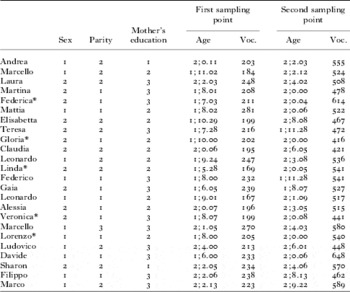
Complete demographic information for the children participating in the study is provided in the Appendix.
Procedure
The development of the children's vocabulary was evaluated by monthly input provided by their mothers using the Italian version of the MacArthur Communicative Development Inventory (Primo Vocabolario del Bambino – PVB; Caselli & Casadio, Reference Caselli and Casadio1995) until they had acquired approximately 400 words.
The Italian version of MacArthur Communicative Development Inventory is modeled as closely as possible on the English version in terms of overall format, number and type of lexical categories and number of items. The PVB Infant form (‘Gesti e Parole’, corresponding to the ‘Words and Gestures’ of CDI) consists of a vocabulary list of 408 words, for which both comprehension and production is assessed, and a section (Azioni e Gesti) in which non-verbal communicative and representational skills are assessed. The Italian Toddler form (‘Parole e Frasi’, corresponding to the ‘Words and Sentences’ form of the CDI) contains a vocabulary production checklist of 670 words and another two sections designed to assess morphological and syntactical production. The first form of the PVB (‘Gesti e Parole’) was used up to the month in which a vocabulary size of 50 words or more was reached. Thereafter the ‘Parole e Frasi’ form was used.
Children's vocabulary composition and growth measures
For each sampling point the following were calculated: (a) the percentage of common nouns, including names of animals, vehicles, toys, food and drink, clothing, body parts, furniture and rooms, small household objects, places to go; (b) the percentage of verbs; (c) the percentage of closed-class words, which include adverbs, pronouns, interrogatives, prepositions, articles and conjunctions.
Comparisons with data from Bates et al. (Reference Bates, Marchman, Thal, Fenson, Dale, Reznick, Reilly and Hartung1994) has been made possible by calculation of the number of opportunities (‘saturation index’) that are afforded by the checklist within each category, i.e. what percentage of common nouns (out of 334 possible items, 49·5% of the total checklist), verbs (out of 103 possible items, 15·7% of the total checklist) and closed-class words (out of 104 possible items, 15·5% of the total checklist) were reported at the two sampling points.
The vocabulary growth rate was calculated by evaluating the number of words that the children acquired per day between the first and the second sampling point.Footnote 2 The rate of vocabulary growth within each category was calculated using the procedure described by Bates et al. (Reference Bates, Marchman, Thal, Fenson, Dale, Reznick, Reilly and Hartung1994) and D'Odorico et al. (Reference D'Odorico, Carubbi, Salerni and Calvo2001).Footnote 3
RESULTS
The percentages of nouns, verbs and closed-class words at the two sampling points were analyzed by a repeated measures ANOVA, considering both Vocabulary size (2) and Word type (3) as within-subject variables. A significant effect for Vocabulary size (F(1, 23)=33·59; p<0·001), for Word type (F(2, 46)=907,19; p<0·001) and for the interaction between the two variables (F(2, 46)=45,18; p<0·001) was obtained. As a supplement to p values, the confidence intervals (CI) for marginal means (at a value of 99%) were also calculated and utilized as a guide to the interpretation of the results (Masson & Loftus, Reference Masson and Loftus2003).Footnote 4 Using Tryon's (Reference Tryon2001) decision rule, a statistical difference between two means is inferred if the two confidence intervals associated with the means do not overlap.
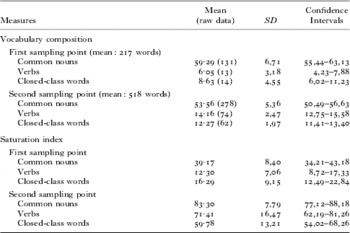
The results show that even at a more advanced developmental level than previously investigated (Caselli et al., Reference Caselli, Bates, Casadio, Fenson, Fenson, Sanderl and Weir1995; Caselli et al., Reference Caselli, Casadio and Bates1999; D'Odorico et al., Reference D'Odorico, Carubbi, Salerni and Calvo2001), nouns continue to be the most frequent lexical category for Italian children: more than 50% of their vocabulary is constituted by common nouns at both the vocabulary levels considered (see Table 1).
Descriptive statistics for the vocabulary composition measures at the two sampling points

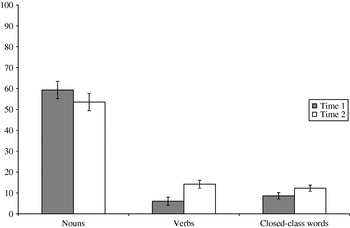
The percentages of verbs at both the sampling points were not statistically different to those of closed-class words because the higher limit of verb interval confidence at T1 is included in the CI calculated for closed-class words, while at T2 the lower limit of CI of verbs is included in the CI calculated for closed-class words. Moreover, while the percentage of nouns did not increase significantly from the first to the second sampling point, the percentage of verbs and closed-class words did. It is interesting to note that the percentages of nouns and closed class-words at the 200-word vocabulary level was very similar to that obtained by D'Odorico et al. (Reference D'Odorico, Carubbi, Salerni and Calvo2001) for the same stage of vocabulary development, while the percentage of verbs (6·05%) was notably lower than the larger category of predicates (13·54%) analyzed in that study (see Figure 1).
Vocabulary composition at the two sampling points.

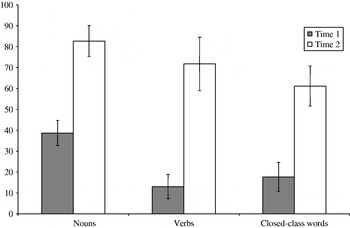
The predominance of nouns is also confirmed by the analysis of the opportunities afforded by the checklist (i.e. the ‘saturation index’) through a repeated measures ANOVA, taking both Vocabulary size (2) and Word type (3) as within-subject variables. A significant effect for Vocabulary size (F(1, 23)=559·29; p<0·001), for Word type (F(2, 46)=49,05; p<0·001) and for the interaction between the two variables (F(2, 46)=19,07; p<0·001) was obtained. Results (see Figure 2) show that the saturation index at T1 is significantly higher for nouns as opposed to verbs and closed-class words, while it does not differ between verbs and closed-class words. At the second sampling point, however, the difference in the saturation index for verbs and nouns disappeared (though the closed-class words had a lower saturation index than nouns). This analysis shows that the higher proportion of nouns with respect to verbs and closed-class words was not due to over-representation in the questionnaire.
Saturation index at the two sampling points.

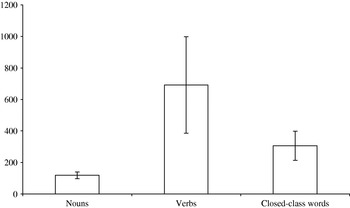
If the predominance of nouns over verbs and closed-class words is confirmed by the vocabulary composition data, the entry of verbs and closed-class words in the vocabulary of Italian children should be very rapid, as testified by the significantly higher percentage increase of these two lexical classes compared to nouns (F=29, 31; p<0·001; see also Figure 3). Therefore between the first and second sampling points the children acquired proportionally more verbs and closed-class words than nouns, even though the absolute number of nouns added is higher (see raw data in Table 1).
Percentage increase from the first to the second sampling point.

This result is consistent with the general characteristics of the Italian language, in which verbs are characterized by a high level of salience and informativeness. Input characteristics, however, cannot completely bypass the semantic and cognitive factors which make nouns easier to acquire in the first phase of vocabulary acquisition.
The analysis of individual differences showed a significant correlation between the two sampling points in the percentages of nouns and closed-class words (see Table 2), while the acquisition of verbs was extremely variable. This result contrasts with the findings of D'Odorico et al. (Reference D'Odorico, Carubbi, Salerni and Calvo2001), which showed evidence of strong continuity in individual differences in the relative proportion of predicates from 50- to 100- and 200-word vocabularies.
Longitudinal correlation between common nouns, verbs and closed-class words at the two sampling points

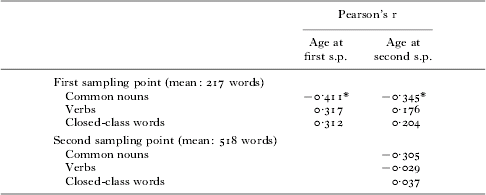
Finally, in order to evaluate the influence of vocabulary composition on vocabulary growth rate, a correlational analysis was performed on the percentage of nouns, verbs and closed-class words and the age at which children reached the vocabulary size established for the two sampling points. The analysis showed that the children who reached the first sampling point with a higher percentage of nouns (see Table 3) are more precocious than children who acquired fewer nouns. This advantage disappears when considering the percentage of nouns at a vocabulary size of 500 words and there is no evidence of a relationship between percentage of verbs or closed-class words and a higher rate of vocabulary development.
Relationships between percentages of common nouns, verbs and closed-class words and the ages at which the two sampling points (s.p.) are reached
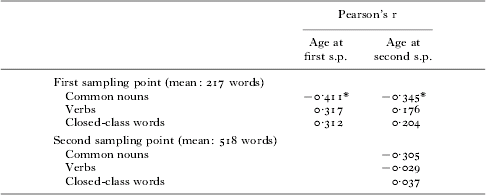
* p<0·05.
The hypothesis that the propensity to acquire nouns influences only the rapidity with which the first lexical basis is construed is confirmed by the results of the correlational analysis on the percentage increase of nouns, verbs and closed-class words (which is the best index for evaluation of the predisposition for acquiring a particular class of lexical items in the passage from the first to the second sampling point) and the mean number of words that the children acquired per day. The analysis did not show any significant correlations (see Table 4), demonstrating that between the 200- and 500-word levels the acquisition of nouns is no longer related to a higher rate of vocabulary growth.
Relationships between percentages increase of common nouns, verbs and closed-class words and vocabulary growth rate

DISCUSSION
The results of this study support the claim that nouns are acquired before verbs even in languages which differ in the relative salience attributed to these two lexical classes in the input. The study also provides evidence that even when the Italian child's vocabulary has reached a consistent dimension (between approximately 400 and 650 words), the most frequent lexical category is the common noun, confirming the predominance of this lexical class even for vocabularies which exceed 200 words (observed in D'Odorico et al., Reference D'Odorico, Carubbi, Salerni and Calvo2001), and for longitudinal data in comparison with cross-sectional data (Caselli et al., Reference Caselli, Casadio and Bates1999). Moreover, the study reveals that the noun–verb acquisition sequence is not due to a different identification of ‘nouns’ and ‘verbs’ with respect to studies conducted with Korean- and Mandarin-speaking children (Choi & Gopnik, Reference Choi and Gopnik1995; Tardif et al., Reference Tardif, Gelman and Xu1999), i.e. it also excluded data concerning proper names, auxiliary verbs and adjectives. The comparison with data on Korean and Mandarin languages is relevant because also in Italian more verbs than nouns (considering both types and tokens; Fasolo, Reference Fasolo2004; cf. Camaioni & Longobardi, Reference Camaioni and Longobardi2001) are used by mothers in their input to their language-acquiring children. There are, however, methodological differences between studies which renders the cross-linguistic comparison inconclusive: while Tardif et al. (Reference Tardif, Gelman and Xu1999) analyzed vocabulary composition in Mandarin- and English-speaking children of the same age, but with different vocabulary sizes, the present study considered children at different ages, but with a similar vocabulary size. Choi & Gopnik's (Reference Choi and Gopnik1995) data regarding vocabulary composition at a fixed vocabulary size of 50 words are, on the other hand, controversial, confirming a predominance of nouns over verbs even for Korean-speaking children, though the percentage of verbs was higher compared to that which emerged in English-speaking children.
Considering the saturation index (the ‘opportunity’ for mothers to check one of the items of the questionnaire), it can be seen that at the first sampling point the children were credited by their mothers with a production of less than 40% of possible common nouns and less than 20% of the other two lexical categories considered here; it follows that the lower percentage of verbs is not due to an over-representation of nouns in the CDI. At the second sampling point, close to the ceiling of 670 words, there is no longer a difference between the saturation index of verbs and nouns, but the percentage of nouns is significantly higher than that of verbs.
Even if common nouns constitute the predominant lexical category, the value of verbs and closed-class words significantly increases between the first and second sampling points: the percentage of new items acquired for these two lexical categories is significantly higher than the percentage of common nouns acquired in the passage between Time 1 and Time 2. This phenomenon could be attributed to the fact that at the first sampling point children only disposed of a small number of verbs and closed-class words, which obviously influenced the result of the comparison of percentage increases. Even if at the second sampling point the children had increased by a factor of five the number of verbs and closed-class words in their vocabulary compared to the first sampling point, the absolute number of verbs and closed-class words acquired was lower than that of nouns.
The predominance of nouns in the vocabulary of Italian children is demonstrated in this study through an analysis of their mothers' reports. It must be noted that this does not exclude the possibility that the relative frequency of nouns and verbs was different in their spontaneous production, even if in studies on direct comparisons of the composition of children's vocabularies a substantial relationship emerged between the results obtained from analyses of spontaneous speech samples and mothers' reports (cf. Tardif et al. Reference Tardif, Gelman and Xu1999; Salerni, Assanelli & D'Odorico, Reference Salerni, Assanelli and D'Odorico2005).
This study also evaluated the stability of the acquisition of different lexical categories. Contrary to the findings of a previous study conducted by D'Odorico et al. (Reference D'Odorico, Carubbi, Salerni and Calvo2001), which found a continuity in the acquisition style for common nouns, predicates and function words, the present study revealed a correlation for common nouns and closed-class words, but not for verbs. Two explanations exist for this. Firstly, in D'Odorico et al.'s (Reference D'Odorico, Carubbi, Salerni and Calvo2001) study, the authors found continuity of individual differences in the percentages of predicates which was much higher than the percentage of verbs (see above). Secondly, individual differences could be obscured by the very high percentage increase in verbs in the period of vocabulary development analyzed in this study. In D'Odorico et al.'s Reference D'Odorico, Carubbi, Salerni and Calvo2001 study individual differences were reported with regards to verb percentage scores in the first and second 100 words acquired, where an increase of approximately 4 percentage points was observed between the two points (from approximately 10% to approximately 14%). In the period of development examined in this study the children had more than doubled the percentage of verbs by the second sampling point; it cannot be excluded that this massive verb acquisition might have obscured individual differences between children.
Those children who had a higher percentage of common nouns in the first stage of vocabulary acquisition had a higher rate of vocabulary growth as testified by the earlier age at which they reached the 200-word sampling points. Nouns are important for the acquisition of the first lexical basis, as demonstrated also by Fasolo & D'Odorico (Reference Fasolo and D'Odorico2002) in which Late Talkers (i.e. children who at 2 ; 0 have a vocabulary of fewer than 50 words) showed a lower percentage of nouns than normally developing children with a vocabularies of 50 and 100 words. The advantage acquired by children who had a greater percentage increase in nouns as opposed to verbs or closed-class words did not persist in the following stages of vocabulary acquisition.
APPENDIX

Demographic information on the sample: sex (1: male; 2: female), parity (1: first-born; 2: second-born; 3: third-born); level of mother's education (1: 8 years of education; 2: 13 years of education; 3: 18 years of education); age (months; days) and vocabulary size at the two sampling points.
* Children who participated in D'Odorico et al.'s study (Reference D'Odorico, Carubbi, Salerni and Calvo2001).