Between 1703 and 1723, Nicolas Bernier (1665–1734) published two books of petits motets (1703 and 1713) and seven books of cantates françaises (1706, 1715, 1718, and 1723).Footnote 1 It was these cantatas ‘by which the composer was best known’ to the general public.Footnote 2 Bernier was among the first French composers — with Jean-Baptiste Morin, Jean-Baptiste Stuck, and André Campra, to name but a few — to introduce the Italian genre of the cantata in France. He was also the most prolific contributor to this new form, and penned no fewer than thirty-nine cantates françaises, to which can be added forty-four petits motets that are best described as cantates on Latin texts.Footnote 3 According to John Voloshin, the most salient Italian features of this body of work are the use of da capo aria, motto (or devise) openings, recitativo secco and accompagnato, driving rhythms, and running basses, as well as angular and leaping instrumental lines.Footnote 4 These features were so well mastered by Bernier that in 1728 J. Bachelier — then a maître de musique in The Hague — was able to write:
I have heard some capable persons from across the Mountains, who formerly despised French Music, say that la Diane, l’Absence [i.e. L’Inconstance?], les Muses [i.e. Le Triomphe de l’Amour], les Forges de Lemnos, from Book i of Mr Bernier; l’Enlevement de Proserpine [Book ii], Hypolite and Aricie [Book iii], Diane and Endimion [Book ii], les Nimphes de Diane, Protée [Book ii], les Songes [Book ii]. &c. were pieces they admired.Footnote 5
There remains, however, one stylistic trait to be addressed in more detail: Bernier’s contrapuntal writing and the relationship between the continuo part and the others. The present article continues my previous investigation into Bernier’s musical studies during his stay in Rome, and seeks to show how his counterpoint was influenced by Bernardo Pasquini’s pedagogical method based on improvisation on partimenti. Footnote 6 The above-mentioned cantatas, which proved very popular in their time, will be particularly scrutinized.
The Basse continue Part in Bernier’s Vocal Works
Decades ago, Philip F. Nelson rightly noticed that the basse continue in Bernier’s vocal works
is often treated as an almost equal partner with the voice in the frequent exchange of melodic material. Especially important in this respect is the presentation of the initial melodic material by the basse continue before the solo voice re-introduces it and expands it.Footnote 7
This characteristic of Bernier’s style was very likely inherited from the musicians he met in Rome around 1690–92.Footnote 8 If Marc-Antoine Charpentier, who was there in the late 1660s, ‘can be seen to be a pioneer in introducing [this practice] to France’, notably in his dramatic motet Judith sive Bethulia liberata (H. 391; 1675), Bernier can still be credited for being among the first French composers to employ this Italian motto technique in printed petits motets and cantates françaises at the dawn of the eighteenth century.Footnote 9 Then the latter technique — which was said to have been used for the first time by Pasquini, before it became a mannerism — turns out to have been widely utilized by Paris-based authors of vocal music.Footnote 10
Yet Nelson’s observation is far too general to describe exactly the contrapuntal relationship between the voice and the continuo part in Bernier’s scores, as it fails to report ‘the composer’s excessive use of imitation and of canons at the octave, the fourth, etc.’.Footnote 11 Indeed, one of Bernier’s most striking stylistic idiosyncrasies is that the vocal and continuo parts often echo one another in canon, be it strict or loose, hence the same musical phrase being stated over and over again in various keys within the same piece of music. Such an idiosyncratic gesture, which could result from ‘calculation instead of inspiration’,Footnote 12 had already been pointed out by Jacques Lacombe as early as 1753: ‘Bernier was skilful in his art, but he is reproached for his propensity to present the same melodic turn in five or six different keys.’Footnote 13 Lacombe’s criticism is all the more acute given that French mottos, and Bernier’s in particular, are not reduced to a few notes as they are in Italy to accommodate one or two words, but are rather extended to entirely fit the opening verse of the French poem.Footnote 14
Bernier in Rome
Following eighteenth-century sources, it has been unquestioningly accepted that Bernier took lessons from Antonio Caldara or Arcangelo Corelli while in Rome, disregarding the fact that Caldara was five years younger than Bernier and was presumably away from the Eternal City at that time.Footnote 15 There is no doubt that Bernier met Corelli at the church of San Luigi dei Francesi where the latter was active, and that Bernier heard and even performed a lot of Italian instrumental and vocal music here and there.Footnote 16 It is also possible that Corelli taught him instrumental composition, as Example 4 below seems to suggest.Footnote 17 But since it is almost certain that the famous violinist hardly ever composed any vocal music — if at all — the question that remains to be addressed is with whom Bernier could have been trained in vocal writing.
From a study of Bernier’s handwritten ‘Principes de composition’, it seems very likely that the French musician came into contact with the partimento tradition, which was notably initiated in Rome by Pasquini, also active at San Luigi dei Francesi.Footnote 18 Pasquini ‘had many students coming from all the musical centers of Europe’, and along with numerous keyboard pieces produced a large number of cantatas, oratorios, and operas.Footnote 19 Could it be possible that Bernier was among his foreign apprentices? Had Bernier truly been a student of Corelli, the latter would undoubtedly have introduced his French protégé to Pasquini, with whom he used to perform.Footnote 20 Given that in 1664 Pasquini went to Paris in the wake of Cardinal Flavio Chigi and performed in front of Louis XIV, it could also be that a witness of the event suggested to the young Bernier that he should go and study with the Italian master in Rome.Footnote 21 A lack of documentation prevents us from ruling out any hypothesis and therefore from arriving at a definitive answer. In any case, it is known that Pasquini and Corelli shared their students. During his Grand Tour (1697–98), Sir John Clerk, then in his early twenties, sojourned in Rome and met the two great musicians. In his Memoirs, he recalled that:
the practise of musick gave me easier access to the best company in Rome than other strangers had. My masters were Bernardo Pasquini, a most skilful composer and performer on the Organ and Harpse, and Archangelo Corelli, whom I believe no man ever equaled for the violin. However, as I bestowed most of my time on the Harpsecord and the knowledge of musical compositions, I profited but little on the violin.Footnote 22
Later, Clerk added that his first visit within Rome was to Pasquini, with whom he studied ‘all the time I lived in Rome for an hour or two every day, and [that I] had many things composed for me by him’.Footnote 23 The latter compositions may well have been partimenti to be practised on the harpsichord. Nearly fifteen years earlier, Georg Muffat had already studied the harpsichord ‘under the guidance of the very famous Apollo of Italy signor Bernardo Pasquini — [his] ever revered signor maestro’, and had also met Corelli.Footnote 24 All of Pasquini’s known pupils agreed that it was a real ‘fortune to practise, or study under the school of the very famous Sig. Bernardo Pasquini in Rome’.Footnote 25 Pasquini’s didactic method was based on written compositions proposing harmonic and contrapuntal formulae — such as cadences, sequences, and contrapuntal combinations — that students memorized by playing on the keyboard and which they could then recognize in the partimenti, ‘conceived as exercises to be realized extemporaneously’.Footnote 26
Bernier, Pasquini, and the Partimento Tradition
Among the hundred or so qualified maîtres working in Paris in the first third of the eighteenth century, Bernier was regarded in the eyes of his contemporaries as the most influential and the most remarkable. Born in Mantes-la-Jolie in June 1665, Bernier had settled in Paris around 1692 as a ‘harpsichord master’, but very quickly began a career as maître de musique at the cathedral of Chartres (1694), then at the Parisian church of Saint-Germain l’Auxerrois (1698) and the Sainte-Chapelle du Palais (1704), succeeding Marc-Antoine Charpentier. Finally, in 1723, he took over officially as one of the four sous-maîtres who divided the direction of the Chapelle Royale between them, taking responsibility for the summer trimester (quartier) until his death in 1734.Footnote 27
Jean Serré de Rieux was the first to allude to the composer’s stay in Rome: in Les Dons des enfans de Latone, published in 1734, he praised Bernier for his ‘Italian science’ [Italique science] and his knowledge of the ‘true Roman style’ [vrai style Romain].Footnote 28 What the adjective ‘true’ means is difficult to say, but it may refer to the practice of partimento, a bass line ‘to which the student was expected to add upper voices or chords in order to create a complete keyboard work’.Footnote 29 This type of exercise, the earliest examples of which likely originated in Rome, was unknown in France in the 1690s.Footnote 30 There, instruction focused primarily on dance and vocal music in which the dramatic declamation inherited from Lully’s tragédies en musique was emphasized, unlike in Italy where new instrumental genres, such as the virtuosic and contrapuntal sonata and concerto, were gaining importance.Footnote 31 Thus French musicians, the overwhelming majority of whom were trained in maîtrises, learnt primarily to create counterpoint around a plainchant, to pen polyphonic masses and motets based on existing models, and to write airs sérieux et à boire. Footnote 32 Even Charpentier’s famous ‘Règles de composition’, intended for the teaching of Philippe d’Orléans (the nephew of Louis XIV) and strongly influenced by his stay in Italy, presupposes the setting of a text to music.Footnote 33
Quite early in his ‘Principes de composition’, Bernier discusses what seems to be the règle de l’octave, a phrase coined by François Campion which means that ‘each scale degree can be associated with a unique harmony’, the tonic and dominant being the only degrees to support root-position triads ‘while the other scale degrees support some variety of sixth chord’.Footnote 34 But instead of presenting the commonly accepted harmonization of the ascending and descending major and minor scales — i.e. two basic partimenti — by providing a specific chord for each scale degree in accordance with harmonic regulations, Bernier proposes an accompaniment derived by contrapuntal rules.Footnote 35 His ‘demonstration of progression by degrees in ascending [form]’ and then descending exemplifies how a voice should proceed against a given bass, either by conjunct or disjunct motion, and either in parallel or contrary motion.Footnote 36 As shown in Example 1, Bernier is less concerned by the harmonic dimension of music than by its contrapuntal quality, and gives special attention to two-voice writing, knowledge of which is necessary and essential to create a three-, four-, or five-part texture.
Nicolas Bernier, ‘Principes de composition’, pp. 28–29. Bibliothèque nationale de France.

Example 1. Long description
The image consists of two horizontal systems of musical notation. Each system contains three treble clef staves and one bass clef staff, totaling eight staves across the page.
Top System:
* The three treble staves show varying whole notes. Below them, text labels define intervals such as Octave.8., Quinte.5., Tierce.3., and Sixte.6.
* The bass staff contains eight measures. Labels below the notes identify scale degrees: Premiere Notte, ou finalle; Deuxieme; Troisieme Notte, ou Mediante; Quatrieme; Cinquieme Notte ou Dominante; Sixieme; Notte sensible ou Septieme Notte; and Finalle.
* Specific figured bass symbols like 5 and 5 with a flat symbol appear above the bass notes.
Bottom System:
* Similar to the top, three treble staves are positioned above a bass staff. The treble staves include a sharp symbol on a note in the third measure.
* Text labels between the treble and bass staves include Octave.8., Quinte.5., Tierce.3., Sixte.6., and Triton, 4x.
* The bass staff labels proceed in reverse or varied order: Finalle; Septieme Notte; Sixieme; Cinquieme ou Dominante; Quatrieme; Troisieme, ou Mediante; Deuxieme; and Finalle.
* Figured bass numbers 4, 5, 6 over 4, 3, and 4 are aligned with the bass notes.
Each of the three rows of digits above the bass should be read independently and stands for a melodic line to be made against the scalic bass. (Of course, each of these three melodic lines can be combined to provide a three-voice accompaniment to the bass.) Digits below the bass indicate intervals that ‘can be used occasionally’.Footnote 37 In other words, these digits are not continuo figures but indicate the interval that the student ought to make against the bass. This detail is of the utmost importance, since the ‘use of figures for representation of melodic lines instead of chords is one of the features that distinguish partimento from continuo practice’.Footnote 38 Following the presentation of the règle de l’octave in both the major and minor modes, Bernier supplies no fewer than twenty-six two-voice examples to accompany a scalic bass progression.Footnote 39 Such a conception of the rule of the octave, unique in French treatises around 1690–1730 and beyond, possibly reflects its evolution in seventeenth-century Italian tutorials, such as those by Lorenzo Penna and Giovanni Maria Bononcini, and later by Antonio Bruschi, in which a contrapuntal accompaniment of scales or scale fragments is enforced.Footnote 40 From a thorough but still debatable analysis of Pasquini’s and Alessandro Scarlatti’s partimenti, François-Joseph Fétis posited that ‘instead of using chords, as was the custom in France and Germany, these masters required that the accompanist made all the parts of the accompaniment sing in an elegant manner’,Footnote 41 thus setting apart ‘the contrapuntal nature of the Italian partimento practice’ from ‘the contemporary [chordal] tradition of French and German continuo accompaniment’.Footnote 42
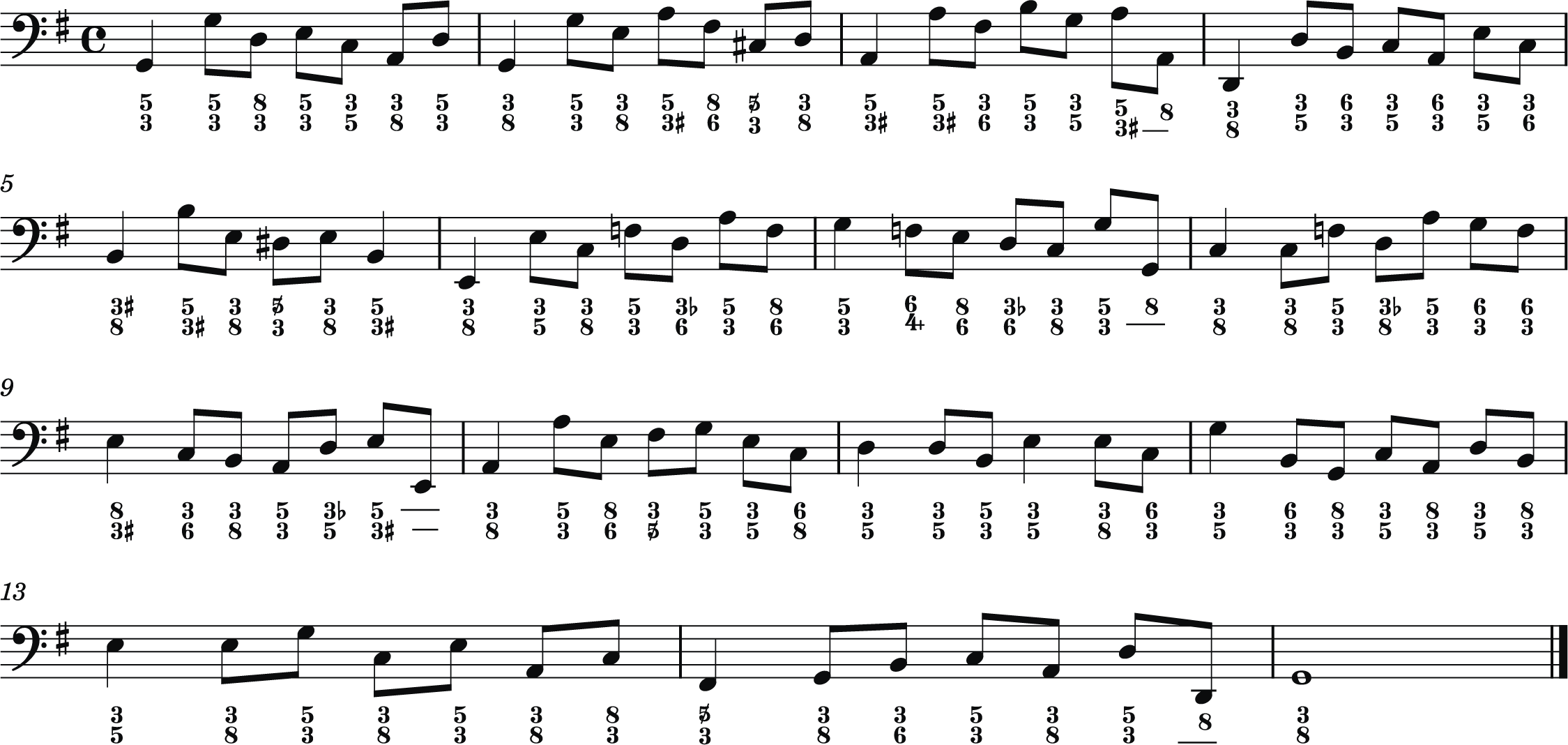
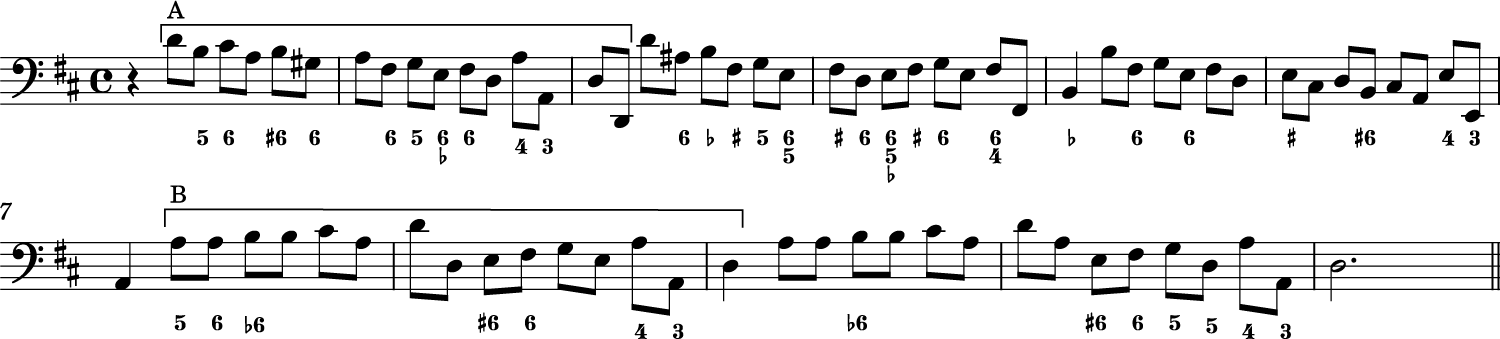
Even though it is impossible to determine how and through whom Bernier came into contact with the contrapuntal realization of the modulazione dell’ottava, a comparison of one of his leçons (partimento-like basses) found in his ‘Principes’ with one of Pasquini’s partimenti suggests that the two musicians were in close contact, or at least that Bernier knew the pedagogic exercises of the Italian master (Example 2). Example 2a reproduces the very last ‘lesson’ found in Bernier’s pedagogical writing; it includes fourteen four-beat motifs derived from one another in steady quavers according to the rhythmic pattern  .Footnote 43 This exercise mainly reviews cadenzae and various leaping patterns involving rising fourths and fifths, falling thirds, and some ascending semitone motions. Pasquini’s partimento, transcribed in Example 2b, is made up of five two-bar phrases in quavers (phrases A and B, and their respective derivations) going over descending third and ascending semitone motions.Footnote 44 From a stylistic standpoint, these two samples are very similar, and cover various patterns in a systematic way; both could have been written by Pasquini.
Nicolas Bernier, ‘Principes de composition’, p. 101. Bibliothèque nationale de France.

Example 2a. Long description
The score consists of 16 measures divided into four staves of four measures each.
* Staff 1 (Measures 1 to 4): Begins with a common time signature and a bass clef. The melody consists of eighth notes and quarter notes. Beneath each note are vertically stacked numerals (figured bass). For example, the first note has a 5 over a 3. Subsequent notes include figures such as 8 over 3, and 6 over 3 sharp.
* Staff 2 (Measures 5 to 8): The key signature includes an F sharp. The melody continues with eighth note patterns. Figured bass symbols include sharps and flats next to numerals, such as 3 sharp over 8, 5 over 3 flat, and a 4 plus symbol.
* Staff 3 (Measures 9 to 12): The melodic line maintains a steady eighth note rhythm. Figures beneath the notes include 8 over 3 sharp, 5 over 3, and 6 over 3. Some figures include horizontal lines indicating the continuation of a harmony.
* Staff 4 (Measures 13 to 16): The final staff shows a similar rhythmic structure, ending on a whole note in the final measure. Figured bass includes 3 over 5, 3 over 8, and 5 over 3. The piece concludes with a double bar line.
Bernardo Pasquini, ‘Partime[n]ti del sig. D. Bernardo Pasquino’, p. 161 (bar 7 corrected in accordance with bar 9). Biblioteca del Real Conservatorio di Musica, Naples.

Example 2b. Long description
The score consists of two horizontal staves in bass clef with a key signature of two sharps.
Top Staff:
* Starts with a common time signature and a quarter rest.
* A bracket labeled A spans the first three measures, covering a descending and ascending eighth-note sequence.
* Figured bass numbers beneath the first staff include sequences such as 5 6 sharp 6 6, 6 5 flat 6 6, and 4 3.
* The second half of the staff contains more complex figures including stacked numbers like 6 over 5 with a natural sign, and 6 over 4.
Bottom Staff:
* Labeled with a small 7 at the start.
* A bracket labeled B spans the first four measures.
* The melody continues in eighth notes until the final measure, which concludes on a dotted half note.
* Figured bass numbers beneath this staff include 5 6 flat 6, sharp 6 6, 4 3, flat 6, and a final sequence of sharp 6 6 5 5 4 3.
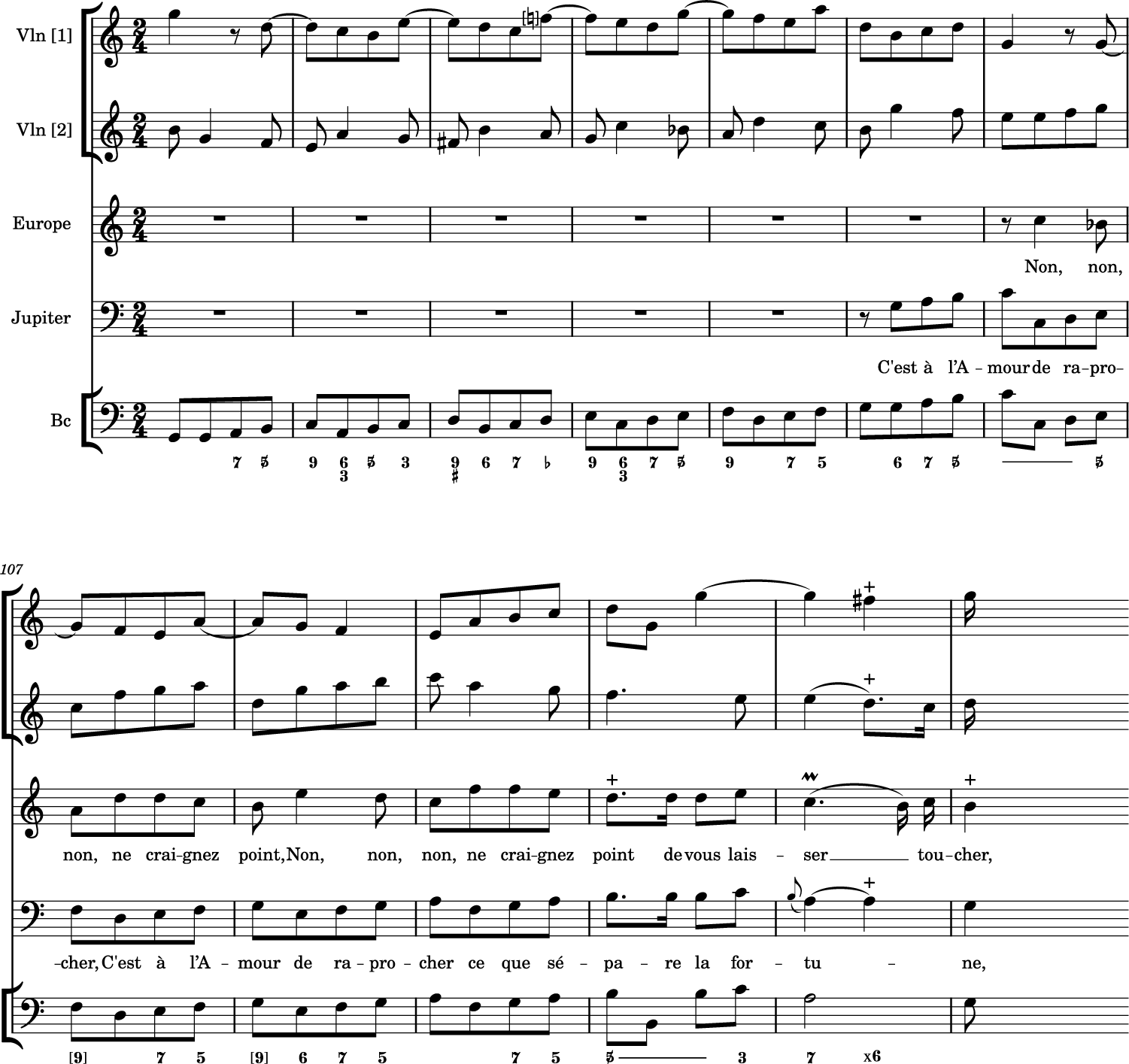
It is therefore not surprising that Robert O. Gjerdingen was able to pinpoint a section from Bernier’s cantata Jupiter et Europe (Example 3) that calls for the same kind of leaping patterns as those shown in Example 2.Footnote 45 To quote Gjerdingen, the duet ‘Non, non ne craignez point’ is ‘full of canons on the rising-fourths schema’:
The violins begin with a canon whose motive descends a third stepwise before leaping up a fourth. That will be the soprano Europe’s initial motive. The baritone Jupiter, by contrast, fills in the ascending fourth stepwise but leaps down the descending third (his part is doubled by the basso continuo). When all four parts are in play, Jupiter’s motive is mirrored by parallel consonances in the second violins while Europe’s motive engages in canon with the first violons. This would be complex enough, but Bernier also manages to include the ‘idea’ of 9–8 suspensions (see the downbeat of mm. 101–04, 107–08).Footnote 46
Nicolas Bernier, ‘Non, non ne craignez point’, bars 100–12, from Jupiter et Europe.

Example 3. Long description
The score is arranged in two systems. Each system contains five staves.
Top system (measures 100 to 106):
* Vln [1] and Vln [2]: Treble clef, 2 over 4 time signature. They play melodic lines with eighth and sixteenth notes, including ties and accidentals.
* Europe: Treble clef. Rests until measure 106, where the vocal line enters with the lyrics ‘Non, non,’.
* Jupiter: Bass clef. Rests until measure 105, entering with ‘C'est à l'A-mour de ra-pro-'.
* B c: Bass clef. Continuous eighth-note movement with figured bass notation (numbers like 7, 5, 9, 6, 3) below the staff.
Bottom system (measures 107 to 112):
* Vln [1] and Vln [2]: Continue melodic interplay with ornaments like crosses and trills above notes.
* Europe: Vocal line continues with ‘non, ne crai-gnez point, Non, non, non, ne crai-gnez point de vous lais-ser tou-cher,’.
* Jupiter: Vocal line continues with '-cher, C'est à l'A-mour de ra-pro-cher ce que sé-pa-re la for-tu-ne,’.
* B c: Continues the eighth-note bass line with figured bass numbers including 7, 5, 6, 3, and x6.
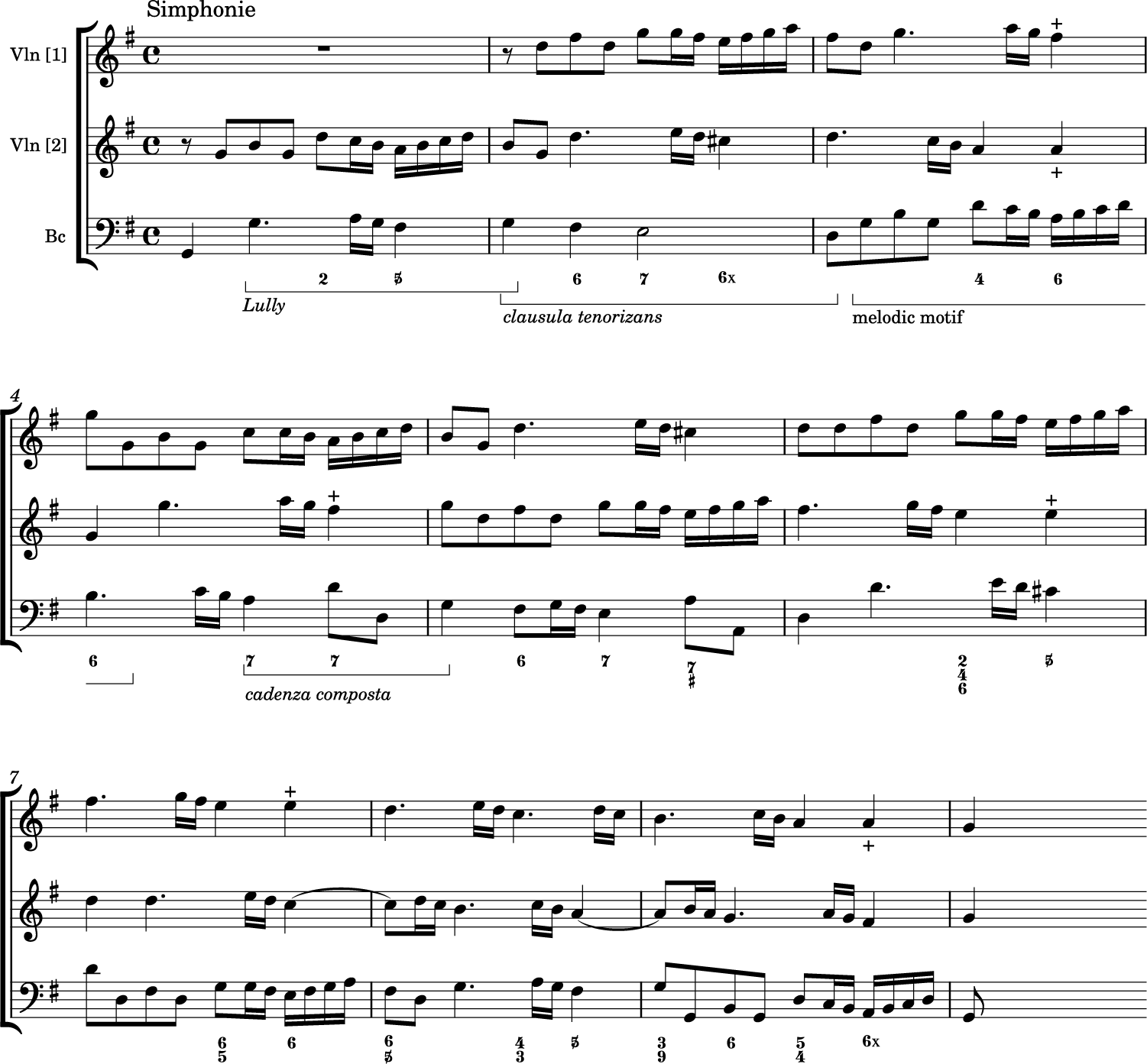
The opening section of the motet O triumphantis Jerusalem (bars 1–50) is also worth singling out because it seems to be a lesson in the practice of dissonance treatment (see Example 4): Bernier resorts to only three basic bass patterns on which is superimposed a melodic motif developed in invertible counterpoint.Footnote 47 Not only do the numerous chains of suspensions recall a manner widely used by Corelli,Footnote 48 but the first five bars of the instrumental bass also resemble a partimento that provides all the musical material necessary for improvisation: a Lully (a suspension in the bass part accompanied by a second and a perfect fourth) connected to a clausula tenorizans or ‘contrapuntal cadence’ (bars 1–3), an energetic melodic motif (bars 3–4), and a cadenza composta or ‘compound cadence’ (bars 4–5).Footnote 49 Also noteworthy is the systematic and repetitive way the melodic motif is employed: it is heard twenty times in its entirety during this opening section, nine times in G major (the home key), ten times in D major (the dominant), and a final time in A major to emphasize the new tonic area of D major, the area in which the ensuing Lentement section begins (bar 51). The challenge lies in Bernier’s ability — or that of a student working on a partimento — to vary the contrapuntal combinations to sustain the interest of listeners. Altogether, O triumphantis Jerusalem is the kind of score that may have prompted Jean-Laurent Lecerf de La Viéville to grumble that ‘Bernier’s duets and trios are unpleasantly marked with the stamp of Italy […] Bernier is enlightened enough to know better than anyone the lack of naturalness of his assembled parts and the unpleasantness of his parts taken in detail.’Footnote 50
Nicolas Bernier, O triumphantis Jerusalem, bars 1–10, in Motets à une, deux, et trois voix, p. 188.

Example 4. Long description
The score consists of three systems, each containing three staves labeled V l n [1], V l n [2], and B c. The time signature is common time and the key signature has one sharp.
System 1 (Measures 1 to 3):
- The top staff is titled Simphonie. V l n [1] begins with a whole rest, followed by eighth and sixteenth note runs.
- V l n [2] enters in measure 1 with eighth notes.
- The B c staff includes figured bass notation. Below the B c staff, measure 1 is bracketed and labeled Lully with figures 2 and 5. Measure 2 is labeled clausula tenorizans with figures 6, 7, and 6 x. Measure 3 is labeled melodic motif with figures 4 and 6.
System 2 (Measures 4 to 6):
- The violins continue with interlocking melodic lines featuring trills marked with a plus symbol.
- Below the B c staff, measure 4 has a figure 6. Measure 5 is labeled cadenza composta with figures 7 and 7. Measure 6 includes figures 6, 7, a sharp symbol, and a vertical stack of 2, 4, 6, followed by a 5.
System 3 (Measures 7 to 10):
- The melodic lines resolve toward a final cadence.
- The B c staff features dense figured bass. Measure 8 has stacks of 6 over 5, 6, and 6 over 5. Measure 9 has stacks of 4 over 3, 5, 3 over 9, and 6. Measure 10 concludes with a stack of 5 over 4, 6 x, and a final whole note.
The Relationship of Continuo and Voice in Bernier’s Cantates françaises and Petits motets
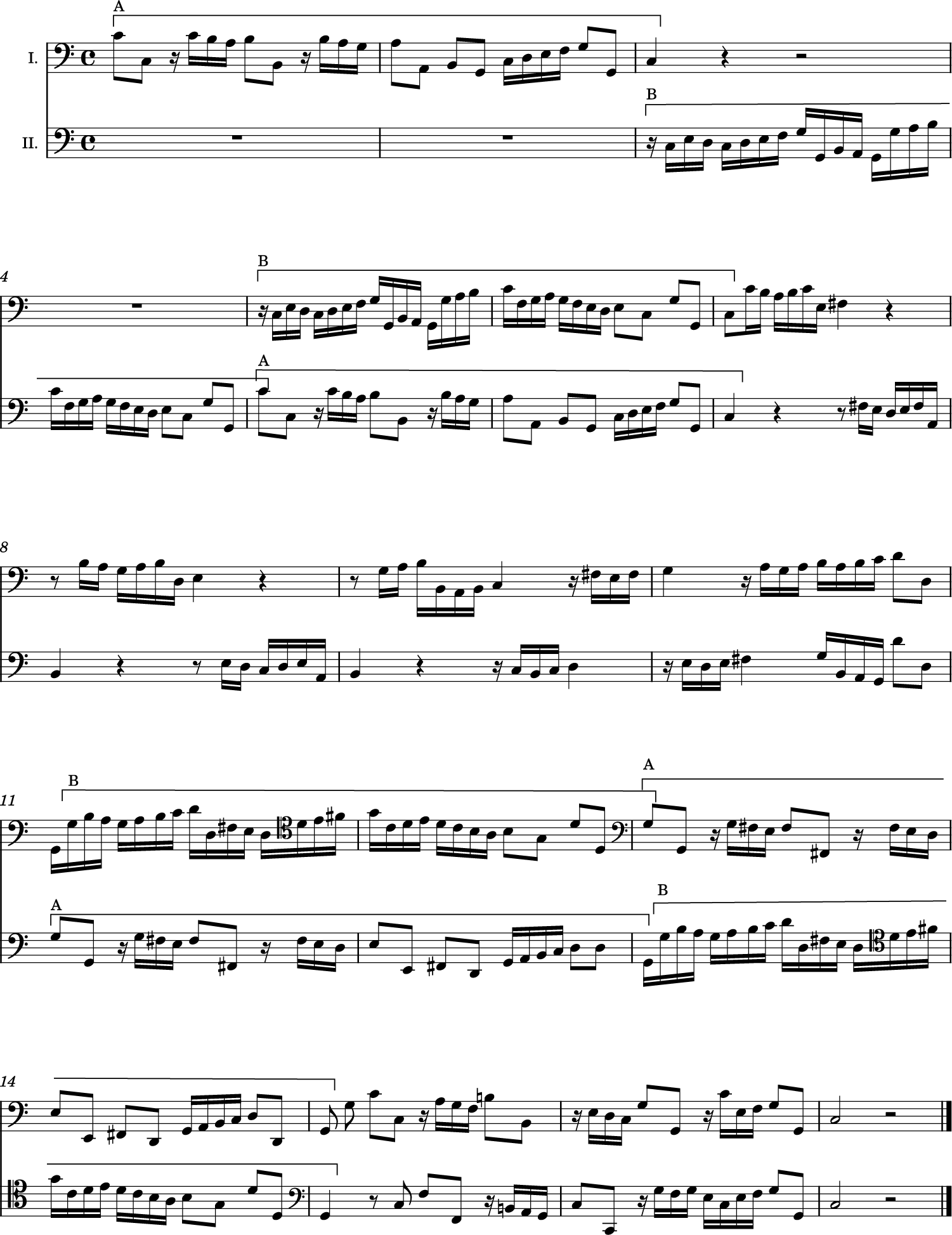
Another possible point of contact between the French and the Italian musicians is suggested by Pasquini’s sonatas for two harpsichords, notated as two partimenti. Footnote 51 Playing these can become quite demanding if one decides to realize them as two contrapuntal lines, because keyboardists have ‘to discover [for] themselves the contrapuntal implications that Pasquini concealed in the two partimenti’.Footnote 52 It is conceivable that Bernier performed these sonatas with Pasquini, and learnt from them how to combine two fragments (A and B) of the same melodic bass with each other in a neat two-voice counterpoint and to transpose the resulting module A+B into various keys. The opening movement of Pasquini’s Sonata II for two partimenti in C major provides a paragon (Example 5).Footnote 53 Fragment A (bars 1–2) is presented in the home key by the first harpsichordist and echoed by fragment B (bars 3–4) played by the second. Thereafter the two fragments are combined (bars 5–6) and followed by a tight imitative dialogue between the two instrumentalists to underline the progression to G major (bars 7–10). A and B are superimposed one last time in the dominant key (bars 11–14) before leading to a conclusion — built on the head of A — that brings the movement to an end (bars 15–17). The overall form can be summarized as shown in Table 1.
Bernado Pasquini, Sonata II for two partimenti in C major, first movement. British Library, MS Add. 31501/I.

Example 5. Long description
The score consists of five systems, each containing two staves labeled Roman numeral I and Roman numeral I I, both written in bass clef with a common time signature.
* System 1: Staff I begins with a melodic subject labeled A, consisting of eighth and sixteenth notes starting on middle C. Staff I I is silent for two measures before entering with a second subject labeled B, which features a rising sixteenth-note scale.
* System 2: The voices swap roles. Staff I I takes up subject A while Staff I performs subject B. Horizontal brackets above the notes indicate the duration of these thematic entries.
* System 3: Both voices engage in free counterpoint with frequent eighth-note rests and sixteenth-note runs. The harmony moves through G major, indicated by F-sharp accidentals.
* System 4: Subject B returns in Staff I while subject A appears in Staff I I. Toward the end of the system, the labels A and B appear again as the voices overlap their thematic material.
* System 5: The final system shows the resolution of the counterpoint. Staff I I briefly switches to alto clef before returning to bass clef. The piece concludes with a whole note C in both parts, marked by double bar lines.
OVERALL FORM OF BERNADO PASQUINI’S SONATA II FOR TWO PARTIMENTI IN C MAJOR, FIRST MOVEMENT
| Bars | 1–2 | 3–4 | 5–6 | 7–10 | 11–12 | 13–14 | 15–17 |
|---|---|---|---|---|---|---|---|
| Harpsichord 1 | A | B | dialogue | B | A | A′ | |
| Harpsichord 2 | B | A | dialogue | A | B | A′ | |
| Keys | C major | sequence | G major | G major → C major | |||
TABLE 1 Long description
The table consists of eight columns and four rows.
Row 1 (Header): Bars 1 to 2, 3 to 4, 5 to 6, 7 to 10, 11 to 12, 13 to 14, and 15 to 17.
Row 2 (Harpsichord 1):
- Bars 1 to 2: A
- Bars 3 to 4: Empty
- Bars 5 to 6: B
- Bars 7 to 10: dialogue
- Bars 11 to 12: B
- Bars 13 to 14: A
- Bars 15 to 17: A prime
Row 3 (Harpsichord 2):
- Bars 1 to 2: Empty
- Bars 3 to 4: B
- Bars 5 to 6: A
- Bars 7 to 10: dialogue
- Bars 11 to 12: A
- Bars 13 to 14: B
- Bars 15 to 17: A prime
Row 4 (Keys):
- Bars 1 to 6: C major
- Bars 7 to 10: sequence
- Bars 11 to 14: G major
- Bars 15 to 17: G major yields C major
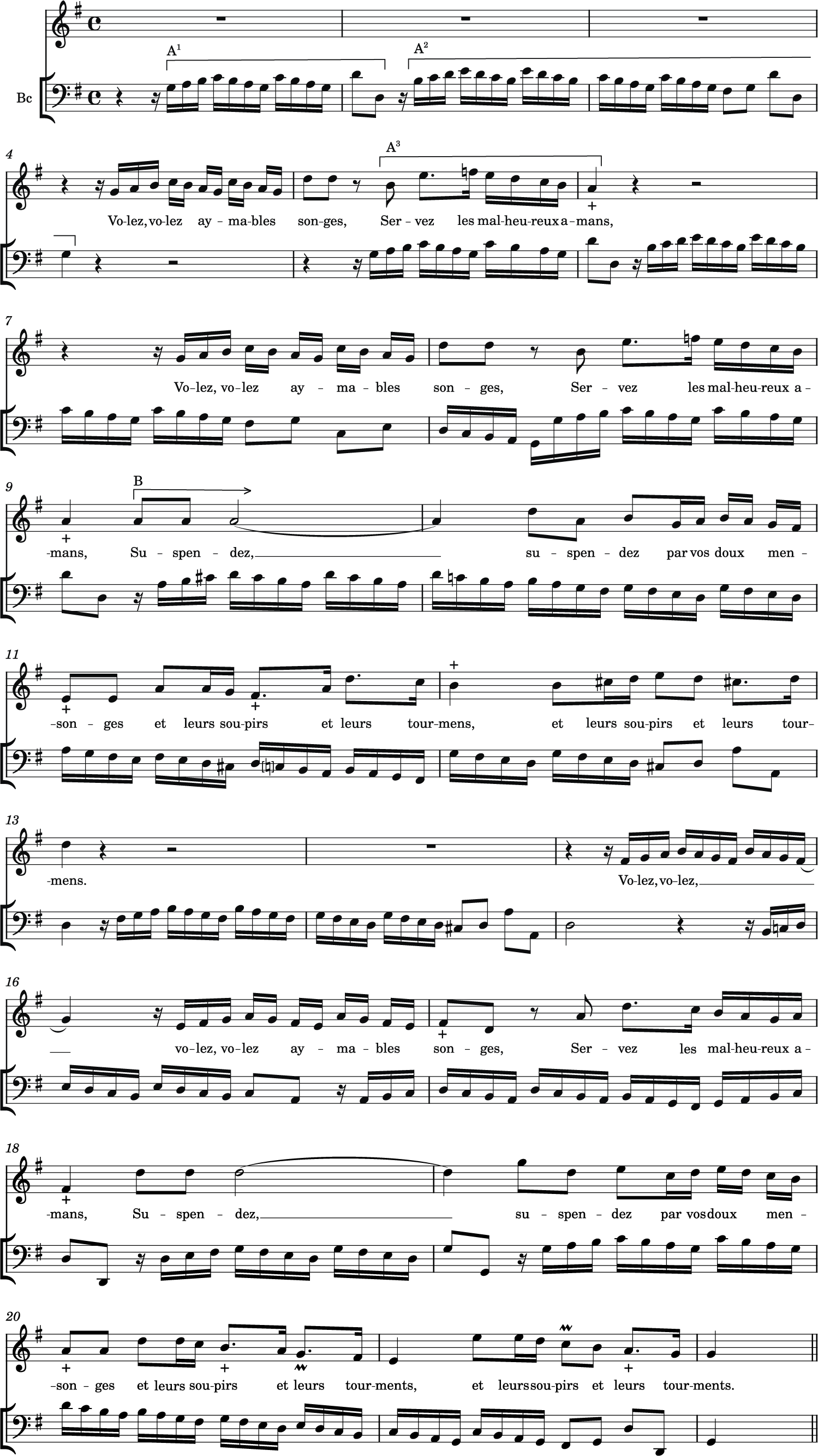
In Example 5, fragments A and B could have been played by the same harpsichordist to form a four-bar phrase. Performed thus, module A+B seems to be extracted from one of Bernier’s cantates françaises. Pasquini’s contrapuntal module is indeed akin to that encountered, among several examples, at the beginning of the da capo aria ‘Volez aymables songes’ from Bernier’s cantata Les Songes (Book ii), except that the French composer uses motifs derived from each other without seeking to contrast them.Footnote 54
As seen in Example 6, the instrumental bass reveals a motto made of two related motifs, A1 (bars 1–2) and A2 (bars 2–3). At its entrance, the voice restates A1 followed by motif A3, the latter accompanied by A1 in the bass (bars 5–6). Then the basse continue takes up A2 again while the voice sings A1 (bars 6–7). In other words, the two motifs of the module, A1+A2, can be superimposed on one another, as can the two fragments of Pasquini’s sonata; all in all, A1 and its cognates are omnipresent.Footnote 55 The motif combinations of the first section of Bernier’s aria are outlined in Table 2.
Nicolas Bernier, ‘Volez aymables songes’, bars 1–22, from Les Songes, in Cantates françoises, pp. 30–32 (continuo figures omitted).

Example 6. Long description
The score consists of eight systems, each containing two staves. The top staff is for a solo voice (labeled Be in the first system) and the bottom staff is for a bass instrument.
* System 1 (Bars 1 to 3): The vocal line is silent with whole rests. The bass line features continuous sixteenth-note patterns. Brackets above the bass line mark two motifs labeled A super 1 and A super 2.
* System 2 (Bars 4 to 6): The voice enters with the lyrics ‘Vo-lez, vo-lez ay-ma-bles son-ges, Ser-vez les mal-heu-reux a-mans,’. A bracket labeled A super 3 appears over the vocal entry. The bass line continues with sixteenth-note runs.
* System 3 (Bars 7 to 8): The vocal melody repeats the previous text. The bass line maintains a steady sixteenth-note motion.
* System 4 (Bars 9 to 10): A bracket labeled B with a right-pointing arrow marks the vocal line on the word ‘Su-spen-dez’. The lyrics continue ‘par vos doux men-'. The bass line features a descending sixteenth-note pattern.
* System 5 (Bars 11 to 12): The vocal line sings '-son-ges et leurs sou-pirs et leurs tour-mens,’. Small plus signs appear above several notes in the vocal part. The bass line consists of rapid sixteenth-note scales.
* System 6 (Bars 13 to 15): The voice has a long rest followed by a re-entry on ‘Vo-lez, vo-lez,’. The bass line continues its active sixteenth-note accompaniment.
* System 7 (Bars 16 to 17): The voice repeats ‘vo-lez, vo-lez ay-ma-bles son-ges, Ser-vez les mal-heu-reux a-'. The bass line remains consistent in its rhythmic density.
* System 8 (Bars 18 to 19): The voice sings '-mans, Su-spen-dez, su-spen-dez par vos doux men-'. The bass line supports with sixteenth-note figures.
* System 9 (Bars 20 to 22): The final system shows the lyrics '-son-ges et leurs sou-pirs et leurs tour-mens, et leurs sou-pirs et leurs tour-mens.’ Ornamentation marks including plus signs and wavy lines (mordents) are present over the vocal notes. The bass line concludes with a final sixteenth-note run.
MOTIF COMBINATIONS IN BERNIER’S ‘VOLEZ AYMABLES SONGES’
| Bars | 1–2 | 2–3 | 4–5 | 5–6 | 6–7 | 8–9 | 9–12 | 13–14 | 15 | 16 | 17 | 18–22 |
|---|---|---|---|---|---|---|---|---|---|---|---|---|
| Voice | A1 | A3 | A1 | A3 | B | A1 | A1 | A3 | B | |||
| Continuo | A1 | A2 | A1 | A2 | A1 | A′2 | A2 | A1 | A2 | A1 + A″2 | ||
| Keys | G major | Sequence | D major | G major | ||||||||
TABLE 2 Long description
The table consists of 13 columns and 4 rows.
Row 1 (Bars): 1 to 2, 2 to 3, 4 to 5, 5 to 6, 6 to 7, 8 to 9, 9 to 12, 13 to 14, 15, 16, 17, 18 to 22.
Row 2 (Voice): Empty for bars 1 to 3 and 13 to 14. Motifs are A super 1 (bars 4 to 5, 6 to 7, 15, 16), A super 3 (bars 5 to 6, 8 to 9, 17), and B (bars 9 to 12, 18 to 22).
Row 3 (Continuo): Empty for bars 4 to 5 and 15. Motifs are A super 1 (bars 1 to 2, 5 to 6, 8 to 9, 16), A super 2 (bars 2 to 3, 6 to 7, 13 to 14, 17), A prime super 2 (bars 9 to 12), and A super 1 plus A double prime super 2 (bars 18 to 22).
Row 4 (Keys): G major spans bars 1 to 9. Bars 9 to 12 are labeled Sequence. Bars 13 to 14 are D major. G major returns for bars 15 to 22.
‘Volez aymables songes’ illustrates well not only Lacombe’s above-mentioned statement that Bernier had the ‘propensity to present the same melodic turn’ in various keys (as does the first movement of O triumphantis Jerusalem), but also the composer’s taste for mottos made of multiple motifs that can be combined with each other. It is probably this type of continuo bass constructed from calculated contrapuntal modules that Lecerf de La Viéville strongly criticized as early as 1706: Bernier’s ‘well-crafted basses do not prevent us from feeling and condemning a constrained genius that revolts’.Footnote 56
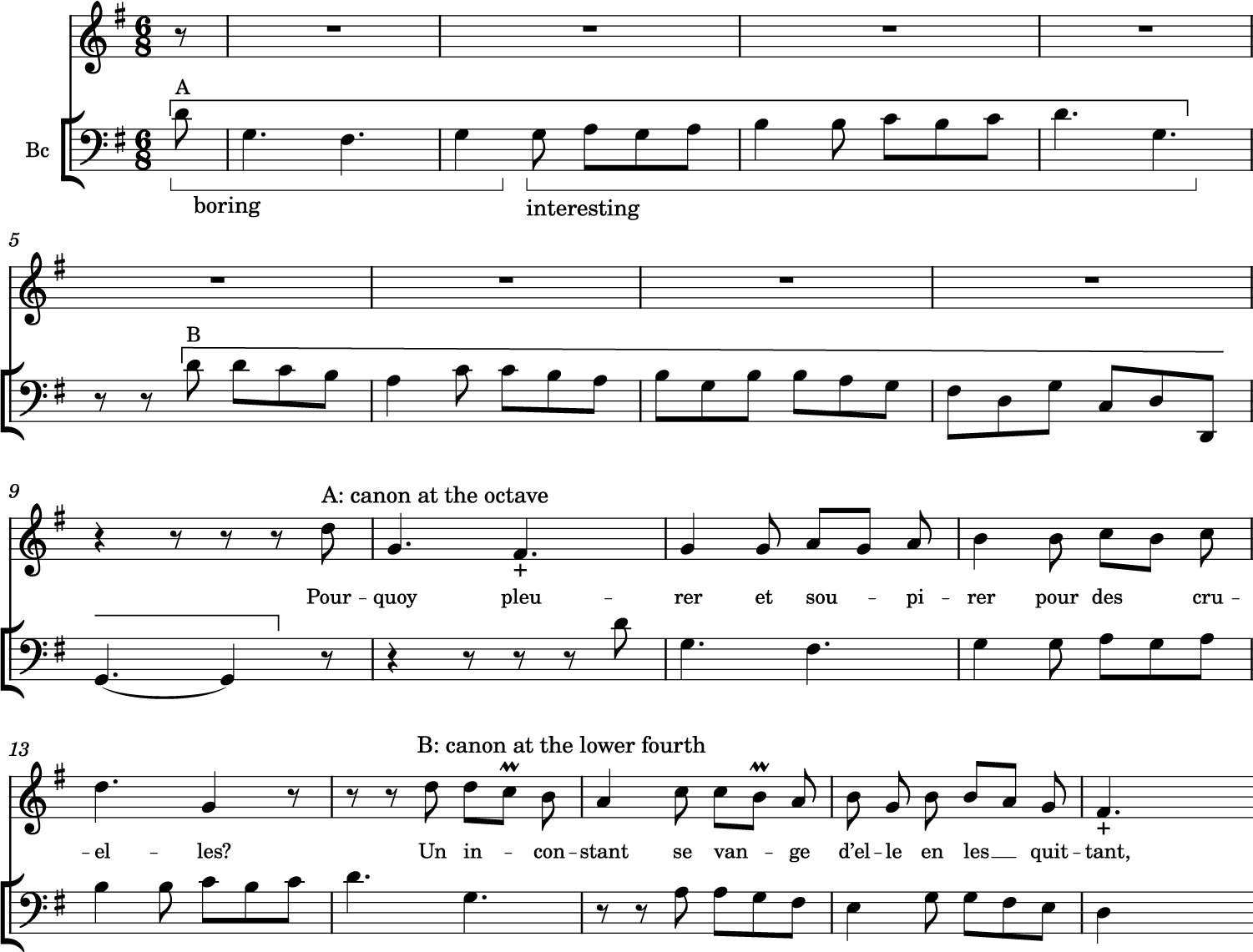
As already noted, one of Bernier’s most striking idiosyncrasies encountered in his entire output, and in his cantates and petits motets in particular, is the canonic or canon-like relationship between the instrumental bass and the voice(s) it accompanies. The tight interplay between motifs A1 and A2 of ‘Volez aymables songes’ provides an unsophisticated sample. However, Bernier’s canonical writing is even more obvious in the opening bars of ‘Pourquoy pleurer’ from Les Zephirs (Example 7).Footnote 57 The motto is divided into two fragments, A (bars 1–4) and B (bars 5–9); each is then heard in canon with itself at the octave (fragment A, bars 10–14) and at the lower fourth (fragment B, bars 14–17).Footnote 58 Fragment A is in turn made up of two invertible motifs, one ‘boring’ and the other ‘interesting’ — two notions pertaining to the partimento tradition and already observed in Example 4 between the ‘boring’ Lully schema and the ‘interesting’ melodic motif — that can be combined contrapuntally, hence favouring their superimposition.Footnote 59 All these contrapuntal devices, strict or loose, pervade the entire air.
Nicolas Bernier, ‘Pourquoy pleurer’, bars 1–17, from Les Zephirs, in Cantates françoises, p. 22 (continuo figures omitted).

Example 7. Long description
The score consists of four systems of two staves each.
System 1, bars 1 to 4. The treble staff is empty. The bass staff, labeled B C, begins with a melody marked A. A bracket under bars 1 to 2 is labeled boring, while a bracket under bars 3 to 4 is labeled interesting.
System 2, bars 5 to 8. The treble staff remains empty. The bass staff continues the melody, now marked B at bar 5.
System 3, bars 9 to 12. The treble staff introduces the vocal line with the text Pour-quoy pleu-rer et sou-pi-rer pour des cru-. Above bar 9 is the label A canon at the octave. The bass staff provides accompaniment.
System 4, bars 13 to 17. The treble staff continues with the text -el les? Un in-con-stant se van-ge d'el-le en les quit-tant. Above bar 14 is the label B canon at the lower fourth. The bass staff concludes the phrase.
Musical notation includes a 6 over 8 time signature and a single sharp key signature for G major or E minor.
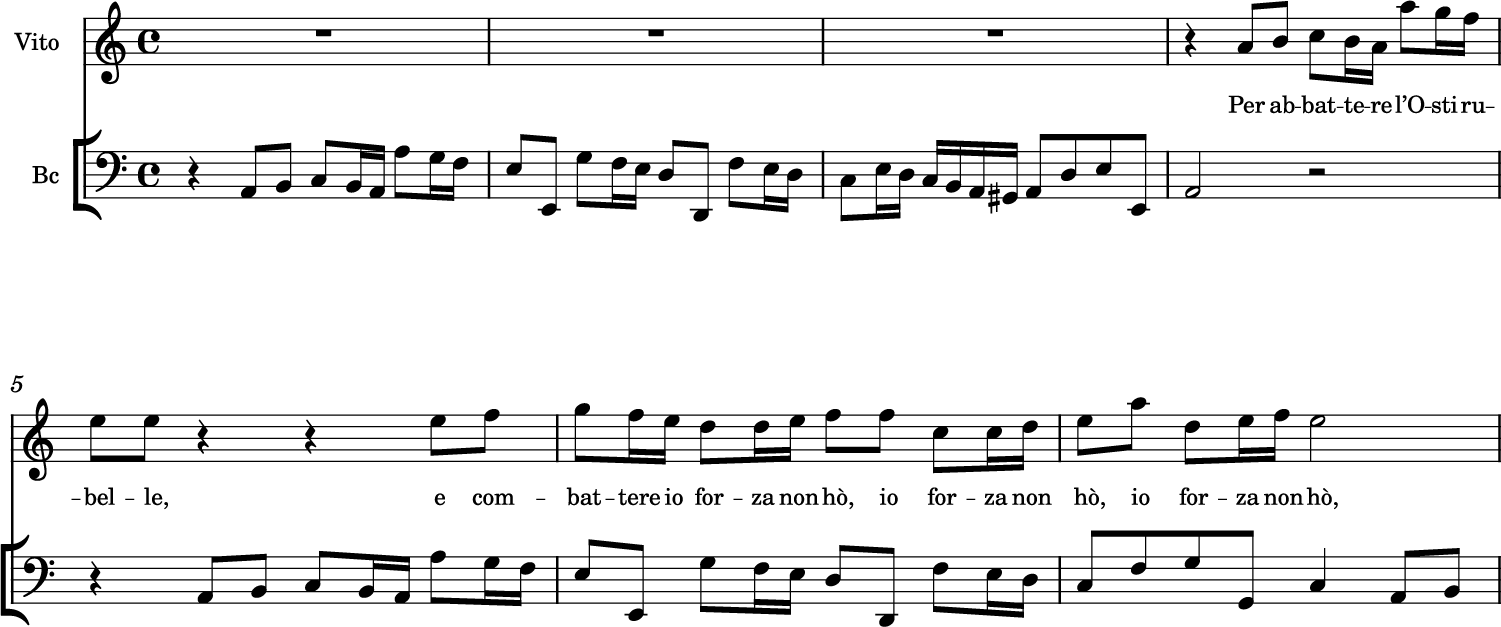
Bernier’s taste for imitative and invertible counterpoint, as well as for motif repetitions, is perhaps the result of his studies of Pasquini’s fugal partimenti and his knowledge of the Roman master’s vocal music, in which the instrumental bass often interacts with the voice(s) in imitative counterpoint.Footnote 60 Another feature shared by Pasquini and Bernier, and to some extent by Campra and other French composers, is the unaccompanied statement of the motto by the voice at its entrance. A comparison between two arias will suffice to substantiate this: ‘Per abbattere l’Osti rubelle’ from Pasquini’s oratorio Il martirio dei santi Vito, Modesto e Crescenzia sotto la tirannide di Diocleziano imperatore (1687) and ‘Reges Tharsis et insulæ munera’ from Bernier’s motet Surge illuminare Jerusalem (Examples 8a and 8b).Footnote 61
Bernardo Pasquini, ‘Per abbattere l’Osti rubelle’, bars 1–7, from Il martirio dei santi Vito (continuo figures omitted). Modena, Biblioteca Estense.

Example 8a. Long description
The score consists of two systems.
System 1 (Bars 1 to 4):
- The top staff is labeled Vito in treble clef with a common time signature. It contains three bars of rest followed by an eighth-note pickup and sixteenth-note run in bar 4. The lyrics under bar 4 read: Per ab-bat-te-re l'O-sti ru-.
- The bottom staff is labeled B c in bass clef. It features a continuous moving line of eighth and sixteenth notes through bars 1 to 3, ending on a half note in bar 4 while the voice enters.
System 2 (Bars 5 to 7):
- The top staff continues the vocal line. Bar 5 completes the word -bel-le followed by rests. Bars 6 and 7 feature a melodic line of eighth and sixteenth notes. The lyrics read: e com-bat-tere io for-za non ho, io for-za non ho, io for-za non ho.
- The bottom staff continues the basso continuo with a steady eighth-note and sixteenth-note accompaniment that mirrors the rhythmic energy of the vocal line.
Nicolas Bernier, ‘Reges Tharsis et insulæ munera’, bars 1–14, in Motets à une, deux, et trois voix, p. 36 (continuo figures omitted).

Example 8b. Long description
The score is arranged in two systems of two staves each.
System 1 (Bars 1 to 7):
* Top Staff: Treble clef with a B-flat key signature and cut-time meter. It begins with five bars of rest. The vocal entry occurs in bar 6 with the text Re-ges Thar-sis et in-su-.
* Bottom Staff: Labeled B c for basso continuo. Bass clef with a B-flat key signature. It features a continuous eighth and sixteenth note melodic line that provides an instrumental introduction before the voice enters.
System 2 (Bars 8 to 14):
* Top Staff: Continues the vocal line with the text -lae mu-ne-ra ob-tu-le-runt, mu-ne-ra ob-tu-le-runt, followed by a rest and a re-entry on the word Re-ges. Small plus signs appear above certain notes as ornamentation markers.
* Bottom Staff: Continues the basso continuo line with active melodic movement, including occasional accidentals like F-sharp and E-natural, supporting the vocal harmonies above.
In both cases, the basse continue launches a motto whose first fragment is taken up unaccompanied by the voice; the bass part then restates the motto in its entirety while the voice carries on with its melodic line. (In the cantates françaises and petits motets by Bernier’s contemporaries, and those of Campra in particular, the continuo generally does not play the entire motto again when the voice enters or has just entered.) The bass part utters Pasquini’s motto five times in A minor within 24 bars, and Bernier’s eight times in D minor and C minor, as well as in F major, within 62 bars. By and large, and considering both the voice and the instrumental lines, the motto fills approximately 79 per cent of Pasquini’s aria and approximately 76 per cent of Bernier’s. Behind these figures lies a very simple reality: in Bernier’s cantates françaises and petits motets, the motto and its fragments — or motifs — literally invade the musical fabric, as do the short motifs (or melodic fragments) of partimenti, in which a particular harmonic progression is presented to students in its various aspects.
Stimulating the student’s imagination by repeating the same motifs or schemata within a partimento was part of Pasquini’s teaching. Perhaps a more difficult task was to vary the vocal line over an ostinato bass that could be stated in different keys. In some of Pasquini’s strophic arias, the stanza itself follows an ABA′ form. The contrast between sections A and B lies in section A being delineated with an ostinato bass in the original key, and section B with the same bass in the dominant or relative key. Therefore, while there are many repetitions of motifs, the musical interest rests in the composer’s (or student’s) ability to vary the vocal part above such a modulating ostinato. For instance, in each of the two stanzas of the aria ‘Divin frutto del mio seno’ from La sete di Christo (1689), the instrumental bass articulates the same phrase, an embellished descending minor-scale fragment, ten times below an ever-varying soprano line, twice in A minor (section A; bars 1–6), four times in C major or minor (section B; bars 7–16), then four times in A minor (section A′; bars 17–27) (see Example 9a).Footnote 62 Bernier follows the same overall design to conclude his very first published motet, Intonuit de cœlo. Footnote 63 In the final ‘Alleluya’, the bass phrase (Example 9b) is a mere elaboration of a romanesca (a descending sequence) leading to a cadenza semplice (a perfect cadence).Footnote 64 It is played three times in A major (section A; bars 1–8), three times in E major (section B; bars 9–15), and then four times back in A major (section A′; bars 16–28), below a soprano part just as varied as that of Pasquini (see Example 9c).
Bernardo Pasquini, ‘Divin frutto del mio seno’, bars 1–27, from La sete di Christo. Modena, Biblioteca Estense.

Example 9a. Long description
The score is organized into seven systems, each containing a treble clef staff for the soprano voice labeled La Vergine and a bass clef staff labeled B c for the basso continuo.
* System 1 (Bars 1 to 3): The voice enters in bar 3 with the lyrics Di-vin frut-to del mio. The basso continuo plays a steady eighth-note pattern.
* System 2 (Bars 4 to 7): The vocal line continues with se-no, che di se-te, che di se-te hor ar-di tan-to, o po-tes-si. The accompaniment maintains a rhythmic pulse with occasional accidentals including sharps and naturals.
* System 3 (Bars 8 to 11): The lyrics are o po-tes-si dar-ti al-men ques-te goc-cie, ques-te goc-cie del mio pi-an-to. The melody features rising and falling melodic contours.
* System 4 (Bars 12 to 15): This section introduces several flats in both the vocal and continuo lines. The lyrics repeat ques-te goc-cie del mio pian-to.
* System 5 (Bars 16 to 19): The vocal line has a long held note on the word to, followed by a rest, then resumes with o po-tes-si dar-ti al-men ques-te.
* System 6 (Bars 20 to 23): The lyrics continue with goc-cie, ques-te goc-cie del mio pian-to, ques-te goc-cie del mio pian. The basso continuo uses chromatic movement with frequent sharps and naturals.
* System 7 (Bars 24 to 27): The piece concludes with the final repetition of the words to, del mio pian-to, del mio pian-to. The final bar shows a whole note in the voice and a final cadence in the basso continuo.
Nicolas Bernier, ‘Alleluya’, from Intonuit de cœlo, in Motets à une, deux, et trois voix (reduction of the bass with schemata).

Nicolas Bernier, ‘Alleluya’, bars 1–28, from Intonuit de cœlo, in Motets à une, deux, et trois voix, pp. 4–5.

Example 9c. Long description
The score is organized into ten systems, each containing a treble clef staff for the voice (labeled S dot) and a bass clef staff for the continuo (labeled Be). The time signature is common time, and the key signature has two sharps.
* System 1 (Bars 1 to 3): The voice enters in bar 3 with a trill on a high A. The bass provides a steady eighth-note movement with figures including 6 and 4 3.
* System 2 (Bars 4 to 6): The vocal line features a long melisma on the second syllable of Alleluya, consisting of sixteenth-note runs. The bass continues with eighth-note patterns.
* System 3 (Bars 7 to 9): The vocal part uses repetitive rhythmic motifs with small cross symbols above certain notes indicating ornaments. The bass line descends stepwise.
* System 4 (Bars 10 to 12): The voice has a rest followed by a re-entry with a trill. The bass figures include 6 5 and 6 x.
* System 5 (Bars 13 to 15): High melodic density in the voice with continuous sixteenth notes. The bass line uses larger interval leaps.
* System 6 (Bars 16 to 19): A brief vocal rest is followed by a new phrase starting with a bracketed trill. The bass line mirrors the vocal rhythm in bar 19.
* System 7 (Bars 20 to 22): The vocal line reaches its highest register with repeated sixteenth-note figures. Bass figures include 9 7 and 4 3.
* System 8 (Bars 23 to 25): The melisma continues with tied notes across beats. The bass remains active with eighth notes.
* System 9 (Bars 26 to 28): The final phrase of the section. The vocal line descends toward a cadence.
* System 10 (Final bar): Both parts conclude on a long note with a fermata symbol above and below the final bar line, signifying the end of the section.
Conclusion
Nothing is known of what Bernier did during his stay in the Eternal City around 1690–92, except that he studied with Roman masters whose identity remains to be ascertained. If Caldara’s name is likely to be ruled out, musical clues suggest that Pasquini would be a serious candidate. If during his Roman sojourn Bernier had many opportunities to improvise on Pasquini’s partimenti and to familiarize himself with the latter’s vocal music, this may explain his great abilities as a contrapuntist, widely recognized among his French colleagues. (Even Campra did not hesitate to ask him for help while composing a chorus for the ballet Les Amours de Vénus et de Mars.)Footnote 65 Bernier is considered one of the first — if not the first — to have introduced the use of partimenti in France, and his cantates françaises and petits motets betray many musical gestures inherited from these Italian pedagogical tools.Footnote 66 These tools have little in common with their verbal descriptors without concrete applications on the keyboard, as proposed for instance by Charles Masson in his renowned Nouveau traité des règles pour la composition de la musique. Footnote 67 Of course, there is a gap between compositional models and actual written works, since the latter cannot be entirely created from a stock of musical phrases. Still, memorized schemata prove very useful in producing them, and this seems to be the case in Bernier’s cantates françaises and petits motets. Indeed, there is little doubt that the partimento tradition had a profound impact on the French composer. However, further research in the Roman archives and a systematic analysis of Bernier’s whole musical output will be necessary to validate, or otherwise, the present conclusions.Footnote 68