
Introduction
The Office of the Prosecutor (OTP) at the International Criminal Court (ICC) has described preliminary examinations as “one of the Office’s three core activities,” alongside investigating and prosecuting crimes within the jurisdiction of the court.Footnote 1 In the fifteen years since the first prosecutor took office, the OTP has opened twenty-seven preliminary examinations, the most recent concerning crimes allegedly committed in the Philippines and Venezuela, as announced on 8 February 2018,Footnote 2 and the alleged deportation of Rohingya people from Myanmar to Bangladesh, announced on 18 September 2018.Footnote 3 In the ICC’s early years, there was little public information about this important aspect of the OTP’s work. As a result, the significance of preliminary examinations was not widely appreciated outside the court, and there was little research on this pre-investigative process.Footnote 4 However, this began to change with increased public reporting on preliminary examinations by the OTP and with greater attention to this topic in media reporting on the court. In fact, these days, the mere decision to open a preliminary examination can have a significant impact, including prompting two states (Burundi and the Philippines) to withdraw from the ICC’s founding treaty, the 1998 Rome Statute.Footnote 5 Additionally, preliminary examinations have been identified in recent years as an important area of research,Footnote 6 leading to a recent thought-provoking collection of essays on preliminary examinations,Footnote 7 together with useful analyses of discrete parts of the preliminary examination puzzle, including the process for opening a preliminary examination;Footnote 8 the purpose of preliminary examinations,Footnote 9 their duration,Footnote 10 and how the principles of complementarity,Footnote 11 “positive complementarity,”Footnote 12 and gravityFootnote 13 function at this stage of proceedings; and the limited scope for judicial review in preliminary examinations.Footnote 14
Missing from this literature is a comprehensive picture of the practice of the ICC’s OTP in relation to all preliminary examinations opened thus far. Filling that gap, this article provides an in-depth analysis of all preliminary examinations up until the 2018 annual preliminary examinations report. It reviews legal decisions made at the preliminary examination stage and identifies patterns in the triggers, outcomes, duration, frequency, and geographic representation of all preliminary examinations under the leadership of its two different prosecutors, Luis Moreno-Ocampo (June 2003 – June 2012) and Fatou Bensouda (June 2012 – present). This in-depth analysis shows that, despite not having full investigatory powers during preliminary examinations, the OTP is very active during this phase. It interacts with a wide range of domestic and international actors, including states parties, non-party states, the United Nations Security Council (UNSC), and members of civil society. It also makes decisions on legal issues that go to the heart of the ICC’s work, including questions about the ICC’s jurisdiction and about the definition of crimes that are yet to be interpreted by judges of the court. As such, preliminary examinations form a major part of the OTP’s work, demanding significant time and resources, and cannot be overlooked when evaluating the court.
Paying close attention to what goes on during the preliminary examination stage is therefore crucial to understanding what the OTP does and sheds light on why certain crimes are later investigated and prosecuted by the ICC, while others are not. It provides insight into who seeks to “use” the court by triggering preliminary examinations and their success in doing so as well as whether or not that usage has changed over the lifespan of the court as it has faced challenges and criticisms. Finally, understanding the full picture of the OTP’s preliminary examination practice is critical to understanding and nuancing many debates surrounding the legitimacy of the ICC, including its independence, impartiality, efficiency, and transparency.Footnote 15 The currency date of the 2018 preliminary examination report (specifically, 30 November 2018) provides a useful marker for a study of the OTP’s preliminary examination practice thus far.Footnote 16 Of course, there are, and always will be, new developments to this practice as the OTP continues its work. However, this study demonstrates trends over more than fifteen years of OTP practice and will provide a point of comparison for future research in the area, perhaps in another fifteen years.
The article begins by introducing the legal regime governing preliminary examinations and outlines relevant policies published by the OTP. It then presents our study of the OTP’s preliminary examination practice to date, beginning with the method and then presenting and discussing our key findings.
What Is a Preliminary Examination?
Put simply, a preliminary examination is the “pre-investigative phase” of the OTP’s work.Footnote 17 More specifically, it is the initial filtering process that the ICC prosecutor undertakes in order to decide whether or not there is a “reasonable basis to proceed to an investigation” by considering the factors listed in Article 53(1) of the Rome Statute — namely, whether the information available provides a reasonable basis to believe that a crime within the ICC’s jurisdiction has been, or is being, committed; whether the potential cases would be admissible before the ICC; and whether an investigation would not serve the interests of justice.Footnote 18
The question of precisely what activities constitute a preliminary examination, as opposed to a “pre-preliminary examination” process, is the subject of some debate. This debate arose recently in the ICC proceedings regarding a possible investigation into crimes allegedly committed in Myanmar and Bangladesh. In its September 2018 decision on that matter, Pre-Trial Chamber I held that “the preliminary examination is the pre-investigative assessment through which the Prosecutor analyses the seriousness of the information ‘received’ or ‘made available’ to her against the factors set out in Article 53(1)(a)–(c) of the Statute.”Footnote 19 Applying that interpretation, it held that the prosecutor’s actions in receiving information on alleged crimes against the Rohingya people, and considering “at least in part” that information against the factors described in Article 53(1)(a)–(c), “do not precede a preliminary examination, but are part of it.”Footnote 20 By contrast, the prosecutor’s view was that those activities occurred in a pre-preliminary examination stage that the OTP describes as “Phase 1” of its four-stage “filtering process” during which it conducts its “initial assessment of all information on alleged crimes received under article 15.”Footnote 21 Thus, the OTP does not consider the “formal commencement of a preliminary examination” to occur until Phase 2 of this process.Footnote 22
This divergence in views is not surprising given the lack of clarity on this stage of proceedings in the Rome Statute. Despite being a core component of the OTP’s work, the term “preliminary examination” appears just once in the statute. Specifically, Article 15(6) refers to “the preliminary examination referred to in paragraphs 1 and 2,” which state, respectively, that the prosecutor may initiate investigations proprio motu (on his or her own motion) on the basis of information on crimes within the ICC’s jurisdiction and that he or she may also seek out information from any “reliable sources.”Footnote 23 If the prosecutor seeks to proceed to an investigation proprio motu, he or she must apply to the Pre-Trial Chamber for authorization to open an investigation.Footnote 24 On the other hand, if the prosecutor receives a referral from either the UNSC or a state party, the prosecutor may proceed from a preliminary examination straight to an investigation if he or she decides that the Article 53(1) criteria are satisfied.
If the prosecutor reaches the conclusion that the Article 53(1) criteria have not been met, he or she must notify the information provider, be it an individual, a non-governmental organization (NGO), a state, or the UNSC, of that conclusion and the supporting reasons.Footnote 25 If the situation was referred by a state party or the UNSC, that referring entity can ask the Pre-Trial Chamber to review the prosecutor’s decision not to proceed.Footnote 26 However, the power of judicial review here is very limited, despite the fact that the prosecutor will inevitably have to make many important legal and factual determinations at this stage. The referring entity is not entitled to judicial review as a right,Footnote 27 and the Pre-Trial Chamber cannot quash the prosecutor’s decision even if it is deemed unreasonable or errant; at most, it can ask the prosecutor to “reconsider.”Footnote 28 On the other hand, if the conclusion not to proceed to an investigation is made on the basis of Article 53(1)(c) — namely, that the prosecution(s) would not be “in the interests of justice” — the OTP must inform the Pre-Trial Chamber.Footnote 29 This provides the only basis upon which the Pre-Trial Chamber can review the prosecutor’s decision on its own initiative, and it must confirm that decision for it to be effective.Footnote 30 Finally, Article 15 of the Rome Statute explicitly states that a decision to close a preliminary examination “shall not preclude the Prosecutor from considering further information submitted to him or her regarding the same situation in light of new facts or evidence.”Footnote 31 Thus, the prosecutor may reopen a preliminary examination at any time in light of new evidence, which has occurred only once thus far.
Given the limited statutory guidance on the conduct of preliminary examinations, it is helpful to consider relevant policies produced by the OTP that, while not binding, are key to understanding the office’s approach to this area of its practice. First, in a September 2003 document, the OTP made clear that a preliminary examination is always required before the prosecutor can proceed to an investigation, even if the situation was referred by a state party or the UNSC (even though the term “preliminary examination” only appears in the statutory provision dealing with an investigation initiated by the prosecutor proprio motu).Footnote 32 In November 2013, the OTP published a final Policy Paper on Preliminary Examinations,Footnote 33 which was based on an earlier October 2010 draft.Footnote 34 This 2013 policy paper outlines the principles that guide the OTP in its preliminary examinations — namely, independence, impartiality, and objectivity.Footnote 35 It also articulates the four-phase process that the office applies in conducting preliminary examinations — namely, examining Article 15 communications from states, civil society, and individuals to rule out those that fall “manifestly outside the jurisdiction of the Court” (phase 1); determining whether or not the alleged crimes appear to fall within the jurisdiction of the ICC (phase 2); determining whether or not the potential cases would be admissible to the Court (phase 3); and determining whether or not an investigation would be against the “interests of justice” (phase 4).Footnote 36 The policy paper states that those criteria of “jurisdiction,” “admissibility,” and the “interests of justice” are assessed in the same manner regardless of the trigger for the preliminary examination.Footnote 37 It also states that the OTP will publish regular reports on its preliminary examination activities, in line with its commitment to transparency at the preliminary examination stage.Footnote 38
In addition to that specific policy paper, a number of other OTP policies are also relevant to the preliminary examination process. For example, in September 2007, the OTP produced its Policy Paper on the Interests of Justice, which guides the OTP’s consideration of this criterion under Article 53(1)(c) of the Rome Statute.Footnote 39 As well, the OTP’s June 2014 Policy Paper on Sexual and Gender-Based Crimes Footnote 40 and its 2016 Policy Paper on Children Footnote 41 inform the conduct and focus of preliminary examinations. This is apparent, for example, in the OTP’s statement that it will pay “particular attention to the commission of sexual and gender-based crimes at all stages of its work,” including at the preliminary examination phase.Footnote 42 Furthermore, these policy papers provide guidance as to how the relevant criteria should be analyzed, such as the assessment of the genuineness of national proceedings for the purposes of determining admissibility,Footnote 43 the gravity threshold (noting that sexual and gender-based crimes as well as crimes against children are particularly grave),Footnote 44 and the interests-of-justice criterion.Footnote 45
Finally, a number of the strategic goals delineated in the OTP’s most recent strategic plan are relevant to preliminary examinations, such as Strategic Goal 3, which includes: developing the contribution that preliminary examinations can make to future investigations and prosecutions, promoting national proceedings, continuing its policy of increased transparency for preliminary examinations, enhancing the deterrent effect of preliminary examinations, and encouraging the timely completion of preliminary examinations.Footnote 46 That, in brief, is the framework governing preliminary examinations. But how has this framework been applied in the fifteen years since the first prosecutor took office at the ICC? That question is the starting point for our study, the method and findings of which are detailed below.
Research Method
For this study, we conducted a review of all preliminary examinations opened by the ICC prosecutor up until the 2018 preliminary examination report (specifically, 30 November 2018). As noted above, the question of when a preliminary examination begins — and, therefore, how many preliminary examinations have been “opened” — is the subject of debate. However, for this study, we have counted only those situations in which the OTP has acknowledged that a “preliminary examination” — in name or in substance — has occurred.Footnote 47 This brings the total to twenty-seven preliminary examinations: Afghanistan, Bangladesh/Myanmar, Burundi, Central African Republic I (CAR I), Central African Republic II (CAR II), Colombia, Registered Vessels of Comoros, Greece and Cambodia (Comoros), Côte d’Ivoire, Darfur, Sudan (Darfur), the Democratic Republic of the Congo (DRC), Gabonese Republic (Gabon), Georgia, Guinea, Honduras, Iraq/United Kingdom (UK), Kenya, Libya, Mali, Nigeria, Palestine I, Palestine II, Republic of Korea (South Korea), Republic of the Philippines (the Philippines), Uganda, Ukraine, Venezuela I, and Venezuela II.
The study is based on a review of information made publicly available by the OTP, most notably the detailed reports on preliminary examination activities published from 2011 onwards.Footnote 48 In earlier years, the office did not routinely publish such information. Nonetheless, some information about earlier preliminary examinations can be found in the annual reports of the Court to the Assembly of States Parties (ASP), in the annual ICC reports to the United Nations General Assembly (UNGA), and in some public statements of the OTP.
After collating this information, we then classified all preliminary examinations according to relevant criteria. The first of these was the relevant geographic region(s), including the region(s) where the alleged crimes were committed (state of territorial jurisdiction) as well as the region(s) that the alleged perpetrators were from, if known (state of nationality jurisdiction). For this purpose, we used the UNGA regional categories.Footnote 49
The second criterion was the “trigger” for the preliminary examination using four categories: state party referral; UNSC referral; a decision made by the prosecutor proprio motu on the basis of an Article 12(3) declaration; or a decision made by the prosecutor proprio motu without an Article 12(3) declaration. We distinguished between these two types of proprio motu situations because the OTP has a policy of treating these situations differentlyFootnote 50 and because experience shows that the relevant state(s) are likely to react differently depending on whether or not they invited the ICC to intervene. Where there were two triggers for the same preliminary examination, we classified the situation according to the first one temporally because the second has no effect in terms of triggering a preliminary examination (but can have a subsequent legal effect — namely, if the second trigger is a referral from a state party or the UNSC, the prosecutor can proceed to an investigation without judicial authorization).Footnote 51
The third criterion was the outcome of the preliminary examination, with the options being: decision not to proceed to investigation; decision to proceed to investigation; and decision pending. For situations in which the prosecutor decided not to proceed to an investigation, we took note of the reasons, with the options being: preconditions to jurisdiction not met; subject-matter jurisdiction not met; inadmissible (complementarity); inadmissible (gravity); and investigation would not serve the interests of justice. These categories track closely with the criteria found in Article 53(1) of the Rome Statute while allowing for a more specific analysis of the data.
The fourth criterion was the preliminary examination’s duration, based on the best information that is publicly available. For the starting date, we recorded the date that the preliminary examination was openedFootnote 52 or, where that date is unknown, the date that it was announcedFootnote 53 or the date that the relevant UNSC referral,Footnote 54 state referral,Footnote 55 or Article 12(3) declaration was received.Footnote 56 Due to information gaps, some modifications to this method were necessary. For example, for the preliminary examinations in Afghanistan and the DRC, the specific start date was unknown, but there was some public information that allowed us to approximate the start date.Footnote 57 Moreover, for the first Venezuela preliminary examination, there was no available information on the start date. Hence, the approximate duration of the preliminary examination could not be calculated.Footnote 58 There is similarly no available information on the initial start date of the Iraq/UK preliminary examination;Footnote 59 all that is known is the date on which this preliminary examination was “reopened.”Footnote 60 For the end date, we recorded the date that the prosecutor decided either to open an investigation,Footnote 61 to seek judicial authorization to do so,Footnote 62 or to close the preliminary examination (where the prosecutor decided that there was not a reasonable basis to proceed).Footnote 63 Finally, for those preliminary examinations that remain ongoing, the currency date of the 2018 preliminary examination report (30 November 2018) was used to calculate the duration of these preliminary examinations thus far.
For the fifth criterion, to the extent possible, we recorded the time spent by the OTP during the preliminary examination, determining whether or not the court had jurisdiction and whether or not potential cases would be admissible to the ICC. While the OTP says that it conducts its preliminary examinations holistically and, thus, will continue to gather and analyze all relevant information throughout the preliminary examination, its Policy Paper on Preliminary Examinations indicates that the office approaches the Article 53(1) criteria of jurisdiction, admissibility, and “interests of justice” sequentially.Footnote 64 To make the most of the available information, our study also considered correlations between different data series. For example, it considered correlations between the triggers for preliminary examinations and their duration, among others. As shown below, these correlations shed light on the OTP’s practice in opening, closing, and conducting preliminary examinations.
Finally, with respect to nomenclature, two points should be clarified. First, certain preliminary examinations relate to crimes allegedly committed in states that have already been the subject of a preliminary examination before. These include CAR, Palestine, and Venezuela, each of which lends its name to two distinct preliminary examinations concerning different alleged crimes. The OTP itself has adopted the sequential numbering of “CAR I” and “CAR II” situations, and we have followed this approach with respect to both Palestine I and II and Venezuela I and II for clarity.Footnote 65 By contrast, we regard the preliminary examination regarding crimes allegedly committed by a UK national in Iraq as one preliminary examination, noting that it was closed in 2006 but then “reopened” in 2014.Footnote 66 Second, the OTP’s practice of naming situations is inconsistent. In some cases, it labels situations according to the state on whose territory the alleged crimes occurred, notwithstanding the nationality of the alleged perpetrators;Footnote 67 in other cases, it labels situations according to the state where some of the alleged crimes occurred;Footnote 68 and, in still others, it also references the state of nationality of the alleged perpetrators.Footnote 69 While this naming practice is inconsistent, it is followed here for simplicity.
Findings: Fifteen Years of Preliminary Examinations
TRIGGERS FOR PRELIMINARY EXAMINATIONS
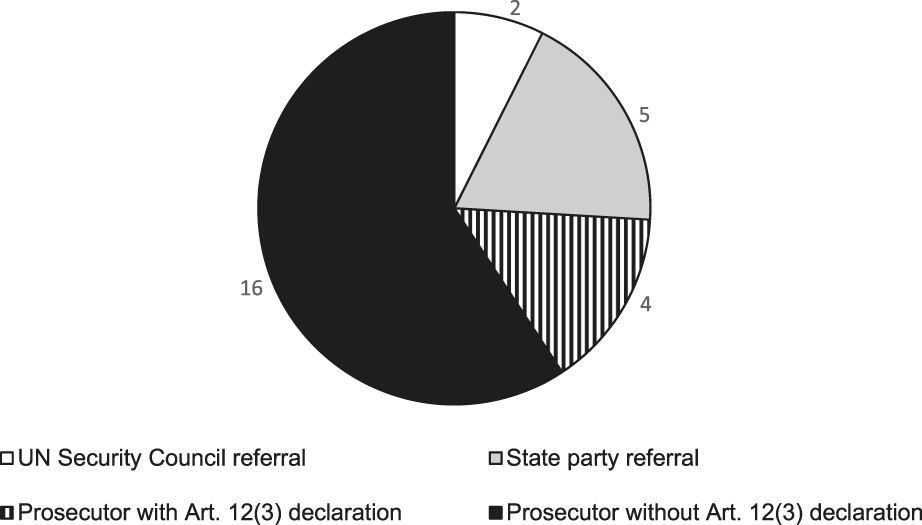
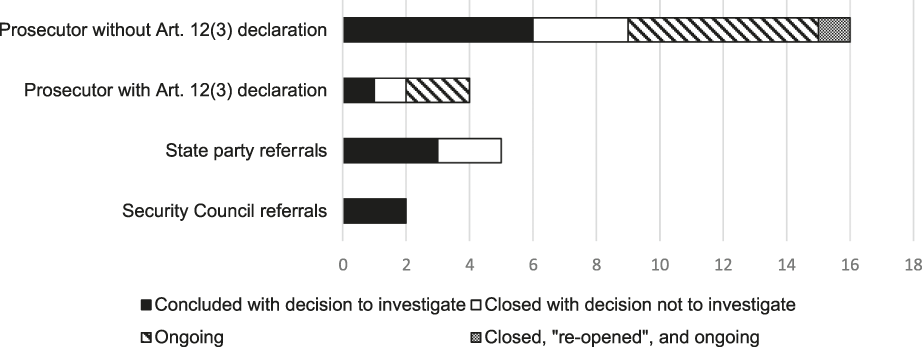
Of the twenty-seven preliminary examinations analyzed, five (19 percent) were triggered by a state party referral;Footnote 70 two (7 percent) were triggered by an UNSC referral;Footnote 71 four (15 percent) were triggered by the prosecutor proprio motu, following the receipt of an Article 12(3) declaration;Footnote 72 and sixteen (59 percent) were triggered by the prosecutor proprio motu without an Article 12(3) declaration.Footnote 73 Given that the majority of preliminary examinations were opened proprio motu without an Article 12(3) declaration (and, thus, were likely opened on the basis of Article 15 communications), this suggests that the court, to some degree, is fulfilling its goal of being an international institution that not only is controlled by states but also is one to which victims, individuals, and civil society organizations can have recourse as well (although state actors can also submit Article 15 communications and have done so) (see Figure 1).Footnote 74
Triggers for preliminary examinations (as at 30 November 2018)

INFORMATION SEEKING AT THE PRELIMINARY EXAMINATION STAGE
At the preliminary examination stage, the OTP has “limited powers at its disposal.”Footnote 75 Notwithstanding this constraint, the OTP has considerable scope to gather information at this stage of proceedings. The Rome Statute states that, in order to analyze the seriousness of the information received at this stage, the prosecutor “may seek additional information from States, organs of the United Nations, intergovernmental or non-governmental organizations, or other reliable sources that he or she deems appropriate” and may also “receive written or oral testimony at the seat of the Court.”Footnote 76
In practice, the OTP has made full use of these powers. Far from adopting a passive role at the preliminary examination stage, it undertakes numerous information-seeking activities, including conducting missions to relevant states and hosting and participating in meetings at the seat of the court and in other locations during which it engages with relevant stakeholders, such as state officials, victims and victim representative organizations, and international and local NGOs. The OTP also reviews open source information. For example, in its 2018 preliminary examination report, the OTP stated that, in the reporting year, “the Office sent preliminary examination missions to Abuja, Bogota, Conakry, and Kyiv and held numerous consultations at the seat of the Court with State authorities, representatives of international and non-governmental organisations, Article 15 communication senders and other interested parties.”Footnote 77
When possible, the OTP conducts missions to the relevant states in the conduct of its preliminary examinations in order to verify information received about alleged crimes and to engage with local stakeholders and judicial actors. For example, since opening the Guinea preliminary examination in September 2009, the OTP has conducted sixteen missions to that country.Footnote 78 Since announcing the Georgia preliminary examination in August 2008, it has conducted nine missions regarding that situation: six to Georgia and three to Russia.Footnote 79 In relation to the situation in Colombia, the OTP conducted three missions to that country in 2018 alone.Footnote 80 During these and other preliminary examination missions, the OTP met with political and judicial authorities, as well as representatives of intergovernmental organizations, NGOs, and victims.Footnote 81 The prosecutor has also met with numerous heads of state, including the presidents of Palestine, Colombia, Guinea, and Nigeria, to discuss relevant preliminary examinations.Footnote 82 However, the OTP has struggled to conduct missions to the relevant states on some occasions. It was not able to conduct its first mission to Afghanistan until 2013, even though it had been conducting a preliminary examination in the situation since 2006.Footnote 83 Similarly, the OTP was unsuccessful for years in its attempts to conduct a mission to Côte d’Ivoire.Footnote 84
The OTP has also used the preliminary examination process to promote “positive complementarity,” meaning that it seeks to encourage and support genuine domestic proceedings.Footnote 85 For example, the OTP met with the president of the Criminal Appellate Division of the Colombian Supreme Court, participated in a conference on strengthening the Attorney General’s office on transitional justice, and met with the president of the Constitutional Court of Colombia, amongst other liaison activities to support such positive complementarity efforts.Footnote 86 The prosecutor even submitted an amicus curiae brief to the Constitutional Court of Colombia with respect to certain Colombian transitional justice legislation.Footnote 87
In accordance with the Rome Statute, the OTP also requests relevant information at the preliminary examination stage. For example, in the context of its preliminary examination in Georgia, the OTP has made a total of fourteen formal requests for information, “six to the Government of Georgia, four to the Government of the Russian Federation, three to the Organization for Security and Cooperation in Europe (OSCE) and one to the European Court of Human Rights.”Footnote 88 The OTP meets with varying success with respect to these formal requests. In the context of its Afghanistan preliminary examination, the OTP submitted twenty-nine formal requests but only received fifteen responses.Footnote 89 In its preliminary examination in the situation in South Korea, the OTP sought and received information from the government of South Korea but received no response to its request to the government of North Korea.Footnote 90 In addition to formal requests for information, the OTP has solicited and received legal submissions to assist in its analysis of challenging legal questions that arise. For example, in its Palestine I preliminary examination, the OTP reported having considered “15 legal submissions from experts, academics and NGOs on the issue of jurisdiction.”Footnote 91
Finally, if the OTP concludes that there is a reasonable basis to open an investigation and there is no state or UNSC referral, its work at the preliminary examination stage includes the preparation of a detailed request to the Pre-Trial Chamber for authorization to commence an investigation. The OTP’s most recent request, submitted upon completion of its preliminary examination in Afghanistan, totalled 181 pages of written submissions (plus numerous annexes).Footnote 92 As shown in this brief outline, preliminary examinations constitute a significant part of the OTP’s work. Far from waiting for information to arrive at its doors, the OTP proactively seeks information from a wide range of sources, engages extensively with external actors, and expends considerable energy promoting “positive complementarity” as well.
LEGAL FINDINGS ON ARTICLE 53(1) CRITERIA
In terms of internal activities, the OTP’s main task during a preliminary examination is for the prosecutor to determine whether or not the statutory criteria for opening a preliminary examination are made out. As stated above, these criteria are found in Article 53(1) of the Rome Statute and relate to “jurisdiction,” “admissibility,” and the “interest of justice.”
Jurisdiction
In determining whether or not there is a reasonable basis to believe that crimes within the ICC’s jurisdiction have been committed, the OTP must first consider whether certain preconditions to jurisdiction are satisfied. Specifically, with the exception of UNSC referrals, the alleged crimes must have been committed on the territory of a state that has accepted the ICC’s jurisdiction (either by ratifying the Rome Statute or by making a declaration under Article 12(3)) or by a national of such a state.
This issue proved contentious in the Palestine I preliminary examination, which was triggered in 2009 when the Palestinian National Authority (PNA) attempted to submit an Article 12(3) declaration accepting the jurisdiction of the ICC.Footnote 93 The OTP also received 400 Article 15 communications relating to Palestine.Footnote 94 However, without the consent of a relevant state or a UNSC referral, the prosecutor had no legal basis to proceed on these communications. Thus, the ability of the prosecutor to act in this situation depended on the validity of the Article 12(3) declaration. Ultimately, the prosecutor closed this preliminary examination on 3 April 2012 based on its conclusion that the court lacked jurisdiction because the statehood of Palestine was not at that time confirmed by the UNGA and, thus, the PNA did not have the capacity to lodge an Article 12(3) declaration.Footnote 95 This situation is noteworthy because on other occasions, including an attempted Article 12(3) declaration by the Freedom and Justice Party in Egypt and proceedings relating to Myanmar and Bangladesh, the OTP has made its conclusion on whether the preconditions to jurisdiction are satisfied before a preliminary examination has formally begun.Footnote 96
If satisfied that the preconditions to jurisdiction are fulfilled, the OTP must next consider whether the alleged crimes fall within its temporal and subject-matter jurisdiction. The prosecutor has closed four preliminary examinations on this basis. The first occasion was in 2006 when the (then) prosecutor closed the Venezuela I preliminary examination. The OTP stated that it had received twelve communications relating to this situation but that some communications were related to crimes committed in the context of a failed coup in April 2002 and, thus, predated the temporal jurisdiction of the court.Footnote 97 The other communications related to allegations of crimes committed by the government of Venezuela against its political opponents but were criticized as being “very generalized,” “not … substantiated by analysis of open source information,” and rife with inconsistencies.Footnote 98 Thus, the prosecutor concluded that there was no reasonable basis to believe that crimes against humanity were committed.Footnote 99
The next occasion was in June 2014 when Prosecutor Fatou Bensouda closed the South Korea preliminary examination that began in 2010, which concerned war crimes allegedly committed during the sinking of the South Korean warship Cheonan in the Yellow Sea and the shelling of South Korea’s Yeongpyeong Island by North Korea.Footnote 100 While the OTP concluded that the chapeau requirement of an international armed conflict was established and that the court could exercise jurisdiction on the basis of objective territoriality, it concluded that the specific elements of relevant war crimes were not made out.Footnote 101
The third example was in 2015 when the OTP closed the preliminary examination that it had been conducting in the situation in Honduras.Footnote 102 This preliminary examination initially focused on alleged crimes against humanity in the aftermath of the June 2009 coup d’état. In November 2013, the prosecutor reached an initial conclusion that there was no reasonable basis to believe that there was a widespread or systematic attack in the aftermath of the coup, and, thus, the acts in question did not amount to crimes against humanity.Footnote 103 Despite this, the OTP continued its preliminary examination in light of further allegations of crimes committed in the Bajo Aguán region of the country. Ultimately, in 2015, the OTP concluded that these alleged crimes may have been linked to the rise of drug trafficking in the country but, again, did not amount to crimes against humanity.Footnote 104
Most recently, the OTP closed its preliminary examination into the situation in Gabon on 21 September 2018.Footnote 105 Following the submission of a state referral by the government of Gabon on 21 September 2016, the OTP opened a preliminary examination in relation to post-election violence in the country eight days later (the OTP also reported having received eighteen Article 15 communications in relation to this situation).Footnote 106 However, the prosecutor ultimately concluded that the available information did not provide a reasonable basis to believe that allegations against both state security forces and opposition forces amounted to crimes against humanity nor did allegations against the opposition leader amount to incitement to commit genocide.Footnote 107 Accordingly, the prosecutor closed the preliminary examination on the basis of a lack of subject-matter jurisdiction.
With respect to ongoing assessments, the OTP is currently analyzing jurisdiction in the preliminary examinations in Ukraine, the Philippines, Venezuela II, and Bangladesh/Myanmar. The preliminary examination in Ukraine was opened on 25 April 2014 following the submission of an Article 12(3) declaration by the government of Ukraine.Footnote 108 That government then lodged a second Article 12(3) declaration on 8 September 2015, extending the time frame of the acceptance of jurisdiction.Footnote 109 In addition, the OTP has received eighty-six Article 15 communications in relation to this situation.Footnote 110 This preliminary examination focuses on allegations in three related contexts: the protests that erupted in Kiev’s Maidan square in 2013; in Crimea; and in Eastern Ukraine.Footnote 111 In 2015, the OTP concluded that there was a reasonable basis to believe that the suppression of the “Maidan protests” was an attack against a civilian population pursuant to a state policy but that the attack was neither widespread nor systematic, and, thus, no crimes against humanity were committed.Footnote 112 The OTP has continued its assessment of subject-matter jurisdiction in the other contexts, including the Russian seizure and annexation of Crimea and in relation to fighting between the Ukrainian government and anti-government forces in the Donbas region of Eastern Ukraine, including the shooting down of Malaysian Airlines Flight MH17.Footnote 113
On 8 February 2018, Prosecutor Bensouda opened two new preliminary examinations proprio motu in the situations in the Philippines and Venezuela II.Footnote 114 The Philippines preliminary examination focuses on alleged crimes perpetrated in the context of “the so-called ‘war on drugs’,” including those “promoted and encouraged” by Philippine President Rodrigo Duterte and other senior government officials.Footnote 115 The Venezuela II preliminary examination relates to allegations of crimes against humanity perpetrated “in the context of demonstrations and related political unrest” in the country since early 2017.Footnote 116 Interestingly, the Venezuela II situation is the first for which a state referral has been made (post hoc)Footnote 117 from states other than the territorial state (that is, the first non-self-referral). This referral was made jointly by six states from the Americas — namely, Argentina, Canada, Colombia, Chile, Paraguay, and Peru — on 26 September 2018.Footnote 118
Finally, on 18 September 2018, Prosecutor Bensouda announced that she was opening a preliminary examination proprio motu in relation to the alleged deportation of the Rohingya people from Myanmar to Bangladesh, and possible other crimes, after receiving thirty-four Article 15 communications relating to this situation.Footnote 119 This announcement followed a decision issued by Pre-Trial Chamber I, upon application from the OTP, which concluded that the court could exercise jurisdiction over the alleged deportation of the Rohingya people from Myanmar into Bangladesh and possibly other crimes against humanity as well.Footnote 120 The Pre-Trial Chamber reasoned that, although Myanmar is not a state party to the Rome Statute, the court had jurisdiction because the alleged deportation occurred in part in Bangladesh, which is a state party.Footnote 121
Admissibility
After considering jurisdiction, the OTP must determine whether or not potential future cases would be admissible to the ICC in accordance with Article 17 of the Rome Statute. The first consideration here is the principle of “complementarity,” which limits admissible cases to those not investigated or prosecuted genuinely by the relevant domestic courts.Footnote 122 While there are no actual “cases” at the preliminary examination phase, the prosecutor must assess whether any potential cases would be admissible. To date, no preliminary examinations have been closed on the basis of inadmissibility due to complementarity. This is likely, at least in part, to be a result of the OTP’s commitment to “positive complementarity” — that is, its commitment to encouraging genuine national prosecutions of the alleged crimes.
Additionally, a case is inadmissible before the ICC if it “is not of sufficient gravity to justify further action by the Court.”Footnote 123 On 9 February 2006, the OTP announced that it was closing a preliminary examination into the Iraq/UK situation on this basis.Footnote 124 While Iraq is not a state party to the Rome Statute, the allegations relate to crimes allegedly committed by nationals of the UK, which is a state party, giving the ICC jurisdiction under Article 12(2)(b). The preliminary examination was opened on the basis of “over 240” Article 15 communications.Footnote 125 The OTP concluded that, within its limited jurisdiction over what allegedly happened in Iraq, there was a reasonable basis to believe that the war crimes of wilful killing of approximately four-to-twelve victims and inhumane treatment of less than twenty victims had been perpetrated.Footnote 126 Nonetheless, it ultimately concluded that this did not meet the required gravity threshold and, thus, was not admissible.Footnote 127 Accordingly, the OTP closed the preliminary examination with a decision not to proceed to an investigation. However, on 13 May 2014, Prosecutor Bensouda “reopened” this preliminary examination on the basis of new information relating to the allegations.Footnote 128
The Comoros preliminary examination was the second to be closed due to a conclusion of insufficient gravity, and the only preliminary examination to remain closed on that basis. The preliminary examination was initiated as a result of a state party referral by Comoros concerning the 2010 interception by the Israeli Defence Forces of a humanitarian aid flotilla destined for Gaza of ships registered to Comoros, Greece, and Cambodia, which resulted in the death of ten people on the vessel registered to Comoros (the Mavi Marmara) and the mistreatment of other passengers.Footnote 129 The OTP concluded that there was a reasonable basis to believe that war crimes were committed on the Mavi Marmara; however, “the total number of victims of the flotilla incident reached relatively limited proportions as compared, generally, to other cases involved by the Office.”Footnote 130 Accordingly, the preliminary examination was closed due to insufficient gravity. Comoros asked the Pre-Trial Chamber to review the prosecutor’s decision and to request that she reconsider.Footnote 131 The Pre-Trial Chamber granted that request.Footnote 132 This was the first and, thus far, the only time that such a request to the prosecutor has been made. On 29 November 2017, the prosecutor released a “final decision” affirming her prior conclusion on the gravity threshold.Footnote 133 A year later, a differently constituted Pre-Trial Chamber released yet another decision reiterating the request to the prosecutor to reconsider her decision (the majority concluding that the prosecutor did not adequately comply with the earlier pre-trial decision in her purported “final decision”).Footnote 134 The prosecutor has sought leave to appeal that decision.Footnote 135 Thus, proceedings in relation to the Comoros situation linger on, more than four years after the prosecutor’s initial decision to close the preliminary examination.
With respect to other ongoing preliminary examinations, the OTP is still assessing admissibility in five situations: Colombia, Guinea, Nigeria, the reopened Iraq/UK preliminary examination, and Palestine II. The preliminary examination in Colombia was opened in June 2004 (although it was not made public until later).Footnote 136 It focuses on crimes against humanity and war crimes allegedly committed by government forces as well as members of non-state armed groups including the Fuerzas Armadas Revolucionarias de Colombia — Ejército del Pueblo, the Ejército de Liberación Nacional, and other paramilitaries.Footnote 137 While the OTP has not clarified precisely when it concluded that there was a reasonable basis to believe that crimes within the jurisdiction of the court had been committed in this situation, its reports show that this decision was made no later than 2010, at which point the OTP was already focused on admissibility.Footnote 138 Over the past few years, Colombia has sent the OTP hundreds of judgments that may relate to crimes within the court’s jurisdiction.Footnote 139 Nonetheless, the OTP has kept open the preliminary examination, with no final decision on whether the potential ICC cases are already the subject of genuine national proceedings.Footnote 140
On 14 October 2009, the OTP opened a preliminary examination in the situation in Guinea, focusing on the violent suppression of pro-democracy/anti-government protests by security forces in Conakry stadium on 28 September 2009.Footnote 141 By 13 December 2011, the OTP had concluded that there was a reasonable basis to conclude that crimes against humanity had been committed in this situation.Footnote 142 Since then, the OTP has been focused on its admissibility assessment. Despite the fact that Guinean authorities have expressed a commitment to investigating and prosecuting these crimes for years and have taken significant investigatory steps towards such prosecutions,Footnote 143 the OTP has kept its preliminary examination ongoing, noting in its 2018 report that the national investigation in Guinea has been completed and that proceedings into the relevant case are underway. Therefore, the OTP’s admissibility assessment has focused on whether the national authorities are willing and able to conduct those proceedings genuinely, “in particular whether proceedings are conducted with the intent to bring to justice the alleged perpetrators within a reasonable time frame.”Footnote 144
The preliminary examination in Nigeria was opened proprio motu by Prosecutor Luis Moreno-Ocampo. It was made public on 18 November 2010,Footnote 145 but the OTP had been receiving Article 15 communications over the preceding five years.Footnote 146 This preliminary examination has considered numerous allegations in relation to three different regions and contexts within the country, including “inter-communal, political and sectarian violence” in the Middle Belt states; allegations of violence in the Niger Delta region; and alleged crimes committed by Boko Haram in the country’s northeast.Footnote 147 In its report of 5 August 2013, the OTP concluded that there was no reasonable basis to believe that the alleged crimes committed in the “inter-communal violence” and in the Niger Delta qualified as crimes within the jurisdiction of the ICC but that there was a reasonable basis to conclude that crimes against humanity were committed by Boko Haram.Footnote 148 While the OTP continues to look into reports of new crimes in Nigeria,Footnote 149 for the past five years it has focused primarily on the issue of admissibility, noting that although “there seems to be a tangible prospect of further proceedings against members of Boko Haram, including high-level commanders, at this stage the same cannot be said of the [National Security Forces].”Footnote 150
In relation to the Iraq/UK preliminary examination, Prosecutor Bensouda “reopened” this preliminary examination on 13 May 2014 on the basis of new Article 15 communications.Footnote 151 The OTP has since concluded that there was a reasonable basis to believe that members of the UK forces committed war crimes within the jurisdiction of the court against at least sixty-one victimsFootnote 152 and is now focusing on the issue of admissibility.Footnote 153 Subsequent to the failed attempt by Palestine to submit an Article 12(3) declaration in 2009, the UNGA granted Palestine “non-member observer state” status in late 2012.Footnote 154 This allowed Palestine to submit a valid Article 12(3) declaration on 1 January 2015, prompting the OTP to open a preliminary examination on 16 January of that year. The day after the deposit of its Article 12(3) declaration, Palestine deposited its instrument of accession to the Rome Statute, making it a state party. In addition to Palestine’s declaration, the OTP has received 125 communications in relation to alleged crimes committed in this context.Footnote 155 As part of this preliminary examination, the OTP has stated that it is looking into crimes allegedly committed in relation to settlement activities in the West Bank and East Jerusalem and by both Palestinian armed groups as well as Israeli Defence Forces (IDF) during the conflict in Gaza in July and August 2014 and more recent violence along the Israel–Gaza border.Footnote 156 The OTP has noted challenges that have arisen in the context of this preliminary examination, including certain (unspecified) “novel and/or complex legal issues” involved.Footnote 157 In May 2018, Palestine submitted a post hoc state self-referral of the situation to the ICC, thereby enabling the prosecutor to open an investigation without judicial authorization should she be satisfied that the statutory criteria are satisfied.Footnote 158 The OTP’s 2018 report on preliminary examination activities indicates that it is continuing to assess subject-matter jurisdiction in this situation and is also considering the admissibility of potential cases in line with a “holistic” (as opposed to sequenced) assessment of the Article 53(1) criteria.Footnote 159 The report states that the OTP has reached an “advanced stage” of its assessment of those criteria in relation to PalestineFootnote 160 and “intends to complete the preliminary examination as early as possible.”Footnote 161 However, it is silent as to whether the prosecutor has determined that there is, or is not, a reasonable basis to believe that any crimes were committed, which is different from the other ongoing preliminary examinations where the OTP has proceeded to consider issues of admissibility.
On the issue of complementarity, the OTP noted that there is no evidence of national investigations or prosecutions in relation to settlement activity or other crimes in the West Bank and East Jerusalem but that there have been investigative activities in relation to alleged crimes perpetrated by the IDF in relation to the 2014 Gaza conflict. By contrast, it suggests that there are no ongoing national proceedings, in either Palestine or Israel, in relation to crimes allegedly committed by Palestinian armed groups.Footnote 162
Interests of Justice
The final requirement of Article 53(1) states that the prosecutor should proceed to an investigation unless, “[t]aking into account the gravity of the crime and the interests of victims, there are nonetheless substantial reasons to believe that an investigation would not serve the interests of justice.” To date, the prosecutor has never closed a preliminary examination on the basis of this “interests-of-justice” criterion. Furthermore, the OTP’s analyses of this criterion tend to be very brief because Article 53(1)(c) is framed in the negative rather than as something that the prosecutor must establish. In September 2007, the OTP issued a Policy Paper on the Interests of Justice, which emphasizes the exceptional nature of a decision by the prosecutor not to proceed on this basis and that “there is a presumption in favour of investigation” when the criteria of jurisdiction and admissibility are satisfied.Footnote 163 While the policy paper provides little guidance on what would satisfy this test, it distinguishes between the “interests of justice” and the “interests of peace,” stating that the latter falls outside the purview of the OTP.Footnote 164 In the intervening eleven years, the OTP has not reviewed this policy.
In most situations in which the OTP has concluded a preliminary examination with a decision to proceed to an investigation, very little is said about this criterion short of a brief sentence or two stating that there are “no reasons to believe that the opening of an investigation into the situation would not be in the interests of justice.”Footnote 165 On some occasions, the OTP has pointed to support from victims and victim organizations for prosecutions to substantiate its conclusion to proceed.Footnote 166 For example, in its preliminary examination in the situation in CAR I, the OTP noted, in particular, a recent mission to Bangui “where the OTP received clear confirmation that many of the victims in the Central African Republic were awaiting the involvement of the ICC in order to see justice done and to recover their dignity.”Footnote 167 In its request for authorization of an investigation in the situation in Afghanistan, the OTP pointed to a nationwide consultation conducted by Afghanistan’s Independent Human Rights Commission that “found that the desire for criminal justice was strong” as well as to a joint letter to the prosecutor submitted by fifteen civil society organizations and an open letter published by twenty-eight Afghan NGOs, both of which called on the ICC for action.Footnote 168 Similarly, in concluding its preliminary examination in Georgia, the OTP pointed to submissions made by victims and human rights organizations indicating the victims’ desire to see justice done as well as to the calls for an ICC investigation by the Office of the Public Defender/Ombudsman of Georgia.Footnote 169 The OTP also noted that it considered “views expressed by the Parliamentary Assembly of the Council of Europe, which has recurrently called for independent investigations.”Footnote 170
OUTCOMES OF PRELIMINARY EXAMINATIONS
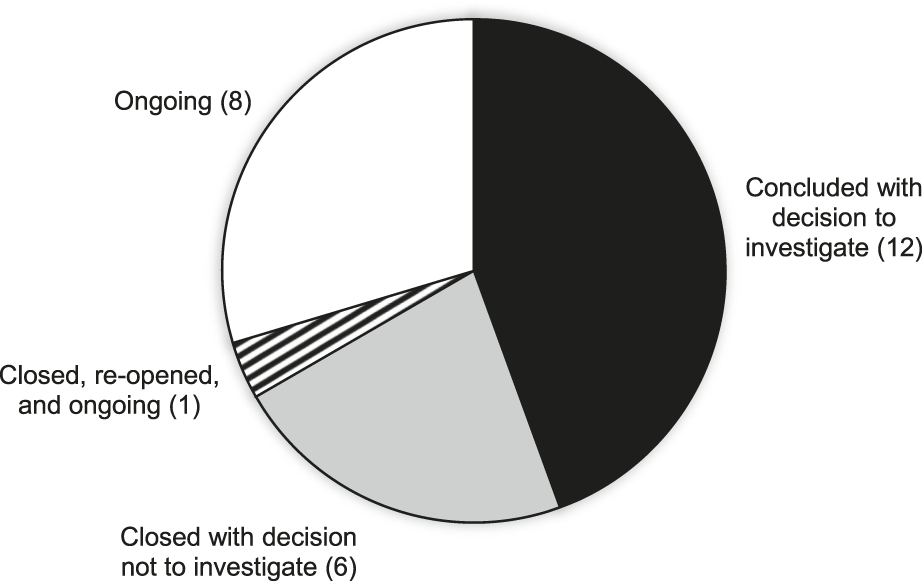
Once the OTP has concluded that all of the Article 53(1) criteria are satisfied, the Rome Statute mandates that the prosecutor shall open an investigation. If there was no referral by a state party or the UNSC, the prosecutor must first obtain authorization from a Pre-Trial Chamber before the investigation can proceed.Footnote 171 As of the 2018 report on preliminary examinations, twenty-seven preliminary examinations had been opened, twelve of which concluded with a decision to proceed to an investigation (seven under the leadership of Prosecutor Moreno-OcampoFootnote 172 and the remaining five during Prosecutor Bensouda’s term).Footnote 173 Of the remaining preliminary examinations, seven were closed with a decision not to proceed to an investigation (although the Iraq/UK preliminary examination was subsequently “reopened”),Footnote 174 and nine (including Iraq/UK) remain ongoing (see Figure 2).Footnote 175
Outcome of preliminary examinations (as at 30 November 2018)

Preliminary Examinations Leading to an Investigation
The most common outcome for preliminary examinations has been to progress to an investigation. The first example was in June 2004, when Prosecutor Moreno-Ocampo opened an investigation in the DRC after receiving a “self-referral” from that state in April 2004.Footnote 176 Interestingly, although that investigation was triggered by a referral, the preliminary examination was opened by the prosecutor on his own motion (in September 2003, the prosecutor announced that he was ready to request authorization to open an investigation in the DRC, indicating that he had already conducted a preliminary examination proprio motu and determined that there was a reasonable basis to proceed).Footnote 177 One month later, the prosecutor opened a second investigation in the situation in Uganda.Footnote 178 This development followed the decision by Ugandan president Yoweri Museveni to refer “the situation concerning the Lord’s Resistance Army” — a rebel group that had been working to overthrow his government since the 1990s — to the ICC prosecutor in December 2003.Footnote 179 Since the OTP did not announce the opening of preliminary examinations at this early stage in its practice, there is some uncertainty as to whether or not the prosecutor was already conducting a preliminary examination into the Ugandan situation prior to Museveni’s referral.Footnote 180
For both the DRC and Uganda situation, there is limited information about the steps taken by the OTP during these early preliminary examinations. However, as time went on, the OTP’s practice of opening preliminary examinations and investigations became increasingly transparent. On 22 May 2007, the OTP announced the start of a third investigation, this time into crimes allegedly committed in CAR.Footnote 181 This investigation followed a preliminary examination that began when the OTP received a self-referral from that state in December 2004Footnote 182 and that took into account several communications from NGOs and international organizations,Footnote 183 some of which were submitted before the referral was received.Footnote 184
The next major development was in March 2005 when the UNSC referred the situation in Darfur, Sudan, to the ICC.Footnote 185 Two months later,Footnote 186 Prosecutor Moreno-Ocampo announced his decision to open an investigation into that situation. The court’s second UNSC referral came on 26 February 2011, in relation to the situation in Libya. Prosecutor Moreno-Ocampo announced the opening of the OTP’s investigation into the situation a mere five days later, making this the shortest preliminary examination to date.Footnote 187 After that flurry of referrals, the prosecutor began to open investigations proprio motu. The first example concerned Kenya’s 2007–08 post-election violence. In line with the former prosecutor’s practice of seeking referrals from states, the OTP held several discussions with Kenyan authorities about a possible state referral after beginning a preliminary examination in December 2007.Footnote 188 However, no such referral eventuated, and, in November 2009, the prosecutor requested judicial authorization to open an investigation and received that authorization in March 2010.Footnote 189 In June 2011, the prosecutor requested authorization to open another investigation proprio motu, this time in relation to the 2010–11 post-election violence in Côte d’Ivoire. Côte d’Ivoire was at that time not a state party to the Rome Statute. However, it had accepted the jurisdiction of the ICC through an Article 12(3) declaration in 2003Footnote 190 and later confirmed acceptance of the court’s jurisdiction on two further occasions.Footnote 191 The pre-trial judges authorized the investigation on October 2011,Footnote 192 and, in February 2013, Côte d’Ivoire ratified the Rome Statute.
The ICC’s next investigation, and the first opened by Prosecutor Bensouda, related to crimes allegedly committed in Mali. That investigation was opened in January 2013, after Prosecutor Bensouda received Mali’s “self-referral” in July 2012, which triggered the preliminary examination.Footnote 193 By November 2012, the OTP had already determined that there was a reasonable basis to believe that crimes within the jurisdiction of the court had been committed, and the investigation was opened shortly thereafter.Footnote 194 An earlier situation in CAR had already been the subject of an investigation by the OTP when Prosecutor Bensouda opened an investigation in relation to a subsequent conflict in that state in September 2014 (CAR II).Footnote 195 While the prosecutor opened the CAR II preliminary examination proprio motu in February 2014,Footnote 196 CAR subsequently referred the situation to the court in May 2014, removing the need to seek judicial authorization before the investigation could proceed.Footnote 197
The investigation into the situation in Georgia, concerning the armed conflict in and around South Ossetia in 2008, was the next to be opened. This investigation was the first investigation opened in relation to a country outside of Africa, and the first investigation opened by Prosecutor Bensouda proprio motu. The preliminary examination was also notable because, unlike prior examples, it was initiated with the support of a major non-state party, Russia. In fact, the vast majority of Article 15 communications that triggered the preliminary examination (a total of 3,817) were sent by the prosecutor general of Moscow.Footnote 198 The OTP commenced the preliminary examination on 14 August 2008 and, by 2011, concluded that there was a reasonable basis to believe that crimes within the jurisdiction of the court were committed.Footnote 199 On 17 March 2015, the government of Georgia informed the OTP that national proceedings had been indefinitely suspended, which prompted the OTP to conclude that “the potential cases identified in the Request would be admissible, due to State inaction.”Footnote 200 The OTP requested authorization to open an investigation into the situation in Georgia on 13 October 2015, which was granted by Pre-Trial Chamber I on 27 January 2016.Footnote 201
The commencement of the next investigation, in relation to the situation in Burundi, occurred in tense circumstances. On 25 April 2016, Prosecutor Bensouda announced that the OTP was opening a preliminary examination into crimes that had been reportedly committed in Burundi since April 2015.Footnote 202 In response to that announcement, Burundi submitted notification of its intent to withdraw from the Rome Statute to the UN secretary-general.Footnote 203 Pursuant to Article 127 of the Rome Statute, Burundi’s withdrawal became effective one year later, making it the first state to officially withdraw from the ICC. In the context of that impending deadline, the preliminary examination proceeded more quickly than most. Despite not having reached a conclusion with respect to either questions of jurisdiction or admissibility as of its 2016 preliminary examination report,Footnote 204 the Prosecutor had concluded her preliminary examination by 17 August 2017 and notified the ICC president of her intent to submit a request for authorization, which was submitted on 6 September 2017.Footnote 205 The Pre-Trial Chamber also moved quickly, granting authorization to open an investigation on 25 October 2017.Footnote 206 The prosecutor opened her investigation that same day, a mere two days before Burundi’s withdrawal came into effect.
The most recent preliminary examination to conclude with a request for authorization to open an investigation is in the situation in Afghanistan. The OTP has stated that it has received Article 15 communications in relation to Afghanistan since 1 June 2006.Footnote 207 The Afghanistan preliminary examination, which relates to the conflict in, and associated with, that country following the 9/11 attacks,Footnote 208 is one of the longest known preliminary examinations to date, second only to Colombia (see Figure 5).Footnote 209 By 2013, the OTP had concluded that there was a reasonable basis to believe that crimes within the jurisdiction of the court had been committed.Footnote 210 However, it was not until 30 October 2017 that the prosecutor notified the ICC president of her intent to submit a request for authorization of an investigation, which was submitted on 20 November 2017.Footnote 211 In addition to numerous allegations against Taliban forces and “affiliated armed groups,” as well as against Afghan National Security Forces, the OTP concluded that there was a reasonable basis to believe that members of the US armed forces and the Central Intelligence Agency (CIA) had perpetrated crimes,Footnote 212 making the situation in Afghanistan politically challenging given the United States’s current posture towards the ICC.
Preliminary Examinations Closed without an Investigation
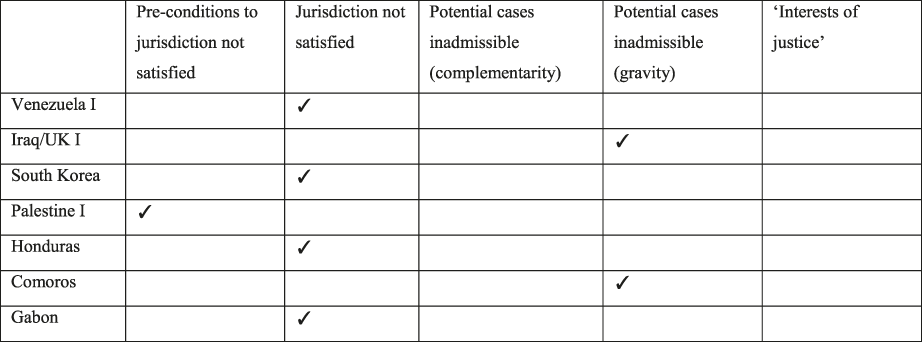
As of 30 November 2018, seven preliminary examinations were closed with a decision not to proceed to an investigation. The reasons for this outcome vary. As detailed above, one was closed because the OTP concluded that the preconditions to jurisdiction were not satisfied (Palestine I); four were closed because the OTP concluded that there were not reasonable grounds to believe that crimes within the ICC’s jurisdiction had been committed (Venezuela I, South Korea, Honduras, and Gabon); and two were closed because the OTP concluded that the potential cases would be inadmissible due to insufficient gravity (Iraq/UK and Comoros).
In 2014, Prosecutor Bensouda “reopened” the Iraq/UK preliminary examination, which the previous prosecutor had closed for lack of gravity, on the basis of new information.Footnote 213 Additionally, in relation to Comoros, Pre-Trial Chamber I requested the prosecutor for the first time ever to “reconsider” her conclusion that the alleged crimes did not meet the gravity threshold for the ICC.Footnote 214 While the prosecutor affirmed her initial conclusion, judicial proceedings in relation to this situation remain ongoing.Footnote 215 These two events suggest that conclusions based on gravity may be more susceptible to challenge, critique, or reconsideration given that the gravity threshold is highly discretionary and that there is still a fair amount of debate about how it should be applied.
To date, no preliminary examinations have been closed due to the existence of genuine national proceedings (complementarity). However, when the OTP initially closed the Iraq/UK preliminary examination in 2006 on the basis of insufficient gravity, it also stated that “the Office also collected information on national proceedings … and … national proceedings have been initiated with respect to each of the relevant incidents.”Footnote 216 Recently, the OTP has reiterated that “the UK has initiated a number of criminal proceedings in relation to the conduct of UK troops in Iraq.”Footnote 217 Additionally, the OTP has been conducting some lengthy complementarity assessments, most notably in the situation in Colombia, as well as the Guinea and Nigeria preliminary examinations. Thus, one of these situations may become the first preliminary examination closed by reason of inadmissibility based on complementarity. Finally, the OTP has never concluded that it is not in the interests of justice to proceed to an investigation (see Figure 3).
Reasons not to proceed past a preliminary examination (as at 30 November 2018)

FREQUENCY AND DURATION
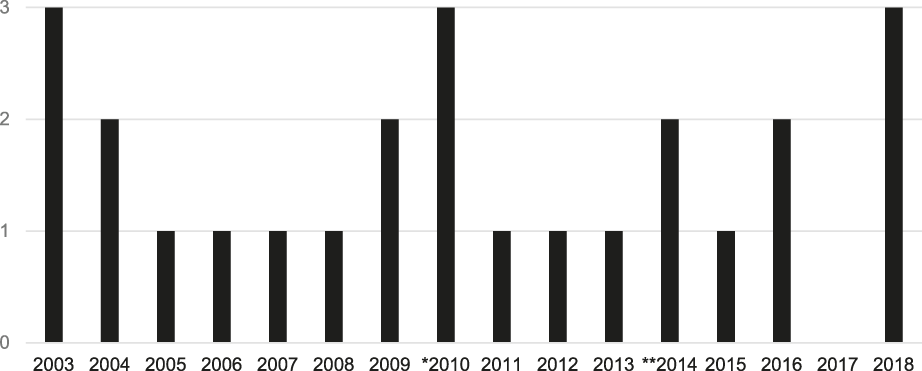
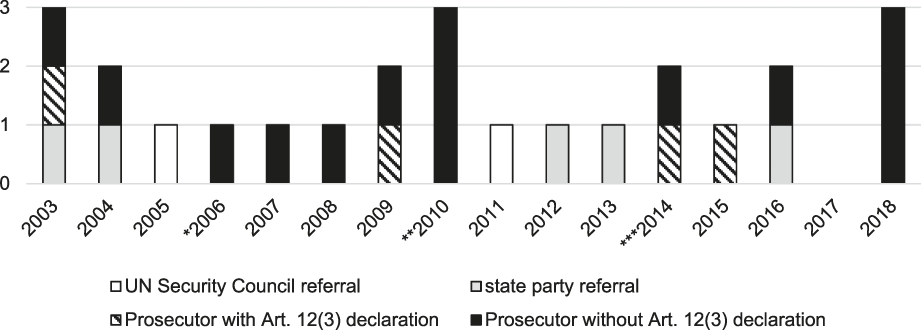
The frequency with which preliminary examinations are opened has been fairly consistent, with one to three preliminary examinations opened or announced almost every year since the appointment of the ICC’s first prosecutor in June 2003 (see Figure 4).
Number of preliminary examinations opened per year
Notes: Iraq/UK and Venezuela I not shown (preliminary examinations closed in February 2006, but starting year unknown).
* Nigeria and Honduras preliminary examinations made public in 2010, but actual starting year unknown.
** Excludes Iraq/UK, which was “reopened” in May 2014.

While there was a slight surge in the opening of preliminary examinations in the ICC’s early years, the frequency of new preliminary examinations has remained relatively consistent since then. It is noteworthy that there has been at least one new preliminary examination opened every year since the first prosecutor took office until 2017. However, 2017 was still a busy year for the OTP in relation to its preliminary examination activities, with the speedy conclusion of the Burundi preliminary examination, the request to open an investigation into Afghanistan being submitted, and the OTP’s “final decision” on the Comoros preliminary examination being rendered. Furthermore, the fact that three new preliminary examinations have already been opened in 2018 demonstrates the continuing regularity of new preliminary examinations for the OTP. This consistency is interesting because it suggests that both state and non-state actors continue to turn to the ICC to seek justice for atrocities despite the criticisms that the court has faced.
With respect to the duration of preliminary examinations, the OTP has stated that there are no “rigid timetables” for its work during the preliminary examination phase and that to impose such timetables “would not be workable.”Footnote 218 As multiple commentators have observed, the fact that the prosecutor is under no time limitations to conduct preliminary examinations is legally correct.Footnote 219 Reasons given by the prosecutor for the absence of time limits include the need to monitor certain situations over time as they continue to develop, the potentially lengthy period of time needed to monitor national proceedings before making a decision on admissibility, and the prioritization necessarily resulting from the limited resources of the OTP.Footnote 220
Despite the prosecutor’s stated objective “to complete all analyses as expeditiously as possible in order to reach timely decisions whether to investigate,”Footnote 221 the OTP has been criticized for the relatively slow pace of some preliminary examinations.Footnote 222 The sheer length of certain preliminary examinations has been criticized for keeping the potential accused, victims, and affected communities in “potential purgatory.”Footnote 223 Affected parties have raised similar concerns. For example, the legal team that submitted the referral on behalf of the state of Comoros sent multiple letters to the prosecutor expressing concern about the length of time it was taking to make a decision about whether or not to proceed to an investigation.Footnote 224 Similar concerns were expressed by the government of CAR after it submitted its first state referral to the court.Footnote 225 Chambers of the ICC have also stressed the need for timeliness in the conduct of preliminary examinations.Footnote 226 For example, in a recent decision relating to the Bangladesh/Myanmar situation, Pre-Trial Chamber I stated that “[e]xtended preliminary examinations affect the rights of victims and maintain them in a state of uncertainty which is prejudicial.”Footnote 227 The disparity in length among preliminary examinations has also been criticized for “feed[ing] into the perceptions of bias with which the Court is struggling.”Footnote 228 Finally, it has also been suggested that allowing preliminary examinations to go on for so long may work against the Court’s deterrent efforts by “desensitizing actors.”Footnote 229
In response to such criticisms, many have suggested the imposition of timelines for preliminary examinations and increased judicial review of prosecutorial activities if the office fails to proceed within such timelines.Footnote 230 While some of the strict timelines suggested by these authors may be untenable for the OTP, the unduly lengthy nature of some preliminary examinations, as well as the vastly disparate lengths amongst preliminary examinations, have justifiably raised concerns.
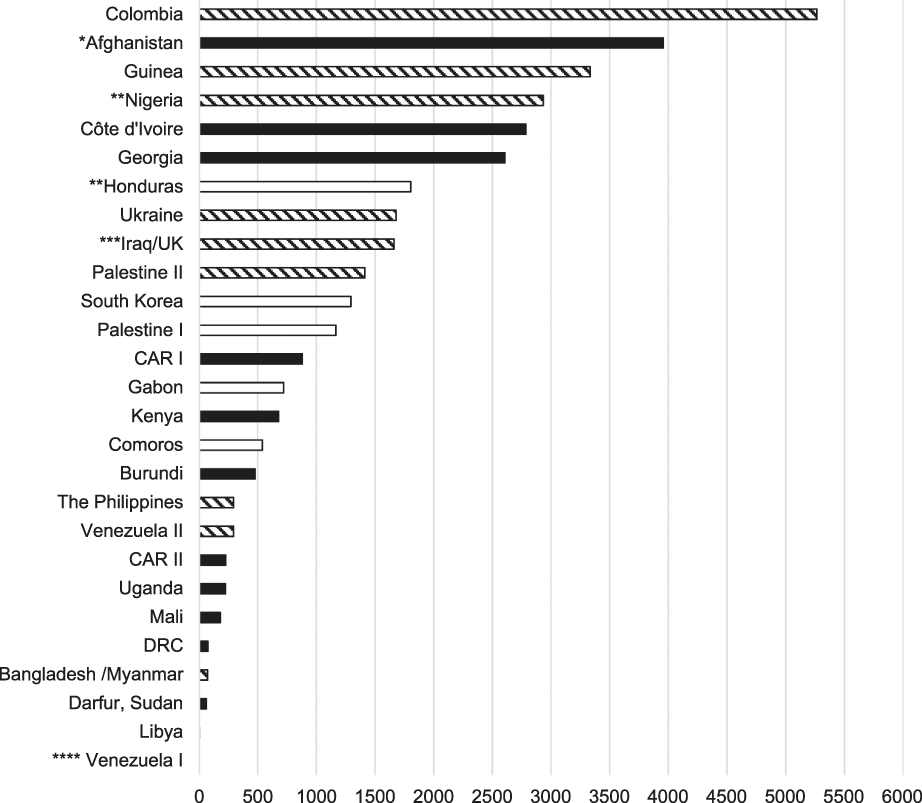
Figure 5 shows the duration of preliminary examinations based upon the best publicly available information.Footnote 231 As is immediately apparent, the length of different preliminary examinations varies drastically. The preliminary examination in Libya lasted only five days before the OTP decided to proceed to an investigation, whereas the preliminary examination in Colombia has been ongoing for more than fourteen years. The longest concluded preliminary examination involves the situation in Afghanistan, which lasted well over ten years at least. The OTP has demonstrated that preliminary examinations can be completed in a timely fashion, with half a dozen being completed in less than a year and a total of ten preliminary examinations completed in less than two years. On the other hand, another half a dozen preliminary examinations have lasted more than seven years, including the situations in Nigeria, Georgia, Côte d’Ivoire, Guinea, Afghanistan, and Colombia, with three of these still ongoing. Eighteen preliminary examinations have been completed to date with an average length of just over 1,041 days (2.85 years).Footnote 232
Duration of preliminary examination in days (as at 30 November 2018)
Notes: Black bars represent preliminary examinations that concluded with an investigation; white bars represent preliminary examinations that closed without an investigation; striped bars represent ongoing preliminary examinations.
* Afghanistan preliminary examination has been open “since 2006,” but the specific start date is unknown (thus, the last date of that year used for purposes of calculation).
** Nigeria and Honduras preliminary examinations made public on 18 November 2010 but actual start dates unknown.
*** No initial start date for Iraq/UK preliminary examination is available. Start date for calculation above is the date on which the preliminary examination was “reopened”.
**** Venezuela I preliminary examination closed in 2006, but the start date is unknown. Therefore, there is no basis to calculate duration.

It has been suggested that preliminary examinations that entail very involved complementarity assessments will be lengthier as the OTP engages with the state to evaluate the status of domestic proceedings.Footnote 233 Examples include the ongoing preliminary examinations in Nigeria, Guinea, and Colombia, which have been at the admissibility phase for approximately five years, seven years, and eight years respectively thus far. On the other hand, there have been lengthy preliminary examinations where the bulk of time was spent determining whether or not there is a reasonable basis to believe that the ICC has subject-matter jurisdiction. For example, the preliminary examination in Côte d’Ivoire was opened on 1 October 2003.Footnote 234 In his December 2010 address to the ASP, Prosecutor Moreno-Ocampo stated that “the Office is examining whether crimes under the jurisdiction of the Court exist” in the preliminary examination in Côte d’Ivoire, indicating that the OTP was still at the phase 2 assessment this late in the preliminary examination.Footnote 235 And, yet, the preliminary examination was concluded five-and-a-half months later when the prosecutor informed the president of his intention to submit a request for authorization of an investigation.Footnote 236 Thus, the bulk of the over seven-and-a-half-year-long preliminary examination was spent determining the question of jurisdiction. By contrast, the rather quick complementarity assessment was made upon receipt of a letter to the prosecutor from President Alassane Ouattara stating that “‘the Ivorian judiciary is not at this stage in the best position to address the most serious of the crimes’ committed since 28 November 2010, and ‘any attempt at trying the most responsible individuals may face multiple obstacles’.”Footnote 237
GEOGRAPHY
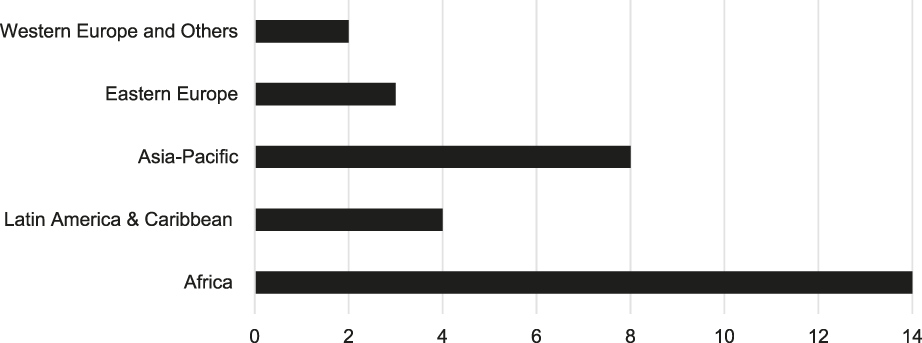
One of the strongest and most consistent points of critique of the ICC is the perceived bias of the court with respect to African states. Assessing whether such bias exists would require a comprehensive comparison against unprosecuted grave crimes within the court’s jurisdiction, which is beyond the scope of this article. However, a geographical assessment of the content of the OTP’s preliminary examinations helps to nuance this critique and is also informative because it provides a fuller picture of where the OTP has focused its efforts and where it may be operating in the future. First, it is clear that the court’s first twenty-seven preliminary examinations have primarily concerned conflict and mass violence in African states. Of the twenty-seven preliminary examinations that had been opened as of 30 November 2018, thirteen have concerned crimes allegedly committed solely in African states;Footnote 238 four have concerned crimes allegedly committed solely in Latin American and Caribbean states;Footnote 239 five have concerned crimes allegedly committed solely in Asia-Pacific states;Footnote 240 two have concerned crimes allegedly committed solely in Eastern European states;Footnote 241 one concerned crimes allegedly committed in both Asia-Pacific and Eastern European states;Footnote 242 one concerns crimes allegedly committed in both an Asia-Pacific state and a state from the “Western European and Others Group” (WEOG);Footnote 243 and one involves an African state, an Asia-Pacific state, and a WEOG state.Footnote 244 Based on the location of the alleged crimes, this brings the total number of preliminary examinations for each geographic region to: Africa (14), Asia-Pacific (8), Latin America and Caribbean (4), Eastern Europe (3), and WEOG (2) (see Figure 6).
Number of preliminary examination by region, organized by state with territorial jurisdiction (as at 30 November 2018)

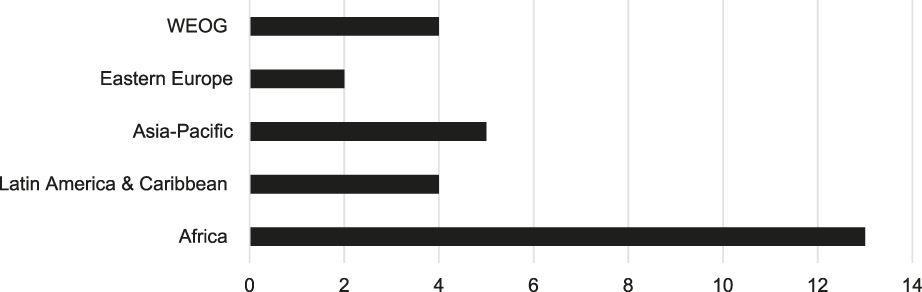
To better understand the geographic spread of preliminary examinations, it is also relevant to consider the states of nationality of the alleged perpetrators (see Figure 7).Footnote 245 Thirteen preliminary examinations concern crimes allegedly committed by African nationals, once again making Africa the most represented region by a significant margin. Furthermore, the same four preliminary examinations that concern crimes allegedly committed in Latin America and Caribbean states also involve potential allegations against nationals from those same states. From there, the picture begins to change, and the role of non-states parties becomes more visible. The number of preliminary examinations concerning WEOG states climbs from two to four (because the Palestine II and Comoros preliminary examinations both involve allegations against Israeli nationals, the Afghanistan preliminary examination involves allegations against nationals from the United States, and the Iraq/UK preliminary examination involves allegations against UK nationals). The number of preliminary examinations concerning Asia-Pacific states drops from eight to five (the preliminary examination in South Korea involves allegations against North Koreans, the Philippines preliminary examination involves allegations against nationals of that state, the Bangladesh/Myanmar preliminary examination involves allegations against nationals of Myanmar, and both the Palestine II and Afghanistan preliminary examinations involve allegations against nationals of those two states).Footnote 246 And the number of preliminary examinations concerning Eastern Europe drops from three to two — namely, the Georgia preliminary examination (which included allegations against Georgian nationals and members of the Russian armed forces) and the Ukraine preliminary examination (which includes allegations against Ukrainian nationals and members of the Russian armed forces).Footnote 247
Number of preliminary examination by region, organized by state with nationality jurisdiction (as at 30 November 2018)

Thus, the OTP has analyzed, or is currently analyzing, allegations against three permanent members of the UNSC (the United States, the United Kingdom, and Russia) as well as Israel, another powerful non-party state (Russia and the United States are similarly not parties to the ICC). This picture also reveals that the OTP has been more active in relation to WEOG states than much of the public commentary on the court suggests, at least at the preliminary examination stage.
Of course, the OTP’s preliminary examination work is only one piece of the ICC’s overall work, and most victims, perpetrators, and those evaluating and critiquing the court will be more concerned with the actual investigations and prosecutions and the territories in relation to which they do or do not occur. It is beyond dispute that the OTP’s early investigations and prosecutions are heavily dominated by African states, with the first nine investigations opened relating to African nations. It was not until 2016 that the first preliminary examination proceeded to the opening of an investigation in relation to a non-African state in the situation in Georgia. This was followed, again, by an African state in the situation in Burundi. Most recently, reaching out of the African continent once more, the OTP has requested authorization to open an investigation in relation to the situation in Afghanistan. Nonetheless, a deeper look at all preliminary examinations helps to give a fuller picture of how the court got to this place and also some indication of where it may be heading.
The preliminary examinations that were closed with a decision not to proceed to an investigation include two in which the alleged crimes occurred in the Latin America and Caribbean region (Venezuela I and Honduras), two in which the alleged crimes occurred in the Asia-Pacific region (South Korea and Palestine I), one in which the alleged crimes occurred in Africa (Gabon), and one in relation to crimes allegedly perpetrated on vessels from Africa, Asia, and WEOG and by WEOG (Israeli) nationals in the situation in Comoros. Finally, the preliminary examination involving allegations against WEOG nationals (United Kingdom) on the territory of an Asia-Pacific state (Iraq) was initially closed but subsequently re-opened.
Of the current ongoing preliminary examinations, two relate to crimes allegedly committed in African states and by nationals of those states (Guinea and Nigeria); two relate to crimes allegedly committed in Latin American states and by nationals of those states (Colombia, Venezuela II); one relates to crimes allegedly committed in Eastern Europe and by nationals of Eastern European states (Ukraine); two relate to crimes allegedly committed exclusively in Asia-Pacific states and by nationals of Asia-Pacific states (the Philippines and Bangladesh/Myanmar); and one relates to nationals and the territory of both Asia-Pacific and WEOG states (Palestine II). The preliminary examination into crimes committed by WEOG nationals (United Kingdom) on Asia-Pacific (Iraq) territory has been “reopened.” Thus, there is the potential for the ICC to move in the direction of a somewhat more geographically diverse future of investigations and prosecutions with the Asia-Pacific region being the most prevalent region for ICC investigations on the horizon.
CORRELATIONS
Thus far, we have presented findings based on individual criteria. However, when one considers correlations across several criteria, a more detailed picture emerges.
Triggers and Outcomes
For example, by considering the trigger and outcomes together, we can better assess the role that states, the UNSC, and other actors play in triggering the actions of the ICC (see Figure 8).Footnote 248
Triggers and outcomes for ICC preliminary examinations (as at 30 November 2018)

Both preliminary examinations triggered by UNSC resolutions resulted in the opening of investigations and, ultimately, the issuance of arrest warrants. Three of the five preliminary examinations triggered by state referrals also resulted in investigations being opened and arrest warrants being issued, the exceptions being the situations in Comoros and Gabon. The outcomes of the preliminary examinations opened proprio motu have been far more varied. Of the four preliminary examinations initiated by the prosecutor proprio motu upon receipt of an Article 12(3) declaration, one proceeded to investigation (Côte d’Ivoire), one was closed without an investigation (Palestine I), and two are ongoing (Ukraine and Palestine II). Outcomes also vary significantly among preliminary examinations opened proprio motu without an Article 12(3) declaration. Three of these preliminary examinations were closed due to lack of subject-matter jurisdiction (Venezuela I, Honduras, and South Korea), a fourth was closed due to insufficient gravity but subsequently reopened (Iraq/United Kingdom), six remain continuously ongoing (Bangladesh/Myanmar, Colombia, Guinea, Nigeria, the Philippines, and Venezuela II), and six have led to an investigation or a request to authorize an investigation (Afghanistan, Burundi, CAR II, DRC, Georgia, and Kenya).
With respect to the preliminary examinations that concluded (whether with an investigation or with a decision not to proceed), a pattern in outcome has begun to emerge based on whether or not the trigger involved explicit consent of one or more states.Footnote 249 To explain, both preliminary examinations triggered by the UNSC resulted in the opening of an investigation. Additionally, of the eight other situations in which the state in some way invited the prosecutor to act (either by a state self-referral, an Article 12(3) declaration, or a post hoc self-referral that indicates state consent after a preliminary examination was opened, even if it was not present initially), six (75 percent) resulted in a decision to proceed to an investigation.Footnote 250 By contrast, of the concluded preliminary examinations that were triggered by the prosecutor without explicit state consent, four have concluded with a decision to proceed to an investigationFootnote 251 and three were closed due to lack of subject-matter jurisdiction.Footnote 252 Thus, of the seven concluded preliminary examinations in this category, 57 percent resulted in a decision to proceed to an investigation. This discrepancy suggests that explicit state consent tends to somewhat increase the likelihood that the prosecutor will seek authorization to proceed to an investigation.
Triggers and Frequency
As there have only been two UNSC referrals, not much can be said about their frequency. However, it is noteworthy that, despite the fact that neither referral has resulted in a case that has proceeded smoothly to trial,Footnote 253 attempts have still been made to have further UNSC referrals (for example, in relation to SyriaFootnote 254 and MyanmarFootnote 255). With respect to state referrals, there were a couple of referrals early on in the ICC’s practice, followed by a lull in the receipt of state party referrals for a number of years between 2004 and 2012. This is even more apparent if one combines both the triggering state party referrals and the four post hoc referrals that occurred in 2004 and 2014 and the two in 2018.Footnote 256 This gap may represent some hesitancy on the part of states after the initial burst of referrals to see how the court’s work progressed as it actually began its first prosecutions, although there is no way to know for sure. It may also simply reflect the fact that the prosecutor stopped being so active in seeking referrals. It is interesting, however, that the frequency of state party referrals has picked up again in recent years. This suggests that, despite the many criticisms levied at the court, states are still willing to turn to the ICC. It is particularly noteworthy that of the six referrals submitted since 2012 (including post hoc referrals), four have come from African countries,Footnote 257 despite the general African Union position of antipathy towards the court, including threats of mass withdrawals.Footnote 258 A somewhat similar pattern is apparent with Article 12(3) declarations, with somewhat of a gap appearing after the court’s initial years but with continuing use of this mechanism more recently as exhibited by the declarations submitted by Ukraine in 2014 and Palestine in 2015 (see Figure 9).
Frequency and trigger for preliminary examinations (as at 30 November 2018)
Notes: * Iraq/United Kingdom and Venezuela I preliminary examinations closed in February 2006, but the starting year is unknown.
** Nigeria and Honduras preliminary examinations made public in 2010, but the actual starting dates are unknown.
*** Excludes Iraq/United Kingdom, which was ‘reopened’ in May 2014.

With respect to preliminary examinations opened by the prosecutor without Article 12(3) declarations, the frequency pattern is different. After fairly consistent frequency of new preliminary examinations proprio motu in the ICC’s early years and a spike in 2010, the frequency of such preliminary examinations tapered off for a number of years. This is not a reflection of a change in the submission of Article 15 communications, which have remained relatively consistent and have continued to come in high volumes each year.Footnote 259 More likely, it is a question of resourcing; given that the OTP must work within a budget and cannot control when the next referral will come, there is a practical incentive for the prosecutor to take a conservative approach to opening preliminary examinations proprio motu. Having said that, the instigation of three new preliminary examinations on this basis in 2018 indicates that the OTP remains responsive to reported crimes, even in the face of resource constraints.
Triggers and Geography
Considering the trigger when compared to the geography of different preliminary examinations is revealing and helps nuance some of the critiques of the court such as the alleged African bias. It is well known that the two UNSC referrals involve African states and that such referrals have been unsuccessful in relation to non-African countries. However, it is also noteworthy that all five preliminary examinations triggered by state party self-referrals concern crimes allegedly perpetrated in African states or on an African-flagged vessel,Footnote 260 as did one of the preliminary examinations initiated in response to an Article 12(3) declaration (Côte d’Ivoire) and two preliminary examinations in which the states concerned made post hoc referrals (the DRC and CAR II). Thus, when one looks at the triggers for preliminary examinations and investigations together, it is clear that many African states have “invited in” ICC activity, so to speak (although sometimes, in the early days, at the prompting of the prosecutor).Footnote 261 This state-led activity, together with the approach of the UNSC, has contributed to the ICC’s initial focus on the African continent.
The OTP has played an important part in expanding the ICC’s reach beyond Africa. Of the preliminary examinations triggered proprio motu without an Article 12(3) declaration, six concern crimes allegedly committed in African states,Footnote 262 four concern crimes committed in Latin America,Footnote 263 two concern crimes committed in Eastern Europe,Footnote 264 and five concern crimes committed in Asia-Pacific.Footnote 265 Additionally, two of these preliminary examinations involve allegations against nationals from two WEOG states, namely the United States and the United Kingdom.Footnote 266
Geography and Duration
We also looked at the geography of preliminary examinations in relation to their duration. As noted above, the two UNSC referrals were the two shortest preliminary examinations, and both relate solely to African countries. This trend is repeated when looking at the four other preliminary examinations completed in less than a year, which, again, include only African countries (DRC, Uganda, Mali, and CAR II). The Burundi, Kenya, Gabon, and CAR I preliminary examinations were also relatively short, all concluding in less than two-and-a-half years. The only other preliminary examination completed in less than two years was the situation in Comoros, involving allegations against Israeli nationals, which lasted just under a year and a half (although proceedings in relation to this preliminary examination were subsequently prolonged due to the request for reconsideration). In fact, including the Comoros preliminary examination (in which crimes were alleged to have been perpetrated on the territory of an African-flagged vessel, although allegations were against non-African nationals), the eleven shortest concluded preliminary examinations all involved African countries. The six completed preliminary examinations that took longest to conclude are more geographically diverse, including Palestine I, South Korea, Honduras, Georgia, Côte d’Ivoire, and Afghanistan. While there are many reasons why the prosecutor may proceed quickly or slowly in any given preliminary examination, this paints an interesting picture in relation to critiques about the court’s willingness to act in Africa as well as concerns about the prolonged wait for justice by victims in other regions. Thus, the prosecutor would do well to explain why the OTP proceeded so quickly in some preliminary examinations and far more slowly in others.
Triggers and Duration
As has been observed elsewhere, the length of preliminary examinations varies with respect to the jurisdictional trigger.Footnote 267 In particular, the two preliminary examinations triggered by UNSC referral are the shortest of all preliminary examinations. State party referrals clearly represent the second shortest category. The longest preliminary examination triggered by a state party referral is the situation in CAR I, which lasted for two years and five months, and all preliminary examinations triggered by state party referrals (which are all now concluded) lasted less than the average total length of 2.85 years. Preliminary examinations triggered by Article 12(3) declarations are generally lengthier, despite the fact that they also involve states inviting ICC intervention. The Palestine I preliminary examination took over three years to conclude that the declaration was invalid, and, as mentioned above, the Côte d’Ivoire preliminary examination lasted close to eight years.
Preliminary examinations opened by the prosecutor without Article 12(3) declarations include many of the lengthiest preliminary examinations, such as those in Colombia, Afghanistan, Guinea, Georgia, Nigeria, and Honduras. Three notable exceptions to this trend include the preliminary examination in Kenya, which was concluded in less than two years, the preliminary examination in Burundi, which took just over one year and three months, and the preliminary examination in the DRC, which lasted only approximately two-and-a-half months. It is notable that all three of these involve African states. In short, the average length of preliminary examinations based on the trigger has varied greatly, with only 33.5 days for UNSC referrals, 510 days (just under a year and a half) for state party referrals, 1,762 days (almost five years) for Article 12(3) declarations, and 1,666 days (just over four-and-a-half years) for preliminary examinations opened proprio motu without an Article 12(3) declaration.Footnote 268
As Anni Pues notes, this discrepancy is probably due in part to the fact that the OTP is unlikely to require a lengthy complementarity assessment in situations involving referrals.Footnote 269 States parties will presumably only make referrals if their own judiciary is incapable of prosecuting the relevant case(s) domestically.Footnote 270 For example, in Mali’s referral to the court, “the Malian authorities informed the Office that … the Malian courts are unable to prosecute crimes.”Footnote 271 Similarly, after referring the situation on its territory to the ICC, the Democratic Republic of the Congo confirmed that there was no national case underway against Germain Katanga in relation to the Bogoro attack because “at the time of the crimes (February 2003) … the DRC was unable genuinely to investigate the crimes” and “since then the situation has shown little improvement.”Footnote 272 Additionally, if the OTP receives a referral from either the UNSC or a state party (including a post hoc referral after the preliminary examination has been commenced), it does not need to prepare a submission requesting authorization of the investigation, which will shorten the preliminary examination considerably.
Preliminary examinations will also likely proceed more quickly with state cooperation, which will often (but not always) be present where the situation was referred to the ICC by a state with jurisdiction over the alleged crimes.Footnote 273 This raises a question as to why the preliminary examinations opened by the prosecutor upon receipt of an Article 12(3) declaration, which works like a self-referral from a state that is not (yet) a party to the Rome Statute, have all been relatively lengthy (the shortest being the Palestine I preliminary examination, which took over three years). Furthermore, in some circumstances, preliminary examinations can be completed quickly even without cooperation from the relevant state. The OTP recently demonstrated this in relation to Burundi, in which a relatively swift preliminary examination resulted in a successful authorization to investigate, despite a lack of cooperation from the state and the inability of OTP staff to even enter the territory.Footnote 274
At the end of the day, prioritization is inevitable due to limited resources of the OTP. However, as commentators have rightly pointed out, the lack of transparency regarding how this prioritization is undertaken and the vastly differing time frames among the preliminary examinations inevitably creates room for critique.Footnote 275 As Human Rights Watch has suggested, “when resource constraints factor into decisions about situations under analysis, the OTP should openly acknowledge that fact, lending increased transparency and credibility to OTP decision-making.”Footnote 276
Preliminary Examinations and Prosecutors
As of 30 November 2018, Prosecutor Bensouda had only completed approximately 6.5 years (just over 72 percent) of her nine-year term. Even so, some initial comparison of the OTP’s preliminary examinations under the leadership of its two prosecutors is possible. During his nine-year term, Prosecutor Moreno-Ocampo opened seventeen preliminary examinations, ten of which (59 percent) were concluded by the end of his term. Of these ten, seven resulted in the opening of an investigation, and three were closed with a decision not to proceed to an investigation (Venezuela I, Palestine I, and Iraq/UK).
Of the seven preliminary examinations that were opened by Prosecutor Moreno-Ocampo but not concluded as of the end of his term, three still remain ongoing. These include the preliminary examinations in Colombia, Guinea, and Nigeria, which are among the longest-running preliminary examinations to date. The Iraq/UK preliminary examination, which Prosecutor Bensouda “reopened” in 2014, also remains ongoing. Two preliminary examinations opened by Moreno-Ocampo were later closed by Bensouda — namely, Honduras and South Korea. Two other preliminary examinations opened by Moreno-Ocampo concluded with a decision by Bensouda to proceed to an investigation (Georgia and Afghanistan). It is also noteworthy that all of the preliminary examinations inherited by Bensouda from Moreno-Ocampo’s tenure were opened proprio motu on the basis of Article 15 communications, whereas Moreno-Ocampo completed all preliminary examinations opened by state party referral, UNSC referral, and Article 12(3) declaration before leaving office. In total, by the end of Moreno-Ocampo’s term, seven out of seventeen preliminary examinations resulted in a decision to proceed to an investigation,Footnote 277 three were closed with a decision not to proceed to an investigation (although one of these, namely Iraq/UK, was subsequently “reopened”),Footnote 278 and another seven remained underway.Footnote 279
The ICC’s second prosecutor, Prosecutor Bensouda, took office on 15 June 2012. During her term, the OTP has opened ten new preliminary examinations,Footnote 280 “reopened” the Iraq/UK preliminary examination, and continued work on the seven preliminary examinations inherited from Prosecutor Moreno-Ocampo. This brings the number of preliminary examinations worked on during Bensouda’s term to date to eighteen, which has already surpassed the total number during her predecessor’s term. In relation to outcomes of preliminary examinations during Bensouda’s term, as of 30 November 2018, four have led to investigations,Footnote 281 a fifth (Afghanistan) will potentially proceed to investigation pending the Pre-Trial Chamber’s decision, four have been closed without an investigation,Footnote 282 and nine are ongoing.Footnote 283 That breakdown may change by the end of Bensouda’s term, which will end in June 2021.
Conclusion
This comprehensive analysis of the OTP’s preliminary examinations add a much needed “birds-eye view” to the rapidly growing scholarship on this important area of the ICC’s work. It gives a sense of the major energy expended by the OTP at this very early stage of proceedings, enables a more informed assessment of where the ICC has been most active and why, and gives an indication of where the court’s work may be heading in the future. The article has also identified a number of points on which further research is warranted that are beyond the scope of this analysis, in particular in relation to many substantive points of law. As shown above, the OTP’s analysis at the preliminary examinations stage spans a wide range of legal issues, and functions almost as a mini-jurisprudence in its own right. For example, the statute’s gravity threshold has been considered in detail by the OTP and Pre-Trial Chamber in the Comoros preliminary examination. Similarly, a look at the Honduras, Venezuela I, and Gabon preliminary examinations may shed light on the OTP’s analysis of the application of the contextual elements of crimes against humanity and the South Korea preliminary examination contains the OTP’s first interpretation of the war crime of “perfidy” (i.e. killing or wounding treacherously), which is currently also being considered in the preliminary examination in Ukraine. As well, the South Korea preliminary examination contains a critical jurisdictional determination by the OTP which it referenced in its recent application seeking a jurisdictional ruling in relation to allegations of deportation of Rohingya people from Myanmar to Bangladesh that has recently garnered significant attention.Footnote 284
Ongoing preliminary examinations also give considerable insight into the OTP’s “positive complementarity” efforts, and may shed light on the largely unexamined concept of the “interests of justice.” It is also worth keeping an eye on current preliminary examinations where the Prosecutor is examining crimes not previously given consideration before the Court such as allegations of gender-based persecution in both the Afghanistan and Nigeria preliminary examinations. The importance of these issues suggests that this largely over-looked body of analysis deserves closer attention. Finally, it is also hoped that this work will provide fruit for further reflection, debate, and comparison as the OTP’s work progresses and as new prosecutors take the helm.