Introduction
The genus Anguillonema Fuchs, 1938 was established by Fuchs (Reference Fuchs1938) with a description of five species. Later, Rühm (Reference Rühm1955) and Massey (Reference Massey1974) added four species to the genus. Siddiqi (Reference Siddiqi2000) transferred seven Anguillonema species to other genera, such that two species are now valid, namely A. poligraphi Fuchs, Reference Fuchs1938 and A. crenati Fuchs, Reference Fuchs1938 (Siddiqi, Reference Siddiqi2000). A third species, A. amolensis Mobasseri, Pedram & Pourjam, 2017, has recently been described from Iran.
Within the family Neotylenchidae Thorne, 1941, the genus is mainly characterized by the presence of basal stylet knobs, an excretory pore anterior to the nerve ring, a cylindroid and non-muscular pharynx, protuberant vulval lips, a conoid tail with dorsally bent tip, very long spicules, the presence of a gubernaculum and absence of a bursal apparatus on the male tail (Siddiqi, Reference Siddiqi2000). In the description of A. amolensis, the shape of the pharynx was clarified and the generic character of the tail, i.e. dorsally bent, was extended and amended. During the last few years, several taxonomic studies have been performed on Hexatylina Siddiqi, 1980 nematodes in Iran (a history is given in Yaghoubi et al., Reference Yaghoubi, Pourjam and Pedram2018). During an extensive study of sphaerularioids in northern Iran, we collected and identified a population of this group of nematodes. Detailed morphological studies revealed that it belongs to an undescribed species of Anguillonema. The new species is described, and molecular phylogenetic analyses based on 18S rDNA and 28S rDNA D2-D3 segments are provided herein.
Materials and methods
Sampling, extracting, mounting and drawing
Specimens of Anguillonema iranicum n. sp. were obtained from the bark of a dead angiosperm tree belonging to the family Sapindaceae, infected with larvae and adults of some unidentified beetles, in Gilan province, northern Iran, during May 2016. The nematodes were extracted by the tray method (Whitehead and Hemming, Reference Whitehead and Hemming1965) and were transferred to anhydrous glycerin according to the De Grisse (Reference De Grisse1969) method. Photographs were taken using an Olympus DP72 digital camera attached to an Olympus BX51 microscope (Olympus Corporation, Tokyo, Japan) powered with differential interference contrast (DIC). Drawings were made using a drawing tube attached to the microscope and were redrawn using the CorelDRAW® software version 12 (https://www.coreldraw.com).
DNA extraction, PCR and sequencing
A single live nematode specimen of Anguillonema iranicum n. sp. was picked and transferred to a small drop of TE buffer (10 mM Tris-Cl, 0.5 mM EDTA; pH 9.0, Qiagen, Hilden, Germany) on a clean slide and squashed using a clean slide cover. The suspension was collected by adding 15 μl TE buffer. The DNA samples were stored at −20°C. Primers for 28S rDNA D2-D3 amplification were forward primer D2A (5′-ACAAGTACCGTGAGGGAAAGT-3′) and reverse primer D3B (5′-TGCGAAGGAACCAGCTACTA-3′) (Nunn, Reference Nunn1992). Primers for amplification of 18S rDNA were forward primer 1096F (5′-GGTAATTCTGGAGCTAATAC-3′), reverse primer 1912R (5′-TTTACGGTCAGAACTAGGG-3′), forward primer 1813F (5′-CTGCGTGAGAGGTGAAAT-3′) and reverse primer 2646R (5′-GCTACCTTGTTACGACTTTT-3′) (Holterman et al., Reference Holterman2006). Primers for amplification of mitochondrial cytochrome c oxidase subunit I gene (COI) were forward primer COI-F1 (5′-CCTACTATGATTGGTGGTTTTGGTAATTG-3′) and reverse primer COI-R2 (5′-GTAGCAGCAGTAAAATAAGCACG-3′) (Kanzaki and Futai, Reference Kanzaki and Futai2002). The number of polymerase chain reaction (PCR) cycles used was according to Yaghoubi et al. (Reference Yaghoubi2014). PCR products were purified and sequenced directly for both strands using the same primers used during PCR with an ABI 3730XL sequencer (Bioneer, South Korea). Sequences were deposited into the GenBank database (accession numbers: MG857083 for partial 18S rDNA, MG857082 for partial 28S rDNA D2-D3 and MH069656 for COI).
Phylogenetic analyses
The molecular sequences of Anguillonema iranicum n. sp. were compared with those of other nematode species available in GenBank using the BLAST homology search program. Our newly obtained DNA sequences, together with the GenBank sequences used for phylogenetic analyses, were aligned using MUSCLE (Edgar, Reference Edgar2004) as implemented in MEGA6 (Tamura et al., Reference Tamura2013). Poorly aligned positions and divergent regions were eliminated using the online version of Gblocks 0.91b (Castresana, Reference Castresana2000) with all three less stringent options. The model of base substitution was selected using MrModeltest 2 (Nylander, Reference Nylander2004). The Akaike information criterion (AIC) supported model, a general time-reversible model including among-site rate heterogeneity and estimate of invariant sites (GTR + G + I), and a general time-reversible model including among-site rate heterogeneity (GTR + G) were selected for phylogenetic analyses of the 18S rDNA and 28S rDNA D2-D3 datasets. Bayesian analysis was performed using MrBayes 3.1.2 (Ronquist and Huelsenbeck, Reference Ronquist and Huelsenbeck2003), running the chains for 107 generations. Burn-in was arbitrarily chosen to be 25% of the results. The Markov chain Monte Carlo (MCMC) method within a Bayesian framework was used to determine equilibrium distribution and help estimate the posterior probabilities of the phylogenetic trees (Larget and Simon, Reference Larget and Simon1999) using the 50% majority rule. Tracer v1.5 software (Rambaut and Drummond, Reference Rambaut and Drummond2009) was used to visualize the results of each run in order to check the effective sample size for each parameter. A maximum likelihood (ML) tree was reconstructed using RaxmlGUI 1.1 software (Silvestro and Michalak, Reference Silvestro and Michalak2011) under the same evolutionary model as in Bayesian analysis, in 1000 bootstrap (BS) replicates. For both the Bayesian inference (BI) and ML analyses, Aphelenchus avenae Bastian, 1865 and Paraphelenchus acontioides Taylor & Pillai, 1967 were used as outgroup taxa (accession numbers EU306347 and HQ218323, respectively, for the 18S rDNA, and accession numbers JQ348400 and HQ218322, respectively, for the 28S rDNA D2-D3 tree). Due to poor sequences of COI for this group of nematodes in the database, the phylogenetic analyses were not performed using this fragment.
Results
Anguillonema iranicum n. sp.
Order: Tylenchida; Suborder: Hexatylina, sensu Siddiqi (Reference Siddiqi2000)
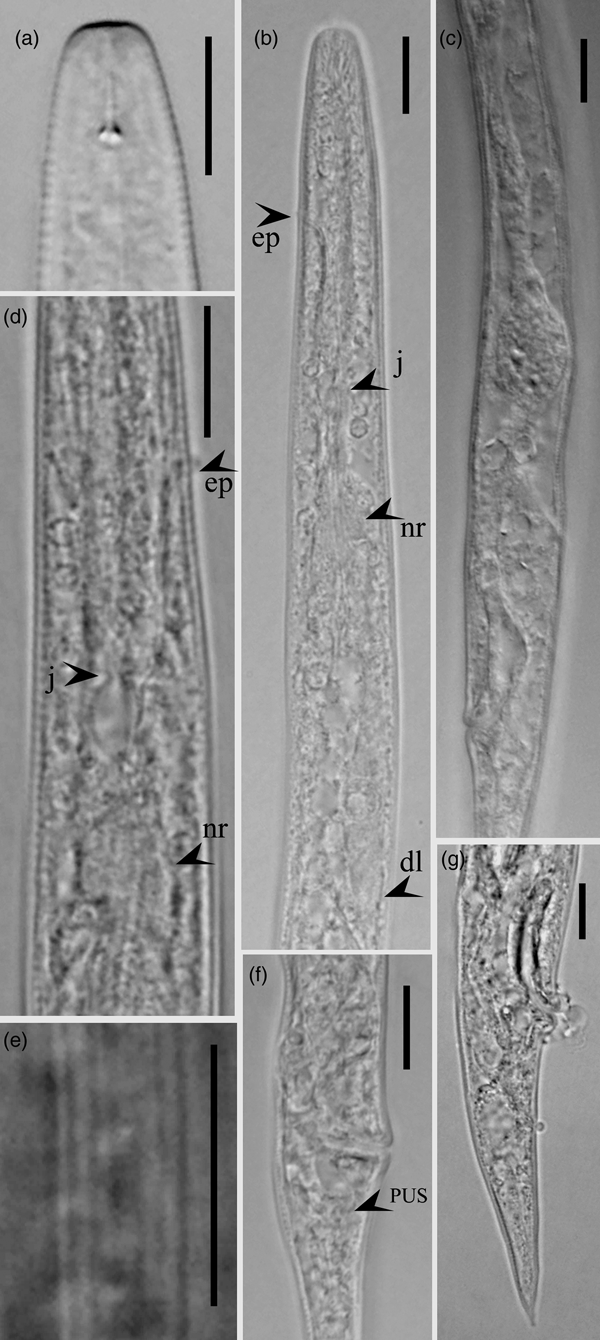
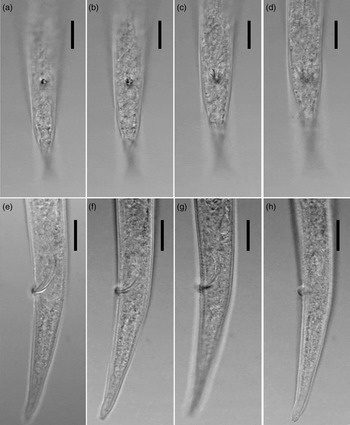
Figures 1–3 show diagrams and micrographs of A. iranicum n. sp.
Line drawings of Anguillonema iranicum n. sp. (a) Male, entire body. (b) Female, entire body. (c) Details of pharynx. (d) Anterior body region. (e) Female reproductive system. (f) Cephalic region. (g) Lateral field. (h) Male cloacal region, showing absence of bursa. (i, j) Female tail.

Photomicrographs of female of Anguillonema iranicum n. sp. (a, b) Details of anterior end. (c) Part of female reproductive system. (d) Details of pharyngo-intestinal junction. (e) Lateral field. (f) Vulval region. (g) Details of posterior body end. Scale bars = 10 μm. ep = excretory pore, j = pharyngo-intestinal junction, nr = nerve ring, dl = dorsal lobe of pharyngeal glands, PUS = post-vulval uterine sac.

Photomicrographs of male cloacal region of Anguillonema iranicum n. sp. (a–d) Ventral view. (e–h) Lateral view. Scale bars = 10 μm.

Measurements
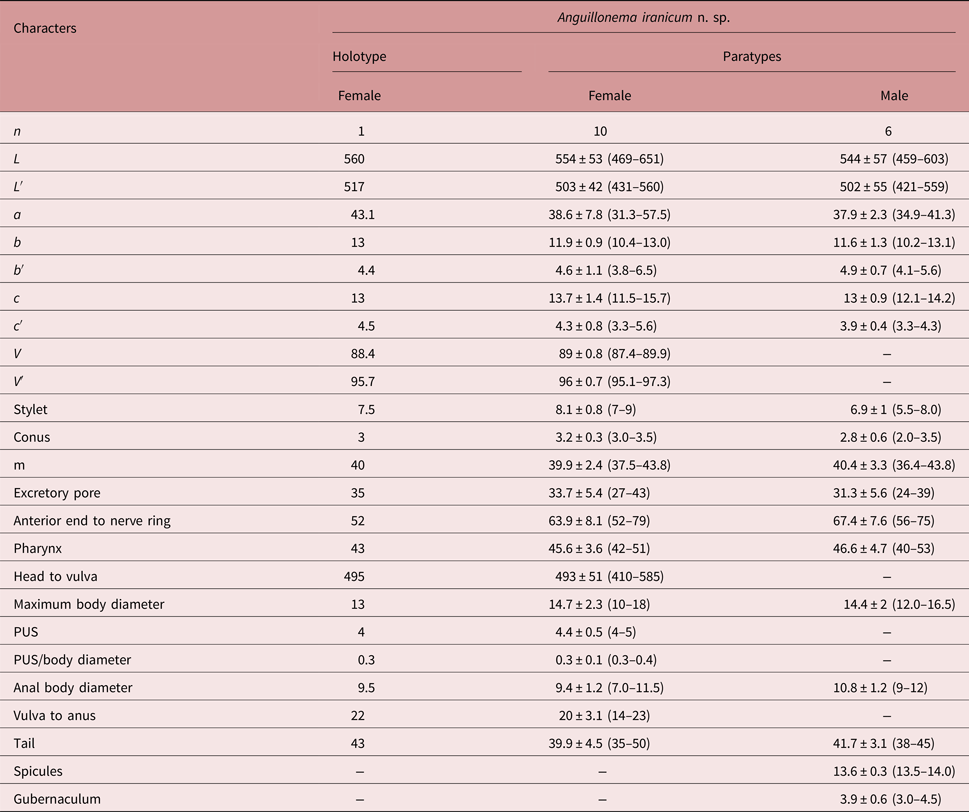
The morphometrics of A. iranicum n. sp. are presented in table 1.
Morphometrics of Anguillonema iranicum n. sp. All measurements are in μm and in the form Mean ± SD (range).

Description
Female. Body slightly ventrally arcuate after fixation. Cuticle finely annulated, c. 1 μm at mid-body. Lateral field with six incisures. Lip region low, rounded and slightly flattened, continuous with body contour. Stylet thin, short, conus c. 37.5–43.8% of the stylet length, with minute rounded basal knobs. Orifice of dorsal gland 1–2 μm behind stylet base. Procorpus wide, muscular. Metacorpus not well developed, without refractive valve. Isthmus lacking, pharyngo-intestinal junction anterior to the nerve ring and posterior to the excretory pore, pharyngeal glands forming long dorsal overlapping on intestine. Excretory pore opening anterior to the pharyngo-intestinal junction and nerve ring. Hemizonid distinct, posterior to the nerve ring. Ovary single, outstretched, extends anteriorly and sometimes reaching the pharynx. Except for a double row in the anterior portion, the ovary contains a single row of oocytes. An oviduct connects the ovary to a rounded to oval spermatheca. Spheroid sperm cells always present in spermatheca. Crustaformeria Hexatylus-type sensu Geraert (Reference Geraert2006) and composed of 6–10 rows. Uterus long, 2–3 times body width at vulva. Vagina less than half body diameter in length, vulva a small transverse slit. Post-vulval uterine sac (PUS) less than half body diameter at the vulva, long. Vulva–anus distance 14–23 μm. Tail elongate conoid, not dorsally bent, with finely rounded to pointed tip.
Male. General morphology similar to that of female except for character states associated with sexual differences. Testis single, anteriorly outstretched, vas deferens with spheroid sperm cells. Spicules short, paired, ventrally arcuate, with rounded manubrium and pointed distal tip. Gubernaculum arcuate. Bursa lacking.
Etymology
The specific epithet refers to the country of occurrence of the new species.
Type habitat and locality. Recovered from the bark of a dead angiosperm tree belonging to the family Sapindaceae, collected in Gilan province, northern Iran, during May 2016. GPS coordinates: 37°4.227′N, 49°50.645′E.
Type material. Holotype female, five paratype females and four males deposited in the Nematode Collection of the Faculty of Agriculture, Tarbiat Modares University, Tehran, Iran. Two paratype females and one male deposited in each of the following collections: WANECO collection, Wageningen, The Netherlands, and Nematology Research Unit, Department of Biology, Ghent University, Ghent, Belgium.
Remarks
Out of 10 examined females, eight individuals had normal oviducts and ovaries, and two had long oviducts (as long as the ovaries). It is noteworthy that the rounded-to-oval spermatheca filled with sperm cells was present in all 10 examined specimens. Several taxonomically unidentified small beetles (c. 5 mm in length) and several white grubs were collected and dissected to inspect the tentative entomoparasitic form of the new species; however, no sphaerularioid nematode specimens were recovered from inside their bodies. No attempts were made to rear the new species on fungal lawns.
Diagnosis and relationships
Anguillonema iranicum n. sp. is characterized by the pharyngo-intestinal junction posterior to the excretory pore and anterior to the nerve ring, the presence of short PUS, tail elongated, with a finely rounded to pointed tip and not dorsally bent. It is further characterized by a short 554 (469–651) μm and thin 14.7 (10–18) μm female body, continuous lip region with body contour, six incisures on lateral field, short stylet 8.1 (7–9) μm long with minute basal knobs, V = 89 (87.4–89.9), and common functional males with short spicules and lacking bursa.
A. iranicum n. sp. is distinguished from its closest related species as follows:
It differs from A. amolensis by the position of its pharyngo-intestinal junction (posterior vs anterior to excretory pore), rudimentary PUS (vs absent), a more anterior position of the vulva (V = 87.4–89.9 vs 94.9–96.2), longer tail (35–50 vs 15–19 μm), rounded to pointed tail tip (vs widely rounded), lower c (11.5–15.7 vs 35.9–54.7) higher c′ (3.3–5.6 vs 0.9–1.6) and higher a (31.3–57.5 vs 13.6–25.9) ratios in the female.
It differs from A. crenati, by a shorter body in the female (469–651 vs 1082 μm), rudimentary PUS (vs absent), a more anterior position of the vulva (V = 87.4–89.9 vs 92.6), tail not dorsally bent (vs dorsally bent) and lower c (11.5–15.7 vs 22.3) ratio in the female.
It differs from A. poligraphi by a continuous head (vs offset), longer stylet in the female (7–9 vs 6.3 μm), rudimentary PUS (vs absent), shorter spicules in the male (13.5–14.0 vs 23 μm), a more anterior position of the vulva (V = 87.4–89.9 vs 94.1), a longer tail in the female (35–50 vs 28 μm), not dorsally bent at tip (vs dorsally curved), lower c (11.5–15.7 vs 23), higher c′ (3.3–5.6 vs 2.1) and higher a (31.3–57.5 vs 16.4) ratios in the female.
Molecular phylogenetic relationships
Partial 18S rDNA phylogeny
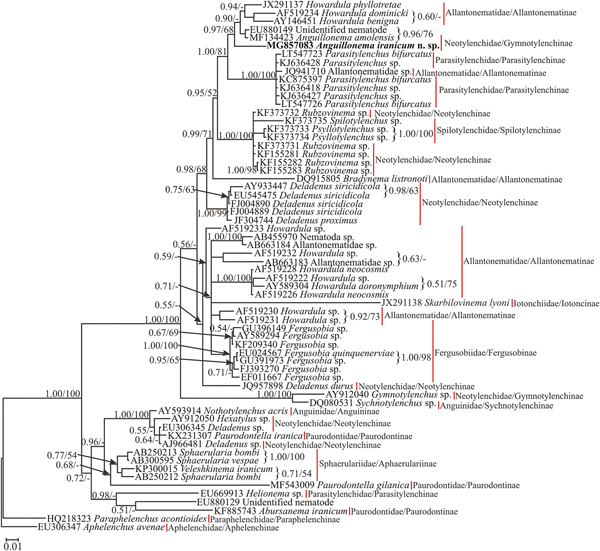
To determine the phylogenetic relationships of A. iranicum n. sp. with other nematode species, a newly obtained 1159 nt long partial sequence of 18S rDNA with accession number MG857083 was used. The BLAST search using this fragment revealed it has 97% identity with Rubzovinema sp. (accession number KF155281). Figure 4 represents a Bayesian phylogenetic tree inferred from the multiple alignment of partial 18S sequences of 62 sphaerularioid taxa (including one isolate of the new species), and two aphelenchid taxa as outgroup species. The dataset was composed of 1635 total characters, of which 597 were variable and 354 were parsimony-informative, with an average nucleotide composition of 25.4% A, 21.0% C, 26.7% G and 27.0% T. In this tree, the new species formed a sister clade with Howardula phyllotretae Oldham, 1933 (accession number JX291137), H. dominicki Elsey, 1977 (AF519234), H. benigna Cobb, 1921 (AY146451), A. amolensis (MF134423) and an unidentified nematode (EU880149) with 0.97 Bayesian posterior probability (BPP) and 68% ML BS value.
Consensus 50% majority rule Bayesian phylogenetic tree of Anguillonema iranicum n. sp. based on 18S rDNA sequences under GTR + I + G model. Bayesian posterior probabilities and maximum likelihood bootstrap values >50% are given on appropriate clades in the form BPP/ ML BS. The new sequence is in bold.

D2-D3 fragment of 28S rDNA phylogeny
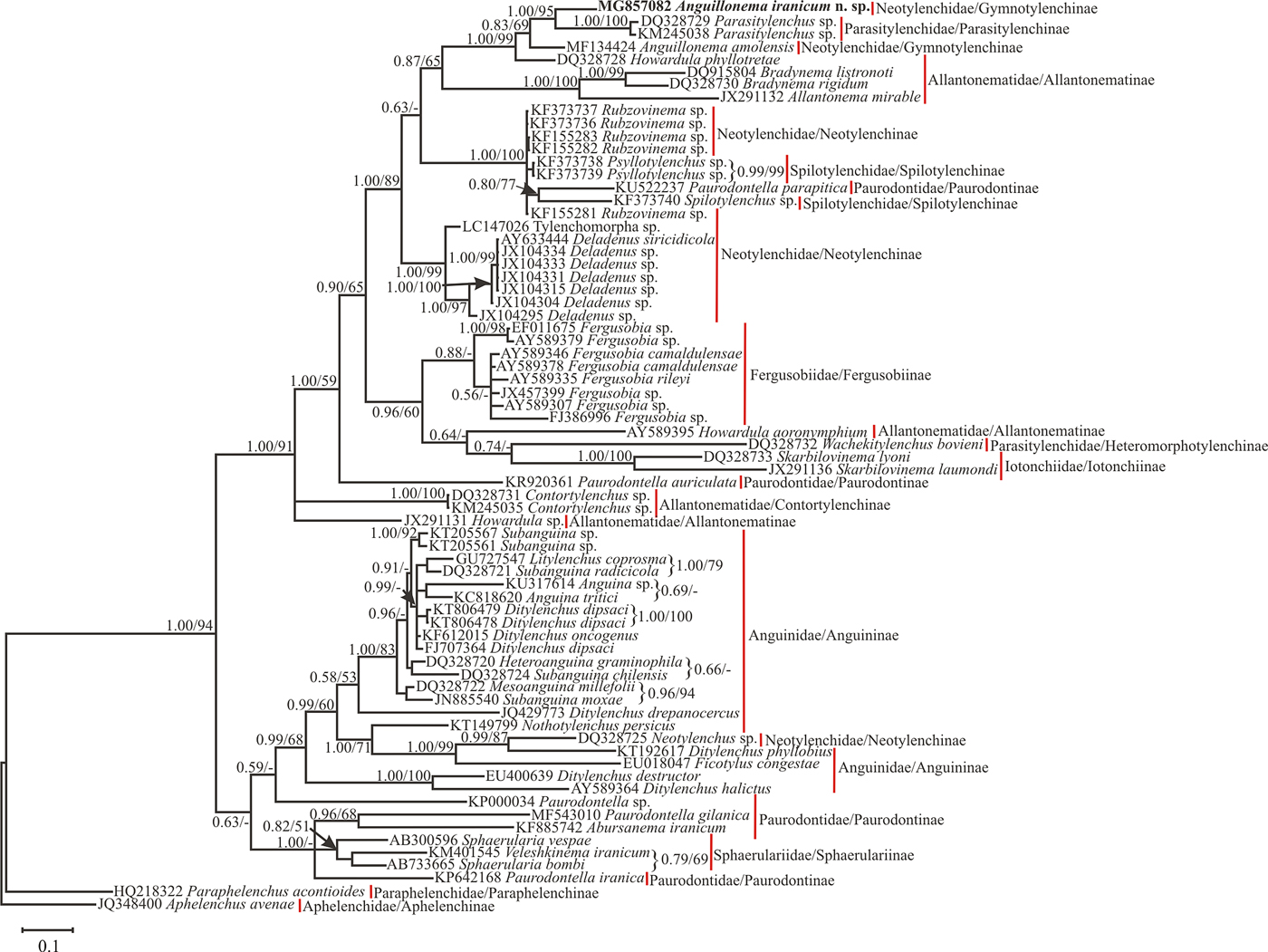
To reconstruct the 28S rDNA tree, a newly obtained 681 nt long partial sequence of the D2-D3 region with accession number MG857082 was used. The BLAST search using this fragment revealed it has closest identity to A. amolensis (accession number MF134424), with 87% identity. Figure 5 represents the phylogenetic tree inferred using 28S sequences of 69 sphaerularioids (including one isolate of the new species), and two aphelenchids as outgroup taxa. The dataset was composed of 637 total characters, of which 465 were variable and 380 were parsimony-informative, with an average nucleotide composition of 23.6% A, 20.4% C, 30.8% G and 25.1% T. In the 28S tree, the new species formed a clade with two isolates of Parasitylenchus Micoletzky, 1922 (accession numbers DQ328729 and KM245038), with 1.00 BPP and 95% ML BS value. This clade formed a sister clade with H. phyllotretae (DQ328728) and A. amolensis (MF134424), with 1.00 BPP and 99% ML BS value.
Consensus 50% majority rule Bayesian phylogenetic tree of Anguillonema iranicum n. sp. based on 28S (D2-D3) rDNA sequences under GTR + G model. Bayesian posterior probabilities and maximum likelihood bootstrap values >50% are given on appropriate clades in the form BPP/ ML BS. The new sequence is in bold.

Mitochondrial cytochrome c oxidase subunit I gene phylogeny
Sequencing of partial COI of the new species yielded a single fragment, 642 nt long. The BLAST search using this fragment showed there is no highly matched sequence to it available in the database; and the highest identity and coverage belonged to two isolates of Deladenus laricis (Blinova & Korentchenko, 1986) Ebsary, 1991 (accession numbers KY272634 and KY272633), with 85% identity. As already mentioned, the corresponding phylogenetic analyses were not performed because of a lack of sufficient molecular sequences of COI for Sphaerularioidea Lubbock, 1861 (Poinar, 1975) members available in the GenBank database.
Discussion
With no certain description of the male of A. poligraphi, and lack of access to the type materials of this species and A. crenati, Siddiqi (Reference Siddiqi2000) placed Anguillonema as genus dubium in suborder Hexatylina. Andrássy (Reference Andrássy2007) believed it belongs to the subfamily Gymnotylenchinae Siddiqi, 1980 of the family Neotylenchidae. Long dorsal overlapping of pharynx on intestine, anterior position of the pharyngo-intestinal junction to the nerve ring, and lack of bursa on the male tail are determinant key characters for accepting the placement proposed by Andrássy (Reference Andrássy2007). However, it should be noted that the male of Anguillonema, unlike the subfamily Gymnotylenchinae, has a gubernaculum.
Until now, Anguillonema species were found from bark samples and described based on free-living forms. Inhabiting bark samples and having a delicate stylet could indicate that members of the genus Anguillonema are fungus feeders; however, future culturing tests on different species of fungal lawns could further clarify this biological status.
The unknown entomoparasitic generation of the genus, and the position of the excretory pore near the cephalic region bear similarity to members of the family Paurodontidae Thorne, 1941. Jairajpuri and Siddiqi (Reference Jairajpuri and Siddiqi1969) classified the genus Anguillonema under the family Paurodontidae. However, the structure of the pharynx and the nature of its junction with the intestine differ from that in Paurodontidae members.
In both phylogenetic analyses based on 18S and partial 28S rDNA D2-D3 sequences, A. iranicum n. sp. and A. amolensis (currently only known in their free-living, probably mycetophagous form) are in close phylogenetic affinity with the genera Howardula Cobb, 1921 and Parasitylenchus. Both these latter genera are characterized by having entomoparasitic generation and free-living forms that occur very rarely, whereas Anguillonema species were described only based on free-living forms. Besides differences in bionomics of all three genera, Anguillonema may be further differentiated from Howardula by males having a stylet (vs lacking).
In our 18S phylogenetic analyses, the non-monophyletic nature of Howardula and Deladenus Thorne, 1941 is evident. Given that the members of Neotylenchidae (Deladenus, Hexatylus Goodey, 1926, Rubzovinema Slobodyanyuk, 1991 and Anguillonema) and Allantonematidae Pereira, 1931 (Howardula and Bradynema zur Strassen, 1892 and other isolates named Allantonematidae sp. (accession numbers JQ941710, AB663184 and AB663183)) occupied separate clades, they are polyphyletic based on this genomic fragment. Also in the partial 28S tree, the polyphyletic nature of members of Neotylenchidae (Deladenus, Neotylenchus Steiner, Reference Steiner1931, Rubzovinema and Anguillonema), Allantonematidae (Howardula, Contortylenchus Rühm, 1956, Bradynema and Allantonema Leuckart, 1884) and Parasitylenchidae Siddiqi, 1986 (Wachekitylenchus Slobodyanyuk, 1986 and Parasitylenchus) are clear. The polyphyletic nature of the families Neotylenchidae, Allantonematidae and Parasitylenchidae, using SSU-ITS1-5.8S-LSU rDNA sequences, has already been discussed by Koshel et al. (Reference Koshel2014).
In conclusion, it is difficult to identify suspected sphaerularioid samples using ribosomal sequences, due to the paucity of their sequences in GenBank and the polyphyletic nature of Howardula, Deladenus and Paurodontella Husain & Khan, 1968. Therefore, the use of morphological and biological characteristics is more useful for identification of these samples. Furthermore, additional sequences will resolve the complexity of phylogenetic studies on this group of nematodes.
Update to the identification of Anguillonema
The genus Anguillonema is currently characterized only by free-living forms. It has vermiform females with low cephalic region, continuous with, or offset from body contour, stylet small and knobbed, dorsal gland orifice close to the stylet base, pharynx cylindroid, reproductive system monodelphic–prodelphic, tail conical, with dorsally bent tip. The males have long spicules (as long as tail length), gubernaculum, and lack bursa (Siddiqi, Reference Siddiqi2000). However, Sumenkova (Reference Sumenkova1989) pointed out that the taxonomic status of the male assigned to the type species A. poligraphi is uncertain. The recent (Mobasseri et al., Reference Mobasseri, Pedram and Pourjam2017) and the present study, however, further clarified some uncertainties regarding the morphology of the genus. In addition to the abovementioned morphological features, new detailed observations have revealed that the procorpus is muscular and wide, there are no symptoms of metacorpus, the corresponding valve and isthmus, pharyngeal glands forming a long dorsal overlap on intestine, the pharyngo-intestinal junction is anterior to the nerve ring, but anterior or posterior to the excretory pore. PUS could be present too (currently known only for the new species, in a very small size). Tail tip could also be dorsally bent or straight (the species A. amolensis and the new species described here have conical, not dorsally bent tail tip in permanently mounted specimens). And finally, the new species has short spicules, a newly observed trait for the genus, compared to the already known long form, illustrated by Sumenkova (Reference Sumenkova1989) for the type species. In conclusion, Anguillonema is delimited by having a flattened cephalic region, small knobbed stylet, cylindroid and muscular corpus lacking metacorpus and isthmus and with long dorsal overlapping of the glands on intestine, pharyngo-intestinal junction anterior to the nerve ring and anterior or posterior to the excretory pore, monodelphic–prodelphic reproductive system, conical tail with or without dorsally curved tip, with males having tylenchoid spicules, gubernaculum, and lacking bursa.
The proposed key for identification of currently known species of the genus is based on the overall morphology and morphometric characters of females. In this paper, four species (including one new species) are included in Anguillonema on the basis of commonly shared characters.
Key to the species of Anguillonema
1 PUS present………………………………………………. A. iranicum n. sp.
– PUS absent…………………………………………………………………… 2
2 L > 1 mm…………………………………………………………… A. crenati
– L < 1 mm…………………………………………………………………… 3
3 Tail tip dorsally curved, and apparently sharp, in mounted specimens, c = 23….. A. poligraphi
– Tail tip not dorsally curved, but broadly rounded, in mounted specimens, c = 35–54…. A. amolensis
Acknowledgments
We thank the Iranian National Science Foundation (INSF) and Tarbiat Modares University (Iran) for their financial support.
Conflict of interest
None.