Introduction
Studies on the diet and feeding habits of the nototheniid Notothenia rossii Richardson have been conducted in different areas of its range (summarized in Kock Reference Kock1992 and Barrera-Oro Reference Barrera-Oro2002). Around the South Shetland Islands, investigations on sub-adult specimens caught inshore (juvenile brown phase) included representative numbers (n > 50) of medium and larger sizes, but only a limited number of the smaller fish (< 20 cm TL), hence leaving the early juvenile phase virtually unexplored.
In Potter Cove, South Shetland Islands, ichthyological research has been developed using trammel nets with mesh sizes that allowed the capture of specimens usually over 15 cm TL. Two studies dealt respectively with the trophic ecology (Casaux et al. Reference Casaux, Mazzotta and Barrera-Oro1990) and age estimation (Barrera-Oro & Casaux Reference Barrera-Oro and Casaux1992) of intermediate and late juvenile N. rossii stages of about 20–44 cm TL. After 2003, the scope of this research was expanded using a pelagic trawl within the cove, capable of sampling small sizes of fish down to c. 4 cm TL. This paper reports on age, diet and feeding habits of early juvenile brown phase N. rossii in Potter Cove and compares these data with those of intermediate and late juvenile stages of the same species from the same site and from nearby areas.
Materials and methods
A total of 140 N. rossii specimens were collected at Potter Cove, King George Island, from December 2005–March 2006 using mainly a pelagic trawl net (mesh 4 mm) but also bottom trammel nets (inner mesh 2.5 cm) at depths between 6 and 43 m. For a detailed description of a similar sampling procedure, see Barrera-Oro & Piacentino (Reference Barrera-Oro and Piacentino2007). The age was determined from scales and entire otoliths (Barrera Oro & Casaux 1992). The diet analysis was done using the frequency of occurrence (F%) and dietary coefficient “Q” methods (complete description in Barrera-Oro & Piacentino Reference Barrera-Oro and Piacentino2007). The Q index (Hureau Reference Hureau1970) is the product of the percentage by number and the percentage by weight of each prey type; it separates prey into the categories of main (Q > 200), secondary (200 > Q > 20) or occasional food (Q < 20). The stomach fullness was estimated as empty, 25% full, 50% full, 75% full and 100% full. For diet analysis in relation to length, fish were grouped into three size classes of 4 cm each.
Results and discussion
The gonad stages (I and II), length (8.5–20.9 cm) and age (1–2 years) ranges of the specimens analysed indicate that they were early juvenile stages. These ranges are complementary to those of intermediate and advanced juvenile fish (TL = 22–44 cm, 3–7 years) caught exclusively with trammel nets in Potter Cove (Casaux et al. Reference Casaux, Mazzotta and Barrera-Oro1990). The significant smaller mesh of the pelagic trawl net allowed the capture of smaller fish.
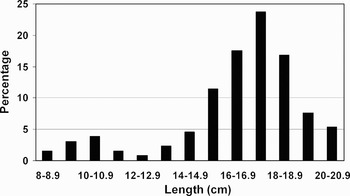
Correlations between age and the two peaks (at 10–11 cm and 17–18 cm) in the bimodal length frequency distribution (Petersen method) shows agreement for the mean lengths estimated for age groups 1 (10.1 cm) and 2 (17.1 cm) identified in the sample (Fig. 1). These results are in line and are complementary to those in a previous study on age determination of intermediate and advanced juvenile N. rossii caught with trammel nets in the same site, in which the age groups 3–7 were found (Barrera-Oro & Casaux Reference Barrera-Oro and Casaux1992).
Length-frequency distribution of early juvenile Notothenia rossii.

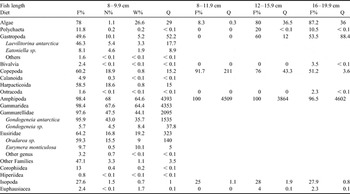
The results of the diet analysis, including the variation in the type of food with respect to the body length, showed that only a few taxa constituted important food items (Table I). Demersal-benthic amphipods, chiefly of the suborder Gammaridea, were the most frequent and main prey (F% = 98, Q = 4393), with predominance of the families Gammarellidae (F% = 97, Q = 2095) and Eusiridae (F% = 64, Q = 323). Gondogeneia antarctica (Chevreux) was the most abundant species (F% = 96, Q = 1535). Other families of the same suborder (e.g. Lysianassidae, Phoxocephalidae, Stenothoidae, Iphimediidae, and Eophliantidae) were scarcely represented (individually, F% < 36, Q < 0.4), as well as amphipods of the suborders Corophiidea and Hiperiidea (F% < 14, Q < 0.1).
Diet of early juvenile Notothenia rossii showing the frequency of occurrence (F%), percentage by number (N%) and by weight (W%) and the dietary coefficient (Q) of each food item.

Although the frequency of occurrence of algae and gastropods was high (F% = 78 and 50 respectively) these items were secondary food (Q = 29 and 53 respectively). Copepods were found in a high proportion of stomachs (F% = 60) but constituted occasional food (Q = 15). Among this group, demersal-benthic harpacticoids were largely the most abundant (F% = 58, Q = 15), whereas pelagic calanoids were scarcely represented (F% < 5, Q < 0.1). Other diet components such as ostracods, bivalves, polychaetes, isopods and krill (Euphausia superba Dana) were also occasional food, with low F% (< 28) and negligible Q (< 1).
The total number of prey in the stomachs increased with increasing size of N. rossii, from 1197 in smaller to 5808 in larger specimens. The trophic spectrum was also wider in larger fish, since some food items such as ostracods and bivalves were not found in the stomachs of smaller and intermediate fish. Variation of diet during ontogeny was on the basis of different sizes of the same taxa. For example, amphipods constituted the main food in all fish sizes, but while in the diet of the smaller fish, the smallest prey, copepods, were also main food, the larger fish eat copepods only occasionally. Conversely, the largest prey, krill (4.5 cm TL), was absent in the stomachs of smaller fish but was occasionally taken by intermediate and larger fish. In line with this, in the diet study of larger juvenile N. rossii (22–44 cm TL) at Potter Cove, krill reached the status of secondary food (Casaux et al. Reference Casaux, Mazzotta and Barrera-Oro1990).
Stomach fullness showed high food availability during sampling (72% with stomachs 75–100% full), in concurrence with the absence of empty stomachs. January and February were the months of higher feeding intensity (78% and 74% of stomachs 75–100% full, respectively).
Casaux et al. (Reference Casaux, Mazzotta and Barrera-Oro1990) concluded that intermediate and advanced juvenile N. rossii were benthos and plankton feeders because, although these stages eat mainly demersal-benthic organisms, in summer fish migrate in the water column to feed on pelagic prey such as hyperiid amphipods and krill. In the present study however, vertical migrations of early juvenile fish to upper layers were not evident because of the lack of hyperiids (n = 1) and other plankton components such as calanoid copepods (n = 23) whilst in neritic waters krill can be found near the bottom.
Many studies have defined N. rossii as a demersal-benthic species and it is known that in offshore waters larger fish prey mainly upon krill and other fish (summarized in Barrera-Oro Reference Barrera-Oro2002). However, the present work deals with early juvenile stages of the brown phase, smaller than in previous investigations and therefore results from both sources are not suitable for direct comparison. Burchett (Reference Burchett1983) analysed stomachs of 146 blue phase fingerlings of 4.7–5.9 cm TL caught at South Georgia. This phase is pelagic and the diet consisted mainly of small planktonic organisms such as copepods, hyperiids and fish larvae. Linkowski et al. (Reference Linkowski, Presler and Zukowski1983) studied the diet of brown phase specimens from Admiralty Bay, King George Island, but without a representative number of sizes under 20 cm TL. They reported benthic amphipods and polychaetes as the main food (coefficient Q), and salps as main food in summer and secondary food in winter.
In summary, early juvenile N. rossii specimens in the ranges 8.5–20 cm TL and 1–2 years are demersal, preying mainly on gammaridean amphipods and other invertebrates of the benthic community associated with macroalgae beds. Unlike in intermediate and larger juvenile sizes, no evidence of vertical migrations for feeding on pelagic organisms was found, since the importance of plankton components in the diet was virtually negligible.
Acknowledgements
We appreciate very much the collaboration of Dr G. Alonso, Lic. E. Dinofrio, Lic. N. Landoni, Dr J. López Gappa, Dr L. Quartino and Dr D. Roccatagliata in the identification of preys. We thank Dr G. Piacentino for her useful advice and C. Bellisio for technical assistance and help in the field activities. We thank Dr Marino Vacchi for his constructive review.