
Introduction
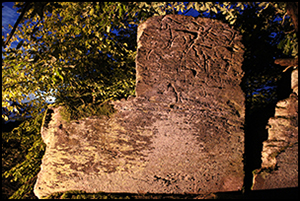
Since 2010, archaeologists have been examining a series of engravings found by Jürgen Weinheimer on a slate rock face in a V-shaped valley in the Hunsrück Mountains of Germany. Their subject matter includes three horses and one other complete animal shown in profile. These animals are carved in a kind of bas-relief (Figure 1). The results presented here should be considered a preliminary summary of ongoing work, which is the product of collaboration between the Koblenz branch of the State Archaeology Office (GDKE Rheinland-Pfalz) and a study group (with Marco Schaffranski and Ruth Hecker) from the Verein für fachübergreifende und angewandte Archäologie (ARRATA e.V.) (Welker Reference Welker2014a).
Palaeolithic rock art in the Hunsrück, Germany (photograph: M. Schaffranski).

After an initial appraisal by Gerhard Bosinski in the summer of 2010, the site was visited by Antonio Martinho Baptista and Dominique Sacchi in 2011 and by Paul Bahn in 2013, all of whom attributed the decorated panel to the Palaeolithic period. On 1 July 2014, the rock engravings were revealed to the public during a visit to the site by the Minister of Education and Cultural Affairs for Rhineland-Palatinate, Doris Ahnen(Welker Reference Welker2014b). Since the first discovery of open-air Palaeolithic rock art in Europe, at Mazouko in north-east Portugal in 1981, other examples have also been found in Spain and France (Sacchi Reference Sacchi1988; Bahn Reference Bahn1995; Baptista Reference Baptista2009).
Site topography
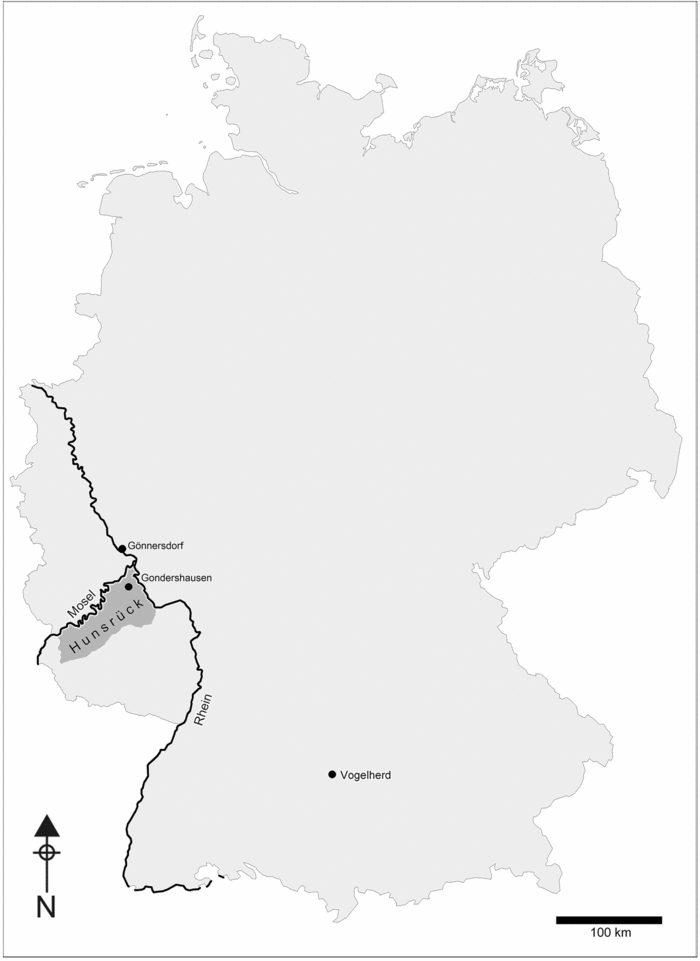
The panel in question is situated near the village of Gondershausen in the northern Hunsrück in the German federal state of Rhineland-Palatinate (Figure 2). The Hunsrück is a region of low mountains bordered by three rivers. To the west is the Moselle, to the east, the Rhine and to the south, the Nahe. The engravings were found on a small, exposed plateau on a mountain spur in one of the V-shaped valleys typical of this region. The Hunsrück is part of the Rhenish Slate Massif, which runs south-west to north-east. The engraved panel of Hunsrück slate can be geologically dated to the Early Devonian period and is distinguished by its layered deposits. The concave nature of the engraved surface and its position facing the hillside in a valley has provided good natural protection against weathering.
The Hunsrück (Rhineland-Palatinate, Germany) showing Gondershausen and its geographic position in relation to Gönnersdorf and Vogelherd (map: ARRATA e.V.).

The image area
The engraved slab of rock is c. 1.95m high and 2.25m wide at its base. The area of engraving (c. 1.2m2) is on the upper part of the rock face. It measures up to 1.25m in length and is at least 0.9m high (Figures 3 & 4). In places, heavy weathering has left scars on the surface of the images. In other areas, lichens have grown on the decorated surface making it difficult to decipher the engravings correctly, especially those produced by fine incision. A total of three different periods of work can be identified, with the deep animal engravings produced during the first phase of a sequence of multiple reworkings.
The Hunsrück rock with its deep engravings (black), fine incision (red), other historical markings (green) and areas of natural disturbance (blue); sketch: R. Hecker/W. Welker; digital representation: A. Schmidt/W. Welker.

The Hunsrück animal engravings in artificial light (photograph: M. Schaffranski).

The initial phase of images with the deep engravings is chiefly characterised by a number of animals shown in profile (Figure 5). The subject matter is dominated by horses, which are similar in style. Two horses (I and II), facing north-east and around 0.5m in length, form a diagonal axis from the top left to the bottom right and dominate the panel. Horse I, unlike horse II, is shown moving: this is supported by the inclusion of anatomical details such as the bent foreleg and hooves, which are not shown on the other animal figures. This seems to polarise the two horses. The static, simplified legs of horse II and the straight line of the stomach create an impression of stationary rest. Horses I and II otherwise incorporate the same stylistic conventions.
Plan of the deep engravings (digital representation: A. Schmidt/W. Welker).

At the bottom left of the main image area is a complete, indeterminate animal that is c. 0.4m long and faces north-east (animal V). This differs markedly from the horses and is characterised by its long, thin and rather unusual head. Some engraved lines, which may represent horns or antlers, are badly preserved and difficult to interpret. The well-formed withers and angular rump suggest a bovid or cervid.
Towards the upper right of the image area there is a third horse (horse III), approximately 0.25m long and also facing north-east; it is illustrated in less detail but in the same style as the two larger horses, I and II; horse III is missing its legs. This small horse is drawn within the outline of an incomplete animal (animal IV), which is chiefly identifiable by a carved line forming its back. The depiction of a ‘stumpy tail’ in the same style as that of the horses indicates that this animal is also facing the left and north-east (i.e. it is looking to its left, as are the others).
Besides the full animal images, the decorated rock also contains other notable deep engravings, at least some of which show animal figures in an abridged form. According to the same scheme, engraving VI can be compared, for example, with the lines of the lower jaw or neck contour in the horse carvings.
Geometric signs
In addition to the complete and abridged figures of animals, there are also a number of abstract geometric incisions on the rock face that belong to a later phase of working (phase II), and are technically striking in that they consist primarily of fine incisions (Figure 6). These finely engraved lines, which occur either singly or in groups forming patterns, each appear to have been carved into the rock with a single firm stroke. In profile, they are more U-shaped than V-shaped, and vary between 0.5mm (particularly in parallel line area XII) and 1.5mm in width; this suggests that they were made using different implements to the phase I images and that these finer incisions are of a later date.
Plan of the fine incisions (digital representation: A. Schmidt/W. Welker).

Among the geometric marks is an area of parallel lines (XII-1), some of which are dissected by a number of slanted, diametrically opposed lines to form a grid-like pattern (XII-2). Two single lines, etched in parallel, run down vertically from the forefoot of horse I over a length of more than 260mm. These cut across indeterminate animal V and thus postdate it. In the lower third, the row of parallel lines is broken. Three oblique etched lines supplement the pair of lines in the shape of a hook (XIII). A pattern comprising several lines engraved in parallel, around 10mm wide and 150mm long, runs perpendicularly as a clear indentation beneath the crustose lichen. Four hooked lines incised at the upper end of the line pattern (XIV) are of note here. There are also a number of other incisions distributed around the image area that form small patterns and are partially covered with lichen.
The image also features two ‘anomalies’ whose origins are considerably more recent. These are the carved abbreviation ‘AIG’, which cuts across the Palaeolithic image, and a chiselled number ‘1’.
Reflections on movement, perspective and the concept of space
In contrast with all of the other static animal figures, horse I is shown at a gallop (Figure 7). The sequence of movement is chiefly depicted by the line of the legs and stomach. The first aspect to catch the eye is the angled foreleg (Figure 8). Of note are the disproportionately long hind leg and the foreleg, both of which point forward. Together with the concave line of the stomach, this gives horse I a lively and energetic expression, one that is enhanced by the detailed portrayal of the front hooves.
Horse I (photograph: M. Schaffranski).

Front leg of horse I (photograph: M. Schaffranski).

The second hind leg also uses a stylistic convention in the depiction of perspective, which can be observed frequently in Upper Palaeolithic cave art. This is the ‘perspective tordue’ (twisted perspective), first described by Henri Breuil, where certain elements of an animal shown in profile are turned through an angle of up to 90° (Leroi-Gourhan Reference Leroi-Gourhan1981: 32).
The image area (c. 1.2m2) is marked by a striving for spatial design and order, and is primarily concentrated in the upper half of the rock face, which is almost 2m high. The artist could therefore execute his or her carvings while standing, easily accessing all areas from one position. Almost all of the available space, framed by the edges of the rock, was used. The distances between the neighbouring engraved animals are, in some places, less than a centimetre, resulting in a very narrow array of the separate beasts. There is, however, no overlapping. Very few intersections can be discerned among the isolated, undefined deep engravings found in the lower image area. The animal images are evenly distributed across the space. Horses I and II form an oblique axis that dominates the image area and by which the other engraved animal drawings appear to be guided. By and large, there is an ordered and even distribution of images that can be referred to as symmetry of mass in the sense of André Leroi-Gourhan (Leroi-Gourhan Reference Leroi-Gourhan1981: 24–25). The close arrangement of the animal carvings, the high degree of order, the harmonious composition and the time-consuming method of production behind the somewhat relief-like engravings indicate that the work is the result of deliberate planning; this supports the assumption that the animals were fashioned by a single artist. The other engravings, at least some of which portray animals using a heavily schematised drawing technique, are mostly in the centre below the diagonal axis and appear to have a separate role.
In view of the aforementioned principle of arrangement, it can be assumed that one artist created the entire work and thus applied all principles of design—including those that serve to depict the third dimension—consciously and not at random. The purposeful rendering of perspective is initially shown in the staggered depiction of horses I and II, and in their relation to the other engraved animals. In surrounding the small horse with the contours of animal IV the artist creates a sense of depth, having the observer believe that the small horse is in the foreground. With the same artistic device the observer is also given the illusion that the head of animal IV is behind horse I. This illusion of overlapping is an artistic principle, used to create a sense of perspective. This partial assemblage of the small horse and animal IV, in close proximity to horses I and II, also appears to be compared in the background to the two dominant horses; this impression is helped by its proportions. A further perspective trait is used in the individual animal depictions and is evident in the perspective tordue of the ‘second’ hind legs of horses I and II. Additionally, the proportions of the limbs add to the creation of perspective; the artist has made the legs closest to the viewer slightly longer.
This is obviously a planned composition that manages, through the application of various artistic techniques, to create an illusion of spatial depth for the observer. In addition to the use of space, the effect of various lighting conditions on the decorated panel can vary naturally with open-air art. In both natural (Figure 1) and artificial light (Figure 4), the illusion that this is a three-dimensional design is enhanced by the contrast between light and shade. Bas-relief-like engravings have, to date, only been discovered in rock shelters or the daylight areas of caves and are now also found in open-air rock art. It is hence evident that there is a special correlation between the use of bas-relief and daylight.
Technique and method of production
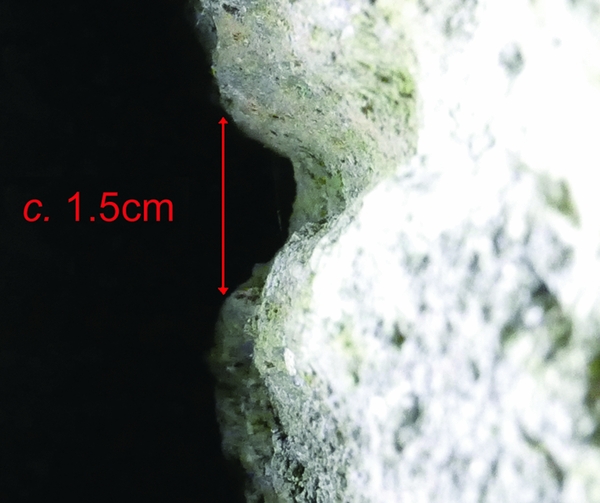
The pictorial ensemble, with its depictions of animals, displays an intensive preparation of the rock, with the animal figures produced by pecking, hammering, scratching and scraping the rock face. The lines of the carvings achieve widths of up to 40mm and depths of around 10mm. The relative depth between the outline and inner area of the animal bodies is over 20mm in places. It is also to be assumed that the rock in areas I–III, on which the horse was engraved, was worked flat beyond the outlines, at least in part. The neck and back lines of the animals, especially of the horses, are particularly strong. The V-, or more often, U-shaped groove of the engravings is asymmetrical here (Figure 9), giving the animal body a three-dimensional design. The wide line carvings thus serve to emphasise the relief-like properties of the animal bodies (Figure 10).
Profile of the stomach line of horse II (photograph: M. Schaffranski).

Angled view of horse II (photograph: M. Schaffranski).

In contrast, the vertical engravings have a different character. Particular mention will be made here of the strong outlines of the legs on horse II and to those of indeterminate animal V.
The technical accomplishment of the engravings and the bas-relief aspects of design applied to the head, neck and back line areas of the Hunsrück horses is comparable with bas-reliefs created during all periods of the Upper Palaeolithic, some of which reached depths of up to 100mm (Lorblanchet Reference Lorblanchet1997: 71). Examples of relief-like images in rock shelters and caves include the depictions of women at Laussel (Dordogne), dating back to the Gravettian Period, and the Solutrean images at Roc de Sers (Charente). With regard to the method of production, the Magdalenian images of Domme, such as the large mammoth (Delluc & Delluc Reference Delluc and Delluc1983: 40, fig. 25), and the partially executed ibex of Sainte-Eulalie at Espagnac, Lot (Lorblanchet Reference Lorblanchet1973: 31–32, fig. 23), can also be cited. The motifs here were emphasised by flakes of rock being hammered or pecked out from around the drawing of the animal. In general, the Hunsrück engravings do not achieve this monumentality and their overall impression is flatter. Remarkably, all of the bas-reliefs we know of to date are found in rock shelters or the daylight areas of caves. As of yet, no bas-reliefs have been found in the rock art of the Côa Valley, Portugal (Baptista Reference Baptista2009: 76). This is also true of all other rock art in Europe. In terms of its technique and method of production, the Hunsrück rock art is in an ambiguous position, lying somewhere between the above-mentioned bas-reliefs known from the Upper Palaeolithic Gravettian period onwards, which are up to 100mm in depth and chiefly found in rock shelters and daylight cave areas, and the deep, wide carvings from the early phases of the Upper Palaeolithic. By way of example, the Aurignacian engravings on limestone blocks, found in rock shelters at La Ferrassie, Cellier, Castanet and Belcayre in the Dordogne (cf. Bosinski Reference Bosinski1982: 15; Leroi-Gourhan Reference Leroi-Gourhan1982: 248 and figs 255–62; Lorblanchet Reference Lorblanchet1997: 295), and especially the cave art in Pair-non-Pair (Prignac-Marcamps, Gironde), can be mentioned here.
Style
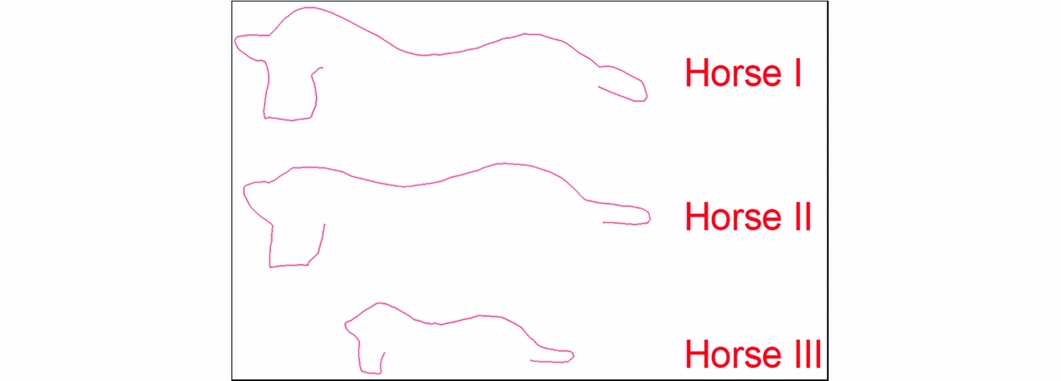
The Hunsrück animal carvings are representative of a cautious naturalism that is marked by a schematic style. The contours of the virtually square heads with their V-shaped ears, and the S-shaped line of the neck, back and tail follow a fixed, repetitive pattern on all the horses. The schematisation is so pronounced that the lines could be placed on top of one another and used as a template (Figure 11).
The head, neck and back lines of the horses follow a fixed pattern (drawing: W. Welker/A. Schmidt).

Only the leg and stomach lines are treated differently on the horses, thus making a clear distinction between them. On horse I details such as the hooves are especially prominent, while the legs on small horse III are not fully formed. The line of the leg and stomach of horse II, on the other hand, has a clear geometrical style and gives the impression of a static leg hanging in the air. The line defining the legs and stomach on indeterminate animal V follows the same pattern.
The heavy overemphasis of the heads in both shape and size is particularly notable. It is true that compared to other species of horse, Przewalski's wild horse is distinguished by its comparatively large head on a stocky body (Braun & Zessin Reference Braun and Zessin2011: 5). Jiri Volf describes the thick neck and box-like head as being typical traits of Przewalski's horse (Volf Reference Volf1996: 47).
Comparisons
Both the general schematisation of the Hunsrück animal engravings and the particular accentuation of various body parts and the neck and back lines are reminiscent of the early phases of Palaeolithic art; they are clearly distant from the naturalist style found, for instance, in the Magdalenian in nearby Gönnersdorf (and Andernach-Martinsberg). In Gönnersdorf, images of various animals, including 79 horses, were engraved on portable slates (Bosinski Reference Bosinski2007: 218).
Owing to the overemphasis of certain body parts, the Hunsrück animal engravings can be safely compared in style to the small Aurignacian sculptures of the Swabian Alb, where characteristic traits are also over-accentuated, such as the massive body of the bison and the lengthy neck of the horse (Bosinski Reference Bosinski1981: 7; cf. Conard & Seidl Reference Conard and Seidl2008; Conard & Kölbl Reference Conard and Kölbl2010). The small sculptures of the Swabian Alb are also remarkable for their methods of production, although it is difficult to make a comparison between portable and rock art. A 69mm mammoth carved in bone from Vogelherd and a 38mm ivory slab bearing a human image from the Aurignacian Geißenklösterle deserve particular mention here for similarities in the manner in which they were created. Both artefacts have been worked in bas-relief (Bosinski Reference Bosinski1982: 14 & 77).
Thanks to the greatly exaggerated and rather grotesque accentuation of the long and thin head of animal V, a comparison may also be made with the great panel in the Gravettian cave of Cussac (Dordogne). In Cussac it is also the undefined animals that are portrayed in a rather exotic way with their unrealistically elongated heads (Jaubert & Feruglio Reference Jaubert and Feruglio2013: 197, fig. 2). Their style is what makes it hard to discern their species.
The stylistic similarities to early images of the Upper Palaeolithic become particularly evident when comparing the schematic leg lines of horse II and animal V. Regardless of the species of animal, the leg and stomach lines at La Grande Grotte (Arcy-sur-Cure) in northern France, for example, which dates back to the Gravettian period, are very schematic and appear quadratic or ‘horseshoe shaped’, especially in the case of bears and mammoths. Details of feet are not shown and the lines at the ends of the legs are left open as if cut off (Baffier & Girard Reference Baffier, Girard and Otte2013: 224–25). In particular, the horseshoe-shaped leg line of a mammoth, about 0.45m in length, can serve by way of an example and comparison here because of its similar appearance to the Hunsrück animal V (cf. Baffier & Girard Reference Baffier and Girard1998: 77, 80, fig. 66).
The strongest parallels in style and technique with the Hunsrück engravings are found in the drawings on panel 1 at Pair-non-Pair, which date to the Aurignacian Period (Martinez & Loizeau Reference Martinez, Loizeau, Lenoir, Roussot, Delluc, Delluc, Martinez, Loizeau and Mémoire2013: 100). Ibex number 10 from this panel is a good example of a similar technique (Delluc & Delluc 2013: 31, fig. 43). (Delluc and Delluc (2013) identify the animals at Pair-non-Pair with Arabic numbers, in contrast to the Roman numerals used with reference to the engravings on the Hunsrück slate.) The grooves are broad and deep and use the natural rock surface to create a form of bas-relief impression in some areas. Other animal carvings in Pair-non-Pair have been heavily pecked out of the rock and also partly resemble a bas-relief; the lines are up to 23mm in width and sometimes over 20mm deep (Delluc & Delluc 2013: 28, 32). It is worth mentioning that at the time of their creation these engravings were in an area of the cave lit by daylight. It is not only the similarities in production technique that are remarkable; the stylistic parallels are also striking. Again, we can cite ibex 10 or even horse 7 as examples here. Their reduced, schematic legs create a hanging, immobile impression, and the ends of the feet are not depicted. Unlike the Hunsrück animal engravings, however, the ends of the legs have been left open. The uniformity of position and pose of Hunsrück horses I and II described above is also evident at Pair-non-Pair. Horses 6 and 7 on panel 1, both of which turn their heads to look over their right shoulder, were engraved one behind the other and in close proximity (Delluc & Delluc 2013: 29; fig. 38). Here too the contrast is found in the different postures, especially the poise of the head and the execution of the neck and back lines of the two stylistically similar horses. There are further parallels between panel 1 and the decorated Hunsrück rock face in terms of the use of space. The artist arranged the animals very close together and avoided overlaps between the various figures, integrating natural niches and cracks in the rock into his or her work. Besides the animals shown in full, there are others depicted in an abridged form. This striking similarity of style, subject matter and technique points to a close cultural relationship between the rock art in the Hunsrück and the engravings in the small cave of Pair-non-Pair.
Parallels in Gravettian period imagery can be found in Pech-Merle. As Lorblanchet observes, the Black Frieze is dominated by schematic animal figures and animals shown in abridged form that reveal an attention to anatomical detail (Lorblanchet Reference Lorblanchet2010: 431–32). This concern with the definition of detail can also be seen in the Hunsrück animal engravings. The existence of a stylistic relationship is corroborated by a direct comparison of horse I from the Hunsrück with horse I on the Black Frieze. The execution of the neck and back line, together with the square head and V-shaped ears, offer very notable parallels between both of the horses from the Black Frieze and Gondershausen. In addition to these features, the rather schematic depiction of the leg and stomach lines, with a precise rendering of the front hooves, provides a further convincing parallel (Lorblanchet Reference Lorblanchet2010: 61–62, fig. 1).
By way of a preliminary summary, it can be said that there is much conformity in technique, style and subject matter with securely dated works of art from the older phase of the Upper Palaeolithic, probably indicating a date before the Last Glacial Maximum.
The question of authenticity
The most pressing issue is that of authenticity. The greatest problem is that rock engravings cannot be directly dated. The advanced signs of (partial) erosion, which overlie the animal carvings and verify that the engravings are indeed old, are thus of great relevance (Figure 12). The animal engravings are overlain by both geometrical patterns from the second phase and by later incisions made during a third phase. It must be noted that the traces of erosion in these later incisions differ from those of the Palaeolithic images in that they are less eroded, which also serves to underline that the figurative carving was executed in several stages.
Segmentary erosion, which overlies the engravings of horse I within the area of the hind quarters (photograph: M. Schaffranski).

Over the past few years, at least three sites with datable engravings have been found in the immediate vicinity of the Hunsrück panel (i.e. within a radius of 300m) that face in the same direction and have the same geological formation. Although these areas are exposed to more extreme weather conditions than the Ice Age Hunsrück horses (such as driving rain), these depictions have only minor traces of weathering. One site dates to 1935 and a second site includes, among other symbols, the inscriptions 1923 and 1926. A third site with similar sharply edged engravings probably dates to the Roman period. These other sites are therefore very obviously different in age from the engraved animal drawings. In view of these relative comparisons, a huge chronological depth must be assumed for the Hunsrück panel. These observations are also corroborated by more distant rock engravings on, and preparation of, Hunsrück slate from the Medieval and Roman periods.
Conclusion
The discovery of open-air art in Germany has significantly altered our understanding of Palaeolithic art in Central Europe. The panel of images at Hunsrück is distinguished in particular by its depictions of horses engraved using a bas-relief technique. Parallels in style, theme and technique, especially with the cave art of France, suggest a date before the Last Glacial Maximum.
The Hunsrück panel at Gondershausen represents the first example of Palaeolithic open-air art in Germany and the northernmost Palaeolithic open-air art in Europe. The topographic situation of the panel and its advanced signs of erosion, significantly further advanced than those of more recent rock art, contribute to our understanding of the conditions in which Ice-Age art can be preserved. The Hunsrückpanel shows that open-air art in Central Europe can indeed survive the rigours of weathering depending on the individual topographic circumstances.