INTRODUCTION
The flagellated protozoan Giardia duodenalis (syn. Giardia intestinalis, Giardia lamblia) commonly causes enteric infections in humans and animals worldwide. Recent molecular epidemiological studies showed that G. duodenalis is composed of at least 7 genetically distinct but morphologically identical assemblages (A to G). Moreover, assemblages C to G appear to have host-specific preferences (Ey et al. Reference Ey, Mansouri, Kulda, Nohynkova, Monis, Andrews and Mayrhofer1997; Monis et al. Reference Monis, Mayrhofer, Andrews, Homan, Limper and Ey1996, Reference Monis, Andrews, Mayrhofer, Mackrill, Kulda, Isaac-Renton and Ey1998, Reference Monis, Andrews, Mayrhofer and Ey1999), but the genotypes of assemblages A and B are important in human infection because these genotypes have been detected not only in livestock but also in companion animals such as dogs and cats (Thompson et al. Reference Thompson, Hopkins and Homan2000; Berrilli et al. Reference Berrilli, Di Cave, De Liberato, Franco, Scaramozzino and Orecchia2004).
In Japan, giardiasis, like amoebiasis and cryptosporidiosis, was classified as a category V notifiable infectious disease according to the Law Concerning the Prevention of Infectious Disease and Medical Care for Patients of Infections that was enacted in 1999. There has been an average of 89 cases per year for the last 10 years (http://idsc.nih.go.jp/idwr/ydata/report-Ea.html). Human infection with G. duodenalis occurs by ingestion of its cysts in contaminated food or water (Mintz et al. Reference Mintz, Hudson-Wragg, Mshar, Cartter and Hadler1993), by person-to-person transmission at nursing homes and institutions for people with intellectual disabilities (White et al. Reference White, Hedberg, Edmonson, Jones, Osterholm and MacDonald1989; Suzuki et al. Reference Suzuki, Murata, Kobayashi, Yanagawa and Takeuchi2005), or by animal-to-person transmission (van Keulen et al. Reference van Keulen, Macechko, Wade, Schaaf, Wallis and Erlandsen2002); however, the role of zoonotic transmission in G. duodenalis has not been clarified in Japan.
Facilities in which customers make contact with cats immediately before eating and drinking, called ‘cat cafés’, have recently increased in Tokyo and metropolitan districts in Japan. G. duodenalis transmission to humans is always a concern in the presence of infected cats. In this study, we surveyed the prevalence of G. duodenalis in cats maintained at cat cafés. G. duodenalis prevalence was also investigated at pet shops and at the Animal Care and Consultation Center in Tokyo, Japan because their cats are supplied to cat cafés. The sequence-based approach classifies isolates by sequence analysis of the small subunit ribosomal RNA (18S rRNA) gene. Moreover, to understand genetic polymorphisms among G. duodenalis isolates and transmission routes in a limited area such as cat cafés, sequence and phylogenetic analyses of the glutamate dehydrogenase (GDH) and triosephosphate isomerase (TPI) genes with a high degree of polymorphism (Bertrand et al. Reference Bertrand, Albertini and Schwartzbrod2005) were performed.
MATERIALS AND METHODS
Stool samples
In 2009 and 2010, 115 cat stool samples were collected from 16 cat cafés in Tokyo. Eighty-six cat stool samples were collected from 31 pet shops in Tokyo between 2003 and 2006. Additionally, between 2008 and 2010, 121 cat stool samples were collected from the Animal Care and Consultation Center of the Tokyo Metropolitan Government. Consent to survey for Giardia infections was obtained in all cases. Moreover, 7 different genotypes of G. duodenalis, as references, were prepared for phylogenetic analysis: human clinical isolates (IndA2 and IndB; assemblages A II and B, respectively) detected in 2 giardiasis patients from India (Nakamura-Uchiyama et al. Reference Nakamura-Uchiyama, Nakamura, Komiya, Ohnishi, Suzuki and Kobayashi2008); a primate isolate (WS1; assemblage B) detected in a White-faced Saki (Pithecia pithecia) from the Ueno Zoological Gardens in Tokyo (Nakamura et al. Reference Nakamura-Uchiyama, Nakamura, Komiya, Ohnishi, Suzuki and Kobayashi2008); Ca39 isolate (Assemblage E) detected in cattle in a slaughterhouse in Shibaura, Tokyo; Dd4 (Assemblage D) and Dd5 (Assemblage C) isolates detected in 2 dogs in the Animal Care and Consultation Center in Tokyo; and the axenically cultivated G. duodenalis reference strain (Portland 1; assemblage A I, ATCC 30888).
Microscopic examination
Giardia cysts were concentrated from the stool samples of cats using the formalin-ether sedimentation technique (Ritchie, Reference Ritchie1948). Subsequently, smears from all concentrated specimens were examined; the cysts were identified morphologically under a microscope; and G. duodenalis cysts were re-examined by direct antibody fluorescence using Aqua-Glo G/C Direct, FL (Waterborne Inc., New Orleans, USA).
Polymerase chain reaction and sequence analysis
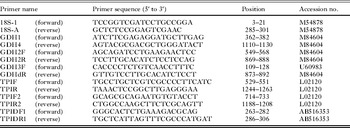
The stool samples for detecting Giardia cysts were dissolved in distilled water and filtered through a 40 μm cell strainer (BD Sciences, Franklin Lakes, NJ, USA). The stool suspensions were centrifuged at 1000 g for 5 min, and Giardia cysts were concentrated using anti-Giardia magnetic beads provided with the Dynabeads GC-Combo kit (Invitrogen Dynal AS, Oslo, Norway). Subsequently, genomic DNA of G. duodenalis was isolated with the QIAamp® DNA Mini kit (Qiagen GmbH, Hilden, Germany). Genomic DNA of G. duodenalis isolates, which could be cultured axenically from stool samples, was prepared using the QIAamp® DNA Mini kit from the trophozoites after centrifuging the culture tubes. Polymerase chain reaction (PCR) amplification of each DNA template was performed using primer sets targeting the 18S rRNA, GDH, and TPI genes of G. duodenalis (Table 1). The 18S rRNA and GDH genes were detected with previously reported primer sets using 18S-1/18S-A for the 18S rRNA gene (van der Giessen et al. 2006) and GDH1/GDH4 for the GDH gene (Homan et al. Reference Homan, Gilsing, Bentala, Limper and van Knapen1998). In cases where a minimal PCR product of the GDH gene was obtained from the DNA template, a second round of PCR was performed with 2 primer sets for DNA of G. duodenalis isolates from human and animals excluding dogs, GDH1/GDH2R and GDH2F/GDH4, and 2 primer sets for isolates from dogs, GDH1/GDHdR and GDH3F/GDH4. Two primer sets, GDH2F/GDH2R and GDH3F/GDHdR, were newly designed in this study from the GDH gene sequence of G. duodenalis (GenBank Accession numbers M84604 and U60986). PCR amplification of the Giardia TPI gene was performed using the primer set TPIF/TPIR, which was designed from the TPI gene sequence of G. duodenalis (GenBank Accession number L02120). In cases where the minimal PCR product of the TPI gene was obtained from the DNA template, a second round of PCR was performed with 2 primer sets for DNAs of G. duodenalis isolates from human and animals, excluding dogs, TPIF/TPIR2 and TPIF2/TPIR, and 2 primer sets for isolates from dogs, TPIF/TPIDR1 and TPIDF2/TPIR. Four primers – TPIF2, TPIR2, TPIDF2, and TPIDR2 – were newly designed in this study from the TPI gene sequence of G. duodenalis (GenBank Accession numbers L02120, AB516353). PCR was performed in a reaction mixture (50 μl) containing 5 μl of DNA template, 1·0 U of LATaqDNA polymerase (Takara Bio Inc., Shiga, Japan), 0·4 μ m of each primer, and 0·25 mm of deoxynucleotide triphosphates. The following cycling parameters were used for all PCR amplifications: (1) Taq activation at 94°C for 3 min; (2) 35 cycles of denaturation at 94°C for 40 s, annealing at 60°C (18S rRNA gene) or 58°C (GDH and TPI genes) for 40 s, and extension at 72°C for 1 min; and (3) final extension at 72°C for 5 min. Sequence analyses were performed as reported previously (Suzuki et al. Reference Suzuki, Kobayashi, Murata, Tajima, Hashizaki, Yanagawa and Takeuchi2008).
Oligonucleotide primers used for PCR assays in the present study

Phylogenetic analysis
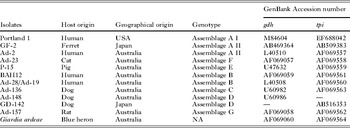
The multiple alignments and phylogenetic analysis of the obtained sequences of the GDH and TPI genes of G. duodenalis were performed using Clustal W (Thompson et al. Reference Thompson, Higgins and Gibson1994), maximum likelihood (ML) by PHYML version 2.4.5 software (Guindon and Gascuel, Reference Guindon and Gascuel2003), and Bayesian (MrBayes version 3.1.2.) methods (Ronquist and Huelsenbeck, Reference Ronquist and Huelsenbeck2003). The ML method and a general time-reversible (GTR) model were used to calculate genetic distances. Statistical support was evaluated using bootstrapping of 1000 replicates for ML. In Bayesian analysis, we ran 4 simultaneous chains (nchain=4), 2 000 000 generations, and an initial burn-in of 1250, at which point the likelihood values had stabilized. The GTR model with a proportion of invariant bases and 4 categories of among-site rate variation were used, and trees were sampled every 100 generations. The ML tree and Bayesian tree data files were visualized using MEGA version 4.0.2 (Tamura et al. Reference Tamura, Dudley, Nei and Kumar2007). The GenBank Accession numbers and strain names of the reference strains of G. duodenalis used in the phylogenetic analysis of GDH and TPI genes are shown in Table 2.
GenBank references for Giardia isolates used in this study

RESULTS
Prevalence of parasite infections in cats
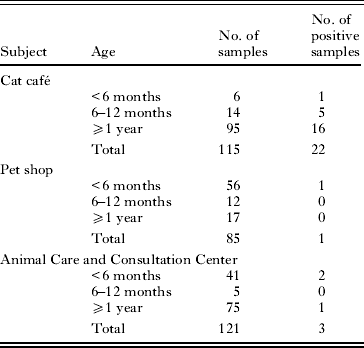
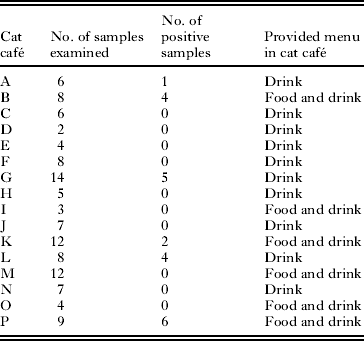
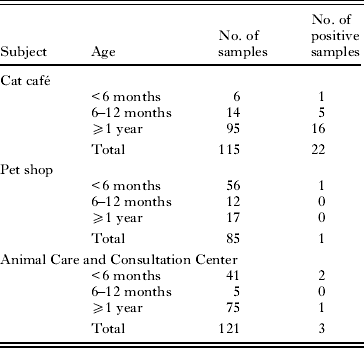
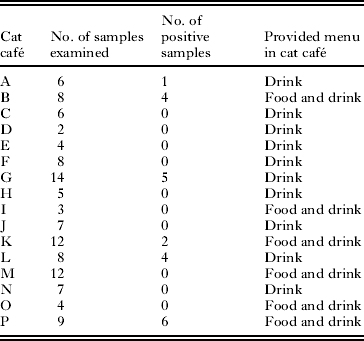
The detection rates of G. duodenalis isolated from cats in 16 cat cafés, 31 pet shops, and the Animal Care and Consultation Center were 19·1% (22/115), 1·2% (1/85), and 2·5% (3/121), respectively (Table 3). All cats infected with G. duodenalis were asymptomatic. The highest detection rate of G. duodenalis was observed in cats that were between 6 and 12 months old, and cysts were detected in cats from 37·5% (6/16 shops) of cat cafés. The detection rates of G. duodenalis in the 6 positive cat cafés ranged from 16·6% to 66·7%, and 50·0% (3/6) of the menus at the 6 cat cafés consisted of food and drink (Table 4).
Prevalence of Giardia duodenalis by fecal examination of cats in cat cafés, pet shops, and the Animal Care and Consultation Center in Tokyo, Japan
Prevalence of Giardia duodenalis infection in cats in cat cafés and the menus provided in these cafés
Sequence and phylogenetic analyses of Giardia duodenalis isolates
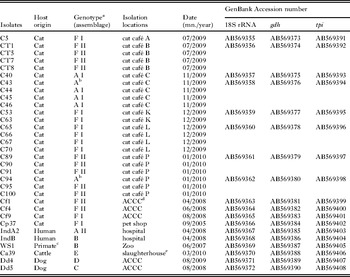
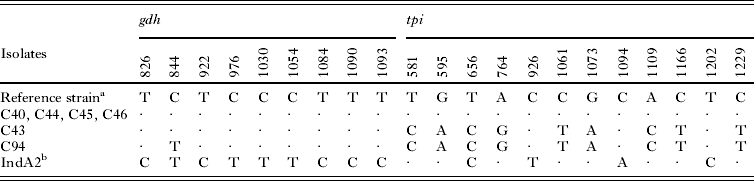
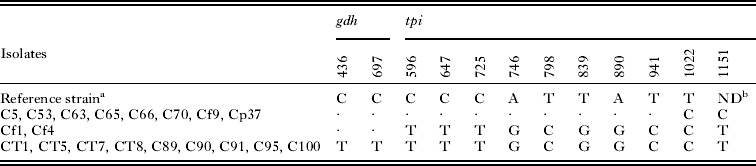
PCR and sequence analyses of the 18S rRNA, GDH, and TPI gene sequences were performed for 26 samples, including 22 samples from 6 cat cafés, 1 sample from a pet shop, and 3 samples from the Animal Care and Consultation Center (Table 5). In the sequencing results of the 263-bp fragment of the 18S rRNA gene, the genotype of 6 samples from 2 cat cafés was zoonotic genotype assemblage A as compared with the G. duodenalis Portland 1 reference strain (GenBank Accession no. M54878). The genotype of the other 20 samples was the cat-specific genotype assemblage F, determined based on identity with the BAG7 reference strain (GenBank Accession no. AF199444). In the sequencing results of the 727-bp and 692-bp fragments of the Giardia GDH (1691 bp) and TPI (1583 bp) genes, respectively, 6 G. duodenalis isolates, identified as assemblage A genotype in sequence analysis of the 18S rRNA gene, could be divided into 2 groups based on a single base substitution in the GDH gene and 9 base substitutions in the TPI gene (Table 6). The sequence of the C94 isolate in the GDH gene showed 100% identity with that of the G. duodenalis GF-2 reference isolate (GenBank Accession no. AB469364) from ferrets (Abe et al. Reference Abe, Tanoue, Noguchi, Ohta and Sakai2010), but the nucleotide sequences of the TPI gene of the C43 and C94 isolates did not match any of the known Giardia sequences in GenBank by BLAST search. On the other hand, 20 G. duodenalis isolates, identified as assemblage F genotype in sequence analysis of the 18S rRNA gene, could also be divided into 2 groups based on 2 base substitutions in the GDH gene and 10 base substitutions in the TPI gene (Table 7).
Sequence-based genotyping of Giardia duodenalis in this study

a This grouping of assemblages depended on analysis of TPI.
b Assemblage A III or Assemblage A new cluster.
c Pithecia pithecia (white-faced saki).
d Animal Care and Consultation Center in Tokyo Metropolitan Government.
e Slaughterhouse in Shibaura, Tokyo, Japan.
Polymorphic sites of GDH and TPI sequences in Giardia duodenalis isolates of assemblage A in this study
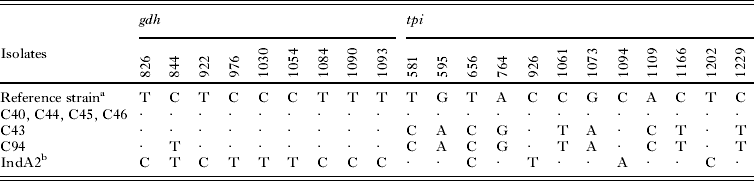
a The sequence data of Portland 1 (M84604) and WB (L02120) reference strains are represented as numbers at variable positions in the GDH and TPI genes, respectively.
b IndA2 isolate was identified as assemblage A II.
Polymorphic sites of GDH and TPI sequences in Giardia duodenalis isolates of assemblage F in this study
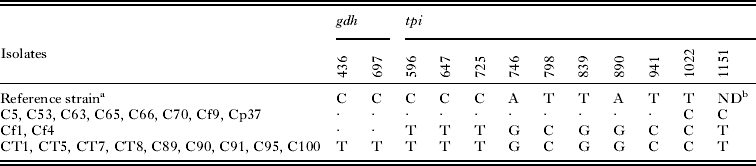
a Reference strain of the GDH and TPI genes was Ad-23 strain (AF069057 and AF069558).
b Data on reference strain at position 1151 are unknown.
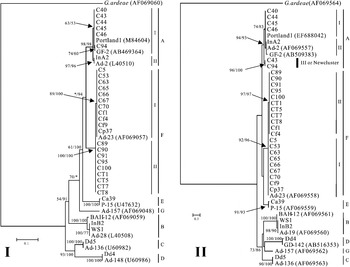
Phylogenetic trees in assemblage F generated by the ML method and GTR model revealed 2 major lineages that were designated assemblages F I and F II (Fig. 1). The 6 G. duodenalis isolates of assemblage A from cat stool samples from 2 cat cafés belonged to the same cluster with regard to the GDH gene, but 2 isolates (C43 and C94) belonged to a new cluster that was different from assemblages A I and A II based on analysis of the TPI gene.
Phylogenetic relationships obtained by ML analysis between (I) GDH and (II) TPI gene sequences of Giardia duodenalis isolates and reference strains. The ML tree was derived with a GTR model by using estimates of the proportion of invariable site parameters of 0·327 (GDH) and 0·341 (TPI). Significant bootstrap support (>50%) from ML by 1000 replicates and Bayesian analysis are shown above the node in the order ML/BI. An asterisk indicates <50% support for a node. The scale bar represents the distance in substitutions per nucleotide. GenBank Accession numbers are given within parentheses.

DISCUSSION
In sequence analysis of the TPI gene of Giardia detected at 5 cat cafés, excluding C43 and C94 isolates at C and P cat cafés, all G. duodenalis isolates from cats that were maintained at the same cat café were identical. On the other hand, in the genotyping of 26 G. duodenalis isolates from cats, 2 (C43 and C94) of the 6 isolates of zoonotic genotype assemblage A belonged to a different cluster from the other 4 isolates with regard to phylogenetic analysis of the TPI gene. It has been reported by Monis et al. (Reference Monis, Andrews, Mayrhofer and Ey2003) that BAC2 and BAC3 isolates from cats belonged to assemblage A III based on allozyme analysis, but the sequences of BAC2 and BAC3 isolates in GDH and TPI genes were not clear in GenBank. Therefore, it is possible that 2 isolates (C43 and C94) in this study belonged to assemblage A III or a new cluster that was different from assemblage A III by analysis of the TPI gene. Moreover, in the deduced amino acid sequences of the TPI gene, C43 and C94 isolates could be divided into 2 groups based on a polymorphism (serine or asparagine) at position 23. The deduced amino acid sequences of the TPI gene in assemblages F I and F II of G. duodenalis isolates possessed a polymorphism (histidine or tyrosine) at position 91. Previously, it has been reported that genetic exchange within and between assemblages of G. duodenalis occurred by allelic sequence divergence within G. duodenalis isolates and intra- and inter-assemblage recombination (Teodoravic et al. Reference Teodorovic, Braverman and Elmendorf2007; Lasek-Nesselquist et al. Reference Lasek-Nesselquist, Welch, Thompson, Steuart and Sogin2009). This may explain why the subclusters of C43 (assemblage A), Cf1, and Cf4 (assemblage F) isolates varied between the GDH and TPI genes, suggesting that the 3 isolates had exchanged genetic information within the assemblages of G. duodenalis.
Household companion animals may serve as sources of Giardia infection and, as previously reported in Australia and Italy, assemblages A and B of G. duodenalis were detected in dogs and cats, which are popular companion animals (Berrilli et al. Reference Berrilli, Di Cave, De Liberato, Franco, Scaramozzino and Orecchia2004; Read et al. Reference Read, Monis and Thompson2004; Vasilopulos et al. Reference Vasilopulos, Rickard, Mackin, Pharr and Huston2007). On the other hand, in the surveillance of Giardia infections in animals in Japan, G. duodenalis genotypes of assemblages A and B were detected in ferrets (Abe et al. Reference Abe, Read, Thompson and Iseki2005, Reference Abe, Tanoue, Noguchi, Ohta and Sakai2010), but G. duodenalis assemblages A and B have not been detected in cats (Itagaki et al. Reference Itagaki, Kinoshita, Aoki, Itoh, Saeki, Sato, Uetsuki, Izumiyama, Yagita and Endo2005; Itho et al. Reference Itoh, Muraoka, Kawamata, Aoki and Itagaki2006). Eating and drinking facilities that are pet-friendly, such as cat cafés, were previously uncommon in Japan, although guide dogs have long been able to accompany their owners to restaurants. The infection rate of G. duodenalis at cat cafés was about 8-fold higher than that in cats maintained at pet shops and the Animal Care and Consultation Center that supplied cats to the cat cafés. Zoonotic-genotype Giardia was detected in 2 (cat cafés B and P) of the 16 surveyed facilities, and on sequence analysis of the TPI gene of Giardia detected at 5 cat cafés, virtually all of the G. duodenalis isolates from cats maintained at the same cat café were identical, suggesting that cats were infected after arriving at the cat café in 5 (cat cafés C, B, K, L, and P) of the 6 Giardia-positive facilities.
The Japanese Food Sanitation Law does not prohibit animals from entering the kitchen in eating establishments by separating the kitchen from the seating area by a door, which excludes animals. However, many cat cafés permit customers to eat and drink while in contact with cats, thus the possibility of cats entering the kitchen cannot be ruled out because training cats is difficult. Zoonotic-genotype G. duodenalis was detected in several cat cafés, suggesting the necessity of instructing customers to wash their hands before eating and drinking and upon leaving the café, the periodic testing of cats and at the introduction of new cats, and mass de-worming, regardless of whether any detected Giardia is of the zoonotic genotype.
ACKNOWLEDGMENTS
We are grateful to the veterinarians of the Animal Care and Consulting Center of the Tokyo Metropolitan Government for providing the cat and dog stool samples. We would sincerely like to thank veterinarians H. Tajima of the Ueno Zoological Gardens and H. Tsukuda of the Shibaura Meat Sanitary Inspection Station for providing the primate stool sample and cattle stool sample, respectively.