


At the base of an ice sheet where the thickness is h and the surface slope is α (assumed small) it has been held (Reference NyeNye, 1952[a], Reference Nye[b]) that the shear stress τb is given approximately by
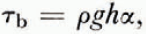
where ρ is the density and g is the gravitational acceleration. This formula may be justified in several different ways, which may be briefly reviewed.
(i) One way is to note that the hydrostatic pressure is much greater than the shear stresses at all levels in the ice sheet except those near the top, and to assume that it is equal to ρgd, where d is the depth beneath the surface. The hydrostatic stress formula ρgd, is, of course, only exact when the material is a fluid, at rest, sustaining no shear stresses and having a horizontal surface. When a is small and non-zero, and when the material supports shear stresses, it will only hold as an approximation—and when α is large it will break down completely. a must therefore be assumed small. The rock bed is allowed to have a small, non-uniform, slope β in the same direction as the non-uniform surface slope. On these assumptions the longitudinal stress is approximately equal to the hydrostatic stress. Equation (1) then follows (Reference NyeNye, 1952[a]) from a balance of forces, the interesting point being that β does not appear in the final formula.
(ii) For a parallel-sided slab of ice of thickness h, resting on a uniform slope α, provided all conditions are uniform down the slope, a balance of forces immediately shows that

In this derivation, essentially due to Reference OrowanOrowan (1949), there is no restriction to small α, but if α is small we find Equation (1) again. Note that there is no reference to the hydrostatic stress formula. The longitudinal stress, along with everything else in the problem, including α and h, is simply assumed not to vary down the slope.
(iii) Having noted in derivation (i) that β does not appear in Equation (1), a semiintuitive argument may be given (Reference NyeNye, 1952[b]) in support of the idea that Equation (1) still holds for small α and β even when the bed slope β is not in the same direction as the surface slope that is, when the strikes are not parallel).
(iv) In an exact (numerical) calculation (Reference NyeNye, 1967, p. 706) for a perfectly plastic material flowing under gravity over a horizontal base it is found that, over the greater part of the field, Equation (1) holds as a first approximation when a is small (and a second approximation is also given), but near the up-stream boundary the flow is disturbed from the “normal” pattern and here, even though α is small, Equation (1) is totally invalid even as an approximation.
Clearly, there are conditions under which Equation (1) is a valid approximation and also conditions, even when α is small, where it is not. The difficulty is to formulate the precise conditions under which it is a valid first approximation, and to improve it satisfactorily. (i), (ii) and (iv) all imply different, and equally valid, sets of sufficient conditions, but the set of necessary and sufficient conditions has yet to be found.
As soon as one tries to apply Equation (1) in practice one meets the question of the interpretation of α and, to a lesser extent, h. Over what distance are these to be averaged? The derivations of the formula indicate that this distance should be at least of order h and perhaps greater, but the mere fact that one cannot use very local values of α in the formula emphasizes its limitations.
In face of these problems there have been various attempts to improve Equation (1), and discussion has centred particularly on the role of the longitudinal stress. In all the derivations (i) to (iv) above, the longitudinal stress, in a certain sense, has been assumed uniform along the flow direction. If it has a gradient in this direction, Equation (1) will be changed. This was first emphasized by Reference LliboutryLliboutry (1958). More recently Reference RobinRobin (1967), Reference BuddBudd (1968, Reference Buddunpublished) and Reference BeitzelBeitzel (in press), in interpreting field data on the surface and bed profiles of ice sheets, have concluded that longitudinal stress gradients are an important aspect of the problem. Reference ShumskiyShumskiy (1961) also has included them in his analyses.
The purpose of this paper, which arose after a very helpful discussion with Dr Budd, is to try to put the theoretical derivations which he gave on a more secure foundation. By choice of a suitable coordinate system and suitable redefinition of the variables it is possible to derive a formula for the basal shear stress that is comparatively free from restrictive assumptions, and, incidentally, is valid for any slope angle. The next step, necessary before the formula can be applied, involves a crucial assumption about the connexion between the longitudinal stress and strain-rate that may be questionable. The present treatment does not avoid this assumption, but it does remove certain doubts and difficulties from the earlier stages of the analysis. One has to bear in mind that the new term that is being calculated, and which depends on the longitudinal stress gradient, is, in some circumstances but not always, a second-order correction term to Equation (1). Therefore, particular care is necessary in making any approximations, and it becomes especially important to define all quantities precisely.
Collins’s careful paper Reference Collins(1968), which analysed the mathematical justification for Reference RobinRobin’s (1967) approach, has the same aims as this one, but it uses a different coordinate system with axes horizontal and vertical. Physically the two treatments are very similar (although the treatment here introduces an optional no-slip condition at the bed, which is not present in Collins’s analysis) and there seems to be no disagreement between them. But the method used here is simpler. Collins does indeed refer to the possibility of taking local orthogonal axes in the surface, as is done here, but he rejects it because “the axes are curvilinear and may be initially unknown”. Strictly speaking, the axes used here are rectilinear, not curvilinear. However, the equations derived are only used on the z-axis, which is normal to the surface, and for each surface station one sets up a new rectilinear coordinate system. Thus it is true that the coordinate directions are different for each surface station, but nevertheless the quantities in the equations are all defined with respect to rectilinear axes. There are no complications due to curvature terms in the equations of equilibrium. The fact that these axes lead to simpler equations indicates that they suit the phenomenon under investigation and thus make it easier to understand. This is a sufficient reason for using them. In some field applications there is an additional practical advantage in having axes referred to the upper, accessible, surface of the ice sheet. In others it may be better to use horizontal and vertical coordinates at the expense of equations that are less easy to interpret.
We confine ourselves to two dimensions (plane strain). Choose an origin at some arbitrary point in the top surface (Fig. 1), and choose rectilinear axes in a vertical plane, with Ox tangential to the top surface in the direction of movement, and Oz perpendicular to it pointing downwards. Let the angle between Ox and the horizontal be α 0 and let the slope of the bed at the point where Oz meets it be β 0 Thus, although the top surface and the bed have slopes that are non-uniform, α 0 and β 0 as defined here arc constants. They need not be small and may be positive or negative. Figure 1 shows their positive senses. Since accelerations are negligible we may use the equations of equilibrium for the stress components σ x ,σ z ,τ xz :


for all x and z within the ice, and let us allow ρ, the density, to be a function of x and z.
Integrate Equation (3) with respect to z from z = 0 to z = h 0, where h 0 is the thickness of the ice at x = 0:

for all x. Write

for all x. h 0, being the thickness at x = 0, is a constant independent of x (but the thickness of the ice is, of course, non-uniform and does depend on x). Therefore


for all x. The top surface being free, we have (τ xz ) z = 0 = 0 at x = 0.
Coordinate system. Ox is tangential to the lop surface at O.

It is generally supposed that when the basal ice is below the melting point it does not slip on the bed. If the basal ice does not slip, a line in the basal ice drawn parallel to the bed does not extend. Assume that the volume change of the basal ice is zero. It follows that the bed is in a direction of maximum shear strain-rate; the basal ice is deforming by simple shear. We conclude that the bed is also a direction of maximum shear stress. This would be true by symmetry if the ice were isotropic; but even if the ice were anisotropie in its flow properties it is still true, provided the flow properties have a plane of symmetry parallel or perpendicular to the bed, which seems a very plausible assumption. Now at x = 0 the bed makes an angle α 0−β 0 with the x axis, and the positive sense of τ xz is opposite to that of τ b , the shear traction on the bed at x = 0 (since x was taken positive in the direction of motion). Therefore, for x = 0,

and, substituting in Equation (7) written for x = 0,

The term on the left in Equation (8) involves a longitudinal stress gradient. But, as we have pointed out,


That the distinctions are far from trivial may be seen by considering the “hydrostatic” model we began with under heading (i), taking the base as a flat horizontal plane, and letting the density be uniform. Then

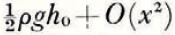


If α 0 = β 0 and

Continuing the general analysis, let us assume that at x = 0, ∂ρ/∂x = 0. Then, following Budd, we may differentiate Equation (4) with respect to x, remembering that ao is α 0 constant, to obtain

and then integrate twice with respect to z, from o to z and then from 0 to h 0:

Since Ox is tangential to the free top surface at x = 0 it follows that (∂σ z /∂x) x = 0,z = 0 = 0, so we may write

Subtracting Equation (9) from Equation (8) we obtain

(Since the plane z = 0 may enter air on both sides of x = 0, and since the plane z = h 0 will certainly enter rock on one side or other of x = 0, it is necessary to define the x derivatives in the equations at x = 0. This may be consistently done by regarding the derivatives as limiting values obtained by letting z↘0 and z↗h 0, that is, by approaching the limits from within the ice.)
The assumptions and restrictions on which Equations (8) and (10) are based are: (a) two-dimensional flow, (b) equilibrium, (c) ∂ρ/∂x = 0 on x = 0, (d) top surface free, (e) no slip on the bed, (f) no volume change in the basal ice, (g) the assumption about the anisotropy of the flow properties of the basal ice. There are no others. If the basal ice were not below the melting point, so that there was slip on the bed, the direction of maximum shear stress could cease to be parallel to the bed, and then the term τ b cos 2(α 0−β 0) would not be exact—but the term would still continue to be approximately τ b for small α 0and β 0 except at places of high longitudinal strain-rate. For cold ice in two-dimensional flow, however, all the assumptions are very plausible and, accordingly, Equations (8) and (10) are expected to be true to high accuracy in this case.
Robin bases his work on an equation similar to Equation (8) (after subtracting a hydrostatic pressure from

The objective, which was to derive Equations (8) and (10) as rigorously as possible, has now been reached. It remains to summarize the continuation of the argument, which is due to Budd and Robin. Write

Budd supposes that the longitudinal strain-rate


or better, since

This is the key assumption, and Robin makes a similar one. It may be questioned, as they recognize, because, among other difficulties, τ xz as well as


All the quantities in Equation (11), including α 0 and β 0 are to be measured at x = 0. But, since the origin was chosen arbitrarily, the equation may equally well be applied anywhere, provided of course that α 0 and β 0 and all the other quantities are measured in the new local coordinate system. (The assumption (∂ρ/∂x) x = 0 = 0 then means simply that the ice is stratified parallel to the wavy top surface.)
To facilitate further discussion write the terms in Equation (11) as

(G for the gradient term, τ for the basal shear stress term, τ ⋆ for the shear stress as given by Equation (2), and T for the last term). In his application to the Wilkes ice cap Budd averages the equivalent of Equation (11) over a distance of 15 to 20 km (≈20h 0) at a series of points and finds that, on this scale, terms G and T become relatively unimportant. Thus approximately

where bars denote averages over (≈20h 0). For small slopes, as in this application, this is simply Equation (1). Budd then averages over about 4 km (say ≈ 4h 0) thus

where


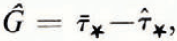


The conclusion is that the basal shear stress does not fluctuate in sympathy with the surface slope α over distances ≈4h 0 (since


It is to be noted that the argument in this form essentially depends on the observational fact of Equation (14). Why the ice sheet should behave in such a way that Equation (14) is true is a deeper question that does not seem to have been answered.
I am grateful to Dr I. F. Collins for his helpful comments on the first draft of this paper.



