

Introduction
Studies on the development of Christianity usually focus on male missionaries and their organisation but pay less attention to the role of indigenous women and gender in the process of conversion. In the Canadian eastern Arctic, many scholars have contributed to a better understanding of Inuit conversion to Christianity but have hardly discussed the role of women (see Remie Reference Remie1983; Brandson Reference Brandson1996; Saladin d’Anglure Reference Saladin d’Anglure1997; Laugrand Reference Laugrand2002; Laugrand and Oosten Reference Laugrand and Oosten2009; Trott Reference Trott.1997, Reference Trott1998; Stuckenberger Reference Stuckenberger2005). In the last decade, a few anthropologists and ethnohistorians have started exploring the role of women in Christianisation in North America: Nancy Shoemaker (Reference Shoemaker and Shoemaker1995a, Reference Shoemaker and Shoemaker1995b) and Greer (Reference Greer2005) among the Iroquois, Kathleen Bragdon (Reference Bragdon1996) among the Indians of New England, Sergei Kan (Reference Kan1996) among the Tlingit, and Michael Harkin among the Heiltsuk, Monica Diaz (Reference Diaz2010) in colonial Mexico. Kan and Harkin dedicated an entire issue of Ethnohistory to this topic (see also Bowie and others Reference Bowie, Kirkwood and Ardener1993). In the eastern Arctic only Nancy Wachowich (Reference Wachowich1999) who devoted a book to Inuit women provides interesting details about women perspectives on religious matters. In our research on the adoption of Christianity by the Inuit we just started to explore the role of women in a study of the case of Pelagie, the first Inuit nun (Laugrand and Oosten in press). In this paper, we will enlarge the study and focus on the role of Inuit women in inspiring and converting their fellow Inuit.
Missionary sources show that in the first years of the mission in the Inuit camps the missionaries mainly taught women and children who remained in the camp when the men went out hunting. Women thus appear to have been the first to receive the gospel and probably played a key role in the conversion process. The first converts in the south Baffin area were women. In the Kivalliq Inuit women were also strongly involved in Roman Catholic evangelisation. Thus Teresikiluk succeeded in effecting the conversion of her father in law, the angakkuq (shaman) Taleriktok and his family. In the Kivalliq Roman Catholic missionaries were present through the Missionary Oblates of Mary Immaculate, a congregation founded in France in 1816 by Eugene de Mazenod, to revive the spirit of faith among rural populations and to preach to the poor in the most difficult missions of the Church, and through the Grey Nuns. These played an important part in inspiring Inuit women. Grey Nuns belong to the order of the Sisters of Charity that was founded by Marie-Marguerite de Lajemmarais d’Youville in 1737 with the objective to help the poor people. They arrived in Canada in 1844 at the invitation of Bishop Provencher who thought they could help the Oblate missionaries who had just arrived in Saint Boniface to evangelise the Indians. In 1931, a group of Nuns from St-Nicolet was sent to Chesterfield Inlet to take care of a hospital built that same year.
Teresikuluk never was a candidate to become a nun since the Grey Nuns only arrived in 1931 at the invitation of the Oblates, but after her early death she became a powerful symbol of religious commitment. Several other Inuit women in the Kivalliq tried to become a nun, but only one woman succeeded, Sister Pelagie Inuk (1931–2010).
In this paper we use historical and archival documents as well as oral information collected in the last ten years in Nunavut, notably interviews with elders.
We will first describe examples of Inuit women from Baffin Island, particularly in the earliest Anglican mission posts, to show that women were very responsive to the Christian ideas and values. Here we will mainly rely on the information provided by Revd. E.J. Peck and the early missionaries in the area. The perspective of the Inuit women comes to the fore in their letters to Peck written after his departure from Uumanarjuaq (Blacklead Island). We will then briefly discuss the situation in the north Baffin area. Information on early Christianity is provided by ethnographers such as Rasmussen (1929) and Mathiassen (Reference Mathiassen1928) as well as in interviews with elders in the Iglulik oral traditions project and interviews with elders conducted by the authors. Finally we discuss the development in the Kivalliq region to examine in more details the cases of Teresikuluk and Pelagie. Here we rely on information provided by the Roman Catholic missionaries as well as interviews with Pelagie and other elders conducted between 2000 and 2008. By presenting missionary as well as Inuit perspectives we aim at a balanced view of the role of women in the adoption of Christianity.
The Anglican missionaries did not particularly emphasise the contributions by women as they were, putting their hopes on men and local leaders to become native preachers and catechists. In contrast, Catholic missionaries spent much energy in stimulating and valuing female vocations, not only to demonstrate their success, but also to mark the advent of a new era in which shamanism gave way to Catholicism.
In the early stages of the Arctic missions Inuit women often responded with greater enthusiasm than their husbands and often proved to be better informed about the tenets of the Christian creed. Ethnographic sources indicate that in the pre-Christian period, Inuit women had to respect many ritual injunctions and rules of abstention. Like shamans, they had to observe many pitailiniit (rules of refraining) with respect to food. They were isolated in a small igloo during birth and separated from the rest of the group for a long time after. These women may have seen Christianity as a way to escape from these rules but they still could not escape their own gender roles.
The role of Inuit women on Baffin Island
South Baffin
On Baffin Island, the Anglican missionaries opened their first mission post in 1894 with the arrival of Revd. E.J. Peck. As the men were most of the time out hunting or whaling, the missionaries concentrated their efforts on teaching women and children, a long-term strategy that proved to be highly effective. In November 1894, Peck developed adult reading classes. Two techniques were adopted for attracting people: the use of a magic lantern and an invitation to a family for tea each day (see Laugrand and others Reference Laugrand, Oosten and Trudel2006: 19).
But it took several years for the first conversions occurred. The first Inuit to show some interest in Peck's preaching were women and sick people. In March 1897, Peck reports the case of a woman named Toologak who had not only retained much of what she had heard, but has also mastered the syllabic characters (see Laugrand and others Reference Laugrand, Oosten and Trudel2006: 22). In March 1896, he refers to another woman proselyte, Padlo, instructed during the winter 1895 (Peck Reference Peck1895: 25/2). In 1900, another candidate was found among the women: ‘A woman came to see me. She stated that her heart has been touched by the Word of God’ (Peck Reference Peck1901: 8/01).
As interest developed among the Inuit, missionary activities in the school increased. In 1901, a first group of Inuit proselytes was constituted: ‘a goodly band [that] became what we may call chief readers or leaders in the congregation’ (Peck Reference Peck1922: 21). In that year a more general change in the attitude of the Inuit become apparent: ‘There is a reality about prayer here which the writer has never experienced elsewhere. [. . .] God becomes a reality; faith is strengthened and hope is brightened’. On 4 May 1901, Atterngouyak (probably Atagujuk), an old woman suffering from consumption expressed the wish to be baptised. Worried by her state of health and her weakness, Peck agreed to baptise her the next morning. On 7 May, Atterngouyak was not able to come to the Church, and she asked Peck to baptise her again but this time in public (Peck Reference Peck1922: 21).
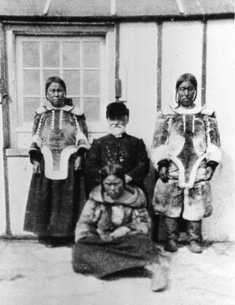
That year, 1901, the number of candidates for baptism increased greatly. In January, 26 persons were asking for it, 24 women and 2 men. (see Laugrand and others Reference Laugrand, Oosten, Kakkik, Laugrand, Oosten and Kakkik2006: 23). On 26 May 1901, the three most promising candidates were finally baptised while a large and most attentive congregation was gathered: Arane [Araniq], Immukke [Imaqi] and Nooeyout [Nuijaut] (Fig. 1).
Rev. E.J. Peck and the first Inuit converts: Imaqi, Nuijaut and Arani.Toronto: Anglican Church of Canada, General Synod Archives (A ANG P 7502.22)
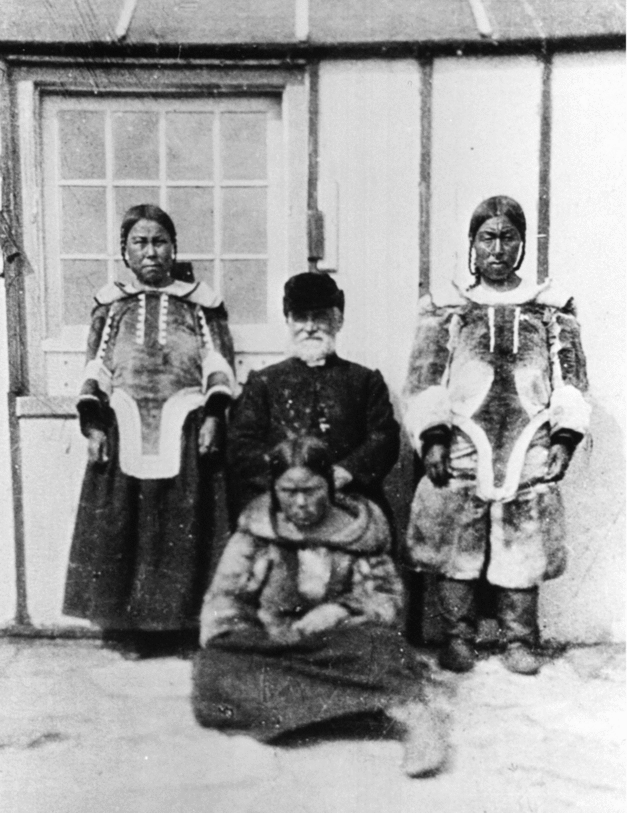
At the same time, some Inuit men also converted to Christianity, some of them accepting to act as teachers and leaders for their fellow people but women clearly soon showed more enthusiasm. In 1904, Peck listed the first 30 Inuit baptised. The years 1901–1904 marked a period of rapid conversion. Peck observed: ‘It must be obvious to anyone that a marked change has taken place in this people’. The trend was continued after he left. So, if Peter Tulugarjuaq's conversion and transition to Christianity in 1903 may have triggered a series of conversions in Cumberland Sound, and especially at Uumanarjuaq, women already played a key role before that time, especially in the places where no missionaries were posted. A closer look at Arani, Imaqi and Nuijaut shows that they maintained a close connection with Peck.
Eve Nuijaut
Eve Nuijaut assisted Peck at the mission and provided him with much information on Inuit traditions to him. In the Peck archives we find a long excerpt by Eve Nooeyout of the Gospel of St. Matthew. She may have been the author of the text of Eskimo heathen customs that was published in our book on Peck (Laugrand and others Reference Laugrand, Oosten and Trudel2006: 308). Her name also occurs in the list of helping spirits compiled by Peck (no. 224). Peck describes the spirit as follows: ‘Like a woman. Good spirit. Gives joy. The female class of torngat give joy more than material supplies’. Eve Nuijaut continued to support the work of the missionaries and in September 1907, the Anglican missionary Julian Bilby noted: ‘The work at Blacklead has also gone forward and good work has been done by our native teachers. The school has been kept up regularly by two of my former pupils, Nooyout and Ningeorapik, they taught the children whilst their husbands were away hunting.’ Bilby published a letter he received from her in which Nuijaut declares her great faith in Jesus and God who cause the dead to live whereas ‘the conjurors cause the dead to rise’ (Laugrandand others Reference Laugrand, Oosten, Kakkik, Laugrand, Oosten and Kakkik2003: 32).
Nuijaut remained in contact with Peck after his departure from Baffin Island. In the ethnographic manuscripts of Peck we find several texts provided by her
(A7) I am Nuijaut Ivik.
I am writing to you, because I miss you. I really want to see you, but I am unable to come. My brother, Naullaq, was really sick and almost died, but he is really grateful to God, because He had heard his prayers. Long ago he had an infection in his head, and he almost died. Last year, he was sick again, but it was in his abdomen. We prayed a lot and he is better and we are grateful to God. I think about God a lot, I am also grateful to Ilataaqau (Reverend Greenshield), he had helped him a lot, and he has been helping Inuit too. He preaches really well. I do not know where you are, but I am writing to you. I thought you were in Kimmirut. I think of you a lot. My husband, Qilavaaq, and I would like to see you again. I do not have anything to give you right now. I have two children, my son Piituluusi, and my daughter Ivi. Farewell to all of you, and I think of all of the Inuit there.
I heard that they are now believing in God, our father, and to Jesus.
I am Nuijaut in Uumanarjuaq (Laugrand and others Reference Laugrand, Oosten, Kakkik, Laugrand, Oosten and Kakkik2003: 36).
Nuijaut regrets that she has nothing to give to Peck. We find such statements often in Inuit letters to Peck. They reflect the importance of the gift in Inuit society. Moreover, the missionaries themselves often distributed gifts at special occasions such as Christmas. Apparently Nuijaut's mother was also converted. In a letter Nuijaut's mother explains how her daughter was a stillborn child and that she loved her a lot. She also informs Peck that ‘some Inuit here are not being good to us’ and she even denounces Naullaq who was recently married by the missionaries but broke up with his wife who apparently ‘slept with other men’ (Laugrand and others Reference Laugrand, Oosten, Kakkik, Laugrand, Oosten and Kakkik2003: 38).
Aaraniq
Aaraniq wrote several long letters to Peck. In her letters she refers to the sickness of her husband Ikirak who had TB and was saved by Ilataaq (Bilby). She herself almost died of starvation. Her letters testify to the difficult conditions of life at Uumanaqjuaq in the years after Peck left even though the missionaries provided food and medical care. She informs Peck about her family situation as well as the progress of Christianity in Uumanaqjuaq. She assures him that the Inuit will persevere in their Christian beliefs and practises
(A13, 1/2) From Maria Arani
I am grateful to you, because you have not forgotten me, and you have been praying for me. I am also grateful, because you wrote to me. I will not forget what you have told me about Gods’ words. You also told me to seek for this and I will not forget that at all. I am grateful to God in helping me and keeping me alive. I am also grateful, because we are being preached to, that will help us, by our preacher in Uumanarjuaq. Last year, my husband, Ikiraq, was really sick. He had TB, Tuberculosis, but he was helped by God. It happened in the summer, while we were out caribou hunting, and when we went back to Uumanarjuaq Ilataaq helped him. If Ilataaq did not come to our land, (A 13,2), if Ilataaq did not arrive, Ikiraq would have died, but Ilataaq saved him and he is alive today. This is for you to see, a sketch of my qulliq (oil lamp) and an old pot. Inuit use these. But now, I do not use the old pot anymore. It was the only pot we had back then. I do not have a qulliq, that is why I am not sending you one. I am sure you are praying for us, we pray to God, and we have to practise it more and more. We are also grateful to God because He helped us and keep us alive, although we live quite far from each other. He is in us. He hold us by our hands, He is the one who give us air to breath, He is the one who provides us with food, and we are grateful from that. I know we have a Saviour (Arani between Reference Arani1909 and 1919).
Just like Nuijaut, Aaraniq is not able to send Peck a gift. She sends him a sketch of her qulliq because she cannot send him a real one. We may assume that by emphasising their inability to give the authors also indicate that they are in need of gifts themselves.
In another letter Aaraniq relates how she survived starvation and was saved by Jesus. (C 1. 1/4) (To Uqammaq, from Araniq
(C1.1) I’m more alive than I was. I am grateful, because we are getting Inuit ministers.
Now have four Inuit ministers: Tulugaqjuaq, Killapik, Naullaq, who is Uqijuaqsiut's son, and Qilavaak. We have a minister even when Ilataaqqau is away. We are happier and we want to be Christians, before God, One who gives His love. He is One and only One. (C1.2) Uqammak, you wrote me a letter last year. I know that God has kept us alive, and He has helped us. Jesus is my Saviour. In Uumanarjuaq, when we did not have a Qallunaaq, I almost died from starvation, I was not able to walk and get up on my own, and my three children were not able to get up either, because we were starving. I thought to myself that it would be all right if we starved, but if He wanted us to be alive, would be. We do not have a Saviour on earth. We have God, and Jesus who is our Saviour. That is what I thought, and I prayed to Jesus and God. (C1.3) It is definitely true that because the words of Jesus we are truthful I am still alive. I am grateful because I was saved. Death was really close to me (Laugrand and others Reference Laugrand, Oosten, Kakkik, Laugrand, Oosten and Kakkik2003: 41–42).
She informs Peck that she does not have a comb and that they are all praying for him.
Mary Imaqqi
Imaqqi was also one of the first three converts in 1901, but we could find no further information about her. In the collection of letters only one letter could be traced to her. She acknowledges the receipt of a Bible and indicates that she would appreciate help. She will try to spread the gospel among the Inuit
(B 1) My friends, I am very grateful because we did not know God and now we do. He hears our prayers. Uqammaq has introduced Him to us, and we are really grateful. Uqammaq has given us something that is bigger and better. When we go to church we want to hear Jesus’ good words. I will pray for you, I would like it if people help me sometimes. I am really grateful to receive a Bible. We will see each other up there. We love Jesus very much, and I pray for everyone. I make a lot of things for the Inuit here. I will try and talk to Inuit who have not heard of Jesus yet. Farewell to my family, my friends
From Mary Imaqi (Laugrand and others Reference Laugrand, Oosten, Kakkik, Laugrand, Oosten and Kakkik2003: 44).
Mary explains that she is making a lot of things for Inuit and spreading the gospel. The gift of a Bible therefore seems most appropriate.
Aasivak
Aasivak was the wife of Angmaalik, a leader and a shaman from Qikirtat, later described by the German explorer B. Hantzsch ([1910–1911] Reference Hantzsch1977: 32) as ‘the most successful seal hunter on the Gulf’. In 1902, Angmaalik stated that he had a revelation from Sedna, the inua of the sea. He was prepared to follow some Christian rules but not all of them, Peck and Greenshield decided to meet him again and have a good talk with him. A few weeks later, Angmaalik accepted a full conversion to Christianity (see Laugrand and others Reference Laugrand, Oosten and Trudel2006: 25–26). But Inuit tradition holds that Angmaalik finally converted himself not so much because of the pressure of the missionaries but rather under the influence of his wife Aashivak, a strong character who decided they should reject the old practices and beliefs. Stevenson (Reference Stevenson1984: 35) refers to the tension between Angmaalik and his wife with respect to the new religion:
The Inuit leader at Kekerten after the 1890s was Angmalik. His house is located here. Angmalik was regarded for his hunting prowess, leadership, fairness and faith in the old beliefs. For reasons that are unclear, women readily accepted Christianity, while men tended to reject it. The size of Angmalik's qammaq reflects his wealth and status, whereas the adjoining room, built by his wife, may symbolize the conflict created between the sexes when Christianity was introduced.
Aasivak succeeded in convincing her husband that he should convert to Christianity. The story that the women at Qikirtat made a complete set of shamanic ceremonial clothing and threw it into the sea to express their rejection of the old religion became famous.
In 1976, Qatso Eevik related the story of Ashivak's [Aasivak] conversion in Stories from Pangnirtung.
Later, when my parents returned to Kikitaet [Kikerton] from Oomanayoak [Uumanarjuaq], they saw that the people had changed from their old ways of life into bad and evil ways and worshipped a false god they called Sanah. My mother wanted the people to turn back. So in the summer my mother got some women together to make caribou clothes. The clothes were at least two times as big as the ones Eskimos wore, or maybe bigger than anybody could use on earth. They made everything, the parkas, the kamik (boots), the mittens, the pants, in fact the whole works. After they finished, everything was thrown into the water because that is what my mother wanted them to do. They made these clothes so that they could throw them into the water and no longer be followers of this God (‘Sedna’) (Eevik Reference Eevik1976: 78–79).
The sea woman was often imagined to be of giant size so the clothes were probably made to fit her. This act was intended to terminate the relation with the sea woman. A letter to by Aasivak to Peck illustrates her preoccupation with clothes (Laugrand and others Reference Laugrand, Oosten, Kakkik, Laugrand, Oosten and Kakkik2003: 48).
(D 4.1/3) This is what Aasiva is sending to the minister's wife. This is what Aasivak would like to get from the minister's wife. She really likes the clothing that Miali Imaqqi, Arnaq, Qaqqaatunaaq, and Usuutaapik wear. I really like what they wear, I know that Qaqqatunaaq does not get her material herself, but she gets her's from Arnaq. I know Arnaq has some, that's where Qaqqaatunaaq gets hers. Although I would like to get some, I do not mention it to anyone, because it is just a material for my body. I would not mind if I were to receive some qallunaaq material. I am the only one who does not have any. This is what I am asking for. I am trying really hard to believe. Although I cannot see what I believe in, I am trying to believe. Although I know a person who is not a real believer, I have not mentioned it to anyone. This person says that she is a believer, but I do not think that this person is a true believer. She reads and she says she is a believer, but we know she is not. People know it is not true. They also know that she was sleeping with other men. She told us not to tell you, and her husband went to see another woman while they were out caribou hunting. I wanted to tell you that. I was planning not to tell you until you come back to our beautiful land. I would tell you more if you were here. When you talk to her, if you don't tell her who you heard it from. You do not have to, because I am really scared of her. (D 4.2) This is what I am writing to you, about them. I am more scared of them than of you, because they tend to scold more. I am giving you this sad information, about how they are not good people. I wanted to tell you that if you do not want to tell them that I told you, you do not have to, if you do not want to. I am sending you, your wife, and your children some hats. I am not sending one, of them because I am afraid that it might be too small. Farewell to you, your wife, and your children, all of you. Inuit are not listening to our minister in church, even the adults. The children are always fooling around in church, even if our minister tells them to calm down, they do not listen at all.
You are the only person they listen to. I feel very uncomfortable when they are not listening. I am asking for some material from your wife, because I envy those women when they are wearing their clothing in the summer time when it gets warm. I am not a stranger to you, but I really would like to get some nice material from your wife. Even though I have not seen where you live, I think it is a really nice place, and I like to see it too. I am also envious that you can write in qallunaatitut (English). Of course qallunaat can write qallunaatitut, because they are Qallunaat. Farewell to all of you. (D4. 3) I think that maybe our minister's wife can teach me, because she can speak Inuttitut, I cannot understand qallunaatitut, I can only understand Inuttitut. I always remember you, and the Luuttaakuluk (little doctor that is J.C. Parker). My mother told me about Luuttaakuluk's (doctor’s) mother. Farewell to my minister and to everyone.
It may well be that Aasivak associated qallunaat clothing with Christianity and therefore made quite a point of obtaining material to make it.
The late Paulusie Angmaalik, born in 1911, was adopted by Angmarlik and Aasivak. He was taught by Aasivak and later became a lay minister in Broughton Island. He remembered Aasivak well:
Aasivak was my adoptive mother. She was also my wife by using my Angmarlik name. I think she took religion very seriously. She taught me about Christianity more than her husband who concentrated more on hunting. Yes, during all her life, she took religion very seriously. She prayed every morning and every night. She was always like that. She helped me in believing about Christianity so much. Angmarlik taught me more about hunting (Laugrand and others Reference Laugrand, Oosten, Kakkik, Laugrand, Oosten and Kakkik2003: 46).
Another example is the case of Mary, a woman in Kimmirut who, a few years before missionaries came, started evangelising people by herself. Peck met her in 1909 when his boat stopped near Kimmirut. He describes his arrival in this camp: ‘A loud cry arose from many, and as we walked up we were soon surrounded by these expectant people, [. . .] cries arose on every hand; such as “How joyful!”, “How loving!”, “We wanted Ministers and now they are come”’(Peck Reference Peck1909a). Soon Peck realised that an Akuliarmiut woman had taught her fellow Inuit using a copy of one of his books obtained from Inuit from Uumanarjuaq (Peck Reference Peck1909b): ‘Sunday after Sunday she had taught them and a real work of God had gone’. Bilby made a similar observation:
On Sunday we had an outdoor service for the natives, morning and evening, and none were away. They knew the hymns, and could read the Gospels, having taught one another. They prize their Books. One woman had given a complete Eskimo woman's dress for a copy of the Gospels, and she has the Book still. They frequently told us they were so glad we had come (Bilby Reference Bilby1909; see also Fleming 1956: 51–53 who makes a similar statement).
In some of the letters she wrote to the missionaries, Mary emphasises the necessity of being taught by them and her willingness to co-operate with them. She explains how much she preaches and prays (see Laugrand and others Reference Laugrand, Oosten, Kakkik, Laugrand, Oosten and Kakkik2003: 50–54 for more details on these letters).
Thus the role of women should not be overlooked, even in places where missionaries were not yet permanently present. In this case this woman managed to obtain a copy of the Gospels by trading her own clothing, a gesture that indicates the value of these writings for the Inuit.
North Baffin
Whereas in the South Baffin area missionaries were present and could check undesirable developments such as the initiatives of Angmaalik, this was not the case in the North Baffin area. Here the Gospel spread through word of mouth and the famous red books that were distributed by the Anglican missionaries. The first Christian movements in this area therefore developed completely outside the control of the missionaries themselves. Inuit developed a ritual called siqqitiq that consisted of eating a part of an animal that was prohibited by the old rules. In this way they made the transition to Christianity. Many Inuit learnt to read the red books in syllabics, and practiced siqqitiq. Inuit women followed their men in eating these forbidden parts of sea mammal entrails (see Laugrand Reference Laugrand2002; Laugrand and Oosten Reference Laugrand and Oosten2009).
In the early 1920’s a shaman from North Baffin Island named Umik began to preach the Gospel together with his son Nuqallaq, who was known to have killed the trading officer Robert Janes (Sakirmia). Just after this killing, which took place north of Mittimatalik in 1920, the two men left Baffin Island for the Iglulik area and founded a new Christian cult. During the winter of 1921–1922, more than 35 Inuit families from the camps of Ingnertoq, Pingerqalik, and Iglulik were converted ‘in a flash’ to Umik's religious movement (Mathiassen Reference Mathiassen1928: 235). According to Emile Imaruittuq from Iglulik (personal communication, 1995), ‘Inuit started following him, then his relatives came and then people from the whole community.’ The new religion spread quickly, reaching the Aivilingmiut camps of Ava and Apaq in Itibdjeriang in the spring of 1922. Mathiassen's companion, Freuchen (Reference Freuchen1939: 394), provided a few details on the movement, describing ‘Umiling’ as a Christian preacher who, with his son, tried to elevate the morality of Inuit sexual mores by forbidding the trading of wives, even though they also stipulated that he and his son were allowed to borrow anyone's wife. Mathiassen's (1928: 235) more detailed description of Umik's movement does not agree in every respect with Freuchen's information:
When we came to Ingnertoq, the most southerly settlement of the Iglulingmiut in the winter of 1921–22 we saw a white rag on a pole outside the snow house and, when we arrived at the place we were surprised by the inhabitants shaking hands with us; even the tiniest child had to do it. Inside the snowhouse the crucifix . . . was hanging . . . We wished to buy it, but they were unwilling as they said it was a very powerful amulet. We met the same white flag and the same handshake at the more northerly places, Pingerqalik and Iglulik, signs that the inhabitants belonged to Uming's congregation. At Iglulik we met the prophet Uming himself, an elderly, intelligent man, who ruled there absolutely. Besides the hand-shake and the flag, his religion included abstention from work on Sundays, gathering now and then in his snow house and singing hymns which he had taught them, and, what is more, the hunters were to bring their booty to him and he would distribute it. His son, the murderer Noqatdlaq, acted as a sort of assistant priest and did not lift a finger in hunting either. When people arrived at the settlement or departed from it, all the inhabitants gathered and sang a hymn, after which the hand-shaking commenced; even the dog's paws were taken. Uming was also a liberal man, permitted polygamy, offered to ‘lend’ us his wife during our stay at Iglulik and continued to exchange wives for a year at a time with another man.
Freuchen states (1939: 394) that Umik forbade the exchange of women (excepting his son and himself) and Mathiassen reports that Umik offered to lend his wife to the members of the Fifth Thule expedition. Inuit elders did not mention this feature of Umik's movements and we do not know to what extent it affected the attitude of women to early Christianity. Rose Iqallijuq met Umik, but related that she did not convert to the new religion.
We didn't know Umik for a long time, because we used to live in a different camp. But I heard about him. Umik used to say that he was a very religious person, being himself a God. ‘God's son has been taken down south,’ that's what he used to say. Umik was a shaman and he was a Christian too. When somebody was coming from very far, he would know and tell you their names. He was probably all mixed-up, so his mind was probably not good. As Umik drew that ivory crucifix and carved it, he started praying for that [. . .] As Umik told me, ‘Pray this and then never change your religion again.’ I said, ‘Yes,’ but I only said yes through here [pointing to her forehead]. I didn't wanted to pray to that ivory stone, so I only said yes here and not inside. Umik was like that, he used to pray for this (Laugrand Reference Laugrand2002: 377).
The first mission post in the North Baffin areas was founded in 1929 (Mittimatalik) and soon other mission posts followed. Atoat explained that Inuit women were particularly attracted by the new Christian rules, as the abstainings and refrainings connected with shamanism were much harder for them:
There were shamans. [. . .] They still existed when my present husband was young. [. . .] I did not hear about God until after my marriage to Shappa and at that time all these things were still going on. When the minister came, we believed in God right away because he explained it all very clearly and well. So we tried to forget about the old ways. [. . .] Shamanism died out because of religion. Yes, I think life is better than it was before we heard about God. Before that, there were shamans trying to take my soul away so that my life would not last long. Twice it happened that a shaman tried to take my soul. That same spring we heard about God. I confessed all my sins then, and my soul was not taken. That is why I have lived for so long, and why I am still living today (Cowan and Inuksuk Reference Cowan and Inuksuk1976: 20–21).
So she attributed her survival to her conversion to Christianity.
Rosie Iqallijuq related how her mother's conversion to Christianity was triggered by a dream
When I was growing up, I used to go to church and as I came home, my mother used to tell me never to go to church. [. . .] my mother was saying that we were praying for nothing. But later, my mother dreamt about something, maybe about herself. She heard a voice but she had never seen anything. The voice was wearing white clothing, and was saying: ‘He made all these people to become Christians and he even made a land, somewhere up there so they can go there after they died’. My mother got really scared and she did not know what to say. She went to visit the priest about her dreaming and the priest thanked her so that's how she became a Christian and started to go to church. Then, my mother told me to go to church very often in order that she would not have another dream like this (Laugrand Reference Laugrand2002: 445).
Iqallijuq's example shows how Inuit women might suddenly turn from strong opponents to Christianity into converts. This may also have happened in South Baffin in the very early period even before the women were instructed by Peck.
We know little about the role of women in the adoption of Christianity in the North Baffin area. The case of Ikummaq, in Arctic Bay is instructive showing how women might become religious teachers and instructors.
The events started just after World War II in 1946. At that time, the Inuit of Admiralty Inlet had been in contact with missionaries since 1936 and had heard of Christianity since about 1919 (Trott Reference Trott.1997: 216), and possibly even earlier if we consider the spread of the Holy Writ through the circulation of bibles (see Laugrand Reference Laugrand2002). The missionary John H. Turner, known as Mikiniqsaq, reported, ‘Alooloo's wife began acting strangely last fall. She set herself up as a teacher and to give authority to her words, pretended to be able to perform ridiculous little miracles [. . .] Some visitors from Fury and Hecla Straits became influenced, so much that they all became abnormal [. . .] A number of the Eskimo were half inclined to believe them’ (Turner in Flint Reference Flint1949: 49–51).
It seems clear that Inuit were divided since a few of them were now willing to follow the woman as reported by Fleming (Trott Reference Trott.1997: 216–217; see also Laugrand Reference Laugrand2002: 389–391), whereas others preferred to keep away from her. According to the Royal Canadian Mounted Police, a woman named Ikummaq, described as having a tendency toward hysteria (see Trott Reference Trott.1997: 217), stated that she was able to go to Heaven and see Jesus as well as a few deceased people. She also claimed the capacity perform little miracles and to discern in men's hearts those who were good and those who were bad. Ikummaq soon convinced a few disciples such as her husband Ahlooloo, and Evalak and Eepik. But for Canon J.H. Turner this was too much and as soon as he heard of the affair, he quickly went to visit the Inuit of Admiralty Inlet, warning them against fanatical teachings. In this way Turner managed to avoid further spread of the movement, and gradually Ikummaq and her group returned to their normal activities (Turner Reference Turner1946).
In his paper, Trott (Reference Trott.1997: 218–219) provides more details about Ikummaq: ‘The visionary was a middle aged woman, married to Aluluk, with some six children. [. . .] Ikummaq's father, Ivalaaq, and her half brother, Ipiq, lived at nearby Qakkiaq. . .Ivalaaq was a well known shaman, and while Ipiq was later to be known as a shaman, I cannot say if he was already experienced by this time.’
The case of Ikummaq illustrates how much women were often at the frontline of religious change. Trott (Reference Trott.1997: 219) concludes that Ikummaq's experience cannot be reduced to a crisis of hysteria: ‘I am troubled by the fact that Ikummaq's father and brother appropriate leadership of the movement.’ These men were convinced of Ikummaq's revelations and their attitude contrasts with that of the Anglican and Catholic missionaries who dismissed Ikummaq's revelations as an example of fanaticism, hysteria or incapacity to understand the Bible, ‘a case of pseudo mystical madness’ to use Mary-Rousselière's expression (Mary-Rousselière Reference Mary-Rousselière1949: 2) or ‘a mixture of Christianity and the old Eskimo pagan religion’ to use Turner's words (Trott Reference Trott.1997: 221). Anglican and Catholic missionaries were very apprehensive of any attempts to combine Christian and shamanic views. Initiatives such as those by Angmalik in South Baffin were to be avoided. Ikummaq in North Baffin and Suluk in the Kivalliq were therefore always condemned in strong terms. The events at Admiralty Inlet evoke those on Milliit Island in the 1940’s. On the island between Inujjuaq (Port Harrisson) and Puvirnituq, a clairvoyant woman prophesied that Jesus would return on a beautiful day in June after the disappearance of the ice. She had a big igloo built for prayer and dancing and invited single persons to marry and rearranged married couples.
The timing of the coming of Christ in June contrasts with the prophecy in the Iglulik case expecting the advent of Christ at Christmas. The construction of the igloo and the marriage arrangements immediately evoke the traditional exchanges of wives in the feast houses in pre-Christian times.
The spread of Catholicism in the Kivalliq
When they opened their first mission in Chesterfield Inlet, in 1912, the Oblate missionaries faced indifference and resistance. Inuit had no interest in following the new Christian practices, and the shamans opposed them. A first success was constituted by Joseph Tuni's conversion in 1916 resulting in some collective conversions in the following years, particularly in 1917 and 1923 (see Laugrand Reference Laugrand2002; Laugrand and Oosten Reference Laugrand and Oosten2009). The situation evolved positively between 1923 and the mid 1930’s, with the conversion of the shaman: Taliriktuq. After this event, the Christian creed was more and more adopted by the Inuit, and from the 1930's to the 1940’s, the Catholic mission developed considerably, strengthened by the arrival of the Grey Nuns in 1931. The nuns proved very effective in running a hospital that was very much appreciated by the Inuit. The conversion of Taliriktuq was triggered by the death of his daughter in law, Teresikuluk.
Teresikuluk
Teresikuluk, ‘Little Thérèse’, was named after Saint Thérèse. In Inuit traditions the namesake relationship implies a close bond between the deceased and the living namesake. According to the Oblates, the conversion of Tuni was preceded by what they call ‘the miracle of Sainte-Thérèse’. Apparently, Father Turquetil had received an envelope containing a small booklet on Thérèse de Lisieux entitled La Petite Fleur de Lisieux and also some earth taken from the soil under her coffin. One day, Brother Girard approached a group of Inuit from behind and furtively scattered some of this earth on their hair. After that, Tuni accepted to convert and be baptised (see Turquetil Reference Turquetil1954; Laugrand Reference Laugrand2002).
The story of Teresikuluk also constituted a turning point in the local history of Chesterfield Inlet and led to new conversions. The story is well remembered by Inuit elders and their accounts vividly express Inuit perspectives of these events.
Teresikuluk's Inuit name was Niaqulluk. The missionary archives specify that she was coming from an Uqqumiut family. Born in 1896, Niaqulluk's mother, Tibvareak, left the Cape Dorset area for Naujaat on board a Scottish whaling ship. In Naujaat, she married a man named Erkridjuk. According to the Catholic missionaries (Fafard Reference Fafard1977), Tibvareak soon decided to visit the Chesterfield Inlet mission post where she met Father Turquetil and other missionaries.
For many years, Tibvareak and her children attended catechism sessions in Chesterfield. Niaqulluk who was soon described as a having a ‘sincere piety’ could not be baptised because of a sudden departure of the family to Wager Inlet ordered by her grandfather. During the summer of 1925, Tibvareak was baptised by Father Duplain who gave her the name of Leonie. Father Fafard provided some more information about Leonie: Leonie was married again, during the spring of 1932, to Attartak, baptised under the name of Louis. At that time, Leonie still had two living children from her first husband: Victorine Saïmanerk (who was 12 years old), adopted by the nuns at the hospital, and a little boy, Celestin, who was 3 years old. Moreover, she had three other children adopted from her second husband: Felix Kopak, who was 13 years old at that time, Nicolas Itkoptit, who was 15 years of and a girl of 12 years old named Bernadette (Fafard Reference Fafard1935b).
According to the Inuit tradition of arranged marriages, Niaqulluk's parents promised her to a man living in Naujaat. Fafard (Reference Fafard1977: 16) explained that the Oblate missionaries respected this Inuit custom: ‘The traditional practice, which, at that time, had many advantages, was respected by the missionaries. It was a curb to prolonged courting and at the same time, a protective barrier for the girl’ (see Turquetil Reference Turquetil1935).
In the case of Niaqulluk, the rule was broken by the angakkuq Taliriktuq whose son Issakiark could not find a partner and had expressed the wish to have her as a wife. Without considering the initial arranged marriage, and supported by Taliriktuq, Issakiak simply took Niaqulluk with him and brought her to his camp, near Depot Island. According to Fafard (Reference Fafard1977: 17), this violation of the Inuit rules, ‘created a certain uneasiness between the young couple and the missionaries, and even the Eskimos who did not consider them as really married.’ But the new couple, adds Fafard, ‘loved one another in the Lord and lived as commendable Christians.’ A first child was born in 1932 and from there, ‘the Eskimo community considered them, more and more, as real husband and wife.’ Soon, this new union was thus ‘regularized at the foot of the altar’. Two years later, in 1933, Niaqulluk asked to be baptised with her small child who received the name of Inosar (Innocent), ‘as if she had foreseen her death which was to occur scarcely two months later’, explained Fafard (Reference Fafard1977: 17). Indeed, soon after the Christmas celebration, Niaqulluk became sick contracting a severe mastoiditis. For a few days, Taliriktuq, who had opposed Tuni many years ago, tried to heal her by various prescriptions: ‘dogs were to fast during 10 days until complete cure was obtained; no metal recipient were to enter the igloo of the patient; no one was to use a stone to extract oil from the fat of the seal (for Eskimo lamp), but rather a piece of ice, etc.’ (Fafard Reference Fafard1977: 20). But these prescriptions were to no avail. Niaqulluk became weaker and weaker. According to Fafard she did her best, always objecting to Taliriktuq's performances: every time Taliriktuq practiced his incantations, Niaqulluk would weep and scream, calling the priest to come to her help. Sometimes, she would sing a hymn in a loud voice and grasp her rosary.
Finally, her mother Leonie wrote a letter to Fafard: ‘Come quickly, it is urgent, my daughter has much pain in her head, but I think you can arrive before she dies.’
That night at four o’clock, Fafard and Ajaruaq departed by dogteam in order to see her as soon as possible. Lying on a bed and very weak, Niaqulluk asked him again for baptism. Fafard (Reference Fafard1977: 23) described the conversations when he arrived at her igloo:
Since this morning only, the sorcerer owned himself vanquished, acknowledging that he was unable to cure her’, said one of them, ‘the patient suffers more and more, but she is still fully conscious.’ Another one said, ‘We do not visit the dying woman for fear of her father-in-law. Her mother is the only one taking care of her.’ Niakrogluk's igloo was the largest in the camp. It, then, became a sanctuary where everyone liked to enter, to see and listen to a prayerful and ardent soul, zealous for the conversion of all her people. During two weeks she was to be a preacher to all of us. [. . .] And Taliriktuq who used to drive away his own people by his practices that the Christians found horrible, owned himself vanquished before the assembly, saying, ‘I am unable to cure her, take her under your care.
On 20 February 1934, Niaqulluk was finally baptised and received the name of Teresikuluk, derived from Saint Thérèse to whom the conversion of Joseph was attributed. She was also the patron Saint of the hospital that was named after her.
Teresikuluk soon urged Taliriktuq to convert to Christianity: ‘You also have to live a life leading to heaven; and be baptized if you want to see me again up there.’ According to Fafard (Reference Fafard1977: 27), Taliriktuq reacted cautiously: ‘He renounced a few of his superstitions: he fed his dogs and, himself, ate caribou. From that day, he inquired about our religion and risked, awkwardly enough, his sign of the cross.’ Fafard also mentioned that every day Teresikuluk would spend a lot of time praying, kissing the crucifix and often inquired about her pagan relatives, mentioning them by name, ‘This one at least is beginning to pray. . .Has he a desire for baptism?. . . Did he have his children baptized?. . .’
The Grey Nuns archives provided additional information:
22 February 1934
Father Fafard, who went out with Jean to visit a sick woman, realizes that it would be imprudent to move her. So he decides to stay a few days to take care of her, to assist her in her last hours of life but especially to baptize her, a favor that she had been asking with some fervour for a long time. The guide comes back with a sick child that is baptized the same evening with its mother Bibiane. Father Fafard sends a few lines to express his happiness of staying for a few days, with the woman for whom he just opened the doors of heaven. [. . .]; He professes to witness with great emotion an act of preaching by this young convert. Her name is Theresekuluk, a name she asked to receive and like her Patron Saint she promises to help the missionaries (Chroniques de l’hôpital St Thérèse de l’Enfant Jésus 1931–1960: 22 February 1934).
According to the missionary, Teresikuluk started to enter in a ‘sort of an ecstasy’ after her baptism during which she shared her celestial visions, saying ‘Jesus, bring me to heaven’.
Three days after her baptism, on 23 February, Fafard (Reference Fafard1977: 27) related:
She began to sing the Ascension Hymn, ‘Jesus, open the door of heaven for me’. The visitors, who filled the igloo, sang, with her, all verses from the first to the last. After the singing, Teresikuluk smiled more than usual, looking fixedly at a picture hanging from the roof of the igloo (the picture represented the Blessed Virgin holding out her arms to a dying child). Teresikuluk moved her lips as if she were talking to somebody. . ..then lowered her eyes as one listening. All of a sudden she became motionless. Her mother, fearing that the end had come, put her ear on the chest of the enraptured patient [. . .] After about two minutes of complete immobility, she turned her head, very slowly, towards her mother sitting beside her. She wanted to talk; everybody listened, ‘Mamma, I saw heaven; it is very beautiful, it is not dark like here. Oh, our earth is miserable. You, too, Mamma, will see all that.’
After a short improvement of her health, Teresikuluk became weaker and weaker again. Predicting her death she announced that she would soon be a ‘real kin of Jesus’ (Jesusemiuttamarik). On 25 February 1934, at her request, she received communion for the first time. Her husband Issakiark promised to be baptised in Chesterfield Inlet soon and to receive communion on fifteen consecutive days. The conversion of Taliriktuq also progressed. Exactly one week before Teresikuluk's death, he was woken up in the middle of the night by his daughter-in-law who was singing a hymn to her patron saint, Teresitnar. He decided to sing along with her folding his hands. Fafard (Reference Fafard1977: 31–32) related:
Taleriktuq dictated to me the details of that memorable night. He said to me: ‘Look at my hair. Formerly, the way I cut my hair was very bad. Now, I will have my hair cut like the Christians. [. . .] ‘In former times’, he said, ‘I wore a belt with all kinds of things hanging around it: a rabbit's paw for speed in traveling, the nose of a fox to smell the game, a piece of a dog's tail for fecundity in marriage, etc. [. . .] When I will be baptized, I will give you all that, if you want’.
Fafard (Reference Fafard1977: 32) was quite proud and happy about the effects of Niaqulluk's conversion, stating that ‘The days spent with Teresikuluk and Taliriktuq have been the best retreat in my life.’
For their part, the Grey Nuns were aware that something extraordinary was going on
2 March 1934
Father Fafard returns after an absence of two weeks spent at Theresekuluk's camp, nursing Theresekuluk day and night and resisting the shaman, stepfather of the small patient. It is the camp of Taleriktok. The faith and piety of this new convert have greatly edified him. She only talks of heaven that she seems to have seen at the moment of baptism in a continuing ecstasy. Her great pain means nothing to her, she even seems happy that she has to suffer. There is something supernatural in this new Christian (Chroniques de l’hôpital St Thérèse de l’Enfant Jésus 1931–1960: 2 March 1934).
The missionary quoted the final letter she wrote a few hours before her death to her Anglican uncle, Putjuk, Emmanuel, and his wife, all not yet baptised people from Naujaat
Always remain submissive to the priests. They do not tell lies when they talk about heaven. The priest made me see that place of happiness. Our exile on earth is very miserable. Me, I can only wish for good. Always do only what's good; we will meet again in heaven. Love the missionaries (Fafard Reference Fafard1977: 4).
Just before her death, Teresikuluk also insisted again on the necessity to break the ordinary funeral rules. When she saw Taliriktuq cutting out an opening in the side of the igloo to take out her body, Teresikuluk stopped him briskly: ‘No, no, not through there’ [. . .] and Fafard (Reference Fafard1977: 33) noted:
Taleriktok obeyed like a child. He went to get a small sled on which he spread two caribou skins. Teresikuluk, all smiling, is laid on this means of transport. A young man pulls the sled and some twenty Eskimos escort it. It is in cold of 35 degrees below zero that Teresikuluk gets out for the last time in this world. [. . .] When entering her mother's igloo, Teresikuluk enters the vestibule of heaven.
A few days later, on 5 March in the evening, Teresikuluk died of a hemorrhage. She had predicted her death and took time just before to recite the evening prayer in company of her half-brother, Felix Kopak (Kupak). The Grey Nuns described the events of that night:
9 March 1934
Worried about his patient, Father Fafard returned to see her [on March the 7th]. On his way, like a scene from the Gospel, he meets a messenger who comes to warn him that she has passed away. As a good pastor, he continues on his way not to revive her, but to comfort her family. He finds her truly dead, wrapped in a well-sewn caribou skin. He puts her on his sledge so she can be brought to the cemetery. The marvelous things that were related to him increase his admiration for her. For instance: without seeing, even before a visitor would enter her igloo, she would say if the person had been baptised or not. If the person was baptised, she invited everyone to join in and share her happiness. If the person were a pagan, she would appear to become sad. Father Fafard himself arrived at the camp at dusk. His guide got lost without knowing which side to move on. Everyone was looking towards the horizon to find the right way to go when suddenly they saw a luminous cloud. The dogs started to bark and of their own accord went in the direction of the camp. The Eskimos confirmed that the night when she died, they saw clouds and rays of light above the igloo like they had never seen before. Contrary to the Eskimo practice, they kept her corps inside the igloo for two days after her death. At dawn, they set out with the corps and arrived [in Chesterfield Inlet] that same night. The body is deposited in the portico of the church in anticipation of the service (Chroniques de l’hôpital St Thérèse de l’Enfant Jésus 1931–1960: 9 March 1934).
In his book, Fafard (Reference Fafard1977: 42) who arrived at her igloo on 7 March, stressed this peculiar light: ‘After having questioned all the adults, I found that they were unanimous to say that northern lights above the igloo were very luminous, very low and reflected marvelous colours. [. . .] The Eskimos said that they had never seen anything so beautiful in the sky.’
In contrast to the traditional custom, Teresikuluk's body was not moved to the graveyard immediately but kept inside her igloo transformed into a funeral chapel for four days. The funeral ceremony was held a few days later, on 12 March and Teresikuluk was buried in Chesterfield Inlet according to her wishes near the large cross. The Sunday after the funeral, Teresikuluk's husband, Issakiark was baptised with another Inuk named Ohutok. The Grey Nuns reported:
12 March 1934
Mass and burial service of Theresekuluk. Let's hope that this little one so privileged with gifts from heaven will now be concerned with the conversion of her nation as she promised to do. On her coffin flowers were placed, a feeble symbol of the beauties she had seen.
On Holy Saturday, after the Holy Water Ceremony, Theresekuluk's husband is baptised. Father Fafard's stay in the camp of his father to take care of his wife, her demonstrations of her faith, not more was needed for a man to take a decision, he only had to complete his instruction. After arriving, [in Chesterfield Inlet] a few days ago, he seriously took private lessons. Father Fafard sprinkled him with the water of regeneration and he was given the name of Athanase. (Chroniques de l’hôpital St Thérèse de l’Enfant Jésus 1931–1960: 12 March 1934).
At the end of this episode the last non-Christian Inuit of the area finally decided to convert to Christianity. The baptism of Issakiark, the widower of Teresikuluk took place on 31 March 1934 and Athanase asked for two favours that were granted: his marriage with Elizabeth Kubvakak who was a nursing aid at the hospital in Chesterfield and the baptism of his father Taliriktuq and his whole family. Unable to move without dogs, the angakkuq was brought to Chesterfield by Jean Ayaruaq on the mission's sled and he was baptised with his wife and his sixteen children, and in proof of his sincerity he asked Father Pigeon to cut his hair. Taliriktuq was baptised under the name of Timothy, his son Okuktok was named Vital and his wife Titi was named Paulina.
The Grey Nuns rejoiced about the conversion of the angakkuq:
1 May 1934
The arrival of Taleriktok, a sorcerer, is also quite an event. His whole family accompanies him. It's a conquest by Father Fafard. Little Saint Thérèse, helped by Theresekuluk, did a good work. He is completely changed. He wants to follow the teaching and follow the Christian rules, he wants to be a Christian and he looks sincere. This family alone provides ten baptisms (Chroniques de l’hôpital St Thérèse de l’Enfant Jésus. 1931–1960.1 May 1934).
12 May 1934
This day is the most solemn day of all that brings remuneration to the missionaries for their apostolic devotion. The scene is very emotional and the quality of the people involved compensates for the number. Before the bell has invited the people for the ceremony, the new Christians, twelve in total, meet together. They take their seats on the balustrade. The sorcerer Taleriktok is in front, about sixty years old, who was touched by the Grace when his daughter-in-law Theresekuluk passed away, and with him his whole family. Another hard-bitten one, Kadjuk, for a long time living around here. The hour of Grace has struck. As always, beauty is inside, but the missionary who has followed the work of Grace, he is entitled to be proud. Their smiling faces show their happiness and sincerity. They answer to the questions with enthusiasm, and the old man always adds an extra superlative (Chroniques de l’hôpital St Thérèse de l’Enfant Jésus 1931–1960 12 May 1934).
A few months later, on 29 July 1934, the Bishop gives the sacrament that confirms 27 adults as full Christians: ‘Among them is Taleriktok, the famous sorcerer who is now open for everything would like to do more’ (Chroniques de l’hôpital St Thérèse de l’Enfant Jésus 1931–1960: 29 July 1934.)
A week later, Teresikuluk's widower concluded a new marriage (Chroniques de l’hôpital St Thérèse de l’Enfant Jésus. 1931–1960: 6 August 1934).
6 August 1934
At the mass celebrated by the Bishop, Elisabeth and Athanase (Teresekuluk's widower) join their destinies. Elisabeth, a fine girl from Eskimo Point, stays with us since the death of her mother who was married to Jean. Since she had no future, she had to choose between five men, all Christians. Athanase, newly baptised, was the one she preferred, a choice that he attributes to his deceased wife Teresikuluk. The wedding is most solemn; the new couple behave like white people. Breakfast is served here. Elisabeth, who knows the customs of the house, serves her new parents. Old Taleriktok is full of admiration.
In 1934, the conversion of Taliriktuq and his family through the intervention of Teresikuluk marked the end of an era. Father Turquetil was well aware of it and was jubilant. Fafard (Reference Fafard1977: 55) reported that when he heard that Taliriktuq had been baptised, he exclaimed ‘Impossible, unless there be a great miracle.’ Turquetil then wrote to his missionaries:
At Chesterfield Inlet a wonderful event has happened that brought the conversion of Taleriktok and his whole family. Even Papak has come to tell me on the spot: ‘Now we are only three, me my wife and my son’, implying ‘We are the only three heathens left’ . . . For me who has seen the beginning of the mission, the land has completely changed (Turquetil Reference Turquetil1934).
Today, the episode of Teresikuluk and Taliriktuq is well remembered by Inuit elders.
Kupak, from Naujaat, recalled his stepsister Teresikuluk well. He related that during a walk inland she appeared to him and told him she wished to convert Taliriktuq and his relatives:
I myself walked inland and I was on my way home after being out for a walk. My stepsister was so ill she wasn't able to walk and she walked behind me and she asked me, ‘Anitasiraq, where are you going?’ I knew she was in the iglu but when she asked me this I said, ‘I am on my way home.’ Then she said that she wanted her new in-laws and her husband to become Christian and that I was to aid her in this (Oosten and Laugrand Reference Oosten and Laugrand2007: 224).
Kupak spent much time with her during the night when she was unable to sleep and she asked him to write down what she said. She explained that she wanted to convert her relatives:
Our igluit were not that close because of the lack of snow. My adopted mother took her and she said that she wanted her in-laws and her husband to see her before she died so I went to go and tell them. [. . .] It was dark and there was no moon. When my adopted mother told me to go I went to her in-laws. The land was flat so I was going to run there. I went out. From high above me right down to the ground there was a bright mist. It was about this wide. When the brightness touched the ground there was brightness all around us. It was even brighter than it is today; I could see a great distance. I had no difficulty running to the other iglu. Her in-laws and her husband started coming to our iglu. They had no difficulty walking because it was so bright. There was no moon. When they came in, Issakkijaaq, who was her husband, started crying right away. He took her hand. It was spread out like this. She tried to take his hand. She wasn't aware of what was going on because she was dying. She said to her husband, ‘Your irinaliuti [powerful words used in traditional pre-Christian Inuit culture] are too numerous. I don't want to touch you.’
My adopted mother wanted her to touch his hand. When she was losing consciousness, she finally allowed him to take her hand. She died shortly after that. She said she would make her in-laws, and Issakijaaq, and the whole family into Christians. It was shortly afterwards that they became Christians. Her father-in-law wanted it known that he was no longer able to be an angakkuq because he had left angakkuuniq behind. (Laugrand and Oosten Reference Oosten and Laugrand2007: 224–225).
Kupak also remembered a relic was taken to Chesterfield Inlet and he added that shortly after her death in 1934, he performed siqqitirniq.
There was a watch like this that would open. Her hair was put in this and taken to the church in Igluligaarjuk. This was kept in the church there. You can see that in the book that was written. Shortly before she died, they came to go and get her. The one who baptised her was Father Fafard. Inuksak her son was the only one who had been baptised at that point. Shortly after she died, I was eating heart. That was another occasion for them to become Christian. I don't remember when they were baptised because I moved on. Her in-laws were baptised later. (Kugaarruk Workshop 2004).
These events had a great impact, and more families were then converted. Ollie Itinnuaq from Rankin Inlet recalled:
It was the next year that we were baptised. I was baptised at the same time as Taliriktuq.’
Taliriktuq asked to have his hair cut to show that he abandoned shamanism. But reputations die hard. Itinnuaq continued:
‘When Taliriktuq died I was entering my youth. He was a real angakkuq. He died just in front of Qamanittuaq. We found his footprints at his grave. He was an old man when he died. He had a cane before he died but there was no cane in his tracks. People recognised the tracks to be his. We don't know where he went. He was heading towards the south. He had not been headed to the Nattilingmiut area where he was from. He was heading eastward towards the beginning of the day (Oosten and Laugrand Reference Oosten and Laugrand2007: 210).
The events around the death of Teresikuluk were viewed as miraculous by Inuit as well as by the missionaries and the Grey Nuns. Miracles revealed God's hand in the missionary work and therefore the Grey Nuns enjoyed miracles and experienced some on a quite regular basis. Teresikuluk was almost considered as a Saint as her own conversion led to the conversion of strong shamans. The missionaries often relate her story and Father Fafard wrote a book on her (see Fafard Reference Fafard1934, Reference Turquetil1935, Reference Fafard1950, Reference Fafard1986–Reference Fafard1986).
Pelagie Inuk
In 1946, the Grey Nuns received a young woman who announced her wish to become one of them. In the Chronicles of the hospital, the Nuns quote extensively a paper by Brother Jean-Philippe that was later published in Eskimo. It was written at the occasion of Pelagie's first vows at the Institute of the Grey Nuns in Montreal on 15 February 1951.
Naya Pelagie's story is quite interesting. She belongs to the Padlemiut tribe of Eskimo Point. Her father, Okatsiak, an old shaman, was with his wife among the first converted of his tribe and later, both always behaved like Christian models. On March 9th 1931, in an igloo somewhere inland, Joseph Okatsiak's wife gave birth to a little girl who received the name of Pulvalerak, and [was] later baptised as Pelagie (Philippe Reference Philippe1951: 443–444)
According to the same source, Pelagie stopped at the hospital in Chesterfield Inlet after an epidemic of diphtheria and came to meet the Grey Nuns who greatly impressed her.
Another missionary, Father Bouffard gives more details. He relates that in 1925, Pelagie's brother Okatsiar was dangerously sick and weak. Their father first intended to heal him through shamanism but as the cure did not work, he decided to turn to the Catholic missionaries, promising that if his son were healed, he himself would convert to Christianity. At that time, Catholic missionaries had just opened a mission post in Eskimo Point (Arviat) in 1924. In 1925–1926, both parents of Pelagie had followed catechism and were baptised under the names of Joseph and Cécile Okatsiar (Bouffard Reference Bouffard1955: 101).
At first, according to Bouffard (Reference Bouffard1955: 102), Pelagie had no intention of becoming a nun, but the situation changed in the mid-forties. Philippe also related that she experienced her vocation much later and he emphasised her courage in opposing shamanism:
In 1945, an epidemic of diphtheria made many victims among the Padlemiut tribe. To soothe what he believed to be the anger and the punishment of ancestral spirits, an Eskimo made himself apostle of a new religion. He was going from camp to camp, preaching the return of the old ways pagan rules and superstitions. He tried to gain Pelagie's family whom he knew to be enthusiastic. During a big shamanic ritual, he tried to invoke and make visible the spirit of the deceased grandfather, thus hoping to convince people of his divine mission. But he finally had to conclude: ‘Your Father is too high in the sky, I can't make him to come down’. And disappointed, he went away and continued elsewhere his proselytism.
. . . It is during that time that Pelagie felt like an inside voice inviting her to devote herself to God for the sake of her Eskimo brothers. Once consulted, the father was extremely happy to offer his daughter to God. The request of Pelagie was sanctioned by Bishop Lacroix, and in 1946, Pelagie came to Chesterfield Inlet (Philippe Reference Philippe1951: 443–444).
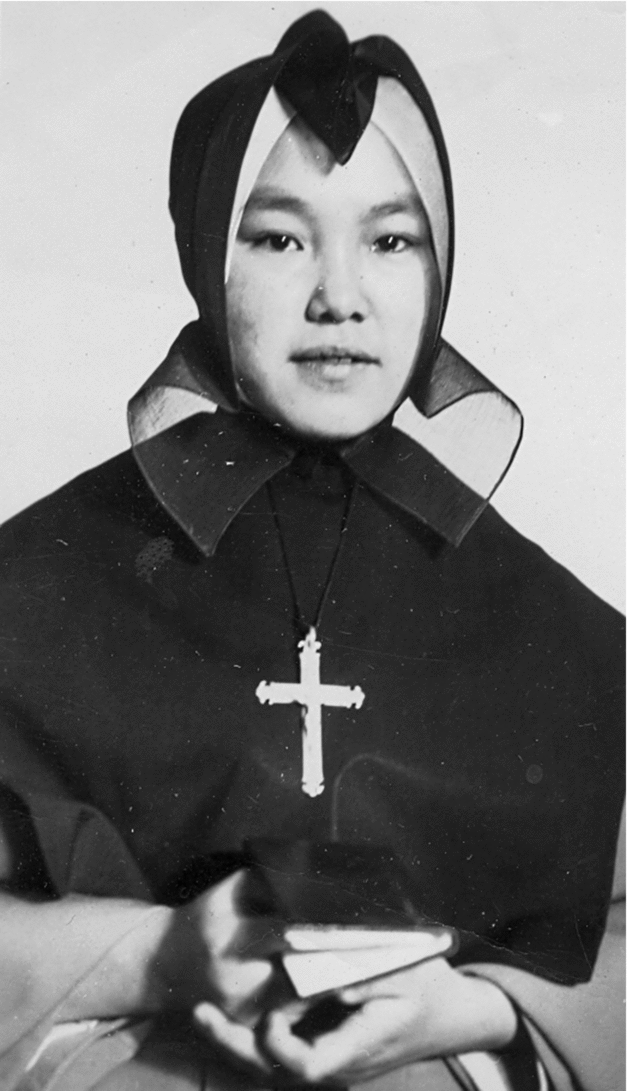
Philippe contrasts Pelagie's reaction and the shaman, probably Donald Suluk or Sulutnar who tried to face the epidemic by combining Christian and shamanic traditions. By contrasting Pelagie and Suluk, the missionaries wanted to show the right path, that is the emergence of Christian Inuit leaders who would completely relinquish shamanic traditions. The Oblate missionary Charles Choque (Reference Choque1985: 117–118) provides a very critical view of Suluk but many Inuit still remember him as a very powerful angakkuq, an excellent musician and a Christian preacher. Thus Felix Kupak recalls that ‘Sulu’naaq was a powerful man. He was able to show his spirit’ (See Laugrand and Oosten Reference Laugrand and Oosten2012: 77). According to Ollie Itinnuaq, Suluk was an angakkuq who ‘was able to let you see the soul of the dead persons so the people can see them’ (Itinnuaq, personal communication, 5 March 2003; Fig. 2).
Naja Pelagie. Archives Provinciales de Nicolet.

When we interviewed Pelagie on her vocation, she related a different story (Pelagie, personal communication, 17 June 2005):
I learned about Christianity through my parents. My parents were already baptised. My father Joseph Okatsiaq would pray a lot and he always wanted to help. [. . .] It was in 1943 when we lived inland in the igloo with my older brother Thomas Siatalaq. He just died a year ago. Back then, my brother used to wake up early in the morning and pray to God, saying the Our Father prayer. During that time, he would get up early in the morning, look towards the North facing the wind. After he prayed that morning, and as he was going to go back to bed, he experienced something. At that time, there was an adjoining igloo with the same doorway where my mother would stay. That morning, without knowing, my brother turned to my mother's igloo and in the doorway he experienced a very strong feeling from God. After this strong feeling, Christianity really became very strong in our lives.
In a 2006 interview, Pelagie recalled attaching an object to Suluk's belt so that her own wish to become a nun would be fulfilled (Laugrand and Oosten Reference Laugrand and Oosten2009: 65). Her account contrasts sharply with that of the Oblate missionaries who present Pelagie as a Christian role model. Pelagie did not reject shamanism in the same way as the missionaries did, and was prepared to make good use of it.
Pelagie's account provides more details about her intentions to become a nun asking her mother to be sent to Igluligaarjuk in 1946:
I was born in 1931 and it was in 1946 when my father died that I asked my mother if I could go to Igluligaarjuk to go to school with the Nuns. She said ‘yes’. So that summer I went to Igluligaarjuk by boat. There were no planes here at that time. [. . .] I did not have any plan to become a Nun but I wanted to try the life with the Nuns. I was happy to become a Nun. It was something I wanted to do. Nuns were people like us, not different from us. But the Nuns’ responsibility was to help sick people and to help the people in need. I asked the priest if I could join the Nuns at the age of 13. He told me that I was too young, so I waited. Finally at the age of 15, I went to school to Igluligaarjuk. I was just living an ordinary life there. . . It was the everyday life like any of us. It was only when I turned 17 that I started taking a learning responsibility as a Nun (Pelagie, personal communication, 17 June 2005)
Her account shows how strongly Pelagie was rooted in her family. She asked permission to leave the house and waited to be old enough to be accepted as a novice by the priests. According to Sister Levasseur (personal communication, 15 June 2007) Pelagie's parents, not Pelagie herself, asked the priest to send their daughter to the nuns so she could escape from an arranged marriage. In fact, she may have been given by her parents to the nuns to be adopted by them.
Pelagie perceived the role of a nun as someone helping others and this is always mentioned by her and by other Inuit remembering her.
On April 23, 1952 the missionaries and the Nuns not only discussed the progress of Pelagie but also referred to two other candidates besides Pelagie interested in becoming Nuns. They did not say much about Blandine and seemed happy not to have pushed Marie who apparently decided not to pursue her vocation (Loyola Reference Loyola1952).
In an interview, Pelagie acknowledged that she was not alone: ‘At first, there were three of us to be candidates to be Nuns but the two other candidates couldn't go on. One was sick with TB in her lungs. The other one couldn't go on with her studies. She gave up (Pelagie, personal communication, 17 June 2005).
The two Inuit women who tried to follow Pelagie never succeeded. About Marie, we could find no further information. But the archives provide more information about Blandine, a daughter of Victor Sammurtok and Leonie Igalak. According to the archives, Blandine was also known as Nennout (Nennaut), and was originally from Chesterfield Inlet. Born in November 1935 and baptised by Father Ducharme, she separated from her boyfriend at the age of 15 in order to become a nun in 1953. Bouffard (1956: 106) relates that she made her ‘first vows’ on 19 August 1953 but finally decided not to continue on 8 March 1954 and returned to her family.
Two more women have been candidates to become Nuns and members of the Grey Nuns community. One woman who was seriously tempted by such a vocation was Alexina Nutarardjuk. Born in 1936, in Igloolik, Alexina Nutaradjuk (also known as Alexina Makkik, according to Robert Lechat (personal communication, 8 January 2006) became a postulant on 5 August 1955, and a novice on 15 August 1956 but then abandoned her vocation on 18 March 1957. ‘Sister Alexina unfrocks. Before going back to her family she needs to go to the sanatorium’ (Chroniques de l’hôpital St Thérèse de l’Enfant Jésus 1931–1960: 18 March 1957: 547).
Other vocations occurred and were more or less encouraged by the nuns. On 10 January 1947, the nuns relate the case of Melanie Arnaluk, born in 1919 in Eskimo Point:
It has to be noted that this woman, who was converted with her family, had been promised to a pagan when she was young, and she had no choice but to accept this. But Melanie wished to be a nun. After her wedding, she was persecuted. She even had to throw her religious objects in the fire. But in her heart, her faith and her love for God was only becoming greater. Also, among the confidences she made to us, let's mention the following one, which shows her spiritual attitude: ‘Myself, I didn't want to get married. I wanted to become a nun like you. I always prayed and worked with that desire. Also, I think that the Lord (Nunaliorte) will reward me like if I had been a nun (Chroniques de l’hôpital St Thérèse de l’Enfant Jésus 1931–1960: 10 January 1947: 354).
Another case mentioned to us by Lechat was that of Salome Paoktut. Born in Igloolik in 1947, Salome Paoktut attended school from 1955 to 1964 and thought of becoming a nun, but she finally gave up the idea and became Theophile Kanguk's husband.
In the Chronicles Pelagie is often mentioned but we loose her path in the mid 1950s. On 29 October 1955, it is related that Pelagie gave birth to a child: ‘Pelagie gives birth to a son. The baptism takes place in our chapel, Sunday the 30th. His name is Yvon’ (Chroniques de l’hôpital St Thérèse de l’Enfant Jésus 1931–1960: October 1955: 521). The Oblates, hardly comment on this unexpected event. Various reasons can explain this silence, but the church probably wanted to keep her in the diocese. Although Pelagie gave birth to a child, her religious vocation was not put to an end. On 15 August 1956, she even presented ‘her eternal vows’ and a year later, on 14 August 1957, the nuns related: ‘Sister Pelagie Innuk has her obedience for the hospital; we welcome our benjamin’ (Chroniques de l’hôpital St Thérèse de l’Enfant Jésus 1931–1960: October 1955: 555).
Pelagie remained within the order until 1970. Neither the archives, nor the Inuit interviewed on the topic in Arviat and Chesterfield were willing to discuss the reasons for her departure. The Grey Nuns themselves and even Sister Yvette Paquin who knew Pelagie quite well never gave us a clear picture either. Marco Michaud (Reference Michaud2004) was told by Blandine's brother that he was not aware of the reason that motivated Pelagie to leave the order: ‘I don't know why she left. It's like one day the most important thing was to be a naya, and the next day she decided to leave’. Other elders only commented: ‘People were proud that an Inuit woman was training to become a nun (Leonard Putulik, personal communication, June 2002).
After discussing the issue with Pelagie, Bouffard (1956) evoked the problems of marriage and stated than even in her case, the situation was not always clear:
Several women indeed, writes [Pelagie], were in search of daughters-in-law according to the Eskimo tradition. But their requests were of no use. When they realized my intention, they have had bad words for me and my older brother. They were saying that I only wanted to become a Nun to rejoice my brother. On the contrary, I was the one who told him my intention and he didn't object to it. He had suffered himself of the mischievousness of the men, of the influence of the shamans and other predicators. He thought that this way, I would be able to pray to God and that I would even pray more for him. That's the reason why he agreed to my desire (Bouffard 1956: 103).
Pelagie moved back to Arviat and according to Levasseur (2004), she joined the man to whom she was once promised to as a wife. As this man was already living with another woman, Pelagie had to wait for a while doing chores in the house until the first wife died. Then she married her intended husband and gave birth to a daughter in 1976. When we interviewed her in 2003, she reflected on her life
I loved the work because in those days there were no community schools. It was the only way for me to help people because I like helping people. It makes me happy to help people. When I went there I did my part in helping others who are in need. My work was not taking part in a school. It was not a learning job. It was a job of training because that hospital in Igluligaarjuk was a place for special people, for handicapped people. Sometimes the Nuns were very tired. I was to help them. It was the only place to help people in Igluligaarjuk. It was hard work. You have to be entirely dedicated to the cause. It is the same thing being a Nun. You have to work hard and keep at it. I spent all these years with the Nuns thanks to the support I received from other people. I thought to give up but I continued with the support of others. I was ordained in 1946 and I left in 1951 or later. There were a lot of Nuns who worked there for a while and then gave up. 1969 is the time I really quit the Nuns. I also worked at the school until it closed.
I was happy to be ordained but when I stopped to be Nun, there was no big feeling about it because I returned to my family. I didn't have any serious thoughts about it (Pelagie, personal communication, 15 March 2003).
Pelagie emphasized the hard work of the nuns. According to Sister Levasseur (2004) she always worked hard with them, cleaning, washing and visiting the Inuit women around the mission. She also recalls that she would sometimes do the reverse of what she was told to do but the other sisters adapted to this. Pelagie felt uncomfortable with praying and singing in French and that may have played an important role in her decision to quit the order. Just before she left, Sister Levasseur recalls meeting Pelagie crying in the kitchen and stating: All the Nuns here think I can pray like them but I am not able. . . .I can't stay here’. We know Pelagie continued to help the nuns and the priests, which may explain why she had no ‘serious thoughts’. Even after her late marriage, she remained involved in church activities and continued visiting Inuit who were in hospitals. When we met her in her house in Arviat, she commented about this hard work and about a huge statue (about a few meters high) that was placed in her living room. I remember that the Nuns worked very, very hard. [. . .]
I made this big statue with the help of other men with clay. It was given to Father Ducharme and when he died, it was given back to me. This is a sign that I helped the nuns. This statue is a copy of an old one that was brought here in 1947 (Pelagie, personal communication, 17 June 2005).
Despite the high hopes expressed by the priest and the Grey Nuns, only one Inuk became a nun for some time only to leave the order after a few years. All Inuit women who aspired to become nuns finally decided that they preferred a married life.
Conclusion
The role of women appears to have been important in the process of the adoption of Christianity. We have compared three regions, the South Baffin area, the North Baffin area and the Kivalliq. In the South Baffin area and the Kivalliq Christianity was spread from the mission posts and the missionaries recorded the progress of their efforts. In the North Baffin area this was not the case as the missionaries only arrived after Christianity had already been introduced by Inuit. At the mission posts the missionaries concentrated their efforts on women and children as the men were out hunting most of the time. In these areas women were generally better informed than their husbands about the tenets of the Christian creed. This will not have been the case in the Northern Baffin area and here we see men such as Umik and Nuqallaq taking the lead and organising the siqqitirniq rituals. Traditionally, men as well as women could perform as angakkuit but in the context of Christianity women might come to the fore as prophets as in the case of Ikkumaq.
The missionaries reasoned that shamanism and Christianity were incompatible and therefore did everything they could to suppress shamanism. Aasivak in the South Baffin area and Teresikuluk in the Kivalliq are remembered for their success in effecting the conversion of important angakkuit (respectively Angmaalik and Taliriktuq). Women probably adopted Christian values and rules before the men seeing Christianity as a form of liberation of the old rules, the abstainings and refrainings they had to observe. This idea of liberation was clearly expressed by Atuat from Arctic Bay and later highlighted by some missionaries.
In the South Baffin area the transfer of goods may have played an important part. Here there was already a strong impact of the whalers and Inuit adopted western clothing, and materials (steel knives and needles, kettles etc.) (see Kumlien Reference Kumlien1879). The letters by Aasivak suggest a strong interest in western clothing. Although this clothing was obviously much less warm than Inuit clothing it probably represented a festive dress, suitable for the Sundays that also expressed a connection to modernity associated with the Qallunaat and their materials. We probably have to place the rejection of Sedna through discarding a set of traditional clothing in this context. Conversion in the Kivalliq occurred much later and here the exchange of goods hardly seems to have played a part. But women took leading roles in taking strong religious positions. Both Teresikuluk and Pelagie committed themselves to a religious life in different ways. Teresikuluk by rejecting contacts with pagans and trying to convert her relatives, Pelagie by becoming a Grey Nun. Her failure to remain in the order should not surprise us. As members of society, Inuit women were supposed to marry and have children. By becoming a nun, Pelagie managed to escape temporarily from marriage but this could not last. Remaining a nun implied keeping a distance from your family and living like a qallunaaq among qallunaat. That is hard to do. It may imply that a person becomes lonely even though she is living among people. Once she left the order, she continued her work in the hospitals as a married woman and continued to be respected by the Inuit as someone helping others. The history of Teresikuluk and Pelagie reminds us of the strength of Inuit social values that encompass everything else including Christianity. Inuit may have embraced it with great enthusiasm, but their own traditions show great resilience and give little scope to Inuit women to escape their destiny as wives and mothers. We should take into account that no Inuk was ever consecrated as a Roman Catholic priest. In this respect the Roman Catholic Church contrasts sharply with the Anglican Church where for more than a century Inuit have been appointed as pastors, ministers and even bishops.
Apparently the celibate life does not fit well into Inuit culture. Inuit value survival and they know people need each other to survive. A woman needs a man to hunt and provide food for her, and a man needs a woman to cook the food for him and prepare and sew the skins for his clothing. Together they will bring forth children who will support them when they get old. These old values were deeply embedded in Inuit society and Christianity did not change them.
Women acted as mediators among groups and they were often the first ones to be taught by the missionaries. Their responses varied extensively (Brown Reference Brown1996: 714) but some women undoubtedly welcomed the Christian ideas seeing that they could gain tangible or intangible rewards to use Harkin and Kan's expression (Reference Harkin and Kan1996: 566). Today women are still very active in contemporary churches of the north especially in the case of Anglican, the Evangelical and Pentecostal churches. Many women can also be found among the healing circles leaders. In Christian ideas and values women found new scope for their traditional role as protectors of men and children. Even if the coming of Christianity brought many changes in terms of rules, it did not fundamentally change the roles of men and women in society. As in shamanism where men as well women might perform as angakkuit (see Oosten Reference Oosten and Laugrand1986), in a Christian context men as well as women could act as teachers and convert others but in the long run they could not escape their gender roles.
Acknowledgements
This paper is part of an extensive research on the adoption of Christianity by the Inuit in the eastern Arctic regions. We thank the late Susan Sammons, and also Alexina Kublu, Marco Michaud, Guy Tremblay, Sister Nicole Fournier, Lorraine Brandson, Father André Dubois, Father Robert Lechat and Bishop Reynald Rouleau for their contributions. We are also grateful to the SSHRC for its financial support. In the paper various names are written with different spelling. Tirisikuluk is often written as Teresikuluk or Theresikuluk. To keep the reference to St.Therèse, we used the spelling Teresikuluk. Taliriktuq is often written Taleriktok or Talleriktok. In all cases we have kept the original spelling of these names as they appear in the archival documents. The original texts from the Chroniques de l’hôpital St Thérèse de l’Enfant Jésus are all written in French. The translations are ours.