Introduction
School-aged students are the target audience for many educational outreach efforts, including those from the materials research community—and for good reason. As Moskal and Kosbar discuss in their introduction to this issue of MRS Bulletin, globally we are relying on today’s students to become tomorrow’s leaders. Science and engineering will be fundamental for addressing many of the grand challenges this generation of students will face as adults. Sharing the excitement and potential of materials science with children through educational outreach can help encourage them to pursue careers in the field, thereby increasing their chance of success at meeting these grand challenges.
This article addresses the essential steps and considerations for developing a successful educational outreach program, whether it is a single classroom activity, or a large, multi-year project involving several institutions and numerous strands of effort. The scale and complexity of each of the components will vary, but common considerations exist for all outreach efforts. These components include building collaborations, setting goals, understanding audiences, integrating evaluation, and taking advantage of passion. Throughout this article, examples from the materials research educational outreach community will illustrate particular implementations of these concepts and offer ideas for collaborations and future projects.
Collaborate and form partnerships
An unfortunate mistake many people make when exploring K–12 educational outreach is trying to do it all on their own. In fact, a recent article in Nature Reference Lok1 supports this erroneous notion that scientists are left without help to develop educational materials and engage in outreach efforts. The reality is that a wide range of groups, institutions, and professionals exist who are interested in working with scientists on such efforts. For an example of such a collaboration, see the “University K–12 partnership” sidebar.
University K–12 partnership
The University of Maryland Materials Research Science and Engineering Center (MRSEC)10 has partnered with the Charles Herbert Flowers High School for the past six years on its Project Lead the Way (PLTW) program.11 Members of the Maryland MRSEC also serve on PLTW’s advisory committee. PLTW is a national pre-college engineering program that partners with middle and high schools to implement a rigorous, hands-on science and engineering curricula.12 The project reaches all 50 states in the United States and has involved more than 350,000 students thus far. By collaborating with C.H. Flowers High School, a PLTW school, the scientists and educators at the Maryland MRSEC benefit from the pre-established infrastructure and expertise of PLTW and the high school and, in turn, the school benefits from the expertise and facilities of the MRSEC.Reference Prasertchoung and Hammer13
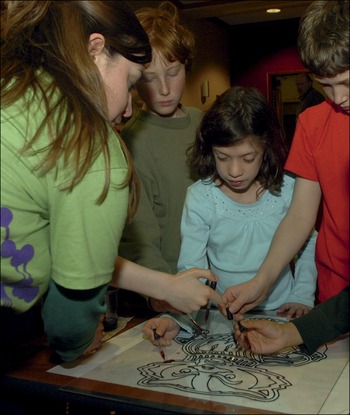
Forging and cultivating partnerships allow scientists (and their partners) to divide the work and take advantage of a range of skills. A scientist’s area of expertise is content, whereas a K–12 educator’s expertise is pedagogical strategies for students in a formal classroom, and an evaluator’s expertise is assessing the effectiveness of a particular educational effort. For example, just as it would not make sense to expect a fifth grade teacher to be fully knowledgeable about quantum dots, it also does not make sense to expect a government laboratory scientist to be fully knowledgeable about creating and leading an activity with fifth graders. Through partnerships, we can take advantage of the wide range of expertise and connections of others, thereby making the entire project stronger (Figure 1).
A University of Wisconsin-Madison graduate student guides students as they contribute to a collaborative science-and-art project. Photo courtesy of Kelly Luster. This innovative outreach activity was made possible through the collaboration of graduate students from fine arts, art education, and engineering.

Some potential resources and partners to consider include:
• Museums, including children’s museums, natural history museums, science museums, and art museums.2
• Area K–12 teachers, schools, and/or districts.
• Community groups, such as Venture Scouts/Venturers, the International Order of the Rainbow for Girls,3 Boys & Girls Clubs of America,4 4-H,5 Rotary International,6 The Resource Foundation.7
• Professional societies, organizations, and non-profits, such as the World Association of Young Scientists8 and Cosmos Education.9
• Your own institution. Many universities, colleges, government laboratories, and industries have pre-existing educational outreach programs and infrastructures.
Asking for help (i.e., seeking collaborators) is not only acceptable, but actually ideal. A strong partnership will strengthen the work and impact of both partners.
Slow down, conduct background work, and lay a foundation
One of the biggest pieces of advice for those working on an educational outreach plan is to “slow down.” Frequently, scientists and education professionals jump too quickly to the development of hands-on materials, bypassing several important steps that should precede development and that will make the entire process smoother and increase the quality of the final product. The first of these is setting goals; the second is understanding the audience.
Set goals
It is essential to set goals that you hope to achieve through the project. Goals will help to establish a framework for the evaluation process, re-focus efforts during the development process, and gauge the accomplishments of the objectives. (See the article by Reed-Rhoads in this issue.) Content learning goals, or the content we hope students will learn through participating in the outreach project, are the most commonly considered type of goals. This tends to be the category of goals with which scientists feel most comfortable. However, we still frequently fail to take the time and effort to enumerate the goals and make them concrete. It is not uncommon for close colleagues working on the same project to have slightly different ideas of content learning goals, which can obscure the effectiveness of a project. To avoid this pitfall, the first step in setting content learning goals should be writing them down and sharing them with collaborators and colleagues. The core leadership group can then review the goals together and work toward a consensus. Do not underestimate the importance of this step. It may seem obvious and straightforward, but it can substantially improve the quality and effectiveness of an educational outreach project.
In addition to content learning goals, an equally valid set of goals exists that complements and enhances content goals. A recent U.S. publication by the National Science Board (NSB) enumerated six different strands of learning. The publication was explicitly for informal science institutions, but much of K–12 educational outreach by our materials research community falls into that category.
As summarized in the NSB publication, Learning Science in Informal Environments: People, Places, and Pursuits, the six strands of science learning include:
• Strand 1: Experience excitement, interest, and motivation to learn about phenomena in the natural and physical world.
• Strand 2: Come to generate, understand, remember, and use concepts, explanations, arguments, models, and facts related to science.
• Strand 3: Manipulate, test, explore, predict, question, observe, and make sense of the natural and physical world.
• Strand 4: Reflect on science as a way of knowing; on processes, concepts, and institutions of science; and on their own process of learning about phenomena.
• Strand 5: Participate in scientific activities and learning practices with others using scientific language and tools.
• Strand 6: Think as science learners and develop an identity as someone who knows about, uses, and sometimes contributes to science.Reference Bell, Lewenstein, Shouse and Feder14
It is noteworthy that only one of these six strands, Strand 2, directly addresses content. Content comprises only one-sixth of the entire list, which means that there are five other valid kinds of learning a student might experience through outreach activities. Beyond these six, educational outreach efforts may have additional goals not directly related to science. For example, many university- or college-based summer camps for kids, especially those from underrepresented backgrounds, want to help K–12 students become familiar with a campus and to see themselves as college students.
Learning Science in Informal Environments supports the idea that affecting people’s attitudes toward science is equally as important as improving content understanding.Reference Bell, Lewenstein, Shouse and Feder15 The likelihood that a person who participates in an educational outreach event will be able to remember the content goals of the activity in six months is relatively slim. In contrast, a much higher likelihood is that a person will remember positive interactions with “real” scientists and the scientists’ enthusiasm for their work.
Other sources that are situated in the formal educational setting also recognize the wide range of learning goals educational efforts can achieve, including the National Research Council’s National Science Education Standards 16 and Taking Science to School: Learning and Teaching Science in Grades K–8,Reference Duschl, Schweingruber and Shouse17 and ACT’s College Readiness Standards.18 Some components of these publications may not be as appropriate for some educational outreach efforts, depending on the structure of the program and the level of repeated interaction with specific audiences. Many outreach projects target K–12 students in a structured setting, such as a classroom visit. However, unless your program forges a close relationship with one or a few teachers or takes a systemic approach by partnering with an entire school or district, K–12 classroom-based interactions may be more informal settings in reality. Interaction with students in these situations will be brief and singular. Many scientist-offered educational outreach efforts are truly informal in nature (e.g., afterschool clubs, expos, and camps). This may make the Learning Science in Informal Environments a slightly more relevant resource when setting learning goals in addition to content.
Once you have enumerated your learning goals, streamline, simplify, and condense them. I have never witnessed the development of an educational outreach project where the goals started as too simple and succinct. In contrast, both scientists and education professionals start out with learning goals, especially content learning goals, that are too lofty and too numerous. It is also appropriate and wise to revisit and revise learning goals throughout the development process as you obtain feedback from audiences and gain experience leading the project.
Know your audience
One of the most important rules in outreach is “know your audience.” That can be challenging at times, but collecting a baseline of information and taking that into consideration during the development and delivery of your project can dramatically increase the effectiveness of your efforts. This section provides an overview of the different kinds of audiences and strategies for understanding them.
There is a wide range of potential audience characteristics given that social categories and people are extremely diverse and fluid. A relatively straightforward quality is age. K–12 students can be thought of in approximately four different age ranges:
• Early elementary (pre-K through second grade, ages 4–8),
• Middle/late elementary (third through fifth grade, ages 8–11),
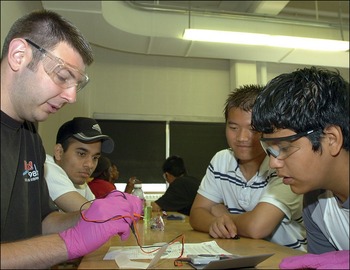
• Middle school (sixth through eighth, ages 11–14) (Figure 2), and
• High school (ninth through twelfth grade, ages 14–18).
John Uhlrich leads middle-school students through an exploration of dye-sensitized solar cells during a summer camp at the University of Wisconsin-Madison. Photo courtesy of Professor Wendy Crone.

Students vary tremendously within each of those categories. For example, although this list suggests that they belong to the same category, 14- and 15-year-old students from a ninth-grade physical sciences class will have significantly different levels of sophistication, content understanding, and emotional maturity than 17- and 18-year-old twelfth-grade students in an advanced physics class. This does not mean that an activity designed for high school-age students could not be used with both classes, but modifications would need to be made to accommodate each group of students’ specific backgrounds. Teachers are excellent resources for helping outreach scientists determine the backgrounds and needs of different classes and students. Talking with them beforehand will provide strategies for modifying the materials appropriately.
Recognition of the need for diversity in science and engineering has thankfully helped increase the number of programs targeted at audiences who are underrepresented or underserved in science and engineering, including materials science. These groups differ across cultures. Possible groups to consider in the broad category of “underrepresented” or “underserved” in the United States for instance include:
• Girls
• Non-native English speakers/English language learners
• Low socio-economic status students
• Ethnic and/or racial minorities
• Students with disabilities
• Pre-grade five/10 years old and younger
Educational outreach efforts that target underrepresented populations need to pay attention to the barriers to science and engineering that individuals in these groups might face and to their specific needs and culture, broadly defined. Part of the developmental process for these targeted outreach programs will be determining approaches for overcoming whatever barriers might exist and making the experience as positive as possible. Examples of possible considerations when designing outreach programs for diverse populations are provided in the sidebar “Considering backgrounds and culture.”
Considering backgrounds and culture
Free afterschool or summer programs can be effective approaches for students from low socio-economic backgrounds, as the cost of afterschool care or a summer camp might be prohibitive for their families. Another benefit of an afterschool program for this population is that no additional transportation time and means are required, which can be a burden for parents. Elementary school teacher Troy Dassler and Professor Doug Weibel at the University of Wisconsin-Madison (UW) took this strategy with their afterschool MicroExplorers Club,19, Reference Dassler20 as did the UW Nanoscale Science and Engineering Center through their SciENCountErs program, which partners with the Boys & Girls Club to offer afterschool science activities.21
In their effort to increase the number of girls interested in engineering careers, WBGH, the public television station in Boston, Massachusetts, took advantage of the fact that “many high school girls care deeply about making a difference in the world.”Reference Sahr and Zweil22 WGBH partnered with a range of institutions to create Engineer Your Life, an engineering program for high school girls that seeks to shift the portrayal of engineering.23
When working with English-language learners, several publications offer techniques for helping them become comfortable with scientific language.Reference Hademenos, Heires and Young24–Reference Spycher26
Additionally, in the United States, the National Science Foundation funds partnerships between large materials research centers and minority-serving institutions through their Partnerships for Research and Education in Materials (PREM) Program.27 Collaborating with PREM awardees helps researchers connect with pre-established education and research projects dedicated to underserved audiences.
It is also important to appreciate students’ knowledge levels at various ages. For example, the design of a classroom activity about nanotechnology for fourth and fifth graders will face the issue of whether or not to discuss atoms in your activity. Atoms and molecules are integral ideas when talking about nanotechnology, but if students do not understand them or the particulate nature of matter, the educational activity will have little meaning content-wise. Resources exist that can help those engaged in outreach develop a baseline understanding of the ideas and concepts that students have mastered at different ages and grade levels in the United States. These include
• The National Science Education Standards28
• The National Council of Mathematics Teachers Learning Standards29
• The Atlas of Scientific Literacy, Volumes 1 and 2, by the American Association for the Advancement of Science (AAAS)30
• Journals published by the National Science Teachers Association (NSTA): Science and Children (elementary school), Science Scope (middle school), The Science Teacher (high school), and Journal of College Science Teaching (undergraduate).
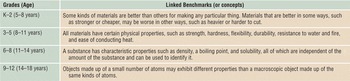
Browsing these sources, especially the Standards and the Atlas, offers a quick assessment of the concepts that students are learning and are capable of learning at different ages (Table I). I emphasize capability because we often assume that if we just explain something well enough, children will understand it. However, some concepts, such as atoms and the particulate nature of matter, are beyond the comprehension levels of children below a certain age. Research shows that even high school students and adults hold misconceptions about the particulate nature of matter and that young children find the topic particularly inaccessible.Reference Ozmen and Kenan31–Reference Talanquer34 No matter how well you explain the idea, the manner in which young students make sense of the world around them prevents true comprehension of atoms and molecules.
Materials science concepts from the AAA Atlas of Scientific Literacy 35

The NSTA journals are likewise good sources to assess the content students learn at various levels, as well as the ways that educators teach the content. These publications can be worthwhile both to help understand a particular audience and to glean ideas for education projects.
Written sources are excellent starting points for developing an understanding of your target audience, but, as with scientific research, first-hand experience is always best. To develop a real understanding of and appreciation for the realities of your target audience, you must experience it. If possible, visit a site that serves your target audience so you can witness the reality of that environment. It does not have to be extensive—it can even be sitting in one or two class periods or visiting a local museum and informally observing visitors’ interactions. It is also wise to take advantage of the experience and expertise of professional educators. Teachers and other educators have extensive knowledge about their students, pedagogical strategies, and more. Talk with them throughout the development process of your educational outreach effort, as their feedback and input are invaluable. See the sidebar on “Programmatic approaches.”
Programmatic approaches
A wide range of K–12 materials science educational efforts take place around the world. This section lists a sampling of programmatic categories and recent examples from people and institutions active in the MRS K–12 educational outreach community. Each example includes the appropriate MRS Meeting connected to the activity as well as the MRS paper identification number for further reference.
Older students leading activities for younger students
• Undergraduates teaching biomaterials to K–8, University of California-Berkeley (2009 MRS Fall Meeting PP1.4)
• Cal Tech/California State University of Los Angeles PREM (2007 MRS Fall Meeting W2.8)
• Underrepresented grad students leading outreach for underrepresented K–12 students, University of Southern Mississippi (2007 MRS Fall Meeting W2.6)
• University of Nebraska and a rural Nebraska high school (2008 MRS Spring Meeting 001.10)
Ask-a-scientist
• University of South Florida, K–12, elementary school (2008 MRS Spring Meeting 003.9)
Development of hands-on classroom materials and demos
• Best practices for demos (2009 MRS Fall Meeting PP3.3)
• Low-cost tool for studying indentation in high schools, Greece (2009 MRS Fall Meeting PP3.5)
• Lego SPM model (2008 MRS Spring Meeting 001.8)
• Everyday, low-cost materials science: glass candy, Lehigh University (2009 MRS Fall Meeting PP3.6)
• Project-based classroom approach, adaptable for high school, Olin College (2009 MRS Fall Meeting PP8.3)
• Hooks for a range of audiences (Shield-NE, 2009 MRS Fall Meeting PP9.1)
• CNS Institute for Physics Teacher and lending library (2009 MRS Fall Meeting PP7.3, 2008 MRS Spring Meeting 003.7)
• University of Connecticut PLAN Teachers Academy (2007 MRS Fall Meeting W2.3)
• Semiconductor modules in Uruguayan schools (2007 MRS Fall Meeting W4.8)
Real-life relevancy
• Alternative energies kits, University of Nebraska (2009 MRS Fall Meeting PP3.7)
• Materials science as real-life relevancy opportunity for education (2008 MRS Spring Meeting, 001.5)
Research experiences for high school students
• One-month summer research internships at Johns Hopkins (2007 MRS Fall Meeting W2.7)
• Cal Tech/Cal State University Los Angeles PREM (2007 MRS Fall Meeting W2.8)
• 10-week summer research internships at the University of Alabama (2007 MRS Fall Meeting W2.10)
Systemic impact through curriculum changes and institutional partnerships
• High school materials science capstone course (2009 MRS Fall Meeting PP7.2)
• University of Nebraska and Nebraska K–12 schools (2009 MRS Fall Meeting PP3.7, 2008 MRS Spring Meeting 001.10)
• University of South Florida, GK-12, elementary school (2008 MRS Spring Meeting 003.9)
• University of Maryland MRSEC and local high school, curriculum enhancements (2008 MRS Spring Meeting 002.10)
Partnerships with established programs
• Project Lead the Way and University of Maryland MRSEC (2009 MRS Fall Meeting PP6.2)
• Public Broadcasting Systems (PBS) K–12 engineering programs (2007 MRS Fall Meeting W1.9, W2.1)
Underrepresented minority audiences
• Ohio State University, students with disabilities (2009 MRS Fall Meeting PP1.8)
• PBS and Engineer Your Life (2007 MRS Fall Meeting W2.1)
• Reaching non-traditional audiences through art, University of California-Santa Barbara (2007 MRS Fall Meeting W2.4) and University of Wisconsin-Madison (2009 MRS Fall Meeting PP3.2)
• Underrepresented K-12 students interacting with underrepresented grad students, University of Southern Mississippi (2007 MRS Fall Meeting W2.6)
Lab tours, summer camps, online resources, and more
• Georgia Tech/National Nanotechnology Infrastructure Network (NNIN) (2008 MRS Spring Meeting 003.5)
Large expos
• Princeton University (2009 MRS Fall Meeting PP7.1, 2007 MRS Fall Meeting W2.2)
Kits and teacher workshops
• Alternative energies kits, University of Nebraska (2009 MRS Fall Meeting PP3.7)
• Cornell CNS Institute for Physics Teachers and lending library (2009 MRS Fall Meeting PP7.3, 2008 MRS Spring Meeting 003.7)
Integrate evaluation
Evaluation is essential during all stages of educational outreach projects and programs. Good materials scientists review the literature extensively before beginning research on a new topic, and they conduct several experiments and tests to verify that their data consistently display what they claim they display. The same should be true with education efforts. Conduct work at the beginning of the project, or front-end evaluation, to find out more about your target audience—their needs, wants, and current level of understanding. Front-end evaluation can also consist of background research to determine what others already have tried, what has worked, and what has not. Conducting evaluations during the development process, or formative evaluation, allows you to find out what is working well with your project, what is not, and whether you are on the path to achieving your project’s goals. See the Reed-Rhoads article in this issue for a detailed discussion of the evaluation process.
Conclusion: Take advantage of passion
Your educational outreach efforts will be stronger if you pursue activities about which you are enthusiastic and passionate. This may seem like an obvious recommendation, but scientists sometimes feel pressure to work on a project for a specific group or audience or to work on a specific content area. This can happen because they assume they should (i.e., they feel their stakeholders expect it), or because they assume that a specific audience has the highest need. My experience with educational outreach has led me to believe that all audiences and potential partners have needs, it is just a matter of finding the right fit. Since need is so widespread, make decisions about your educational outreach efforts based upon your interests and enthusiasm.
For many professionals, educational outreach is “extra,” something added to their already full plates of research, administration, service, travel, training, teaching, mentoring, and more. In addition, educational outreach projects rarely offer tangible benefits such as awards, significant funding, or recognition that help in the tenure process or industrial career advancement. This means that some of the reward must be inherent in the project’s activities. That, combined with the fact that your passion for your work is arguably the most important message to share, makes it crucial to choose projects that play to your passion.
Acknowledgments
This material is based upon work supported by the National Science Foundation through the University of Wisconsin-Madison’s Materials Research Science and Engineering Center on Nanostructured Interfaces (DMR-0520527), the Internships in Public Science Education program (DMR-0424350), and the Nanoscale Informal Science Education Network (ESI-0532536). Any opinions, findings, and conclusions or recommendations expressed in this material are those of the author and do not necessarily reflect the views of the National Science Foundation. The author would also like to thank her numerous collaborators and colleagues for making education and outreach a rewarding and exciting endeavor.