Introduction
Focusing on the advancing of the ‘interpellation and orbit of the commodity form’ (Gill and Cutler, Reference Gill, Cutler, Gill and Cutler2014: 14), the principal aim of this article is to seek to advance understandings of the recommodification of social policy in the context of financialised capitalism, austerity and post-crisis welfare states. Drawing on the ‘canonical’ social policy literature on commodification as well as more recent contributions that have drawn attention to ‘in-work commodification’ and to the commodification of social services, the article joins together areas of reform that are typically treated separately to look at recommodification as a multiple set of processes that involve the state in labour and welfare market-making, regulating the ‘saleability’ of labour. As such, in the context of economic crisis and recovery under the dynamics of re/financialisation, the article suggests that the logic of recommodification shifts further away from long established Piersonian observations. Re/financialisation denotes the fact that while financialisation is a process whose evolution can be observed from the 1970s, the last decade represents a crisis and recuperation phase: ‘finance staged a major comeback’ (Storm, Reference Storm2018: 307). In a movement beyond the Piersonian perspective, which understands recommodification as the dismantling of those elements of the welfare state that shelter individuals from market pressures and their replacement with market buffers, this article looks at how recommodification compels individuals to act in ways that are, first and foremost, responsive to what are constructed as the needs and vulnerabilities of markets and the associated imperatives of financialised austerity capitalism post-crisis. The significance of this understanding of recommodification and of associated empirical trends for social policy is considered in terms of how it opens up the prospect of the further erosion of social citizenship and the social solidarities underpinning the welfare state as citizens are compelled to ‘live by finance’ (Martin, Reference Martin2002: 17).
The article begins by developing the idea of recommodification as a multi-dimensional concept involving out-of-work and in-work processes that shape the saleability of labour, in addition to the recommodification of social services that reproduce labour. It then examines how the recommodification of social policy has evolved in the context of re/financialised capitalism and post crisis welfare states. This includes an examination of the overall conditions that weaken the power of labour and the consequent ways in which in-work and out-of-work recommodification and the commodification of social services have evolved. Treating financialisation as a systemic influence on social policy, the terrain analysed in the article is necessarily broad and synoptic, focusing on macro-level factors and trends rather than a detailed exercise in measuring recommodification. It looks broadly at how aspects of social policy associated with recommodification have evolved across the European Union as a whole and this evolution is placed in historical context and juxtaposed with European countries particularly swept up in the ‘hostile decade’. They were especially impacted by the 2008 financial crisis and, in the case of the latter six countries, also by the subsequent Eurozone crisis: namely, the UK, Greece, Ireland, Italy, Portugal, Spain and Cyprus. However, the article does not seek to make any particular claims for these countries beyond their illustration of how recommodification can be conceptualised and has evolved in the context of financialisation. Within this broad script there are, of course, many instances of geographical, temporal and welfare regime variation. Uneven pathways of austerity capitalism and impacts of financialisation can be found across EU economies, whether imposed by the Troika or manifesting as particular varieties of financialised austerity capitalism, which are not possible to address within the scope of this article.
While attention has been given to issues and reforms in labour market policy in a raft of employment and labour-relations literature, the implications for social citizenship and the social foundations of the welfare state have been given less attention. Making connections between these domains and arguing that labour market reform cannot be looked at in isolation from its wider implications for the quality and experience of social citizenship, the final section briefly draws out some of the significance of the analysis of recommodification presented for what might be construed as the further erosion of social citizenship.
De-coding commodification – processes of decommodification and recommodification in the welfare state
The work of Esping-Andersen and Pierson is typically the touchstone on which social policy research on decommodification and recommodification rests. Esping-Andersen’s conceptualisation of decommodification has been subject to some debate for its uncertain and shifting roots (Powell, Reference Powell2015), and for the relatively narrow use to which it has been put, focusing ‘obsessively on classificatory minutia’ (Vail, Reference Vail2010: 313). However, at the core of his work rests a useful formulation of the decommodification of welfare as ‘the degree to which they permit people to make their living standards independent from pure market forces’ (Esping-Andersen, Reference Esping-Andersen1990: 3). This is enabled by the bestowal of social rights on the basis of social citizenship rather than labour market performance (Esping-Andersen, Reference Esping-Andersen1990: 21). This understanding built upon the earlier work of Marshall (Reference Marshall1950: 42) who also saw citizenship as a form of societal membership not subject to the ‘economic value of the individual claimant’. For Esping-Andersen western welfare states did not reach such a level of decommodification until the 1970s, reflecting the strengthening power resources of labour by the mid-twentieth century. Yet, already by the 1980s and 1990s conditions shifted to the replacement of decommodification with recommodification, captured in Pierson’s (Reference Pierson and Pierson2001) discussion of welfare state restructuring.
Pierson’s work identified recommodification as a key dynamic shifting the focus of welfare from emancipation to participation in the labour market and dismantling those aspects of welfare states that ‘shelter workers from market pressures’ (Pierson, Reference Pierson and Pierson2001: 422). With reference to liberal welfare states, already the most commodified, Pierson noted that ‘the main political debate … has not focused on whether or not low-skilled workers should be in the labour market, but on the terms under which their participation should take place. The key issue is the extent to which commodification should be subsidised’. Ranging from in-work benefits such as tax-based wage supplements, to the institution of minimum wages, to access to affordable childcare, Pierson (Reference Pierson and Pierson2001: 451) saw these forms of recommodification as specific to liberal welfare states and tensions around ‘neoliberal retrenchment versus compensated commodification’. However, they subsequently became mainstream, de-politicised measures across welfare regime types under the rubric of ‘making work pay’ (Immervoll and Pearson, Reference Immervoll and Pearson2009).
While the contributions of Esping-Andersen and Pierson might constitute the kernel on which the dynamics of commodification within welfare states rest, the subsequent empirical focus on measuring welfare retrenchment to account for recommodification, using criteria such as restricted eligibility and reduced generosity, produces a limited picture. Such accounts also rest on the assumption that the role of the state in recommodification is a relatively ‘passive’ one. That said, Pierson’s account of recommodification as ‘compensated commodification’ hints at ways recommodification still involves the state in the provision of social protection, which is addressed more substantially in Offe’s (Reference Offe1984) earlier conceptualisation of ‘administrative recommodification’ which he used to illuminate his contradictions of the welfare state thesis. Here, Offe noted the ways in which recommodification entailed not simply a withdrawal of state intervention. This is because capitalism cannot survive by treating labour simply as a commodity form, its reproduction (and thereby the functioning of markets) depends on creating conditions for ‘the saleability of labour power’ (Offe, Reference Offe1984: 124). Offe elaborated on this point with reference to human capital measures such as education and training. It is now clear, however, that ‘administrative recommodification’ must conceivably include disciplinary forms of active labour market policy (Greer, Reference Greer2016; Dukelow and Kennett, Reference Dukelow and Kennett2018) which involve greater use of coercive power by the state.
Furthermore, as more recent contributions to conceptualising and tracking recommodification suggest, state intervention extends beyond maintaining the saleability of those out-of-work (Papadopoulos, Reference Papadopoulos2005; Pintelon, Reference Pintelon2012). It also involves ‘in-work’ commodification. As Papadopoulos rightly maintains in the context of commodification, treating labour market and social policy as separate is a false distinction. For Papadopoulos (Reference Papadopoulos2005: 11) therefore, recommodification ‘is characterised by the intensification of commodification of Labour in and out of paid employment’. He goes on to add that recommodification is a ‘power dynamic’ that widens ‘power asymmetries in favour of Capital’. Power asymmetries are particularly salient in the context of increasing financialisation, albeit not addressed by Papadopoulos and, as argued here, is now central to understanding the policy dynamics of recommodification.
Finally, to produce a fully comprehensive understanding, it is important not to restrict analysis to the recommodification of labour but to include the wider field of social services. Mirroring their neglect compared to cash benefits in welfare regime analysis, welfare services have also not been subject to the same level of analysis in terms of commodification compared to labour. However, they are also subject to processes of de- and re-commodification (Holden, Reference Holden2003) and are intrinsic to the reproduction of labour as a fictitious commodity (Papadopoulos, Reference Papadopoulos2005). To the extent to which social services are also subject to recommodification they are an indication of increased exposure to market pressures that have a bearing on how the commodification of labour is experienced. When the boundaries between public and private services are eroded by policy instruments such as user fees and privatisation, then access to welfare shifts from citizenship status to participation in the labour market and the ability to engage in commodified exchange (Vail, Reference Vail2010). At the same time, the degree to which social services are commodified also exposes people to market volatility and to the dynamics of debt and assetisation associated with household financialisation.
In sum, bringing these threads of recommodification together, it can be understood as a multiple set of processes which implicate the state in facilitating market pressures, via the state’s hand in labour and welfare market-making to promote labour’s ‘saleability’. Implicating recommodification as a structural issue brings power back into the picture. This is an issue which has arguably been overshadowed by treating recommodification as a technical issue focused on classification and measurement, and consequently neglected since Esping-Andersen’s initial proposal of power resources (Fine, Reference Fine2014). The question now is what ways has the recommodification of social policy evolved in the context of re/financialised capitalism and post-crisis welfare states? In other words, how does ‘market making’ evolve under the conditions of financialised market imperatives and what does it mean for labour? As many authors observe, the conditions for the recommodification of social policy have been present since the 1980s and recommodification or exposure to market pressures has intensified over time. Whilst the financial crisis was a manifestation of massive market failure, as the following analysis shows, the post-crisis era has not seen a fundamental transformation of conditions that drive the recommodification of social policy, but in many instances a further intensification of them. This is occurring in the context of a re-financialising phase with fiscal, monetary and social policy entangled in the recuperation of financialised capitalism.
Contextualising recommodification within the shifting dynamics of financialisation
One of the effects of the 2008 crisis has been to expose financialisation as a core element of the structural transformation of economies since the 1970s. If we understand recommodification as related to the growing strength of market forces and the state’s role in mediating those forces, then financialisation needs to be central to considering how market forces have shaped recommodification in recent times. This is not to suggest that financialisation is an isolated or distinctly causal driver of recent trends in recommodification, but part of what can be described as ‘financialised capitalism’ (Lapavitsas, Reference Lapavitsas2009). As such, the growing influence of financial capital and financial actors in both financial and non-financial enterprises interlocks with the growth of neoliberalism and globalisation, both of which have pushed financial and labour market liberalisation and have put welfare states under siege. While the role of financialisation in the structural transformation of economies has gained greatest attention, as Karwowski and Centurion-Vicenico (2018) note, the financialisation of the state is an equally important but rather neglected aspect of financialisation. This signifies a ‘changed relationship between the state and financial markets’ across several domains of state activity including fiscal and monetary policy, which consequently diminishes ‘the sovereign’s duties and accountability towards its citizens’ (Karwowski and Centurion-Vincenco, Reference Karwowski and Centurion-Vicencio2018: 19). The lineage of these inter-locking forces – namely, neoliberalism, globalisation and financialisation – also needs acknowledgement and the conditions under which recommodification is evolving since the crisis need to be located in the longer evolution of austerity capitalism taking shape in advanced economies since the 1970s (Dukelow, Reference Dukelow, Ellison and Haux2020). The growing power of finance, and financial motives and interests were not identified in early accounts of austerity capitalism, but since the 2008 crisis are now clearly established as part of the repertoire of structural transformation and the unequal, unstable growth regimes that evolved since the roots of re-structuring in the 1970s.
Jumping forward to the post-2008 period and the aftermath of the near collapse of financialised austerity capitalism brings us to efforts at re-financialisation in the context of heightened public debt burdens and the continued influence of financial market discipline. That re-financialisation has occurred is evident by the fact that the overall global stock of debt has surpassed levels reached before the 2008 crisis and levels of corporate debt (financial and non-financial corporations) far exceed levels of household and public debt. By 2019, global debt grew to the equivalent of 322 per cent of global GDP and forty percentage points of GDP higher than 2007 (Institute of International Finance, 2020). Broken down between different sectors of global debt, household debt accounts for 19 per cent of the total, government debt for 27 per cent and corporate debt for 54 per cent (Institute of International Finance, 2020). These debt levels and accompanying asset inflation are driven by pro-financial market monetary policy through quantitative easing pursued by central banks, whose principal concern, as Streeck (Reference Streeck2016: 5) remarks, is ‘the health and goodwill of financial markets’. In this context, as Fumagalli and Lucarelli (Reference Fumagalli and Lucarelli2015: 56-57) assert, the role of welfare states shifts further from social protection (securing against social risks) to financial protection (securing against financial market risks). In the process, new norms are instituted imposing ‘constraints on support for any expansive economic policies or any experimentation with social policies that do not entail the management of resources by means of financial markets’ (Fumagalli and Lucarelli, Reference Fumagalli and Lucarelli2015: 57).
Declining labour income share
The most significant over-arching contextual factor informing the evolution of recommodification is the continued decline of labour income share. Notwithstanding other structural factors, including compositional shifts away from labour intensive sectors, technological change and globalisation, financialisation’s role in the process is associated with modes of growth that are debt- or profit-led, reflecting the interests of financial capital (Howell, Reference Howell2016; Pariboni and Tridico, Reference Pariboni and Tridico2019). Such forms of growth supersede wage-led growth, leading to a decoupling of productivity and real wages and, as such, financialisation is a redistributive process that channels income from labour to capital. As Pariboni and Tridico (Reference Pariboni and Tridico2019: 3) observe, ‘labour and wage compensation [are treated] as costs that need to be restrained as much as possible because they are seen as an ‘obstacle’ that needs to be overcome to fit with the needs of business and investors’.
Accordingly, wage repression has been a key feature of western economies since the 1970s. Since the crisis, as Vidal (Reference Vidal2013: 459) notes, ‘financialisation has led to wages being put ‘back at the centre of competition’ as firms across the economy more actively seek shareholder value’. As wage repression continues it sets the context for the intensification of in-work recommodification of labour.
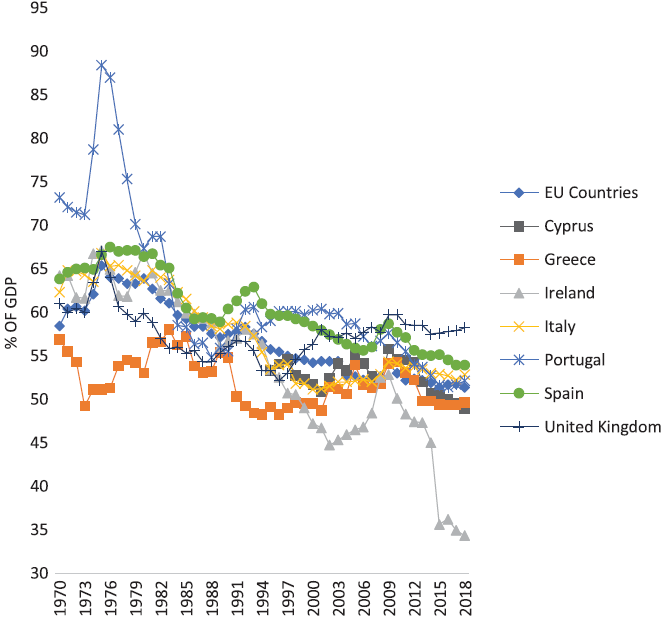
Figure 1 illustrates the changing nature of the labour share for the EU as a whole and for EU countries particularly affected by the economic crisisFootnote 1 . A dramatic decline in the labour share over the last five decades is clearly observable. However, this decline typically pauses during recessionary periods as wages tend to be less volatile than profits (ILO and OECD, 2015). This is borne out in Figure 1 which shows that labour shares generally improved during the early years of the crisis but, by the late 2010s, return to the mid-2000s situation in most countries as financialised growth resumes. Recent wage reports suggest the continuation of this downward trend, with the OECD (2018) drawing attention to the phenomenon of ‘wageless growth’: a trend similarly described by the ILO (2018: 15) as ‘declining unemployment with flat wages’. Thus, while economic growth and employment has returned, albeit unevenly, wages remain largely stagnant.

This overall pattern masks uneven distributions within the declining labour share; in particular, it obscures the fact that those at the top of the income distribution have markedly gained in terms of income and job quality as growth has returned. The most recent evolution of wageless growth co-exists with the fact that wages of the top 1 per cent of earners ‘have never been so high’ (OECD, 2018: 39), while low and average-paid workers have borne the brunt of wage stagnation. Such patterns also reflect the effects of financialisation. Very high-income earners belong to a financial elite whose salaries, as the ILO and OECD (2015) point out, can be composed in part of contributions to pension funds and other forms of capital gains, which derive from an emphasis on increasing shareholder value and are typically not available to other workers. Moreover, these gains are frequently the reward for delivering ‘efficiency innovations’ at the cost of workforce numbers and conditions (Cushen and Thompson, Reference Cushen and Thompson2016).
The declining power of labour
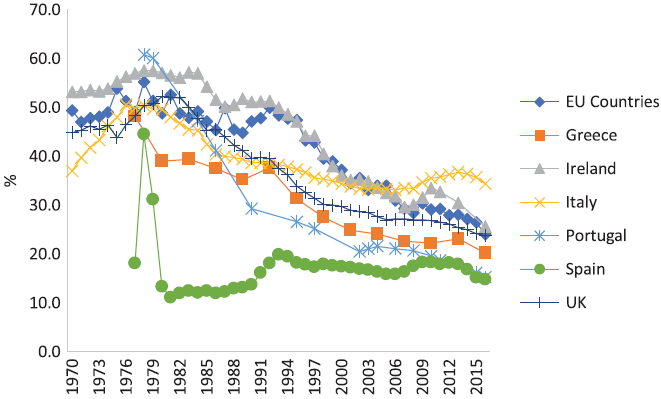
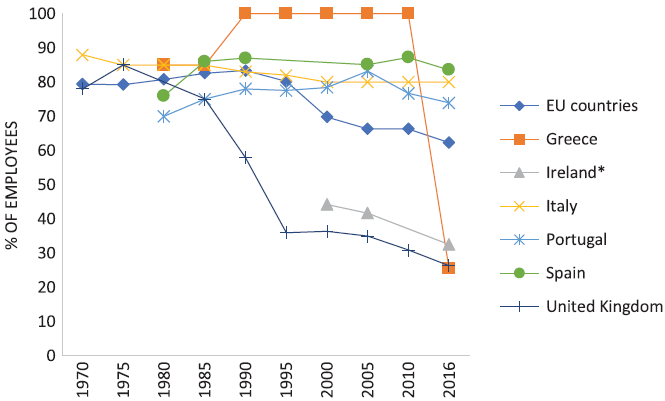
The declining labour share is closely related to a second contextual effect of financialisation on the recommodification of labour. This concerns the declining power resources of labour. As previously noted, labour’s power resources were integral to the decommodifying role of welfare state expansion. The era of financialisation has witnessed the declining power of organised labour and the ability of trade unions to defend against the encroachment of in-work recommodification and market discipline. If wage-led growth is now less important, it simultaneously weakens the position of trade unions and their need to be centrally involved in the regulation of labour market. This impacts on both their ability to gain from productivity growth as labour compensation and to protect themselves against reforms that increase labour insecurity as employment relations shift from a collectivised to an individualised model (Howell, Reference Howell2016). As with the decline in labour income share, this pattern has had a long evolution and it has been one of continuity since the 2008 crisis (Figure 2). This decline is mirrored in the individualisation of employment rights and the decline in collective bargaining coverage; data available over a shorter time range shows the decline in the proportion of employees covered by collective bargaining since the early 2000s, with a noticeable decline in coverage after the 2008 crisis (Figure 3).

Collective bargaining coverage
Note: *Final point for Ireland dates to 2014
Source: OECD.Stat (2020b)

The rise of labour insecurity and in-work recommodification
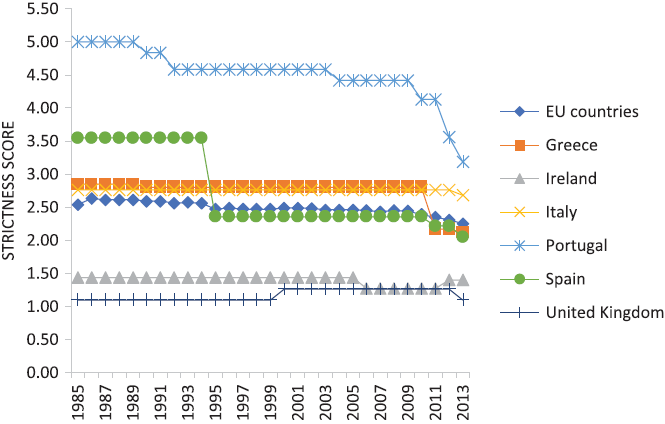
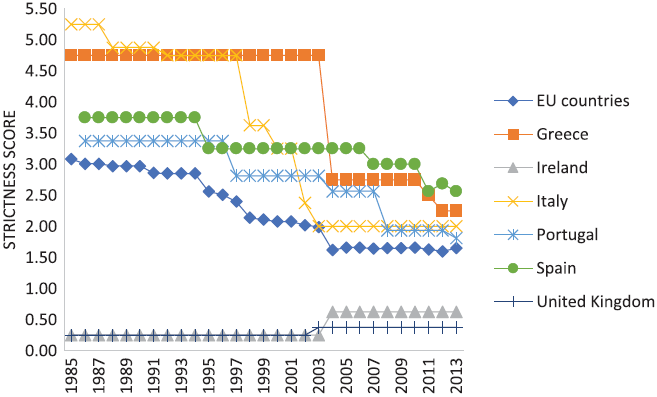
The two macro-contextual factors just reviewed – namely, declining labour share and declining labour power – are particularly significant for understanding the dynamics and significance of in-work recommodification which, as discussed earlier, do not feature in the conventional Piersonian understanding of recommodification. Reforms that have increased in-work recommodification and labour insecurity are clearly discernible in how employment protection legislation (EPL) has evolved in Europe since the 2008 crisis. Combined with the phenomenon of wageless growth, weaker EPL signals the eroding security and increased exposure to market forces of those in work since the financial crisis. While many reforms were generated by Troika conditionality for countries at the heart of the Eurozone crisis (Clauwaert and Schömann, Reference Clauwaert and Schömann2012), the relaxation of EPL in these countries is part of a wider drive across Europe to consolidate recent crisis-generated structural reforms and push for the continued flexibility, resilience and adaptability of labour markets. Data from the OECD EPL Index shows a downgrading of protection in dismissal for workers on regular contracts (Figure 4), and in the protection of workers on temporary contracts (fixed term and agency) (Figure 5), with the most marked downgrading observable in the case of temporary contracts. The direction of these reforms indicates a move to institute new norms around work contracts that reduce their security.
Strictness of employment protection – individual dismissals (regular contracts)
Source: OECD.Stat (2020c)


Other types of work associated with precarity – namely, atypical contracts and self-employment – do not come under the OECD EPL index. These belong to a so-called ‘grey zone’ (OECD, 2019) of work transformations that hold workers in ambiguous, insecure situations which are becoming increasingly common and are the subject of minimal or no regulation. In these cases, there are examples of reforms aiming to regularise their status. While these reforms might outlaw certain particularly exploitative practices, such as zero hour contracts in the case of Ireland (2018), they simultaneously normalise less secure, atypical work contracts by attaching minimal protections to them, as in the case of occasional job opportunities in Italy (2009), seasonal short-term work in Bulgaria (2015), apprenticeships in Lithuania (2016) and ‘flexi-jobs’ in Belgium (2017) (EC DG EMPL, 2018).
These legislative changes dovetail with the actual growth of precarious types of work which is another signal of more intense in-work recommodification. Precarity is a contested term open to multiple modes of understanding and measurement. Yet, to the extent that it includes characteristics such as temporary and atypical contracts involving variable and non-guaranteed hours of work as part of the contemporary dynamics of competitiveness, then precarious work is another expression of the financialised dynamics of recommodification. As Cushen and Thompson (Reference Cushen and Thompson2016) note, forms of surplus value extraction associated with financialisation are premised upon reforms and innovations that reduce the payroll as part of a strategy to maintain shareholder value and positive financial market incentive. Labour cost-cutting is thus part of a ‘perpetual restructuring that exacerbates work insecurity and intensification’ (Cushen and Thompson, Reference Cushen and Thompson2016: 359) via mechanisms such as labour outsourcing and the concomitant use of temporary and atypical contracts, loading risk on to labour.
Long term employment trends in Europe suggest a ‘downward divergence’, in the sense of rising rates of involuntary part-time work and temporary work, taking short-term effects of the economic crisis into account. Thus, data for the Euro Area since 2000 suggest an overall up-ward trend in involuntary part-time work with a spike during the most acute years of the crisis, growing from 19.1 per cent of all part-time work in 2000, peaking at 31.1 per cent in 2014 and falling to 27.8 per cent by 2018. A similar pattern is observable with temporary forms of work, increasing over time, with the exception of a dip during the most acute years of the crisis, reflecting the fact that temporary workers are easier to let go in recessionary times compared to permanently contracted workers. For the Euro Area temporary employment as a percentage of employees has thus grown from 14.6 per cent in 2003 to 16.1 per cent in 2018. Temporary work is also more likely to be involuntary, with almost two-thirds of temporary workers preferring permanent employment (Eurofound, 2019). The insecurities associated with these contracts are numerous: compared to permanent contracts, they typically involve less pay, less training and less career advancement, whilst the insecurities also extend to areas of life such as housing options (Eurofound, 2019).
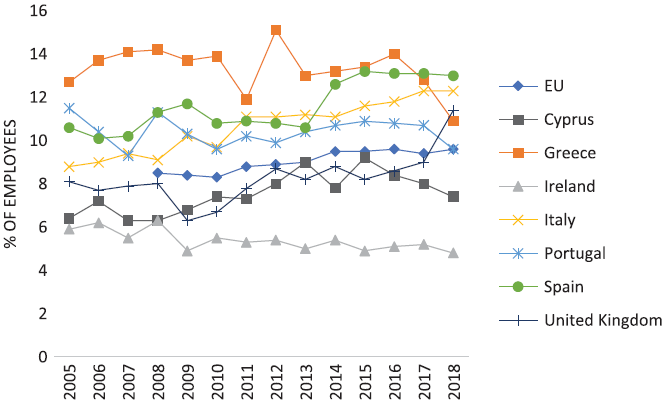
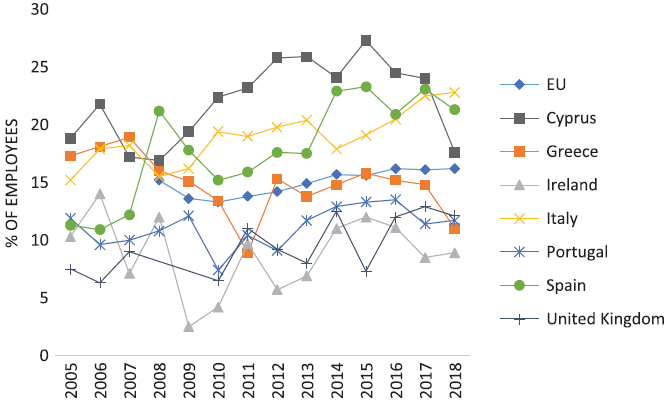
Mechanisms besides the reform of EPL implicate the state in these processes. In particular, precarious work questions the notion of in-work benefits as forms of recommodification that buffer the effects of market pressures. Re-invoking critical debates about in-work benefits in the 1990s, as Rubery et al. (Reference Rubery, Grimshaw, Keizer and Johnson2018) suggest, they simply sustain and normalise low-wage and precarious work, and include not only in-work benefits, but also instances where casual and part-time work is permitted while claiming welfare and where both in-work and out-of-work benefits are offered simultaneously. Although cast as buffers, incentives, or ways of ‘making work pay’, they also normalise precarious work as an intense form of recommodification. The social protection system thus becomes integral to market making and a tool of hybrid forms of in-work and out-of-work modes of recommodification. Such patterns are also reflected in the rise in in-work poverty, particularly when associated with more demanding or coercive types of activation that push the unemployed to take up any job (Seikel and Spannagel, Reference Seikel, Spannagel, Lohmann and Marx2018). Again, available data since 2005 show that in-work poverty has been drifting up-wards in the EU, a pattern replicated in many, though not all, of the countries heavily impacted by the 2008 crisis (Figure 6). Looking specifically at the risk of poverty rate for temporary workers, the upward trend is also in evidence while the overall incidence is much more acute (Figure 7).


The rise of labour insecurity and ‘out-of-work’ recommodification
More demanding types of activation combine with changes to social protection to intensify out-of-work recommodification. Consequently, periods of unemployment become more insecure. Moreover, as social protection is increasingly integrated with activation measures that have become increasingly demanding, they constitute forms of ‘coercive commodification’ (Dukelow and Kennett, Reference Dukelow and Kennett2018), compelling individuals to re-integrate with the labour market. Consequently, state disciplinary forms of out-of-work recommodification twin with the market disciplinary effects of in-work recommodification.
Many of the trends are again not new but continue previous waves of welfare reform. Regarding changes to the eligibility conditions and coverage of social protection, there has been a shift in several countries, since the crisis, to ease access to benefits and to extend coverage to groups whose route into unemployment is from atypical types of work such as self-employment and irregular work (EC DG EMPL, 2018). Yet, such decommodifying moves inter-lock with simultaneous moves towards recommodification. These reforms are therefore typically coupled with reductions in benefit duration and reductions in replacement rates, so while coverage is extended it is less protective.
With regard to activation requirements, conditions such as job availability and the use of sanctions have become pervasive since their introduction across several EU countries in early 1980s (Knotz, Reference Knotz2018). The construction, since 2011, of an OECD unemployment benefit eligibility strictness index, based on availability requirements, job search requirements and sanctions, demonstrates a continued upwards creep in strictness, although there are variations across EU member states (Immervoll and Knotz, Reference Immervoll and Knotz2018). EU countries which have increased their strictness include Hungary, Greece, Belgium, France, Italy, Latvia, United Kingdom, Romania, Croatia, Luxembourg and Malta, with an increase in sanctions for refusing to take up job offers or to participate in active labour market programmes or for voluntary unemployment. Younger and older cohorts have been especially targeted (EC DG EMPL, 2018). Conversely, eligibility is deemed to have become less strict in Ireland, the Netherlands, Denmark and Portugal. However, in the Irish case, significant sanctions were introduced in 2010, the year preceding the start of the index.
The commodification of social services
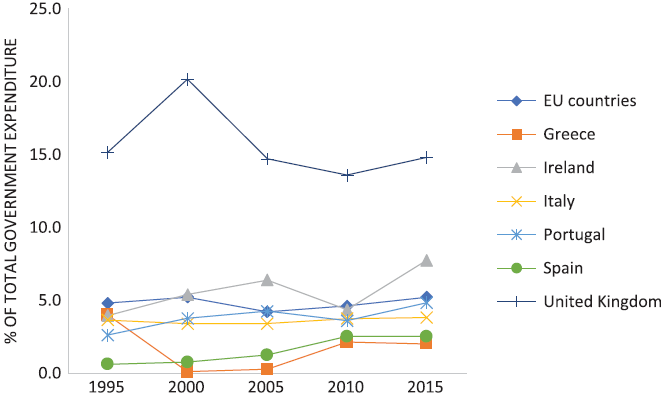
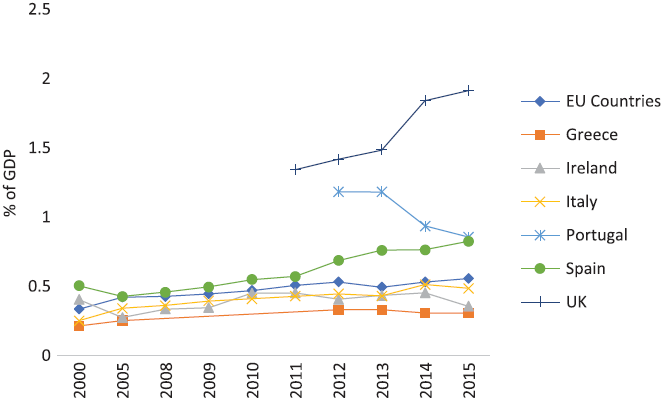
Private forms of social expenditure essentially advance the ‘frontier of accumulation’ and bind labour to ‘participate in expanded reproduction’ (Bryan et al., 2009 in Cushen and Thompson, Reference Cushen and Thompson2016: 362). While housing and consumer credit were central to the advance of private Keynesianism and the financialisation of everyday life in the lead up to the 2008 crisis, an underlying trend has been a gradual creep in the commodification of social services. Inasmuch as available data on private social expenditure trends reveal this, an upward trend is observable since the early 2000s, encompassing social expenditure on social protection, health and housing, with the UK being a clear outlier (Figure 8). Figure 9, which tracks private expenditure in education, illustrates the same pattern. Yet focus on changes in expenditure alone does not account for other shifts from the public to the private. This includes, for example, ways in which people are increasingly compelled, via various restrictions on social housing, to access and bear the risk of housing as a commodity (Scanlon et al., Reference Scanlon, Fernández Arrigoitia and Whitehead2015). Nor does it account for the ‘commodification of life’s time’ (Biggs et al., Reference Biggs, McGann, Bowman and Kimberley2017) in how the retirement age has been revised upwards in several countries. The normal retirement age is due to increase by 3.3 years on average in eighteen out of thirty-five OECD countries by 2060, out of which twelve are in the EU (OECD, 2017). Through these types of recommodification, individuals and households absorb more risk and more responsibility for their security over the life course.


Recommodification eroding social citizenship?
This article has conceived of recommodification as a multiple set of processes that advance commodification and surveyed how these are evolving under conditions of re/financialisation. A further step can be taken to raise points about what this implies for the nature of social citizenship. Returning to Esping-Andersen’s (Reference Esping-Andersen1990) understanding of social citizenship as decommodification, or the granting of social rights on the basis of social citizenship rather than labour market performance, in practice this does not imply a norm of not working. However, it does mean that social citizenship offers a degree of autonomy and security in peoples’ day-to-day lives, and the ability to live and work without being subject to pure market forces. In this scenario the underlying principles of social citizenship, equality, security and solidarity as classically outlined by Marshall (Reference Marshall1950) shape state-citizen relations and inform both the organising principles of social protection and labour market policy. As recommodification both evolves and extends under re/financialised austerity capitalism we can ask what remains of the social and specifically social citizenship?
To ask this question is to engage with similar questions in an evolving debate about the nature of citizenship. For a long time, critiques of social citizenship have pointed to its differentiated character in practice, noting class inequalities that social citizenship never managed to dismantle as well as gender and racial inequalities not originally countenanced by Marshall or by Esping-Andersen. Notions of two-tier citizenship still remain prominent. A core focus rests on the erosion of citizenship rights for those outside the labour market (Edmiston et al., Reference Edmiston, Patrick and Garthwaite2017; Edmiston, Reference Edmiston2018). Edmiston (Reference Edmiston2018), for example, suggests that citizenship under austerity in the UK and elsewhere is bifurcating between thin and thick versions, with the latter contingent upon employment. Within the labour market, differentiations also prevail via conventional understandings of insiders and outsiders, or those with and without job security and decent social protection (Palier and Thelen, Reference Palier and Thelen2010). This is echoed in Standing’s (Reference Standing2014) depiction of the precariat as denizens, pertaining only to a particular segment of the labour market. A more radical intervention by Turner (Reference Turner2016) is to pose denizenship as an all-encompassing status replacing citizenship. This is in addition to the traditional meaning of the denizen depicting individuals, typically migrants, with partial rights, and is generated by the dominance of the market in contemporary societies. People become ‘strangers in their own societies’, social and economic status is weakened and ‘membership resembles temporary, limited, and unpredictable denizenship’ (Turner, Reference Turner2016: 679; 684).
The analysis of recommodification presented in this article tilts towards this wider process of erosion. Recommodification is not only shrinking the social and generating insecurity outside the labour market as people try to get by; insecurities are also to be found in the labour market generated by in-work recommodification that erodes worker protections and further exacerbates the inequalities between capital and labour. Security is further eroded by the creeping commodified access to social services. These are not completely separate processes but are manifestations of anti-social policy measures followed by states under conditions of re/financialisation. There is also a vicious circle element to this as solidarities and cohesive social bonds are fractured by the individualised, competitive, resilient performances generated by recommodification in all its forms. This is evident for example in how trade union solidarities are fractured by financialised imperatives in industry (Grady and Simms, Reference Grady and Simms2019), and by how increasingly coercive forms of out of work recommodification lead to ‘cracks’ appearing in solidarity and support for out of work citizens (Deeming, Reference Deeming2018).
Yet the ‘social does not go quietly’ (Clarke, Reference Clarke2007: 984). Even as recommodification becomes more pervasive and pernicious under re/financialised austerity capitalism there are emergent ideas and proposals about decommodification. Chief among these is perhaps the attention given to universal basic income, a long-standing idea about which there is growing interest since the 2008 crisis and increasingly nuanced debate about its potential. The analysis presented here, however, does raise questions about the extent to which it can challenge contemporary forms of recommodification and represent a meaningful form of decommodification.
Conclusion
This article has attempted to provide a broad synthesis of the thrust of recommodification in the context of the long-term evolution of financialised austerity capitalism and the more recent phase of refinancialisation. In this context it has argued that, under the influence of financialisation, recommodification increasingly acts to expose, rather than buffer, citizens to market rule and risks. Empirically the article demonstrated that the core contextual factors in which the intensification of recommodification is unfolding – namely, declining labour shares and the declining power of labour – are part of the longer-term structural evolution of financialised austerity capitalism since the 1970s. Looking specifically at how this has impacted on recommodification across three dimensions: in-work and out-of-work recommodification, and the (re)commodification of social services, the article has demonstrated ways in which these have ultimately intensified and increased insecurity since the 2008 crisis. Though of course not completely uniform, this impact is evident not only in countries particularly affected by the crisis but across the EU as a whole. A decade on from the crisis therefore, its effect on labour remains acute, with broader issues at stake for the quality and experience of social citizenship.
Acknowledgements
I am very grateful to the anonymous referees and to the guest editors Zoë Irving and Kevin Farnsworth for their constructive feedback on earlier versions of this article.