Introduction
Palaemonidae family is one of the speciose groups of caridean shrimp consisting of more than 1107 species inhabiting a wide range of aquatic habitats from freshwater to marine systems with varying reproductive traits (De Grave and Fransen, Reference De Grave and Fransen2011; Azofeifa-Solano et al., Reference Azofeifa-Solano, Elizondo-Coto and Wehrtmann2014; Gilpin and Chadwick, Reference Gilpin and Chadwick2017; Prakash et al., Reference Prakash, Muthu and Kumar2021, De Grave et al., Reference De Grave, Decock, Dekeyzer, Davie, Fransen, Boyko, Poore, Macpherson, Ahyong, Crandall, de Mazancourt, Osawa, Chan, Ng, Lemaitre, van der Meij and Santos2023). Palaemonid shrimps are mostly free-living, while some species are commonly associated with various marine invertebrates including ascidians, molluscs, sea anemones, sponges, dead and live corals and other crustaceans (Bruce, Reference Bruce2007, Reference Bruce2010; Titus and Daly, Reference Titus and Daly2014; Horká et al., Reference Horká, De Grave, Fransen, Petrusek and Ďuriš2016; Prakash and Marimuthu, Reference Prakash and Marimuthu2020; Purushothaman et al., Reference Purushothaman, Dhinakaran, Ajith Kumar and Lal2022). Studies on life-history patterns and biological traits like reproductive parameters of these shrimps influence species abundance and help to understand species' evolution (Gilpin and Chadwick, Reference Gilpin and Chadwick2017). Palaemonid shrimps of the genera Macrobrachium and Palaemon are relatively well studied, mainly due to their higher commercial value in the fishery (Lima et al., Reference Lima, Silva, Silva, Garcia, Pereira and Amaral2014; Guliyeva, Reference Guliyeva2018; Ahamed et al., Reference Ahamed, Barai, Ahmed and Ohtomi2022). Most Palaemonid shrimps are collected from the wild for the ornamental aquarium trade, because of their attractive coloration and symbiotic interactions with other marine organisms (Okuno and Nomura, Reference Okuno and Nomura2002; Becker and Grutter, Reference Becker and Grutter2004; Calado et al., Reference Calado, Dionísio, Bartilotti, Nunes, dos Santos and Dinis2008, Reference Calado, Olivotto, Planas and Holt2017; Prakash et al., Reference Prakash, Ajith Kumar, Raghavan, Rhyne, Tlusty and Subramoniam2017a, Reference Prakash, Muthu and Kumar2021; Akash et al., Reference Akash, Purushothaman, Madhavan, Ravi, Hisham, Sudhakar and Kuldeep2020).
Palaemonid shrimps exhibit diverse sexual systems, and developmental and reproductive patterns in their life cycle (Holthuis, Reference Holthuis1952; Bauer, Reference Bauer2004). The majority of the species are gonochoric, with individuals having separate sexes and never changing their sex throughout their lifetime, like species from genera Ancylocaris, Macrobrachium, Palaemonetes, Palaemon and Odontonia (Baeza et al., Reference Baeza, Hemphill and Ritson-Williams2015; Prakash et al., Reference Prakash, Ajith Kumar, Subramoniam and Baeza2017b, Reference Prakash, Muthu and Kumar2021). A few caridean species exhibit hermaphrodism, with individuals changing sex during growth and different age periods, like species from genera Lysmata, Exhippolysmata and Parhippolyte (Bauer, Reference Bauer2000; Braga et al., Reference Braga, López Greco, Santos and Fransozo2009; Onaga et al., Reference Onaga, Curt Fiedler and Antonio Baeza2012; Baeza et al., Reference Baeza, Behringer, Hart, Dickson and Anderson2014, Jose et al., Reference Jose, Prakash, Ajith Kumar and Sarkar2023). Sexual dimorphism is another markable feature for decapod crustaceans that is related to allometric growth patterns of various body parts, specifically the variation in the pereopod for males and abdominal segments for females (Hartnoll, Reference Hartnoll, Bliss and Abele1982; Bauer, Reference Bauer2004; Prakash et al., Reference Prakash, Ajith Kumar, Subramoniam and Baeza2017b).
Genus Ancylomenes Okuno and Bruce, Reference Okuno and Bruce2010 of the Palaemonidae family Rafinesque, 1815 include 22 species, of which 19 species are commonly distributed in the Indo-West Pacific region while three species are available on the mainland coast of East Africa (Okuno and Bruce, Reference Okuno and Bruce2010; Bruce, Reference Bruce2013). These shrimps are one of the important groups in the marine ornamental trade because of their translucent body with colourful dots or bands. Their symbiotic association with different marine invertebrates (e.g. Cnidarians), and cleaning behaviour with various fishes (Becker and Grutter, Reference Becker and Grutter2004; Calado, Reference Calado2008; Calado et al., Reference Calado, Olivotto, Planas and Holt2017) make them in great demand. Around eight species are reported worldwide in the marine ornamental trade which includes Ancylomenes holthuisi, A. longicarpus, A. lucasi, A. magnificus, A. pedersoni, A. sarasvati and A. venustus (Calado et al., Reference Calado, Lin, Rhyne, Araújo and Narciso2003; Prakash et al., Reference Prakash, Ajith Kumar, Raghavan, Rhyne, Tlusty and Subramoniam2017a). Many researchers have studied the distributional patterns, social behaviour and cleaning services to reef fishes of Ancylomenes (Mascaró et al., Reference Mascaró, Rodríguez-Pestaña, Chiappa-Carrara and Simões2012; Titus et al., Reference Titus, Daly and Exton2015; Gilpin and Chadwick, Reference Gilpin and Chadwick2020; Romain et al., Reference Romain, Exton, Smith, Rose, Vondriska and Titus2020), life-history traits, population structure and reproductive biology (Gilpin and Chadwick, Reference Gilpin and Chadwick2017), and phylogenetic analysis (Palombit, Reference Palombit2016). Ancylomenes pedersoni is one of the major species in the marine aquarium trade and is frequently exploited directly or as a bycatch with sea anemone collection (Titus and Daly, Reference Titus and Daly2014). Ancylomenes magnificus, commonly called magnificent anemone shrimp, is another important marine aquarium species in trade and has a transparent body and is covered with white transverse bands over the abdomen and violet bands on pereopods which make them attractive (Calado et al., Reference Calado, Olivotto, Planas and Holt2017). This species is commonly distributed in the Indo-Pacific region and associated with a variety of sea anemones (Antheopsis, Cerianthus, Entacmaea and Macrodactyla) (Okuno and Bruce, Reference Okuno and Bruce2010; Prakash et al., Reference Prakash, Ajith Kumar, Subramoniam and Baeza2017b).
In India, A. magnificus is distributed throughout the major reef-associated regions including the Gulf of Mannar and Andaman and Nicobar Islands (Bruce, Reference Bruce2007; Okuno and Bruce, Reference Okuno and Bruce2010; Prakash et al., Reference Prakash, Ajith Kumar and Subramoniam2015). The information on the reproductive traits and population dynamics are pre-requisite for exploring the potential utilization, establishing fishery management regimes and standardizing the captive breeding protocol for this new candidate species. Therefore, the objective of this present study was to investigate and generate biological information including population structure, growth, sex ratio, fecundity, egg sizes, development stages and sexual dimorphism for sustainable exploitation and conservation planning.
Materials and Methods
Study area, sampling and laboratory maintenance
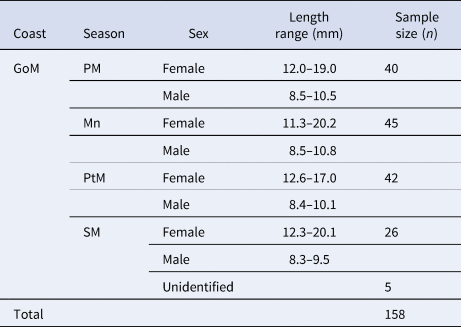
The magnificent shrimp A. magnificus (Figure 1) was recently reported from intertidal regions of the Gulf of Mannar (GoM), Tamil Nadu, India (Prakash et al., Reference Prakash, Ajith Kumar and Subramoniam2015). The GoM is a marine biosphere reserve and hotspot for coastal and marine biodiversity, particularly coral reefs and associated organisms. This biosphere covers an area of 560 km2 between the coordinates of 8°47′–9°15′N and 78°12′–79°14′E and comprises 21 coral islands of sand, calcareous sandstone, dead and live reefs (Prakash et al., Reference Prakash, Ajith Kumar, Raghavan, Rhyne, Tlusty and Subramoniam2017a; Magesh and Krishnakumar, Reference Magesh and Krishnakumar2019). As the shrimp occur in association with sea anemones, these shrimps were collected using scoop nets and hand nets from the tentacles of Bubble-tip Sea anemone, Entacmaea quadricolo (Leuckart in Rüppell and Leuckart, Reference Rüppell and Leuckart1828) (Figure 2) at a depth of 2–4 m. About half of the specimens collected were stored immediately in 95% ethanol solution and the other half were packed in sealed polyethylene bags filled with seawater and over-saturation with oxygen and carefully transported to the laboratory at Peninsular Aquatic Genetic Resources (PAGR) Centre of the ICAR-National Bureau of Fish Genetic Resources, Kochi, Kerala, India by air. In total, 158 individuals collected from the intertidal regions of GoM, from various seasons (August 2021–April 2022) viz., pre-monsoon (PM: July to September), monsoon (Mn: October to December), post-monsoon (PtM: January to March) and summer (Sm: April to June) were transported to the laboratory (Table 1). In the laboratory, the shrimps were acclimatized and transferred into a 100-l glass tank with proper aeration and optimum conditions (salinity: 34–37, pH: 8.0–8.5, temperature: 25–28°C, dissolved oxygen: 8–10 mg l−1). Coral boulders and live rocks were used as hiding substratum for the animals. Artemia flakes and commercial pellets (JBL GmbH and Co. Germany) were used as feed twice a day. The tanks were cleaned by removing uneaten food and excreta every morning before feeding and simultaneously moults were noted and stored in the 95% ethanol for further study.
Live coloration of Ancylomenes magnificus (Bruce, Reference Bruce1979) from Gulf of Mannar, India. (A) Lateral view; (B) dorsal view.

Bubble-tip Sea anemone Entacmaea quadricolor (Leuckart in Rüppell and Leuckart, Reference Rüppell and Leuckart1828) is a host for Ancylomenes magnificus (Bruce, Reference Bruce1979).

Details of sampling sex, time, season, and length ranges of Ancylomenes magnificus from the Gulf of Mannar, India

PM, pre-monsoon; Mn, monsoon; PtM, post monsoon; SM, summer.
Population structure
Ancylomenes magnificus were identified following the literature of Bruce (Reference Bruce1979) and Prakash et al. (Reference Prakash, Ajith Kumar and Subramoniam2015). The size of individuals, carapace length (CL) and total length (TL) were measured under a stereomicroscope (0.5─8X; Nikon SMZ1270, Japan). The CL was measured from the posterior margin of the orbital angle to the posterior margin of the carapace, while TL was from the anterior tip of the rostrum to the posterior tip of the telson. The total body weight (BW) was measured with 0.0001 g accuracy using a Mettler Toledo weighing balance (ME203E, Mettler, Greifensee, Switzerland). The sex of A. magnificus was identified from the preserved specimens by observing the secondary sexual characteristics: the presence of an appendix masculina on the endopod of the second pleopod for males, while absence for females. In live specimens, the sex was determined by the presence of a transparent body with a white rostrum and the absence of saddle-like white transverse bands on the ventral side for males, vs the presence of white transverse bands on the ventral side for females (Prakash et al., Reference Prakash, Ajith Kumar, Subramoniam and Baeza2017b). The CL data were segregated into 0.5 mm class intervals and used to estimate the distribution frequency based on sex. The χ2 test (P < 0.05) was applied to determine the differences between the length frequency of male and female individuals (Sokal and Rohlf, Reference Sokal and Rohlf1981).
Length–weight relationship and sex ratio
The carapace length–weight relationships for A. magnificus were measured for each sex separately, using the equation of exponential regression by Kunju (Reference Kunju1978)

where, BW – body weight (g), CL – carapace length (mm), and a b are the constants.
The sex of individuals was recorded based on secondary sexual characters and a t test was used to identify possible differences in the sex ratio (1 male: 1 female) for each season.
Reproductive traits
Developmental stages
Female individuals carry developing eggs under the abdomen till they are completely mature and released as larvae into the water. The development stages of females were determined by the presence of eggs namely, the early stage (non-ovigerous females), mature stage (ovigerous females) and spent stage (ovigerous spent out from abdomens or presence of a few ovigerous), documented from dead specimens, which enables the classification of maturation stages and thereby understanding the spawning period. Additionally, the Kolmogorov–Smirnov test was implemented to detect significant differences between the female stages and size frequency, and the Mann–Whitney test was used to establish the relationships between the medians.
Fecundity and egg sizes
To estimate the fecundity, the eggs of the ovigerous females were carefully removed from the pleopods using fine needles and forceps. Further, the total weight of eggs was measured to the nearest 0.0001 g using ME203E balance. The sub-samples were taken out and counted under the stereo zoom microscope (Nikon SMZ1270, Japan). The length, width and possible development stages of the eggs were also recorded using a compound microscope (10–40X, Leica D750). The absolute fecundity (AF) and relative fecundity (RF) of A. magnificus were measured by standard formulae of Prakash et al. (Reference Prakash, Muthu and Kumar2021) which will help to find the relationship between the range of fecundity and body size of the animals.

where, EW is the total egg weight, and BW is the body weight.
Further, the linear relationship between the fecundity distribution and length ranges of A. magnificus was estimated by the formula of Yousuf et al. (Reference Yousuf, Chazaro-Olvera and Noor-Ul_Ain2009). The log-transferred data was used for the analysis.

where, F – fecundity, M – CL or TL, a = constant, b = slope.
Sexual dimorphism
To statistically compute the significant differences in the sexes of A. magnificus, CL, TL, second pereopod carpus length (CrL) and second pereopod chela length (ChL) (Prakash et al., Reference Prakash, Ajith Kumar, Subramoniam and Baeza2017b) were examined between the sexes (Figure 3A, B). All the measurements were log transferred and the normality and homogeneity assumptions among the variable were verified. One-way ANOVA was utilized to determine and compare significant morphometric features between sexes. The multivariate method, linear discriminant analysis (LDA), was also employed to predict the group concerning above mentioned morphometric variables. The multivariate method is well-established and robust method for finding the variations among the morphotypes of the Decapoda (Purushothaman et al., Reference Purushothaman, Chakraborty, Gidda, Ganesan, Ponnathara Kandankoran, Laxmanan and Nadakkal2018; Kuberan et al., Reference Kuberan, Chakraborty, Sarada and Maheswarudu2021). All the analyses were carried out using the R program (version 2022) and SPSS version 16 (SPSS Inc. Released, 2007).
Reproductive and second pereopod morphology of Ancylomenes magnificus (Bruce, Reference Bruce1979) from Gulf of Mannar, India. (A) Major second pereopod for male; (B) major second pereopod for female; (C) dorsal view of first pleopod of male; (D) ventral view of first pleopod of male; (E) second pleopod of male; (F) dorsal view of first pleopod of female; (F) closer view of endopod of first pleopod for female; (H) second pleopod of female; (I) segregated oocytes. Chela length (ChL), carpus length (CrL), exopod (Ex), endopod (En), appendix masculina (am), appendix interna (ai).

Results
Morphology of the secondary sexual characters
Male
Male animals were identified based on the structure of the endopod of the first pleopod and the presence of appendix masculina on the endopod of the second pleopod (Figure 3C–E). The endopod of the first pleopod is thin and short, commonly spatulate shaped, distally expanded and as long as 0.35 length of exopod. The disto-lateral margin of the endopod has a short appendix interna and is fringed with small setae distally. The endopod of the second pleopod is similar and slightly shorter than the exopod bearing appendices interna and masculina on the proximal mesial margin. Appendix interna is similar to females and is slightly extended anteriorly to the tip of appendix masculina with a group of distal cincinnuli (coupling hooks). Appendix masculina is also slender and bears a few long spiniform setae distally. Basipods of pleopods do not bear setae on lateral and distal margins.
Female
The endopod of the first pleopod (Figure 3F, G) is short, slightly thick, generally elliptically shaped, distally rounded, bearing sparse simple setae distally and reaching the level of 0.2–0.3 length of exopod. The endopod of the second pleopod (Figure 3H) is similar in length to the exopod bearing only appendix interna, absence of appendix masculina making it easier to distinguish the females. Appendix interna is slender, the median and lateral surface appears smooth arising at proximal one-third of the mesial margin and bearing cincinnuli distally. Endopod of all pleopods except the first pleopod have appendix interna. Compared to males, the lateral margin of the basipod bears numerous long plumose setae which help during the spawning period and act as an incubator chamber for egg development (Bauer, Reference Bauer2013).
Population structure
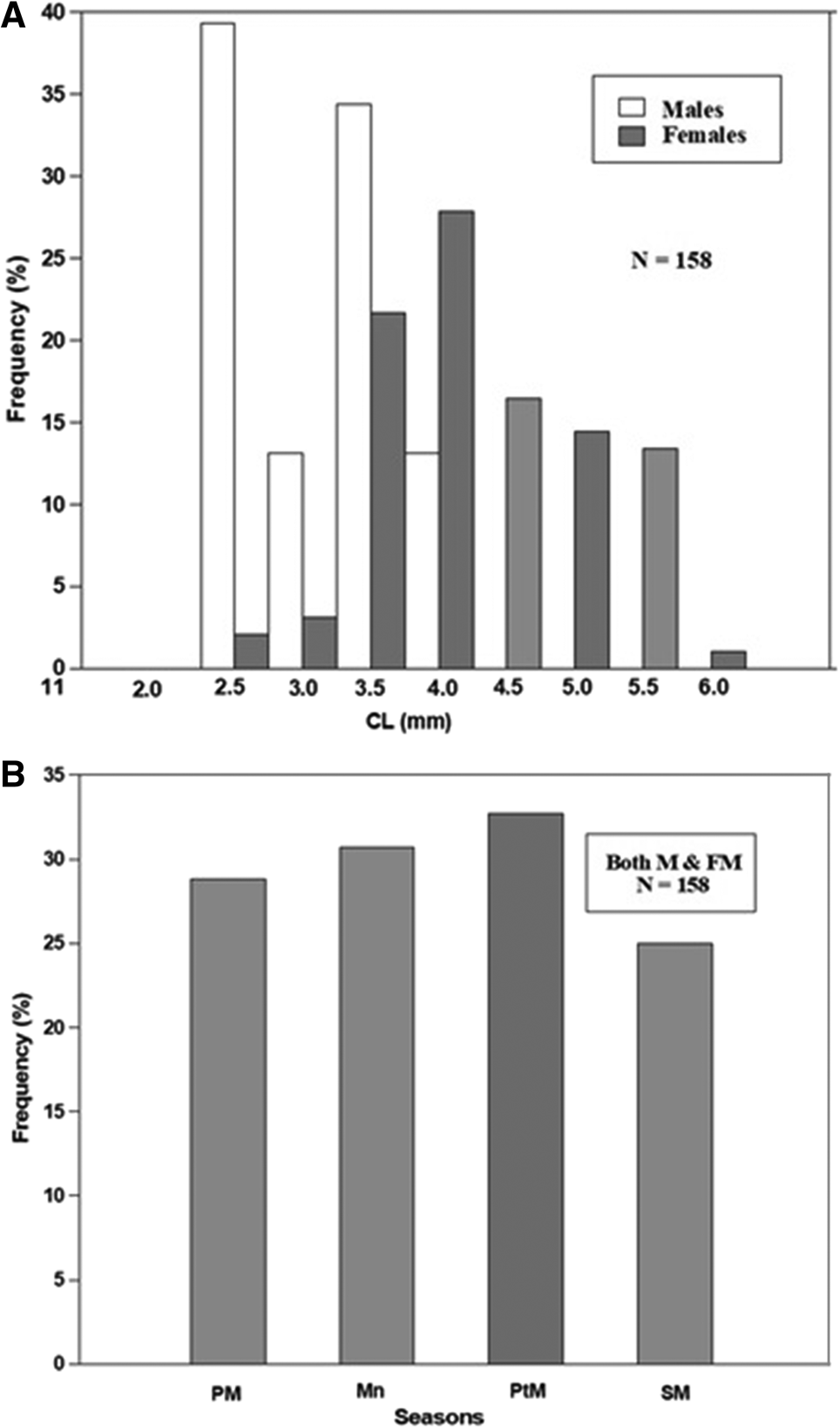
Out of 158 individuals collected, 61.4% (97 individuals) were females and 38.6% (61 individuals) were males. The estimated mean size (CL ± SD) of female animals was 4.93 ± 0.78 mm (ranges 3.1–6.5 mm), while that of males was 3.22 ± 0.56 mm (ranges 2.5–4.3 mm) (Figure 4A). The maximum individuals were noted between 2.5 and 4.5 mm CL for females and 2.1 and 2.9 mm CL for males. The observed size frequency distribution significantly differed between the sexes, where females showed wider size ranges and significantly larger sizes than males (DF = 157; F = 220.329; P < 0.001).
Size frequency (A) and seasonal distributions (B) of males and females for Ancylomenes magnificus (Bruce, Reference Bruce1979) from Gulf of Mannar, India. M, males; FM, females; N, number of specimens.

Furthermore, length frequency distributions of A. magnificus were compared with all four seasons of the region (Figure 4B). The maximum number of animals was recorded in the post-monsoon season (32.69%) followed by the monsoon (30.70%), pre-monsoon (28.84%) and summer seasons (25.00%). Female individuals were observed to be dominant in all the seasons, where CL 4.5 mm group predominated and occurred maximum in monsoon season.
Sexual dimorphism
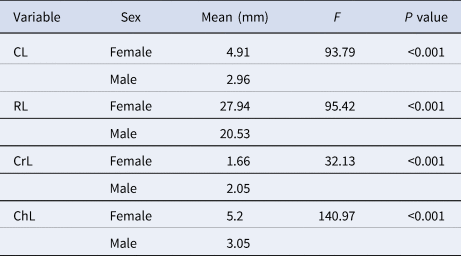
A total of 45 specimens (26 females, 15 males and 4 unidentified) were used and specific morphometric characters were measured. The sexual dimorphism was analysed in the size ranges of 4.0–6.3 mm for females and 2.4–3.6 mm for males. One-way ANOVA was carried out for dependent variables CL, RL, CrL and ChL for all individuals (Table 2). The length frequencies of CL, RL, CrL and ChL for females were higher than for males and showed a significant variation (<0.001). Consequently, the relative size of the second pereopod increased with the overall body length of all males and females.
One-way ANOVA for dependent variables of Ancylomenes magnificus from the Gulf of Mannar, India

CL, carapace length; TL, total length; CrL, second pereopod carpus length; ChL, second pereopod chela length.
The LD analysis was carried out with dependent variables CL, RL, CrL and ChL for females, males and unidentified individuals (UI). The initial variation among the sexes was further supported by LDA and included data from unidentified individuals. The prior probabilities for these groups were 0.577, 0.333 and 0.088, respectively. Overall, morphometric characters of male and female individuals showed maximum variability and UI overlapping with males and showed no significant variation. The cross-validation analysis also confirmed the same. Plots of coefficients of linear discriminant functions 1 and 2 showed both positive and negative values for all characters between the sexes. The ordination of female and male individuals on LD 1 and 2 again showed good separation among the sexes and UI individuals overlapped with males based on the LD function 1 (Figure 5).
Linear discriminant functions 1 and 2 with morphometric comparisons of all the variables of Ancylomenes magnificus (Bruce, Reference Bruce1979) for differentiating females (F), unidentified (I) and male (M).

Length–weight relationships and sex ratio
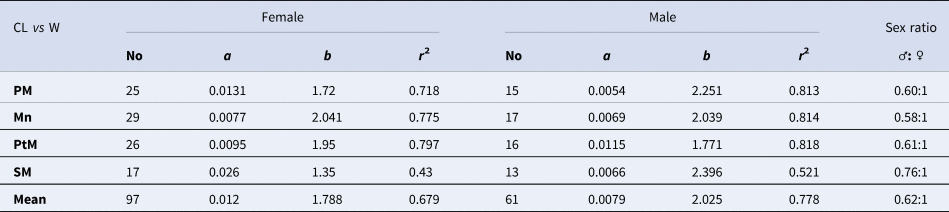
In the present study, we measured a total of 97 females and 61 males. The carapace length–body weight relationship was estimated based on sex and season (Table 3). An overall mean relationship between CL and BW was observed BW = 1.2 × 10⁻² CL1.788 (R 2: 0.679, P < 0.001) for females and BW = 7.90 × 10⁻³ CL2.025 (R 2: 0.778, P < 0.001) for males. The estimated mean value of BW was 0.091 and 0.219 g in the males and females, respectively.
Estimated parameters a and b of the relationship between carapace length (CL in mm) and total weight (W in g) for females and males of Ancylomenes magnificus in Gulf of Mannar

PM, pre-monsoon; Mn, monsoon; PtM, post monsoon; SM, summer.
The estimated sex ratio of the overall mean was 0.62♂: 1♀ and a female-biased sex ratio was observed in all the seasons (Table 3). The maximum sex ratio was 0.76♂: 1♀ in the summer season and a minimum of 0.58♂: 1♀ in the monsoon period. However, the total number of males and females did not differ significantly in the various seasons (χ2 = 2.35; P = 0.175).
Development stages and spawning season
Of the 97 females, 56.7% were found to be egg-carrying animals. The female stage I ranged in size from 4.0 to 6.5 mm CL with a mean ± SD of 4.80 ± 0.69 mm. Stage II females were observed in a wider size range (CL: 3.1–6.3 mm) and were dominated by smaller-sized animals. Stage III females were observed in very few animals and sizes ranging from 3.5 to 4.7 mm CL. Median and size frequency distributions differed significantly between stage I and II groups (KS test: z = 2.386, P < 0.001; Mann–Whitney test: U = 625.5, P < 0.005). The ratio of brooding females proportionately increased with size groups. The maximum number of ovigerous females was observed in the size range of 4.0–5.0 mm CL.
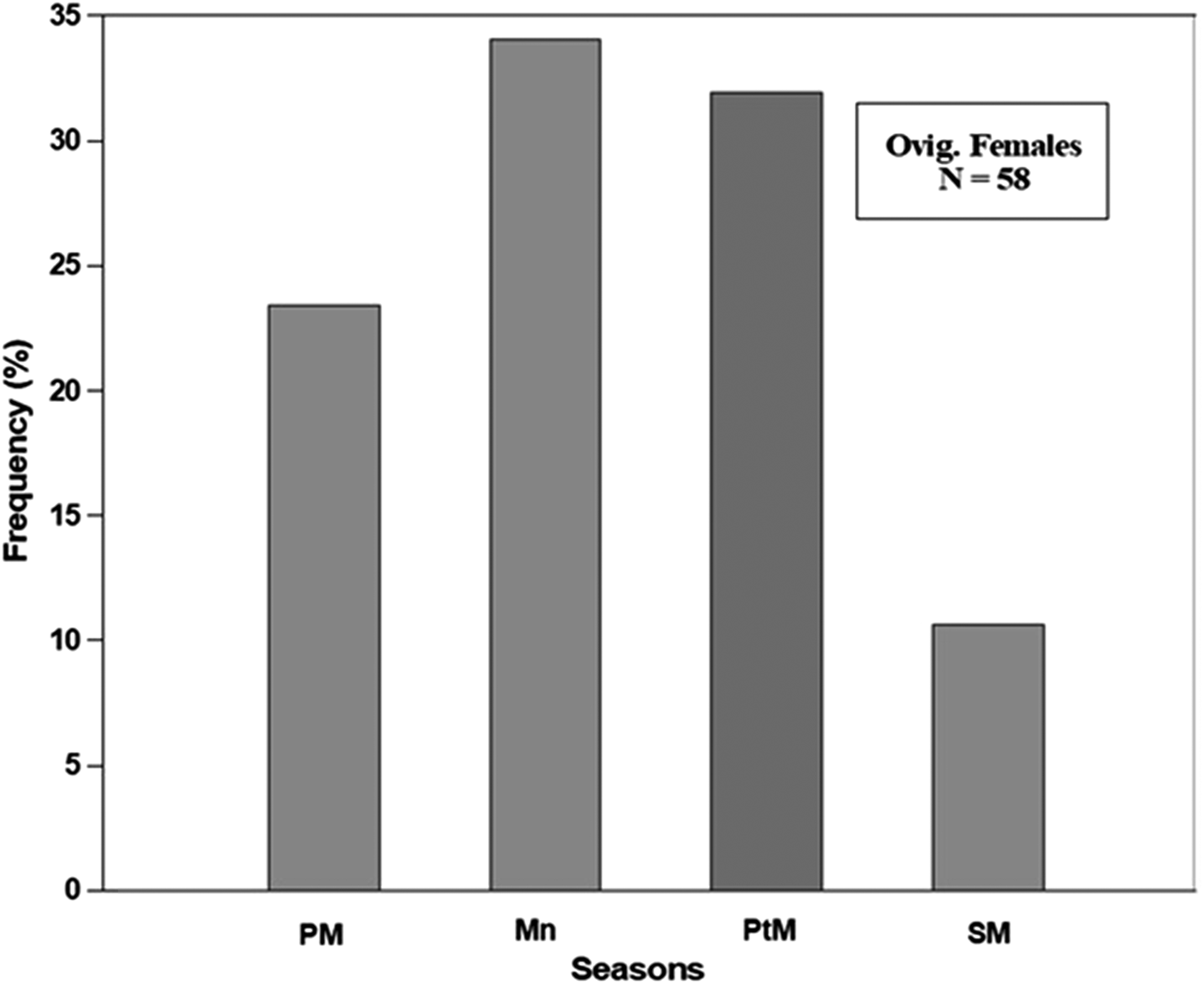
The level of ovigerous females was observed throughout the study period. The highest level of ovigerous females was found in the monsoon season (34.04%) and the lowest in the summer season (10.63%) (Figure 6).
Seasonal frequency ovigerous females for Ancylomenes magnificus (Bruce, Reference Bruce1979) from Gulf of Mannar, India. pre-monsoon (PM), monsoon (Mn), post monsoon (PtM), summer (SM).

Fecundity and egg size
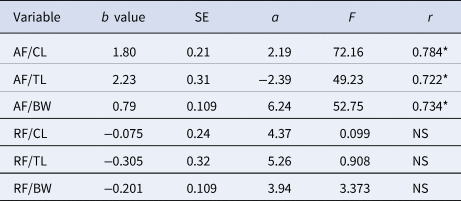
The oocytes were oval-shaped and ranged from 0.5 to 0.75 mm (mean: 0.62 mm) in width (Figure 3I). The average absolute and relative fecundities were 158 oocytes (ranges: 93–272) and 72 oocytes mg−1 (ranges: 46–102), respectively. The linear regression analysis was used to find out the relationships between AF, RF, CL, TL and BW (Table 4). The absolute fecundity showed a significant relationship with CL, TL and BW (P < 0.001) of the animals. However, the relationship between relative fecundity/CL, TL and BW was observed as non-significant with a very weak correlation.
Regression analysis for absolute fecundity (AF) and relative fecundity (RF) for Ancylomenes magnificus from the Gulf of Mannar

CL, carapace length; BW, body weight; TL, total length, b = regression coefficient (slope), SE = standard error of b, F = variance ratio, r = correlation coefficient, *P < 0.001, NS, non-significant.
Discussion
The population structure is majorly influenced by the food availability, seasonality, sexual dimorphism and sex ratio, which are reported in other shrimp species (Chakraborty et al., Reference Chakraborty, Purushothaman, Maheswarudu, Kuberan, Sreesanth and Ragesh2018; Purushothaman et al., Reference Purushothaman, Chakraborty, Ganesan and Gidda2020; Prakash et al., Reference Prakash, Muthu and Kumar2021). Reproductive parameters including spawning process, sex ratio, fecundity, size at first maturity and reproductive output are measures of great importance in determining the yield or recruitment unit by improving the performance potential of a candidate species (Benjamin et al., Reference Benjamin, Rovere, Fontana, Furlani, Vacchi, Inglis, Galili, Antonioli, Sivan, Miko and Mourtzas2017; Calado et al., Reference Calado, Olivotto, Planas and Holt2017; Almeida et al., Reference Almeida Lima, Sertorio, Souza, Menezes, Mouro, Goncalves, de Oliveira, Henry and Machado-Neves2018). The present study is the first systematic study on the population dynamics and reproductive traits of a magnificent shrimp, A. magnificus. The morphology of the secondary reproductive characters and variation in body size between the sexes of A. magnificus is similar to that of other gonochoric species of palaemonid shrimps (Bruce, Reference Bruce2000; Bauer, Reference Bauer2004; Baeza et al., Reference Baeza, Ritson-Williams and Fuentes2013, Reference Baeza, Hemphill and Ritson-Williams2015, Reference Baeza, Simpson, Ambrosio, Guéron and Mora2016; Prakash et al., Reference Prakash, Ajith Kumar, Subramoniam and Baeza2017b, Reference Prakash, Muthu and Kumar2021) and mostly with A. luteomaculatus (Okuno and Bruce, Reference Okuno and Bruce2010) and other Ancylomenes species (Chace, Reference Chace1958; Okuno, Reference Okuno2002, Reference Okuno2004; Bruce, Reference Bruce2013).
In the present study, A. magnificus exhibited seasonal differences in the population structure. A greater number of individuals were observed in the post-monsoon season (32.69%). The female showed a wider size range and was slightly bigger than the male specimens throughout the year. The χ2 test statistically confirmed the presence of size dimorphism in the species. The dominant length frequency of females in the population is mainly composed of a greater percentage of matured animals. Similarly, a prominent sexual dimorphism of small males and larger females has been reported in a closely related symbiotic cleaner species, A. pedersoni by Gilpin and Chadwick (Reference Gilpin and Chadwick2017). They suggested that the larger body size of females increased the number of embryos incubated in the abdomen. Gilpin and Chadwick (Reference Gilpin and Chadwick2017) observed that the largest and most sexually active females were noticed all around the year which contributed to a high number of larval production and sustainable maintenance of the populations. Prakash et al. (Reference Prakash, Muthu and Kumar2021) have reported an obligate symbiotic sea anemone shrimp, Ancylocaris brevicarpalis, from GoM that showed similar seasonal variation in population structure and a higher number of individuals during monsoon and post-monsoon seasons. Even the body size of the female individuals was higher than the male individuals, and all-year-round breeding activity was observed (Prakash et al., Reference Prakash, Ajith Kumar, Subramoniam and Baeza2017b, Reference Prakash, Muthu and Kumar2021). In Heterocarpus chani, a commercially important widely distributed animal found along the Indian coasts and the peak egg-carrying animals were observed during monsoon and post-monsoon seasons, and year-round spawning activity was also reported (Kuberan et al., Reference Kuberan, Chakraborty, Sarada and Maheswarudu2021). Similarly, the present study also suggests year-round breeding in A. magnificus with regular availability of egg-carrying animals during monsoon and post-monsoon seasons.
Previous studies have reported that morphometric features are important in separating the sexes in the decapod species (Torres et al., Reference Torres, Dos Santos, Balbín, Alemany, Massutí and Reglero2014), particularly in the group of palaemonids (Kuris et al., Reference Kuris, Ra'anan, Sagi and Cohen1987; Mariappan et al., Reference Mariappan, Balamurugan and Balasundaram2002; Mariappan and Balasundaram, Reference Mariappan and Balasundaram2004; Moraes-Riodades and Valenti, Reference Moraes-Riodades and Valenti2004; Melo and Masunari, Reference Melo and Masunari2017). Most of the researchers frequently used characters such as length of carapace, abdomen length, total length, carpus, palm, propodus and dactylus of pereopods (Konan et al., Reference Konan, Allassane, Beatrice and Germain2008). These variations have already been reported in many of the species like Palaemonetes antennarius from freshwater habitat zones of north-western Greece (Anastasiadou et al., Reference Anastasiadou, Liasko and Leonardos2009), M. borellii from freshwater zones of northern Argentina (Torres et al., Reference Torres, Dos Santos, Balbín, Alemany, Massutí and Reglero2014), M. potiuna from the freshwater stream of Brazil (Melo and Masunari, Reference Melo and Masunari2017), A. brevicarpalis from shallow coastal waters of the GoM, India (Prakash et al., Reference Prakash, Ajith Kumar, Subramoniam and Baeza2017b, Reference Prakash, Muthu and Kumar2021). Similarly, Prakash et al. (Reference Prakash, Ajithkumar, Bauer, Thiel and Subramoniam2016) used morphometric characters such as carapace length, length of the terminal segment of the third maxilliped, propodus length and dactyl length of the major chela of first pereopods for the analysis of sexual dimorphism in Rhynchocinetes durbanensis, which is another important marine ornamental shrimp species from GoM with canonical discriminant analysis. In the present study, LDA based on the dependent variables CL, RL, CrL and ChL was used to distinguish both sexes of A. magnificus, which showed reversed sexual dimorphism (Bauer, Reference Bauer1976). This species has been commonly observed in shallow water regions inhabiting sea anemones in pairs. Some freshwater palaemonid species like M. jelskii and M. rosenbergii show variable growth in the chelipeds and is considered as an evolutionary signal to the intraspecific relationship of the species which is the reason for development in the pereopods (Kuris et al., Reference Kuris, Ra'anan, Sagi and Cohen1987; Barki et al., Reference Barki, Goren and Karplus1991; Nascimento et al., Reference Nascimento, De Lucena, Macedo and Pinheiro2020). Similarly, the sexual variation of this species (particularly chelated legs) may be due to habitat segregation, and intrasexual competition during the copulation process of this shrimp in the aquatic environment. A detailed experiment is required to address the important role in the shaping of chelated legs during the mating process.
In the present study, the calculated mean value of the length–weight relationships of A. magnificus was b = 1.788 and 2.02 for female and male animals, respectively. The observed coefficient values were less than 3, indicating the presence of negative allometric growth in the magnificent sea anemone shrimp throughout the development. The similar negative allometric growth of animals was noticed in other palaemonid shrimps such as A. brevicarpalis (Prakash et al., Reference Prakash, Ajith Kumar, Subramoniam and Baeza2017b), Macrobrachium nobilii (Mariappan and Balasundaram, Reference Mariappan and Balasundaram2004), M. amazonicum (Rocha et al., Reference Rocha, Silva, Santos and Oliveira2015), M. malcolmsonii (Soomro et al., Reference Soomro, Baloch, Chandio, Achakzai and Saddozai2012), M. jelskii and M. rosenbergii (Kuris et al., Reference Kuris, Ra'anan, Sagi and Cohen1987; Barki et al., Reference Barki, Goren and Karplus1991; Nascimento et al., Reference Nascimento, De Lucena, Macedo and Pinheiro2020). Prakash et al. (Reference Prakash, Ajith Kumar, Subramoniam and Baeza2017b) have reported a pure-search mating behaviour in the GoM area meaning the male animals have to move and compete with others and search for a female among the different environments (Correa and Thiel, Reference Correa and Thiel2003; Bauer, Reference Bauer2004; Baeza and Hernáez, Reference Baeza and Hernáez2015). The sex ratio of A. magnificus is 0.62♂: 1♀ and it favours female animals with greater size, which was observed commonly in the other palaemonid shrimps of symbiotic association with sea anemones (Nizinski, Reference Nizinski1989; Baeza and Piantoni, Reference Baeza and Piantoni2010; Gilpin and Chadwick, Reference Gilpin and Chadwick2017). Ancylocares brevicarpalis also showed a similar kind of sex ratio, which was studied from the same area (Prakash et al., Reference Prakash, Muthu and Kumar2021). The female-favoured sex ratio suggests that A. magnificus is not monogamous and male animals may move to many other host species to pair with receptive females which might be the reason for the lower ratio for the male animals. A similar kind of behaviour was reported in the other symbiotic-associated shrimps (Shine, Reference Shine1989; Baeza and Díaz-Valdés, Reference Baeza and Díaz-Valdés2011).
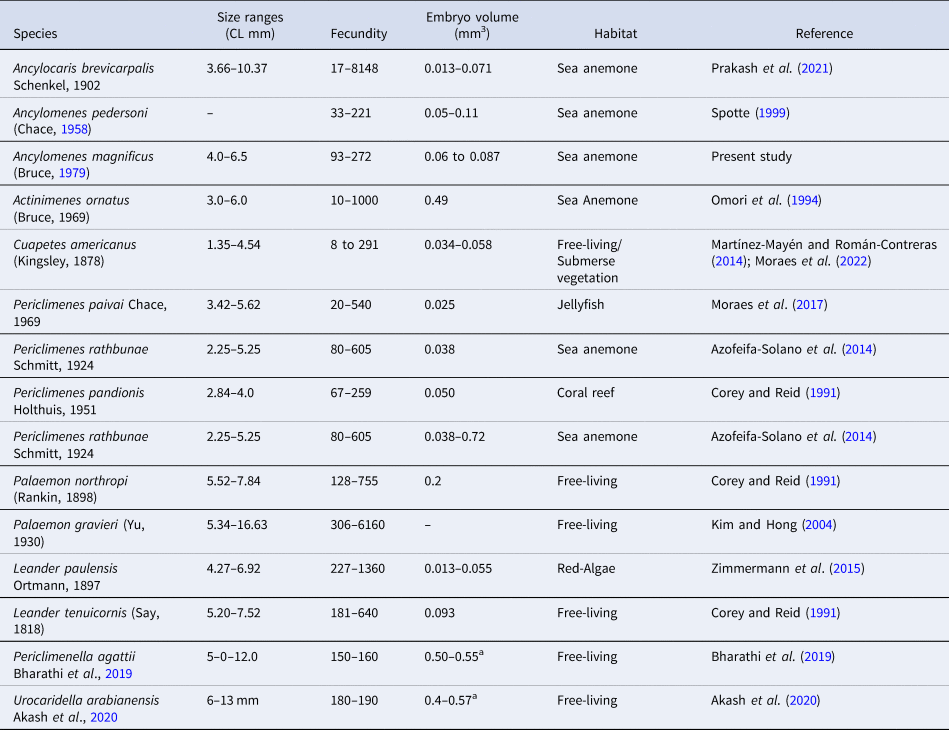
The study indicated that A. magnificus produces comparatively a smaller number of offsprings, when compared to other palaemonid species and a similar number to the congener species Ancylomenes pedersoni (Table 5). Ancylocaris brevicarpalis was reported to produce a great number of embryos (8148). Its size was also reported to be higher than others (Prakash et al., Reference Prakash, Muthu and Kumar2021), which contradicts with our result on A. magnificus from the same region. Many of the reports on the palaemonid species revealed that the fecundity is correlated to the size of the female animals (Da Silva et al., Reference Da Silva, Sampaio and Santos2004; Meireles et al., Reference Meireles, Valenti and Mantelatto2013; Prakash et al., Reference Prakash, Ajith Kumar, Subramoniam and Baeza2017b, Reference Prakash, Muthu and Kumar2021) and our report on the A. magnificus has confirmed this hypothesis. In the present study, the range of embryo volume was 0.06–0.087 mm3 which is similar to other closely related shrimps such as Ancylomenes pedersoni, Ancylocaris brevicarpalis, Periclimenes pandionis and P. rathbunae (Table 5). Prakash et al. (Reference Prakash, Muthu and Kumar2021) suggested that the increase in embryo volume might be related to rates of oxygen consumption and availability of optimum physical conditions and environments during the period of egg development to hatching out, which were reported in other palaemonid species (Azofeifa-Solano et al., Reference Azofeifa-Solano, Elizondo-Coto and Wehrtmann2014; Calado et al., Reference Calado, Olivotto, Planas and Holt2017). The results of the fecundity relationship with CL, TL and BW revealed that absolute embryo mass positively correlated with the overall growth of the female animals, and similar results were observed in other caridean shrimps from the Indian waters (Rajasree, Reference Rajasree2004; Dineshbabu, Reference Dineshbabu2005; Chakraborty et al., Reference Chakraborty, Nandakumar, Maheswarudu, Chellappan, Sajeev, Purushothaman and Kuberan2014; Kuberan et al., Reference Kuberan, Chakraborty, Sarada and Maheswarudu2021). Researchers have suggested that this kind of positive correlation is influenced by the environmental parameters and host animal's relationship with advancing embryonic development and maintenance until the hatching out (Azofeifa-Solano et al., Reference Azofeifa-Solano, Elizondo-Coto and Wehrtmann2014; Baeza and Hernáez, Reference Baeza and Hernáez2015).
Range of size, fecundity, embryo volume and habitat of ovigerous females in various species of Palaemonids

a Measurement in mm.
Conclusion
The study generated an important baseline data on the reproductive potential and population characteristics. The present study revealed that size frequency and egg-carrying females were observed in all seasons, suggesting that a year-round breeding occurs in A. magnificus with peaks in the monsoon and post-monsoon period. The presence of reversed sexual dimorphism with the female being larger than the males was observed using linear discriminant functions. The length–weight relationship indicated that the species have negative allometric growth throughout the development. The average sex ratio favoured female animals, which denotes that males search for receptive females. The fecundity ranges were relatively smaller and similar to congener species. However, we recommend more studies across the spatio-temporal scale to reveal detailed information on the reproductive strategies of A. magnificus in nature and captivity. The objectives of the study were fulfilled and the information generated could be useful for conservation and management.
Data
Data available on request from the authors.
Acknowledgements
The authors thank the Director, ICAR – National Bureau of Fish Genetic Resources for providing the necessary facilities and constant encouragement for carrying out this research. We also acknowledge the Centre for Marine Living Resources and Ecology (CMLRE, MoES) for funding support. The authors fondly appreciate (Late) Dr P. Purushothaman, former student of PAGR centre, ICAR-NBFGR, for his contribution to this work. M/S. Sunshine Aquarium, Chennai is acknowledged for their support in specimen collection. The authors also thank anonymous reviewers and the associate editor of the journal for their voluntary efforts in facilitating this manuscript for publication.
Author contributions
Rejani Chandran: data compilation, analysis and manuscript preparation. N. Saravanane: manuscript revision and further corrections. T. T. Ajith Kumar: concept ideation, sample collection and manuscript. U. K. Sarkar: supervision and manuscript editing.
Financial support
This work was supported by the Centre for Marine Living Resources and Ecology (CMLRE, MoES) (grant number: MoES/CMLRE/MLRE/GIA/2022).
Competing interest
None.
Ethical standards
The protocols for this study were approved by the Institutional Animal Ethical Committee (IAEC), ICAR-NBFGR, Lucknow, India (NBFGR/IAEC/2022/040, Dated 25/05/2022).