Total dry lichen mass per area (DM/A) and water holding capacity (WHC) are interesting anatomical and physiological parameters in ecological and taxonomic studies of lichens. These parameters are partly under genetic control (constitutive adaptation) as evidenced by considerable interspecific variation, and partly influenced by external factors (inducible acclimation; e.g. Gauslaa et al. Reference Gauslaa, Lie, Solhaug and Ohlson2006). Despite the simplicity in measuring such variables, their potential has not been fully exploited in lichenological science (see e.g. Gauslaa et al. Reference Gauslaa, Palmqvist, Solhaug, Hilmo, Holien, Nybakken and Ohlson2009). Subdivision of the total biomass into biomass fractions of separate thallus layers can help scientists understand internal processes such as resource partitioning and biont interactions. However, this task is difficult, and has rarely been done.
Some gastropods form species-specific grazing traces on lichen thalli (Baur et al. Reference Baur, Fröberg, Baur, Guggenheim and Haase2000), and some show strong grazing preferences for specific thallus structures (e.g. Gauslaa Reference Gauslaa2008; Asplund & Gauslaa Reference Asplund and Gauslaa2010). The slug Arion fuscus feeds on the upper cortex and the underlying photobiont layer in some lichens such as the cyanobacterial Lobaria scrobiculata (Scop.) DC. (Asplund et al. Reference Asplund, Larsson, Vatne and Gauslaa2010a). These two species are sympatric in Scandinavian forests. Following ecological studies (Asplund et al. Reference Asplund, Larsson, Vatne and Gauslaa2010a, Reference Asplund, Solhaug and Gauslaab), we investigate here the efficiency of natural tree-climbing gastropods to discriminate between different thallus layers of the forest lichen L. scrobiculata by consumption of the upper cortex and photobiont layer. Our main objective is to use these gastropod-grazed samples to quantify DM/A and WHC, and to estimate the dry density of 1) the upper photosynthetic part including the upper cortex and 2) the lower purely fungal parts of the medulla including the lower cortex. In this way, we can quantify thallus layers and some major internal water reservoirs.
Lobaria scrobiculata thalli without any grazing damage were sampled on Salix caprea in Picea abies forests in Horka (64°26′N, 11°47′E, 30 m a.s.l., Overhalla, W Norway) where the species is abundant. The collected thalli were stored air-dry in the refrigerator until the start of the experiment. The lichens were tied with a thin white flax thread onto a nylon mesh stapled onto stems of Fraxinus excelsior using plastic Plas-staples (Takkurat®; Dr Gold & Co. KG, Nürnberg, Germany). These lichen units were then transplanted into hemiboreal stands in SE Norway with large gastropod populations: Askehagen (59°40′N, 10°46′E, 100 m a.s.l.), Bekkevoll (59°43′N, 10°43′E, 20 m a.s.l.) and Pollevann (59°44′N, 10°45′E, 10 m a.s.l.). The transplant locations did not have indigenous L. scrobiculata, but small natural populations occurred nearby. To secure a range in grazing intensity, lichens were placed at different heights (0·5–6 m) on all trunks. Lichens were transplanted on 25 April 2008 and harvested on 9–11 September 2008. Further details of the methods and study area are given by Asplund et al. (Reference Asplund, Larsson, Vatne and Gauslaa2010a). The snail species (Cepaea hortensis, Cochlodina laminata, Columella edentula, Helicigona lapicida and Vertigo pusilla), two slugs (Arion fuscus and Lehmannia marginata) and one lepidopteran larva (Dahlica sp.) were seen on transplanted lichens during visits. The vast majority of grazing damages were interpreted as gastropod grazing based on the presence of radular traces. Before and after transplantation, the lichens were weighed air-dry (± 0·1 mg) in the laboratory. The air-dry weights were converted to oven (at 70°C) dry weights (DM) by using the ratio between air-dry and oven-dry weights obtained from additional, sacrificial thalli. The thalli were then fully hydrated and photographed with a Nikon D70s digital SLR with a Tamron AF SP 90/2,8 Di Macro 1:1 lens. When photographed, each thallus was placed on millimetre graph paper and covered with a piece of glass to flatten the lichen. Images were georeferenced against the background scale. Thallus and grazed areas were measured by polygon delineation in ArcGIS™ Version 9.2 (ESRI®, Redlands, California). The thalli were also inspected in a dissecting microscope to examine the grazing patterns in detail. Finally, air dry thalli were placed in boxes with all internal walls covered by wet filter papers creating a saturating atmosphere. After 24 hrs at 7 °C, the lichens had become wet. Immediately before measuring the wet weight, each thallus was quickly blotted between dry filter paper to remove surface water.
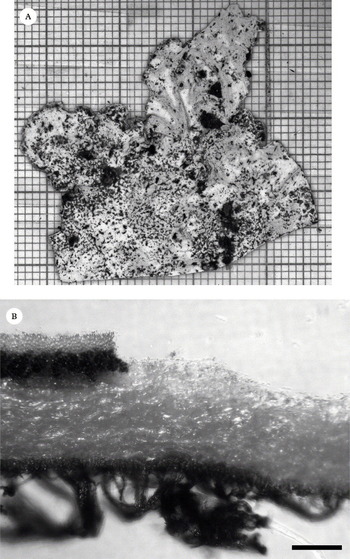
Grazing consistently influenced primarily the upper cortex and the photobiont layer. Fig. 1A shows a typical photograph of a heavily grazed thallus (96·5 % grazed). Only a few large dark patches had an intact upper cortex with a complete photobiont layer below. The white medulla below the photobiont layer was still intact without perforations or deeper holes (also evidenced by cross sections such as Fig. 1B). A few patches of cyanobacterial cells remained. However, most of the photobiont layer in these patches had been grazed; only a thin layer of the lowermost cyanobacterial cells in close contact with the medulla was left behind. Such patches were counted as grazed area. There were no signs of regenerative tissue in grazed patches (personal observation: >1 year required to regenerate in this region).
Lobaria scrobiculata; A, a severely grazed thallus (96·5 % of thallus surface area grazed), only the dark patches are ungrazed, the small grey patches show grazed parts with thin clusters of untouched cyanobacterial cells at the lower edge of the photobiont layer (grid = 1 mm squares). B, cross section of another thallus. Scale: 0·1 mm.

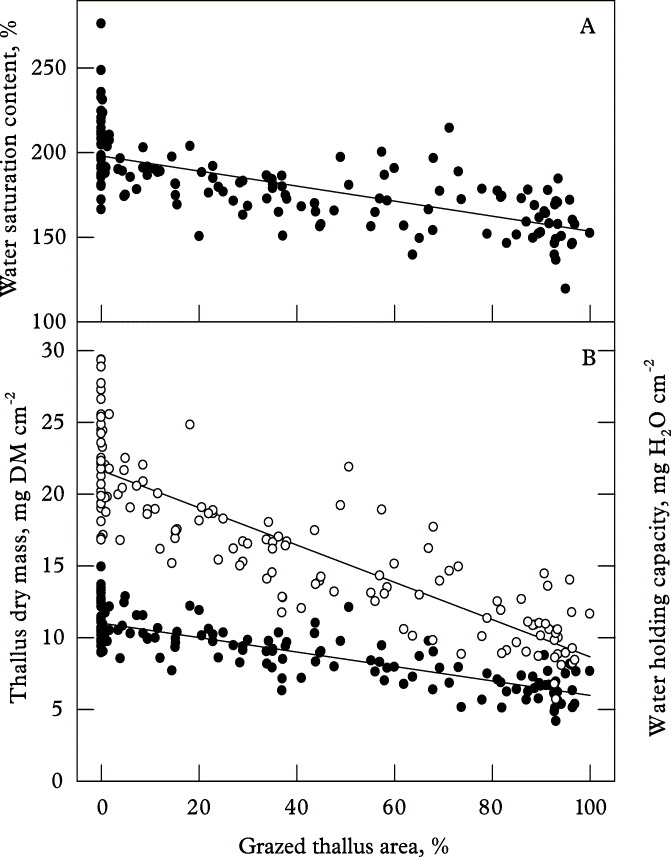
From linear regression analysis there was no relationship between thallus dry mass per area (DM/A) as measured before transplantation and percentage of subsequent grazed area (r 2 = 0·000; n = 146), meaning that changes in DM/A during grazing were the direct result of grazing. Before transplantation, the mean total DM/A was 11·3 ± 0·1 mg cm−2 (mean ± standard error; n = 146). According to the regression model, in which grazing accounted for 68·1 % of the variation in DM/A after transplantation (Fig. 2B), mean total DM/A was 11·0 mg cm−2 in intact thalli (0 % grazing) versus 6·0 mg cm−2 in thalli with only the medulla and lower cortex intact (100 % grazing). Therefore, the total dry mass of the photobiont layer including the adjoining upper cortex was 5 mg cm−2; as much as 45 % of the total dry mass. Measurements of thickness (excluding the rhizines) in one thin (Fig. 1B) and one thick thallus (data not shown) showed in both cases that the photobiont layer including the upper cortex comprised 29 % of total thallus volume after calculation assuming a uniform thickness. These measurements combined with weights give an air-dry density of the photobiont layer including upper cortex of 0·57 g cm−3 versus 0·33 g cm−3 of the lower thallus layers.
Relationships in Lobaria scrobiculata between extent of thallus grazed and three physical characteristics of the thallus. A, water content (WC; %) at saturation, after removing surface water by blotting with filter paper [WC = 198·06 – 0·444 × (% grazing), r 2=0·447, n=146]; B, thallus dry mass per unit area after grazing (•, left vertical axis: DM/A) [DM/A = 11·006 – 0·0503 × (% grazing); r 2=0·681; n=146], and water holding capacity after grazing (○, right vertical axis: WHC) [WHC = 21·639 – 0·130 × (% grazing); r 2=0·737; n=146].
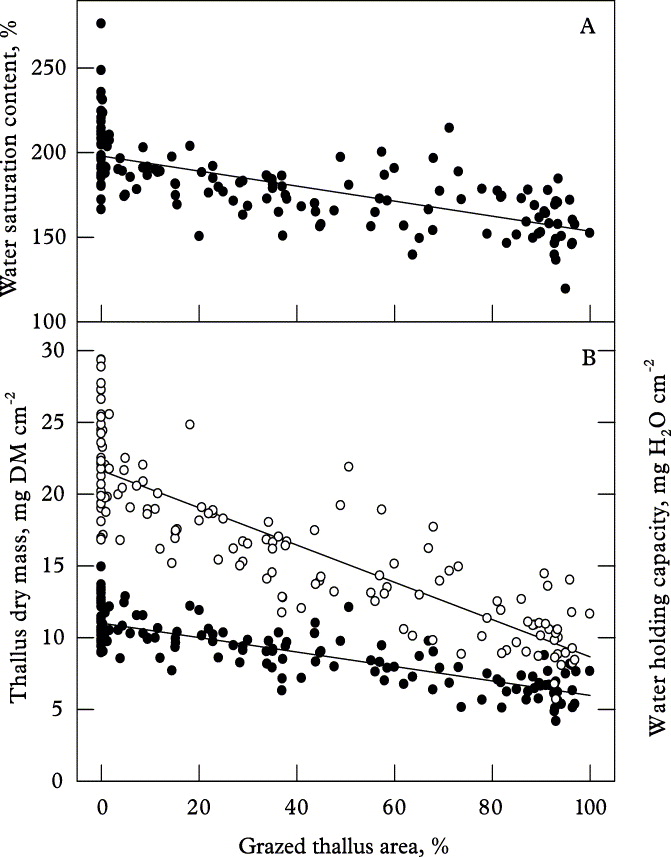
Water content at saturation differed between the 100 % grazed (154 % water) and the 0 % grazed thalli (198 % water); grazing accounted for 44·7 % of the variation in water content (regression model in Fig. 2A). Water holding capacity (WHC) varied between 21·6 mg H2O cm−2 for intact entire thalli (0 % grazing) and 8·6 mg H2O cm−2 for the medulla and lower cortex including tomentum and rhizines (100 % grazing). Percentage grazed explained 73·7 % of WHC according to the linear regression (Fig. 2B). These results imply that WHC for the upper cortex and photobiont layer was as high as 13 mg H2O cm−2, equivalent to 60 % of total WHC. Even though these upper layers occupy just 29 % of the total lichen volume, they comprise the major water reservoir in a L. scrobiculata thallus.
This study shows that gastropods can potentially be used as tools to quantify anatomical lichen structures and their properties. Such features are difficult to study by other means. Some gastropods can be highly specific in their feeding behaviour with lichens (Fröberg et al. Reference Fröberg, Baur and Baur1993; Baur et al. Reference Baur, Fröberg, Baur, Guggenheim and Haase2000), limiting their feeding to the upper cortex and leaving the photobionts and lower layers untouched (Y. Gauslaa, personal observation). A closer study of gastropod – lichen interactions thus might allow separation of three tissue layers. Gastropods cannot be a universal tool for all lichen species, as most have species-specific palatability for the specific separate layers. However, as gastropods do the painstaking job freely, it may be worthwhile to try. Also with other grazing patterns such as selective feeding on cephalodia in Nephroma arcticum (L.) Torss. (Asplund & Gauslaa Reference Asplund and Gauslaa2010), such patterns can improve the understanding of lichen biology.
The selective feeding probably depends on a combination of the nutrient quality of lichen tissues and their content of defence compounds (Hesbacher et al. Reference Hesbacher, Giez, Embacher, Fiedler, Max, Trawöger, Türk, Lange and Proksch1995). In the green-algal lichen Umbilicaria hyperborea (Ach.) Hoffm. the visible extracellular deposits of lichen compounds were densest within and just below the photobiont layer, and virtually absent deep in the medulla (Fahselt & Alstrup Reference Fahselt and Alstrup1997). The fine-scale internal spatial distribution of medullary secondary compounds is not known in L. scrobiculata. The stictic acid complex deters grazing in this species (Asplund et al. Reference Asplund, Solhaug and Gauslaa2010b), in L. pulmonaria (L.) Hoffm. (Asplund & Gauslaa Reference Asplund and Gauslaa2008), and in Pseudocyphellaria crocata (L.) Vain. (Gauslaa Reference Gauslaa2008). Lobaria scrobiculata also has usnic acid in the grazed upper cortex, and meta-scrobiculin restricted to soralia (Asplund et al. Reference Asplund, Solhaug and Gauslaa2010b). One may infer from the grazing pattern in L. scrobiculata that the sharp boundary between the grazed photobiont layer and the avoided medulla (Fig.1A & B) is probably located just above the highest concentrations of stictic acid complex defensive compounds.
One important finding is that the photobiont layer provides the most significant internal water reservoir in L. scrobiculata. Real values of DM/A and WHC are presumably slightly higher than estimated values, since the lowermost photobiont cells were not always grazed (Fig. 1A). Other heteromerous cyanobacterial lichens do not necessarily function in the same way as L. scrobiculata. Degelia plumbea (Lightf.) P. M. Jørg & P. James, for example also contains Nostoc, but has a thick hypothallus that represents the most significant water reservoir during periods of hydration (Gauslaa & Solhaug Reference Gauslaa and Solhaug1998). The lower cortex of L. scrobiculata is covered by patches of tomentum interrupted by naked areas. Our data indicate that this tomentum is less efficient as water storage than the hypothallus of D. plumbea. In general, photosynthesis of cyanobacterial lichens cannot be activated by water vapour alone as in green algal lichens (Lange & Kilian Reference Lange and Kilian1985). Therefore, anatomical and morphological acclimations and/or adaptations to raise the WHC are significant for these lichens, although the location of water storage may vary between species. Compared to the tripartite Lobaria pulmonaria, L. scrobiculata needs a 2·5 times higher hydration level to become photosynthetically active (MacKenzie & Campbell Reference MacKenzie and Campbell2001). Maximum photosynthetic rate also occurred at higher water contents for L. scrobiculata than for L. pulmonaria (Máguas et al. Reference Máguas, Griffiths and Broadmeadow1995; Máguas & Brugnoli Reference Máguas and Brugnoli1996).
In conclusion, grazing gastropods can be used as tools through their feeding on the upper cortex and photobiont layer of thalli of L. scrobiculata to allow estimation of the density and WHC for the upper and lower thallus parts, respectively. The photobiont layer represents a significant part of the total water holding capacity in this lichen.