Introduction
The high likelihood of smoking relapses—the return to smoking after a period of abstinence—remains a significant issue in the treatment of nicotine dependence, and indeed in drug treatment generally. Even when currently accepted gold-standard treatments are utilised, the majority of quit attempts ultimately end in the resumption of smoking (Fiore & United States. Tobacco Use and Dependence Guideline Panel., Reference Fiore2008). Even single, isolated instances of smoking following the initiation of abstinence—smoking ‘lapses’—greatly increase the odds of relapse (Kenford et al., Reference Kenford, Fiore, Jorenby, Smith, Wetter and Baker1994). Understanding the factors that lead to smoking lapses and relapse can inform the developing effective treatment strategies.
The dominant model of dependence emphasises the role of nicotine withdrawal in stimulating relapse. Indeed, numerous studies—including those that the current analyses are based on—have demonstrated that craving and withdrawal severity predict smoking lapses: Both craving and withdrawal severity at the start of a quit attempt, and day-to-day fluctuations in thes symptoms, strongly predict the proximal occurrence of smoking lapses and relapse (Ferguson & Shiffman, Reference Ferguson and Shiffman2014; Ferguson, Shiffman, & Gwaltney, Reference Ferguson, Shiffman and Gwaltney2006; Piper et al., Reference Piper, Schlam, Cook, Sheffer, Smith and Loh2011). Furthermore, the majority of lapses tend to occur in the first days and weeks of a quit attempt (Hughes, Keely, & Naud, Reference Hughes, Keely and Naud2004), when withdrawal symptom severity is at its peak (West, Hajek, & Belcher, Reference West, Hajek and Belcher1987) and, like withdrawal severity, relapse risk decreases steeply as the duration of abstinence extends (Ferguson, Gitchell, Shiffman, & Sembower, Reference Ferguson, Gitchell, Shiffman and Sembower2009; Hughes et al., Reference Hughes, Keely and Naud2004). Not surprisingly, therefore, reducing withdrawal and craving severity is an objective of pharmacotherapies designed to aid cessation, and assessment of the degree to which agents ameliorate such symptoms is often included as a component of their evaluation. Indeed, the degree to withdrawal severity reduction achieved has been found to partially mediate the effect of nicotine patch on lapse risk (Ferguson et al. Reference Ferguson, Shiffman and Gwaltney2006).
However, it is also well documented that lapses can occur weeks, months, and even years after initial abstinence has been established; well after we would expect withdrawal symptoms to have abated (Piasecki et al., Reference Piasecki, Niaura, Shadel, Abrams, Goldstein and Fiore2000; Shiffman et al., Reference Shiffman, Patten, Gwaltney, Paty, Gnys and Kassel2006; West et al., Reference West, Hajek and Belcher1987). Such observations are at odds with withdrawal-based explanations (Russell, Reference Russell1971; Shiffman, Kassel, Paty, Gnys, & Zettler-Segal, Reference Shiffman, Kassel, Paty, Gnys and Zettler-Segal1994) of smoking and relapse. This apparent discrepancy can be reconciled with models (Niaura et al., Reference Niaura, Rohsenow, Binkoff, Monti, Pedraza and Abrams1988) that posit smoking behaviour is also under a degree of stimulus control (Freeman & Lattal, Reference Freeman and Lattal1992). In addition to withdrawal and craving severity, it is now well documented that environmental factors can also trigger lapses and relapse. Observational studies have consistently found that smoking lapses are associated with exposure to environmental triggers (or cues) such as seeing others smoking, or drinking alcohol (Ferguson & Shiffman, Reference Ferguson and Shiffman2009). Similarly, results from observation studies of ad lib smoking support the notion that smoking is—at least partially—under stimulus control, with smoking more likely to occur in the presence of certain internal (e.g., mood) and/or external (e.g., others smoking) stimuli (Shiffman, Dunbar, & Ferguson, Reference Shiffman, Dunbar and Ferguson2015; Shiffman et al., Reference Shiffman, Dunbar, Li, Scholl, Tindle and Anderson2014). Environmental triggers are suggested to gain their potency from learning processes that, over time, have linked these stimuli with smoking. Laboratory cue-reactivity studies (Carter & Tiffany, Reference Carter and Tiffany1999) have consistently shown that exposure to drug-related cues result in increases in craving (termed cue-provoked cravings), with these ‘spikes’ in craving believed to prompt the smoking behaviour itself.
The temporal patterns of withdrawal-based triggers and environmental—or behavioural—triggers are currently poorly understood. Such knowledge is important for the development and tailoring of interventions aimed at helping smokers to avoid lapses. Why might lapse triggers vary over time? Because the nicotine withdrawal syndrome is known to have a limited duration, one would expect its influence on lapses to wane over time, leading to a shift towards environmental triggers as causes of lapses. It is not known whether such a shift occurs. Contrary to this hypothesis, however, is existing evidence that quit medications such as nicotine patch—which, even at high (35mg/24 hr) doses, has been shown to have little impact on cue-provoked cravings (Ferguson & Shiffman, Reference Ferguson and Shiffman2009)—continue to improve a user's odds of success even as long as 6-months post quit (Shiffman et al., Reference Shiffman, Scharf, Shadel, Gwaltney, Dang and Paton2006). If such medications successfully manage withdrawal severity (Shiffman, Ferguson, Gwaltney, Balabanis, & Shadel, Reference Shiffman, Ferguson, Gwaltney, Balabanis and Shadel2006), but do not protect against cue-provoked cravings, this suggests withdrawal may still play some role in triggering lapses later in a quit attempt. [An alternative interpretation, however, is that the effect of treatment at later time points is simply carried over from helping more smokers survive the initial quit period when withdrawal is at its peak.]
Recently, Shiffman and colleagues (Shiffman et al., Reference Shiffman, Dunbar and Ferguson2015) proposed a two-factor model of dependence that posits smoking behaviour is maintained through both withdrawal-avoidance and stimulus control. An important component of this theory is that the level of stimulus control seen during smoking initiation is not superseded by nicotine dependence (Shiffman & Paty, Reference Shiffman and Paty2006); rather, stimulus control remains relevant even in established daily smoking but it is shrouded by the more dominant drive to maintain nicotine levels. The model predicts that the role of stimulus control becomes more prominent once nicotine withdrawal starts to abate. If this is the case, we would expect to see that the risk of suffering a lapse triggered by withdrawal would decrease over time, whilst the risk of suffering a lapse due to smoking cues would increase over the course of a quit attempt. Here, we test these hypotheses using data from two smoking-cessation studies in which the time taken to experience a first lapse, and the circumstances surrounding these events, were recorded.
Methods
Overview of the Studies
The current analysis is based on pooled data from two smoking-cessation trials using similar protocols to investigate the process of quitting and smoking lapses (Study 1 (Shiffman, Paty, Gnys, Kassel, & Hickcox, Reference Shiffman, Paty, Gnys, Kassel and Hickcox1996); Study 2 (Shiffman et al., Reference Shiffman, Scharf, Shadel, Gwaltney, Dang and Paton2006)). After providing baseline demographic and smoking history characteristics, participants engaged in Ecological Momentary Assessment (EMA; (Shiffman et al. Reference Shiffman, Stone and Hufford2008)) using hand-held electronic diaries (ED) to monitor their smoking, mood, activities and situations in real-time for up to 7 weeks over the course of a quit attempt. Participants were instructed to record every time they smoked a cigarette—including post-quit smoking lapses—in real-time using the study-issued ED. In the case of lapses, participants were asked to indicate the primary trigger of the lapse. Self-reported abstinence was verified during study visits using CO.
In both studies, participants received behavioural counselling consisting of multiple group sessions providing psychoeducation and support (similar across the two studies; see Shiffman et al., Reference Shiffman, Scharf, Shadel, Gwaltney, Dang and Paton2006 for further details). In Study 1, no pharmaceutical aid was offered; in Study 2, participants were randomised (double-blind) to receive high-dose (35 mg/24 hour) nicotine or placebo patches (in a 3:2 ratio). Our analyses only include those given placebo in Study 2, restricting them to participants attempting to quit smoking without pharmacological assistance.
Participants
Details of the participants’ recruitment and screening procedures have already been reported elsewhere. To be eligible for the current analyses, participants must have (1) achieved initial abstinence (defined as lasting at least 24 hours without smoking a cigarette as part of a quit attempt), (2) reported suffering at least one smoking lapse whilst under EMA observation and (3) reported their first lapse in real-time and hence have completed a full assessment of the circumstances (described below). Following these exclusions, a total of 186 (Study 1: n = 108; Study 2: n = 78) quitters were deemed eligible. The University of Pittsburgh Institutional Review Board approved both studies, and written informed consent was obtained from all participants.
Procedures
The study procedures and assessments—including the post-quit lapse monitoring—for the two studies have been reported in detail in previous publications. The two studies utilised largely similar study designs. Participants were instructed to carry an ED with them throughout the waking day and to log—by tapping a button on the screen—every time they smoked a cigarette.
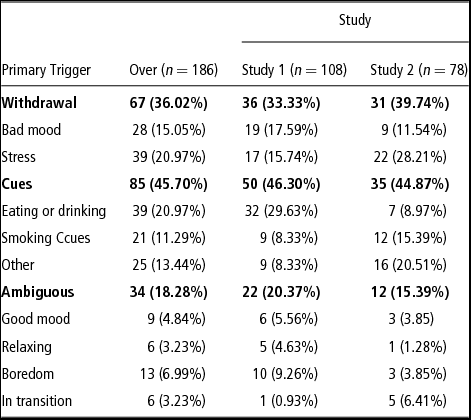
The ED monitored smoking and automatically determined (and logged) the time and date when participants achieved initial abstinence (defined as a continuous 24-hour period when no cigarettes were reported). Once initial abstinence had been achieved, any instances of smoking that occurred—even just a single puff of a cigarette—were treated as smoking lapses. If a lapse was reported, participants were required to complete an on-screen assessment of mood, social setting and activities that immediately preceded the decision to smoke (see: Ferguson & Shiffman, Reference Ferguson and Shiffman2010, Reference Ferguson and Shiffman2014 for more detail regarding the lapse assessment structure). Importantly for the purposes of this study, participants were asked to indicate the primary trigger of the smoking lapse—that is, the trigger that caused them to lapse—from a list of options derived from prior research (bad mood, stress, good mood, eating or drinking, smoking cues, relaxing, boredom, in transition, other trigger; Table 2); only one primary trigger could be selected for each episode. Participants were also asked to rate the intensity of the cigarette craving they experienced immediately before the lapse. Participants also completed a ‘confessional’ at the end of each study day during which they were able to report any lapses during the day that they had failed to report in real time. These confessed lapses were date- (but not time-) stamped, and were not assessed in detail.
Analytic Plan
We selected each participant's first lapse episode for analysis because the initial lapse is thought to have after-effects (whether due to pharmacological exposure to nicotine (Shaham, Shalev, Lu, De Wit, & Stewart, Reference Shaham, Shalev, Lu, De Wit and Stewart2003) or to psychological processes (Kirchner, Shiffman, & Wileyto, Reference Kirchner, Shiffman and Wileyto2012)) on subsequent lapses that could obscure the relationships involved. Only lapses that were recorded in real time (and hence subject to a full assessment) were eligible. Data gathered from end of day reports were used in this process to eliminate real-time lapse assessments that had been preceded by a confessed lapse and hence were not actually first lapses (see: Ferguson & Shiffman, Reference Ferguson and Shiffman2010). One hundred and eight eligible first lapses were identified in Study 1, and 78 in Study 2, with a total of 186 eligible first lapse episodes overall.
The trigger for each participant's first lapse episode was determined from the primary lapse trigger nominated by the participant (via EMA) immediately after the lapse. Lapses for which the participants nominated ‘smoking cues’, ‘other trigger/s’ or ‘eating or drinking’ (including drinking alcohol) as the primary trigger (each of which has been identified as common smoking cues in previous studies (Ferguson, Frandsen, Dunbar, & Shiffman, Reference Ferguson, Frandsen, Dunbar and Shiffman2015; Shiffman et al., Reference Shiffman, Dunbar, Li, Scholl, Tindle and Anderson2014)) were categorised as ‘smoking cues’. Because affective disturbance is the dominant theme in nicotine withdrawal (Hughes & Hatsukami, Reference Hughes and Hatsukami1986), lapses for which the participants indicated that the primary trigger was either ‘bad mood’ or ‘stress’ were classified as lapses that had been trigged by withdrawal. The remaining lapses were classified as ‘ambiguous’ because the reported triggers (‘good mood’, ‘relaxing’, ‘boredom’ and ‘in transition’) could not be clearly classified as being either due to a smoking cue or withdrawal-based. Time to first lapse was calculated as the number of days between the quit day and the day of the first lapse.
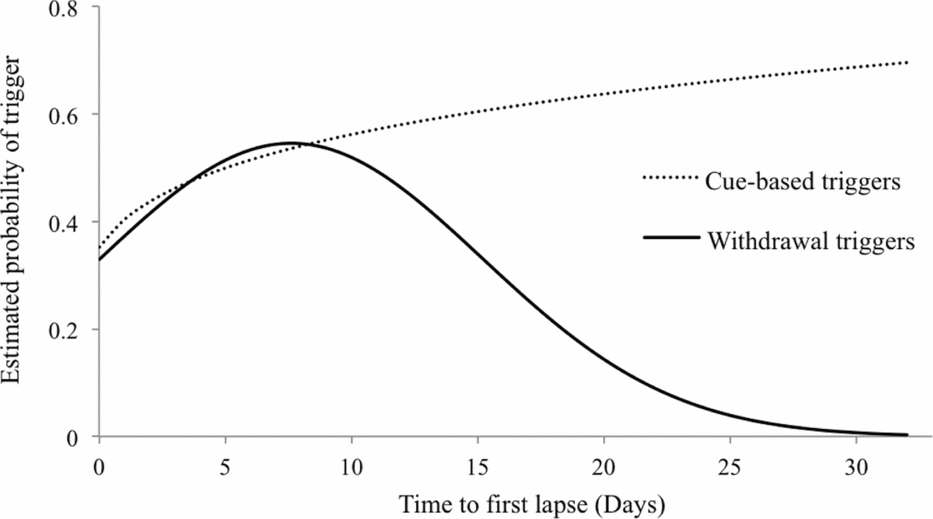
Each participant nominated a single primary trigger for their first smoking lapse; there was a single observation on each participant. The response variable for analysis was a single nominal outcome with three attributes (1 = smoking cue, 2 = withdrawal, 3 = ambiguous) that each represented a possible trigger for the first lapse by each participant. The principal study factor was time to first lapse. Log multinomial regression (Blizzard & Hosmer, Reference Blizzard and Hosmer2007) was used to estimate the probability that respondents would nominate each multinomial outcome as the trigger for their lapse. Results are presented for smoking cues and withdrawal-based triggers; it is not possible to model all three outcomes. We did not have a theoretical reason to assume that the patterns would be linear, or similar across trigger groups. The best representations of the non-linear relationships involved were achieved by using the logarithm of time to first lapse to estimate the probability of a smoking cue being the trigger for a lapse, and time to first lapse and its square to estimate the probability of withdrawal being the trigger for a lapse. A binary covariate was added to take account of the fixed effect of pooling two samples each drawn from the same population. This modelling produced the estimated probabilities depicted in Figure 1. To assess whether our findings were an artefact of confounding bias, adjustment was made for age, sex, ethnicity (Caucasian vs. non-Caucasian) and Nicotine Dependence Syndrome Scale (total score). The results are shown in Table 3.
Estimated probabilities of reporting a lapse triggered by a smoking cue, and of reporting a lapse triggered by withdrawal, by time of first lapse.

Results
Participant Characteristics
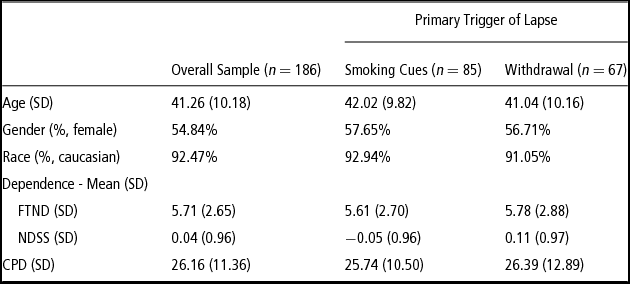
The demographic and smoking history characteristics of the sample are shown in Table 1. Additional details on the characteristics of the smokers in both studies have been published elsewhere.
Demographic and smoking history characteristics of the sample, overall and by primary trigger of first lapse

Notes: SD = Standard Deviation. FTND = Fagerström Test of Nicotine Dependence (Heatherton, Kozlowski, Frecker, & Fagerstrom, Reference Heatherton, Kozlowski, Frecker and Fagerstrom1991). NDSS = Nicotine Dependence Syndrome Scale (Shiffman et al., Reference Shiffman, Waters and Hickcox2004). CPD = Cigarettes per day.
The proportion of smoking lapses attributed to each of the primary trigger options is shown in Table 2. Of the 186 first lapses, just under a half (46%) were categorised as being triggered by smoking cues and a third (36%) by withdrawal, with the remaining 18% being categorised as ambiguous. The proportion of lapses in each category (cues, withdrawal or ambiguous) did not differ between the two studies (Table 2). The average time to a first lapse was 4.71 days (SD = 6.47; Range 0–31 days). On simple comparison of days to lapse, lapses attributed to withdrawal occurred earlier, on average, than those attributed to smoking cues, but this difference was not statistically significant (mean: 4.25 days vs. 5.87 days, P > 0.15; median: 2 days vs. 2 days, P > 0.24). The mean intensity of craving experienced immediate before the lapse did not differ by trigger type (Cues: 6.47, Withdrawal: 6.70, P > 0.70).
Number and proportion of lapses episodes (n = 186): overall and by study

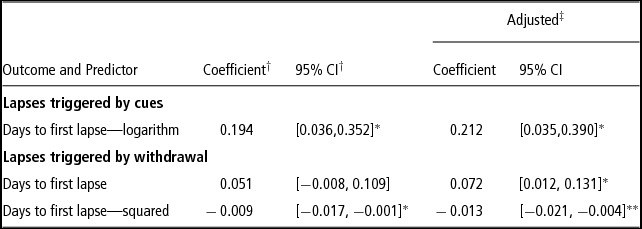
Table 3 presents the regression coefficients used in the estimation of the probability of a smoking cue being the trigger for the lapse, and of the probability of withdrawal being the trigger for the lapse, at the time of the first lapse. The probability of a smoking cue being the trigger for lapse becomes progressively higher as days elapse since the quit day, whilst the probability of withdrawal being the trigger is highest about a week after the quit day and becomes progressively lower thereafter. This is depicted in Figure 1.
Regression coefficients from the estimation of the probability of a lapse being triggered by a smoking cue, and of the probability of a lapse being triggered by withdrawal, over the range of times to first lapse

Notes: *denotes P < 0.05, ** denotes P < 0.01.
†Regression coefficient (95% confidence interval [CI]) adjusted for study sample.
‡Regression coefficient (95% CI) adjusted for study sample, age, sex, ethnicity (Caucasian vs. non-Caucasian) and dependence (Nicotine Dependence Syndrome Scale (Shiffman et al., Reference Shiffman, Waters and Hickcox2004)).
Also shown in Table 3 are the changes in the regression coefficients due to adjusting for four putative confounders: age, sex, ethnicity and dependence. Suggesting the results are not an artefact of confounding bias, each of the regression coefficients is slightly higher after adjustment. Of particular importance is the robustness of the results to adjustment for nicotine dependence, because more dependent smokers have been shown to lapse earlier and to suffer greater withdrawal severity (Shiffman et al., Reference Shiffman, Hickcox, Paty, Gnys, Richards and Kassel1997). This raises the possibility that the pattern shown in Figure 1 is due to differences in dependence. Indeed, in this sample, participants with a greater dependence (as measured by the Nicotine Dependence Syndrome Scale (Shiffman, Waters, & Hickcox, Reference Shiffman, Waters and Hickcox2004)) did display a shorter time to first lapse (P < 0.005). However, the adjusted results in Table 3 suggest that for all smokers, irrespective of their level of dependence, the probability that a lapse will be triggered by withdrawal diminishes after the first week and the probability that a lapse after that time will be triggered by a smoking cue becomes increasingly strong.
Discussion
It is well known that both nicotine withdrawal symptoms and smoking cues can act as triggers for smoking lapses during quit attempts. However, shifts in the likelihood of these triggers over time has not previously been documented. There was theoretical reason (Shiffman et al., Reference Shiffman, Dunbar and Ferguson2015) to expect that withdrawal would be more prominent early on, with cues becoming more prominent later. Indeed, we found that lapse triggers were not randomly distributed over a quit attempt; rather, as a quit attempt progressed, the probability of a lapse being triggered by withdrawal diminished, whilst the probability of a lapse being triggered by smoking cues increased. The probability of a lapse being triggered by withdrawal—here operationalised as negative affect or stress—followed a time course similar to that documented (including using data from the studies used in these analyses) for withdrawal symptom severity itself (West et al., Reference West, Hajek and Belcher1987); namely, it peaked in the initial days of a quit attempt before dropping off as the duration of abstinence increased.
The observed patterns are consistent with the two-factor model of dependence proposed by Shiffman and colleagues (Shiffman et al., Reference Shiffman, Dunbar and Ferguson2015). As in earlier models of dependence, Shiffman and colleagues argued that both withdrawal-avoidance (trough-avoidance (Russell, Reference Russell1971)) and stimulus control have a role in smoking behaviour. The defining point of difference with the two-factor model is its assumptions about the relationship between stimulus control and classical nicotine dependence. Traditionally, models of dependence allow for stimulus control as a mechanism for establishing smoking patterns, but assume that over time the role of stimulus control is replaced by pharmacological dependence; put another way, that smokers transition from smoking because of environmental cues into smoking in order to maintain nicotine levels. The two-factor model of dependence on the other hand assumes that stimulus control is not superseded by nicotine dependence, but rather remains relevant even in established daily smoking. During initial abstinence stimulus control is shrouded by the more dominant drive to maintain nicotine levels, but re-emerging when nicotine-maintenance motivations recede. The results from the current study are consistent with model predictions that the role of smoking cues in triggering lapses would become more prominent once nicotine withdrawal starts to abate; the very pattern of results we observed here.
The observed patterns of smoking triggers have practical implications for the provision of assistance to smokers interested in quitting. Traditional behavioural support focusses on teaching a range of behaviour change techniques, including the management of withdrawal and coping skills to either avoid or manage cue-induced craving and relapse crisis situations. It is possible that the application of these skills may be improved if they were taught in sequence (stress withdrawal-management first, then cue management later). Future work is necessary to determine whether such an approach actually improves the recall and use of behaviour change techniques, and boosts quit rates. The effect of pharmacotherapy—which reduces withdrawal severity—on the observed trends also needs to be explored.
The primary limitation of the analyses presented is that we cannot rule out that the observed temporal trends are actually due to subject-level effects. Because participants could only suffer a first lapse once during a quit attempt, it is possible that what we are observing are differences between smokers; specifically, that participants who lapse due to withdrawal may lapse earlier than participants who lapse due to smoking cues. We adjusted in analysis for theoretically relevant factors—study, age, sex, ethnicity and a measure of nicotine dependence—but the observed patterns might be explained by other factors not able to be examined. An alternative analysis might be to include multiple lapses for each person, thus allowing within-subject effects to be modelled, but interpreting the outcome of these models would be problematic because earlier lapses influence later lapses and lapses segue into continued smoking. Another similar alternative would be to include temptation episodes (Shiffman et al., Reference Shiffman, Paty, Gnys, Kassel and Hickcox1996) preceding first lapses in the models, but again it is unclear whether we would be modelling the same processes, given that temptation episodes are categorically different from lapse episodes (in that only lapse episodes directly resulted in smoking). A more pragmatic alternative might be to use data from larger scale survey data that, whilst retrospective, may be able to better explore participant-level effects (due to the increased sample sizes), or to track the trigger of first lapse episodes across multiple quit attempts. In any case, the results presented warrant replication. The categorisation of lapses as being triggered by either withdrawal or cues—whilst theoretically justified—was post-hoc; future studies might consider directly asking participants whether a lapse was due to withdrawal or cues rather than categorising them after the fact; in this sense, the findings warrant replication. A qualitative study on participants’ understanding of lapse triggers might also aid categorisation. Similarly, it would be compelling to model each trigger type individually, to ensure that the grouped triggers followed similar trajectories; unfortunately, this was not possible in our study due to the limited sample size (see Table 2). Finally, it is also possible that the triggers identified as the primary trigger were not the real reason that someone lapsed. However, this is minimised by the fact that we asked subjects to report in real time so recall is unlikely to have had a significant influence on the results. More importantly, we can think of no plausible reasons why this this would vary systemically; so at worst it would be adding noise rather than bias.
Here, we report results from two EMA studies that examined the triggers of first lapses. Consistent with the time course of withdrawal symptoms, the probability of a first lapse being triggered by withdrawal rose in the initial days of a quit attempt before dropping as the quit attempt progressed. Conversely, the probability that a lapse was triggered by a smoking cue rose over the course of a quit attempt. These results have implications for tailoring smoking-cessation treatments; in particular, for the stepwise provision of smoking-cessation support—both pharmacological and behavioural—over the course of a quit attempt.
Acknowledgements
The authors acknowledge the assistance of Stephanie Paton and Celeste Elash in conducting Study 2.
Financial Support
Both Study 1 and Study 2 were supported by grants from the National Institute of Drug Abuse award to SS (DA06084). Leigh Blizzard is supported by a Career Development Fellowship provided by the National Health and Medical Research Council of Australia.
Conflict of Interest
SGF has consulted for GlaxoSmithKline Consumer Healthcare and Chrono Therapeutics on matters relating to smoking cessation and has received researcher-initiated project grant funding from Pfizer (through the GRAND initiative). He has also served on an advisory board for Johnson & Johnson. SS consults on tobacco harm minimization (including nicotine replacement therapy and digital vapor products) to Niconovum USA, RJ Reynolds Vapor Company, and RAI Services Company, all subsidiaries of Reynolds American, Inc. SS owns an interest in intellectual property for a novel nicotine medication that has been optioned to Niconovum USA.
Ethical Standards
The authors assert that all procedures contributing to this work comply with the ethical standards of the relevant national and institutional committees on human experimentation and with the Helsinki Declaration of 1975, as revised in 2008.