During the 2018 midterm election, The Washington Post ran a story with the headline “Midterm Fear Factor: Republicans, Democrats Stoke Anxiety over Health Care, Rule of Law.”Footnote 1 Highlighting the battle over “Medicare for All” and the “radical” push toward socialism, the Post article summarizes the way that candidates from both parties are framing partisan policy battles and raising the alarm for constituents. Our article presents a common claim: by making emotional appeals about both future and imminent threats to health care, many campaign ads during the 2018 elections stoked constituents’ fears of partisan opposition.Footnote 2 Using this type of rhetoric in elections does not guarantee electoral success—as 30 GOP incumbents discovered on November 6, 2018—but research in political psychology demonstrates that leveraging threat-laden rhetoric is a sound strategy for candidates who need to change hearts and minds. Campaigns facing disadvantages therefore should be incentivized to use fear appeals in campaign messaging (Brader Reference Brader2006).
Although there is a large body of research on how emotions are used by political candidates to influence vote choice and to mobilize voters (Brader Reference Brader2006; Lodge and Taber Reference Lodge and Taber2005; Valentino et al. Reference Valentino, Brader, Groenendyk, Gregorowicz and Hutchings2011), much of our understanding of the strategic use of emotions in campaigns comes from studies of messaging communicated through traditional media (e.g., television). Building on initial inquiries (Gervais, Evans, and Russell Reference Gervais, Evans, Russell, Foreman, Godwin and Wilson2019), this article contributes to the literature on how campaigns use emotion by focusing on emotional rhetoric in tweets issued by candidates running for seats in the US House of Representatives during the two months leading up to the 2018 midterm election.
this article contributes to the literature on how campaigns use emotion by focusing on emotional rhetoric in tweets issued by candidates running for seats in the US House of Representatives during the two months leading up to the 2018 midterm election.
Previous research on the use of general negativity on Twitter during campaigns has shown that certain groups of individuals are more likely to go negative. Those in competitive races, losers, challengers, and women are more likely to go negative, whereas partisanship also matters but not in a consistent direction (Evans et al. Reference Evans, Smith, Gonzales and Strouse2017).Footnote 3 Given this previous research, we examined whether vulnerable and losing candidates were more likely to use anxious language in their campaign tweets. In contrast to conventional wisdom, we found that vulnerable and losing candidates do not incorporate more anxious rhetoric into their tweets; however, vulnerability does appear to influence the use of sad rhetoric and third-party candidates were less likely to use positive rhetoric. We also found evidence that Republican candidates were less inclined than Democrat candidates to use angry and anxious rhetoric and that female candidates were more likely to use angry rhetoric—findings we interpreted to be particular to the dynamics of the 2018 election season.
ANXIETY IN CAMPAIGN ADVERTISING
There has been much discussion about the influence of anxiety on the processing of political information (Ladd and Lenz Reference Ladd and Lenz2011; Marcus, MacKuen, and Neuman Reference Marcus, MacKuen and Neuman2011; Valentino et al. Reference Valentino, Hutchings, Banks and Davis2008). Whereas adherents of affective intelligence theory (AIT) assert that anxiety can unmoor citizens from strict adherence to partisan orthodoxy, other scholars have shown the power of anxiety to be more nuanced. Albertson and Gadarian (Reference Albertson and Gadarian2015) found that rather than inducing only reflective, deliberative citizens, anxiety can—under certain conditions—produce biased information processing—an effect that AIT reserves for anger (Albertson and Gadarian Reference Albertson and Gadarian2015, 52–70, 135).
Albertson and Gadarian (Reference Albertson and Gadarian2015, 135) also found that political elites can use evocative-issue advertisements to boost support for their party. For example, advertisements meant to induce anxiety over immigration can increase trust in the Republican Party among Democrats (Albertson and Gadarian Reference Albertson and Gadarian2015, 89–92)—although these types of ads do not necessarily lead out-party voters to be more supportive of the party’s position on the issue. The idea that political elites leverage anxiety in traditional campaign advertising for strategic advantage concurs with Brader’s (Reference Brader2006) findings. Leveraging the tenets of AIT, Brader found that when candidates need only to turn out aligned voters, rather than change minds, they use enthusiasm (i.e., positive) appeals in their political advertising. However, candidates who lack the advantage of incumbency, are in competitive races, are minor-party candidates, or are otherwise disadvantaged (e.g., a Democrat running in Republican stronghold) are more likely to resort to fear appeals in their effort to get voters to consider campaign information. Inducing anxiety, therefore, is a means for getting voters to change their mind.
As Brader (Reference Brader2006, 2) stated, “[t]he notion that politicians routinely appeal to the emotions of voters when they campaign for public office is unlikely to be controversial.” We agree that this is conventional wisdom. However, if candidates truly do use emotional appeals strategically, we would expect to see higher levels of fear not only in the television advertisements of disadvantaged candidates but in their social media postings as well. To date, however, we are aware of no analysis that demonstrates that disadvantaged candidates are more likely to include anxiety in their social media posts in the lead-up to Election Day.
There is, of course, a notable difference between televised campaign appeals and those on social media. Brader (Reference Brader2006) focused on the strategic use of the nonverbal aspects of ads, including imagery, color scheme, and music. It is important to note that campaign messages spread through social media are less likely than television ads to feature images and sound. This is especially true of messages on Twitter, which—except for occasional video posts and imagery like gifs and memes—are predominantly text based. At the same time, social media affords candidates the ability to be creative and experiment with their emotional appeals. In contrast to coffer-draining television ads, posting on social media is more or less costless, and an ineffective messaging strategy can be replaced immediately by another.Footnote 4
This article attempts to extend findings about the use of fear appeals in televised advertising to campaign tweets. We focused on the tweeting behavior of all general-election congressional candidates during the run-up to Election Day 2018. We expected that candidates in disadvantaged contexts—nonincumbents, candidates in more competitive races, those who ultimately lose their race,Footnote 5 and third-party candidates—will be more likely to incorporate anxious rhetoric in their campaign postings. In addition, we expected that disadvantaged candidates will be more likely to use other types of negative rhetoric—specifically, anger and sadness. Finally, given that advantaged candidates are more likely to incorporate enthusiasm appeals in their campaign messaging, we expected that candidates in disadvantaged contexts should be less likely to incorporate positive rhetoric in their campaign tweets.
DATA AND METHODS
We leveraged a dataset of about 63,000 tweets issued by the campaign accounts of general-election candidates for the US House of Representatives from September 5 to November 5, 2018. Tweets were collected from 666 different accounts, including those of independent candidates. The mean number of tweets per candidate was 94.4 (SD=102.89; median=64).
We measured emotion in the tweets posted by the campaign accounts using Linguistic Inquiry Word Count (LIWC), a well-known dictionary-approach text-analysis program. Drawing from psychometric research, LIWC calculates the percentage of words and word stems in a text that fall under various linguistic categories, including negative (i.e., anxious, angry, and sad) and positive emotions (Tausczik and Pennebaker Reference Tausczik and Pennebaker2010). The program previously was leveraged to measure affect in the tweets of political elites (Gervais and Morris Reference Gervais and Morris2018; Nulty et al. Reference Nulty, Theocharis, Popa, Parnet and Benoit2016). For instance, Nulty et al. (Reference Nulty, Theocharis, Popa, Parnet and Benoit2016) focused specifically on the tweets of candidates as opposed to tweets posted by the incumbents’ official accounts (à la Gervais and Morris Reference Gervais and Morris2018) but focused on the broader categories of “positive” and “negative” rhetoric.
Drawing from psychometric research, LIWC calculates the percentage of words and word stems in a text that fall under various linguistic categories, including negative (i.e., anxious, angry, and sad) and positive emotions (Tausczik and Pennebaker 2010).
By multiplying the percentages produced by LIWC by the total number of words appearing in each tweet, we calculated the number of words that fell under each emotional category for each post. We then summed the total number of anxious, angry, sad, and positive words issued by each account during the study period.Footnote 6 Thus, our dependent variables are count data.Footnote 7 Table 1 lists examples of frequently occurring anxious, angry, and sad words.
Examples of Anxious, Angry, and Sad Words

Note: * indicates word stems.
During the study period, the mean number of anxious words used per campaign account was 3.16 (SD=5.47, median=2). Given that candidates averaged 2,307.78 total words (SD=2,713.6, median=1,487.5) during this period, anxious words were used rather infrequently. Angry words (mean=9.36, SD=15.46, median=5) and sad words (mean=4.91, SD=6.72, median=3) appeared more often than anxious words,Footnote 8 but positive rhetoric was used much more frequently than negative rhetoric in general (mean=86.39, SD=104.18, median=53).Footnote 9 For more details on the frequency of negative emotions in tweets and examples of tweets featuring those emotions, see Gervais, Evans, and Russell (Reference Gervais, Evans, Russell, Foreman, Godwin and Wilson2019).
Our measure of race competitiveness (0–3) was based on ratings published by the Cook Political Report in September 2018,Footnote 10 with “0” indicating that the candidate was running a race deemed “solid” “and “3” indicating that the race was a “toss-up.” Our other measures of candidate vulnerability included whether candidates won or lost their election (1=won, 0=lost), incumbency (1=incumbent, 0=challenger), and third-party status (1=third party, 0=major party).
To test the relationship between candidate vulnerability and use of emotional rhetoric, we turned to negative binomial regression.Footnote 11 We regressed the counts of anxious, angry, sad, and positive words used onto our several measures of vulnerability (i.e., incumbency, competitiveness, winning, and third-party candidacy), controlling for candidate gender, partisanship (i.e., Republican), and total number of tweets issued. In addition, we interacted incumbency with competitiveness, expecting that the effects of incumbency may be moderated as competition increases.
MODEL RESULTS
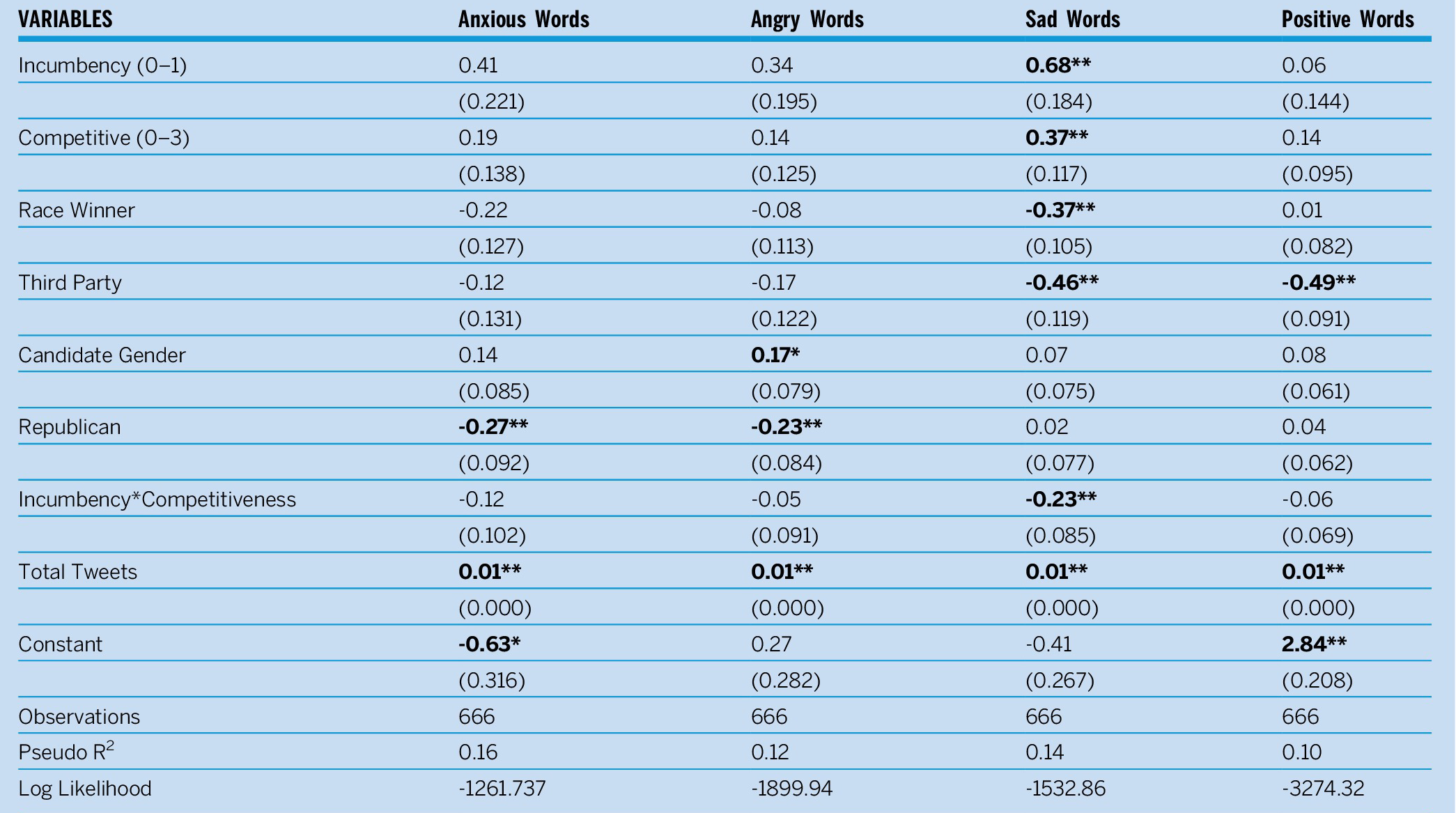
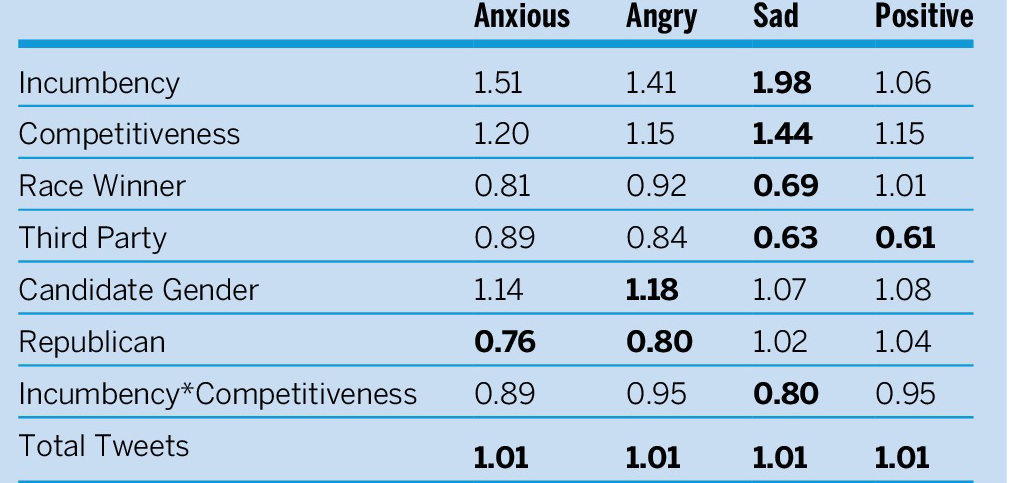
Contrary to theoretical expectations, we found little evidence that candidates in disadvantaged contexts are more likely to incorporate anxious rhetoric in their tweets. As displayed in the first column of table 2, neither incumbency, competitiveness, victory status, nor third-party status were significant in the Anxious Words model, holding all else constant. The interaction between incumbency and competitiveness also was not significant. However, partisanship had a significant impact on the likelihood that a candidate uses anxious rhetoric, with Republicans less likely to incorporate anxious rhetoric in their tweets. To interpret the coefficients, table 3 reports the incident-report ratios for the models included in table 2. Holding all else constant, Republicans issued anxious words in tweets at 0.76 times the rate of Democrats.
Vulnerability and Emotional Rhetoric

Notes: Coefficients are the results of negative binomial regression. Standard errors are in parentheses. **p<0.01, * p<0.05.
Incidence-Report Ratios for Emotional Rhetoric in Candidates’ Tweets

Note: Boldface=p<0.05.
Republicans also were less likely to use angry rhetoric in their tweets (see the second column of table 2); their rate of angry words was 0.80 times the rate of Democrats (see table 3). It is interesting that female candidates were more likely to use angry rhetoric in their tweets; as shown in table 3, female candidates included angry words at a rate 1.18 times the rate of male candidates.
Perhaps the most surprising findings in table 2 are in the Sad Words model (column 3). Holding all else constant, there is a positive relationship between incumbency and the number of sad words included in tweets. In fact, as shown in table 3, incumbents—those who were less vulnerable—used sad rhetoric at a rate 1.98 times the rate of challengers—a rather significant difference. However, contradicting the findings for incumbency, we found that the more competitive the race, the more likely candidates were to issue sad rhetoric. The interaction term between incumbency and competitiveness was negative and significant, indicating that the effect of incumbency is reduced (by a rate of 0.80) as a race becomes more competitive. In addition, eventual winners also were less likely to use sad rhetoric (at a rate 0.69 times the rate of losers), and third-party candidates also issued less sad rhetoric than major-party candidates. In summary, we found a number of interesting and significant but contradictory relationships between vulnerability and the use of sad rhetoric in tweets.
Holding all else constant, there is a positive relationship between incumbency and the number of sad words included in tweets.
Finally, we found few significant relationships in the Positive Words model (see the fourth column in table 2), except for the Third-Party variable, which is negative and significant. As reported in table 3, third-party candidates issued positive rhetoric at a rate 0.61 times that of major-party candidates. This finding aligns with the theoretical expectation that vulnerability has a negative relationship with positive campaign rhetoric.
CONCLUSION
We expected to find that congressional candidates used anxious rhetoric strategically in their campaign tweets similar to the way that fear appeals are used strategically in televised campaign advertisements. Specifically, we expected that challengers would use anxious rhetoric more than incumbents, that candidates in more competitive races would use anxious rhetoric more often than those in less competitive races, and that congressional candidates who lost their election in 2018 would be more likely to incorporate anxious language in their social media postings. We found that vulnerability does not appear to inspire candidates to use more anxious language in their tweets.
What do these findings—or lack thereof—mean? First, we note that we should be careful about generalizing findings from one election to elections in general. That said, we believe it complicates the thesis that vulnerable candidates use anxiety strategically. It may be that the candidates’ calculus on social media is different than it is for traditional media. The expense of television advertisements means careful, considered, and tried-and-true messaging strategy, whereas relatively costless social media posts enable experimentation. Leveraging other types of affect is less risky when a new post can be immediately tweeted.
This may be why we found surprising relationships between sad rhetoric and some of the vulnerability measures. The relationship is not always consistent—sometimes vulnerability is positively associated with sad rhetoric, other times negatively—but it perhaps hints at a digital messaging strategy calibrated for our current moment. That is, when Americans are united by little but their pessimism about the future (Parker, Morin, and Horowitz Reference Parker, Morin and Horowitz2019), sad rhetoric about the state of the country is one way that candidates can connect with these sentiments (Gervais and Morris Reference Gervais and Morris2018, 132–35). The strategic use of sad rhetoric, we believe, deserves more attention, which we plan to do in future work.
Relationships between other variables and the measures of emotional rhetoric suggest that using emotional appeals in tweets may vary with electoral contexts. For instance, women used significantly more anger in their tweets than men, and Democrats used more anxious and angry words than Republicans. Although we can only speculate about these patterns, we suspect that as the out-party in 2018, Democrats were attempting to tap into and mobilize anger toward the incumbent president—and perhaps change minds in traditionally Republican districts through fear appeals.Footnote 12 Because previous research has shown that women are more likely to tweet unflattering remarks about their opponents (Evans, Cordova, and Sipole Reference Evans, Cordova and Sipole2014), we might expect there to be more general negativity expressed in their tweets during each election. The anger expressed by women in 2018 might be unique to the context of the first election since Donald Trump became president and the #MeToo movement. As such, our findings do not suggest that candidates do not tweet for “hearts and minds” but rather that the strategic use of affect in campaign posts may not mirror what has been seen in traditional campaign messaging.
Supplementary Materials
To view supplementary material for this article, please visit http://dx.doi.org/10.1017/S1049096520000852.