The year 2006 was the occasion of two anniversaries: one hundred years earlier, in 1906, Charles Ives wrote his piece Central Park in the Dark, projected as the second of Two Contemplations for orchestra; one year earlier, in February 2005, the artists Christo and Jeanne-Claude unfurled 7500 saffron-coloured cloth panels for a sixteen-day installation that drew tens of thousands of people to that same park.Footnote 1 Both works live on: Ives's music in numerous recordings and Christo's art in hundreds of online sites that include everything from carefully composed professional photographs to bouncing amateur videos.Footnote 2 As artistic documents they bring moments from the past into our present and preserve them for the future. Although the works were separated by a century, composer and artists appear to have been similarly preoccupied with the construction, manipulation, and perception of nature and place, and with the impact that people have had upon this unique New York site. While Ives on the one hand and Christo and Jeanne-Claude on the other honoured and celebrated the park as a naturalistic setting, both also acknowledged the place as a fabricated entity, and an ongoing cultural project. A direct comparison of the two works, were it possible, is not the intention of this study, nor will both works be treated equally in what follows; this article focuses on Ives's piece. Nonetheless, it argues that parallels may exist between Ives's construction of the park in sound and ‘Christo's Gates’, as the installation became known – parallels that suggest the continuing resonance of Ives's musical ‘contemplation’.Footnote 3 ‘Christo's Gates’ calls attention to many of the same issues that occupied Charles Ives as the Gilded Age gave way to the progressive era.Footnote 4
Numerous scholars have written on Ives's work, among them H. Wiley Hitchcock, Robert P. Morgan, J. Peter Burkholder, Larry Starr, and David Nicholls. As the earliest to address the unique features of Central Park in the Dark in his 1977 survey of Ives's music, Hitchcock cited the multiple musical layers that characterized the piece, and Ives's ‘achievement of a new relationship between time and music’. He explained this as the result of ‘the elimination of a sense of beat or pulse – the even “measuring” of time – that had been common to all Western music for centuries’.Footnote 5 The same year, Robert P. Morgan called attention to Ives's well-known ‘interest in the role of actual physical space in the musical experience’ and, more importantly, the composer's ‘fundamental spatial orientation within the music itself’. Central Park provided a prime example of this new orientation.Footnote 6
In the first of his books, Charles Ives: the Ideas Behind the Music (1985), J. Peter Burkholder noted Ives's ‘attitude of intent listening’ and his efforts ‘to capture the sounds and feelings of what he heard’. He saw Central Park in the Dark as a piece thoroughly informed by such practices.Footnote 7 He also characterized the string ostinato of the work as a ‘virtual catalogue of Ives's favorite […] chordal structures’, an idea that would be more thoroughly explored in the 1990 book American Experimental Music 1890–1940 by David Nicholls. Nicholls illuminated Ives's employment of specific interval structures as both distinguishing and unifying features of Central Park, and called attention also to rhythmic and dynamic groupings of instruments that separate sounds into foreground and background materials. Maintaining the focus upon Ives's unique polyphonic textures, Larry Starr identified discrete stylistic types associated with the individual timbral layers of Central Park in his 1992 study A Union of Diversities: Style in the Music of Charles Ives.Footnote 8
In a second book devoted to Ives, All Made of Tunes: Charles Ives and the Uses of Musical Borrowing (1995), Burkholder named a half dozen tune fragments integral to Central Park and argued for their historical appropriateness, essential motivation by the programme, and importance as conveyors of style and character. But he went beyond details of compositional technique to speculate on a listener's ‘imagined position’ in relation to Ives's particular setting.Footnote 9 His conclusion that ‘we are always observers, akin to an audience in the theater’ invites a number of questions: Where is the theatre? What play is being performed? What are we meant to observe? And in the context of this article, how might ‘Christo's Gates’ relate to this imagined spectacle? Understanding the original inspiration and intentions for Central Park, the place, contextualizes not only Ives's and Christo's works but also, perhaps, our own responses.
In 1850 Frederick Law Olmsted, accompanied by his brother and a friend, undertook a walking tour of England, where he revelled in the ‘green, dripping, glistening’ countryside:
We stood dumb-stricken [sic] by its loveliness, as, from the bleak April and bare boughs we had left at home, broke upon us that English May – sunny, leafy, blooming May – in an English lane; with hedges, English hedges, hawthorn hedges, all in blossom; […] the mild sun beaming through the watery atmosphere and all so quiet.Footnote 10
Olmsted also visited Joseph Paxton's newly completed Birkenhead Park, near Liverpool. Opened to the public for the first time in April 1847, Birkenhead became ‘the first public park created by a municipality anywhere in the world’.Footnote 11 Just a few years later, challenged by less even and attractive land than Paxton had confronted in 1843, Olmsted would take inspiration from the English designer's achievement and incorporate many of the features of Birkenhead Park within his own ‘Greensward’ plan for Central Park.Footnote 12 Paxton's cricket-club fields ultimately became Olmsted's baseball fields, but similar curvilinear roads, gardens, bowling greens, meadows, lakes, and boathouses found their way to Manhattan a decade later.Footnote 13 From the beginning Olmsted (1822–1903) and his partner Calvert Vaux (1824–95), a London-born architect and watercolourist, envisaged their design as a unified work of art on a grand scale. Central Park would become the first landscaped public park in the United States and establish Olmsted's reputation as America's foremost landscape designer.
Eight years after the park's opening in autumn 1858, a report issued by the Central Park Commissioners expressed their hopes that this new public space would predispose citizens to the idea of nature:
The Park, as a whole, is undoubtedly expected to afford to the citizens of the metropolis, day after day and year after year, a succession of views of a rural character so real and genuine as to convey very positive ideas in regard to natural scenery, even to a person who might never see anything more country-like than will ultimately be contained within its limits; and this, in connection with the opportunity it offers for a social enjoyment of fresh air and exercise, is perhaps the most important service that it is calculated to perform in a direct way.Footnote 14
So confident were early champions of the park in its ability to soothe and refresh that, at the height of the Civil War, publishers E. & H. T. Anthony sent a series of their stereo cards to President Lincoln. They believed that views of the Ramble would offer him ‘relaxation from the turmoil and cares of office’.Footnote 15 Stephen Germic observes that Central Park was originally ‘advertised, announced, and rhetorically expounded as a place conducive to the refinement and elevation of the “masses”’. It was designed with mediation and uplift in mind. According to Germic, Olmsted saw the park ‘as a species of cultural institution that would universalize and incorporate threatening differences in urban space’.Footnote 16 Both Ives and, in their different way, Christo and Jeanne-Claude understood the park to have that potential as well.
If Ives's piece called attention to the artificial qualities of the sylvan retreat, using sometimes subtle musical techniques, as we shall see, ‘Christo's Gates’ reminded the public of the stage-like setting of the park in no uncertain terms. Brightly coloured nylon archways – sixteen feet high with widths varying from five and a half to eighteen feet and hanging approximately seven feet above the ground – wafted, sparkled, cast shadows and filtered light, contrasting sharply with the muted ground cover and bare trees of Manhattan's February palette. The blazing gates reframed once-familiar scenes; they decorated and embellished the park. The lake was ringed with what appeared to be poppies – or was it Chinese lanterns? Was it a lake, or a mirror? Spaced at twelve-foot intervals, far enough apart that their flapping fabric would not become entangled, long lines of banners followed the curves of the park's lyrical pathways; others stood sentinel-like, guarding a lone lamppost. Moved by almost constant breezes, the gates animated the park even along people-less walkways. The artists imagined the gates as ‘a visual golden river’ along the park's footpaths.Footnote 17 Ruffling of banners gave the wind additional voice. The banners provided their own visual and audio commentary on the park.
While the number of gates visible to a visitor might have heightened the dramatic effect of the installation in a particular location, with careful spacing the artists avoided any suggestion of clutter, confusion, or chaos. Dozens of online videos and photographs capture intrigued, smiling visitors. This is not to suggest that everyone reacted positively to the installation; some were ambivalent, and others resented its presence.Footnote 18 One online blogger, identified only as ‘B’, complained: ‘The Gates block your view of the sky. In Central Park you have one of your few opportunities to stand in Manhattan, amongst the trees, look up, and see a view of the sky. The Gates took that away from me.’Footnote 19 But such reactions were unusual. The overwhelming reception accorded ‘The Gates’ appears to have been positive, or at least tolerant. They created something of a festival atmosphere in the park. They became a sixteen-day set upon the Central Park stage, and hundreds of thousands of visitors became members of the cast. The original artifice of the park was further exaggerated and complicated with the installation of the fiery flags: exaggerated because of the extreme theatricality of the saffron display, complicated because visitors might have understood the park as truly ‘natural’ in comparison with the obviously decorative banners. In considering the effect of the installation, film documentarian Albert Maysles spoke of the ‘incredible combination of art, nature, [and] people’. Referring to Christo and Jean-Claude, Maysles enthused: ‘what an opportunity to raise our hearts and souls to art and nature, and all because of these two people’. For Maysles, Central Park was synonymous with nature.Footnote 20
The park offered a retreat from industry, even though it was the product of human design and construction. But boundaries between what is natural and what is synthetic are blurred at Central Park without billowing gates. The park is neither wholly synthetic nor wholly natural. While cities are testaments to human achievement, parks enshrine nature. Rocks, shrubs, trees, and flowers are natural even when they are imported, or moved, or artfully arranged. Controlling their placement does not alter their essence. And birds do not distinguish between indigenous and imported trees when they build their nests; they confer a genuineness to the place that cannot be dismissed. A similar ambiguity is inherent in the fluid symbolism of both the music and the artwork.
Throughout history public spaces have accommodated different people and served diverse purposes. And both Ives's piece and Christo's artwork foreground variety. Curiosity about Christo's Gates cut across age, gender, ethnic, and class boundaries, resulting in a diverse promenade of visitors, and raising anew questions of Central Park as a contested space. Ives's piece mixed tunes from the turn of the century, creating a soundscape analogously eclectic. While providing an informal gathering place, early town commons also supplied pastureland for the few animals kept by local residents. Parks occasionally became parade grounds and encampments for practising militia. Public squares offered central locations for stumping politicians to address crowds and for concerned citizens to congregate, or simply to relax and enjoy a bit of shade. If a town boasted its own band, it often held its concert on the green. Today parks, squares, greens, and commons host arts and ethnic fairs, thus promoting cultural exchange. But park visitors are not always pleased by the presence of other users.
Christo's Gates clarified that Central Park, despite having been commandeered early in its existence by the wealthiest classes, was no longer elitist acreage. Anyone able to get to the park could experience the installation; there was no charge, people could linger as long as they liked, and samples of the banner fabric were given away free. Olmsted's and Vaux's original vision of the park as a people's garden, a public space, a free social institution, a place to be enjoyed by both ‘the vicious and the virtuous’, a cultural project that ‘translate[d] Democratic ideas into Trees & Dirt’, was once again on display.Footnote 21 The synthetic polymer banners of ‘The Gates’ revived the original goals of Olmsted and Vaux. They therefore also implicitly conversed with the inclusive aural environment that Ives had rendered in his piece written one hundred years earlier.
In Central Park in the Dark Ives composed what he called a ‘picture in sounds’, freezing an artificial nature scene within a single, recurring ostinato pattern. Portraying Central Park as a particular, seemingly confined place must have been important to the composer, as he generally avoided rigid systems and patterns in his ‘public’ concert works, exploring them more often in his ‘private’ experimental works. As will become clear, however, in this instance Ives's tight foundational structure suited his programmatic needs. By contrast, Christo's undulating banners seemed to announce a different understanding of the park, the park as a kind of living organism, with people as the life force pulsing through the ‘visual golden river’ of orange archways. Where individual palindromic ostinatos ostensibly emphasized stasis, the always-moving gates of Christo's installation boldly foregrounded that which was protean and dynamic.Footnote 22
On the surface, then, it might appear that the artists Christo and Jeanne-Claude and the composer Ives had their eyes and ears trained on different meanings of the park. Paramount to the environmentally aware visual artists was the ephemeral nature of their installation; it imbued the creation with a much-desired urgency; it caused viewers to think about the changing nature of the space.Footnote 23 For Ives, on the other hand, using an inflexible ostinato anchored his piece in place; he appeared to foreground constancy. In that he eventually cast Central Park in the Dark as one of his Two Contemplations, Ives seems to have intended that we take our time to think about the enduring meanings of this established location.Footnote 24 But were their goals really all that different? This study argues that both artists worked from similar understandings and towards similar ends. The latter-day bejewelling of Central Park at the hands of Christo and Jeanne-Claude confirms Charles Ives's ability to identify powerful places, to recognize resonant images, and to apprehend issues that would remain important over time.
The first urban landscaped park in the nation was a public works project precipitated by the confluence of several factors: a financial crisis in New York City that required a quick solution to a growing and increasingly militant body of unemployed workers, a desire on the part of the wealthiest New Yorkers for a public space on a par with the gardens they enjoyed during their European sojourns, and Frederick Law Olmsted's vision of what could be wrought from hundreds of acres of alternately swampy and rocky land.Footnote 25 In their book The Park and the People: a History of Central Park, Elizabeth Blackmar and Roy Rosenzweig detail the many-faceted story of the creation of the nation's most famous city retreat, and point to William Cullen Bryant – poet, writer, and social activist – as the first to have imagined a large, centrally located park in the heart of Manhattan.Footnote 26 It would fall to Olmsted, a pupil of Bryant's architect friend Andrew Jackson Downing, to realize Bryant's dream.Footnote 27 According to Blackmar and Rosenzweig, the naturally irregular terrain made the parcel of land ‘undesirable for private development’. Transforming the site, however, would ultimately cost more than the ten-million-dollar price tag tallied by the mid-1860s.Footnote 28 Approximately 1,600 Irish and German immigrants and African-Americans who lived within the borders of the projected park needed to be removed.Footnote 29 This was carried out in 1853, when the City of New York declared eminent domain and acquired over 700 acres; in 1863 additional land was seized, bringing the total to the current 843 acres.Footnote 30 The choice in 1857 of Olmsted's and Vaux's ‘Greensward Plan’ from among the thirty-three proposals submitted guaranteed a wholly pastoral remaking of the landscape.
According to Blackmar and Rosenzweig, ‘[s]ome 20,000 workers – Yankee engineers, Irish laborers, German gardeners, and native-born stonecutters – reshaped the site's topography […] [They] moved nearly 3 million cubic yards of soil and planted more than 270,000 trees and shrubs. The city also built the curvilinear reservoir immediately north of an existing rectangular receiving reservoir.’Footnote 31 Of the scenery only the rocks were part of the original site, and even they underwent change: ‘blasting out rocky ridges [required] more gunpowder than was later fired at the Battle of Gettysburg’, a Civil War battle infamous for the extent of its carnage, both human and topographical.Footnote 32 In 2005 the diversity of the park's original workers was echoed in the variety of the park's visitors. But the park was not always as congenial.
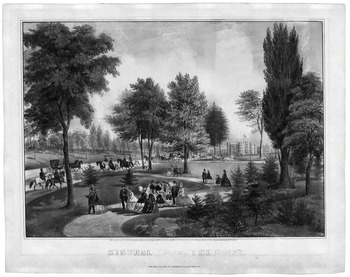
In 1859 the newborn park opened, but the very people who blasted through the granite and hauled the soil were not welcome to enjoy the results of their toils. Blackmar and Rosenzweig clarify: ‘By 1865, the park received more than seven million visitors a year. The city's wealthiest citizens turned out daily for elaborate late-afternoon carriage parades. Indeed, in the park's first decade more than half of its visitors arrived in carriages, costly vehicles that fewer than five percent of the city's residents could afford to own.’ As Germic puts it, ‘the wealthy [could] announce their identification with idealized Nature […] In Nature they [could] see themselves.’Footnote 33 Currier and Ives's 1862 lithograph Central Park, the Drive (see Figure 1) captures the upper classes promenading in their finery, or riding on horseback or in carriages amidst newly planted trees and shrubs.Footnote 34 There is no sign of any but the wealthiest New Yorkers. This was not coincidental. There were rules banning group picnics, and not even ‘small tradesmen were […] allowed to use their commercial wagons for family drives in the park’.Footnote 35 Thus, with the imported trees and shrubs just taking root, the nation's first public urban park became a site of cultural contestation, an 800-acre symbol of the nation's ostensibly classless, but oh-so-class-conscious society. Olmsted's hopes for a people's garden were subverted, at least temporarily.Footnote 36
Central Park, the Drive (hand-coloured lithograph), Currier & Ives, New York, 1862. Gift of Lenore B. and Sidney A. Alpert, supplemented with Museum Acquisition Funds. Michele and Donald D'Amour Museum of Fine Arts, Springfield, MA. Photography by David Stansbury.

By 1898, however, when Ives had graduated from Yale and moved to the city, policies governing park use had loosened, and the zoo, lawn tennis, carousel and goat rides, and a Sunday concert series attracted a more diverse population of visitors. In addition the park was just achieving the look Olmsted and Vaux had imagined in 1857, when they had projected that it would take at least forty years for the plantings to grow tall and thick enough to provide optimal scenic effects. The trend towards more democratic use continued through the twentieth century with the building of skating rinks, boathouses, and ball fields, though never without significant controversy between those who wanted to hold tight to more restrictive uses and those who fought against what they considered to be an elitist, divisive vision of a public space.Footnote 37
Ives composed Central Park in the Dark while living at 65 Central Park West, in one of the numerous successive bachelor pads he dubbed ‘Poverty Flat’ – apartments that he shared with a changing cast of Yale graduates who, like himself, had come to the city to either continue their education or find employment. The street lines the western edge of the park, and is today an address available only to moneyed city dwellers. A New York Times article from 1906 refers to apartments along Central Park West, especially the brand new structures that were going up, as ‘high class’. The addresses named are five blocks north of Ives's flat. Sharing the apartment with a group of young professionals no doubt made living there possible for Ives. That said, the name ‘Poverty Flat’ should be understood as a relative and perhaps ironic term.Footnote 38 At the time, the address would have given Ives an ideal location from which to collect sounds wafting through the park and up from Columbus Circle – all the potential ingredients for an aural picture of turn-of-the-century Manhattan as it might have been heard by visitors to Central Park. Whether anyone but Ives would have remembered the sounds specifically or understood their significance is another issue; part of Ives's genius was in recognizing the universal resonance of personal experiences. While Ives later became famous for remarks disparaging the city, in Central Park in the Dark he reveals one way of interacting with and living in the richly diverse urban environment.Footnote 39 His piece emphasizes the continuous, the simultaneous, and the integrated aspects of that place. This is the work not of someone looking in from outside, or speaking vicariously for others, but rather of someone who is comfortably embedded in city life.Footnote 40 Although, over the years, he preferred the quieter surroundings of the house he built with his wife Harmony in West Redding, Connecticut, in 1906, Central Park in the Dark suggests that Ives was comfortable in this urban place; he had reconciled himself with the diversified environment, and he invites us to do the same.
According to Ives's Memos, the piece was inspired by an experience in New York in the summer of 1906. In the bottom right-hand corner of a sketch for the piece he noted, ‘Runaway [horse] smashes into fence […] heard at 65 C[entral] P[ark] W[est], July – finit Dec […] 1906, with J.S. M[yrick]’.Footnote 41 As newspaper stories from 1906 attest, such occurrences were commonplace in and around the park. Horses drawing their fashionable carriages were regularly frightened by increasing numbers of automobiles. One such story that appeared in the New York Times in 1906 details the misadventures of Mr and Mrs Isaac Meinhard, who were injured ‘in a lively runaway which occurred in Central Park’ late in the afternoon. According to the article, ‘the animal took fright at a passing automobile opposite Sixty-fifth Street and bolted’. The incident occurred near the address Ives identified in the sketches, where an entrance to the park's 65th Street Transverse intersects with Central Park West.
The account is richly detailed and worth including: ‘After going a block the victoria struck another vehicle with such force that one of the shafts was broken off. The driver, Cunningham, was thrown to the drive, where he lay in a semi-conscious condition.’ The story relates the efforts of ‘Mounted Policeman Faney of the Park Squad’, who ‘rode across the path of the runaway and attempted to stop it’. But ‘the remaining shaft of the victoria struck his horse on the flank. Next moment both Faney and his mount were rolling in the dust.’ They recovered enough to continue pursuit and ‘make another attempt to stop the runaway’. But before Faney reached the carriage ‘the horse in the victoria slipped and the carriage was overturned. Mr and Mrs Meinhard were thrown out.’ The anonymous journalist concludes his account: ‘The victoria was wrecked beyond repair.’Footnote 42 The frequency of such mishaps is underscored by another story that appeared directly below this first one; it tells of a similar incident at Prospect Park in Brooklyn, in which a Mr Cobine and his son ‘were thrown from [their] runabout’ by a horse that ‘took fright at something and bolted’. Once again chaos ensued as ‘motorists and drivers scattered before the runaway’.Footnote 43 Equine accidents were ubiquitous and frequently replayed in newspapers. Ives may have witnessed the Meinhard story recounted above: a horse jumping his traces becomes the climactic moment of Central Park in the Dark.Footnote 44
The context into which the composer interpolated that event was a musical narrative replete with tunes befitting the turn of the century. An explanatory note that Ives wrote years later clarifies his intentions, and fleshes out the scene with details of the season, the location, the time of day, the temperature, and the myriad sounds wafting through the park air. Ives is clear about his desire to capture the place in sound:
This piece purports to be a picture-in-sounds of nature and of happenings that men would hear some thirty or so years ago (before the combustion engine and radio monopolized the earth and air), when sitting on a bench in Central Park on a hot summer night. The strings represent the night sounds and silent darkness – interrupted by sounds [the rest of the orchestra] from the Casino over the pond – of street singers coming up from the Circle singing, in spots, the tunes of those days – of some ‘night owls’ from Healy's whistling the latest or the Freshman March – the ‘occasional elevated’, a street parade, or a ‘break-down’ in the distance – of newsboys crying ‘uxtries’ – of pianolas having a ragtime war in the apartment house ‘over the garden wall’, a street car and a street band join in the chorus – a fire engine, a cab horse runs away, lands ‘over the fence and out’, the wayfarers shout – again the darkness is heard – an echo over the pond – and we walk home.Footnote 45
The scene Ives evokes is time- and place-specific. The Casino, which originally stood just inside the east side of the park at 72nd Street and Fifth Avenue, was demolished in 1934, but in 1906 it would have provided light refreshments and live music. Healy's was a restaurant at 66th and Columbus Avenue that was one block west of Ives's flat. And ‘the Circle’ refers to Columbus Circle, which joins Central Park West and South at the southwest corner of the park. It is just seven blocks down from Ives's address. While a person sitting on a bench on a summer night would probably not have heard all that Ives enumerates – for instance it is doubtful that one would have heard street parades and street bands in the evening hours – all the sounds he mentions would have been audible at some time from that location. For Ives the public park became the metaphorical meeting place for the young businessman and the wider culture. More generally, the park was a mixing board for the noises and musics that made up New York's unique soundscape. Although cities throughout Europe and the rest of the world boasted equally famous urban retreats, the musical sounds that Ives associated with this particular park – rags, marches, the tunes of the day: vernacular musics all of them – expose the location unambiguously as turn-of-the-century America. Ives's democratic ‘picture-in-sounds’ is one that is peculiarly American, peculiarly New York. It is Central Park.Footnote 46
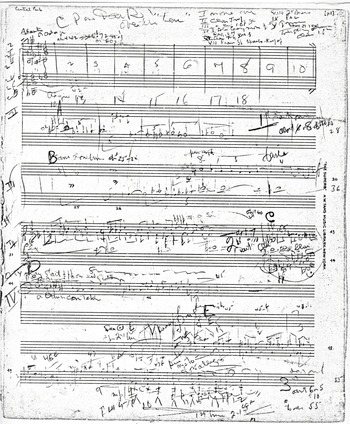
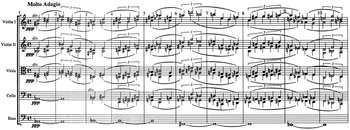
Written remarks found in sketches for the piece point to Ives's intentions regarding the musical depiction of this place. Pages from two of four extant sources contain explicit references to Central Park and its manifestations in sounds. In the centre of the first page of a two-page fragmentary pencil sketch, among many scribbled comments, Ives identified the string ostinato as ‘night sounds of nature, bugs, leaves on trees, sounds of silent darkness, sounds natural and unnatural’.Footnote 47 On a second pencil sketch, Ives specified the location of that nature scene by writing at the top of the page ‘“C.P. in the Dark” – over the “ten” [the ten string bars]’ (Figure 2). Whereas the first comment might suggest that the piece is generally about ‘night sounds […] sounds natural and unnatural’ heard in Central Park, Ives's notation on the second sketch pinpoints his reference: the ostinato is Ives's musical manifestation of Central Park. As becomes clear, Ives built the entire musical work upon precise characteristics of this ten-bar ostinato – from metrical details of individual bars and larger rhythmic phrases to harmonic ambiguity and large-scale palindromic behaviour. The ostinato (Example 1) is a microcosm of the larger work. It provides the essential static element that Ives requires to locate his sound picture. It, and by extension the place it represents, imposes a logic upon the piece at all levels of activity.
Central Park in the Dark, sketch 2529. The Charles Ives Papers, Irving S. Gilmore Music Library, Yale University. Used by permission.

Charles E. Ives, Central Park in the Dark, bars 1–10. © 1973 by Boelke-Bomart, Inc. Copyright assigned 1978 to Mobart Music Publications, Hillsdale, NY 12529. International Copyright Secured. Used by permission.

Ten repetitions of a ten-bar ostinato lock the piece in tonal, rhythmic, and harmonic spheres, much as the action of Ives's picture-in-sounds is locked in a well-defined location, Central Park. Dynamics remain fixed in the piano range. Strings alone play the ostinato. Dynamic and timbral continuity reflect the steadfast ‘natural’ oasis buried deep within the noisy, bustling environment. Ives recognizes that the urban retreat can offer city dwellers a place for quiet reflection, precisely what Olmsted had envisaged for the park in 1857. While a survey of each of the musical elements would disclose myriad characteristics and relationships, an acquaintance with basic rhythmic qualities of the ten-bar pattern (see Example 2) suffices to make the larger point regarding the seminal importance of the ostinato to the piece and to the programme.
Central Park in the Dark, ostinato: basic rhythmic pattern.

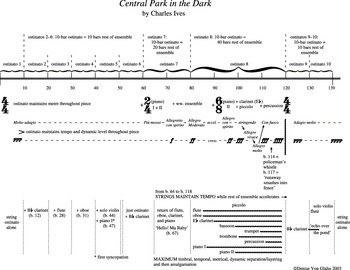
Tensions between duple and triple thinking exist on all levels of the music. The bass line of the ostinato articulates this conflict in a harmonic rhythm of 2 bars (two tied semibreves) – 3 bars (three tied semibreves) – 3 bars (three tied semibreves) – 2 bars (two tied semibreves). The ostinato is organized into alternating duple and triple divisions of the common-time metre in all bars but bar 8; here Ives introduces a group of quintuplet crotchets that obscure notions of duple or triple divisions. Ives works up to and away from the quintuplet bar by surrounding it with a pair of crotchet bars that divide duply. Those bars are themselves framed by a pair of minim bars that divide triply. The quintuplet at bar 8 is unique in the ostinato and, as such, serves several purposes: first, it creates a necessary tension in an otherwise predictable duple–triple pattern; second, it introduces the rhythmic framework that is associated with the B♭ clarinet tune (‘Ben Bolt’) first heard beginning at bar 12 – the clarinet timbre and the tune fragment will become large-scale unifying devices on their own; and third, and most importantly, it focuses a listener's attention on that half of the ostinato where there is maximum surface rhythmic activity. The intensification at bar 8 augurs similarly intensified larger-scale musical behaviour at the eighth ostinato, which can be seen in Figure 3. Musical behaviour at the lower levels reflects activity at the structural level, and throughout, as this ‘aerial view’ of the piece makes clear, the structure serves the programme.
‘Aerial view’ of Central Park in the Dark.

The syncopated crotchet–minim–crotchet rhythm first present at bar 5 of the ostinato enlarges to the syncopated tune that first appears in ostinato five, the statement beginning at bar 41. The piece becomes denser and more complex as it approaches the seventh and eighth iterations of the ostinato, the structural analogues of the seventh and eighth bars of the ostinato. Here rhythmic activity becomes so frantic that the non-string instruments break away from the string choir's 4/4 metre and begin a gradual accelerando that resists confinement within a single metrical scheme.
At bar 64 Ives indicates that ‘the string orchestra throughout does not change tempo’, though ‘it plays louder when the rest of the orchestra does [change tempo and accelerate]’. Starting at bar 91 Ives writes the Piano II part in 6/8, thus allowing for both duple and triple interpretations of the metre, in effect echoing at this structural level what occurred in the ostinato with adjacent duple/triple divisions of 4/4. The gathering momentum of the accelerando causes seven tempo changes in the seventh and eighth repetitions of the ostinato alone. The music enters a passage of maximal activity and, by comparison with the beginning of the work, maximal contrast, much as the programme approaches its moment of climactic confusion.
Olmsted and Vaux created a park whose softly curving paths and canopied walkways acted as a counterpoint to the surrounding rectilinear cityscape. Writing in 1859 Olmsted explained that Central Park ‘should present an aspect of spaciousness and tranquility […] thereby affording the most agreeable contrast to the confinement, bustle, and monotonous street-division of the city’.Footnote 48 They designed a retreat where nature – carefully graded, shaped, and planted to provide optimal calming effects – could restore the work-weary urbanite: they designed the park as an ‘antidote to the strains the city imposed on the “nerves and minds” of its residents’.Footnote 49
With their showy saffron banners the artists Christo and Jeanne-Claude created maximal contrast with the muted palette of the winter park. But the banners were not wholly oppositional to their surroundings, and in other seasons might actually have been mistaken for blooming flowers and changing trees. The soft, flowing fabric doubled the park's undulating walkways, and the frames that supported the banners echoed the vertical profile of the city's buildings. The square-cornered frames brought the geometry of the surrounding skyscrapers into the park. Like the eclectic musics that came together in the park, Christo's Gates challenged notions of what belonged and what didn't. Or perhaps they, like Ives, made clear that all belonged in a wholly fabricated environment. Nature and human creation could not be easily disengaged.
The brief existence of the art installation created a sense of excitement and necessary haste.Footnote 50 With his timbrally and dynamically contrasting performing forces, tension-producing rhythmic juxtapositions, and melodic mélange, Ives also created excitement. But merely capturing attention or creating a stir was not the final purpose of either the art or the music. As with the gates, the ultimate goal of Central Park in the Dark was not to suggest the separateness of the source materials or what they represented: the goal was to suggest their reconciliation; the goal was to demonstrate that the contrast was inherent within them. Before Ives could achieve that end, however, the dissimilarity of the forces had to be fully exposed and acknowledged. He had to demonstrate their separateness before he could argue for their wholeness.Footnote 51
If the string choir suggested the steadfastness of Central Park's naturalized nature – the sounds of ‘silent darkness’ – woodwinds, piano, and then brass suggest the presence and evanescence of humanity.Footnote 52 This division of labour is not unlike that found in the companion contemplation, The Unanswered Question. Ives anthropomorphizes Central Park in the Dark by assigning roles to specific timbres and families of instruments, and then associating them with distinct material. Starting at bar 12 with the hesitant B♭ clarinet, individual instruments quietly appear and disappear; the clarinet seems reluctant at first to impose itself upon the ostensibly serene string ostinato or to introduce a new timbre to the soundscape. When, however, at bar 67 (in ostinato 7) the piano explodes with a forte rendition of the rag ‘Hello! Ma Baby’ and joins the flute and oboe, rhythmic, timbral, and spatial distinctiveness is unequivocal. Here is a new sphere of activity, one whose presence cannot be ignored. Here is something that sounds quite different from the park itself.
Over the next forty-five bars Ives creates a vertiginous swirl of activity. The duple–triple tension first detected in consecutive bars of the ostinato now characterizes the vertical mass of sound. By bar 109 the new timbres and rhythms of the Allegro, which had sounded distinctive and autonomous when first introduced, blend together in a single, sonic amalgam. They become a sound mass of their own, overpowering the opening and hitherto predominant string timbre. Instruments that had appeared individually just bars earlier now join forces in an indistinguishable collective bleat. The airwaves shudder as the ‘happenings’ of men overwhelm the sounds of ‘nature’. At bar 114 the upper woodwinds simulate a policeman's whistle, a sound long associated with the idea of ‘arrest’, and ideally suited to the programme that Ives has described. Without any sense of ‘finishing’, the huge vibrating ensemble screeches to a stop: musical motion is arrested.
Symbolic of ‘the runaway [that] smashes into a fence’ and destroys a physical barrier, triple forte percussion, brass, and woodwinds overwhelm rhythmic and tonal space, ostensibly destroying the neat edifice of the ostinato. Only when the final echoes of ‘man-made’ sounds dissipate, however, does the string choir make its continuing presence known; it finishes its eighth repetition of the ostinato. Although it had not been distinctly audible, the ostinato, it turns out, had never left the soundscape. After the ruckus, its immutability is soothing.
The piece concludes with the ninth and tenth repetitions of the ostinato, finishing much as it began, with Ives's depiction of the night sounds of Central Park. But human activity leaves its imprint on the place and the piece with a piano reprise of the fragmentary clarinet tune first heard at bar 12, and two solo violins wafting pianissimo in parallel harmonics, hinting at a melody that never materializes. Rather than ending the piece with the final chord of the last ostinato, Ives suggests the continuity of the place by having the music fade out with the opening sounds of yet another ostinato repetition. The piece returns to the initial sonority and dissipates quadruple piano into the atmosphere: the place, even this naturalized place, continues in music that seems just beyond our hearing.
The success of Ives's piece depends upon the construction of multiple, autonomous strata of activity that emphasize linearly unfolding materials, which are layered upon a recurring ostinato that emphasizes circularity and return. Although the smallest surface activity within the ostinato suggests a degree of forward momentum, ten repetitions of the same ostinato pattern, with its palindromic bass rhythm, challenge a larger sense of unilinear directionality. With the audible return to the beginning of yet another ostinato to round out the piece, circularity ostensibly overtakes linearity. More important than where the music is going is where the music is, and Ives tells us that it is Central Park. A memory becomes a ‘picture-in-sounds’.
The piece bears out Robert P. Morgan's observation that ‘Ives wrote pictorial music – music based largely on relationships that are simultaneous, reciprocal, and reflective in nature rather than successive, sequential, and unidirectional’.Footnote 53 For all the activity in the second half of the ostinato and the second half of the piece, the work is about continuity. But it is also about diversity and integration, and in that respect it is also about an ongoing national cultural project.
Although this study has focused upon the rhythmic qualities of the ostinato, harmonic and melodic elements of the ostinato suggest a similar programmatic purpose. Individual pitch movements offer listeners little sense of inevitable directionality. The absence of a clear tonal centre prevents the interpretation of any harmonic motion as locally functional or structurally hierarchical. The whole-tone cluster of the first chord of the piece (A♭, B♭, C, D, E, F♯, G♯) exemplifies the kind of democratic harmonic world Ives creates in the work, an analogy for his ideal society. While avoiding the suggestion of a tonal centre might have been achieved through a dense chromatic cluster or some non-invertible series, the whole-tone sonority is one way Ives distances his music from the chromatic German Romantic tradition and its associations. Symmetrical chords in parallel motion that occur throughout the ostinato – the majority of which are based on quartal and quintal harmonies, with a healthy dose of tritones thrown in – eliminate the motion and drama of functional harmonic progressions. The ostinato, then, boasts a melodic, harmonic, and rhythmic profile that, while suggestive of repose and stability, is in fact conspicuous for its tonal and temporal ambiguity. Or perhaps a better word would be ‘richness’.
While the circular ostinato symbolizes relative repose – especially, as has been demonstrated, in contrast to the louder, more insistent linear usurping forces – the ostinato is itself the site of much uncertainty; repose is an illusion. How one hears threes and twos, how one interprets harmonic behaviour, and how one understands the multiple layers of sound that mix in the piece – all suggest the myriad possibilities for interpretation that also exist in Central Park. The place is protean, inherently contested, and that is what is most natural about this wholly constructed place. There are no restricted airspaces in Ives's Central Park. Different musics and different sounds, like the different people of the city, commingle naturally.
Central Park in the Dark, like its paired contemplation The Unanswered Question, operates on multiple levels. Musically, Central Park is a study in the ways that circular and linear materials can cohabit the same soundscape and alternately create extended moments of repose and activity. Like its companion piece, it is also a study of the dramatic possibilities of timbral contrasts and the effects obtained by layering discrete musical materials one upon the other. In The Unanswered Question Ives forthrightly anthropomorphizes his musical forces with a programme note that indicates how the strings are intended to represent ‘The Silence of the Druids – Who Know, See, and Hear Nothing’ and the woodwinds ‘The Fighting Answerers’.Footnote 54 Ives's programme note for Central Park clearly associates specific musics with specific people – ‘street singers’, ‘night owls’, ‘newsboys’, and ‘wayfarers’. Both pieces suggest moments of improvisation and chaos: in Central Park in the Dark, what sounds like a musical free-for-all in the eighth statement of the ostinato; in The Unanswered Question, the final flute choir response to the trumpet's question. In both pieces, listeners find themselves situated in a musical scene that appears to be unfolding already, perhaps before they are fully conscious of it. Finally, both contemplations soar over the widest possible dynamic range, from quadruple piano to quadruple forte, providing a similarly expansive expressive compass.
There is, however, more to Central Park in the Dark than the manipulation of musical materials. It is the ideas behind Ives's sounds that argue for the continuing relevance of the piece in the age of ‘Christo's Gates’. Few would contend that Central Park is as inviting a night-time destination for solitary, genteel visitors of the twenty-first century as it was when Charles Ives sat on a bench there one summer evening a century ago: crime reports tell the tale. But even such changed circumstances do not alter the most profound messages of the piece. On one level the music suggests the permanence of the natural place, even a wholly constructed, symbolic, naturalized place, in contrast to the transitory nature of urban industry. For all the boisterous and distracting commotion created by human activity and human musics in this ‘picture-in-sounds’, it is the sylvan place that prevails and has the final, albeit softly spoken, word. Such is not a unique theme for Ives. Central Park in the Dark shares this idea with ‘The Housatonic at Stockbridge’ from Three Places in New England, in which Ives also explores the interactions of nature and humanity (though in ‘The Housatonic’ nature is not artificially constructed).Footnote 55
On another level, however, with the rigid ostinato Ives invites us to accept the artificiality of the park as a ‘natural’ part of the already artificial urban scene: the park is at least as natural as its larger, wholly constructed, and similarly contested environment. But Ives does not seek to indict; he recognizes the city as a site for potentially profound human interaction. He makes a similar point in his piece ‘From Hanover Square North, at the End of a Tragic Day, the Voice of the People Again Arose’ – the third piece of Orchestral Set no. 2 – where an elevated train station in lower Manhattan becomes the site of a deeply spiritual human drama that was possible only in the ‘unnatural’ city setting.Footnote 56
Both ‘Christo's Gates’ and Ives's piece use the park to educate us about an ongoing national project and the contemporary human condition. The spectacle of 7,500 saffron banners drew thousands of curious visitors from across all demographic groups to see the park, to see the artwork, to see each other, and to be seen: to be part of a place and an event. In his musical mélange of chamber-like string sounds, piano ragtime wars, marches, and the tunes of the day, Ives creates an aural analogue, a similar intermingling of a variety of people through the agency of the musics with which they are identified. Just as there was a place for everyone in Christo's parade, so there is a place for everyone in Ives's musical amalgam. While recognizing the tensions inherent in the place, both artworks embrace Olmsted's vision of a park that ultimately unites rather than divides.
In the rationale of the ‘Greensward Plan’ Olmsted explained:
The primary purpose of the Park is to provide the best practicable means of healthful recreation for the inhabitants of the city, of all classes. It should present an aspect of spaciousness and tranquility with variety and intricacy of arrangement, thereby affording the most agreeable contrast to the confinement, bustle, and monotonous street-division of the city […] The Park is intended to furnish healthful recreation for the poor and the rich, the young and the old, the vicious and the virtuous, so far as each can partake therein without infringing upon the rights of others, and no further.Footnote 57
Germic sees Olmsted's ‘list of binaries’ as ‘revealing that the geographic segregation of the Park and the city is to be reflected in the separation of human “classes” within the Park’.Footnote 58 I do not see such a conclusion expressed anywhere in Olmsted's aesthetic, philosophy, or physical plan. Olmsted's close identification with Transcendentalism, and his belief in the infinite power of nature to uplift all humankind, was consistent with both his support for the activities of John Audubon and John Muir and his affinity for the thinking of Ralph Waldo Emerson and Henry David Thoreau. Ives had similar affinities for Transcendentalism, as is well known. He too believed in the infinite power of nature to uplift. With their artwork and their music Christo and Jeanne-Claude and Charles Ives invite ‘all classes […] to partake therein’. Their works ‘contain multitudes’; they are hopeful; reconciliation is possible.Footnote 59 While speaking of and for their time, both ‘Christo's Gates’ and Central Park in the Dark acknowledge that the national project continues.