Research has demonstrated that youth who show serious conduct problems (CP) can show very distinct developmental trajectories. Particularly, research suggests that youth who develop serious CP prior to adolescence are more likely to exhibit severe, aggressive, and persistent antisocial behavior than those whose antisocial behavior onsets during adolescence (Burt et al., Reference Burt, Donnellan, Iacono and McGue2011; Lahey et al., Reference Lahey, Goodman, Waldman, Bird, Canino, Jensen, Regier, Leaf, Gordon and Applegate1999; Moffitt, Reference Moffitt1993). A comprehensive review of this research by Moffitt (Reference Moffitt2018) suggested that those with child-onset CP are over 2.5 times more likely than those with adolescent-onset CP to be convicted of adult crimes, including violent crime. These differences have led to subtypes based on age of onset being included in most mental health classification systems for Conduct Disorder. While the exact age at which this distinction is made has varied, the DSM-V defines the child-onset specifier for this diagnosis as a child showing at least one serious CP before age 10 and adolescent-onset as showing no serious CP prior to age 10 (American Psychiatric Association, 2013).
In addition to the differences in their age of onset and life-course trajectory, there is evidence that there may be different causal processes for the two groups of youth with CP. Research suggests that child-onset CP is more likely to be related to individual predispositions, while adolescent-onset CP is more associated with social factors, such as peer delinquency (see Assink et al., Reference Assink, van der Put, Hoeve, de Vries, Stams and Oort2015; Frick & Viding, Reference Frick and Viding2009; Moffitt, Reference Moffitt2018 for reviews). For example, in a study of 1,037 males, youth with adolescent-onset CP were significantly elevated only on peer delinquency, whereas youth with child-onset CP showed more pathological personality traits (e.g., impulsivity, hostility, callousness) and poorer scores on neuropsychological tests (Moffitt & Caspi, Reference Moffitt and Caspi2001). Similarly, in a study of 990 families, children with child-onset CP showed significantly lower cognitive abilities compared to youth with adolescent-onset CP (Roisman et al., Reference Roisman, Monahan, Campbell, Steinberg and Cauffman2010).
It is important to note that, while there is strong support for the distinction between child-onset and adolescent-onset CP, some studies have reported findings that could suggest additional ways to subdivide youth with CP, such as designating a childhood-limited subtype who desist from externalizing behavior before adolescence (Barker et al., Reference Barker, Oliver and Maughan2010; Fairchild et al., Reference Fairchild, van Goozen, Calder and Goodyer2013). Other researchers have suggested that the classifications may be better considered along quantitative dimensions rather than qualitative, with younger age of onset being associated with more severe CP and more dispositional risk factors throughout childhood and into adolescence (Assink et al., Reference Assink, van der Put, Hoeve, de Vries, Stams and Oort2015; Fairchild et al., Reference Fairchild, van Goozen, Calder and Goodyer2013). However, despite these suggestions for advancing this developmental typology, the wealth of research supporting the childhood vs. adolescent-onset distinction clearly suggests that causal theories should consider the differences in the two groups when attempting to explain the various risk factors that have been associated with CP.
Such research can be guided by the theoretical framework provided by Moffitt (Reference Moffitt1993; Reference Moffitt2018). Her theory proposes that those in the childhood-onset group tend to have more dispositional vulnerabilities (e.g., lower intelligence, impulsivity, callous-unemotional traits) that place a person at risk for showing antisocial behavior across developmental stages and even in the absence of significant environmental adversity. This theory further posits that those in the adolescent-onset group have fewer dispositional vulnerabilities and, as a result, do not show problematic behavior in early childhood. However, their problematic behavior begins in adolescence as an exaggeration of normative adolescent rebellion that is attributable to strain during the period between biological maturity and social maturity, when society grants the privileges related to adulthood (i.e., the “maturity gap”). This strain leads to rebellion against authority and traditional status hierarchies in an attempt to seek the power and privilege offered by mature status in alternative ways. While some rebellion is normative in adolescents, it can take the form of serious antisocial behavior through the encouragement of peers who also engage in antisocial behavior (Moffitt, Reference Moffitt2018). Thus, according to Moffitt’s theory, peer delinquency is considered a critical risk factor for adolescent-onset CP. Research has clearly suggested that associating with delinquent peers is one of the strongest and most consistent risk factors for adolescent antisocial behavior generally (Assink et al., Reference Assink, van der Put, Hoeve, de Vries, Stams and Oort2015; Chen et al., Reference Chen, Drabick and Burgers2015; Lahey et al., Reference Lahey, Goodman, Waldman, Bird, Canino, Jensen, Regier, Leaf, Gordon and Applegate1999; Moffitt, Reference Moffitt, Lahey, Moffitt and Caspi2003; Piquero & Brezina, Reference Piquero and Brezina2001). However, research has not clearly demonstrated whether exposure to deviant peers is differentially related to the CP subtypes. In the few studies that have tested the moderating role of CP onset, results have generally found similar levels of deviant peer affiliation for those in the childhood and adolescent-onset CP groups (Dandreaux & Frick, Reference Dandreaux and Frick2009; McCabe et al., Reference McCabe, Hough, Wood and Yeh2001; Moffitt et al., Reference Moffitt, Caspi, Harrington and Milne2002).
Despite there being similar levels of deviant peer association between the two groups, the role of deviant peers may still differ. Moffitt posits that association with delinquent peers may be a cause of the antisocial behavior for those within the adolescent-onset trajectory and the result of the CP for those from the childhood-onset trajectory, as youth in the childhood-onset group may be rejected by prosocial peers due to their CP (Moffitt, Reference Moffitt2018). Further, youth with child-onset CP may act as models of delinquent behavior for those in the adolescent-onset group and encourage the maladaptive antisocial behavior (Moffitt, Reference Moffitt, Lahey, Moffitt and Caspi2003; Vitaro et al., Reference Vitaro, Tremblay, Kerr, Pagani and Bukowski1997). In support of this possibility, a study involving an entire birth cohort from New Zealand showed that, when controlling for other predictors, peer influence no longer predicted delinquency in youth with child-onset CP but continued to predict delinquency in youth with adolescent-onset CP (Moffitt & Caspi, Reference Moffitt and Caspi2001). Further, a longitudinal study of 354 adolescents showed that youth with child-onset CP had more delinquent friends than youth with adolescent-onset CP at age 10; however, by late adolescence this difference was no longer significant (Evans et al., Reference Evans, Simons and Simons2016).
In addition to peer delinquency, living in disadvantaged neighborhoods has been established as a predictor of CP. Various measures of neighborhood disadvantage (ND) (e.g., poverty, level of community violence, residential instability, neighborhood disorder) have long been considered risk factors for CP (see Cleveland, Reference Cleveland2003; Goodnight et al., Reference Goodnight, Lahey, Van Hulle, Rodgers, Rathouz, Waldman and D'Onofrio2012; Jennings et al., Reference Jennings, Perez and Reingle Gonzalez2018; Ludwig et al., Reference Ludwig, Duncan and Hirschfeld2001; Wikstrom & Loeber, Reference Wikstrom and Loeber2000). For instance, in a large study using a nationally representative sample of 7,077 adolescents, ND as measured by self-report of physical (e.g., litter, graffiti, abandoned buildings) and social (e.g., fighting, public drug use, gang activity) disorder was robustly related to CP, even when controlling for a host of other family and individual characteristics (Goodnight et al., Reference Goodnight, Lahey, Van Hulle, Rodgers, Rathouz, Waldman and D'Onofrio2012). Similarly, in a sample of 3,225 children and adolescents recruited from Child Protective Services, Briggs et al. (Reference Briggs, Quinn, Orellana and Miller2015) reported a strong relationship between neighborhood dangerousness (i.e., level of violence in the neighborhood) and CP.
As noted from these past studies, ND can be measured using many different structural or experiential dimensions. Many structural neighborhood variables have been linked to CP, such as level of poverty (Hay et al., Reference Hay, Fortson, Hollist, Altheimer and Schaible2006; Katz et al., Reference Katz, Esparza, Smith Carter, Grant and Meyerson2012; Sampson et al., Reference Sampson, Raudenbush and Earls1997) and concentration of public housing (Ingoldsby & Shaw, Reference Ingoldsby and Shaw2002; Wikstrom & Loeber, Reference Wikstrom and Loeber2000). One unique study used Google Maps to systematically characterize neighborhoods based on factors like presence of litter/graffiti, physical decay, and green space. The authors showed that higher levels of these indicators predicted greater levels of antisocial behavior in youth (Odgers et al., Reference Odgers, Caspi, Bates, Sampson and Moffitt2012). Additionally, experiential neighborhood factors have been consistently linked to CP. These include perceived ND (Goodnight et al., Reference Goodnight, Lahey, Van Hulle, Rodgers, Rathouz, Waldman and D'Onofrio2012; Leventhal & Brooks-Gunn, Reference Leventhal and Brooks-Gunn2000), neighborhood dangerousness/safety (Pettit et al., Reference Pettit, Bates, Dodge and Meece1999; Trentacosta et al., Reference Trentacosta, Hyde, Shaw and Cheong2009), and collective efficacy (i.e., effectiveness of neighborhood residents in maintaining public order; Sampson et al., Reference Sampson, Raudenbush and Earls1997). These factors are usually measured using questionnaires to obtain the perspective of an informant. For example, Goodnight et al. (Reference Goodnight, Lahey, Van Hulle, Rodgers, Rathouz, Waldman and D'Onofrio2012) administered an eight-item scale of ND to participating mothers and reported that higher scores from this measure were significantly associated with higher mother-reported CPs and youth-reported delinquency.
Unfortunately, despite the consistent link between ND and CP in children and adolescents, it has not been extensively studied in relation to the CP subtypes. However, there is evidence that youth in neighborhoods with higher levels of disadvantage could experience increased exposure to delinquent peers (Dupéré et al., Reference Dupéré, Lacourse, Willms, Vitaro and Tremblay2007; Sampson et al., Reference Sampson, Raudenbush and Earls1997; Wikstrom & Loeber, Reference Wikstrom and Loeber2000). For example, a study of 3,522 adolescents reported that higher levels of both economic disadvantage and residential instability predicted greater gang involvement (Dupéré et al., Reference Dupéré, Lacourse, Willms, Vitaro and Tremblay2007). There is also evidence that the influence of these delinquent peers is stronger in these neighborhoods (Dubow et al., Reference Dubow, Edwards and Ippolito1997; Eamon, Reference Eamon2001; Pettit et al., Reference Pettit, Bates, Dodge and Meece1999). For example, a study of 438 male adolescents reported that delinquent peer interactions were a stronger predictor of CP in unsafe neighborhoods (Pettit et al., Reference Pettit, Bates, Dodge and Meece1999). There have been several theories to explain the link between ND and associating with delinquent peers, including fewer opportunities for prosocial activities (e.g., employment, extracurricular activities) in disadvantaged neighborhoods, lower quality supervision by parents who are economically stressed, or increases in crime due to fewer economic opportunities (see Sampson et al., Reference Sampson, Raudenbush and Earls1997; Wikstrom & Loeber, Reference Wikstrom and Loeber2000).
Thus, while there could be other reasons for ND to be related to CP (e.g., greater number of stressors on a family), it is possible that ND could be at least partially related to CP through its influence on exposure to deviant peers. As a result, it could be particularly important for predicting CP in those in the adolescent-onset group. While this mediational relationship has not been tested to date, Wikstrom and Loeber (Reference Wikstrom and Loeber2000) reported that serious late-onset offending was three times more likely among youth living in disadvantaged neighborhoods with high concentrations of public housing than youth in advantaged neighborhoods, while rates of early-onset offending were similar across neighborhood types. To our knowledge, no other studies have examined the differential impact of ND based on CP subtype, and this study did not consider whether this risk was due to adolescents’ association with deviant peers.
The current study
In summary, ND has been shown to be a robust predictor of CP, but its role in the development of CP across the different developmental trajectories has not been the focus of much past research. This omission is particularly problematic, given that it could lead to increases in one of the key causal factors hypothesized to result in adolescent-onset CP – the association with deviant peers. Thus, in the current study we tested the associations among ND, peer delinquency, and antisocial behavior in a sample of adolescents who were arrested for the first time for offenses of moderate severity. This sample provides an optimal one for testing differences between childhood-onset and adolescent-onset CP, as first time offenders in adolescence are likely to include significant numbers of youth from both onset groups (Moffitt, Reference Moffitt2018). Importantly, we collected multiple measures of ND, including one that assesses the adolescent’s perception of their neighborhood disorganization (e.g., graffiti, trash, illegal activities), as well as an objective indicator of neighborhood poverty taken from indicators from the US Census. Further, we also collected both self-reported antisocial behavior (i.e., variety of self-reported delinquent acts), as well as official records of arrests, obtained from repeated assessments of the youth in the 3 years following their first arrest. Using this strong methodology, we tested several predictions based on past research and based on the theories of the different developmental mechanisms that can lead to CP. First, we tested the prediction that ND and the level of peer delinquency would be associated with CP, based a large amount of past research. Additionally, to advance this past research in important ways, we tested the novel prediction that age of onset would moderate the associations among ND, peer delinquency, and delinquent behavior, with the association being stronger in those with an adolescent-onset to their CP relative to those with a childhood-onset to their CP. We also tested the novel prediction that associations between all measures of ND and delinquency would be at least partially mediated by the adolescents’ affiliation with delinquent peers.
Methods
Participants
The sample included 1127 adolescents who were participants in the Crossroads Study, which drew from the juvenile justice systems of Jefferson Parish, LA (n = 139); Orange County, CA (n = 508); and Philadelphia, PA (n = 480). The Crossroads Study was designed to study the effects of juvenile justice involvement on adolescent development (Cauffman et al., Reference Cauffman, Beardslee, Fine, Frick and Steinberg2021). Inclusionary criteria was limited to English speakers between the ages of 13–17 (M = 15.29; SD = 1.29) who had been arrested for the first time for an offense of moderate severity, such as theft of goods, simple battery, and vandalism. Given the limited number of girls arrested for more than minor offenses in the participating justice systems, the study included only males. The sample was predominately White-Latino (46.4%) and Black (35.9%), followed by White-non-Latino (15.0%), and other (2.7%). Because IQ has been consistently linked to antisocial behavior, especially in youth with child-onset CP (e.g., Lynam et al., Reference Lynam, Moffitt and Stouthamer-Loeber1993; Moffitt, Reference Moffitt2018; Silver, Reference Silver2019), IQ was used as a control variable in analyses. IQ was measured using two sub-tests (Vocabulary and Matrix Reasoning) of the Wechsler Abbreviated Scale of Intelligence (Wechsler 1999) Full-Scale IQ. The average IQ of the sample was 88.53 (SD = 11.66). The sample generally came from families from lower socioeconomic statuses, with the participants reporting that 25.73% of their parents obtained less than a high school education, 32.83% of their parents obtained a high school diploma or GED, 19.70% of their parent completed some college or an Associates/trade school degree, and 17.30% of their parents completed a Bachelor’s degree or higher. The most disadvantaged quartile lived in census block with an average of 46.63% of the population below the poverty line and the least disadvantaged quartile lived in a census block with 7.89% below the poverty line, with the national average being a rate of 11.6% (Creamer et al., Reference Creamer, E, Burns and Chen2022).
Procedures
Institutional Review Board approval was obtained at each site before data collection began. Before the baseline interview, assent was obtained from the participant and consent was obtained from their parent/guardian. The parent/guardian and youth were informed that participation in the research project would not influence how the participant was treated in the justice system and that the research project had obtained a Certificate of Confidentiality from the Department of Justice, allowing the research information to be protected from being subpoenaed for use in legal proceedings. Youth completed the baseline assessment within 6 weeks of the disposition date for their first arrest. The interview was administered using a laptop with an interviewing program that included the items and measures for convenience and standardized administration. To control for reading ability, interviewers read all items to the participant.
Originally, 1216 participants agreed to participate and completed the baseline assessment. Participants were then contacted to be reassessed every 6 months for 36 months. Retention rates ranged from 95.48% at the 6-month follow-up to 91.34% at the 36-month follow-up with an average retention rate of 93.38% across the 6 follow-up points. For the current study, those who participated in at least four of the six follow-up interviews were included in analyses, to ensure that there were enough data points to get a generalizable estimate of self-reported delinquency over the follow-up period. This led to the elimination of only 89 (7.32%) participants. Independent samples t-tests confirmed that the eliminated participants did not significantly differ from included participants on any study variable and the effect sizes for these analyses were quite small (ranging from η2 ≤ .000 to η2 = .005). Also, based on consent and assent provided at baseline, arrest data from institutional files were collected for all participants, even if they did not participate in a follow-up interview. Thus, there were no missing data for this outcome. Participants were compensated for their participation at each time point, beginning at $50 for the baseline interview and then increasing by $15 for each subsequent interview.
Measures
Outcome variable: antisocial behavior
Self-Reported Delinquency. The self-report of offending scale (SRO; Huizinga et al., Reference Huizinga, Esbensen and Weihar1991) asks participants whether they have engaged in 24 types of crime, ranging from destroying or damaging property, stealing, selling drugs, or carrying a gun, to killing someone. In the current study, questions were asked as to whether they engaged in each behavior over the past 6 months (i.e., since the last interview). The outcome variable was the number of different types of delinquent behavior that the participant reported engaging in during the 6 months prior to each assessment. We chose to use the variety score, rather than a score that considers frequency, because it prevents the total score from being heavily weighted toward more frequent but less serious crimes (Huizinga et al., Reference Huizinga, Esbensen and Weihar1991). For example, an adolescent who reported 8 instances of selling drugs and 1 instance of violence toward others would have a score of 2 rather than 9. Scores from all available follow-up interviews (i.e., 4 to 6 interviews) were averaged to measure the participants’ self-reported delinquent behavior over the 36-month follow-up period. The SRO variety score has been significantly correlated with official arrests in past samples of adolescents (Huizenga & Elliot, Reference Huizenga and Elliot1986; Sampson, Reference Sampson1985; Thornberry & Krohn, Reference Thornberry and Krohn2000). In this sample, the internal consistency of the SRO ranged from α = .81 at the 18-month follow-up to α = .83 at the 30-month follow-up.
Official Arrest Records. Data from participants’ official records of juvenile and adult arrests were obtained during the 36-month follow-up period within the jurisdictions in which the participant was initially arrested. Only new charges during the follow-up periods were included. Over the 36-month period, 48% (n = 539) of the sample were arrested for any offense. Among the entire sample, 22% were arrested once, 12% were arrested twice, 7% were arrested three times, and 7% were arrested four or more times. The arrest outcome variable was the total number of arrests across the 36-month follow-up period.
Predictor variables: ND
Structural ND. Since baseline interviews took place between 2011 and 2013, data from the 2013 American Community Survey administered by the United States Census Bureau was used for analyses. Participant addresses were geocoded using the US Census Bureau Census Geocoder into census block groups. Block groups are the smallest geographic unit summarized by the census and are more demographically homogenous than census tracts. There are typically four to five block groups per census tract, each containing about 1,110 people (Cleveland, Reference Cleveland2003).
Existing research has utilized groups of three to six census variables to create a composite of ND (Sampson et al., Reference Sampson, Raudenbush and Earls1997; Wikstrom & Loeber, Reference Wikstrom and Loeber2000; Winslow & Shaw, Reference Winslow and Shaw2007). We based our selection of variables on the one used by Wikstrom and Loeber (Reference Wikstrom and Loeber2000), which included median income, percent of single-parent households, percent of residents below the poverty line, percent of families on public assistance, percent of residents who are unemployed, and percent of residents who are Black. We controlled for participant race and ethnicity in our analysis and, as a result, we did not include this variable in the measure of ND. Also, to avoid including two variables related to income, we replaced median income with parental education level (Hay et al., Reference Hay, Fortson, Hollist, Altheimer and Schaible2006; Winslow & Shaw, Reference Winslow and Shaw2007). Thus, we included five neighborhood variables based on the participants home address: percent of households in the participant’s neighborhood below poverty line (Mn = 25.44, SD = 17.95), percent of households receiving public assistance (Mn = 7.13, SD = 8.21), percent unemployed (Mn = 37.37, SD = 11.85), percent of single-parent households (Mn = 45.39, SD = 22.43), and percent of households without a Bachelor’s degree or higher (Mn = 82.14, SD = 16.26).
A principal components analysis with oblique rotation was conducted. The Kaiser–Meyer–Olkin test of sample adequacy indicated that the data was a good fit for the analysis (KMO = .84; Kaiser, Reference Kaiser1974). The first component had an eigenvalue of 3.00 that explained 60% of the variance. The second component had an eigenvalue of .69 and explained 14% of the variance. Thus, there was strong support for a single component underlying the census variables. Loadings on this component were as follows: percent of households below poverty line, .85; percent of single-parent households, .82; percent of households receiving public assistance, .75; percent of households with a Bachelor’s degree or higher, .73; and percent unemployed, .71. A composite score was created by weighting each variable by its loading on the first component and then combining this weighted variable into a composite index of ND.
Experiential ND. Youth self-reported neighborhood disorder was assessed at baseline using the 21-item Neighborhood Conditions Measure, which was adapted from Sampson and Raudenbush’s (Reference Sampson and Raudenbush1999) measure of physical (e.g., cigarettes on the street or in the gutters, boarded up windows on buildings) and social (e.g., people drunk or passed out, adults fighting or arguing loudly) disorder. Participants endorsed the physical and social disorganization items on a 4-point Likert scale ranging from 1 (Never) to 4 (Often), such that higher total scores indicate more disorganization in the neighborhood. The neighborhood disorganization scale and self-reported offending were significantly correlated in a sample of serious juvenile offenders (Chung & Steinberg, Reference Chung and Steinberg2006). In the current sample, the coefficient alpha for the Neighborhood Conditions Measure was .94.
Predictor variables: peer deviance
Peer Delinquency Scale (PDS). Peer delinquency was measured at baseline using the 13-item PDS (Thornberry et al., Reference Thornberry, Lizotte, Krohn, Farnworth and Jang1994). The items ask about 13 different delinquent acts (e.g., “Carried a knife?”, “Hit or threatened to hit someone?”), and participants responded with how many of their friends have done the specific behavior, ranging from 1 (none of them) to 5 (all of them). The scores are summed, with higher scores indicating a higher number of friends who are perceived to engage in the behaviors. The PDS was correlated with both neighborhood disorder and self-reported offending in a sample of serious male juvenile offenders (Chung & Steinberg, Reference Chung and Steinberg2006). In the current sample, the coefficient alpha for the PDS was .93.
Moderator variable: age of onset of CPs
Using data from the baseline interview, two indicators were used to determine age of onset of serious CPs. First, at baseline, the SRO was administered and each participant was asked to report (yes or no) on every behavior that they had ever committed. For every delinquent act endorsed on the SRO, the participant then reported on the age at which they first engaged in the behavior. Consistent with the DSM-5 (American Psychiatric Association, 2013) definition of childhood-onset, youth who engaged in any delinquent behavior prior to age 10 were coded as having early-onset CP. In addition, participants were asked questions related to four school-related behavior problems: bullying, fighting, being suspended, and being expelled. Participants reported whether they engaged in the behavior and, if so, the age the behavior began. If participants reported having school behavior problems prior to age 10, they were also coded as having early-onset CP. Any participant who was not coded as having early-onset CPs from either of these two measures was coded as having adolescent-onset CP. Fifty-five percent of the sample fell into the childhood-onset group, which is consistent with rate of found in past research using justice-involved youth (Dandreaux & Frick, Reference Dandreaux and Frick2009). As would be expected from past research (Moffitt, Reference Moffitt2018), being in the childhood-onset group was not significantly correlated with overall self-reported delinquency (r = .01; p = .668) but was associated with self-reported person offenses (r = .08, p = .010) in the current sample.
Data analysis
The study hypotheses were tested through multiple regression analyses with ND and peer delinquency, age of onset, the interaction between age of onset and ND, and the interaction between age of onset and peer delinquency as predictors. Also, age, race, ethnicity, and IQ were included in all analyses as covariates. Experiential and structural ND, peer delinquency, and age of onset were measured at baseline and self-reported delinquency and arrests were measured at each of the follow-up interviews. Separate regression analyses were conducted for each of the measures of ND in order to determine their distinct impact on the outcomes. The continuous predictors (ND, peer delinquency, age, IQ) were mean-centered for all analyses and prior to creating any interaction terms. Since the arrest variable was an over-dispersed count variable, analyses using this dependent variable were conducted using negative binomial regression (Coxe et al., Reference Coxe, West and Aiken2009).
For the first two hypotheses in which we predicted a moderating role of age of onset, we expected the effects of both ND and peer delinquency to be stronger in youth with adolescent-onset CP. For any significant interaction, we tested the form of the interaction by using the regression equation from the full sample to plot the simple slopes of the predicted association between ND and SRO for the childhood and adolescent-onset groups separately. For the third hypothesis where we predicted a mediating role of peer delinquency, we planned to use bootstrapped mediation analyses to determine if there were significant indirect effects of ND on the two measures antisocial behavior through peer delinquency. Unstandardized indirect effects of ND on offending were computed for 5000 bootstrapped samples.
Results
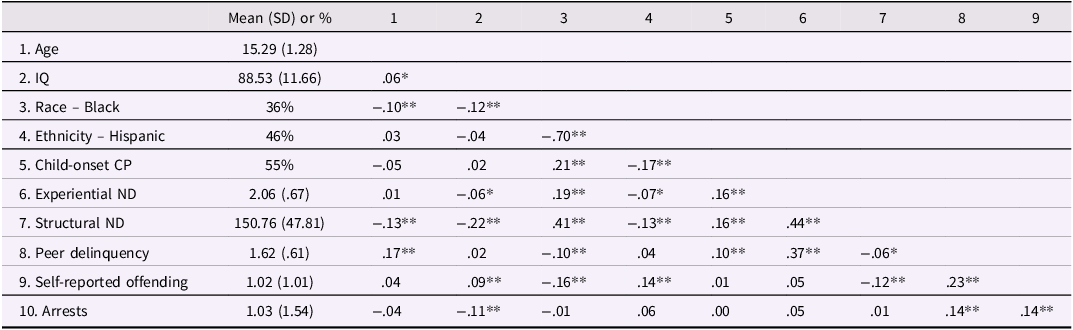
Descriptive statistics and zero-order correlations for all study variables are provided in Table 1. Experiential ND at baseline was not significantly correlated with either self-reported offending or arrests over the follow-up period. While structural ND at baseline was significantly associated with later self-reported offending (r = −.12, p < .001), it was not in the expected direction. That is, greater ND was associated with less self-reported delinquency over the follow-up period. To illustrate this association, participants in the most disadvantaged quartile of ND had a mean of .82 (SD = .90) delinquent acts over the follow-up period, while the least disadvantaged quartile had a mean of 1.16 (SD = 1.21) acts. Also, peer delinquency at baseline was significantly associated with self-reported offending (r = .23, p < .001) and arrests (r = .14, p < .001) over the follow-up period, as predicted.
Correlations among demographic variables and main study variables

SD = standard deviation; IQ = Weschler Abbreviated Scale of Intelligence Full Scale IQ; ND = neighborhood disadvantage; Black race was coded as Black = 1 and other = 0. Hispanic ethnicity was coded as Hispanic = 1 and other = 0; Child-onset CP was coded as onset before age 10 = 1 and other = 0*p < .05; **p < .01; ***p < .001.
Neighborhood disorganization and antisocial behavior
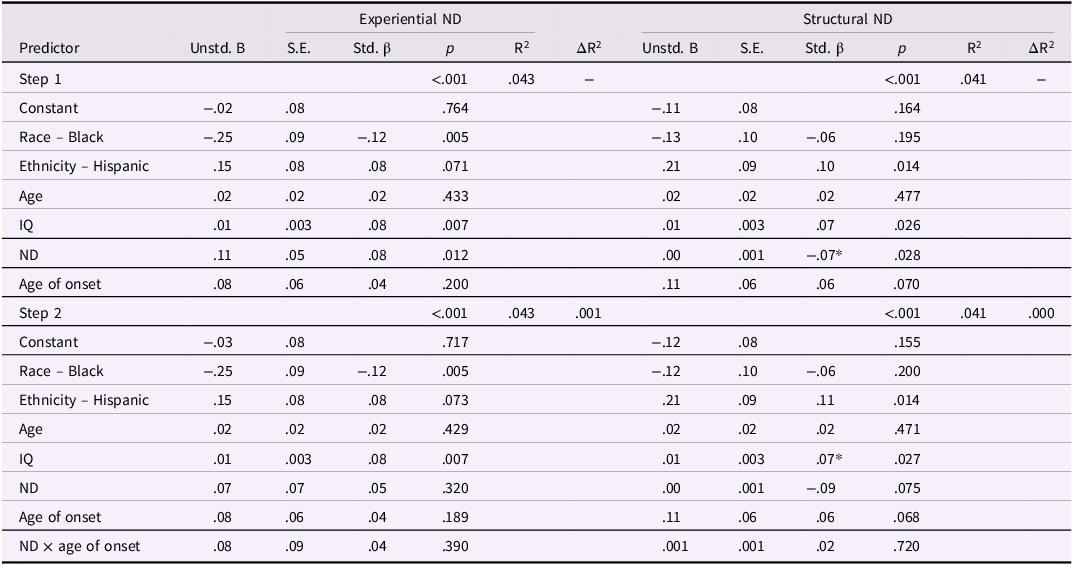
Hierarchical linear regression analyses were used to determine if ND at baseline and age of onset predicted self-reported delinquency across the follow-up period, while covarying age, race, ethnicity, and IQ. The results of these analyses are reported in Table 2. For both experiential ND and structural ND, there were significant main effects for predicting self-reported offending in the first step of the analyses. Consistent with the hypothesis, more experiential ND at baseline was associated with more delinquency over the follow-up period (β = .08, p = .012). However, contrary to predictions, greater structural ND was associated with less self-reported delinquency (β = −.07, p = .028). In both cases, the addition of the age of onset by ND interaction did not add to the prediction of self-reported delinquency.
Hierarchical linear regressions of neighborhood disadvantage (ND) predicting self-reported offending

Unstd. = unstandardized; S.E. = standard error; Std. = standardized; Black race was coded as Black = 1 and other = 0. Hispanic ethnicity was coded as Hispanic = 1 and other = 0; Child-onset CP was coded as onset before age 10 = 1 and other = 0. *p < .05; **p < .01; ***p < .001.
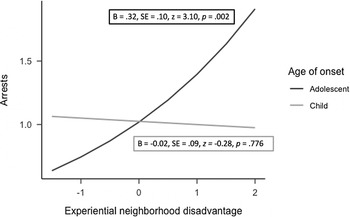
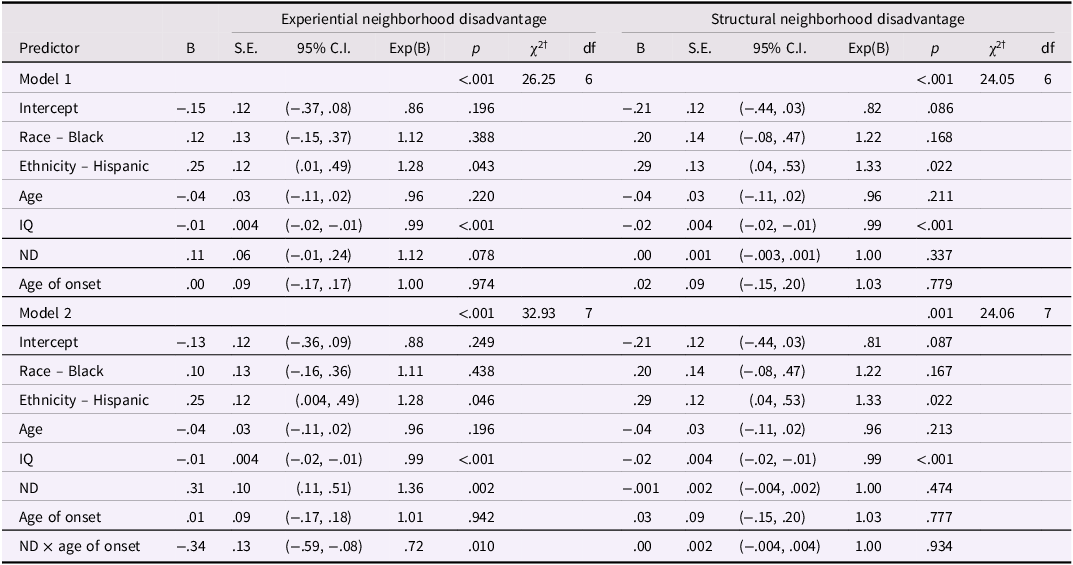
Analogous hierarchical negative binomial regressions were used to determine if ND at baseline and age of onset of CP predicted arrests over the follow-period, while covarying age, race, ethnicity, and IQ. The results of these analyses are reported in Table 3. For both experiential and structural ND, there were no significant main effects of ND in the first step. However, the interaction between ND and age of onset was significant for experiential ND (Exp (B) = .72, p = .010), when it was added in the second step. The form of this interaction was plotted and provided in Figure 1. As predicted, experiential ND at baseline predicted arrests over the follow-period for the adolescent-onset group (Exp(B) = 1.39, SE = .10, z = 3.10, p = .002, 95% CI = .17– .51) but not for the childhood-onset group. Pairwise comparison showed that the difference between the simple slopes was significant (p = .011).
Interaction between neighborhood disadvantage and age of onset of conduct problems.

Negative binomial regression of neighborhood disadvantage (ND) predicting arrests

S.E = standard error; C.I. = confidence interval; Exp = exponentiated; df = degrees of freedom; Black race was coded as Black = 1 and other = 0. Hispanic ethnicity was coded as Hispanic = 1 and other = 0; Child-onset CP was coded as onset before age 10 = 1 and other = 0. *p < .05; **p < .01; ***p < .001 †Likelihood ratio Chi-square.
Peer delinquency and antisocial behavior
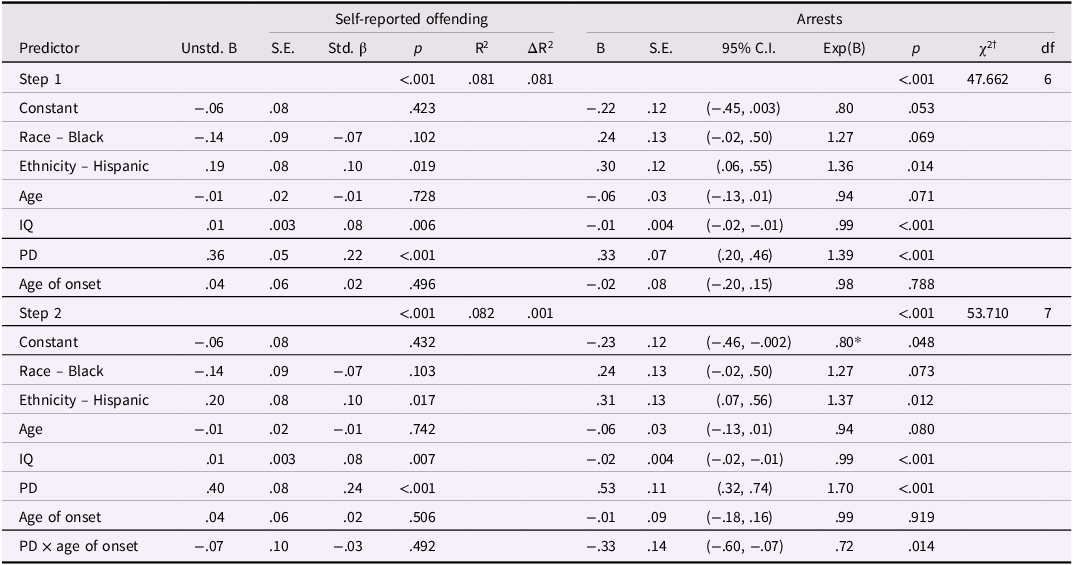
Hierarchical linear regression analyses were used to examine whether peer delinquency at baseline and age of onset predicted self-reported offending over the follow-up period, while covarying age, race, ethnicity, and IQ. The results of these analyses are reported in Table 4. There were significant main effects of peer delinquency in the first step of the analysis (β = .22, p < .001) but age of onset of CP did not moderate this association.
Hierarchical linear regression of peer deviance (PD) predicting conduct problems

Unstd. = unstandardized; S.E. = standard error; Std. = standardized; C.I. = confidence interval; Exp = exponentiated; df = degrees of freedom; Black race was coded as Black = 1 and other = 0. Hispanic ethnicity was coded as Hispanic = 1 and other = 0; Child-onset CP was coded as onset before age 10 = 1 and other = 0. *p < .05; **p < .01; ***p < .001; †Likelihood ratio Chi-square.
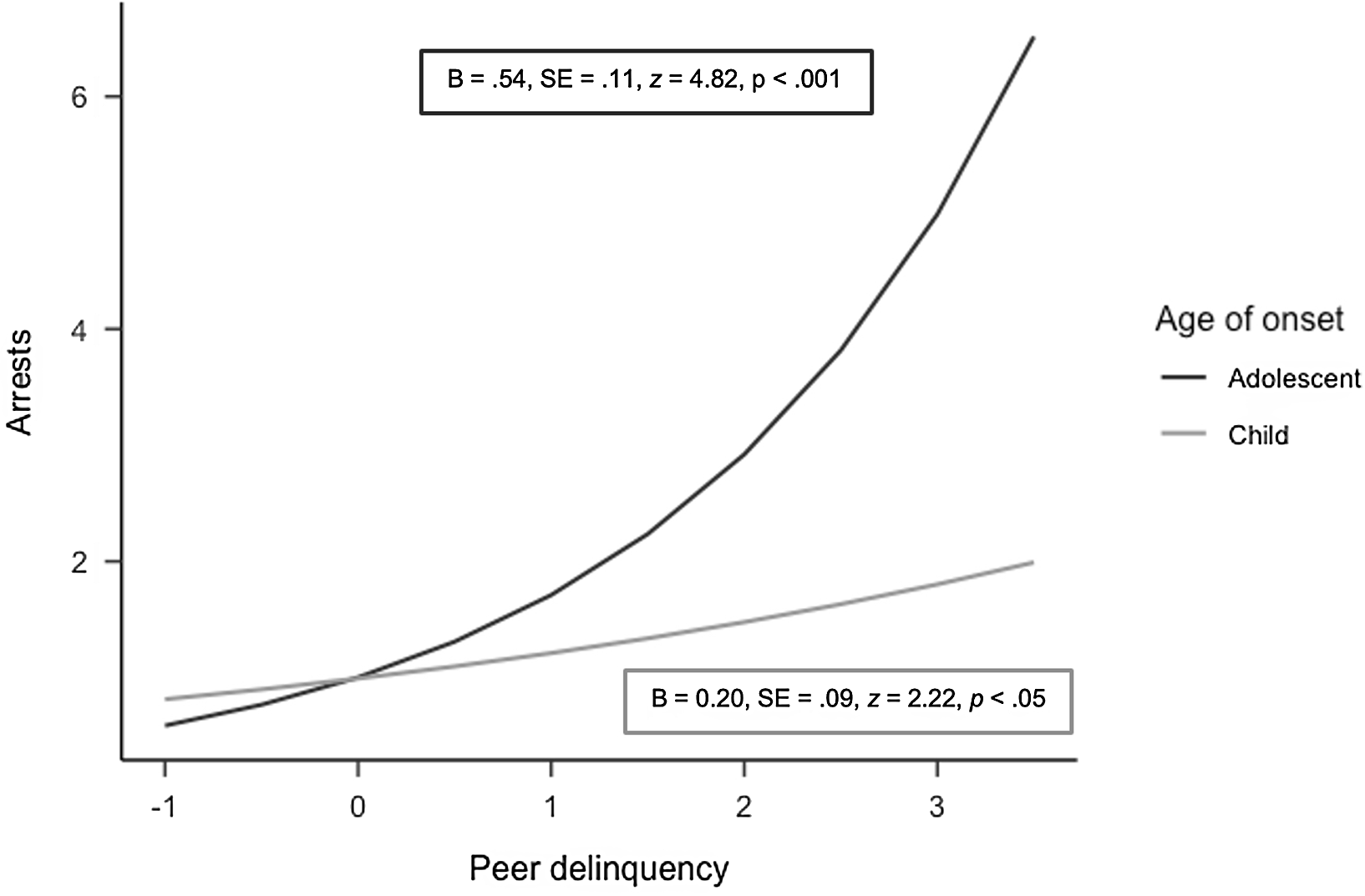
Hierarchical negative binomial regression analysis was used to determine if peer delinquency at baseline and age of onset predicted arrests over the follow-up period, while covarying age, race/ethnicity, and IQ. The results of these analyses are reported in Table 4. There was a significant main effect of peer delinquency in the first step (Exp(B) = 1.39, p < .001). However, age of onset moderated this association, as indicated by the significant interaction between age of onset and peer delinquency when it was added to the second step of the regression analysis (Exp(B) = .72, p = .014). The form of the interaction and simple slopes are provided in Figure 2. The simple slopes showing the association between peer delinquency and arrests for the adolescent-onset CP (Exp(B) = 1.70, p < .001) and the child-onset CP (Exp(B) = 1.22, p = .026) groups were both significant. However, consistent with hypotheses, pairwise comparisons showed that the association was stronger for the adolescent-onset group (p = .018).
Interaction between peer delinquency and age of onset of conduct problems.

ND, peer delinquency, and antisocial behavior
Experiential ND at baseline showed a significant main effect for predicting self-reported offending over the follow-up period in the expected direction. Thus, the indirect effects of experiential ND on self-reported offending were tested using bootstrapped mediation analysis. These results indicated that 95% CI did not include 0 and thus, the indirect effect for experiential ND on self-reported delinquency through peer delinquency was significant (B = .14, S.E. = .025, 95% CI = .09-.19).
For predicting arrests over the follow-up period, the interaction between experiential ND and age-of-onset and between peer delinquency and age-of-onset were both significant. Thus, a hierarchical negative binomial regression analysis was performed to determine if the interaction with peer delinquency accounted for the interaction with experiential ND in predicting future arrests. In the first step, experiential ND, age of onset, and the interaction between ND and age of onset, as well as the study covariates were entered as predictors. In the second step, the main effect of peer delinquency and the interaction term peer delinquency × age of onset were added. At this second step, the main effect of experiential ND and its interaction with age-of-onset were no longer significant. However, the main effect of peer delinquency (B = .49, S.E. = .117, p < .001) remained significant.
Discussion
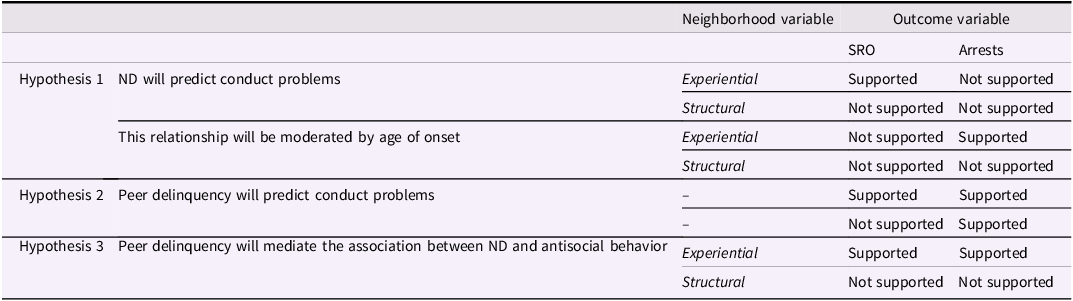
This study aimed to advance developmental theories of serious CPs by examining the influence of ND and peer delinquency on adolescent antisocial behavior and testing whether these influences were moderated by the age at which the adolescent first started showing CP. Although a number of findings were consistent with our predictions, many of our results were not consistent across the different ways we measured ND (e.g., experiential vs. structural) and antisocial behavior (e.g., self-reported delinquency and official records of arrests). The differences in findings across the different measurement methods are summarized in Table 5. Importantly, we did not make a priori predictions about potential differences in results based on the type of measure used. Thus, our interpretations of these differences across methods were post hoc and need to be replicated in future studies.
Summary of study hypotheses and results

ND = neighborhood disorganization.
The main finding that was consistent with our hypotheses and that was consistent across both ways of measuring delinquency (i.e., self-report and official arrests) was that associating with deviant peers predicted later delinquency. Further, the regression model using peer deviance as the predictor (with all covariates) explained nearly twice as much of the variance in self-reported offending over the follow-period as the regression model using experiential ND as the predictor (R2 = .081 and R2 = .043, respectively). These findings demonstrating the importance of peer delinquency are not surprising, given that associating with deviant peers is one of the strongest and most consistent predictors of antisocial behavior in adolescents (e.g., Dandreaux & Frick, Reference Dandreaux and Frick2009; McCabe et al., Reference McCabe, Hough, Wood and Yeh2001; Moffitt, Reference Moffitt2018; Simons et al., Reference Simons, Wu, Conger and Lorenz1994). Further, our hypothesis that the association between ND and adolescent delinquency would be largely mediated by peer delinquency was also supported. That is, the main effect of experiential ND on self-reported delinquency and the interaction between structural ND and arrests were both largely accounted for by peer delinquency. While the importance of peer delinquency for predicting adolescent antisocial behavior has been widely supported in past research, our results suggest that associating with deviant peers could help to explain the influence of other risk factors, like ND. Further, our findings suggest that one of the more iatrogenic effects of living in disorganized and impoverished neighborhoods may be because it can lead to adolescents associating with antisocial peers (Dupéré et al., Reference Dupéré, Lacourse, Willms, Vitaro and Tremblay2007; Sampson et al., Reference Sampson, Raudenbush and Earls1997; Wikstrom & Loeber, Reference Wikstrom and Loeber2000).
Our findings on whether the influence of peer delinquency or ND was moderated by the age of onset of CP were dependent on the outcome measure. That is, we found no moderation in any analysis using self-reported offending as an outcome. However, the influence of both peer delinquency and experiential ND at baseline in predicting arrests over the follow-up period was stronger for the adolescent-onset group, which was consistent with predictions. One possible explanation for why our results were confined to arrests is that youth with adolescent-onset CP may engage in more publicly visible antisocial behavior, such as vandalism and shoplifting, as a way of appearing more rebellious or they may be more willing to directly confront and defy police, both of which could make them more likely to be arrested. This explanation would be consistent with the findings of Dandreaux and Frick (Reference Dandreaux and Frick2009), who reported on a comparison of childhood-onset and adolescent-onset of antisocial behavior in a sample of justice-involved adolescents. These authors reported that those youth in the adolescent-onset group scored lower on a measure of “traditionalism,” a personality dimension defined by a tendency to reject status hierarchies and rebel against authority figures. These explanations would also be consistent with Moffitt’s developmental theory suggesting that adolescent-onset CP is an exaggeration of normal adolescent rebellion against social conventions, including respecting the police (Assink et al., Reference Assink, van der Put, Hoeve, de Vries, Stams and Oort2015; Moffitt & Caspi, Reference Moffitt and Caspi2001; Moffitt, Reference Moffitt2018). However, it is important to reiterate that this interpretation was post hoc and was not directly tested.
Another unexpected but intriguing set of findings were the differences in results when using our adolescent-reported measure of neighborhood disorder (i.e., experiential ND) and our census-derived measure of neighborhood poverty (i.e., structural ND). Despite being correlated (r = .44, p < .001), these measures assess very different aspects of neighborhood disorder. Experiential ND assesses the adolescent’s perception of physical and social disorder in their neighborhood, while the neighborhood poverty measure focuses solely on the socioeconomic status of the persons living in the neighborhood. While correlated, these are not interchangeable constructs and some lower income neighborhoods can have relatively low levels of disorder. Further, these different dimensions of ND led to different associations with our outcome variables. Specifically, our experiential ND measure showed some associations with adolescent antisocial behavior that were expected, such as a main effect in predicting self-reported offending and an interaction with age of onset in predicting arrests. In both cases, more ND predicated more antisocial behavior, albeit more strongly predicting arrests in those with adolescent-onset CP. Such findings are consistent with a significant amount of past research linking various indicators of ND to a greater risk for adolescent delinquency (Goodnight et al., Reference Goodnight, Lahey, Van Hulle, Rodgers, Rathouz, Waldman and D'Onofrio2012; Leventhal & Brooks-Gunn, Reference Leventhal and Brooks-Gunn2000; Pettit et al., Reference Pettit, Bates, Dodge and Meece1999; Sampson et al., Reference Sampson, Raudenbush and Earls1997; Trentacosta et al., Reference Trentacosta, Hyde, Shaw and Cheong2009).
Further, the prediction of self-reported delinquency by experienced neighborhood disorder was at least partially mediated by peer delinquency, as we predicted based on Moffitt’s developmental theory. Moffitt’s theory suggests that those youth who start showing antisocial behavior prior to adolescence generally show several enduring vulnerabilities that make them more likely to show antisocial behavior, even in the absence of significant environmental risks. However, those in the adolescent-onset group seem to show an exaggeration of normal adolescent rebellion in which the function of antisocial behavior is to gain a sense of independence from traditional authority figures (i.e., parents, teachers, police) in way that is supported by antisocial peers (Moffitt, Reference Moffitt2018). Such rebellion appears to be particularly likely in adolescent males, in which societal constraints against engaging in behavior that hurts or violates the rights of others are weaker, whereas in adolescent females it may require stronger individual predispositions to engage in such behavior (see Silverthorn & Frick, Reference Silverthorn and Frick1999). Importantly, however, the current study only included male adolescents, so no differences across gender could be tested.
In contrast, our census-derived measure of neighborhood poverty was negatively associated with self-reported offending and unrelated to arrests. Much of the past research linking ND to antisocial behavior has relied on measures of informant-reported experiential ND (e.g., Briggs et al., Reference Briggs, Quinn, Orellana and Miller2015; Goodnight et al., Reference Goodnight, Lahey, Van Hulle, Rodgers, Rathouz, Waldman and D'Onofrio2012; Pettit et al., Reference Pettit, Bates, Dodge and Meece1999; Trentacosta et al., Reference Trentacosta, Hyde, Shaw and Cheong2009). However, even in the limited past research that has used census-derived measures of neighborhood poverty, a positive association between poverty and antisocial behavior is typically reported (e.g., Hay et al., Reference Hay, Fortson, Hollist, Altheimer and Schaible2006; Katz et al., Reference Katz, Esparza, Smith Carter, Grant and Meyerson2012; Sampson et al., Reference Sampson, Raudenbush and Earls1997). Importantly, none of these studies tested this association in an arrested sample. There is evidence to suggest that youth in impoverished neighborhoods are more likely to be arrested than other youth because of greater police presence in these neighborhoods (Fine & Cauffman, Reference Fine and Cauffman2015; Kirk, Reference Kirk2008; Stevens & Morash, Reference Stevens and Morash2014). As a result, youth in more economically advantaged neighborhoods may need to engage in more antisocial behavior to be arrested than youth in disadvantaged neighborhoods. Thus, our sample, which required a single arrest for inclusion, may have resulted in youth from advantaged neighborhoods engaging in more antisocial behavior than youth in less economically advantaged neighborhoods prior this arrest. A similar trend was described in a 2023 study of over 11,000 youth, where youth in unsafe neighborhoods were more likely than youth in safe neighborhoods to report being arrested, even at similar levels of self-reported delinquency (Brislin et al., Reference Brislin, Clark, Clark, Durbin, Parr, Ahonen, Anderson-Carpenter, Heitzeg, Luna, Sripada, Zucker and Hicks2023).
Limitations
This study had several methodological strengths, such as measuring key variables (e.g., ND and delinquency) with multiple methods, using a longitudinal design with multiple follow-up points, using a large sample with high rates of underrepresented youth, and using a sample at high risk for the outcomes of interest (i.e., illegal behavior) who were highly likely to be evenly divided between childhood-onset and adolescent-onset trajectories. However, it also had several limitations that should be considered when interpreting the results. First, the sample included only males, which limits the generalizability of the findings to female samples. As we previously noted, there may be differences in the different developmental trajectories to CP for boys and girls (Silverthorn & Frick, Reference Silverthorn and Frick1999). Second, the sample were youth who had been arrested for an offense of moderate severity, which may have led to some unexpected findings, such as the inverse relationship between structural ND and CP. Thus, these findings should be replicated using samples of youth from the general population. Third, experiential ND, peer delinquency, and self-reported offending were based on youth self-reports, which could have inflated the correlations among these variables due to shared method variance. Fourth, while the predictors and outcome variables for this study were not measured at the same time, the mediator was measured at the same time as the predictors, which weakens the test of mediation because one cannot determine the temporal ordering of effects between the predictors and mediator (Cole & Maxwell, Reference Cole and Maxwell2003). Finally, while this study was longitudinal, the first assessment point took place when the participants were in adolescence (mean age of 15.29 years). As a result, age of onset had to be estimated through retrospective recall, which could lead to inaccuracies in reporting (Moffitt et al., Reference Moffitt, Arseneault, Jaffee, Kim-Cohen, Koenen, Odgers, Slutske and Viding2008).
Implications
Within the context of these limitations, our study has several important implications. First, our results support a large amount of past research highlighting the importance of peer delinquency in the development of antisocial behavior. Our results using a longitudinal study design suggests that peer delinquency may be important for explaining the iatrogenic effects of other risk factors for delinquency, such as neighborhood disorganization. Explaining the influence of the many interrelated risk factors to antisocial behavior is not only important for causal theory but it is also important for policy and practice. That is, our results support the use of interventions that aim to support healthy peer relationships for children and adolescence in disadvantaged neighborhoods to prevent and reduce antisocial behavior (Durlak et al., Reference Durlak, Weissberg and Pachan2010; Enns et al., Reference Enns, Nickel, Chateau, Katz, Sarkar, Lambert and Brownell2022). Second, our results also support continued research on developmental theories of CP (Moffitt, Reference Moffitt2018). That is, the influence of ND and peer delinquency on arrests seemed to be stronger in those adolescents with later onset to their antisocial behavior. As a result, research that fails to consider potential differences in the effects of critical risk factors across subgroups of youth with CP could lead to inaccurate interpretations of the strength of these effects. Third, while in need of replication because it was not predicted a priori, our findings that youth who display less antisocial behavior may be arrested in higher poverty areas could have important implications for policy. A significant amount of research has shown that arresting and formally processing youth in the justice system can have a negative effect on the youth’s outcome, increasing the likelihood of future antisocial behavior and justice system involvement (see Cauffman et al., Reference Cauffman, Beardslee, Fine, Frick and Steinberg2021 for such findings in the Crossroads sample). The negative influence of justice system involvement has been hypothesized as being due to increasing contact with other delinquent youth, who model and reinforce antisocial behavior (Thornberry et al., Reference Thornberry, Krohn, Lizotte and Chard-Wierschem1993) or increasing the adolescent’s chances of witnessing or being victim of violence (Siegel et al., Reference Siegel, Estrada, Crockett and Baskin-Sommers2019). Considering that youth in disadvantaged neighborhoods are already at risk for many negative outcomes (Briggs et al., Reference Briggs, Quinn, Orellana and Miller2015), the potential for being even more disadvantaged through increased involvement in the justice system could have serious implications for their later outcome. Finally, our results highlight the importance of programs to alleviate poverty and provide support to those who are experiencing it. These programs could reduce criminal behavior directly by allowing families greater chances of obtaining housing in neighborhoods with less disorder and indirectly by reducing the adolescent’s chances of associating with and being influenced by antisocial peers (Ludwig et al., Reference Ludwig, Duncan and Hirschfeld2001; Stevens, Reference Stevens2018).
Acknowledgments
The authors thank the many research assistants involved in data collection across the three study sites; the youths and their families for their participation; and the agencies that funded the Crossroads Study, including the Office of Juvenile Justice and Delinquency Prevention, the John D. and Catherine T. MacArthur Foundation, the William T. Grant Foundation, the County of Orange, Calif., and the Fudge Family Foundation.
Funding statement
The Crossroads Study was supported by grants from the Office of Juvenile Justice and Delinquency Prevention (2010-JF-FX-0612) and the John D. and Catherine T. MacArthur Foundation (09-94942-000 HCD and 10- 95,802-000 HCD).
Competing interests
None.