In the years leading up to the U.S. Civil War, free and fugitive persons of color were aware of the need to frame how they were seen in their everyday lives as part of an arsenal of rhetorical strategies to attract audiences to the abolitionist cause. In this article, I examine three spatial contexts that nineteenth-century mixed-race persons navigated for abolitionist ends in which their hybrid bodies were featured as an aspect of their public performances. These locations—Britain's imperially sponsored Crystal Palace, a Brooklyn church pulpit, and the dramatic reader's lectern—were not merely static places but were spaces animated and made meaningful by the interactions performed therein. Each framed a particular ocular and locational politics and strategically imbued some degree of social class privilege on the hybrid persons following its social scripts. But in so doing, each setting also reinforced colorism and contributed to notions of the supremacy of “whiteness” even while it furthered an antislavery agenda.
In the northern United States and in Britain, abolitionists, both black and white, seized upon the indeterminate appearance of mixed-race enslaved persons to highlight the horrors of slavery and to enlist white spectators in the antislavery cause. The spectacle of racial hybridity enraged many antebellum proslavery advocates because they read on the bodies of free and fugitive mixed-race persons a refutation of the lie they used to justify slavery: that the races were distinct and even separate species. However, in public performance venues, in the press, in art, and in illustrations, images of “white-appearing” or racially indeterminate enslaved persons led spectators to question binary classifications at the heart of slavery.
Prologue. William Wells Brown and the Crafts: Mixed-Race Bodies in Public Spaces
On 23 October 1854, on a speakers' platform at an antislavery meeting in the Horticultural Hall in Chester, Pennsylvania, well-known black abolitionist and former slave William Wells Brown, recently returned from five years in Europe, openly addressed the problematics of his hybrid heritage when he asked rhetorically: “Why do I stand before you, Mr. Chairman, tonight, not an African nor an Anglo-Saxon, but of mixed blood? It is attributable to the infernal system of American slavery.”Footnote 1
In the antebellum period, the ambiguous bodies of multiracial Americans presented a crisis of juridical categories for spectators. Because racial hybridity signified the result of interracial sex, the very presence of persons of ambiguous or indeterminate race threatened those who policed the boundaries between the races. Since the law dictated that children inherited their racial designation and status as free or enslaved from their mothers, white slaveholders in the South legally classified all children born of enslaved women as black (even their own mixed-race offspring).
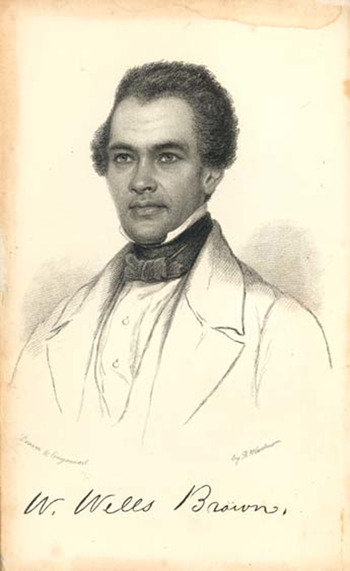
William Wells Brown was well aware that onstage, on a speakers' platform, and in daily social encounters his highly distinguishable body was observed, perceived, and visually consumed by those who witnessed and interacted with him. Brown was a light-complected and light-eyed black man who had been fathered by a white “master.” Perhaps trading on the value of his appearance and the relative privilege it engendered, Brown had chosen to include in the frontispiece of his latest published narrative, Three Years in Europe; or, Places I Have Seen and People I Have Met, an etching of himself that clearly depicted his light skin color and light eyes (see Fig. 1).Footnote 2 I contend that Brown's portrait (and its prominent positioning as the frontispiece of his narrative) functioned as a sign whose purpose was “both the description of an individual and the inscription of [a hybrid] social identity.”Footnote 3
Frontispiece of William Wells Brown, Three Years in Europe; or, Places I Have Seen and People I Have Met (London: Charles Gilpin, 1852).

But Brown's rhetorical question and answer on this occasion, that his “mixed blood” was attributable to the “infernal system of American slavery,” further raised and complicated issues of colorism and the ways that racial hybridity functioned as a signifier of both classed entitlements and the sexual threat enslaved women faced. For in this speech and the performance interventions I discuss below, Brown alluded to the “open secret” of the rampant sexual coercion and rape of enslaved black women, such as Brown's mother, by their white masters (or, in Brown's case, his master's white half-brother), which had resulted in Brown's birth and his mixed racial appearance. Saidiya Hartman has asserted that under slavery “the rape of black women existed as an unspoken but normative condition fully within the purview of everyday sexual practices.”Footnote 4 Yet clearly some abolitionists, such as William Wells Brown, did refer to such sexual violence as endemic in the “infernal system .” Furthermore, in a multitude of settings, as a novelist, playwright, journalist, and essayist, Brown was drawn to narratives of racial ambiguity in stories of passing from slavery to freedom. In 1847, Brown wrote a three-act drama The Escape; or, A Leap to Freedom and performed it in solo readings as a means to further his antislavery message.Footnote 5 Of course, any form of “passing” is inherently spatial. The metaphor of moving from one racialized or gendered identity to another implies literal as well as metaphoric and possibly juridical movement, as did the “Leap” in Brown's title. By the mid-nineteenth century, Brown had published and performed numerous accounts of his own and others' passages out of slavery.
The iconic case of racial and gender passing for Brown was that of Ellen and William Craft. The Crafts escaped their enslavement in Georgia late in 1848 through Ellen Craft's enactment as a young white male “master” of her darker-complected husband. Brown was apparently intrigued with their story and on 12 January 1849—within weeks of hearing about it—he published an account of the Crafts' escape in the Liberator, William Lloyd Garrison's newspaper. Together with the Crafts, Brown addressed antislavery audiences in the United States throughout the winter and spring of 1849. Performativity was a key feature of Brown's appeals. On one occasion in Newburyport, Massachusetts, the three former slaves appeared before an audience of eight to nine hundred persons with a presentation that included, along with “stirring remarks” about their escape, a few antislavery songs composed by Brown.Footnote 6 Shortly afterward, Brown left for Europe. And just months later, prompted by the passage in 1850 of the Fugitive Slave Act, the Crafts—who, like Brown, were still fugitives—followed in Brown's footsteps and traveled to England. The Fugitive Slave Act was fundamentally a spatial law. After its passage, even free states such as Massachusetts, where the Crafts were then residing, were no longer safe spaces for fugitives escaping enslavement, as the act required the return of runaway slaves, and even free persons of color could be sent south into slavery by anyone claiming to be or to represent their owner.Footnote 7 In Britain, the Crafts, often along with Brown, made antislavery appeals and appeared in a range of public spaces and in private homes, where they presented themselves as living exhibits of the horrors of slavery.Footnote 8
Act 1. Displaying the “Most Fitting Companions”: Exhibiting Hybrid Fugitive Bodies at the First World's Fair
Spatiality is key to the ways racialized bodies are read in any setting. In the first “act” of this article, I focus primarily on one unique site where the tensions between representational art and embodied artistry, racist theory, and hybrid theatricality were intentionally displayed under unprecedented public scrutiny: the visit of former slaves William Wells Brown and William and Ellen Craft, along with white British abolitionist friends, to the Great Exhibition at the Crystal Palace in London in 1851.
For Brown, delivering public speeches and publishing slave narratives was not enough; he recognized that in live public appearances and social encounters, persons of color were perceived performatively. The spectatorial value of Brown's live hybrid physical presence among Britons in public social venues and in private homes fostered connections between his dignified appearance and the abolitionist messages he was endeavoring to impart. And the Great Exhibition in London's Crystal Palace in 1851 was the perfect staging ground for a performance intervention that forced spectators and passersby to read the visual drama of slavery onto the bodies of mixed-race persons such as himself and Ellen Craft. In fact, Brown described the London exhibition as “one great theatre, with thousands of performers, each playing his own part.”Footnote 9 As Michel de Certeau has explained, a locale or “place” becomes a “space” when it is “actuated by the ensemble of movements deployed within it.”Footnote 10
London's Great Exhibition in 1851 was the first world's fair. It was staged in a vast, spectacular glass structure built for the occasion called the Crystal Palace because of the imprimatur of Britain's Prince Albert, who had a hand in the conception of the exhibition. The Crystal Palace was designed like a hothouse or a massive specimen case, in which spectators from all over the world came to see and be seen along with objects of industry and artistry from nations around the globe. When William Wells Brown described the Crystal Palace as “the greatest building the world ever saw,” he was invoking more than the beauty of the setting, however. Rather, he suggested, among the “feast of reason and imagination” offered for spectators' ocular consumption was the fact that the exhibition was attended by such a range of people of different races and ethnicities.Footnote 11
Brown seized upon this location, where there was a convergence of international visitors to London, as a venue for the staging and exhibiting of racial hybridity and the opportunity this offered to make discernible to international audiences the sexual exploitation of black women under slavery. This was particularly significant for those such as Brown and Ellen Craft, whose mixed-race parentage made them less detectable to white spectators, who otherwise might not have identified them with slavery. Thus, the Crystal Palace served as an extraordinary performance place and representational space in which former slaves—instead of merely being consumed as visual spectacles—could transform and reappropriate their audience's gaze in an act of performative self-determination.
The setting couldn't have been better. Unlike a traditional proscenium stage or speakers' platform, the architecture of the Crystal Palace was configured for unique ways of showing and seeing. Noting the sightlines and vantage point for spectators' gaze, Brown remarked that
he who takes his station in the gallery, at either end, and looks upon that wondrous nave, or who surveys the matchless panorama around him from the intersection of the nave and transept, may be said . . . to see all the kingdoms of this world and the glory of them.Footnote 12
In this exceptional setting, Brown observed that spectators at the exhibition could see “a greater as well as more various assemblage of the human race, than ever before was gathered under one roof.”Footnote 13 This unique space would serve Brown well. He remarked: “Those who love to study the human countenance in all its infinite varieties, can find ample scope for the indulgence of their taste, by a visit to the World's Fair,” where “All countries are there represented—Europeans, Asiatics, Americans and Africans, with their numerous subdivisions.”Footnote 14
In the months from May to October 1851 Brown attended the Great Exhibition fifteen times; but on a particular Saturday in June 1851, a “day when the largest number of aristocracy”—some fifteen thousand mostly upper-class spectators—attended the fair, including Queen Victoria, Prince Albert, members of Parliament, and “merchants and bankers from almost all parts of the world,” Brown elected to stage a performance intervention with the biggest and most influential audience possible. Brown and the Crafts and “a small party of anti-slavery friends” that included white abolitionists George Thompson and William Farmer and their families did not just attend the Great Exhibition as spectators; they intentionally chose to promenade through the exhibition on a day when the bodily presence of former slaves might have the most impact.Footnote 15
As Brown no doubt knew, popular entertainment venues such as fairs, museums, and theatres operated at different visual registers and deployed different forms of address to audiences in those spaces than the appeals for abolition delivered by orators in a lecture hall, and each drew upon different ways of spectating. At the Crystal Palace, as spectators moved through space their focus would oscillate between the specific corporeality of a passerby, that of the persons accompanying him or her, and the backdrop of objects on display through which they moved, as all would be part of the visual field.
This setting was the perfect staging ground for a performative intervention as Brown, the Crafts, and the white abolitionist friends who accompanied them paraded as dramatis personae through the Crystal Palace and formed a series of moving tableaux that other visitors observed. This choreographed performance drew upon an awareness of spatiality and the unique spectatorial possibilities Brown and the Crafts garnered by merely appearing and placing themselves in this location, under the huge glass specimen case of the Crystal Palace, thereby turning it into a representational space for their own purposes. As Don Mitchell has noted in another context, “A ‘logic of representation’ centers on the right of groups and individuals to make their desires and needs known, to represent themselves to others . . . as legitimate claimants to public considerations.”Footnote 16 Inserting their hybrid, raced bodies into the visual and spatial fields occupied by a diverse collection of visitors from all over the world, Brown and his company's movement through space drew attention to themselves, challenging and decentering the imperial iconography the fair had been constructed to celebrate.
In addition, drawing upon the potentially subversive powers of kinesis, they choreographed a very precisely partnered perambulation, wherein Brown, the Crafts, and their white abolitionist friends deliberately strolled arm in arm in interracial pairs through the Crystal Palace to the United States Department in order to provoke the gaze of onlookers. Moreover, Brown knew that American sculptor Hiram Powers's acclaimed work The Greek Slave was being exhibited there. As he later wrote in Three Years in Europe, although Powers's Greek Slave was the major work of art the United States had sent to the Great Exhibition, “it would have been more to their credit had they kept that at home.”Footnote 17
Brown had good reason for his critique. When Powers's romanticized white marble sculpture of a nude female slave was first exhibited in the United States several years earlier, it had generated widespread praise from observers in twelve American cities, and spectators had traveled and paid to see it. In the narrative that accompanied the sculpture, Powers claimed to be depicting an enslaved Greek Christian girl as she was about to be sold into a Turkish harem. Newspapers such as the New York Daily Tribune had been rapturous over the idealized beauty and “dignity” of Powers's “white” slave, despite the figure's nudity.Footnote 18 By selecting and displaying Powers's sculpture as the featured American work of art, this “world's fair” buttressed the supremacy of whiteness in the creative imaginary of the United States. In Powers's white marble nude sculpture, the torturous treatment of enslaved black women was rendered invisible.
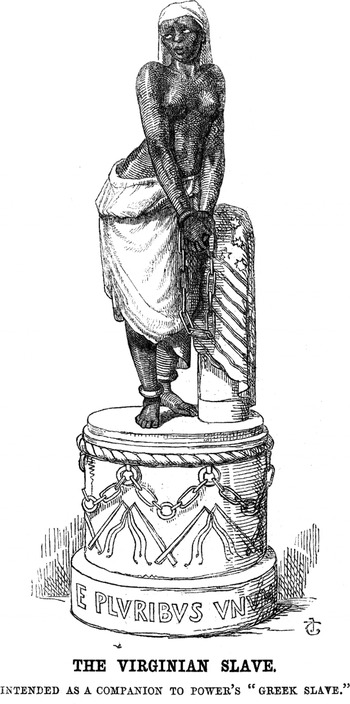
But the classical Greek features and “whiteness” of Powers's marble Greek Slave and its spatial location in the Crystal Palace's United States Department prompted a critical response in the British satirical weekly Punch. On 17 May 1851, Punch published a cartoon woodcut titled with the caption “The Virginian Slave: Intended as a Companion to Power's [sic] ‘Greek Slave’” (see Fig. 2).Footnote 19 John Tenniel's wood engraving of an enslaved black woman bore similarities to and notable differences from Powers's acclaimed sculpture. Unlike Powers's demure Greek Slave, which gazed downward, Tenniel's black “Virginian Slave” looked up, skyward, as if appealing to heaven as she stood on a plinth decorated with a garland made of chains and adorned, ironically, with the American motto, “E pluribus unum,” or “out of many, one.” Depicted with chained hands and shackles on her feet but clothed in a skirt (unlike Powers's nude sculpture), the “Virginian slave” was pictured alongside a post draped with an American flag. The differences between this drawing and Powers's statue illustrated the marked distance between the proclaimed values of equality in the United States and the actual condition of enslaved black women.
“The Virginian Slave,” John Tenniel's woodcut drawing, was published in Punch on 17 May 1851 as a satirical commentary on Powers's Greek Slave then on exhibit at the Crystal Palace.

Clearly, Brown, the Crafts, and their white abolitionist friends seized upon this setting for a spatialized subversion of racial ideology and intentionally selected Powers's sculpture as a backdrop for the performative intervention they were staging. In Brown's account of the event, he claimed that he and his party had chosen to spend time in the United States Department and that they had audibly “criticised the bad appearance” of the goods there.Footnote 20 To illuminate their critique visually, Brown had brought along with them the illustration of “The Virginian Slave” from Punch, which he used as a prop in order to incite further the reactions of spectators. “Upon arriving at Powers' Greek Slave,” William Farmer described, “Punch's ‘Virginia Slave’ [sic] was produced.” Displaying Tenniel's illustration drew viewers' attention to paradoxes implicit in an American sculptor's depiction of a sympathetic, aestheticized “white” Greek slave at the very time when actual black women were being enslaved in America. As Farmer noted, “The comparison of the two [enslaved women] soon drew a small crowd.”Footnote 21 Brown not only forced spectators to consider actual rather than whitewashed representations of enslaved women, he also implicitly demonstrated that, for the most part, hybrid, mixed-race slaves such as himself were the result of the forced or coerced sexual exploitation of enslaved legibly black women—like the one represented in the “Virginian Slave.”
White abolitionist Farmer claimed that for spectators witnessing the group's stroll through the Crystal Palace, “the object of the comparison” between the Greek Slave and the image of the enslaved black woman in Punch “was evidently understood and keenly felt.” Farmer asserted that members of their abolitionist party felt that it “would not have been prudent in us” to have initiated “an anti-slavery discussion in the World's Convention.” Unlike a formal antislavery speech, William Wells Brown's provocative act was visual and performative. When Brown placed Punch's “Virginian Slave” illustration “within the enclosure by the ‘Greek Slave,’” he publicly announced to bystanders, “As an American fugitive slave, I place this ‘Virginian Slave’ by the side of the ‘Greek Slave’ as its most fitting companion.”Footnote 22
In keeping with J. L. Austin's concept of the performative as statements that enact or produce that to which they refer, I suggest that Brown's performative utterance and display of Tenniel's illustration and himself (and the Crafts) alongside Powers's aestheticized representation of “white” slavery transformed both the meaning and space of the United States Department of the Great Exhibition in that it called into question spectators' conceptual understandings of race, slavery, and the hypocrisy of the American nation. Spatiality and movement were at the heart of Brown's act of transforming his own hybrid body into a representational spectacle for exhibit alongside these artistic renderings of slavery.
Although William Wells Brown was not the only fugitive slave in their abolitionist party at the Crystal Palace, no public mention was made of the Crafts' presence or of the circumstances of their escape. Brown spoke only for himself “as an American fugitive slave.” Yet in what Fionnghuala Sweeney has called the “profoundly disturbing twinned images of objectified white and abject black femininity,”Footnote 23 those two representations of enslaved women's bodies were made to serve as backdrop for a performative intervention that featured the (unremarked) presence of an actual formerly enslaved woman participant, Ellen Craft.
It is interesting to speculate about Ellen Craft's reaction to this act. Several months beforehand, American abolitionist Henry Clarke Wright had suggested in the Liberator that former slaves then in Britain should attend the Great Exhibition and highlight the particular horrors that enslaved women experienced. Wright had advised that the Crafts attend the fair in “the guise in which they escaped from slavery. . . . Ellen Craft in the [male] costume in which, alone and single-handed she asserted and vindicated her womanhood.”Footnote 24 That certainly did not occur, although at a later point the Crafts marketed images of Ellen in male clothing, building upon whatever frisson that image may have provided for spectators.
Although Ellen Craft was visibly present at the Crystal Palace, she was dressed unexceptionally in modest conventional female apparel, and no verbal announcement was made that a female member of the dramatis personae had herself been an enslaved black woman in America, like the “Virginian Slave.” Presumably Ellen Craft's silent presence at the Great Exhibition served as it did when she sat silently on the abolitionist speakers' platform; her “almost white” appearance offering corporeal testimony of the range of women subject to enslavement, thereby potentially eliciting the sympathy of white audiences.Footnote 25 In this way Craft may have served as a silent prop. Moreover, as Barbara McCaskill has noted, although Ellen Craft was “no longer disguised as a [white] man,” she was “instead displayed as a specimen of Victorian femininity,” her identity racially and sexually transmuted “from sullied quadroon slave to civilized, authentic ‘white’ lady.”Footnote 26
Although Ellen Craft was not legibly black, once she and her darker-complected husband had escaped, she had made no attempt to pass as white, and in fact affirmed her racial loyalty whenever their story was told. Craft's gender performances and her racial indeterminacy may have contributed to her tactical silence at the Crystal Palace. Since at the time “making a spectacle” of oneself had gendered, classed, and raced implications (as bourgeois individuals, “true women” were generally constrained to domestic spheres), public performances with “speaking roles”—such as Brown's proclamation of his fugitive slave status—registered differently for women than for men, largely as a result of their politics of location.
White abolitionists such as Wright and Farmer and contemporary historians have credited the framing and prompting of antislavery political actions by black antislavery activists largely to impetuses provided by their white friends. Historian William McFeely has described the relationships between white Bostonian abolitionists and black men in the abolitionist movement, such as William Wells Brown, as essentially analogous to that between a theatre director and a fledgling out-of-town actor, claiming that “black anti-slavery speakers were always treated as visiting artists in a production of which the white Bostonians never dreamed of losing direction.”Footnote 27 At the time of this performance, William Farmer claimed in a letter to William Lloyd Garrison that the action at the Crystal Palace was initiated when the white friends accompanying Brown and the Crafts “resolved that they should be exhibited under the world's huge glass case.”Footnote 28 However, based upon my archival research, I have credited the strategic and directorial agency behind this specific performance intervention primarily to Brown—a playwright as well as an abolitionist—who both elected to deploy the “Virginian Slave” image and scripted his performative utterance, “As an American fugitive slave, I place this ‘Virginian Slave’ by the side of the ‘Greek Slave’ as its most fitting companion,” thereby choosing to represent himself in that space rather than be represented by others.
But not all “companions” are equally “fitting.” At virtually the same time fugitive slave William Wells Brown deployed his own mixed-raced body in the Crystal Palace to heighten spectators' awareness of both the horrors and the result of the rapacious treatment to which enslaved black women were subject in the United States, white abolitionist minister Henry Ward Beecher was seizing upon another unique spatial setting where the politics of location would render the existence and plight of mixed-race enslaved women particularly visible to white spectators.
Act 2. Henry Ward Beecher: Staging a Spectacle of “White”-Appearing Slaves
It started in 1848. Just a year after white abolitionist clergyman Henry Ward Beecher arrived in New York to serve as minister of Brooklyn's Plymouth Church, he staged the first of his “mock slave auction” performances at the Broadway Tabernacle, an antislavery hall in New York City, to raise funds to purchase the freedom of the two young captured and enslaved daughters of free black man Paul Edmonson and his enslaved wife, Amelia. The Edmonson sisters had been captured while attempting to escape from Washington, DC, and were being held in a prison prior to being shipped to New Orleans.Footnote 29 After hearing about their dire circumstances from their father, Beecher vividly described the girls' predicament to his antislavery audience at the Tabernacle, graphically suggesting the sexual violence they would experience if they were not freed. Although the young girls themselves were not present, Beecher drove his predominately white audience into a frenzy, asking “How would you feel if your daughter were kidnapped and sold to a man who would rape her, sell her children for a profit, and whip her if she put up resistance?”Footnote 30 The very theatrical Beecher then masterfully shifted character and vacillated between addressing the audience as a minister and portraying a lecherous slave master and a brutal auctioneer as he asked his spectators to contribute to the sisters' freedom. A collection was taken up in the hall and evidently $2,200 was contributed to free the Edmonson girls.Footnote 31
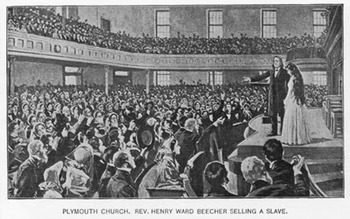
After this success, Beecher—the basement of whose Brooklyn church served as the “Grand Central depot” of the Underground Railroad—decided to stage similar mock auctions from his pulpit in Plymouth Church so that everybody “could see what slave-dealing really meant” (see Fig. 3).Footnote 32 But, as I have argued elsewhere, the performative dimension of Beecher's embodied appeals; his selection of young, light-complected mixed-race fugitive slave girls who appeared, like props, on the pulpit with him; and particularly the specific spatial location of his chosen setting heightened and complicated those meanings for his congregants.Footnote 33
“Mr. [Henry Ward] Beecher selling a beautiful slave girl in his pulpit,” a “mock” slave auction at Plymouth Church. New York Public Library Digital Collections.

The first time Beecher put an enslaved girl's body on display in his Brooklyn church in order to secure her freedom occurred at the conclusion of his sermon on Sunday morning, 1 June 1856. Beecher announced to his congregation that he would present to them a young woman named Sarah “who had been sold by her [white] father to be sent South—for what purpose you can imagine when you see her.” As Beecher led his congregants to consider the sexual slavery to which the beautiful mixed-race young woman would be subject, he informed them that a slave trader who had bought Sarah for $1,200 “has offered to give you the opportunity of purchasing her freedom.” At this point, Beecher invited Sarah up to the pulpit, “so that all may see you.”Footnote 34 Thus, Beecher's largely white, proabolition congregation was presented with the opportunity to observe in their own place of worship the actual body and plight of a particular young enslaved girl whose fate they might have a personal hand in relieving.
As Kelly Oliver has suggested in Witnessing: Beyond Recognition, seeing is an activity that “brings with it responsibilities. When it involves other human beings, then it brings with it ethical, social, and political responsibilities.”Footnote 35 Yet Beecher's suggestion that his congregation “see” Sarah for themselves and “bid” on her freedom both drew upon and complicated such ethical responsibilities, as the spatial and somatic experience for enslaved girls exhibited from the pulpit differed in intent but not in kind from those displayed in actual slave auctions. Certainly Beecher's 1856 audience was aware of the existence of slaves who, like Ellen Craft, appeared to be “almost white”; they were generally “the outcome” (as Thomas Wentworth Higginson described it years later) of “the ungoverned passion of some white man,” who presumably had coerced or raped her enslaved mother. Therefore, given the ideals of beauty and whiteness of the age, they might consider the likelihood that, as Higginson claimed, “the fairer the complexion of every half-breed girl, the greater her attraction and her perils.”Footnote 36
As both a rhetorical and theatrical move, Beecher took on the role of the slave auctioneer, emphasizing the enslaved young girl's attractiveness (by European standards) and suggesting the sexual tortures to which she would be subject if congregants did not pass the collection plate and contribute to purchasing her freedom. Beecher's wife, Eunice, remembered that in character as a slave auctioneer, Henry Ward Beecher's “mellow voice was transformed into hard, rasping tones; he glared at the girl” and asked congregants to “‘Look at this marketable commodity—human flesh and blood, like yourselves.’” Voyeuristically directing those in attendance at Plymouth Church to examine Sarah's hybrid features while the young girl stood silently, as slaves did in actual auctions, Beecher, as auctioneer, directed his audience to “see the white blood of her father” in Sarah's “trim figure and her wavy hair,” her “small and finely formed” hands and feet, and her “high, thoughtful brow.” In character, Beecher announced, “You will have to pay extra for that white blood, because it is supposed to give intelligence.”Footnote 37 In this way, Beecher's actions illustrated what Michael Chaney has described as the “rapacious intimacy between masters and slaves” that “manifests in ocular valuations of slaves as things.”Footnote 38
Spatiality contributed to the scopic logic Beecher deployed, given the spectators' copresence in a specific place of worship, the pulpit of which Beecher metaphorically transformed into a slave auction block. As Katrina Dyonne Thompson has asserted, actual slave auction blocks “were stages of a sort for the ultimate performance of white power over black bodies.”Footnote 39 Paradoxically, Beecher, as both slave auctioneer and Christian minister, proclaimed to congregants in his church that the enslaved girl before them was “a Christian woman—I mean, a praying nigger—and that makes her more valuable, because it insures her docility and obedience to your wishes.”Footnote 40 Thus, congregants addressed in this manner by their minister were placed in the position of simultaneously acknowledging the enslaved young girl as a potentially desirable sexual commodity and as a Christian young woman who resembled themselves or their own daughters.
Disrupting the representational frame and addressing spectators directly, Beecher demanded, “What will you do now? May she read liberty in your eyes? Shall she go out free?” While it is doubtful that Beecher, an abolitionist, would have actually returned any of the young girls he “auctioned” to enslavement, he presented the congregation with the impression that the girls' fate would be determined by how much those in attendance would contribute in the collection plate. Beecher asked “Will you stretch forth your hands and give that without which life is of little worth?” and said, “Let the plates be passed and we will see.”Footnote 41 In this way, Beecher's performative methods implicated his audiences and made them complicit in the destiny of the young woman standing before them.
The most performative of Beecher's mock slave auctions took place in Plymouth Church on 5 February 1860. The enslaved young girl was beautiful nine-year-old Sally Diggs, nicknamed “Pinky” because of her light complexion. “Pinky,” the daughter of a white slaveowner father and an enslaved black mother, was younger and even lighter than the previous fugitives Beecher had “auctioned” in his church. According to her free black grandmother, who was well aware of the sexual violence and other agonies the enslaved child was likely to experience, “Pinky” was “too fair and beautiful for her own good, and was about to be sold ‘down South.’”Footnote 42
When a member of Beecher's congregation made him aware of the young child's predicament and arranged for her to be brought to Plymouth Church, Beecher once again took on the role of slave auctioneer and enjoined his congregation to contribute to purchase her freedom. Observing the young child at the pulpit with him, Beecher agitated his audience into imagining the sufferings to which the nine-year-old girl would be subject if their donations weren't sufficient to “buy her” out of enslavement. While most congregants put money in the collection plate, one of Beecher's congregants, author Rose Terry Cooke, was so moved by Beecher's feverish appeal that she donated a valuable ring. Noticing Cooke's gesture and recognizing that the donations were more than enough to secure Sally “Pinky” Diggs's emancipation from slavery, Beecher removed the ring, placed it on the little girl's finger, and pronounced before his congregation, “Remember—with this ring I do wed thee to freedom.”Footnote 43
Beecher's performative utterance both literally and figuratively changed the young girl's juridical status from “slave” to “free.” Symbolically equating Pinky's change of legal status with a marriage—which, as a clergyman, Beecher was authorized to perform—Beecher changed the young girl's name as well. From that time “Pinky” was officially renamed “Rose Ward”: “Rose” in honor of Rose Terry, whose donation of the ring helped secure her freedom, and “Ward” from Beecher's own name. Ironically, this act of naming, though emblematic of marriage or paternity, was also used by slaveowners to signify ownership. As evidence of how pleased Beecher was with the symbolism of his gesture of “marrying” Pinky “to freedom” with the donated ring, the following day Beecher had this event memorialized in a commissioned portrait by famed genre painter Eastman Johnson of young Pinky holding and gazing at her freedom ring.
Slave traders in the “theatre” of actual slave auctions often orchestrated coerced spectacles of display that stressed the dynamics of visual consumption on the raised platform of the auction block in order to gain the highest possible price from prospective buyers. To some extent, all of Beecher's mock slave auctions on his pulpit drew upon similar strategies, encouraging spectators to scrutinize and objectify the enslaved young women who, through Beecher's efforts, found their way to Plymouth Church so he could aid in the purchase of their freedom. As we have seen, instead of speaking about their appalling situation, Beecher's choice to enact it drew upon his dramatic ability to horrify and titillate spectators enough that they would contribute large sums of money and jewelry for the cause. Thus, Beecher invoked in his congregants a voyeuristic way of looking that rendered all of the young girls he had a hand in freeing in this manner into “an object or spectacle, there for the viewer's pleasure, possessed by the [viewing] subject's gaze” at the same time that the vulnerable young girls' situation as victims of slavery offered spectators who might be so moved the power potentially to relieve their pain and suffering and the emotional satisfaction of doing so.Footnote 44
The performative aspect of these appeals cannot be overstated. Kelly Oliver has noted that “the performative element in any activity, that is, the doing of it, both enables and challenges the constative element, what is done or said.”Footnote 45 In his mock slave auctions, Beecher's multivalent narrative strategy required he flit back and forth between dramatis personae, from embodying the voice of the brutal slave auctioneer to that of the compassionate minister. When addressed in these alternating ways, the audience was invited metaphorically to shift locations and spectatorial positions; they were interpellated both as potential purchasers of other human beings and as liberators of those who were enslaved. Implicit in either position was the audience's response to the visual spectacle of the young women Beecher brought to his pulpit.
The spatial construct of Plymouth Church was particularly suited to such an appeal to spectatorial sympathy, as an anonymous article about Beecher in the Atlantic Monthly suggested. Relating Beecher's dramatic style at the pulpit to the specific architectural space in which he performed, the Atlantic asserted that Beecher's “auditorium is also a theatrum, for he acts to the eye what he addresses to the ear, and at once wisdom enters at the two gates.”Footnote 46 This was due to Beecher's intentional stagecraft and his role in the creation of the space where spectators encountered his sermons and appeals for abolition. In 1849, a year after Beecher first staged his virtual auction of the Edmonson sisters at the Broadway Tabernacle Hall, the Plymouth Church building in Brooklyn where Beecher officiated was destroyed by a fire. Beecher designed the large rebuilt church like a theatre in the round with his performative specifications in mind. Expressing his intention to one of the trustees, a civil engineer, Beecher stated that he wanted churchgoers “to surround me, so that they will come up on every side, and behind me so that I shall be in the center of the crowd, and have the people surge all about me.”Footnote 47 Beecher's rebuilt church drew upon these sightlines and fulfilled the optics of his dramaturgy completely. It had a low pulpit on a wide stage that thrust right into the first close semicircle of pews. No columns blocked the sightlines of the congregants. In the rebuilt Plymouth Church, as one spectator noted, “everything is open on and around the pulpit, so that the pastor can be seen from his boots to his hair.”Footnote 48 Satisfied with the architectural realization of his plans, Beecher repeatedly drew upon this spatial orientation to encourage the spectators' viewing of and potential empathy for the mixed-race girls he presented to them in the mock slave auctions he staged there.
As was the case for William Wells Brown, the specific spatial context Beecher selected framed how these light-complected enslaved girls would be “read” by spectators. Beecher's mock slave auctions in the context of the empathic arena of his church, which featured young enslaved girls whose “white” skin color was “a clear symbol of the wrongs of slavery,”Footnote 49 served to prompt those not otherwise receptive to an abolitionist political address to experience empathy for specific enslaved persons by potentially identifying with their plight. In staging these mock auctions within his church, Beecher deployed a unique spatial context that both displayed the libidinal appeal of the bodies of enslaved young women for (hypothetical) slaveowners' literal appropriation and visual consummation and framed that appeal within the subjective complexity of spectators committed by their faith to securing the girls' freedom from the effects of such rapacious gazes. As he framed his audience's recognition of and empathy for enslaved young women, Beecher's appeals drew upon his white congregants' cross-racial identification with these young fugitives—girls who resembled their own daughters or themselves. In this way, although his ultimate rhetorical goal was the abolition of slavery and liberation for the young women whose tragic predicament he was dramatizing, Beecher's performance simultaneously served to reinforce and underscore white privilege.
Beecher also used other settings to condemn the coercive concubinage of enslaved women by their “masters.” On an abolition speakers' platform in October 1859, Beecher delivered a speech in which he referred directly to the sexual exploitation of enslaved women. Asserting that he was speaking on behalf of two million enslaved women to “protect their right to their own persons,” Beecher begged that “their purity” not be left to “the caprice of their masters.”Footnote 50 However, in his mock auctions, in addition to provoking his white audience's potential concern for and identification with such women, Beecher incited the prurient interest and voyeuristic gaze that rendered such women most vulnerable. Furthermore, while Beecher invited white audiences who resembled the girls phenotypically to sympathize and contribute to the abolition of slavery, the sexual violence and pain experienced by darker-complected enslaved black women (like the woman pictured as the “Virginian Slave”) were rendered invisible.
Like William Wells Brown, Henry Ward Beecher held that the sexual violation of enslaved women whose “purity [was] subject to another's control” and who were forbidden “the sanctity of the marriage state, and the unity and inviolability of the family” because of the gender-based violence to which they were subject was at the heart of the whole system of slavery.Footnote 51 As we have seen with Ellen Craft's bodily presence and silent testimony at the Crystal Palace, the silent girls on display in Beecher's church—like mixed-race enslaved women exhibited on actual auction blocks—served to embody the connection between female slaves' sexual vulnerability and the appearance of “whiteness.” In “Act 3” of this essay, I explore the ways a free, married, mixed-race woman, Mary E. Webb, enacted the agonies of being enslaved on the dramatic reading platform, a completely different spatial and social location, and in so doing challenged and potentially transformed spectators' understandings of the similarities and differences between enslaved women and genteel white readers.
Act 3. Reading and Seeing “Christian Slaves”: At the Lectern with Mary Webb
On 24 May 1856, just eight days before Henry Ward Beecher staged his first mock slave auction at Plymouth Church, his sister, Harriet Beecher Stowe, wrote from Boston to Lady Hatherton in England, introducing her British friends to Frank and Mary Webb, a free black married couple “in whose success in your country I am greatly interested.”Footnote 52 Following the widespread international success of her novel Uncle Tom's Cabin, Stowe had been invited by British antislavery women to tour England and Scotland a few years earlier and had been celebrated and feted during her visit there. In the United States, the success of Uncle Tom's Cabin continued unabated from the time of its 1852 publication, largely as a result of constant dramatic interpretations of the novel, which Stowe neither authorized nor sanctioned. In fact, popular dramatizations of Stowe's novel took a range of contradictory positions on the issue of slavery, and some proslavery adaptations veered toward minstrelsy in their depiction of black characters. Footnote 53
To counter this, Stowe created her own performance text: a dramatized version of Uncle Tom's Cabin she entitled The Christian Slave. She expressly created the script to be performed by one specific reader: a free, mixed-race performer who was trained in elocution, Mary E. Webb.Footnote 54 As was the norm in platform dramatic readings of the period, unlike theatrical productions where costumed performers enact individual characters, the genteel Mary Webb stood behind a podium in her own demure clothes and with her vocal skills alone portrayed the voices of twenty-seven characters in the novel. “Her reading of Uncle Tom's Cabin,” Stowe proclaimed, “has been pronounced unequaled.”Footnote 55
In Stowe's letter of introduction, written as Webb took her reading of The Christian Slave to England, she attested to Webb's prodigious talent for interpreting literature and attributed this to both Webb's respectability and implied her mixed-race parentage. Unlike the other women I have discussed above, whose hybrid bodies resulted from and to some extent served as signifiers of sexual violence perpetuated on black women, Webb was a free, married, middle-class woman whose mixed parentage was regarded by Stowe as a positive attribute. Although Webb was born a free woman of color in New Bedford, Massachusetts, Webb's husband, Frank, in the biographical statement that introduced Christian Slave to British audiences made a point of mentioning that Webb—the daughter of a privileged Spanish father and a black mother who was herself , as Stowe had described Mary's mother, “a fugitive slave who secured her liberty by heroic effort” before Mary's birth—and that Mary had been raised in Cuba and educated in a convent.Footnote 56
Ironically, as if to further claims of Webb's extraordinary interpretative talent as a dramatic reader against charges of a rhetorically motivated choice to perform Uncle Tom's Cabin for abolitionist purposes, Stowe claimed that Webb's performative success “has been so great that even Pro-Slavery Lyceums have broken through the prejudices of colour so far as to solicit her assistance in their courses.”Footnote 57 I have found no evidence to support this claim; on the contrary, a number of Webb's dramatic readings were sponsored by various antislavery societies.
Stowe asserted that Webb's success in England would “benefit the Antislavery Cause by showing the talent which lies concealed in the race which she represents.” Declaring her deep interest in Mary Webb's success and in that of Webb's husband, novelist and journalist Frank Webb, “both from personal friendship” and because of what their talents represented to the antislavery cause, Stowe pronounced, “Every new development of a talent or a prowess in this much depressed people is a new argument for us & helps the struggle in the right direction.” And Stowe was confident that if Lady Hatherton extended her patronage to the Webbs, “you cannot but be both surprised and gratified should you hear her.”Footnote 58
Paralleling the responses of white abolitionists evoked by Ellen Craft, Webb's racially indeterminate appearance coupled with her class-inflected performance of bourgeois feminine respectability figured strongly in Stowe's advocacy on her behalf. In contrast, a few years earlier, when former slave Harriet Jacobs was coming to England in 1853 while working as a nursemaid for American writer N. P. Willis, Stowe had discouraged her from visiting Stafford House, where Stowe herself had been feted, claiming it would “spoil” Jacobs, as it would subject her to more “petting” and patronizing “than [her] race can bear well.”Footnote 59 Although Jacobs was, like Webb, a light complected, mixed race woman, as a former enslaved woman who after her escape, engaged in the domestic labor as a baby nurse, Jacobs was in a completely different socioeconomic position than the respectable, bourgeois Mary E. Webb. For Stowe, who to some extent served as the Webbs' patron, any accolades Mary Webb received from aristocratic Britons would both further the antislavery cause and would be Webb's due.
The cultural space Webb inhabited as a trained dramatic reader was a salient factor in the ways her talent and her hybrid body were perceived. Several factors account for this phenomenon. In an age when reading aloud at home was a common family event, platform readings of literature, whether performed by elocutionists such as Webb or by acclaimed authors such as Charles Dickens, were considered wholesome family entertainment. Thus, public dramatic readings such as Webb's reading of The Christian Slave were associated with the parlor entertainments so popular in bourgeois domestic spaces and were considered appropriate activities through which respectable Victorian women could transmit the values associated with middle-class domesticity in a public setting. Moreover, platform performances by professional dramatic readers such as Webb were regarded as indices of a movement that associated the reading of literature aloud with intellectual betterment as well as entertainment. Such gendered and classed notions of respectability served Mary Webb well as she pursued her career as a professional dramatic reader and gave audiences access to the words of Harriet Beecher Stowe in a wholly new spatial context. While other female performers, such as actress Fanny Kemble, would give notable public dramatic readings of such literature as Shakespearean plays in the years to come, Webb—who was not an actress—was the first woman of color to use this form and this venue to bring antislavery literature to audiences who would not attend theatres.
Although numerous melodramatic dramatizations of Uncle Tom's Cabin were being performed in theatres at the time, the antitheatrical prejudice of many Victorians, including Harriet Beecher Stowe, led them to regard the theatre as a dangerous place peopled by actors who were generally considered to be persons of low morals. The reading platform, however, had none of these associations. Readers such as Webb generally appeared on a platform in a well-lit auditorium, either seated at a desk or standing behind a lectern and clothed in their own modest, dignified clothing, rather than in costumes and makeup as a fictional character in a darkened theatre. Unlike actors, dramatic readers were believed to offer “decent” entertainment that focused the attention of audiences on the effects conveyed by a reader's voice rather than by the visual spectacle of her body.Footnote 60 However, in Webb's case, as in the cases of the light-complected, former enslaved women discussed earlier, her body also served as a site of “racial, status, and gender identity transposition.”Footnote 61
In 1855, several months before Webb traveled to England, she performed The Christian Slave with great success throughout New England and New York. As “J” reported in Garrison's Liberator, “[Boston's] Tremont Temple was thronged” with people who had come “to listen to the reading of Mrs. Stowe's Anti-Slavery Drama, by Mrs. Mary E. Webb.” The Liberator wrote of Webb's performance as though it were the talking book through which auditors would encounter Stowe's characters: “We trust that through this new medium, the story of ‘Uncle Tom’ may find access to thousands of hearts, and so hasten the day when the millions of whom he is the representative shall shake off the fetters of cruel bondage, and stand erect in the dignity of that freedom wherewith God has endowed all who bear His image.”Footnote 62
Thus, in responding to the materiality and setting of Webb's performance, critics such as “J” recognized what Amy Hughes in another context has called the “reciprocity between popular entertainment and extratheatrical political activity,” since it was through Webb's hybrid body that Stowe's antislavery message would be heard and acted upon.Footnote 63 After her performance in Boston, Webb performed her reading at the Broadway Tabernacle in New York City—the site of Beecher's first dramatized mock auction seven years earlier. The experiences and practices of those who had used this particular public space as an arena for representing antislavery activity no doubt contributed to the meanings spectators read into Webb's elocutionary performance there, as Webb's performance in this setting must have reverberated with the ghostly absence/presence of the formerly enslaved young women Beecher had performatively freed there some years earlier. And here—in contrast to Stowe's later attempt (cited above) to distance Webb's performance from the frame of overt antislavery advocacy—Webb's reading at the Tabernacle was sponsored by the New York Anti-Slavery Society.
Webb's reading was composed chiefly of dialogue conversations from Stowe's novel. She was able masterfully to differentiate a multitude of voices. In scripting The Christian Slave, Stowe had reduced the more than a hundred characters in the novel to twenty-seven and, most significantly, had eliminated the (white) omniscient narrative voice. Thus, audiences experienced all the novel's major characters enacted by and through a black woman as Webb recreated the powerful Uncle Tom story, “undiluted by white aesthetic or narration.” Ellen Joy Letostak has asserted that it was “Stowe's muting of her narrative self” that allowed Webb to bring “‘voice’ to [Stowe's] novel's haunting, but flawed black portrayals.”Footnote 64
A notice in the National Anti-Slavery Standard proclaimed that Webb conveyed “the different tones of the different characters so well sustained throughout, that with the eyes closed one would have been sure that different readers were engaged upon the parts.”Footnote 65 This was a standard measure of elocutionary skill. At the time of Webb's performance, the popularity of dramatic readings was coterminous with the private study of elocution, both of which were regarded as worthy vehicles for social mobility and intellectual improvement, particularly for women.Footnote 66
Most noteworthy in reviews of Webb's performances was an association between Webb and the legendary white British tragedienne and Shakespearean performer Sarah Siddons. In mid-May 1855, both the Provincial Freeman and Frederick Douglass' Paper titled early articles about Webb “The Black Siddons,” although both specified that “black” was not at all an accurate descriptor of her mixed-race appearance. Referring to Webb's probable African-Hispanic heritage, the Provincial Freeman described her as “being of a color that will vary but little from that of a native Mexican girl … so that the name black Siddons is a misnomer.”Footnote 67 The National Anti-Slavery Standard noted that the Times proclaimed Webb “the coloured Siddons” and described her as “pretty” and “a bright mulatto.”Footnote 68 Thus, in making special notice of Webb's “good-looking” appearance,Footnote 69 the press highlighted and attempted to codify for readers the visual spectacle of this particular hybrid woman when commenting on her dramatic powers as a reader. And as with white audience's reactions to the appearance of Ellen Craft and other mixed-race juridically black women, Webb's attractiveness by white European standards contributed to the positive reception of her performance.
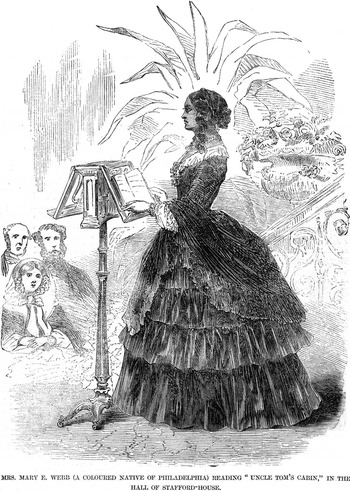
In the summer of 1856, with Stowe's help, Webb successfully took her dramatic reading to Britain. There, as the Illustrated London News reported on 2 August 1856, Mary Webb's dramatic reading at the duchess of Sutherland's Stafford House mansion was “listened to with the most respectful attention by no inconsiderable number of the aristocracy of England.”Footnote 70 Accompanying this claim was an illustration of Webb standing at a lectern in the home of the duchess, her long dark curls framing her face (Fig. 4). As with the frontispiece drawing of William Wells Brown, illustrations in the press of the young girls freed at Plymouth Church, and widely reprinted images of Ellen Craft in male garb, such pictorial representations of racially ambiguous persons served the purpose of demonstrating to largely white readers and viewers how “white-appearing” legally “black” persons might be. They also offered what P. Gabrielle Foreman has called “an iconographic attempt” to provide a “visual and textual bridge of identification and empathy to white readers.”Footnote 71
“Mrs. Mary E. Webb (a coloured native of Philadelphia) reading Uncle Tom's Cabin [i.e., Stowe's adaptation, The Christian Slave], in the hall of Stafford House,” on 2 August 1856, Illustrated London News. Division of Rare and Manuscript Collections, Cornell University Library.

In Britain, the Illustrated London News expressed the “astonishment” that Webb's elocutionary performance and her appreciative reception by privileged white spectators would have engendered in “any gentleman of the Southern states of America.” But conflating an account of Webb's bourgeois demeanor with her perceived hybrid identity and contrasting both with negative qualities associated with blackness, the Illustrated London News baldly asserted to British readers that “Mrs. Webb is not a ‘nigger,’” as though it were acceptable to so delineate any person of color. Instead of refuting prejudice against a person of color, this racist claim in fact reinforced it. Furthermore, by way of explanation, the paper attributed both Webb's respectability and attractiveness to her white Spanish father. Assuring readers that Webb was “the daughter indeed of a woman of full African blood; but her father was European,” the newspaper pronounced that “Her colour is a rich olive” and designated her features “remarkably delicate and expressive.”Footnote 72 Descriptions such as this, while perhaps initially seeming complimentary, highlight physical details that serve to “mirror the bodily attention paid to persons as property” in advertisements for runaway slaves and, by inference, connected Webb with her mother's former enslaved status.Footnote 73
In keeping with the ocular and locational politics of the day, Webb's mixed-race body was also “read” by her British spectators in dialogue with the literary text on which her performance drew—Uncle Tom's Cabin—and the privileged venue in which the performance was staged—the splendid private mansion of a noblewoman known to be sympathetic to the antislavery cause. Of Webb's vocal abilities and appropriate “lady”-like reserve, the Illustrated London News observed: “With very little gesticulation, and simply by judicious modulations of the voice, combined with earnest and effective delivery, she gave great effect to the last dark, powerful scenes of the drama.”Footnote 74
Of course, despite claims that dramatic readings were not theatrical, the public recitation of literature was a performative act. Even more than acting in a full dramatic production, where an actor performed one particular role, solo readings of novels and plays allowed performers the opportunity to demonstrate their virtuosity. At the height of the popularity of the elocutionary movement, Jean Jewel Hotchkiss claimed that skillful dramatic reading “requires, first, a knowledge and appreciation of English literature[,] . . . secondly, the aesthetic sense, which is the soul of elocution and includes imagination and temperament, and finally, the technique of characterization and voice placing developed into a fine art.”Footnote 75
Apparently Webb was able to master all of these bourgeois markers of interpretative artistry. As was the case with Webb's voice, her middle-class appearance and demeanor continued to be cited as evidence of her performative virtuosity. But the fact that hers were the voice and body through whom audiences were introduced to the plight of the enslaved characters in Stowe's novel merits further examination. As we have seen, along with the praise Webb received for her interpretation of Stowe's text, both Webb's respectability and her attractiveness were described in terms of European measures of beauty. This attribution of Webb's “good taste” and her “surprising talent” to her mixed parentage serves to illustrate how Webb's performance of middle-class decorousness on and off the readers' platform could be considered a form of “whiteface minstrelsy,” what Marvin McAllister has described as an “extratheatrical, social performance … in which people of African descent assume ‘white-identified’ gestures, dialects, physiognomy, dress or social entitlements.”Footnote 76
However, as much as Webb, as a racially ambiguous woman of color, was lauded for her performances of bourgeois whiteness, those performances could also serve to critique white privilege rather than merely reenacting it. McAllister claims that “whiteface is a mimetic but implicitly political form that not only masters but critiques constructed versions of whiteness. Attuned to class as much as race, these acts tend to co-opt prestigious or elite representations of whiteness.”Footnote 77 Webb's mastery of a multitude of roles of variously raced characters highlighted the performativity rather than the essentialism of race, as all were seen through her voice and her body.
At the time of Webb's readings, blackface minstrelsy—the performance of stereotypes of blackness by white men who “blacked up” their faces with burnt cork—was among the most popular forms of urban culture in the United States and was also popular throughout Britain. Certainly, as Dwight Conquergood has asserted, elocutionary performances such as those of Mary Webb formed a counterpoint to the minstrelized performances of artificial blackness that were so popular at the time. As Conquergood notes, when Webb performed the twenty-seven characters in Uncle Tom's Cabin, “refracted through [her] cultivated voice but racially marked body,” spectators could attend to the “discreetly channeled thrill of cross-racial impersonation, imposture, and gender play that energized [her] elocutionary readings.”Footnote 78 By way of example, in the Illustrated London News review, Webb's interpretation of the character of “Tom” was highly praised for her vocalization in what the critic took to be “the hoarse Negro voice” as she conveyed “the solemn tones” of “Tom.” The newspaper also lauded Webb's display of “the piety, the resignation, the humility, and, at the same time, the confidence of Tom's character,” asserting that Webb's utterance of what the critic called “the peculiar negro intonation,” with its “mixture of solemnity and pathos,” was particularly moving.Footnote 79
In theatrical dramatizations of Stowe's novel, as in most theatrical productions at the time, white male actors in blackface generally performed black male characters such as Tom. But Webb's venue and performance modality made other interpretations possible, as did the particular script Stowe prepared. In Stowe's scripting of The Christian Slave there are eighteen black characters—ten of them women—and nine white characters. Although Tom is the central figure and the title subject, some of the female characters, such as Cassy, also take center stage. For example, whereas Cassy is a small but pivotal character in the novel, in The Christian Slave she has a four-page soliloquy, the longest in the dramatic adaptation.
Performing males as well as females, giving voice to free and enslaved, black as well as white characters, Webb's elocutionary readings of The Christian Slave can be considered a “counterperformance to minstrelsy.” Conquergood suggests that “the shadow of minstrelsy” intensified “the interplay of pleasure and subversion that simultaneously consolidated and unsettled the norms of elocution underpinning Webb's readings.”Footnote 80 But Webb's performance did more than minstrelize whiteness. As spectators witnessed a racially ambiguous black woman interpreting Stowe's text, they also encountered a new, “noncanonical surrogation” of the original novel. Webb's physical presence replaced Stowe's omniscient white narrative voice. As Letostak has asserted, “The reconstruction of narrative voice through the physicality of Webb privileges black women, and unlike the originary text, memorializes African American agency.”Footnote 81 Webb's ability to perform a range of raced and gendered characteristics called into question the notion of their immutable, essential qualities.
It is tempting to speculate about what privileged white spectators at the Duchess of Sutherland's mansion both heard and saw in Webb's dramatic reading and how their reception of her performance complicated current perceptions about race and hybridity. Webb's ability to produce a remarkable range of vocal effects—literally to speak in multiple and diverse voices—from the divergent positionalities of black, white, and mixed-race male and female characters both contributed to her success and complicated and undermined beliefs in binary racialism—beliefs that posited human groups as discrete entities whose physical characteristics were markers of fixed and unalterable inner intellectual, moral, or temperamental qualities.Footnote 82 Moreover, Webb's vocal skill was reinforced by the specific spatial constructs and ways of seeing implicit in the privileged setting of the dramatic reading platform, in this case, one placed at “the foot of the staircase which span[ned] the magnificent entrance hall of the Duke of Sutherland's mansion.”Footnote 83 This constituted a unique venue that, despite its emphasis on orality, served to spectacularize Webb's hybrid racial performance and, through her, provided agency to black voices.
Epilogue. Hybrid Zones: The Crystal Palace, Plymouth Church, and the Elocutionists' Platform as Theatricalized Spaces
Space is both literal and metaphorical. Every ideological position is always a view from somewhere, “rooted in some position in social space.”Footnote 84 Exhibition halls, places of worship, and the dramatic reading platform are all relational, dynamic spaces within which particular encounters with the visual iconography of hybrid bodies were staged. Dramaturgical and performative concerns figured significantly in the three “acts” I have discussed above: in Brown's staging of the Crystal Palace performance; in Beecher's efforts to shape his church to suit his mock auctions of fugitive girls; and in the lecture halls and lyceums of Mary Webb's dramatic readings. In each space, primarily white spectators encountered the bodies of mixed-race persons—often unexpectedly—and were enjoined to adjust their ways of seeing accordingly.
Audiences' responses are constituted in and shaped by specific spatialized contexts and the modes of spectating and surveillance expected within those frames. In the public spaces I have explored, socioeconomic class–inflected notions of gender performance often were imbricated with beliefs about race in the qualities spectators attributed to both mixed-race persons (particularly women) and the “respectable” public spaces they were seen to inhabit. Inevitably, in public settings such as these, the parts racially indeterminate women played were potentially heightened by the frisson of racial “amalgamation” and the potential of “passing through” juridical categories of race. The bodily testimony of mixed-race women gave lie to the fallacious racist claim that interracial sex was inherently “unnatural” and that the offspring of mixed parentage would thus be both monstrous and sterile. The very bodies of such women refuted such claims.
Whether born of the rape of enslaved women of color by white men who owned them or, in much rarer cases, by the mutual desire of partners of different races, the visible presence of multiracial subjects served as implicit testimony of both the threat and the presence of an erotics of interracial desire that complicated some spectators' responses to enslavement. As Tavia Nyong'o has asserted, “hybridity haunts the dreams of racial purity.”Footnote 85 Thus, given the colorism that afforded relative privilege to light-complected persons of color, it is important to observe that once she was free, Ellen Craft, like Mary Webb, chose not to pass as white but instead to align with other persons of color to combat slavery, and both women selected as their husbands and life partners black men who were darker than themselves. P. Gabrielle Foreman describes this as a form of “race loyalty” and notes that when ambiguous-appearing black women such as Ellen Craft were seen with their black husbands, they risked being read as interracial couples and were subject to the threats, fears, and voyeuristic desires such couplings provoked for some white spectators.Footnote 86
Although the principal members of the “casts” of the three “acts” I have explored were persons of color born in the United States during the period of slavery, two of these performance interventions were staged in transatlantic settings. As we have seen, in the mid-nineteenth century after the passage of the inherently spatial Fugitive Slave Act in 1850, as the United States was being torn apart over slavery, some formerly enslaved persons traveled through spaces of enslavement into freedom in Britain—where slavery had been abolished decades earlier—and appealed to the British public to support the antislavery cause. Performative interventions and dramatic readings in which mixed-race black Americans staged their hybrid identities for British audiences had national consequences, since they called into question the ideological and spatial dimensions of “liberty” and “emancipation” and unmoored the identity category of “Americanness” from its geographic locale.
When racially indeterminate, formerly enslaved persons (such as Ellen Craft, William Wells Brown, or “Pinky” and the other girls auctioned at Plymouth Church) or free, mixed-race women (such as Mary Webb) appeared before and appealed to white audiences on either continent to abolish slavery, they mobilized the apparent contradictions of their hybrid identities to “unsettle the representational and political machinery of a dominant culture.”Footnote 87 But such unsettling did not diminish white privilege, even if it held a magnifying glass up to one of the most pernicious aspects of slavery: the sexual violence endured by enslaved black women. An individual's embodied presence in social space had a material effect, influencing not only what one saw but also potentially influencing how spectators might come to see and think about others and themselves. Thus, although these three sites generally reinforced and instantiated largely hegemonic white, bourgeois surveillant modes and the social norms upon which they were based, on occasion, when deployed by social actors committed to transforming racial inequities, such spaces could and did serve as unique sites of political and social transgression, making mixed-race bodies visible in order to further the antislavery cause.