In an earlier paper published in the Dissecting Bioethics section of the Cambridge Quarterly of Healthcare Ethics, Anna Smajdor suggested that instead of putting the burden on women to have children at times that suit societal rather than women's individual interests, society could advance “technical alternatives,” such as artificial wombs.Footnote 1 Borrowing from John Rawls’ “veil of ignorance,” Smajdor, in her article, challenges her readers with this question:
You, the reader, from behind the veil of ignorance are asked whether you would prefer to be born into society A, where women bear all the risks and burdens of gestation and childbirth, as they do now, or society B, where ectogenesis has been perfected and is routinely used. You do not know whether you will be born as a man or a woman. Which would you choose?Footnote 2
This paper follows this discussion. Ectogenesis—a child brought to term outside a biological womb, is not a novel idea: Since the birth of Louise Brown in 1978, the first “test-tube baby” that was born with the aid of IVF, ectogenesis has been addressed in scientific–philosophical writing,Footnote 3 as well as in science fiction and the popular media. Smajdor's proposal, however, is not just “another” science-fiction-related philosophical exercise. As one of the authors of this paper has suggested elsewhere,Footnote 4 the artificial womb (AW) might become a reality sooner than we may think; present developments in different areas of medical and scientific research (such as neonatal care, assisted reproduction, embryology, fetal surgery, computer science, and the human genome project) are converging to this end. Society is also pressing toward this end, because, at large, it aims at saving premature newborns and (rightly so) demands better outcomes in IVF. Because of this pressure, both sides of the gestation process, its beginning and its end (conception and birth) are presently experiencing a massive research effort. Although today there is still a huge gap between the first stages of gestation (by IVF) and the 22nd week of gestation (inside the womb), plausibly, this gap will be eventually overcome.
The advent of the AW, however, is not welcomed. Most countries ban research on human embryos beyond day 14. Canada has explicitly prohibited any research designed to add to the knowledge of ectogenesis.Footnote 5 Still, becaue prematurely born babies spend less time in a woman's womb, the question of why and for how long an embryo "should" be required to be in a woman's womb (9 months? 6? 5? 2 days?) cannot be easily answered.
Ectogenesis, if proved one day to be safe, might be a solution to avoid the need of a surrogate for women who want a baby but lack a womb (for any reason) and possibly for homosexual male couples. It might also appeal to women who may need IVF to reproduce; women may save time, pain, depression, and endless frustration (when embryos fail to implant, for instance). Generally, the AW may prevent damage to women's health because it may avoid short- and/or long-term negative effects during (or after) a pregnancy.Footnote 6 Remarkably, although without medical care a pregnancy can be deadly,Footnote 7 gestation and birth are not considered an illness. Because this is a “natural” process, reproductive hazards have traditionally been viewed as women's fate and, therefore, taken for granted. Candidly, in this view, for example, Cook, Dickens, and Fathalla explain that “maternity is not a disease” but, “an essential function that women fulfill for the survival of our species.”Footnote 8
Could women get rid of this “essential” but extremely hard function? Smajdor suggests that there is a “moral imperative” for this. Following Shulamith Firestone,Footnote 9 Smajdor suggests that ectogenesis could also achieve women's equality, because a woman who wants a child might not be forced necessarily to slow down her career because of a pregnancy. Although, generally, gender inequality results mainly because of child care and a vast range of other gender-related issues, and not necessarily because of the pregnancy, its roots may be found in the fact that women (unlike men) are those who bear the child and must slow down. For some women, the option to really choose to bear the child (or not) in order to become a parent could be of value.Footnote 10
Undoubtedly, these issues are highly controversial. Moreover, the popular media has shown frightening scenarios of AWs and ectogenesis. Yet little is known about the public's actual views. This pilot study, therefore, aims at starting to fill this gap. Its purpose was to explore Israeli people's attitudes toward the advent of the AWs. We believe that awareness of people's current views could be useful for further discussion. Although ectogenesis and the artificial womb are not the same (ectogenesis is the process and the artificial womb is the tool), in this paper, these expressions will be used interchangeably.
Research Methods
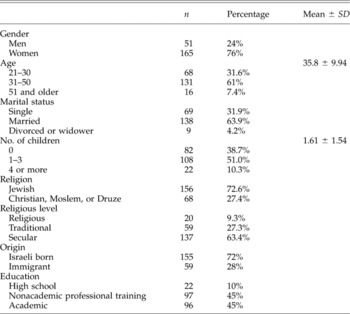
The study included 216 subjects aged over 21 who answered a structured self-report questionnaire. The questionnaire was divided into two sections: The first part addressed personal data of the respondent (such as gender, age, family status, number of children, profession). The second part targeted the views of the respondent toward the AW; this part included statements ranked on a Likert scale between 1 (strongly disagree) and 5 (strongly agree). Half of the statements were negative and the other half positive. The “position score” was calculated as the average of all the answers by the respondent (after the appropriate reversal of the scale for the negative statements). A score close to 1 determined a strong negative position of the respondent—strongly against the AW. A score near 5 expressed a positive stand—that is, strongly agree with this development. The internal consistency (Cronbach's alpha) of the position score was 0.899. The sample in this survey was obtained by a snowball method (i.e., referrals of respondents, which generated additional subjects). One obvious limitation of this way of sampling is that it may affect the representative nature of the sample. However, although not representative (there are fewer men), the sample in this study does include different sections of the Israeli population (Table 1).
Personal Characteristics of the Subjects

Table 1 shows that the percentage of women in this survey was three times higher than the percentage of men, which may suggest that men might be less responsive to this questionnaire than women. The majority of the respondents in this survey were aged 31–51, but nearly a third of the sample were younger than 31; the sample included also a smaller proportion of people older than 51. Most subjects were married, but nearly a third were single and few were divorced or widowed. The majority of respondents had one to three children; a small proportion had more than four children and a third had none. Most of the subjects in this study were Jews, but there was a good representation of non-Jews (Christians, Moslems, or Druze). Although most of the respondents were secular, there was also a good presence of the so-called traditional, and a smaller percentage were religious in various degrees. The majority was born in Israel, but there was also a fair representation of immigrants. An equal part of the respondents had either academic education or some nonacademic professional training and a smaller fraction had just 12 years of education.
Results
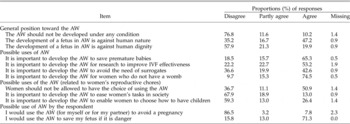
Although people's attitude toward the AW was explored through randomly ordered statements in the questionnaire, for better clarity in this report the responses were grouped in four distinctive categories. The first group contains statements reflecting a general position toward the AW. The second relates to statements about possible uses of the artificial womb. The third category includes possible uses of the artificial womb specifically related to women's reproductive chores. In addition, the questionnaire examined to what extent in two given situations the respondent would actually use the AW: to save her or his own fetus and/or to avoid a pregnancy (Table 2).
Attitudes toward the Artificial Womb (AW) (N=216)

Table 2 shows that just 10.2% of all the respondents thought that the artificial womb should not be developed under any condition; by contrast, 76.8% of all respondents were against this expression. Whereas 47.2% of all respondents agreed that the development of a fetus in AWs is against human nature, a majority of 57.9% disagreed with the phrase stating that the development of a fetus in AW is against human dignity. Sixty-five percent of all respondents agreed that it is important to develop the artificial womb to save the life of premature fetuses. Fifty-three percent agreed with the expression that it is important to develop the artificial womb for research to improve the effectiveness of IVF. Nearly 43% of the respondents agreed that it is important to develop the artificial womb to avoid the need for surrogates, and notably, a large majority of 74.5% thought that it is important to develop the AW for women who do not have a womb. The majority of respondents, 71.3%, thought they would use an AW in order to save their own fetus. Opposing this relatively large percentage of positive views toward the AW, when women's chores in reproduction were at the center of the statements, people's views became less receptive: nearly 65% of all respondents thought that women should not be given the opportunity to freely choose to use the artificial womb. Fifty-nine percent thought it is unimportant to develop the AW so women could choose the way of giving birth. Moreover, 67.9% thought it is not important to develop the artificial womb to ease women's reproductive tasks. Consistently, a large majority, 87% of the respondents, thought they would not use the AW to avoid a pregnancy. We further analyzed the link between sociodemographic conditions and people's position toward the advent of AW. An analysis of the correlation between sociodemographic background and people's views is shown in Table 3.
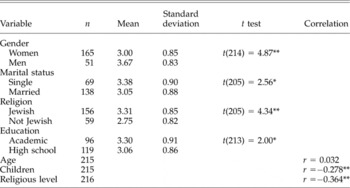
Relationship between Sociodemographic Background and Attitude toward the AW (Mean Attitude Index)

Significance level: *P < 0.05, **P < 0.001.
Table 3 shows that men and singles of both sexes had a significantly more positive approach toward the AW; there was a negative correlation between the number of children and the attitude toward the AW, that is, respondents with fewer children had more positive attitudes to this development. Jewish respondents were significantly more positive toward the development of the AW than non-Jewish respondents. There was also a negative correlation between the level of reported religiosity and the acceptances of AW, that is, secular people were more positive toward the artificial womb. Finally, there was a significant difference between the mean attitudes toward the AW according to educational level; that is, respondents holding an academic degree were more positive to this development.
Discussion
The present study echoes Smajdor's hypothetical question in the introduction of this paper. Yet, contrary to her implicit hope that people would choose to be born into society B (where ectogenesis has been perfected and is routinely used), the large majority of people in this survey chose society A (where women bear all the risks and burdens of gestation and childbirth).Footnote 11 Moreover, in this study, more women than men preferred to bear all the risks and burdens of gestation and childbirth traditionally associated with womanhood.
Nevertheless, the present study suggests that people's attitude toward AWs might not be as negative as could be expected. Although people in this survey were markedly against using AW for ectogenesis, the majority did not think that the artificial womb should not be developed under any circumstance. Most of the respondents agreed that the AW is not natural to human beings; however, a large proportion of the respondents disagreed with the expression that the AW is against human dignity. Remarkably, three out of four people in this survey found acceptable the idea that AWs could resolve the problem of childlessness for women who do not have a womb. Respondents attributed significant value to the development of AW to save the lives of premature fetuses (and for IVF research). Most tellingly, perhaps, the majority of people in this survey thought that they would use AWs to save the life of their own fetus, if it happened to be in danger. This position reflects the actual societal pressure toward the development of the AW.
Sharply contrasting with this view, however, when the idea of easing women's “natural” roles in reproduction was at the center of the statements, the AW became unacceptable. The majority of the respondents disagreed with the idea that it may be important to develop AWs to give women another option for having children and with the notion that women could be allowed to freely choose AWs. Most people also did not accept the statement that it is important to develop AWs to make women's lives easier. In short, neither the reduction of women's reproductive chores nor women's option to have such a real choice on reproductive matters was at the center of people's acceptance of AWs. Consistently, most people in this survey thought they would not use an AW to avoid a pregnancy.
Notably, the mean attitude of men in this survey was significantly more positive toward AWs (although the number of men in this study was smaller). Analysis of gendered positions revealed that the percentage of women who approved the idea that women's reproductive chores could be alleviated by AWs was lower than the percentage of men. The fact that women were significantly less receptive of AWs in this study is hardly surprising, because, in Israel (because of religious and demographic reasons), there is a strong societal conditioning of girls toward motherhood. Israeli girls (regardless of religion) learn from early childhood that infertility is a curse.Footnote 12 Even secular, well-educated, and wealthy women in Israeli society believe that having children is their duty.Footnote 13 Correspondingly, the majority of the women in this survey agreed with the statement that pregnancy and birth are key experiences for a woman. However, this endorsement of womanhood was negatively correlated with age. Thus, older women disagreed more with this statement, which suggests that life experience, beyond the reproductive years, is significant in women's perspective over womanhood. Although most people in this survey were against using AWs to avoid a pregnancy, there was, nevertheless, a positive correlation between the general attitude toward the development of AWs and the level of secularity and education of the respondent. Thus, in this study, secular and well-educated people were more receptive of AWs. This suggests, perhaps, that positive developments in this technology could add to people's receptiveness of AW in Israel.
Concluding Remarks
Although it is difficult to predict how people will actually react when AW technology becomes fully developed and safe (there was a strong aversion toward the idea of creating a child using IVF until the first “IVF baby” was successfully born;Footnote 14 today there are three million “IVF children”Footnote 15), acknowledging people's views on this complex topic remains of key importance. Peter Singer, for instance, suggested that AWs could resolve the outcry against abortions (i.e., aborted fetuses could continue their lives in AWs).Footnote 16 Contrary to Singer's thoughts, however, a study targeting women who actually had abortions revealed that women who may wish to terminate a pregnancy would not necessarily want to keep their aborted fetuses alive.Footnote 17
Smajdor's idea of developing AWs to ease women's reproductive chores was not exactly popular among the respondents of this survey, as just a small fraction were willing to use an AW to avoid a pregnancy. However, this could amount to a significant number of people in the larger population. Moreover, most people in this survey were favorable to using AWs to treat reproductive trouble, which suggests that AWs, when and if proved safe, could in the future become acceptable as another way of making babies.
The present study suggests that additional research addressing the population's views (in Israel and in other parts of the globe) on this topic is essential. We believe that additional study, in-depth analysis, and a broader discussion on the advent of AWs is necessary in order to develop appropriate legislation.