Introduction
Bitter gourd (Momordica charantia L.) is an important market vegetable in South, East and Southeast Asia where it is grown on areas of approximately 340,000 ha annually (McCreight et al., Reference McCreight, Staub, Wehner and Dhillon2013). The crop is grown in some African countries such as Ghana, Zambia, Congo and Madagascar for local consumption or for export to Europe and the Middle East to meet the fresh fruit market demand by expatriate Asian communities. Bitter gourd is also cultivated on a smaller scale in the southern USA and parts of Australia (Morgan and Midmore, Reference Morgan and Midmore2002).
Bitter gourd is a common folk medicine in South and Southeast Asia for the treatment of type 2 diabetes (Cefalu et al., Reference Cefalu, Ye and Wang2008). Type 2 diabetes is a rapidly spreading non-communicable disease that affects 347 million people worldwide, with 80% living in low-income and middle-income countries (WHO, 2015). Bitter gourd fruit contains compounds that have the potential to improve insulin sensitivity, lower blood glucose and help regulate postprandial/intestinal glucose uptake (Krawinkel and Keding, Reference Krawinkel and Keding2006). Fibre (Uebanso et al., Reference Uebanso, Arai, Taketani, Fukaya, Yamamoto, Mizuno, Uryu, Hada and Takeda2007), an insulin-like protein (Khanna et al., Reference Khanna, Jain, Panagariya and Dixit1981), saponins (Oishi et al., Reference Oishi, Sakamoto, Udagawa, Taniguchi, Kobayashi-Hattori, Ozawa and Takita2007; Klomann et al., Reference Klomann, Mueller, Pallauf and Krawinkel2010), triterpenes (Tan et al., Reference Tan, Ye, Turne, Hohnen-Behrens, Ke, Tang, Chen, Weiss, Gesing, Rowland, James and Ye2008) and lipids (Klomann et al., Reference Klomann, Mueller, Pallauf and Krawinkel2010) in bitter gourd fruit have been linked to antidiabetic effects.
Bitter gourd fruit also contains some essential micronutrients such as β-carotene, folic acid, ascorbic acid, iron and potassium (Yuwai et al., Reference Yuwai, Rao, Kaluwin, Jones and Rivett1991). In addition, β-carotene and other carotenoids such as lutein, folic acid, ascorbic acid and vitamin E are also powerful antioxidants that play an important role in preventing chronic diseases such as cardiovascular diseases, diabetes and related complications (Dakhale et al., Reference Dakhale, Chaudhari and Shrivastava2011; Park and Lim, Reference Park and Lim2011; Riccioni et al., Reference Riccioni, D'Orazio, Salvatore, Franceschelli, Pesce and Speranza2012). Hydro- and lipophilic bitter gourd extracts have been shown to have antioxidative effects in the skeletal muscle and adipose tissue of insulin-resistant mice (Klomann et al., Reference Klomann, Mueller, Pallauf and Krawinkel2010) as well as in the plasma and pancreas tissue of type 1 diabetic rats (Sathishsekar and Subramanian, Reference Sathishsekar and Subramanian2005). A study with STZ-induced diabetic mice showed that supplementation of their diet with ascorbic acid and vitamin E reduced blood glucose levels and oxidative stress, and ameliorated wound healing, a serious diabetic complication (Park and Lim, Reference Park and Lim2011).
Cultivated bitter gourd is segmented into about 20 market types based on fruit traits (colour, shape, skin pattern and size). However, there is little information on phytonutrient variation among varieties of different market types (Dey et al., 2005–Reference Dey, Behera and Kaur2006). Similarly, there is insufficient information on the relationship between bitter gourd fruit harvest stage and phytonutrient contents. The identification of bitter gourd lines rich in phytonutrients and the determination of the optimal fruit harvest stage to measure phytonutrient contents is vital for varietal development programmes aiming to breed phytonutrient-enriched bitter gourd varieties. The objectives of this study were to (1) assess genetic diversity in bitter gourd fruit flesh (without seeds) for phytonutrient contents and fruit traits, (2) assess the association between fruit traits and phytonutrients and (3) evaluate the effect of the fruit harvest stage on phytonutrient contents.
Materials and methods
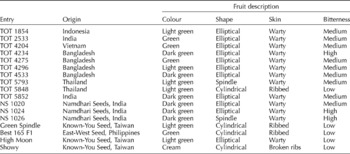
We included a total of 17 bitter gourd entries for the study (Table 1). Of these, ten were bitter gourd accessions originated from five countries and accession sampling was based on previous molecular diversity studies (C. A. Liu, unpublished results) and seven were popular commercial F1 hybrid varieties representing a range of fruit shapes, colours and sizes.
Origin and fruit traits of bitter gourd entries evaluated for phytonutrients and horticultural traits at AVRDC–The World Vegetable Center, Taiwan

Field trials
The selected entries were grown for 2 years in the fields of AVRDC–The World Vegetable Center in Taiwan from March 2008 to July 2008 (year 1) and from April 2009 to July 2009 (year 2). In each trial, the experimental unit was a 10 m × 22 m raised bed with 90 plants per bed. Each bed included two rows of 45 plants spaced 1.5 and 0.45 m between and within rows, respectively. The entries were replicated four times and arranged in a randomized complete block. The plants were staked. The fruit of the four middle plants of all plots were evaluated on the same day for weight, length, width, wall thickness and bitterness. Five fruits that attained marketable fruit size were selected from the plants of each entry in each of the four replications to measure weight, length, width, skin thickness and bitterness. Marketable fruit size refers to the physiologically immature fruit that has a fresh bright appearance and the immature seed coat is creamy white. Mature fruits have yellow flesh with red seed coats. Fruit bitterness of each sample was evaluated by a five-person taste panel who classified bitterness as low, medium and high (Dhillon and Phethin, Reference Dhillon, Phethin, Sari, Solmaz and Aras2012). Mouth-rinsing with water was done after each taste test.
Four plants were randomly sampled from the harvest rows of each plot of two replications for dry matter measurement and analysis of phytonutrients including carotenoids (violaxanthin, neoxanthin, lutein, α-carotene and β-carotene), ascorbic acid and tocopherols (α-tocopherol, δ-tocopherol and γ-tocopherol). Fruit were sampled for analysis at 14 days after fruit set (DAFS) when bitter gourd fruit reached commercial marketable maturity. To assess the effect of the fruit harvest stage on phytonutrient contents, fruit of entries TOT 5848, NS 1024 and ‘Best 165 F1’ were sampled at 12, 16 and 20 DAFS from the same two replications each year.
Sample preparation
At least 2 kg and at least six pieces of bitter gourd fruit were harvested for each sample. Fruit samples were sent to AVRDC's nutrition laboratory within 2 h of harvest. Fruits were cleaned to remove dust and washed with water when necessary. Seeds were removed because most consumers prepare the fruit without seeds. Flesh (with peel) was cut into pieces approximately 3 cm × 1.5 cm in size and mixed thoroughly. A sample of about 500 g was weighed and placed in a − 20°C freezer for 4 h, and then subjected to freeze-drying in a vacuum dryer (Virtis, New York, USA) for 36–72 h for subsequent analyses of carotenoids and tocopherols. The remaining part of the cut fresh sample was taken and chopped into pieces of 1 cm × 0.5 cm and mixed thoroughly. Then, 20 g of the sample were weighed, placed in zip-lock plastic bags and stored at − 70°C for subsequent analyses of ascorbic acid within 1 week. The freeze-dried samples were ground into a fine powder using a mill and stored at − 20°C until analysed within 2 weeks. Moisture content of the freeze-dried sample was determined by oven drying at 135°C for 2 h. Content values for all the measurements are expressed based on 100 g fresh weight of bitter gourd fruit flesh with peel but without seeds.
Ascorbic acid
The determination of ascorbic acid was on the basis of coupling 2,4-dinitrophenylhydrazine with the ketonic groups of dehydroascorbic acid through the oxidation of ascorbic acid by 2,6-dichlorophenol-indophenol sodium salt dihydrate (103028 Merck, Germany) to form a yellow-orange colour in acidic conditions (Pelletier, Reference Pelletier, Augustin, Klein, Becker and Venugopal1985). The detailed method has been described in our previous work (Hanson et al., Reference Hanson, Yang, Lin, Tsou, Lee, Wu, Shieh, Gniffke and Ledesma2004a, Reference Krawinkel and Kedingb; Hanson et al., Reference Hanson, Yang, Chang, Ledesma and Ledesma2011).
Carotenoids
The primary carotenoids in vegetables with green colour are neoxanthin, (all-E)-violaxanthin, (all-E)-lutein and (all-E)-β-carotene (Minguez-Mosquera et al., Reference Minguez-Mosquera, Gandul-Rojas, Montano-Asquerino and Garrido-Fernandes1991; Larsen and Christensen, Reference Larsen and Christensen2005). Commercial carotenoids including β-carotene (CAS No. 7235-40-7, 95%, HPLC; Sigma, Saint Louis, MO, USA), lutein (CAS No 127-40-2, 90%, HPLC; Sigma), neoxanthin (65%, TLC purified; Extrasynthase, Genay, France), violaxanthin (81%, TLC purified; Extrasynthase) were purchased and used for identification and quantification. According to preliminary tests, saponification was not necessary for carotenoid analyses of bitter gourd flesh. Before sample analysis by HPLC, the method was tested for (1) reproducibility with at least three injections per sample for at least two to three vegetable types and (2) the recovery of the carotenoids by spiked vegetable samples with carotenoid standards in appropriate concentrations. The vegetable samples used for the recovery tests included the inner leaves of white Chinese cabbage without detectable carotenoids at a wavelength of 450 nm. Carotenoid extraction and separation were performed following the procedure described in our previous work (Hanson et al., Reference Hanson, Yang, Chang, Ledesma and Ledesma2011). Briefly, about 200 mg of freeze-dried fine powder were rinsed in 0.8 ml of distilled water followed by 9.2 ml acetone. The extract was evaporated under a nitrogen air flow and re-dissolved in 2 ml of 1% tetrahydrofuran (THF; Merck) in methanol (LC grade; Merck). Separation and identification of the carotenoids were performed using a HPLC system (Waters 2695, Milford, MA, USA) equipped with an auto-sampler, a photodiode array detector (Waters 996) monitoring at 210–700 nm, Millennium software and a C30 column (YMC Carotenoid, 3.0 μm, 4.6 mm × 250 mm; YMC, Kyoto, Japan). The running conditions were set at 30°C using a gradient at 1.3 ml/min from 0–1% THF in methanol for 0–15 min, 1–25% THF in methanol for 15–25 min, 25–70% THF in methanol for 25–50 min, and the final 100% THF for 50–60 min. Identification of sample carotenoids was performed by comparing retention time and light absorption spectra (350–700 nm) of known standards, and co-elution of spiked known standards to the samples. The peak areas were calibrated against the known amounts of the standards. The purity of the commercial standards was taken into account for quantification. The concentration of carotenoid standards was measured according to their optical density reading and specific extinction coefficient (E1%1 cm) in respective solvents (Simpson et al., Reference Simpson, Tsou, Chichester, Augustin, Klein, Becker and Venugopal1985).
Tocopherols
Extraction and saponification procedures were followed as reported earlier (Osuna-Garcia et al., Reference Osuna-Garcia, Wall and Waddell1998) with modification in our previous work (Hanson et al., Reference Hanson, Yang, Lin, Tsou, Lee, Wu, Shieh, Gniffke and Ledesma2004a). Separation and quantification were performed using the HPLC system (Waters 2695) as described above. A 250 × 2 mm Phenomenex Prodigy ODS-2 column (5 μm in particle size) was used under isocratic conditions at ambient temperatures. The mobile phase was acetonitrile–methanol (85:15, v/v) at a flow rate 0.4 ml/min. Commercial α-, γ- and δ-tocopherol (all HPLC grade, purity >96%, CAS No. 10 191-41-0, CAS No.54-28-4 and CAS No. 119-13-1; Sigma) were used for identification and calibrations. Three spiked samples with δ-tocopherol standard were used as a reference and for monitoring tocopherol recovery (>90%).
Total phytonutrients
The study measured the contents of carotenoids (five phytonutrients), tocopherols (four phytonutrients) and ascorbic acid. Total phytonutrient contents for each entry were calculated from the sum of the content ratio (%) of ten phytonutrients. The content ratio of each phytonutrient was calculated as the content of an entry/the group mean of all entries per year.
Statistical analyses
Data of individual traits were subjected to analysis of variance (ANOVA) for each year and across years with the SAS general linear model procedure (SAS Institute, Cary, NC, USA). Year was regarded as a random effect, entry as a fixed effect and the year × entry interaction mean square was used to test the significance of the entry mean square. Entry means were separated by the Waller–Duncan test (k= 100, which is equivalent to P= 0.05). Linear correlations were calculated between means of fruit traits and phytonutrients across years. Data of different traits for various fruit harvest stages were analysed using the PROC MIXED procedure of SAS. Phytonutrient contents are expressed on a fresh weight basis.
Results
ANOVA
The combined ANOVA revealed significant (P= 0.05) entry mean squares for carotenoids, total tocopherols, dry matter and all fruit traits (data not shown), reflecting the presence of genetic diversity among the entries selected in this study. The year mean squares were not significant for most variables, indicating that the means across the entries were similar in year 1 and year 2. Highly significant (P= 0.01) year mean squares were detected for β-carotene and fruit width. A non-significant year × entry interaction indicates that entries performed similarly relative to each other each year for a given trait; a significant year × entry interaction component results from inconsistent entry performance for a given trait between years and can arise from rank changes among entries or changes in the magnitude of differences between entry means. In this study, the year × entry interaction was not significant for most carotenoids (except α- and β-carotene), total tocopherol and most individual tocopherols (except δ-tocopherol) and dry matter. A highly significant (P= 0.01) year × entry interaction was found for ascorbic acid and most fruit traits.
Carotenoids
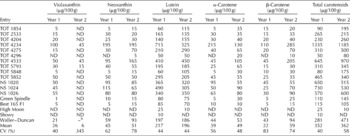
Five carotenoids including violaxanthin, neoxanthin, lutein, α- and β-carotene in bitter gourd fruit without seeds were measured (Table 2). Among the five carotenoids measured, lutein was the dominant carotenoid, making up about 61.6 and 54.1% of the total carotenoid content in year 1 and year 2, respectively. Neoxanthin constituted nearly 14% of the total carotenoid content in both the trials, followed by α- and β-carotenes with about 11–12%. The violaxanthin content of most entries was generally low or undetectable in one or both years, which may account for the large coefficient of variation in the year 2 trial when violaxanthin was detected in only three entries. Trial means for year 1 and year 2 were similar for neoxanthin, lutein, α-carotene, and total carotenoids; generally, the entries with the top five means were consistent each year. The year 2 trial mean (59 μg/100 g) for β-carotene content was almost 2.5 times greater than the year 1 trial mean (22 μg/100 g), although the five entries with the highest β-carotene content were the same in both years. It is noteworthy that entries TOT 4234 and TOT 4533 consistently produced relatively high contents of total and individual carotenoids, while carotenoids were almost absent from entries ‘Showy’ and ‘High Moon’.
Carotenoid contentsa of bitter gourd fruit evaluated in March–July 2008 (year 1) and April–July 2009 (year 2) at AVRDC–The World Vegetable Center, Taiwan

ND, not detected; CV, coefficient of variation.
a Based on fresh weight.
b Mean separations were not performed because the entry mean square from ANOVA was not significant.
Ascorbic acid
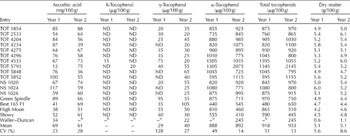
The year 1 and year 2 trial means (69 and 61 mg/100 g, respectively) for ascorbic acid were similar (Table 3). However, many entries exhibited large rank changes between years; for example, entries with the two highest ascorbic acid means in year 1 were NS 1024 and TOT 5852, but these entries were not among the top five highest entries in year 2. The ascorbic acid content of entry TOT 1854 was similar in both years (85 and 88 mg/100 g fresh weight in year 1 and year 2, respectively).
Ascorbic acid, tocopherol and dry matter contentsa of bitter gourd fruit evaluated in 2008 (year 1) and 2009 (year 2) at AVRDC–The World Vegetable Center, Taiwan

ND, not detected; CV, coefficient of variation.
a Based on fresh weight.
b Mean separations were not performed because the entry mean square from ANOVA was not significant.
Tocopherols
Three types of tocopherols (α-, γ- and δ-forms) were measured in bitter gourd fruit without seeds. δ-Tocopherol was undetectable in all but two entries in both years, and γ-tocopherol was present in most entries at least one year but at low levels. Over 95% of the total tocopherols across the entries were in the α-form (Table 3). Consequently, entries with high α-tocopherol content also had high total tocopherol contents. Year effects on total tocopherol content were less pronounced compared with ascorbic acid. Entries TOT 4533 from Bangladesh and TOT 5793 from Thailand ranked among the highest for total tocopherol contents in both years. Commercial F1 hybrid varieties from India were comparable to most germplasm entries with respect to total tocopherol contents.
Dry matter
Although entries differed significantly (P= 0.05) in dry matter content, the range of entry means across years was narrow and varied from 4.2 to 6.0% and 4.4 to 6.1% in year 1 and year 2, respectively (Table 3). The average dry matter content of the entries remained consistent between the two years.
Total phytonutrients
The total phytonutrients of an entry was calculated based on the ten phytonutrients measured from the three target groups (carotenoids, tocopherols and ascorbic acid) and expressed as the percentage of entry mean. Because the total carotenoid concentration varied most within entries each year, carotenoids tended to have a greater impact on the total concentration of the phytonutrients compared with total tocopherols or ascorbic acid. Relative to other entries, TOT 4234 and TOT 4533 consistently produced high contents of total phytonutrients in each year, while ‘High Moon’ and ‘Showy’ were consistently low in total phytonutrient contents. TOT 4234 and TOT 4533 originated from the Dhaka and Chittagong Divisions of Bangladesh, respectively, and possessed dark green fruit colour, which indicated high carotenoid content. In contrast, the commercial F1 hybrid varieties ‘High Moon’ and ‘Showy’ were light green in colour.
Fruit traits
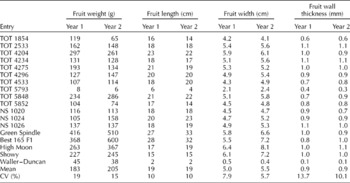
Entries varied with respect to average fruit weight, length width and wall thickness. The commercial F1 hybrid varieties ‘Best 165 F1’, ‘Green Spindle’, ‘High Moon’ and ‘Showy’ produced average fruit weights greater than 200 g. The three commercial F1 hybrid varieties from India (NS 1020, NS 1024 and NS 1026) were mid-sized, with fruit weights ranging from 105 to 158 g. Most germplasm entries (TOT prefixes) had mid-sized fruits. About a 10-fold difference in fruit weight was found among the entries. The smallest fruited entry, TOT 5793, weighed 6–8 g (Table 4).
Bitter gourd entries evaluated for fruit traits in 2008 (year 1) and 2009 (year 2) at AVRDC–The World Vegetable Center, Taiwan

CV, coefficient of variation.
Correlations
Significant negative correlations (Supplementary Table S1, available online) were detected between total tocopherol content and all fruit traits, including fruit weight (r= − 0.60, P< 0.05), length (r= − 0.58, P< 0.05), width (r= − 0.85, P< 0.01) and wall thickness (r= − 0.73, P< 0.01); this suggests a tendency for smaller fruit to have higher total tocopherol content. Although large fruit size was negatively correlated (r= − 0.60, P< 0.05) with total tocopherol content, no significant correlations between fruit weight and ascorbic acid and total carotenoids were detected in this study. As expected, larger fruit was associated with lower dry matter content.
Effect of the fruit harvest stage on nutrient content
Three bitter gourd entries (accession TOT 5848, commercial F1 hybrid varieties NS 1024, and ‘Best 165 F1’) varying in fruit weight, shape, colour, bitterness and concentrations of phytonutrients were assessed for carotenoids, ascorbic acid and total tocopherols at four fruit harvesting stages (12, 14, 16 and 20 DAFS). Analyses of variance (data not shown) revealed significant (P= 0.05) or highly significant (P= 0.01) mean squares for the entries and fruit harvest stages in year 1 for total carotenoids, ascorbic acid, total tocopherols and all fruit traits. In year 2, the mean squares for individual carotenoids and total carotenoid contents were non-significant, while highly significant (P= 0.01) mean squares were detected for total tocopherols. Significant (P= 0.05) entry × stage interactions (data not shown) were detected for some nutrients in one but not both years; a significant entry × harvest stage interaction indicated that the entries differed in their nutrient content response as the fruit harvest stage progressed.
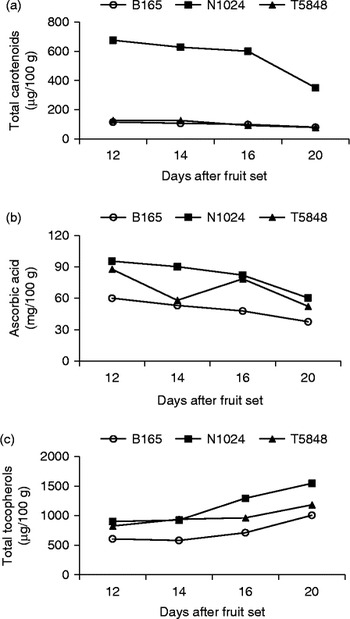
The total carotenoid content of all entries was highest at 12 DAFS (Fig. 1) and gradually declined as fruit matured. At 12 DAFS, the total carotenoid content of NS 1024 was about three times greater than the other two entries, showing a gradual decline until 16 DAFS and a drastic decrease by 20 DAFS. The total carotenoid content of the other two entries (TOT 5848 and ‘Best 165 F1’) was relatively low at 12 DAFS and gradually decreased until 20 DAFS. The ascorbic acid content of all entries was greatest at 12 DAFS and the levels gradually declined by one to one-third by 20 DAFS. In contrast to total carotenoids and ascorbic acid, the total tocopherol contents of all entries were lowest at 12 and 14 DAFS and increased from 14 to 20 DAFS.
Concentrations of total carotenoids (a), ascorbic acid (b) and total tocopherols (c) of bitter gourd fruit at four harvest stages.

Discussion
Varietal development programmes in bitter gourd have focused on traits related to agronomic importance, particularly fruit yield, because these are the traits important to growers. Demand for bitter gourd varieties with higher phytonutrient contents may increase as consumer awareness of the links between diet and health increases. Information on intraspecific genetic diversity in bitter gourd for key nutrients and the effect of seasons on phytonutrient content is of potential interest to plant breeders, nutritionists and the scientific community. In this study, we assessed 17 bitter gourd genotypes representing 12 major market types for phytonutrients and fruit traits in the same season for 2 years. Although 17 entries is a small sample to assess the genetic diversity in bitter gourd, the results can provide preliminary information on the types and ranges of phytonutrient contents found in bitter gourd.
About 75% of the total carotenoids in bitter gourd fruit (without seeds) were non-provitamin A including violaxanthin, neoxanthin and lutein. α-Carotene and β-carotene, which made up about 25% of the total carotenoids in bitter gourd fruit, are provitamin A and can be converted to retinol in the human body for vitamin A functions. The vitamin A content (μg retinol equivalents; RE) of TOT 4234, the entry with the highest content of provitamin A carotenoids in this study, was calculated to be 470 μg RE/kg fruit. The recommended daily allowance (RDA) or recommended nutrient intake of vitamin A for an adult is about 600 μg RE (WHO and FAO, 2005). Our study suggests that consumption of 100 g of fresh bitter gourd fruit of a variety relatively high in α- and β-carotene contents could meet only about 8% of the daily RDA for vitamin A. Although the provitamin A content in bitter gourd is relatively higher than common cabbage (Brassica oleracea, 26 ± 17 μg RE/kg of fresh weight) and some other commonly consumed vegetables, its vitamin A content is several times lower than vitamin A-rich vegetables such as amaranth (Amaranthus mangostanus, 3020 ± 980 μg RE/kg of fresh weight) and high-β-carotene tomato (Solanum lycopersicum, 4500 ± 700 μg RE/kg of fresh weight) (Kidmose et al., Reference Kidmose, Yang, Thilsted, Christensen and Brandt2006). It is unlikely that bitter gourd would contribute significant amounts of provitamin A to diets and breeding efforts to increase provitamin A content in bitter gourd would not be worthwhile or cost-effective. However, it is possible that large-scale screening of many bitter gourd accessions and related species might lead to identification of accessions with much higher carotenoid content than those evaluated in this study. In the meantime, our work and that of others (Dey et al., 2005–Reference Dey, Behera and Kaur2006) points to strong associations between dark green colour and high carotenoid content; selection/promotion of green-skinned varieties might be a low-cost means to select for higher carotenoid content.
Increased concentration of carotenoids, especially lycopene, has been reported in overripe yellowing bitter gourd fruit (Rodriguez et al., Reference Rodriguez, Lee and Chichester1975); however, taste and colour are not acceptable to consumers and have no market value. Lycopene and other carotenoids have been mainly found in the bitter gourd seed coat (Rodriguez et al., Reference Rodriguez, Lee and Chichester1975; Yen et al., Reference Yen, Huang and Lee1981) when the colour turns red. Lycopene has been reported as a strong antioxidant (Kelkel et al., Reference Kelkel, Shumacher, Dicato and Diederich2011) and has been discussed in prostate cancer prevention (Ilic et al., Reference Ilic, Forbes and Hassed2011). A very high carotenoid content (3200 μg/kg of whole fruit weight) in the dark green fruit of one Indian accession of bitter gourd (DBTG-8) has been reported by others (Dey et al., 2005–Reference Dey, Behera and Kaur2006). In our study, the seeds and seed coat were removed because most consumers do not eat the seeds, and thus carotenoids of seed coats were not included in our study.
There are eight naturally occurring forms of vitamin E found in plants, including four tocopherols (α-, β-, γ- and δ-forms). The most potent is α-tocopherol, which has the highest biological activity of vitamin E compared with the other forms. The main tocopherol in bitter gourd was the α-form, while γ- and δ-forms made up a small portion of the total tocopherols.
The RDA of vitamins C and E for adults is 45 and 10 mg α-TE (α-tocopherol equivalents), respectively, and consumption of 100 g fresh fruit of a bitter gourd entry high in these vitamins could meet approximately 190% of the RDA requirements for vitamin C and 17% for vitamin E. The ascorbic acid content of most entries in this study was high, although the content of some entries fluctuated between years by 2-fold or more, indicating that environmental factors affect ascorbic acid content.
Seasonal effect on total tocopherol content was less pronounced compared with ascorbic acid, and several entries such as TOT 5793 and TOT 4533 were relatively high in total tocopherol content and could be potential sources for breeding. There appears to be no association between fruit colour and tocopherol content as high tocopherol content was observed in both dark green and light green entries. High tocopherol content is associated with lower fruit weight.
The highest levels of total phytonutrients (carotenoids, tocopherols and ascorbic acid) expressed as the percentage of entry mean per year were found in accessions TOT 4234 and TOT 4533. These two entries were dark green-fruited landraces that originated from the Dhaka and Chittagong Divisions of Bangladesh and had about two to three times higher total phytonutrients than most of the high-yielding commercial F1 hybrid varieties. Yield was not measured in this study, and therefore it is not possible to make conclusions about the relationship between phytonutrient content and yield, and whether there is a trade-off between high yield and nutrient content. However, the large-fruited commercial hybrids such as ‘Showy’ and ‘High Moon’ were relatively low in total phytonutrients, suggesting a possible negative association between fruit size and phytonutrient contents. Although large fruit size was negatively correlated (r= − 0.60, P< 0.05) with total tocopherols, no significant correlations between fruit weight and ascorbic acid and total carotenoids were detected in this study. Increases in fruit weight and carotenoid and ascorbic acid contents may be possible through breeding.
Growers currently harvest bitter gourd fruit 12–20 DAFS, depending on the variety, before seeds have fully developed and the cavity turns bright red. Small-fruited varieties take fewer days to attain marketable maturity compared with very long-fruited varieties. We found that these fruit harvest stages influenced the phytonutrient content in bitter gourd. Fruit harvest at 14 compared with 20 DAFS resulted in slight or moderate reductions in ascorbic acid and carotenoid contents and increased total tocopherol content in fruits without seeds. For bitter gourd fruits with seeds, it has been reported that carotenoid contents increase substantially during the ripening process, with the fruit changing from green to yellow, and the seed cavity becoming bright red (Rodriguez et al., Reference Rodriguez, Raymundo, Lee, Simpson and Chichester1976). The appearance of red colour during ripening has been attributed to the increased concentration of lycopene, which is a non-provitamin A and a strong antioxidant carotenoid (Kelkel et al., Reference Kelkel, Shumacher, Dicato and Diederich2011). Fully ripe fruits of teasel gourd (Momordica subangulata ssp. renigera) have been found to be a rich source of lycopene (356 μg/g) for use in functional food industry (Singh et al., Reference Singh, Swain, Nisha, Shajeeda Banu, Singh and Dam Roy2015), and it may be worthwhile to survey bitter gourd fruit diversity from this angle. Given strong consumer preferences for immature bitter gourd fruit, it would be difficult to extend the harvest stage by 20 d or harvest earlier than 14 d.
Besides its use as a common vegetable, bitter gourd fruit is also consumed as a ‘functional food’. Bitter gourd is the most extensively used vegetable to manage high blood sugar of diabetes (Kole et al., Reference Kole, Olukolu, Kole and Abbott2010). Using AFLP markers, the first genetic map of bitter gourd was developed on which major fruit trait loci have been localized (Kole et al., Reference Kole, Olukolu, Kole, Rao, Bapai, Backiyarani, Singh, Elanchezhian and Abbott2012), and other researchers have shown that microsatellite markers are a powerful tool for the study of genetic diversity in bitter gourd (Wang et al., Reference Wang, Pan, Hu, Chen and Ding2010; Ji et al., Reference Ji, Luo, Hou, Wang, Zhao, Yang, Xue and Ding2012). Collectively, biochemical and genomic research will enable breeders to introgress the genes controlling phytonutrients from identified germplasm into popular bitter gourd varieties.
Supplementary material
To view supplementary material for this article, please visit http://dx.doi.org/10.1017/S147926211500057X
Acknowledgements
The authors are grateful to AVRDC–The World Vegetable Center colleagues Wan-Jen Wu and Shou Lin for sample preparation and analyses, and to the Federal Ministry for Economic Cooperation and Development, Germany for financial support.