Emotion dysregulation has been conceptualized as “a pattern of emotional experiences or expressions that is experienced either too intensely or too enduringly to be adaptive” (Beauchaine, Reference Beauchaine2015). From a neurobiological perspective, emotion dysregulation can be seen as dysfunctional patterns of bottom-up processes, such as those that subserve emotion generation, as well as top-down processes that subserve emotion regulation (Sheppes, Suri, & Gross, Reference Sheppes, Suri and Gross2015). While there has been much focus on emotion regulatory function, the experience of an emotion's intensity in response to internal and external stimuli is also a key element of understanding this process. Dysregulation of negative emotions such as fear, anxiety, sadness, and anger have been implicated in the development of later psychopathology (Beauchaine, Reference Beauchaine2001, Reference Beauchaine2015). However, there is also evidence that dysregulated positive emotions can result in impairment and psychopathology (Klein, Kotov, & Bufferd, Reference Klein, Kotov and Bufferd2011; Putnam & Stifter, Reference Putnam and Stifter2002; Rydell, Berlin, & Bohlin, Reference Rydell, Berlin and Bohlin2003). While the focus on dysregulated negative affect in the literature has led to an increasing understanding of risk for and manifestations of psychopathology, including from a young age, the role of positive affect dysregulation in psychopathology remains understudied. Here we aim to expand the study of dysregulation to assess both negatively and positivity valanced emotions in preschoolers, first utilizing exploratory factor analysis (EFA) to determine if dysregulation for positive and negative emotions are separable, and second, if separable, to look at the relationships between these different types of early dysregulation and later outcomes.
Irritability as a Paradigm of Emotion Dysregulation
The literature on emotion dysregulation and psychopathology in children has been largely focused on the study of irritability, or as Brotman, Kircanski, and Liebenluft (Reference Brotman, Kircanski and Liebenluft2017) defined it, “a low threshold for experiencing anger in response to frustration.” This focus is with good reason, as irritability specifically has been related to the concurrent diagnosis or later development of a number of psychiatric disorders, including attention-deficit/hyperactivity disorder (ADHD), oppositional defiant disorder (ODD), anxiety, and depression (Brotman, Reference Brotman, Schmajuk, Rich, Dickstein, Guyer, Costello and Leibenluft2006; Copeland, Angold, Costello, & Egger Reference Copeland, Angold, Costello and Egger2013; Copeland, Shanahan, Egger, Angold, & Costello, Reference Copeland, Shanahan, Egger, Angold and Costello2014; Dougherty et al., Reference Dougherty, Smith, Bufferd, Carlson, Stringaris, Leibenluft and Klein2014, Reference Dougherty, Smith, Bufferd, Kessel, Carlson and Klein2016; Ezpelata, Granero, de la Osa, Trepat, & Domenech, Reference Ezpeleta, Granero, de la Osa, Trepat and Domènech2016; Liebenluft, Cohen, Gorrindo, Brook, & Pine, Reference Leibenluft, Cohen, Gorrindo, Brook and Pine2006; Pagliaccio, Pine, Barch, Luby, & Liebenluft, Reference Pagliaccio, Pine, Barch, Luby and Leibenluft2018; Stringaris, Cohen, Pine, & Liebenluft, Reference Stringaris, Cohen, Pine and Leibenluft2009; Wackschlag et al., Reference Wakschlag, Estabrook, Petitclerc, Henry, Burns, Perlman and Briggs-Gowan2015; Whelan, Stringaris, Maughan, & Barker, Reference Whelan, Stringaris, Maughan and Barker2013). The presence of extreme irritability has been such a salient clinical problem that in the latest version of the DSM, disruptive mood dysregulation disorder was included to better describe children who have extremes of irritability but failed to meet criteria for other disorders in which irritability is also present (Roy, Lopes, & Klein, Reference Roy, Lopes and Klein2014).
Extreme irritability is a robust risk factor to many negative behavioral and developmental outcomes. As early as infancy, proneness to anger is linked to later development of disruptive behavior (He et al., Reference He, Degnan, McDermott, Henderson, Xu and Fox2010). Irritability in preschoolers has been linked not only to later psychiatric diagnoses as noted above but also to poor family relations, school functioning, and suicidality (Belden, Thomson, & Luby, Reference Belden, Thomson and Luby2008; Dougherty et al., Reference Dougherty, Smith, Bufferd, Carlson, Stringaris, Leibenluft and Klein2014, Reference Dougherty, Smith, Bufferd, Kessel, Carlson and Klein2016; Ezpelata et al., Reference Ezpeleta, Granero, de la Osa, Trepat and Domènech2016; Pagliaccio et al., Reference Pagliaccio, Pine, Barch, Luby and Leibenluft2018; Wakschlag et al., Reference Wakschlag, Briggs-Gowan, Carter, Hill, Danis, Keenan and Leventhal2007, Reference Wakschlag, Choi, Carter, Hullsiek, Burns, McCarthy and Briggs-Gowan2012). Irritability in older children has been linked to increased psychiatric diagnoses and disability as well as increased suicidality, substance use, risky behavior, school drop out, and poorer work performance and health outcomes (Copeland et al., Reference Copeland, Angold, Costello and Egger2013, Reference Copeland, Shanahan, Egger, Angold and Costello2014; Orri et al., Reference Orri, Galera, Turecki, Forte, Renaud, Boivin and Geoffroy2018). However, expressions of irritability are not necessarily pathologic. Irritability is common and normative during the preschool period (Belden et al., Reference Belden, Thomson and Luby2008; Wackschlag et al., Reference Wakschlag, Choi, Carter, Hullsiek, Burns, McCarthy and Briggs-Gowan2012) and then typically declines with age (Copeland, Brotman, & Costello, Reference Copeland, Brotman and Costello2015; Liebenluft et al., Reference Leibenluft, Cohen, Gorrindo, Brook and Pine2006; Wackschlag et al., Reference Wakschlag, Perlman, Blair, Leibenluft, Briggs-Gowan and Pine2018). Functionally, irritability conceptualized as a negative response to frustration can be adaptive, in that it may increase efforts to gain a desired outcome. Nonetheless, there is evidence that increased irritability, even in the normative range, is associated with an increased risk of later psychiatric problems (Copeland et al., Reference Copeland, Brotman and Costello2015; Wackschlag et al., Reference Wakschlag, Estabrook, Petitclerc, Henry, Burns, Perlman and Briggs-Gowan2015).
Dysregulation of Positive Emotions
Dysregulation of positive affect has been understudied relative to negative affect (Forbes, Reference Forbes2009; Forbes & Dahl, Reference Forbes and Dahl2005; Gilbert, Reference Gilbert2012), despite evidence that the general experience of emotion dysregulation writ large, not only the dysregulation of negative emotions, predisposes to psychopathology and impaired social functioning in adolescents (Sallquist et al., Reference Sallquist, Eisenberg, Spinrad, Reiser, Hofer, Liew and Eggum2009; Silk, Steinberg, & Morris, Reference Silk, Steinberg and Morris2003; Stringaris & Goodman, Reference Stringaris and Goodman2009), including both internalizing and externalizing disorders (Zisner & Beauchaine, Reference Zisner and Beauchaine2016). Dysregulated response to reward has also been related to ADHD (Plicta & Scheres, Reference Plichta and Scheres2014). Conceptually, one might expect to be able to dissociate dysregulation of positive and negative emotion, as neurobiologically these have been thought to be separate processes (Forbes & Dahl, Reference Forbes and Dahl2005). In the research domain criteria model, negative emotion or valence systems comprise acute, potential and sustained threat, loss, and frustrated nonreward, while positive emotion or valence systems comprise approach motivation, initial and sustained response to reward, reward learning, and habit (Cuthbert & Insel, Reference Cuthbert and Insel2013). However, dysregulation in positive and negative emotion are also likely to be correlated and may be in part subserved by overlapping neurobiological processes, given the overlapping risk for later psychopathology and potential overlap related to abnormal response to reward (Zisner & Beauchaine, Reference Zisner and Beauchaine2016).
Like negative emotions, positive emotions also have a normal developmental trajectory. Infants’ level of expressing positive and negative affect can be differentially studied as early as 4 months of age (Park, Belsky, Putnam, & Crnic, Reference Park, Belsky, Putnam and Crnic1997), and while they are correlated, they do not appear to represent a single dimension. The division between state positivity and negativity can be identified in examinations of affect and behavioral inhibition as early as 6–24 months of age (Putnam & Stifter, Reference Putnam and Stifter2002). Highly reactive infants who have a more positive than negative affect can be identified as early as 4 months of age, are referred to as “exuberant,” and display general phenotypic continuity with increased sociability and low distress at older ages (Fox, Henderson, Rubin, Calkins, & Schmidt, Reference Fox, Henderson, Rubin, Calkins and Schmidt2001). Positive expressions appear to generally increase throughout toddlerhood before reaching a point of stability in the preschool age range (Sallquist et al., Reference Sallquist, Eisenberg, Spinrad, Gartner, Eggum and Zhou2010). However, similar to other forms of emotional expression, there then appears to be a general decrease in positive affect expression throughout childhood (Sallquist et al., Reference Sallquist, Eisenberg, Spinrad, Reiser, Hofer, Liew and Eggum2009).
Positive emotion dysregulation is often studied as a “lack of positivity,” with diminished experiences of positive emotion in children being linked to depression (Forbes, Reference Forbes2009) and to a lesser degree anxiety (Kashdan, Reference Kashdan2007). Consistent with this, Silk et al. (Reference Silk, Steinberg and Morris2003) found increased levels of positive emotion in children during a reward task to be associated with a lower level of depressive symptoms. Park et al. (Reference Park, Belsky, Putnam and Crnic1997) demonstrated that high positive affect in infancy attenuated the effect of high negative affect in the development of behavioral inhibition.
Yet increased experiences of positive emotions are not uniformly adaptive, nor do they always have positive outcomes. In 6- to 12-month-old infants, high positive affect predicted externalizing symptoms at age 2 (Putnam & Stifter, Reference Putnam and Stifter2002). The frequency and intensity of positive affect in 5-year-old children, termed “exuberance emotionality,” was positively correlated with anger, negatively correlated with soothability, and predicted externalizing behaviors 18 months later (Rydell et al., Reference Rydell, Berlin and Bohlin2003). Children with higher parent-reported positive anticipation also had higher rates of aggression (Deater-Deckard et al., Reference Deater-Deckard, Beekman, Wang, Kim, Petrill, Thompson and Dethorne2010). The irritability literature also implicates dysregulation in reward systems, which have been traditionally linked to positive emotion. There have been some reports of increased activity in the striatum to reward receipt in irritable children (Deveney et al., Reference Deveney, Connolly, Haring, Bones, Reynolds, Kim and Leibenluft2013), though the opposite pattern has been seen in other studies (Perlman et al., Reference Perlman, Jones, Wakschlag, Axelson, Birmaher and Phillips2015), indicating an excessive response to reward may increase irritable behaviors or outbursts.
Early Emotion Dysregulation as a Risk for Later Childhood Affective Diagnoses
Child-onset depression is an increasingly recognized developmental diagnosis, with longitudinal continuity and considerable impairment (Gaffrey, Tillman, Barch, & Luby, Reference Gaffrey, Tillman, Barch and Luby2018; Luby, Belden, Pautsch, Si, & Spitznagel, Reference Luby, Belden, Pautsch, Si and Spitznagel2009; Luby, Gaffrey, Tillman, April, & Belden, Reference Luby, Gaffrey, Tillman, April and Belden2014; Luby, et al., Reference Luby, Heffelfinger, Mrakotsky, Brown, Hessler, Wallis and Spitznagel2003). As reviewed above, there is an extensive literature linking early emotion dysregulation to depressive disorders. Irritability is frequently seen in depressed children (Luby, Belden, Pautsch, et al., Reference Luby, Belden, Pautsch, Si and Spitznagel2009) and is a risk factor for later development of depressive disorders (Ezplata et al., Reference Ezpeleta, Granero, de la Osa, Trepat and Domènech2016; Paglioccio et al., Reference Pagliaccio, Pine, Barch, Luby and Leibenluft2018; Wackshlag et al., Reference Wakschlag, Briggs-Gowan, Carter, Hill, Danis, Keenan and Leventhal2007, Reference Wakschlag, Choi, Carter, Hullsiek, Burns, McCarthy and Briggs-Gowan2012). Dysregulated expressions of sadness and dysregulated-low expressions of positive affect are also seen early childhood depression and continue to be risk factors for later depressive episodes (Luby, Belden, Pautsch, et al., Reference Luby, Belden, Pautsch, Si and Spitznagel2009; Luby, Belden, & Spitznagel, Reference Luby, Belden and Spitznagel2006; Luby et al., Reference Luby, Heffelfinger, Mrakotsky, Brown, Hessler, Wallis and Spitznagel2003).
Childhood-onset bipolar disorder is also an increasingly recognized developmental disorder, though there continues to be considerable controversy and debate about how narrowly to define criteria for mania in prepubertal children (Goldstein et al., Reference Goldstein, Birmaher, Carlson, DelBello, Findling, Fristad and Youngstrom2017). While chronic irritability was once considered a potential presentation of childhood bipolar disorder (Biederman et al., Reference Biederman, Mick, Faraone, Spencer, Wilens and Wozniak2000), some consensus has been reached that children with bipolar disorder I and II should meet criteria similar to adults. Most investigators suggest that when irritability is being used as a central diagnostic criterion, it should wax and wane with the intensity of other manic symptoms rather than have a more chronic presentation (Goldstein et al., Reference Goldstein, Birmaher, Carlson, DelBello, Findling, Fristad and Youngstrom2017). There continues to be debate about how far to extend the “bipolar spectrum,” and whether to include children who may meet criteria for mania but for shorter than 4 days or who exhibit symptoms consistent with cyclothymia (Goldstein et al., Reference Goldstein, Birmaher, Carlson, DelBello, Findling, Fristad and Youngstrom2017). Notwithstanding these ambiguities on childhood bipolar disorder, emotion dysregulation in general, and dysregulation of positive affect in particular, are core features of this disorder.
Affective lability in general has been implicated as a risk factor in the development of bipolar disorder (Birmaher et al., Reference Birmaher, Gill, Axelson, Goldstein, Goldstein, Yu and Keller2014; Hafeman et al., Reference Hafeman, Merranko, Axelson, Goldstein, Goldstein, Monk and Birmaher2016). While a long-term follow up study showed that more than 50% of children and teens with bipolar disorder will eventually spend most of their time euthymic, increased affective lability was associated with generally worse outcomes (Birmaher et al., Reference Birmaher, Gill, Axelson, Goldstein, Goldstein, Yu and Keller2014). Further, positive emotion dysregulation has been specifically implicated in childhood bipolar disorder. Extremes of positive emotion dysregulation are diagnostic of bipolar disorder, and even in broad-spectrum characterizations of bipolar disorder 70%–90% of the children will have episodes of elated affect (Geller et al., Reference Geller, Zimmerman, Williams, Bolhofner, Craney, Delbello and Soutullo2000; Kowatch, Youngstrom, Danielyan, & Findling, Reference Kowatch, Youngstrom, Danielyan and Findling2005). Grandiosity is another more specific marker of dysregulated positive affect. While more challenging to study in early development (Youngstrom, Birmaher, & Findling, Reference Youngstrom, Birmaher and Findling2008, but see Luby et al., Reference Luby, Belden and Spitznagel2006), grandiosity is also seen in children with mania (Geller et al., Reference Geller, Zimmerman, Williams, Bolhofner, Craney, Delbello and Soutullo2000, Luby & Belden, Reference Luby and Belden2006, Kowatch et al., Reference Kowatch, Youngstrom, Danielyan and Findling2005). However, there is high comorbidity between childhood-onset bipolar disorder and other diagnoses, particularly ADHD (Geller et al., Reference Geller, Zimmerman, Williams, Bolhofner, Craney, Delbello and Soutullo2000; Kowatch et al., Reference Kowatch, Youngstrom, Danielyan and Findling2005; Luby & Belden, Reference Luby and Belden2006), and a number of the most common symptoms of mania in children including increased energy, distractibility, pressured speech, and irritability, can also occur in ADHD. This speaks to the potential for dysregulated positive affect to be a more generic potential risk factor for many later forms of psychopathology. Such findings and ambiguities also underscore the need to better identify and characterize these early manifestations of dysregulated positive affect as risk factors and diagnostic markers in early childhood using a dimensional approach to emotion dysregulation.
The Current Study
Given the importance of emotion dysregulation in psychopathology, the well-established impact of dysregulation of negative emotions and irritability on later impairment even in very young children, but the uncertain relationship between positive emotion dysregulation and later adaptive and pathological outcomes, we aimed to better understand whether positive and negative emotion dysregulation were two empirically separable dimensions in preschool children. In a sample enriched for early childhood affective psychopathology, we sought to investigate whether negative and positive affect dysregulation differentially predicted clinical outcomes or global measures of clinical severity in later childhood and adolescence. We utilized a moderately large, longitudinally studied cohort enriched for children with early childhood depression, but not specifically for emotion dysregulation (Luby et al., Reference Luby, Gaffrey, Tillman, April and Belden2014). We hypothesized that we could separately identify dysregulation in positive and negative emotion. We hypothesized that both types of dysregulation would increase risk for later clinical diagnoses and impairment, but with differential effects. Specifically, we hypothesized that positive affect dysregulation would increase risk for later bipolar disorder and ADHD, while negative affect dysregulation might increase risk for later depressive disorders and ODD. We also hypothesized that negative affect dysregulation would be more predictive of later global impairment in keeping with the extant literature on irritability.
Method
Participants
Study participants were drawn from the Preschool Depression Study, a longitudinal investigation of children enriched for those with early onset depression that has been extensively described elsewhere (Luby et al., Reference Luby, Gaffrey, Tillman, April and Belden2014). Our participants included all of those who had reliable Preschool Age Psychiatric Assessment (PAPA; Egger & Angold, Reference Egger, Angold, Delcarmen-Wiggins and Carter2004) data from the baseline visit (Time 1; T1), between ages 3 and 5 years, N = 302, 145F, 157M. These children were then assessed on a regular basis until their late teens (ages 16–19 years), including almost yearly structured interviews and behavioral questionnaires spanning a 15-year period. At the time of this analysis, children had been asked to participate in nine total annual to biannual assessments (Time 1–Time 9; T1–T9), with 291 (96%) of the 302 included children returning for at least one later assessment.
Measures
Structured diagnostic interviews
In the Preschool Depression Study, children and parents participated in structured diagnostic and developmental interviews annually with a trained clinical interviewer with good interrater reliability (Luby et al., Reference Luby, Gaffrey, Tillman, April and Belden2014). Initially the interviewers used the PAPA and converted to the Child and Adolescent Psychiatric Assessment (Angold et al., Reference Angold, Prendergast, Cox, Harrington, Simonoff and Rutter1995) when age appropriate (at age 8). Items from the structured diagnostic interview at T1 were used to characterize both the symptoms and the symptom clusters described below, and structured interviews at T1–T9 were also used to derive DSM-based diagnoses, using standard DSM-IV criteria.
Global function
The same trained interviewers who rated the diagnostic interviews also performed global ratings of impairment at T1–T9 using the Preschool and Early Childhood Functional Assessment Scale (PECFAS; Murphy et al., Reference Murphy, Pagano, Ramirez, Anaya, Nowlin and Jellinek1999) and the Childhood and Adolescent Functional Assessment Scale (CAFAS; Hodges, Reference Hodges1994), generally transitioning when participants were 7 years old. Both are interviewer-rated standardized scales that rate the day-to-day functioning of the child in multiple environments including home, school, and other public environments, as age appropriate. Total impairment scores were utilized in regression analyses. In general, the CAFAS has lower internal reliability (Cronbach's αs in the development and validation data sets varied between 0.63 and 0.68), thought due to the intended heterogeneity of the included constructs (Bates, Reference Bates2001).
IQ
IQ was assessed using either the Wechsler Abbreviated Scale of Intelligence II (Wechsler, Reference Wechsler2011) at T5 (age 8–12) or the Kaufman Brief Intelligence Test 2 (Kaufmann & Kaufmann, Reference Kaufman and Kaufman2004) at T7 (age 10–14). Later IQ measures were used given that no preschool-age IQ measures were available, and IQ is posited to be largely stable (Deary, Whalley, Lemmon, Crawford, & Starr, Reference Deary, Whalley, Lemmon, Crawford and Starr2000).
Emotion regulation
Children were assessed with a multitude of other behavioral measures at various time points. In this analysis we have focused on the Emotion Regulation Checklist (ERC; Shields & Cicchetti, Reference Shields and Cicchetti1997), a parent-report questionnaire rating emotion regulation capacity as well as emotion lability and negativity. The ERC was performed at four different times from middle childhood to late teens, and here we report data collected from ages 6 to 12 years and from 12 to 19 years of age. In initial validation studies, the emotion regulation subscale had a Cronbach's α of 0.83 and the lability/negatively subscale of 0.96 (Shields & Cicchetti, Reference Shields and Cicchetti1997).
Social adversity
A composite measure of social adversity at age 5 was a sum of yes (1)/no (0) responses to the following: living in a single-parent household, a parent having any DSM-IV axis I psychiatric diagnosis, parental arrest, history of foster care placement, physical or sexual abuse, or caregiver reporting being unable to meet the family's financial needs, computed from the time point of data collection for each child that occurred closest to age 5. A composite measure was chosen to reflect the diversity of adverse events children might experience, and to account for the potential additive effects of having multiple adverse events, which is a common finding in adults (i.e., Felitti et al., Reference Felitti, Anda, Nordenberg, Williamson, Spitz, Edwards and Marks1998).
Maternal history of depression
Maternal history of depression was assessed using the Family Interview for Genetic Studies (FIGS) and questions about current treatment. We chose to use a relatively conservative measure of maternal history, either meeting criteria for the disorder on the FIGS or being currently under treatment for depression or bipolar disorder with a mental health professional. Possible or presumed diagnoses were coded as negative.
EFA
As we aimed to determine if there was an identifiable difference between positive and negative emotion dysregulation, as well as their relationship to each other and other affective symptoms, an EFA was performed using all items from the PAPA structured clinical interview that addressed emotion dysregulation, including items from the depression, mania, and conduct modules. This allowed us to use a hypothesis-neutral approach to data reduction. We performed the EFA on all items that assessed manifestations of emotional experience and regulation from the PAPA depression and mania modules, as well as tantrum-related questions from the PAPA conduct module in order to better represent outward displays of emotion dysregulation, using data collected at baseline, when children were age 3 years 0 months through 5 years 11 months (3–5 years) old.
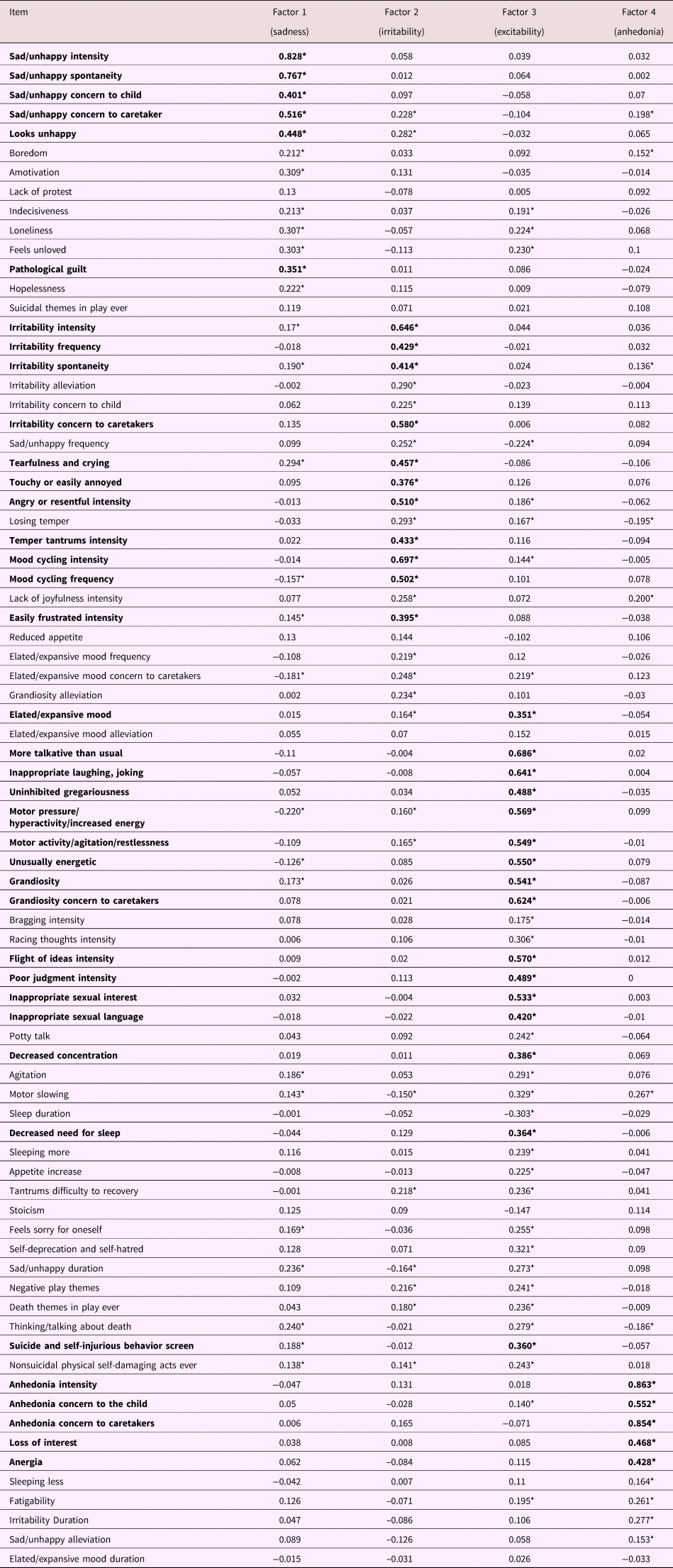
The EFA included intensity-based items and also items reflecting overall duration and frequency of affective symptoms, as frequent shifts and/or short duration may be more reflective of dysregulation or lability than more sustained shifts in affect. For the duration and frequency items, the item responses were divided into deciles and these were converted into a 0–5 rating scale with each decile reflecting 0.5 point on the scale, in order to bring the available range of responses into better alignment with the other items included. A similar method was applied to sleep duration, which was also divided into deciles and converted to a 0–5 scale. All other items were scores as indicated in the PAPA scoring manual. We then excluded 6 items with less than a 50% recorded response rate, which occurred typically due to a negative screen on a preceding question (i.e., delusional guilt was dependent on reporting guilt). Two items with a Pearson's r > .90 with another item were also excluded (spontaneity of elevated mood was correlated at .93 with intensity of elevated mood and alleviation of anhedonia was correlated at .90 with intensity of anhedonia). This resulted in 78 total items (all shown in Table 1). Responses for any of the variables were included for all 302 children with a PAPA collected at baseline (between age 3 and 5 years), making a 302 × 78 matrix, allowing for missing values.
All included Preschool Age Psychiatric Assessment items sorted and colored by assigned factor in the exploratory factor analysis

Note: Factor loadings for each factor are shown, with all significant loadings denoted with an asterisk and all loadings >.30, and thus included in the computation of factor scores, denoted with bold font.
EFA was implemented in M-plus, using standard settings and including the geomin oblique rotation due to expected correlations between factors. Missing data was accounted for using full information maximum likelihood. Inspection of the scree plot and factors resulted in choosing a four-factor model, as all factors at this point had eigenvalues >2, four factors was a noted elbow in the scree plot, and factors demonstrated face validity. Factor assignments for each item and their standardized factor loadings are shown in Table 1; correlations between all individual items can be found in the supplementary material.
Computation of factor scores
Individual factor scores were calculated for each subject at T1 baseline (age 3–5 years) using all items assigned to a factor with a standardized factor loading greater than .35. To account for missing items, data were imputed using the statistical software R (R Core Team, 2017) and the mice package (van Burren & Groothuis-Oudshoorn, Reference Van Buuren and Groothuis-Oudshoorn2011). Then, structured equation modeling, implemented in R package lavaan (Rosseel, Reference Rosseel2012), was used to calculate weighted latent factor scores from the included items for each participant. Four confirmatory factor models were created using the four-factor EFA solution established prior. Tests of internal consistency utilizing Cronbach's α, distributions of the factor scores, and correlations between the scores were calculated.
Relationships between factor scores with both baseline and outcome measures
We hypothesized that factor scores representing emotion dysregulation at baseline would be predicted by cognitive measures such as IQ, age 5 social adversity, and maternal psychiatric history of mood disorder. We conducted linear regressions, implemented in R, predicting each factor score with IQ and the composite measure of social adversity at age 5. The relationship between maternal psychiatric history and the factor scores was tested with first a simple t test to determine any differences in factor scores between those with and without a maternal history of both bipolar disorder or major depressive disorder (MDD). In situations where there was a statistical difference between groups, we tested whether this was partially explained by social adversity by performing four separate univariate regressions with the factor scores as the dependent variable, maternal history as a fixed factor, and social adversity as a covariate.
We then utilized logistic regression to determine whether each of the factors predicted later childhood diagnosis of mania, depression, or other externalizing diagnoses including ADHD, ODD, and conduct disorder (CD) at any time point after baseline, including all other factor scores, the social adversity score, and maternal history of bipolar disorder as covariates. Social adversity and maternal history of bipolar were entered due to their ability to predict one or more factor scores. Maternal history of depression and IQ were not included as covariates as they failed to predict any factor score after social adversity was included in the model. A second set of logistic regressions predicting externalizing diagnoses, including ADHD, ODD, and CD, were conducted including all factor scores, maternal history of bipolar disorder, age 5 social adversity, as well as baseline diagnosis of ADHD, ODD, or CD, respectively. Baseline diagnosis of the same disorder was included due to potential symptom overlap between items included in the factor scores and diagnostic criteria for these disorders.
For all of the analyses, participants were counted as having a later diagnosis of these disorders if they met DSM-IV criteria for the diagnosis at any subsequent structured diagnostic interview in the study (i.e., T2–T9; ages 4–6 through ages 14–19). Given that several factor scores predicted both later diagnosis of depression and mania, we separately calculated the logistic regression for predicting depression without mania (i.e., meeting criteria for MDD at any later time point, but never meeting criteria for mania). In addition, given the controversy surrounding the diagnosis of prepubertal bipolar disorder, we also separately calculated the number of subjects who continued to meet criteria for mania after age 12 (the age at which the diagnosis is more clear cut). Due to the small number of subjects who met such criteria, no further analysis was done.
Next, we performed linear regressions predicting continuous measures of emotion regulation as measured by the ERC and global functioning as measured by the PECFAS and CAFAS. We performed linear regressions predicting ERC emotion regulation and lability/negativity scales in middle childhood (ages 6–12; mean age 10 years) and in the teen years (ages 13–19; mean age 16 years) with all four factor scores, social adversity, and maternal history of bipolar disorder as predictors. A similar analysis predicting global impairment as measured by the PECFAS or CAFAS total score (as age appropriate) at each time point was conducted with all four factor scores, social adversity, and maternal history of bipolar disorder as predictors.
Results
EFA
We performed an EFA using all symptom items from the PAPA depression and mania modules, as well as dysregulation (e.g., irritability and tantrums) items from the PAPA conduct module collected at T1 in order to better represent all manifestations of dysregulated emotion, resulting in 78 total items. We included items with missing data in less than half of the subjects. In total, 17% of items were missing no data, 32% of items were missing data from less than 1% of participants, and 85% of items were missing data from less than 10% of participants, Of the remaining 12 items, 10 were missing data from less than 25% of participants, 1 from 30% (grandiosity concern to caretakers), and 1 from 47% of participants (elated/expansive mood alleviation). As above, inspection of the scree plot and factor assignments led us to choose a four-factor model. PAPA item content of each factor led to the following naming of the four factors: sadness, irritability, excitability, and anhedonia, reflecting both negative and positive emotion dysregulation. All items, their factor assignment, and loadings can be found in Table 1. Factor scores were calculated from all items with standardized loading >.35.
Characteristics of and relationships between factor scores
Factor scores had acceptable internal consistency. Cronbach's α was 0.84 for the excitability factor score, 0.84 for the irritability factor score, 0.77 for the sadness factor score, and 0.75 for the anhedonia factor score. While not fully normally distributed in our population due to the rightward skew in the excitability (2.26) and anhedonia (3.04) factor scores (which might be predicted in a community population enriched for clinical symptoms), all factor scores had a clear unimodal distribution.
There were significant correlations between factor scores, but these were not fully overlapping constructs. For example, the irritability and excitability factor scores were correlated with a Pearson's r = .60 (p < .001), which is a moderate correlation but suggests some nonoverlapping variance. Excitability was also significantly correlated with the sadness factor score (r = .30, p < .001) and anhedonia factor score (r = .40, p < .001). Irritability was also significantly correlated with sadness (r = .60, p < .001) and anhedonia (r = .45, p < .001). Sadness and anhedonia were also significantly correlated (r = .60, p < .001).
Predictors of factor scores
Social adversity
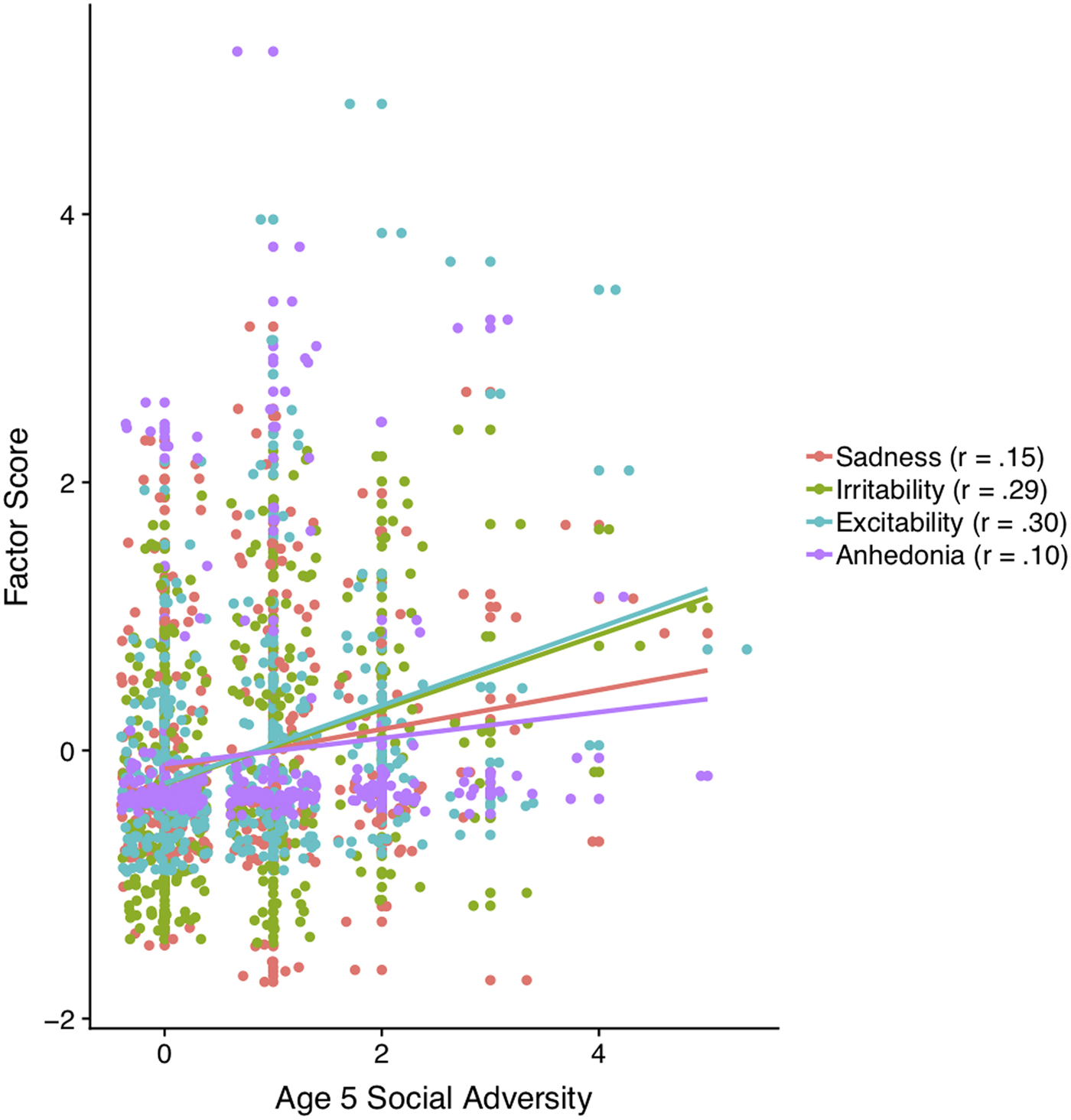
As seen in Figure 1, we found via linear regression that social adversity at age 5 significantly predicted excitability (R 2 = .08, F = 26.42, p < .001) and irritability factor scores (R 2 = .08, F = 24.71, p < .001), as well as the sadness factor score (R 2 = .02, F = 6.24, p = .013). However, social adversity at age 5 did not significantly predict the anhedonia factor score.
Factor scores are predicted by age 5 social adversity score. Scatterplots and trend lines for each factor score (on the y-axis) plotted by social adversity score (on the x-axis). Elevated affect dysregulation factor scores plotted in blue, negative affect dysregulation/irritability factor scores plotted in green, sadness factor scores plotted in red, and anhedonia factor scores plotted in purple.

Family history of mood disorders
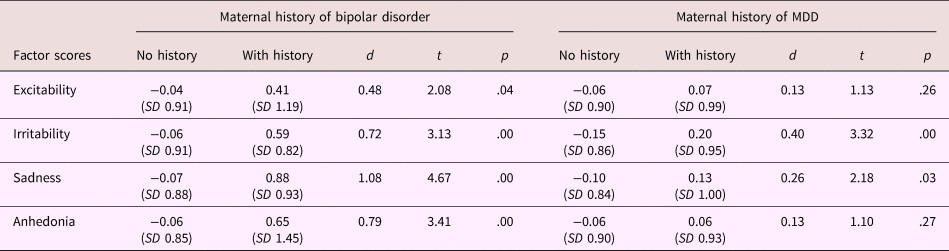
Family history of mood disorders also predicted factor scores. All factor scores were significantly higher in children with a maternal history of bipolar disorder (n = 19) relative to those without such a history (as seen in Table 2). The relationships between anhedonia and sadness factor scores and maternal history of bipolar disorder remained significant even when controlling for age 5 social adversity. In contrast, only the sadness and irritability factor scores were significantly higher when there was a maternal history of MDD (n = 101; see Table 2), and this was no longer significant when age 5 social adversity was included as a covariate.
Factor scores differ depending on maternal history of mood disorders.

Note: T tests do not control for age 5 social adversity.
IQ
While there is some evidence that IQ predicts emotion regulation, only the excitability factor score was predicted by IQ (r 2 = .04, F = 10.07, b = –0.21, p = .002), and this relationship became nonsignificant when age 5 social adversity was added to the model (b = –0.01, t = –1.67, p = .09).
Factor scores differentially predict later psychiatric diagnoses
Mood diagnoses
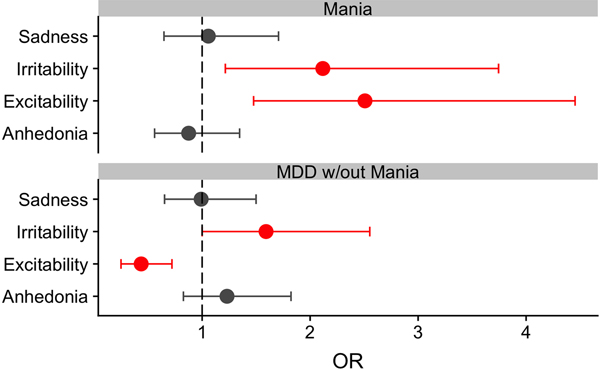
When controlling for all other factor scores as well social adversity and maternal history of bipolar disorder, the excitability factor score significantly predicted ever meeting DSM-IV diagnostic criteria for mania after baseline via binary logistic regression (n = 65, diagnosed at any point from T2 [ages 3–5] through T9 (ages [14–19]). The odds ratio (OR) of ever having mania as a function of each increased point in the excitability factor score was 2.29 (95% confidence interval; CI [1.49, 3.68], p < .001). The irritability factor score from baseline also significantly predicted ever meeting criteria for mania at later assessment points in this model (OR 1.99; 95% CI [1.19, 3.37], p = .009), again even when controlling for all of the other factors scores, social adversity, and maternal diagnosis. The sadness and anhedonia factor scores did not significantly predict later diagnosis of mania in this model. These results are summarized in Figure 2.
Odds ratio (OR) of later developing the diagnosis for each 1 point increase in factor scores, controlling for all other factor scores, maternal history of bipolar disorder, and age 5 social adversity.

When controlling for the contribution of other factor scores, social adversity and maternal mood history, the excitability and irritability factor scores predicted later diagnosis of depression (n = 152, diagnosed at any point T2 [ages 4–7] through T9 [ages 14–19]). The OR of later being diagnosed with depression was 2.55 (95% CI [1.98, 3.36], p = .01) for each point increase in excitability factor score and the OR was 3.11 (95% CI [1.32, 3.27], p = .002) for each point increase in irritability factor score.
However, when considering only those children who were later diagnosed with depression but never diagnosed with mania (n = 91), only the irritability factor score was significantly predictive of later diagnosis of depression (OR 1.77; 95% CI [1.15, 2.74], p = .01). Instead, the excitability factor score became predictive of not having a later diagnosis of MDD without mania (OR for a later diagnosis of MDD but never mania for each point increase in excitability factor score is 0.48; 95% CI [0.30, 0.72], p < .001). Thus, the predictive ability of the excitability factor score for later diagnosis of depression appeared to be due to the overlap in later diagnosis of mania and later diagnosis of depression.
Externalizing diagnoses
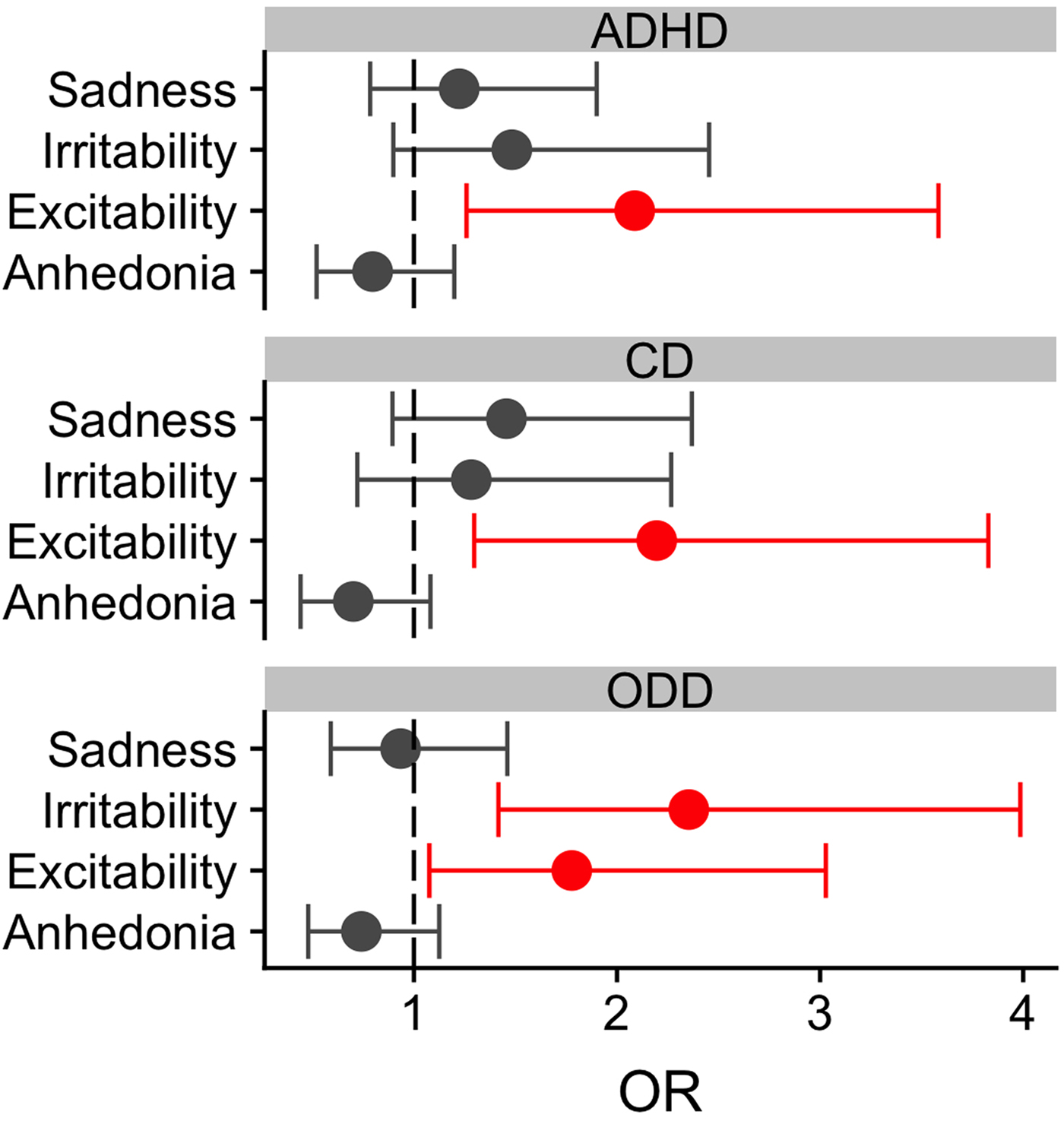
The excitability factor score from T1 predicted later ADHD diagnosis (n = 80; T2 [ages 4–6] through T9 [age 14–19]) via logistic regression, even when all other factor scores, social adversity, and maternal history of bipolar disorder were controlled for in the model (OR of ever being diagnosed with ADHD at a later time for each point increase in the excitability factor score = 2.20; 95% CI [1.38–3.66], p = .001).
Both excitability and irritability factor scores at T1 (ages 3–5 years) predicted later diagnosis of ODD (n = 61, T2 [ages 4–6] through T9 [age 14–19]) via logistic regression when all factor scores, social adversity, and maternal history of bipolar disorder were controlled for in the model (OR of ever having a diagnosis of ODD with each increased point of the excitability factor score = 1.96; 95% CI [1.23, 3.25], p = .006, and OR for the irritability factor score = 2.25; 95% CI [1.35, 3.84], p = .002), as in Figure 3.
Odds ratio (OR) of later developing the diagnosis for each 1 point increase in factor scores, controlling for all other factor scores, maternal history of bipolar disorder, and age 5 social adversity.

The excitability factor score at baseline (ages 3–5 years) also predicted later diagnosis of CD (n = 54 with diagnosis at T2 [ages 4–6] through T9 [ages 14–19]) when all factor scores, social adversity, and maternal history of bipolar disorder were in the model. The OR of ever being diagnosed with CD for each point increase in the excitability factor score = 2.11 (95% CI [1.31, 3.51], p = .003), as in Figure 3.
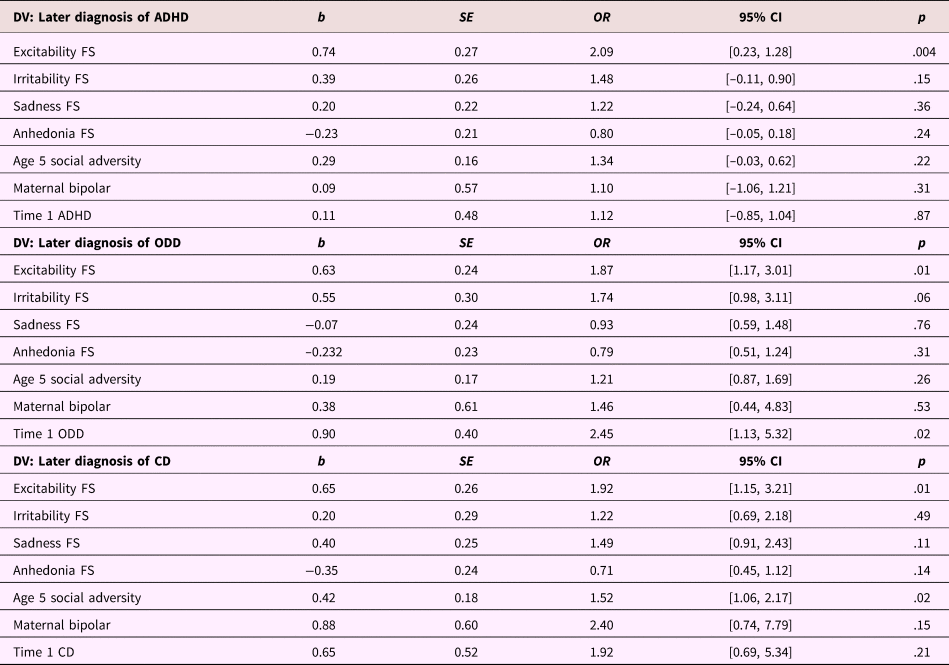
While there are overlapping features between the excitability and irritability factor scores and the diagnostic criteria of the externalizing diagnoses, these factor scores predicted later externalizing diagnoses even above and beyond having a baseline diagnosis of the disorder (Table 3). The excitability factor score remained predictive of ADHD even when ADHD diagnosis at T1 was added to the full model, with OR = 2.08 (95% CI [1.24, 3.50], p = .006) for the excitability factor score. The excitability factor score was similarly predictive of later ODD even when ODD diagnosis at T1 was entered into the model, with OR of 1.87 (95% CI [1.17, 3.01], p = .01), though the irritability factor score was no longer predictive (OR = 1.74; 95% CI [0.98, 3.11], p = .06). Once CD at T1 was entered into the model, the excitability factor score remained predictive of a later diagnosis of CD above already meeting criteria for a CD diagnosis at age 3–5 (OR 1.92; 95% CI [1.14, 3.21], p = .01).
Elevated affect dysregulation factor scores predict later diagnosis of externalizing disorders above having a baseline (Time 1) diagnosis of the same

Note: DV, dependent variable. ADHD, attention-deficit/hyperactivity disorder. FS, factor score. ODD, oppositional defiant disorder. CD, conduct disorder.
Affect dysregulation factor scores predict later emotion regulation problems
Emotion regulation
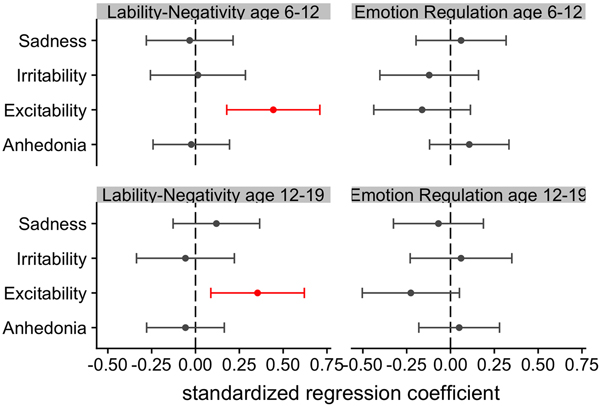
The excitability factor score predicted ERC lability/negativity score at age 6–12 years (mean 10 years old) and at ages 13–19 years (mean 16 years old) with linear regression (R 2 = .29 at ages 6–12 and R 2 = .16 at ages 13–19, both p < .001), even when the other factor scores, age 5 social adversity, and maternal diagnosis of bipolar disorder were in the model (b = 2.54, t = 3.12, p = .002 at ages 6–12 and b = 2.59 at ages 13–19, t = 2.82, p = .006 in the full model), as seen in Figure 4. The other factor scores did not predict later lability/negativity subscale scores when all factor scores were included in the model.
Excitability factor scores predict later emotion regulation as measured by the Emotion Regulation Checklist. Standardized beta weights in regression models with all four factor scores, social adversity, and maternal history are shown for each factor score.

Similarly, only the excitability factor score significantly predicted the ERC emotion regulation score at ages 6 to 12 years when all factor scores were in the model (individual model excitability factor score R 2 = .16, p < .001; with all factor scores, excitability factor score b = –1.35, t = –3.08, p = .003). However, this was no longer significantly predictive once age 5 social adversity was added to the model (t = –1.87, p = .06). By ages 13–19 (mean age 16 years old), while the direction of the relationship remained similar, excitability factor score at baseline was no longer significantly predictive of the emotion regulation score after accounting for the other factor scores.
Emotion dysregulation factor scores predict concurrent and later measures of global functioning
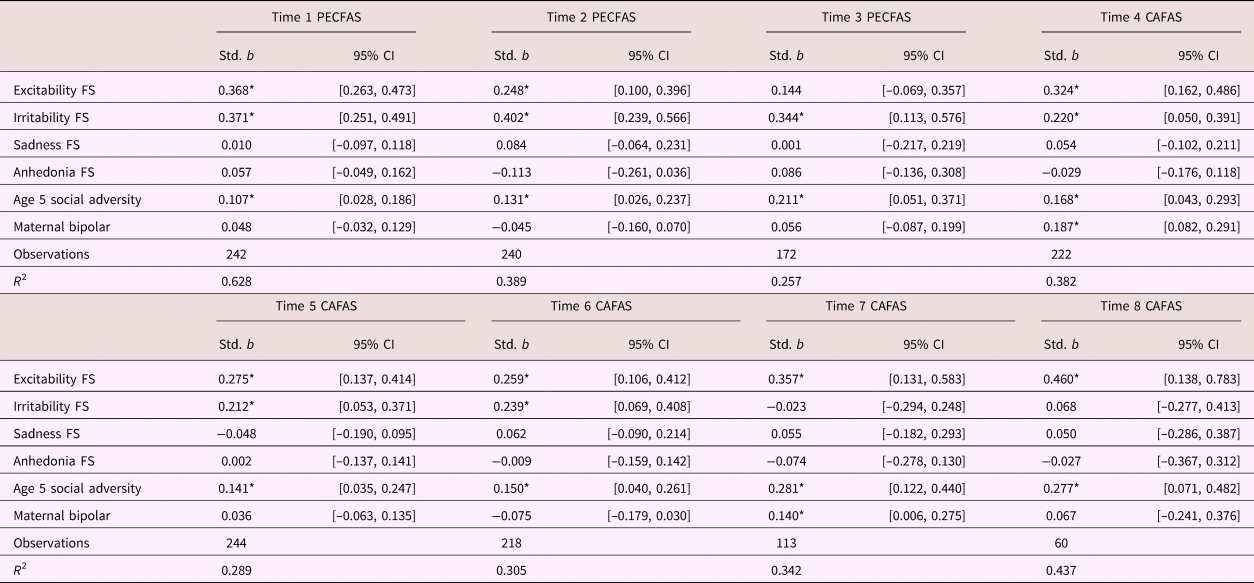
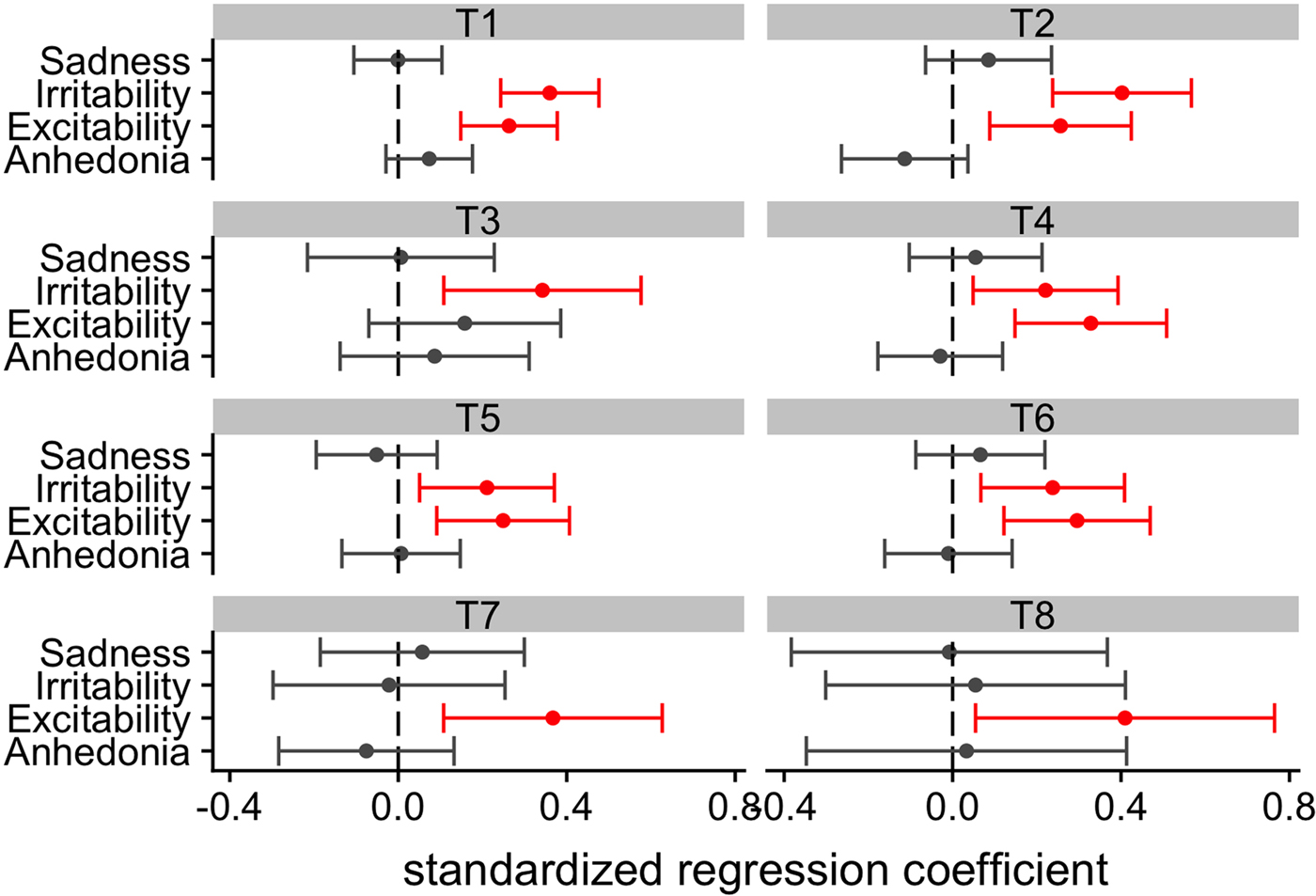
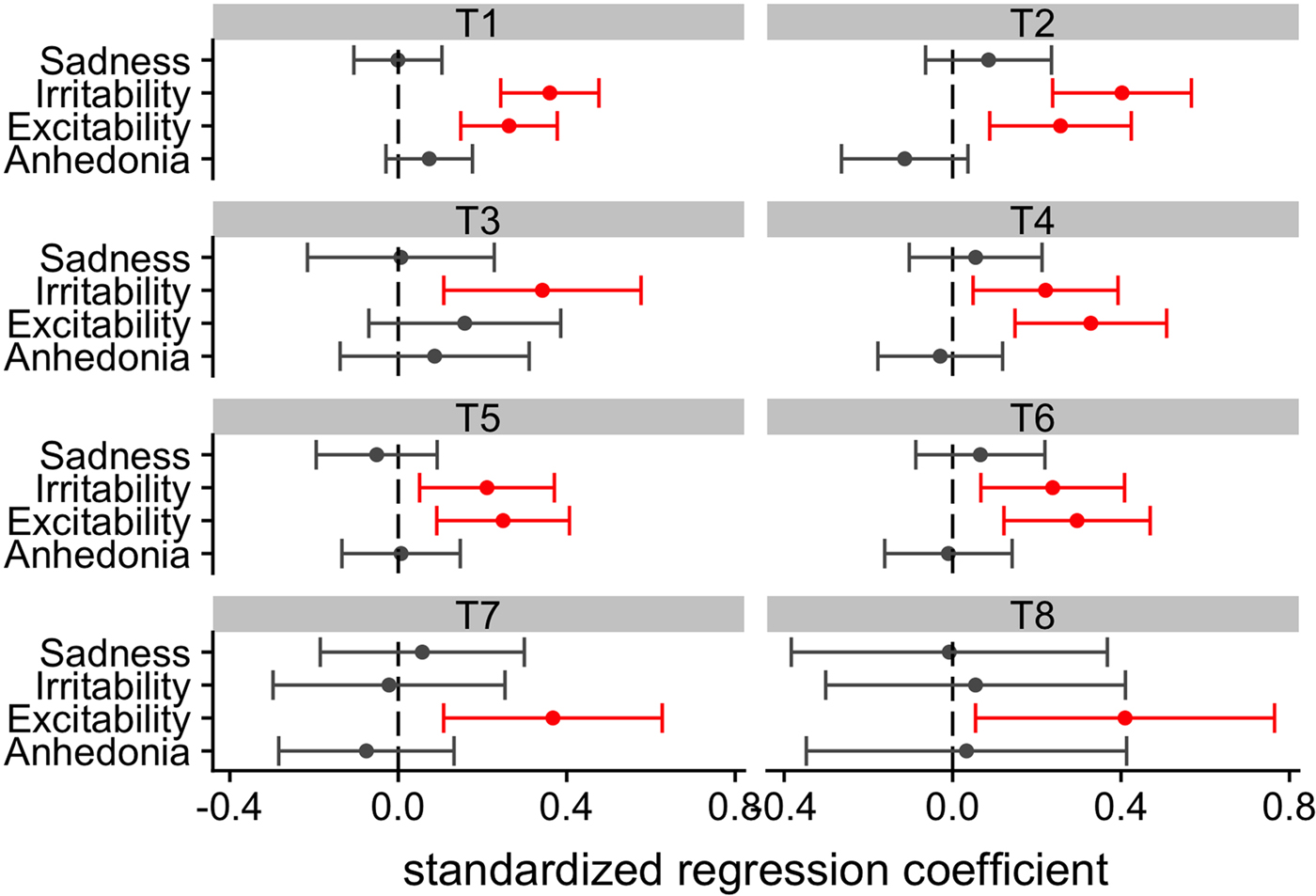
The excitability and irritability factors scores (R 2 =.37, 95% CI [.26, .47] and R 2 = .37, 95% CI [.25, .49], respectively, both p < .05) predicted concurrent levels of global functioning when all factor scores, age 5 social adversity, and maternal history of bipolar disorder were included in the model. Similarly, later global functioning as measured by the PECFAS or CAFAS total score was predicted by the excitability factor score at all subsequent time points except T3, and PECFAS or CAFAS total score was predicted by the irritability factor score at all time points through T6 when including all factor scores, social adversity, and maternal history in the model (see Table 4, Figure 5).
Factor scores predict measures of global functioning as measured by the PECFAS/CAFAS at Time 1–Time 8

Note: Standardized regression coefficients are presented along with 95% confidence intervals (CIs). *p < .05. PECFAS, Preschool and Early Childhood Functional Assessment Scale. CAFAS, Childhood and Adolescent Functional Assessment Scale.
Excitability and irritability factor scores from Time 1 (ages 3–5 years) predict concurrent and future global functioning as measured by the Preschool and Early Childhood Functional Assessment Scale at Time 2 (ages 4–7) and Time 3 (ages 7–10) and Childhood and Adolescent Functional Assessment Scale at Time 4 (age 7–10) though Time 6 (age 9–13) and the excitability factor score continues to predict global functioning at Time 7 (age 10–14) and Time 8 (age 12–16), even when controlling for the effect of all other factor scores, age 5 social adversity, and maternal history of bipolar disorder.
Discussion
Overall, our results demonstrate that two separable manifestations of emotion dysregulation measured during the preschool period predict later psychiatric diagnoses and emotion dysregulation in some specific ways, and global functioning more generally at school age and adolescence. Using an EFA we demonstrated that in preschool children, ages 3–5 years, emotion dysregulation can be divided into separable dimensions of “irritability” related to negative affect and “excitability” related to positive affect, in addition to sadness and anhedonia, consistent with our hypotheses regarding the dual nature of emotion dysregulation. These emotion dysregulation factor scores were influenced by early life social adversity and by maternal mood history, specifically maternal history of bipolar disorder. In turn, these emotion dysregulation factor scores, irritability and excitability, predicted later mood and externalizing diagnoses even when controlling for social adversity, maternal history, and presence of the diagnosis at baseline. This suggests that measures of these manifestations of emotion dysregulation in early childhood are robust predictors of later psychopathology and general functioning over and above baseline diagnosis. Contrary to our hypotheses, but particularly notable, was that excitability, but not irritability, predicted measures of emotion regulation in later childhood and adolescence. Consistent with our hypotheses, excitability and irritability both predicted concurrent and later global functioning. This finding suggests that the measurement of these dimensions may be important predictors of later risk for psychopathology and adaptive functioning. Further, they also highlight the importance of attention to a novel dimension of emotion dysregulation representing “excitability” in early childhood.
The importance of emotion dysregulation in both positive and negative affect
The EFA described above resulted in a four-factor model, which we described as “irritability” and “excitability” characterizing negative and positive affect dysregulation as well as “sadness” and “anhedonia.” As predicted, irritability items grouped together, including tantrums, irritability, frustration, and anger. Consistent with the recently defined diagnosis of disruptive mood dysregulation disorder (Roy et al., Reference Roy, Lopes and Klein2014), mood cycling items from the mania module also grouped with this irritability factor. In contrast, the excitability factor was mainly composed of items from the mania module, including elevated mood, inappropriate laughter, grandiosity and gregariousness, along with concentration, motor, and sleep symptoms. To our surprise, self-deprecation/self-hatred, and suicide/self-injurious behavior items were also grouped with this factor, illustrative of the detrimental aspects of having dysregulated excitability. The remaining factors, sadness and anhedonia, comprised items commonly associated with depression. Specifically, the sadness factor included not only items related to sad mood but also loneliness, feeling unloved, and pathological guilt, consistent with prior work in preschool onset depression (Luby, Belden, Pautsch, et al., Reference Luby, Belden, Pautsch, Si and Spitznagel2009, Luby, Belden, Sullivan, et al., Reference Luby, Belden, Sullivan, Hayen, McCadney and Spitznagel2009). The anhedonia factor included all anhedonia-related items as well as loss of interest and anergia; this was the least normally distributed factor, perhaps arguing for the clinical importance of this factor in depression pathology, though not in emotion dysregulation, which would also be consistent with prior work (Luby, Belden, Pautsch, et al., Reference Luby, Belden, Pautsch, Si and Spitznagel2009).
As hypothesized, separable positive (excitability) and negative (irritability) forms of early emotion dysregulation were found. This expands the conceptualization of emotion dysregulation, which has previously focused largely on irritability or negative affect dysregulation (as reviewed in Brotman et al., Reference Brotman, Rich, Guyer, Lunsford, Horsey, Reising and Leibenluft2010; Wackschlag et al., Reference Wakschlag, Perlman, Blair, Leibenluft, Briggs-Gowan and Pine2018). Such a broader conceptualization is consistent with the research domain criteria model positive and negative valence systems (Cuthbert & Insel, Reference Cuthbert and Insel2013), both of which can be dysregulated. In our work, the excitability factor includes theoretically positive attributes such as elevated affect and gregariousness, which have been previously shown to be protective from the development of behavioral inhibition and depression (Park et al., Reference Park, Belsky, Putnam and Crnic1997; Silk et al., Reference Silk, Steinberg and Morris2003). Consistent with this work, the excitability factor also proved to be protective against later depression without mania. However, it also contained poor judgement, self-hatred, and suicidality, reflecting the impairment that can come with this form of positive affective dysregulation. That excitability in preschoolers predicts not only later affect lability but also externalizing diagnoses and global impairment speaks to the import of better understanding both of these forms of early emotion dysregulation. These findings also suggest that such early symptoms of excitability, which are typically not assessed as a central aspect of clinical interviews in early childhood, are important for clinicians to inquire about in diagnostic interviews of young children.
Predicting later problems with emotion regulation
Both excitability and irritability predicted meeting criteria for mania at school age and early adolescence (prior to age 12) in our sample. They were not generic affective risk factors, as they did not increase the risk of developing MDD without mania. Despite these relations to mania episodes before age 12, only two children went on to meet full criteria for bipolar disorder after age 12, a time frame when the diagnosis becomes clearer and less controversial. This result is consistent with prior longitudinal study of the Child Behavior Checklist “bipolar profile” (Halperin, Rucklidge, Powers, Miller, & Newcorn, Reference Halperin, Rucklidge, Powers, Miller and Newcorn2011), in which many children with the “bipolar profile” were later diagnosed with depression or other externalizing disorders rather than bipolar disorder. Rather, it seems more likely that these factor scores are predicting later problems with emotion dysregulation that are so severe that they are meeting criteria for mania in middle childhood and early adolescence but are not leading to narrow spectrum bipolar disorder as defined by full DSM diagnostic criteria for mania after age 12.
As we conceptualize emotion dysregulation as dimensional, it should confer risk for multiple diagnoses at varying severity rather than one discrete diagnosis of bipolar or bipolar spectrum disorder. Consistent with this, the excitability factor score predicted later lability/negativity as measured by the emotion regulation checklist in both middle childhood and in the teen years. Further study of the relationship between emotion dysregulation and manic symptoms in prepubertal children and more strictly defined bipolar disorder in adolescents and adults may help shed further light on the role of emotion dysregulation in childhood bipolar spectrum disorders and whether emotion dysregulation is predictive for the development of bipolar I or II. Moreover, conceptualizing emotion dysregulation dimensionally and occurring in both negative (irritability) and positive (excitability) valence systems may allow for better predictions of an overall trajectory toward a variety of diagnostic outcomes beyond bipolar disorder. This is consistent with the extant literature in which bipolar diagnoses in childhood and adolescence are associated with very high levels of comorbidity (Geller et al., Reference Geller, Zimmerman, Williams, Bolhofner, Craney, Delbello and Soutullo2000; Luby & Belden, Reference Luby and Belden2006), a feature that has fueled skepticism about this diagnostic classification in childhood.
Consistent with prior work, early emotion dysregulation predicted multiple types of impairment (Aldao, Gee, De los Reyes, Seager, Reference Aldao, Gee, De Los Reyes and Seager2016; Beauchaine & Ziser, Reference Beauchaine and Zisner2017; Calkins & Keane, Reference Calkins and Keane2004; Vasilev, Crowell, Beauchaine, Mead, & Gatzke-Kopp, Reference Vasilev, Crowell, Beauchaine, Mead and Gatzke-Kopp2009). Here we have shown that both excitability and irritability in preschoolers predicted global functioning not only concurrently but also for years into the future. Excitability predicted worse global functioning through adolescence, and irritability predicted worse global functioning through late childhood. The longer duration of excitability predicting global functioning could be related to some level of irritability in preschool years being a normative developmental behavior (Belden et al., Reference Belden, Thomson and Luby2008; Wakschlag et al., Reference Wakschlag, Choi, Carter, Hullsiek, Burns, McCarthy and Briggs-Gowan2012). However, it may also reflect an increased role for excitability in emotion dysregulation in adolescence, a developmental period characterized by increased mood lability, approach behavior, and response to reward (Ernest, Romeo, & Anderson Reference Ernst, Romeo and Andersen2009; Gilbert, Reference Gilbert2012; Van Leijenhorst et al., Reference Van Leijenhorst, Moor, Op de Macks, Rombouts, Westenberg and Crone2010). Relatedly, while emotion regulation typically improves with development (Blandon, Calkins, Keane, & O'Brien, Reference Blandon, Calkins, Keane and O'Brien2008; Calkins & Keane, Reference Calkins and Keane2004; Hill, Degnan, Calkins, & Keane, Reference Hill, Degnan, Calkins and Keane2006; Silvers et al., Reference Silvers, McRae, Gabrieli, Gross, Remy and Ochsner2012; Vasilev et al., Reference Vasilev, Crowell, Beauchaine, Mead and Gatzke-Kopp2009), it is notable that variation present at this very young age predicts later outcome, and thus screening for both positive and negative emotion dysregulation as defined here, and targeting interventions for improving emotion regulation in both of these domains, should begin in the preschool years.
Early childhood emotion dysregulation increases risk of later externalizing diagnoses
As well established in the extant literature, irritability is related to ADHD diagnosis in our study (Karalunas et al., Reference Karalunas, Fair, Musser, Aykes, Iyer and Nigg2014; Shaw, Stringaris, Nigg, & Liebenluft, Reference Shaw, Stringaris, Nigg and Leibenluft2014; Steinberg & Drabick, Reference Steinberg and Drabick2015). We found that excitability was also associated with increased risk of later diagnosis of ADHD. Further, only excitability significantly increases the odds of a later ADHD diagnosis above having a diagnosis of ADHD at baseline, suggesting this may be an important and less recognized early predictor of later ADHD. While there is overlap between some items from the excitability factor and ADHD symptoms, such as “motor pressure, hyperactivity, or increased energy,” “motor activity, agitation, restlessness,” “unusually energetic,” “poor judgement,” and “decreased concentration,” it is notable That the excitability factor score was able to predict later diagnosis of ADHD even when including baseline diagnosis of ADHD in the model, indicating its predictive ability is not solely due to symptom overlap. The excitability factor also contains items regarding elated and expansive mood, grandiosity, self-deprecation and self-hatred, and suicidal and self-injurious behaviors, all of which emphasize the emotion dysregulation component of this factor. Better understanding of the role of early emotion dysregulation in ADHD psychopathology could have significant diagnostic and treatment implications, as currently these are not part of a typical screening for ADHD and addressing emotion dysregulation is often not included in treatment plans for this diagnosis.
Both irritability and excitability factor scores conferred increased risk of later ODD diagnosis, though only excitability above meeting criteria for ODD at baseline. Given the overlap between items in the irritability factor score and ODD symptoms, including irritability, “touchy or easily annoyed,” being “angry or resentful,” and “temper tantrums,” this might be expected, and there are similar reports in the literature (Wiggins, Mitchell, Stringaris, & Liebenluft, Reference Wiggins, Mitchell, Stringaris and Leibenluft2014). However, it is notable that the excitability factor score was associated with increased risk of later diagnosis of ODD, even when controlling for baseline ODD diagnosis, even though this is a diagnosis meant to describe generally negative or irritable children (Rey, Reference Rey1993).
The excitability factor score also predicted later diagnosis of CD even when controlling for baseline diagnosis of CD. This is particularly interesting given that at least some children with CD with callous and unemotional traits are thought to have lower emotional reactivity (Beauchaine, Gatzke-Kopp, & Mead, Reference Beauchaine, Gatzke-Kopp and Mead2007; Wackschlag et al., Reference Wakschlag, Perlman, Blair, Leibenluft, Briggs-Gowan and Pine2018). It is possible that excitability is capturing a subset of children who meet criteria for CD who are not callous and unemotional, as we hypothesize the excitability factor score reflects increase emotional reactivity, but this warrants further study.
Early life adversity and family history influence the emotion dysregulation
Consistent with much prior work, early life adversity, in this case measured by a composite index including items reflecting unstable or stressed caregiving, abuse, and financial stress, is associated with increased excitability and irritability. This finding is consistent with prior literature showing that increased adverse childhood experiences increases the risk of depression (Anda et al., Reference Anda, Felitti, Bremner, Walker, Whitfield, Perry and Giles2006; Chapman et al., Reference Chapman, Whitfield, Felitti, Dube, Edwards and Anda2004; Luby et al., Reference Luby, Gaffrey, Tillman, April and Belden2014; Teicher & Samson, Reference Teicher and Samson2013), externalizing diagnoses (Cohen, Brown, & Smailes, Reference Cohen, Brown and Smailes2001; Rosen, Handley, Cicchetti, & Rogosch, Reference Rosen, Handley, Cicchetti and Rogosch2018), and overall impairments in functioning (Anda et al., Reference Anda, Felitti, Bremner, Walker, Whitfield, Perry and Giles2006; Edwards, Holden, Felitti, & Anda, Reference Edwards, Holden, Felitti and Anda2003; Felitti et al., Reference Felitti, Anda, Nordenberg, Williamson, Spitz, Edwards and Marks1998), as well increased risk of early onset depression (Luby et al., Reference Luby, Belden and Spitznagel2006) and problems with emotion regulation (Hill et al., Reference Hill, Degnan, Calkins and Keane2006; Kim, Cicchetti, & Rogosch, Reference Kim-Spoon, Cicchetti and Rogosch2013) for children in families with lower socioeconomic status. This work extends those findings by showing that social adversity has a marked relationship to behavioral manifestations of emotion dysregulation as early as the preschool period of development.
Family history may impact the development of emotion dysregulation through both genetic and psychosocial mechanisms, and prior work has demonstrated its impact on irritability (Paglioccio et al., Reference Pagliaccio, Pine, Barch, Luby and Leibenluft2018; Stringaris et al., Reference Stringaris, Vidal-Ribas, Artiges, Lemaitre, Gollier-Briant and Wolke2015). Here we demonstrate that while both a maternal history of bipolar disorder and MDD are associated with increased emotion dysregulation factor scores, only a maternal history of bipolar disorder increases this risk above that accounted for by social adversity. While we have used a conservative estimate of maternal bipolar disorder, including only those who met criteria on the FIGS for parents or were being treated by a mental health professional for this diagnosis, we do not have clear measurements about how impaired mom was by her diagnosis or its impact on the family to better understand variable mechanisms of this risk factor.
The role of sadness and anhedonia in psychopathology
At first glance, our results may seem contrary to prior reports of the continuity of pediatric depression through childhood and into later adolescence (Gaffrey et al., Reference Gaffrey, Tillman, Barch and Luby2018; Luby et al., Reference Luby, Gaffrey, Tillman, April and Belden2014). However, upon closer examination, these findings are largely consistent. Luby et al. (Reference Luby, Gaffrey, Tillman, April and Belden2014) and Gaffrey et al. (Reference Gaffrey, Tillman, Barch and Luby2018) both used DSM-defined diagnoses in the preschool period to predict later presentations of the same diagnoses. In contrast, the current study investigates symptoms of emotion dysregulation dimensionally, which allows us to identify the impact of empirically defined groups of symptoms. In both Luby et al. (Reference Luby, Gaffrey, Tillman, April and Belden2014) and Gaffrey et al. (Reference Gaffrey, Tillman, Barch and Luby2018), ongoing depression in adolescence was predicted by preschool-onset depression and preschool-onset CD, which includes a number of the emotion dysregulation symptoms emphasized here. Relatedly, preschool depression predicted later diagnoses of CD, ODD, and ADHD (Gaffrey et al., Reference Gaffrey, Tillman, Barch and Luby2018), again indicating the potential overlap with excitability and irritability. By looking at these symptoms dimensionally, we can see that the component of preschool depression that most strongly predicts later diagnoses of depression may be emotion dysregulation.
Yet, components of sadness, including pathological guilt, and anhedonia have been found to be very specific for childhood depression (Luby et al., 2004), and both symptom reports of anhedonia as well as neural evidence of decreased response to reward in adolescents have been found to predict later depression (Olino et al., Reference Olino, McMakin, Dahl, Ryan, Silk, Birmaher and Forbes2011; Stringaris et al., Reference Stringaris, Vidal-Ribas, Artiges, Lemaitre, Gollier-Briant and Wolke2015). The current study did not investigate the predictive role of guilt in the risk for later depression, and it is possible that it may carry more predictive power when considered alone than as a part of the sadness factor more broadly. Relatedly, while we identified an anhedonia factor in our EFA, this was the least normally distributed factor with considerable right kurtosis indicating the vast majority of children score very low in this factor score. Thus, we might have been underpowered to detect relationships with later depression, particularly if the relationship was with only a subset of children with later depression. As MDD is a disorder with incredibly variable expression (Fried & Nesse, Reference Fried and Nesse2015; Zimmerman, Ellison, Young, Chelminksi, & Dalrymple, Reference Zimmerman, Ellison, Young, Chelminski and Dalrymple2015), it is possible that only a subset is characterized by anhedonia. There are also indications that anhedonia may have a different developmental trajectory than other depressive symptoms (Pine, Cohen, Cohen, & Brook, Reference Pine, Cohen, Cohen and Brook1999) as well as a differential relationship with other symptoms of depression (Buckner, Joiner, Pettit, Lewinsohn, & Schmidt, Reference Buckner, Joiner, Pettit, Lewinsohn and Schmidt2008). It is thus conceivable that anhedonia and even sadness predict subtypes of depression, but due to heterogeneity in diagnoses, we were unable to identify such a relationship.
Future directions
Excitability specifically and dysregulation of positive affect more generally are understudied areas of emotion dysregulation. Clinically, excitability may provide an additional tool for describing potential risk in young children with emotion dysregulation, and further study of the utility of screening for excitability and potential targets interventions such as parent–child interaction therapy or dialectical behavior therapy for children deserve further study. A further description of the longitudinal course of excitability and how this may interact with known developmental changes in emotion regulation, general mood lability, risk taking, and reward sensitivity may help better elucidate whether this is stable over time, or has developmentally sensitive periods for risk. Examining neurobiological correlates of excitability is an important future direction that is likely to be informative. Excitability might be reflected in broadly increased sensitivity of amygdala response to emotionally salient stimuli as has been seen in children with a bipolar diagnosis and mood lability (Rich et al., Reference Rich, Schmajuk, Perez-Edgar, Fox, Pine and Liebenluft2007; Wiggins et al., Reference Wiggins, Mitchell, Stringaris and Leibenluft2014). It may also be seen in sensitivity to reward response in the striatum, as seen in some children with irritability (Deveney et al., Reference Deveney, Connolly, Haring, Bones, Reynolds, Kim and Leibenluft2013).
Further study of how irritability changes across development, given the expected normative decrease with development (Wackschlag et al., Reference Wakschlag, Briggs-Gowan, Carter, Hill, Danis, Keenan and Leventhal2007), and how this may change its ability to predict later psychopathology will also be relevant. For example, elevated irritability may become more predictive in older children, as it is further from the norm. Further, separating irritability from excitability allows for a more thorough investigation of neurobiological mechanisms of irritability. For example, the increase in striatal response that is inconsistently seen in irritability (Deveney et al., Reference Deveney, Connolly, Haring, Bones, Reynolds, Kim and Leibenluft2013; Perlman et al., Reference Perlman, Jones, Wakschlag, Axelson, Birmaher and Phillips2015) may be related to its correlation with excitability, and including both in an analysis will allow for finer grain distinctions.
Finally, further study of the development of sadness and anhedonia and their relationship with concurrent and later depression diagnoses will be of interest. Again, depression is a heterogeneous diagnosis, and a better description of these subtypes of problematic emotional responses may allow us to identify reproducible subtypes, for example those with elevated irritability and excitability and those without, which we would predict to be differentially related to anhedonia.
Conclusions
Our work, consistent with the extant developmental literature, clearly emphasizes the importance of early childhood emotion dysregulation in risk for current and later psychopathology and overall well-being. These findings build on and extend prior work by providing data to suggest that there may be two separable and uniquely predictive forms of early emotion dysregulation: irritability and excitability. While both irritability and excitability measured in the preschool years predicted later psychiatric diagnoses and global functioning, excitability predicted overall measures of emotion dysregulation, multiple later psychiatric diagnoses above having a baseline diagnosis of the same, and global functioning into the teen years. Excitability particularly is an understudied area, and a better understanding of this dimensional measure of positive emotion dsyregulation may be important to inform our understanding of psychiatric diagnosis, treatment, and the underlying neurobiology of emotion dysregulation.
Supplementary material
The supplementary material for this article can be found at https://doi.org/10.1017/S0954579419000609
Acknowledgments
We would like to thank the children and families who have participated in the preschool depression study.
Financial support
Funding for this work was provided by NIMH Grants R01 MH064769 (to J.L.), MH090786 (to J.L. and D.B.), and T32 MH100019 (to A.V.). The NIMH had no further role in the design and conduct of the study; collection, management, analysis, and interpretation of data; or preparation, review, or approval of the manuscript.