Introduction
At this time, behavioral change toward the purchase and consumption of healthier and more sustainable food products is a crucial issue to address (Benedetti et al., Reference Benedetti, Laureti and Secondi2018; Schösler and de Boer, Reference Schösler and de Boer2018). Indeed, most food systems are no longer sustainable at a global level (FAO and WHO, 2019). Notably, excessive consumption of animal products and ultra-processed food (UPF), associated with the lack of variety in diets, may threaten human health, animal and plant biodiversity and the environment as a whole (Fardet and Rock, Reference Fardet and Rock2018). The qualitative 3V rule provides a simple metric for assessing the healthiness and sustainability of consumer food choices, with the three V's standing in French for ‘Végétal’ (plant-based), ‘Vrai’ (‘real’ foods, i.e., not ultra-processed) and ‘Varié’ (varied) (Fardet and Rock, Reference Fardet and Rock2018, Reference Fardet and Rock2020a, Reference Fardet and Rock2020b). It is based on three indicators of the relation between diet and global health: the plant/animal caloric ratio, with an optimum of ≈15% animal calories/day; the degree of processing, with a maximum of 15% ultra-processed calories/day; the diversity of the diets—if possible organic, local and seasonal.
Through its holistic approach, this three-dimensional metric has been built from eight previously identified health protective diets worldwide (including the Mediterranean, Prudent and Okinawa diets), and eight foresight scenarios at horizon 2050 for protecting both human health and food system sustainability (including the EAT-Lancet, INRAE/Agrimonde-Terra, IDDRI/TYFA and Solagro/Afterres scenarios). In the 3V rule, although the impact of animal product consumption and food diversity on health and food systems is globally well known (Fanzo et al., Reference Fanzo, Hunter, Borelli and Mattei2013; Johnston et al., Reference Johnston, Fanzo J and Cogill2014; Tilman and Clark, Reference Tilman and Clark2014; Mariotti, Reference Mariotti2019; Bonnet et al., Reference Bonnet, Bouamra-Mechemache, Réquillart and Treich2020; Benton et al., Reference Benton, Bieg, Harwatt, Pudasaini and Wellesley2021), the effect of the degree of food processing is rather new and has been under-appreciated in studies about dietary patterns and health (FAO et al., Reference Monteiro, Cannon, Lawrence, Louzada and Machado2019). The UPF concept has first emerged in 2009 (Monteiro, Reference Monteiro C2009), and has led to an increasing number of studies in different countries (Pan American Health Organization, 2015; FAO, et al., Reference Monteiro, Cannon, Lawrence, Louzada and Machado2019; PAHO and WHO, 2019), notably in relation to health outcomes (Costa et al., Reference Costa, Del-Ponte, Assunção and Santos2018; Askari et al., Reference Askari, Heshmati, Shahinfar, Tripathi and Daneshzad2020; Chen et al., Reference Chen, Zhang, Yang, Qiu, Wang, Wang, Zhao, Fang and Nie2020; Elizabeth et al., Reference Elizabeth, Machado, Zinöcker, Baker and Lawrence2020; Lane et al., Reference Lane, Davis, Beattie, Gómez-Donoso, Loughman, O'Neil, Jacka, Berk, Page, Marx and Rocks2020; Pagliai et al., Reference Pagliai, Dinu, Madarena M, Bonaccio, Iacoviello and Sofi2020) and food system sustainability (Ministry of Health of Brazil, 2014; Baker et al., Reference Baker, Machado, Santos, Sievert, Backholer, Hadjikakou, Russell, Huse, Bell, Scrinis, Worsley, Friel and Lawrence2020; Fardet and Rock, Reference Fardet and Rock2020a, Reference Fardet and Rock2020b; Seferidi et al., Reference Seferidi, Scrinis, Huybrechts, Woods, Vineis and Millett2020). Thus, the 3V rule has the distinction of addressing more clearly the degree of food processing (FAO et al., Reference Monteiro, Cannon, Lawrence, Louzada and Machado2019; Fardet and Rock, Reference Fardet and Rock2020a, Reference Fardet and Rock2020b).
The multicriteria 3V rule adequately addresses nutritional needs while being adaptable to the specificities of each region of the world, such as socio-economic, pedo-climatic and agronomic conditions and culture and culinary traditions (Fardet and Rock, Reference Fardet and Rock2020a, Reference Fardet and Rock2020b). Ultimately, the value of the 3V rule lies primarily in embracing global health with only three generic and simple indicators; and if one dimension were to be missing, the diet would no longer be protective of global health, e.g., with the increasing development of ultra-processed plant-based foods in response to the revegetation of the plate, French vegans and vegetarians consumed more UPFs compared to meat eaters (Gehring et al., Reference Gehring, Touvier, Baudry, Julia, Buscail, Srour, Hercberg, Péneau, Kesse-Guyot and Allès2020).
In France, the healthiness of the diet is assessed every 7 yr by the French Agency for Food, Environmental and Occupational Health & Safety (ANSES), based on representative surveys of French eating habits in different age groups (Dubuisson et al., Reference Dubuisson, Lioret, Touvier, Dufour, Calamassi-Tran, Volatier and Lafay2009, Reference Dubuisson, Dufour, Carrillo, Drouillet-Pinard, Havard and Volatier J2019; Lioret et al., Reference Lioret, Dubuisson, Dufour, Touvier, Calamassi-Tran, Maire, Volatier and Lafay2010). In particular, between the last two surveys conducted respectively in 2006–2007 and 2014–2015, the content of industrially processed foods on the French plate has increased significantly (ANSES, 2017). Current consumption of UPFs is around 31–36% of daily calories (Fardet et al., Reference Fardet, Thivel, Gerbaud and Rock2021; Julia et al., Reference Julia, Martinez, Alles, Touvier, Hercberg, Mejean and Kesse-Guyot2018; Salomé et al., Reference Salomé, Arrazat, Wang, Dufour, Dubuisson, Volatier, Huneau and Mariotti2021) and animal products would account for approximately 40% of daily calories (Fardet et al., Reference Fardet, Thivel, Gerbaud and Rock2021; Fardet and Rock, Reference Fardet and Rock2020a, Reference Fardet and Rock2020b).
Regarding the places of purchase, convenience stores, discounters, supermarkets and hypermarkets are often the primary suppliers of UPFs worldwide: this is the case in Latin America (Pan American Health Organization, 2015); UPFs represented 83% of packaged foods in a sample of New Zealand supermarkets in 2013 (Luiten et al., Reference Luiten, Steenhuis, Eyles, Ni Mhurchu and Waterlander2016), and 67% of packaged foods in a sample of super- and hypermarkets in France in 2019 (Davidou et al., Reference Davidou, Christodoulou, Fardet and Frank2020). In France, in 2020, hypermarkets, supermarkets and hard discounters represented 55, 38 and 7% of all national employees, respectively (FCD, 2020), with the six leading large food retailers accounting for around 89% of the total food market (Leclerc, Reference Leclerc2020). In total, 60% of French consumers report going to supermarkets and 58% to hypermarkets for their daily shopping, while diversifying their shopping in smaller food stores (30%) and organic food shops (18%) (Delvallée, Reference Delvallée2019). With supermarkets, French hypermarkets are therefore the leading place to buy UPFs. The first evaluation based on the NOVA classification according to the degree of processing (Moubarac et al., Reference Moubarac, Parra, Cannon and Monteiro2014) showed in 2012 that approximately 27% of sales were ultra-processed in French organic specialized stores, compared to approximately 39% in French conventional stores (Desquilbet et al., Reference Desquilbet, Maigné and Monier-Dilhan2018). In this latter study, the structure of food purchases was only assessed in monetary units and not in calorie units, limiting the dimensions of sustainability included in the analysis. Apart from this publication, purchases in French food retail stores have never been evaluated with a ‘One Health’ approach (Fresco et al., Reference Fresco, Bouwstra, de Jong, van der Poel, Scholten and Takken2020).
In this context, the main objective of this study is, therefore, to assess the adequacy of food choices and purchasing behaviors in French hypermarkets according to the three metrics of the 3V rule. To this end, we assessed compliance with the 3V rule in the shopping carts of 708 regular consumers in 122 French hypermarkets, based on actual purchases in four separate months of 2019 covering the four seasons, identified by barcodes provided by a main retailer. We also assessed potential differences in this compliance by season, according to the presence or absence of children in the customer profile, and by price per 100 calories. In particular, the presence of children was expected to influence parents to change their purchasing habits, especially toward healthier and more sustainable foods. Finally, the study will indirectly give an insight into how the environment of hypermarkets influences the sustainability of consumers' food choices.
Methods
Data and study population
Data collection
The data were provided by one of the four national leaders in food retailing, representing over 10% of the French retail market share. Hypermarkets were chosen as the shopping locations because they provide the largest number of food items, especially compared to supermarkets. The retailer's 122 hypermarkets across France were included in the analysis. The database provided by this retailer contained information on 521,023 food products (including repetitions) purchased by 708 selected regular customers in the 122 hypermarkets over four different months covering the four seasons of 2019. For each purchased food product, anonymous information was available on its customer (generic number and category), the hypermarket where it was purchased, and the season of purchase. Information on foods was also available from the barcodes (including those on packaged products and others directly generated within hypermarkets for non-packaged foods such as bulk and fresh foods weighed on the scale). For each different food (n = 38,168), information was given on its food section (30 options), food category (338 options), food sub-category (1859 options), unitary price and the number of purchases by customer.
Study population
In order to include customers likely to make a significant proportion of their food purchases in the surveyed hypermarket, the selected customers were all in possession of a loyalty card and were chosen among those having made the greatest number of food purchases in the most varied and representative food sections. On the basis of their purchasing profile, these customers were classified into three generic categories representative of a model defined by Kantar© (Housden, Reference Housden2006): ‘optimisers’ who are primarily looking for the best prices and want to waste as little time as possible making their purchases, with reasoned and controlled purchases; ‘local traditionals’ who rarely change their purchasing habits and are loyal to local and ‘made in France’ products; the ‘wealthy families’ who tend to frequent the drive-through hypermarket during the week; their purchases correspond to high-quality products and thoughtful purchases for basic necessities.
Individual socio-economic data for each selected consumer (i.e., age, income, dwelling place and sex) were confidential and protected by the French RGPD law (Le Règlement Général sur la Protection des Données, General data Protection Regulation), and may have been only given as percentages of all customers (Supplementary Table 1). The retailer also checked that these consumers did not purchase for food aid associations that provide free food in France to the most deprived, and whose average expenditure is far higher than the average expenditure of each consumer in this study (i.e., €523 ± 338 per month).
For each of the 122 hypermarkets, a selection of customer belonging to the three Kantar categories, and with or without children (six customer types) was attempted. In total, 103 hypermarkets included all six types of customers, 14 hypermarkets included only five and five hypermarkets included only four customer types, leading to 708 consumers. Food expenditure covered all four seasons of 2019, with food purchases in January, April, August and October.
Data formatting for the 3V rule
First, all residual non-food items and non-caloric food items (i.e., nutritional supplements and waters) were removed from the database, resulting in a final database with 511,274 food products purchased in total, with 38,168 different food products purchased after the removal of repeated items. For 19,405 food products, the ingredient list was obtained from the French Open Food Facts database (https://fr.openfoodfacts.org/). Other food products were either present in this database, but without the list of ingredients, or absent from it (e.g., private labels). This open collaborative database of food products marketed in France, under the Open Database License (ODBL), is the most comprehensive database in this respect. To retrieve the list of ingredients of each food item from its bar code, its net weight and the total calorie of the product as sold, a simple algorithm was developed in our laboratory based on the JavaScript Object Notation (JSON; https://fr.openfoodfacts.org/api/v0/produit/‘product bar code’.json), which is a data exchange format. In addition, 265 food products were sold under the private label of the French retailer. For these products, the company supplied the list of ingredients, the net weight and the total number of calories of the sold product, giving a total of 19,670 food products with a list of ingredients. We used the available data on these 19,670 food products to calculate the median calorie content per 100 g in each of the 338 food categories (as defined by the French retailer). For the remaining 18,498 food items, neither the retailer nor the Open Food Facts database provided information on the calorie content of the food item purchased. These food items corresponded mainly to niche products (i.e., local, traditional or foreign specialties) or to bulk and fresh products (i.e., unpackaged foods sold in hypermarkets, for which a specific bar code was assigned at the time of purchase in hypermarkets, i.e., 16% of the 18,498 food products) products. For the latter, we applied the median value of the calorie content per 100 g in each of the retailer's 338 food categories (homogeneous in the types of foods that constitute them), determined from the products for which the calorie content per 100 g was available in the Open Food Facts database. After controlling for non-normality of the calorie content of foods within each category (Shapiro–Wilk test, P > 0.05), we chose the median value as an indicator of the average calorie content within a category. The impact of this approximation was limited by the high level of details allowed by the large number of food categories, and the homogeneity of products within each of the 338 food categories.
Next, formatting according to the 3V rule was established for all foods in these 338 categories, as follows.
Rule 1: ‘Végétal’ (plant)
The final set of 38,168 different food products purchased was classified into three categories for this first rule: 100% plant-based foods, 100% animal-based foods and mixed foods containing both animal and plant-based ingredients. The first two categories were easy to identify (e.g., fresh and bulk products, butchery and bakery, cheese stand, creamery, canned vegetables, sugars, spices, etc.), and we obtained 10,075 different animal food products and 17,285 different plant food products. The 10,808 mixed food products belonged to 127 mixed categories (with an average of about 85 products per category). Within each category, the different mixed foods were fairly homogeneous in terms of formulation. For example, in the ‘fruit yogurt’ category variations were mainly due to the type of fruit added, or in the ‘biscuit’, ‘Viennese pastry’ and ‘soft bread’ categories, variations in recipes were also minor. We selected a representative recipe from each of the 127 mixed categories in order to approximate the shares of animal and plant calories. The percentages of animal and plant calories for each representative recipe were then imputed to all mixed food products in the given category in order to calculate the respective shares of animal and plant calories based on the amount of food purchased and the net weight.
Rule 2: ‘Vrai’ (real, i.e., non-UPF)
UPFs can be found in plant, animal and mixed products. The degree of processing of each of the 38,168 foods purchased was assessed using the Siga methodology, which identifies UPFs from the ingredient list (Davidou et al., Reference Davidou, Christodoulou, Fardet and Frank2020). The Siga score according to the degree of processing (A: not or minimally processed, B: processed and C: ultra-processed) was assigned to the 19,670 food items for which ingredient lists were available. Of the remaining 18,498 food items for which the list of ingredients was not available, all fresh unpackaged foods, bulk foods and catered foods were considered non-UPF (i.e., 60.7% of the 18,498 foods). For the remaining 7269 packaged industrial foods, we applied the percentages of UPFs found in each of the 126 Siga food categories (defined to be representative of the food assortments of French super and hypermarkets) (Davidou et al., Reference Davidou, Christodoulou, Fardet and Frank2020) which we matched to the 338 French retailer food categories for this study. This allowed us to calculate the calorie share of UPFs based on the amount of food purchased and the net weight for each food purchased.
Rule 3: ‘Varié’ (varied)
The varied rule applied to non-UPFs, i.e., ‘real’ foods (Fardet and Rock, Reference Fardet and Rock2020a, Reference Fardet and Rock2020b). In line with the study design, we used the household dietary diversity score (Swindale and Bilinsky, Reference Swindale and Bilinsky2006). Household dietary diversity, defined as the number of unique foods consumed by household members over a given period, was validated as a measure of household food availability. It measures the total number of these food groups consumed by members of the household, out of a possible 12. We adapted this simple method for our study as follows. The French retailer classification considers 293 food categories and 1152 more detailed food sub-categories (e.g., for the category ‘citrus fruits’, sub-categories are ‘lemon’, ‘clementine’, ‘orange’, ‘pomelo’, etc.). A variety index was first calculated among non-UPFs for each customer based on a combination of retail food categories with retail food sub-categories. This absolute variety index for each consumer is calculated by multiplying the number of food categories purchased by the number of food sub-categories purchased. We then selected the individual with the highest absolute variety index from the 708 consumers, and the relative variety index (RVI) of the remaining 707 consumers was expressed as a percentage of the absolute variety index of this individual. This reference individual, with an RVI of 100%, has children and purchased 309 different non-UPF products over the 4 months of the year from 178 different food sub-categories and 107 different food categories, or on average 18 different non-UPF products per week per household. This appears to be a moderate level of food diversity among non-UPF products, especially when children are present. However, the number of children in each household was not known for this study, due to the French RGPD law for confidentiality, and only average percentages were given for the presence of 1, 2, 3 or ≥4 children in the household (Supplementary Table 1). For this particular consumer, 58% of the food was UPF. As an indication, in the 3V rule, food diversity corresponds to at least two different food varieties among usual plant and animal food groups, i.e., at least 24 different non-UPF products per week per person, but not per household (Fardet and Rock, Reference Fardet and Rock2020a, Reference Fardet and Rock2020b).
The cost of the average and sustainable shopping cart
The average cost of the shopping cart for all 708 consumers was calculated based on the basis of purchase receipts provided by the retailer. From the prices per 100 kcal of UPF, non-UPF animal and non-UPF plant calories, the cost of an average shopping cart based on the 3V rule was estimated, i.e., with 15% animal calories, 15% UPF plant calories and 70% non-UPF plant calories.
Statistical and machine learning analyses
The shares of plant and non-ultra-processed calories and the RVIs were determined for each of the 708 consumers over the 4 months, based on season, consumer category and the presence or absence of children. Based on calories purchased by each consumer, we also calculated the price for 100 ultra-processed and animal calories compared to the prices of non-UPF and plant calories. The effect of the criteria ‘presence of children’ and ‘season’ on the median percentages of animal and UPF calories purchased and on the median RVI in each of the three consumer categories was measured with the non-parametric Wilcoxon test after testing the normality of the data (Shapiro–Wilk test). The effect was considered significant when P < 0.05.
Data were also analyzed using multivariate analysis (principal component analysis, PCA) and machine learning (decision tree). Decision trees are used in the fields of decision support (e.g., retail or business intelligence) or data mining. They describe how to divide a population of individuals (e.g., customers of a company or users of a social network) into homogeneous groups according to a set of discriminating variables (e.g., age and socio-professional category) and according to a given objective (also called ‘variable of interest’ or ‘output variable’, e.g., turnover, probability of clicking on an advertisement). The decision tree was applied to the 708 customers to define the purchase rules in the presence and absence of children. According to the 3V rule, the explanatory variables were ‘share of animal calories purchased (%)’, ‘share of UPF calories purchased (%)’, ‘share of animal expenditure (%, euros)’, ‘share of UPF expenditure (%, euros)’ and the RVI. Among the main machine learning algorithms, the chi-square automatic interaction detector was chosen instead of the classification and regression trees and C4.5 algorithms because it is more suitable for an exploratory study with a large sample. In all three decision tree analyses, 90% of the customers were used for the learning sample and 10% remained for the test sample (model validation). The similarities and differences between the 708 consumers (illustrative variables) in terms of compliance with the 3V rule and prices of purchased calories (active variables) were also analyzed and visualized by PCA.
The Wilcoxon and Shapiro–Wilk tests, PCA analyses and decision trees were all performed using SPAD9.1 software (Coheris©, Suresnes, France).
Results
Due to the lack of significant differences between the three Kantar categories as regards the three metrics of the 3V rule (results not shown), they were merged, and only the influence of season and the presence or absence of children was studied.
Overall analysis based on the 3V rule
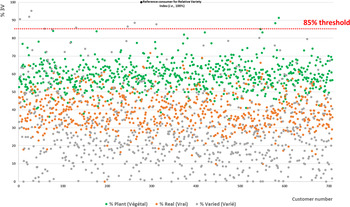
Overall, considering all consumers over 4 months of 2019 in the 122 hypermarkets, the mean percentages of plant and non-UPF calories were 59 ± 8% (mean ± s.d.) and 39 ± 10%, respectively (Table 1). In relation to the consumer with the highest degree of variety, the mean and median RVI were 28 ± 18% and 25%, respectively (Table 1). For 87% of consumers, plant and animal calories (i.e., rule 1: plant) were distributed in a range of 49–69% and 31–51%, respectively. For 76% of consumers, UPF and non-UPF calories (i.e., rule 2: real) were in a range of 29–49% and 51–71%, respectively. For 48% of consumers, the RVI (i.e., rule 3: varied) was in a range of 15–35% (Fig. 1).
Distribution of the compliance percentages with the 3V rule for each of the 708 customers.

Mean and median percentages of adherence to the 3V rule

a Reference 100% was the customer with the highest food variety (among the 708 customers).
b s.d. is the standard deviation for the 708 customers.
Specific analysis based on the 3V rule according to variables of interest
The percentages of animal and UPF calories purchased did not vary significantly by season, remaining within a range of 40–42% for animal calories and 60–61% for UPF calories (Fig. 2). The presence or absence of children did not imply significant differences in the percentages of animal and UPF calories purchased (Fig. 3). For the third rule, varied, the RVI was largely and significantly lower (−33%, P < 0.05, Wilcoxon test) when purchasers had no children (Fig. 3).
Median purchased animal and UPF calorie percentages according to seasons. Significance (P < 0.05) was assessed with the non-parametric Wilcoxon's test.

Adherence to the 3V rule depending on the presence of children or not within the family: median % animal calories, median % UPF calories; and median RVI (relative to the consumer with the highest variety score, i.e., = 100%). Significance (P < 0.05) was assessed with the non-parametric Wilcoxon's test. NS, non-significant.

Expenditure according to the 3V rule
The average price of 100 calories was 0.351 euros for animal calories vs 0.345 euros for plant calories, and 0.272 euros for UPF calories vs 0.315 euros for non-UPF calories. UPFs accounted for 57% of expenditure and 61% of total calories, while animal foods accounted for 50% of expenditure and 42% of total calories (results not shown). Overall, customers would have spent 1.7% less if they had only purchased plant calories, and 15.6% more if they had only purchased non-UPF calories. Considering only non-UPFs food categories, i.e., mainly fresh and bulk foods, 100 calories cost 0.343 euros, which is 26% more than the price of UPF calories. In the animal products, 100 calories of UPF cost much less than non-UPF ones, from 0.295 to 0.466 euros respectively.
Altogether, the switch from UPF to non-UPF animal calories in hypermarkets results in an increase in expenditure of 37%, while the difference for plant calories is minor, at only 2%. Finally, based on 38,168 food products and on the average price per 100 calories, a shopping cart based on the 3V rule, i.e., with 15% animal calories (0.466 euros/100 calories), 15% UPF calories (0.236 euros/100 calories) and 70% plant non-UPF calories (0.272 euros/100 calories), would cost 4.6% less.
Decision tree and multivariate analyses
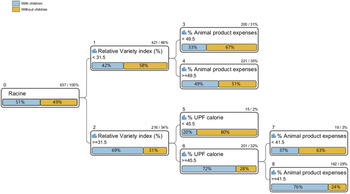
The decision tree analyses allowed us to define rules for the presence/absence of children (Fig. 4). The most discriminating criterion was the RVI, with 34% consumers having an RVI ≥ 31.5%, including 69% of those ‘with children’ (Fig. 4). Notably, for the latter, the presence of children was characterized by the following rules: ‘RVI ≥ 31.5%’ → ‘UPF calorie ≥ 45.5%’ → ‘animal price ≥ 41.5%’.
Decision tree analysis in relation to purchasing behaviors, as regards the three metrics of the 3V rule, for the presence or absence of children.

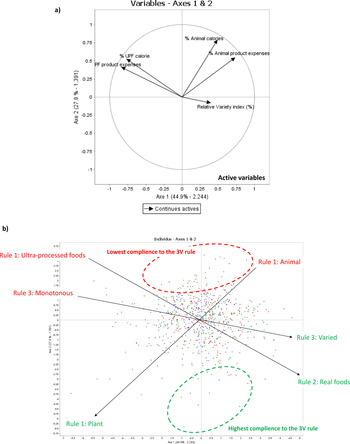
Then, the customers were compared for their similarities and differences in the 3V rule profile through PCA (Fig. 5a, b). The loading plot showed that the first two principal components expressed a high level of variance, i.e., 72.7%, meaning that the PC1 × PC2 plot was a relevant indicator of consumer compliance with the 3V rule (Fig. 5a). It also showed that the dimensions of RVI (R = 0.11, P > 0.05) and percent UPF calories (R = −0.03, P > 0.05) were not significantly correlated with the dimension of percent animal calories, whereas the RVI was inversely and significantly correlated with percent UPF calories (R = −0.21; P < 0.0001). Analysis of the PCA loading plot did not fully discriminate the 708 consumers according to the 3V rule (Fig. 5b). Based on a combination of the loading and score plots, approximately 19 consumers (i.e., ≈2.7%) showed a relatively high level of adherence to the three rules combined (green ellipse), and approximately 39 consumers (i.e., ≈5.5%) showed a relatively low level of compliance to the three rules combined (red ellipse).
PCA loading (a) and score plots (b) derived from the ‘708 (consumers) × 5 (3V criteria)’ matrix (PC1 × PC2 plan represents 74.7% of total variance). On the loading plot, the five active variables based on the 3V criteria are shown.

Discussion
Overall adequacy to the 3V rule
An important finding of this study is the interrelationship between the ‘Vrai’ and ‘Varié’ metrics of the 3V rule with regard to purchasing behavior, but not with the ‘Végétal’ metric. Indeed, the more diversified foods consumers purchased, the less UPFs they purchased. However, of the 708 consumers, only 2.7% exhibited a relatively ‘high’ level of 3V rule adequacy, while about 5.5% has a fairly ‘low’ level of adequacy. The food choices of the 708 customers are therefore far from the optimum 3V rule, with an average of 41% animal calories and 61% UPF calories, well above the optimum thresholds of 15% for each of these two metrics (Fardet and Rock, Reference Fardet and Rock2020a, Reference Fardet and Rock2020b). Furthermore, on the basis of the RVI, the diversity of foods purchased was not very high (median RVI of 25% compared to the consumer with the highest RVI set to 100%), which is similar to previous results from the French INCA3 study (2014–2015) on 2121 adults representative of the French population (ANSES, 2017; Dubuisson et al., Reference Dubuisson, Dufour, Carrillo, Drouillet-Pinard, Havard and Volatier J2019). In this population, the average daily animal calorie consumption was ≈36–41% (Fardet et al., Reference Fardet, Thivel, Gerbaud and Rock2021; Fardet and Rock, Reference Fardet and Rock2020a, Reference Fardet and Rock2020b). Furthermore, from 24,932 packaged foods in French super- and hypermarkets, using the Siga score revealed that 67% of packaged foods were UPFs (Davidou et al., Reference Davidou, Christodoulou, Fardet and Frank2020), close to the 61% UPF calorie share found in the present study, but which included fresh and bulked packaged products. Such a high level of packaged UPFs purchased from food retailers has already been described in other countries. In Norway, from a representative sample of food retailers, UPFs accounted for 59% of purchased and 49% of expenditures (Solberg et al., Reference Solberg S, Terragni and Granheim S2016); similarly, in New Zealand supermarkets, 83% of industrial packaged products were classified as UPFs (Luiten et al., Reference Luiten, Steenhuis, Eyles, Ni Mhurchu and Waterlander2016).
Alternatively, the study by Desquilbet et al. (Reference Desquilbet, Maigné and Monier-Dilhan2018) examined the plant or animal origin of food products as an indicator of the environmental and health impacts of sales and their degree of processing as an indicator of their health impact (Desquilbet et al., Reference Desquilbet, Maigné and Monier-Dilhan2018). In French conventional stores and for conventional products, authors reported, respectively, 29.8, 44.7 and 25.5% of plant-based, animal-based and mixed products, as a percentage of sales for 7883 active households and more than 8 million purchases of food products (Kantar Worldpanel database). This corresponds to an average share of animal-based sales of 57% (Desquilbet et al., Reference Desquilbet, Maigné and Monier-Dilhan2018) compared to 50% in our study.
Finally, considering a reference consumer with the highest degree of variety among non-UPF products, the data showed that 50% of all other consumers had an RVI below 25%. This low food variety at purchase can be related to the evolution of the French diet between 2006–2007 and 2014–2015, which is notably characterized by more industrial processed foods and ready-to-eat meals, and less frequent home food preparations, resulting in a lower diversity of raw or minimally processed foods (ANSES, 2017).
Influence of children
The presence of children had no impact on the percentages of animal and UPF calories purchased. For the ‘varied’ rule, the median RVI was significantly lower when families did not have children, i.e., 33% less, as confirmed by the decision tree analysis. There is, therefore, a tendency to purchase a greater variety of products among non-UPFs when families have children. The greater variety of foods purchased appears quite logical, since the food supply for children may be different from that for adults; and households with children are larger than households without children, and therefore tend to purchase a wider range of products. One reason for the high level of purchase of UPF calories, i.e., about 61%, may be that UPFs can often be stored for a very long time. It has recently been shown in the USA that low-income households participating in the Supplemental Nutrition Assistance Program (SNAP) ‘selected UPFs because of their familiarity and long shelf life, attributes that mitigated fear of wasting money on foods that may be rejected by children or spoil quickly’ (Moran et al., Reference Moran A, Khandpur, Polacsek and Rimm2019). In addition, children of parents who were more confident in their cooking skills ate less UPFs (Martins et al., Reference Martins, Machado, Laura da Costa Louzada, Levy and Monteiro2019). This suggests that the population selected in this study, also purchasing very regularly from hypermarkets, may not be familiar with cooking raw and bulk products at home. Beyond their long shelf life, UPFs are also generally cheaper than non-UPFs (Machado et al., Reference Machado, Claro, Canella, Sarti and Levy2017; Gupta et al., Reference Gupta, Hawk, Aggarwal and Drewnowski2019; Vandevijvere et al., Reference Vandevijvere, Pedroni, De Ridder and Castetbon2020), which makes them very attractive, notably in households with children. Thus, it was reported in the French INCA3 survey that price is the first food choice criterion cited by households (48%), followed by consumption habit (43%), taste (38%) and origin of the product (36%) (ANSES, 2017).
The price of animal and ultra-processed calories under the 3V rule
Although healthy diets are generally more expensive (Rao et al., Reference Rao, Afshin, Singh and Mozaffarian2013), the present results suggest that purchasing foods more in line with the healthy and sustainable 3V rule would not have been much more expensive in hypermarkets, except for considering the additional organic dimension of foods. In the present study, a simulation showed that customers purchasing only plant or non-UPF calories would spend 1.7% less and 15.6% more, respectively. In addition, the cost per 100 UPF calories is approximately 16% lower than that for non-UPF calories, and 26% lower when considering only food categories without UPFs. These differences are lower than those observed in the USA, where the cost per calorie was reported to be 64% lower for UPFs than for minimally processed foods (Gupta et al., Reference Gupta, Hawk, Aggarwal and Drewnowski2019). One possible explanation may stem from either higher prices for minimally processed and/or fresh foods or lower costs of UPFs in the USA than in France.
From a public health perspective, the lower price of UPFs may be a relevant factor in overweight and obesity, especially among low-income families, compared to the cost of a healthier diet (Bonaccio et al., Reference Bonaccio, Bonanni, Di Castelnuovo, De Lucia, Donati, de Gaetano, Iacoviello and Moli-sani Project2012; Darmon and Drewnowski, Reference Darmon and Drewnowski2015). This statement can be generalized from other recently published data. From 103 countries, it has been shown that ‘as countries develop economically, overweight prevalence increased substantially among the poorest and stayed mostly unchanged among the wealthiest’ (Templin et al., Reference Templin, Cravo Oliveira Hashiguchi, Thomson, Dieleman and Bendavid2019). Similarly, in Brazil, the price of UPFs has been shown to be inversely associated with the prevalence of overweight and obesity (Mendes dos Passos et al., Reference Mendes dos Passos, Maia, Levy, Bortoletto Martins and Claro2019), and supermarket circulars promote the sale of UPFs in their health and wellness sections with the presence of claims of reduced unhealthy or increased healthy nutrient content (Botelho et al., Reference Botelho, Milbratz de Camargo, Medeiros, Irmão, Dean and Fiates2020). More recently, in Belgium, it has also been concluded that ‘diets with a larger caloric share of UPF were significantly cheaper (i.e., 2.3 less) than those with a lower contribution of these products’ (Vandevijvere et al., Reference Vandevijvere, Pedroni, De Ridder and Castetbon2020).
Strength and limitations
This study has a number of limitations. First, purchases in French hypermarkets (where 58% of French consumers declare going) are not representative of overall food purchases of the French population. The present study measures purchases, not consumption, and we have no information on food products purchased elsewhere. Indeed, an increasing number of people are purchasing food outside hypermarkets and supermarkets, where the supply of UPFs may be much lower, e.g., open-air markets, small retailers, organic stores, short food circuits or collective catering. However, the consumers included in this study were regular customers of hypermarkets, i.e., possessing a loyalty card and expected to purchase a significant proportion of their food in the hypermarket. Their average expenses were €523 per month, a value close to that reported in 2014 for French households with (678 euros) or without (436 euros) children (CREDOC and IRES, 2014), suggesting that the proportions of foods purchased outside the hypermarket would be relatively low. In addition, purchases on 4 months in 2019 resulted in 2942 kcal day−1 person−1 for a family without children, and from 1962 kcal day−1 person−1 for a family with children (results not shown), which was not so far from the reported 2102 kcal day−1 in French adult population (18–79 yr) in 2014–2015 (Dubuisson et al., Reference Dubuisson, Dufour, Carrillo, Drouillet-Pinard, Havard and Volatier J2019). Also, the consumers selected in this study are regular and loyal consumers, therefore not representative of all consumers of this specific French retailer. Therefore, the study is only measuring how purchases of these consumers follow the 3V rule. Overall, this study indicates that the food environment faced by regular buyers in hypermarkets is not in line with sustainable and healthy nutritional patterns, which is of concern given the role of food environments in shaping dietary preferences (The High Level Panel of Experts on Food Security and Nutrition, 2017).
Another limitation lies in the food products in the French retailer database to which a Siga score could not directly be assigned and in mixed food products for which the shares of animal and plant calories were approximated. These approximations imply that the overall values of 41% of animal calories and 61% of UPF calories found in this study may be slightly underestimated or overestimated. However, these values do not appear unrealistic compared to previous data found in supermarkets for UPF consumption and in the French INCA3 study for animal calories. Moreover, the approximations were made within homogenous food categories for both dimensions (i.e., animal and UPF calories), which limits the risk of under- or over-estimations. Despite these limitations, this study has a number of strengths, including a precise picture of purchasing habits of regular French buyers in hypermarkets with respect to health and sustainable dietary patterns, the follow-up of actual food purchases during 1 yr at different seasons and the high representativeness of the places of purchase including all hypermarkets of the selected French retailer.
Conclusions
The shopping carts of regular customers of the selected French food retailer are far from the sustainable and healthy 3V rule with 26% more animal calories, 46% more UPF calories and a quite low median RVI. This suggests that part of the French population (i.e., the regular ones) might not go to the hypermarket to consume ‘sustainably’, but, rather, to purchase long shelf-life and emergency foods, with generally a high level of UPFs. The population of customers in this study is not representative of France, but this study might reflect an overall habit of at least half of French consumers.
The results also highlighted that it is clearly possible to eat according to the healthy and sustainable 3V rule at a reasonably affordable cost in French hypermarkets, that switching from ultra-processed plant calories to non-ultra-processed plant calories in hypermarkets costs only 2% more, and that replacing the 26% animal calories in excess with plant calories is a relevant strategy to approach the 3V rule without spending much more money. This could be possibly supported by subsidies funded by targeted taxations, and/or a rearrangement of food supply in hypermarkets, e.g., according to the degree of processing. Besides, placing reminders of healthy and sustainable diets in shopping environments where UPF sales are heavily promoted, such as hypermarkets, can be a useful strategy for them to promote healthy and sustainable food choices, and to guide consumer's preferences (Botelho et al., Reference Botelho, Camargo, Dean and Fiates2019). Therefore, policies and interventions to promote healthy and sustainable eating aiming at reducing purchases of animal products and UPFs are expected to disrupt routine decisions at the point of purchase in super/hypermarkets, and encourage consumers to establish new habits of purchasing healthier and more sustainable foods (Machin et al., Reference Machin, Curutchet, Gugliucci, Vitola, Otterbring, de Alcantara and Ares2020).
Supplementary material
The supplementary material for this article can be found at https://doi.org/10.1017/S1742170521000296
Data
The data that support the findings of this study (i.e., the 511,274 purchased food products upon the year 2019 based on consumer's receipts) may be available from Auchan Retail©. Therefore, restrictions apply to the availability of these data, being theoretically under the French RGPD law (i.e., ‘Règlement Général sur la Protection des Données’).
Acknowledgements
Pierre Micheau from the Unit of Human Nutrition (INRAE) is greatly acknowledged for developing the algorithm to retrieve data from the French Open Food Facts database online. Béatrice Javary (CEO Corporate Social Responsibility), Olivia Stoeux (CEO customer data) and Mondher Elj (customer data) from Auchan Retail France are also acknowledged for supplying food and customer data based on the registered receipts of their regular customers in France. And Siga is acknowledged for the identification of UPFs in the Auchan Retail database. Auchan Retail France had no role in the design of the study; in the collection, analysis, or interpretation of data; in the writing of the manuscript, and in the decision to publish the results.
Financial support
Marion Desquilbet acknowledges public funding from ANR under grant ANR-17-EUR-0010 (Investissements d’Avenir program).
Conflict of interest
Anthony Fardet has been a member of the Siga society's scientific committee since 2017. Marion Desquilbet and Edmond Rock declare none.