INTRODUCTION
Throughout their evolutionary history the cartilaginous fish (Chondrichthyes), have remained major components of marine communities, having the ability to adapt to varying selective pressures. Elasmobranchs have adopted alternative life history styles and exploited diverse niches in the aquatic environment. The diversity of life history strategies in elasmobranchs has been qualitatively well documented and some general trends identified; however, very little quantitative information on life history patterns and correlations between traits is available, especially at the intraspecific and intrapopulation level (Cortés, Reference Cortés2000). Similar to sharks, batoids can also be extremely vulnerable to overfishing given that they share life history characteristics (late maturity, long life span, slow growth and fecundity) that result in slow population growth (Stevens et al., Reference Stevens, Bonfil, Dulvy and Walker2000; Dulvy & Reynolds, Reference Dulvy and Reynolds2002).
The ray fishery in the Mexican Pacific was developed with the introduction of bottom gillnets in the Upper Gulf of California. Between 1990 and 2000, the ray landings from the Mexican Pacific coast showed a relative stable trend with an average of 5514 tons. The Gulf of California represented 93% of the Pacific coast total ray production during the same period (CONAPESCA, 2002). The ray fishery extends throughout the Gulf of California decreasing from north to south and is largely represented by small-scale artisanal fishermen (Márquez-Farías, Reference Márquez-Farías2002; Bizzarro et al., Reference Bizzarro, Smith, Márquez-Farías and Hueter2007).
The most abundant ray family in the Gulf of California catches is Rhinobatidae with 52% of the total number of individuals, and the main species are Rhinobatos productus, Rhinobatos glaucostigma and Zapteryx exasperata (Márquez-Farías & Blanco-Parra, Reference Márquez-Farías, Blanco-Parra, Arreguin-Sánchez, Beléndez-Moreno, Méndez-Gómez-Humarán, Solana-Sansores and Rangel-Dávalos2006). Catches are seasonal, with 75% occurring from March to June peaking in April; mainly when gravid females migrate to shallower waters, where they become vulnerable to the bottom gillnets commonly used in the artisanal fishery (Villavicencio-Garayzar, Reference Villavicencio-Garayzar1995; Márquez-Farías, Reference Márquez-Farías2007). The limited distribution in most of the rhinobatids species, the lack of biological information, and the exploitation by directed and indirected fisheries around the world expose them to overexploitation.
The family Rhinobatidae represents one of the most ancient batoid lineages and contains approximately 42 species (Compagno, Reference Compagno and Hamlett2005). Despite rhinobatids are important components of fisheries around the world, their reproductive biology has been studied extensively only in seven species of this family (Abdel-Aziz et al., Reference Abdel-Aziz, Khalil and Abdel-Maguid1993; Wenbin & Shuyuan, Reference Wenbin and Shuyuan1993; Capapé & Zaouali, Reference Capapé and Zaouali1994; Kyne & Bennett, Reference Kyne and Bennett2002; Márquez-Farías, Reference Márquez-Farías2007; Marshall et al., Reference Marshall, White and Potter2007). The genus Zapteryx comprises three poorly known species that are distributed only in the American continent. Two of the three species, Z. exasperata (Jordan & Gilbert, 1880), and Zapteryx xyster (Jordan & Everman, 1896), occur in the eastern Pacific and little is known of the distribution limits (Ebert, Reference Ebert2003) and biology of these rays.
The banded guitarfish, Z. exasperata, is a bottom-living elasmobranch found on rocky reefs from the intertidal zone to a depth of 69 m, on the north-eastern Pacific coast from southern California (USA) to Mazatlán (Ebert, Reference Ebert2003), including the Gulf of California. The presence of this species south of Mazatlán (Gulf of California) is unknown due to possible misidentification with Z. xyster, a more tropically distributed species. Zapteryx exasperata is a commercially important species in the north-west of Mexico, where it is one of the most important species caught in the artisanal ray fishery (Villavicencio-Garayzar, Reference Villavicencio-Garayzar1995; Márquez-Farías & Blanco-Parra, Reference Márquez-Farías, Blanco-Parra, Arreguin-Sánchez, Beléndez-Moreno, Méndez-Gómez-Humarán, Solana-Sansores and Rangel-Dávalos2006), and is caught as bycatch by shrimp trawlers (Perez-Mellado & Findley, Reference Perez-Mellado, Findley and Yáñez-Arancibia1985). Despite the development of this fishery, very few studies have been carried out on the biology and ecology of this species in the Gulf of California region (Bizzarro et al., Reference Bizzarro, Smith, Márquez-Farías and Hueter2007; Márquez-Farías, Reference Márquez-Farías2007).
Information about reproductive parameters on Z. exasperata is restricted to notes on the maturity of males and females, and some aspects of the reproductive cycle (Villavicencio-Garayzar, Reference Villavicencio-Garayzar1995). Detailed life history information, such as size at maturity and fecundity, is essential to determine the potential biological productivity of batoid species and to assess the impact of the fishery on the populations around the world. Thus, the objective of this study was to determine the fecundity, size at maturity and reproductive cycle of the commercially exploited guitarfish Z. exasperata from the west coast of Mexico.
MATERIALS AND METHODS
Sample collection
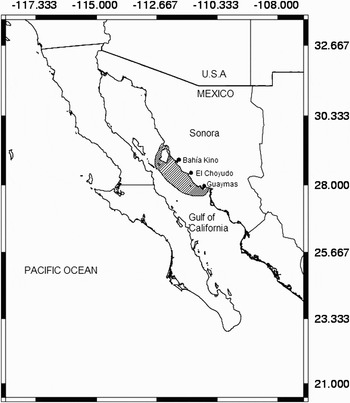
Zapteryx exasperata were sampled from July 1998 to May 2000 and from November 2004 to July 2005 from the artisanal fishery landings in Sonora, along the northern Gulf of California (Figure 1). Specimens were landed by fishermen using monofilament gillnets with a stretched mesh size between 3.5 and 13 inches. The sex of each specimen was determined and total length (TL, to the nearest centimetre) and weight (to the nearest 0.1 kg) was measured.
Study area including fishing camps and fishery ground.

Size at maturity and fecundity
The size composition of females and males were tested for normality using the Kolmogorov–Smirnov–Lilliefors test. Potential differences in mean size were examined using the Kolmogorov–Smirnov test. Reproductive organs of males and females, as well as embryos and yolk sacs were collected and preserved with formalin 10% solution for histological analysis. Sexual maturity in males was estimated by considering the degree of calcification and capacity of rotation in claspers (Carrier et al., Reference Carrier, Pratt, Castro, Carrier, Musick and Heithaus2004). Clasper length was measured from the posterior edge of the cloaca to the tip of the clasper. Clasper length, testis length and oviducal gland width were plotted as a function of TL, to assess changes in size associated with sexual maturity and reproductive activity. Females with presence of vitellogenic oocytes in the ovary or capsules or embryos in the uterus were considered mature. The diameter of the largest ova in each ovary and the width of the oviducal gland and uterus were measured (to the nearest millimetre). Embryos were sexed, measured and weighed. Sections of testes and oviducal glands were prepared for histological analysis, using standard haematoxylin and eosin staining techniques (Castro & Wourms, Reference Castro and Wourms1993). The reproductive cycle encompasses the ovarian cycle and the gestation period. The ovarian cycle is how often a female develops a batch of vitellogenic oocytes and ovulates a batch of eggs and the gestation period is the length of time between fertilization and parturition (Carrier et al., Reference Carrier, Pratt, Castro, Carrier, Musick and Heithaus2004). The ovarian cycle and gestation period were determined following the method proposed by Walker (Reference Walker and Hamlett2005) plotting the mean diameter of the largest follicle and the mean TL of embryos against month.
The logistic model M L = 1/(1 + exp(−(L − L 50%)/φ)) was fitted to binomial maturity data (0 = immature; 1 = mature), where M L is the proportion of mature individuals at length L (cm), L 50% is the length at which 50% of the individuals are mature (median size at maturity), and φ is steepness of the curve. Sex-specific differences between these relationships were tested using analysis of covariance (ANCOVA).
Fecundity was estimated by counting the number of embryos. The relationship between female TL and the number of embryos per litter was calculated. Sex-ratio in embryos was estimated.
RESULTS
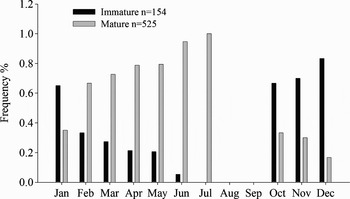
A total of 678 individuals of Zapteryx exasperata were sampled. During autumn months (October–December) and part of the winter (January) landings of Z. exasperata consisted primarily of juveniles (immature), whereas adults were the dominant group between February and July (Figure 2). No Z. exasperata were found in landings during August and September. Males dominated the landings during January and July, but females and males otherwise occurred in the same relative proportions during the entire sampling period. Male mean TL (66.5±7.2 (SD) cm) was significantly smaller than that of females (73.5±10.7 cm) (Kolmogorov–Smirnov, N = 676, P < 0.001).
Percentage of immature and mature individuals of Zapteryx exasperata per sampling month.

Male size at maturity
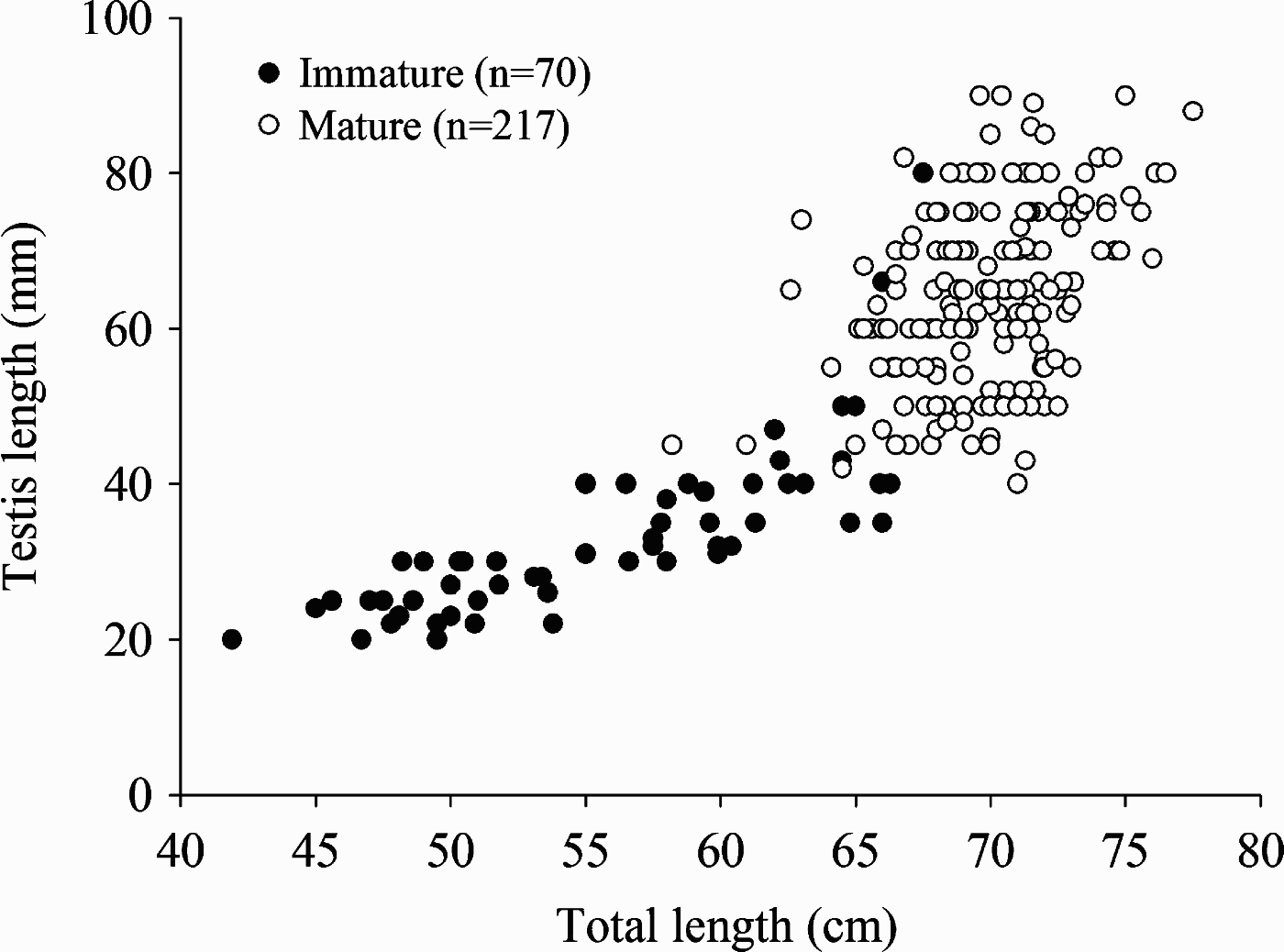
Reproductive data were obtained from 321 male Z. exasperata with a size-range from 41–81 cm TL, of which reproductive organs were measured for 287 individuals. Testis length ranged from 10 to 80 mm and 40 to 100 mm for immature and mature individuals, respectively. Both testes were well developed and functional among mature specimens showing an increase in length in relation to TL (Figure 3).
Relationship between testes length (mm) and total length (cm) of Zapteryx exasperata.

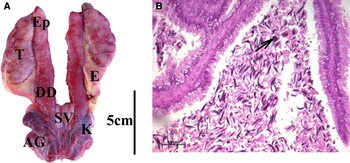
Externally, testes were lobular (Figure 4A) and microscopic observations indicated Z. exasperata had a compound testis with multiple germinal zones located on the dorsal surface and the spermatocyst arranged in columns derived from each germinal zone. Sperm clumps were observed at the epididymis, deferent ducts and seminal vesicle (Figure 4B).
(A) Mature male reproductive tract: testis (T); epididymis (EP); deferent ducts (DD); seminal vesicle (SV); epigonal organ (E); alkaline gland (AG); kidney (K); and (B) sperm clumps (arrow) in the epididymis of Zapteryx exasperata.

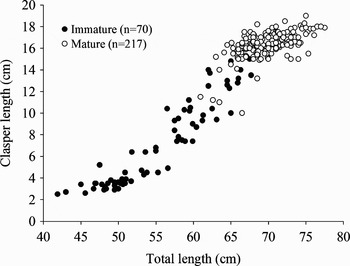
Claspers appeared flaccid in immature specimens and began to elongate and showed some calcification grade when the males approached 50 cm TL. Rapid clasper growth began at 55 cm TL and slowed at about 65 cm TL. Males between 50 and 68 cm TL were in a transitional phase leading to maturity (Figure 5). All males larger than 68 cm TL were mature and showed calcified claspers with sizes between 15 and 19 cm. The smallest mature male with calcified claspers measured 58 cm TL. Mature males were observed during all sampling months; however, semen in the seminal vesicle and claspers was observed only in mature males during late May and June.
Relationship between clasper length and total length of Zapteryx exasperata.

Female size at maturity
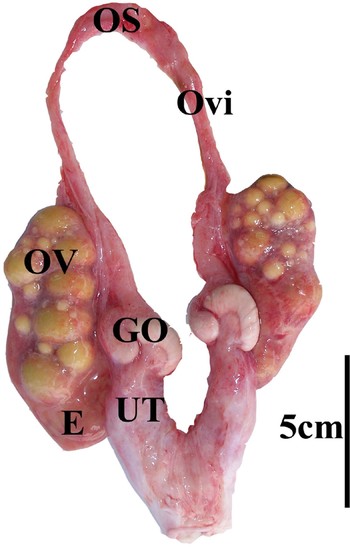
Reproductive data were obtained from 357 female Z. exasperata with a size-range of 41.3–90 cm TL (mean TL 73.5±10.7 cm), of which reproductive organs were measured for 226 individuals. Females had two functional external-type ovaries, each attached to the anterior end of the epigonal organ (Figure 6). Immature females presented undeveloped ovaries with small, clear, yolkless oocytes less than 5 mm in diameter, the uterus appeared narrow and constricted, and the oviducal glands were difficult to distinguish from the rest of the oviducts. In mature females oocytes ranged from 5–40 mm and ovaries showed oocytes from different sizes at the same time (Figure 6).
Zapteryx exasperata, mature female reproductive tract showing the oviducal gland (GO), osteum (OS), anterior oviduct (Ovi), ovary (OV), epigonal organ (E) and uterus (UT).

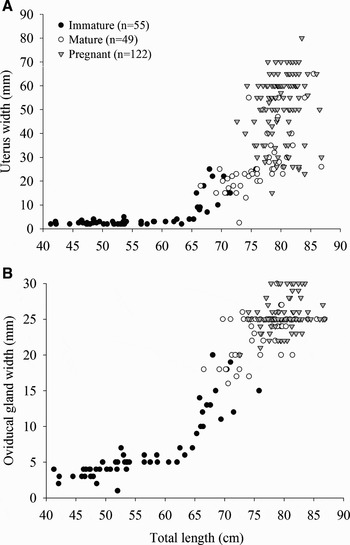
The relationship between uterus width and oviducal gland width to TL showed a sharp increase between 65 and 75 cm TL (Figure 7). In immature specimens, uterus width ranged from 1–20 mm and the oviducal gland ranged from 1–5 mm. In mature females the uterus range was 13–25 mm and the oviducal gland 16–35 mm. The uterus in gravid females ranged from 30–80 mm. No evidence of sperm storage was found in the oviducal gland of females between 52 and 87 cm TL (N = 33).
Relationship of uterus (A) and oviducal gland (B) width and total length (cm) of Zapteryx exasperata.

The smallest mature female in our sample was 66.5 cm TL and the largest immature female was 75 cm TL. Average length of gravid females was 78.8 cm TL (SD = 3.8, N = 192) and the smallest gravid female was 64 cm TL.
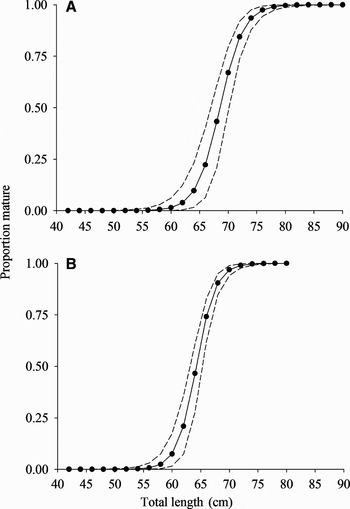
Differences in maturity ogives were observed between males and females (ANCOVA, N = 676, P < 0.001). The logistic function of the best fit for the proportion of mature males was: M L = 1/(1+exp(−(L−64))/2.10) (Figure 8A). Confidence intervals (95%) for L50% were: lower = 62.32 cm and upper = 65.72 cm. Based on ovaries, oviducal gland and uterus condition, female L50% was 69 cm TL. The logistic function of the best fit for the proportion of mature females was M L = 1/(1+exp(−(L−69))/2.10) (Figure 8b). Confidence intervals (95%) for L 50% were: lower = 68.12 cm and upper = 72.25 cm.
Relationship between proportion of mature specimens and total length for females (A) and males (B), of Zapteryx exasperata; dashed lines represent 95% confidence intervals.

Gestation period, ovarian cycle and fecundity
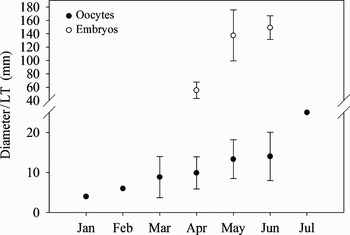
Gravid females were recorded between February and June with the greatest proportion occurring during June (80%, N = 64) and smallest proportion during February (20%, N = 2). In February the females showed eggs encased in a brownish membrane in the uterus (uterine capsules). Females with large vitellogenic oocytes in both ovaries and at the same time uterine capsules or embryos in the uterus were found between February and June. The mean of the largest oocyte diameter increased from 5 mm in February to 25 mm in July with a maximum of 40 mm (Figure 9). Fecundity in 81 gravid females ranged from 2–13 (mean 7±3). Although with low correlation, the linear relationship between fecundity (y) and maternal TL (x) was positive and significant (a = –15.40; b = 0.30, r 2 = 0.27, ANOVA, N = 81, P < 0.001). Embryos were found equally distributed in each uterus and were enclosed in leathery egg cases formed of shell membrane during their development.
Monthly mean and standard deviation of embryo total length (N = 388) and maximum ovum diameter (N = 187) of Zapteryx exasperata.

The embryo size ranged from 26–187 mm TL. In April, when embryos start to be macroscopically visible, the mean size was 58.9 mm TL (SD = 12.3 mm) with a large size interval. The mean TL of embryos increased from April to June (149.2±17.8 mm). Embryo size was highly variable in May with a mean of 137 mm TL (SD = 38.1) (Figure 9). The largest embryo (TL = 187 mm) was found in May. The sex-ratio in embryos (1.03M:0.97F) did not differ significantly from the expected 1:1 ratio (χ2 = 0.03829, N = 81, P > 0.05).
DISCUSSION
The Sonoran coast is an important area for reproduction in some batoid species (Bizzarro et al., Reference Bizzarro, Smith, Márquez-Farías and Hueter2007; Márquez-Farías, Reference Márquez-Farías2007). Catches of Zapteryx exasperata are strongly seasonal in the study area with the highest number of mature specimens (females and males) occurring during spring and early summer, which is probably associated with a reproductive migration, to breed and mate in shallower waters, where bottom set gillnets are used in the artisanal fishery. The same pattern has been observed for other batoid species in the same area and for the Z. exasperata on the west coast of Baja California (WCBC) where this species was abundant in the artisanal fishery catch between March and April (Villavicencio-Garayzar, Reference Villavicencio-Garayzar1995; Bizzarro et al., Reference Bizzarro, Smith, Márquez-Farías and Hueter2007).
Despite Villavicencio-Garayzar's (1995) suggestion of a sexual segregation in Z. exasperata in the WCBC (based on female dominance in the catches), in the present study both sexes were found almost in the same proportion during the entire sampling period, suggesting no sex segregation of this species in the north eastern Gulf of California.
Females rhinobatids have frequently been reported to attain larger total lengths than males (Capapé & Zaouali, Reference Capapé and Zaouali1994; Márquez-Farías, Reference Márquez-Farías2007). This was found for Z. exasperata in the present study in which females mean size was 7 cm greater than that of males.
External anatomy for testes in Z. exasperata is similar to that reported before for other rhinobatids (Wenbin & Shuyuan, Reference Wenbin and Shuyuan1993). As in all batoids, Z. exasperata possess a compound testis with multiple germinal zones located on the dorsal surface (Bonner & Vincz, Reference Bonner, Vincz and Hamlett2005). Sperm clumps found in the Z. exasperata epididymis are similar to those described before for Squalus acanthias, where the sperm are aligned laterally head to head with no matrix (Pratt & Tanaka, Reference Pratt and Tanaka1994). There is no information available for size at maturity in male Z. exasperata. In the WCBC male Z. exasperata larger than 69 cm TL were mature (Villavicencio-Garayzar, Reference Villavicencio-Garayzar1995). The smallest mature male found in the present study was 58 cm TL and all males larger than 68 cm TL were mature.
Size at first maturity among female Z. exasperata has been reported at 77 cm TL (Villavicencio-Garayzar, Reference Villavicencio-Garayzar1995), almost 10 cm greater than the TL of the smallest mature female found in the present study (66.5 cm). Female and male Z. exasperata from the Gulf of California reach their maturity at approximately 65% of the maximum size reported for the species (97 cm TL) (Fisher et al., Reference Fisher, Krupp, Schneider, Sommer, Carpeter and Niem1995). Differences found in size-at-maturity between sexes in Z. exasperata are similar to those reported for Rhinobatos cemiculus and Rhinobatos rhinobatos (Abdel-Aziz et al., Reference Abdel-Aziz, Khalil and Abdel-Maguid1993; Capapé & Zaouali, Reference Capapé and Zaouali1994).
The mean fecundity value (7 embryos/female) found here for Z. exasperata from the Gulf of California, falls into the fecundity range reported for rhinobatid species (Kyne & Bennett, Reference Kyne and Bennett2002). However, the maximum fecundity value found in the present study is higher than that reported for Zapteryx exasperata from the WCBC (Villavicencio-Garayzar, Reference Villavicencio-Garayzar1995). Differences in the mean uterine fecundity estimation between populations could be influenced by the maternal length–frequency distribution of the sample population (Kyne & Bennett, Reference Kyne and Bennett2002) and this is particularly relevant in species with a positive linear relationship between maternal TL and uterine fecundity, as in Z. exasperata.
In viviparous species, the reproductive cycle is generally characterized by entire populations undergoing nearly synchronous mating, gestation and parturition, suggesting that ovulation may be coordinated by environmental signals (Lutton et al., Reference Lutton, George, Murrin, Fileti, Callard and Hamlett2005). In the Gulf of California the sea-surface temperature (SST) changes notably between seasons (Lavín & Marinone, Reference Lavín, Marinone, Velasco Fuentes, Sheinbaum and Ochoa2003). In February SST reaches it minimum value and starts to increase reaching the maximum in August (Soto-Mardones et al., Reference Soto-Mardones, Marinone and Parés-Sierra1999; Lavín & Marinone, Reference Lavín, Marinone, Velasco Fuentes, Sheinbaum and Ochoa2003). Immature Z. exasperata were dominant during autumn months (October–December), but in February mature individuals became the dominant group and remained so until July indicating that spring and part of summer are important reproductive seasons (embryo development, breeding and copulation) for this population and some environmental factor such as changes in SST could be the trigger for a migration to shallower waters in this species. This pattern of mature individuals migrating to coastal zones during certain seasons was described before for Rhinobatos productus from the Gulf of California (Márquez-Farías, Reference Márquez-Farías2007).
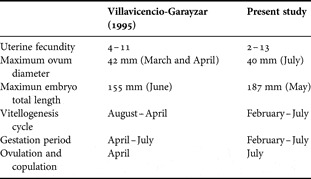
Zapteryx exasperata within the Gulf of California displays an annual reproductive cycle with strong seasonality, as do the population from the WCBC (Villavicencio-Garayzar, Reference Villavicencio-Garayzar1995), however, some differences have been found between these two populations (Table 1). Pregnancy in Z. exasperata seems to last only few months as in other rhinobatid species (Rhinobatos granulaus (Devadoss, Reference Devadoss1998), Aptychotrema rostrata (Kyne & Bennett, Reference Kyne and Bennett2002) and R. productus (Márquez-Farías, Reference Márquez-Farías2007)). The gestation period of Z. exasperata in the WCBC is three to four months (Villavicencio-Garayzar, Reference Villavicencio-Garayzar1995), however, in the Gulf of California the presence of gravid females with uterine capsules in February and near-term embryos in June suggests that the gestation period is approximately five months.
Comparison of some aspects of the reproductive cycle of Zapteryx exasperata, between the west coast of Baja California (Villavicencio-Garayzar, Reference Villavicencio-Garayzar1995) and the Gulf of California (present study).

In the present study we found that the ovarian cycle and gestation period (February–June) ran concurrently in female Z. exasperata. These findings and the presence of seminal fluid in claspers during May and June in males, suggests that the ovulation, copulation and fertilization occur immediately after parturition (during the summer season). Our results are consistent with previous reports on rhinobatid species (Abdel-Aziz et al., Reference Abdel-Aziz, Khalil and Abdel-Maguid1993; Capapé & Zaouali, Reference Capapé and Zaouali1994; Devadoss, Reference Devadoss1998; Ismen et al., Reference Ismen, Yigin and Ismen2007; Márquez-Farías, Reference Márquez-Farías2007) in which both processes (ovarian cycle and gestation period) run at the same time. However, Villavicencio-Garayzar (Reference Villavicencio-Garayzar1995) reports a different reproductive cycle pattern for Z. exasperata from the WCBC, in which the ovarian cycle is not concurrent with the gestation period. We believe that those differences in the reproductive cycle could be due to environmental adaptations and could be a result of a population differentiation as has been reported for other rhinobatid species in the same areas (Márquez-Farías, Reference Márquez-Farías2007).
Embryonic diapause in rhinobatids has been cited as a consequence of unfavourable environmental conditions (Capapé et al., Reference Capapé, Ben-Brahim and Zaouali1997) or sex segregation (Kyne & Bennett, Reference Kyne and Bennett2002). Favourable conditions for newborn rays may occur only at similar seasons each year and over a given period of embryonic development that is less than twelve months, embryos may undergo diapause (Kyne & Bennett, Reference Kyne and Bennett2002). The lack of females with developing embryos between August (mating month) and February (embryo development beginning) could be evidence for embryonic diapause or delayed development occurring in Z. exasperata from the Gulf of California similar to that found in other rhinobatid species from Australia (Trygonorrhina fasciata) (Marshall et al., Reference Marshall, White and Potter2007).
Kyne & Bennett (Reference Kyne and Bennett2002) proposed that rhinobatid species can be divided into two groups based on reproduction: (1) species in which vitellogenesis does not proceed in parallel with gestation; and (2) species in which vitellogenesis proceeds in parallel with gestation; these authors place Z. exasperata into the first group. However, in the present study we found that vitellogenesis and gestation of Z. exasperata from the Gulf of California proceed in parallel, therefore the grouping proposed by Kyne & Bennett (Reference Kyne and Bennett2002) should be re-evaluated.
Batoids are a primary component of landings throughout the Gulf of California (Bizzarro et al., Reference Bizzarro, Smith, Márquez-Farías and Hueter2007). Despite the high level of development of the artisanal ray fishery of the Gulf of California, life history data of the target species are extremely limited. Zapteryx exasperata is a species with less conservative reproductive strategy as other batoids harvest in the artisanal fishery in the Gulf of California (Bizzarro et al., Reference Bizzarro, Smith, Márquez-Farías and Hueter2007), therefore, the peak of landings, which comprise primarily mature and gravid specimens may impact the reproductive success of local populations. Differences in the reproductive cycle of Z. exasperata between the Gulf of California and the west coast of Baja California, could indicate differences in populations as has been previously reported for other rhinobatid species in the same areas (Márquez-Farías, Reference Márquez-Farías2007). The differing reproductive patterns reported in the present study will have implications in the future management plans for this fishery in the Gulf of California. Future directions of research of this and other batoids should be oriented to estimate movement patterns and to elucidate the reproductive behaviour of the species. Estimates of age, growth and survival would help provide necessary information to model the demography and estimate the potential resilience to the fishing mortality.
ACKNOWLEDGEMENTS
Special thanks to Phillip Sanchez and Altagracia Landa for collecting part of the data used; to Carlos Alberto Niño-Torres and Humberto Ortega for assistance during fieldwork and to fishermen from Estero del Soldado, El Choyudo, Bahía de Kino and El Sahuimaro, Sonora; for allowing us to take samples and examine their catch. We thank the staff from the Morphophysiology Laboratory (CICIMAR) for assistance with histological procedures. This study was part of the project ‘Pesca Ribereña’ CRIP–Guaymas from Instituto Nacional de Pesca with partial support of the David and Lucile Packard Foundation. This research project also received financial support from Centro Interdisciplinario de Ciencias Marinas through the project ‘Ecology of elasmobranchs in Baja California Sur’. The first author is grateful to Dirección General de Estudios de Posgrado, Universidad Nacional Autónoma de México for the PhD scholarship. J.F.M.F. thanks the Consejo Nacional de Ciencia y Tecnología (CONACyT-UAS Agreement for Retención 2008–2009) for financial support. F.G.M. thanks the Instituto Politécnico Nacional (COFAA and EDI fellowships). Special thanks are given to Paul Ahuja for revising the English and to Javier Tovar and Wade Smith for their comments and suggestions on this manuscript. The manuscript benefited from the suggestions of one anonymous referee.