Introduction
Within acute or in-patient settings, PRN ‘as required’ psychotropic medication is usually given to treat anxiety, aggression, insomnia or psychosis. The duration of action, ease of administration and side effects influence the suitability of which psychotropic drug to use in this context (Allen et al. Reference Allen, Currier, Hughes, Docherty, Carpenter and Ross2005). Antipsychotics and benzodiazepines form the mainstay of psychotropic PRN treatment. Various audits investigating the nature of PRN prescribing (and administration) have found it to be largely sub-standard with a high potential for harm to the patient (Davis et al. Reference Davis, Lennard, Ghahramani and Pratt2007; Paton et al. Reference Paton, Barnes, Cavanagh, Taylor and Elliot2008). For example, oral (PO) and intramuscular (IM) forms of the same medicine may be prescribed on the same line of the prescription chart (kardex) and written as o/im. Doses may also be prescribed and written as a range (e.g. 2–4 mg; Bowden, Reference Bowden1999; Baker et al. Reference Baker, Lovell and Harris2008). Since parenteral and oral doses of the same drug have different pharmacokinetic properties, notably their onset of action and bioavailability, their doses are not equivalent. Vague directions like these can pose problems for nursing staff when deciding what dose to administer and by which route (Curtis & Capp, Reference Curtis and Capp2003; Usher & Luck, Reference Usher and Luck2004). Furthermore psychotropic PRN medicines are often prescribed at the start of an admission, usually in anticipation and a regular review of the prescription is often lacking or not clearly documented (Usher et al. Reference Usher, Lindsay and Sellen2001; Baker et al. Reference Baker, Lovell and Harris2007). Changes to product licence or market withdrawals can also influence PRN prescribing practice. Thioridizine and droperidol were both widely used about 10–15 years ago but have since been withdrawn due to safety concerns. Lorazepam injection was often the benzodiazepine of choice for rapid tranquillisation (RT). More recently, manufacturing problems affecting its supply have forced clinicians to think of alternatives.
The Mental Welfare Commission for Scotland has consistently raised concerns about the quality of PRN prescriptions in Scottish psychiatric wards (Mental Welfare Commission for Scotland, 2011). Most notably, the omission of dosage intervals between administration and poor details of the maximum doses permitted in a 24 hour period. In Scotland, there are 147 PICU beds within 14 units, in 9 of the 14 health board areas. PICUs are largely used to ‘treat patients displaying seriously disturbed behaviour that cannot be safely treated in an open acute psychiatric ward’ (National Institute for Clinical Excellence, 2005). It should not be uncommon to find a higher prevalence of PRN prescribing and administration on PICUs compared to other wards, in particular a higher incidence of administration by the IM route (Paton et al. Reference Paton, Barnes, Cavanagh, Taylor and Elliot2008). This paper reports on the administration of psychotropic PRN medicines in Scottish PICUs. The data was collected as part of a larger study investigating the prescribing of psychotropic medication in Scottish PICUs.
Methods
A naturalistic retrospective study design was used. Ten out of 14 units representing eight of the nine health boards that have PICUs participated in the study. This represented 104 beds. Non-participation was largely due to logistical difficulties in co-ordinating and collecting the data. Two distinct time periods were allocated to the study and deliberately chosen to include the weekends (Saturday 8th to Sunday 16th January 2011 and Saturday 30th June to Sunday 8th July 2012 inclusive). The dates were largely dictated by the commitments of the first author. Any patient admitted to a PICU during these dates was eligible for inclusion in the study. A pro-forma was used to retrieve the data from the patient's prescription sheet (kardex) or the nursing or medical case notes. This was done by nursing or pharmacy personnel in the week immediately after the last day of the study period. Data consisted of: anonymised patient demographics, details of all prescribed and administered psychotropic PRN medication, the reason for the medication (i.e. the indication) the individual responsible for the PRN request and whether the particular episode of PRN administration could be labelled as RT.
RT was defined by the National Institute for Clinical Excellence (2005) as ‘medication given in the short-term management of disturbed/violent behaviour including pro re nata [PRN] medication taken from an agreed rapid tranquillisation protocol’. Since staff from various units operating in different health boards using different PRN policies were tasked with the data collection, the project leads were not convinced that this definition could be unanimously and reliably interpreted. The variability in RT policy across the UK has previously been identified (Innes & Iyeke, 2012). To ensure validity, it was decided that for this particular study, RT would refer to ‘the administration of any type of PRN intramuscular injection’. This would include any injectable form of a benzodiazepine, an antipsychotic or both. Another domain under investigation was post-RT monitoring. Given the inherent problems associated with RT (National Institute for Clinical Excellence, 2005), it is expected that certain physical health parameters (e.g. temperature, pulse, blood pressure and respiratory rate) are closely monitored whenever it is administered. Details concerning the monitoring of physical health process and whether the patient had been restrained during the RT procedure were also collected.
The pro-forma was piloted on an acute admissions ward at a psychiatric hospital in South Glasgow. As the study consisted of service evaluation it was deemed not to require MREC ethical approval. Data were entered and analysed using a Microsoft Office Access database.
Results
Data were collected for 75 patients consisting of 55 males (73%) with an average age of 37 years (range 16–64 years) and 20 females with an average of 40 years (range 33–48 years). The overwhelming majority of patients (n = 68, 91%) were of white ethnicity, five patients were from the Black Minority Ethnic community, and details for two individuals were missing. The majority of patients (n = 39, 52%) had a diagnosis of schizophrenia and related psychotic disorders, followed by a mood disorder (n = 16, 21%) and personality disorders (n = 5, 7%). Four patients had a diagnosis related to substance misuse. Nine patients did not have a diagnosis recorded in the notes, or none had been confirmed at the time of data collection. This was the total number of patients who had been in a study PICU during the designated time periods.
Administered PRN medication
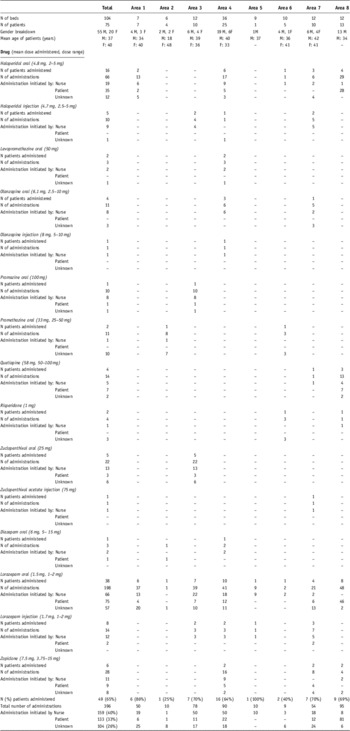
Forty nine patients (65%) were administered 15 PRN medicines over the 18 days of the study. As oral and injectable forms of the same drug were prescribed, only 11 different drugs (antipsychotics, n = 8; benzodiazepines, n = 2; and zopiclone) were actually used. Overall, 396 doses of psychotropic PRN medicine were administered. The mean number of PRN administrations per patient per day was 0.4. Details of PRN psychotropic medicine and doses prescribed but not administered have been presented elsewhere (Akram et al. Reference Akram, Slavin and Davies2014). Table 1 shows the different medicines, the mean dose administered (with dose ranges) and the frequency of administration across the Health Boards. Oral forms of lorazepam (n = 198 administrations) and haloperidol (n = 66) were administered the most frequently followed by oral zuclopenthixol (n = 22), lorazepam injection and quetiapine (both n = 14). (Zopiclone was administered 28 times but exclusively as a hypnotic at 10pm, and therefore excluded from further analysis.) Zuclopenthixol acetate (Acuphase®) was only administered once during the study period. The mean doses administered for oral and IM forms of lorazepam were 1.5 mg and 1.7 mg respectively. The mean doses for oral and IM haloperidol were 4.8 mg and 4.7 mg respectively. Forty percent (n = 159) of PRN administrations were initiated by the nurse, with 34% (n = 133) initiated by the patient. The status of the remaining 26% of administrations (n = 104) was unknown as no details were found in the patient's medical or nursing notes. See Table 1.
Administration of psychotropic PRN medication by health board area

Time of PRN administration
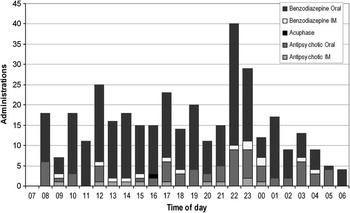
The majority of PRN doses were administered late at night (10–11pm) as shown in Figure 1. Although, peaks in administration occurred throughout the day, for example at lunchtime (12pm), teatime (5pm) and visiting time (7pm). (The hypnotic zopiclone which was always administered at 10pm is excluded to avoid skewing the findings towards night-time administration.)
PRN doses administered over 24hrs

Rapid tranquillisation (RT)
Ten patients (13%) received an IM injection, although 25 IM injections were administered in total. On 10 out of the 25 occasions, the patient received an injection of both haloperidol and lorazepam which was classed as RT. Four patients were restrained whilst receiving their RT dose. Records detailing the post RT monitoring of physical health parameters were patchy and the majority of responses to the question ‘is monitoring in place?’ were recorded on the data collection form either as ‘Don't know’ or were left blank. Out of the potential 25 instances of RT monitoring, none were recorded as ‘Yes’ with three recorded as ‘No’. We are unable to categorically state whether monitoring occurred or not due to the lack of clear and accessible details in patient's notes and the data collection forms. See Table 2.
Incidence of RT by health board area

Discussion
This study provides an insight into the administration of psychotropic PRN medication in Scottish PICUs. The overall prevalence rate for PRN administrations was 65% but the rate of administration varied greatly across the health boards. In Area 1, the prevalence was as low as 25% whereas Area 5 (who returned data for only one patient) the rate was 100%. Nevertheless, the 65% rate is slightly lower than the 70–80% reported in other in-patient populations (Hales & Gudjonsson, Reference Hales and Gudjonsson2004; Baker et al. Reference Baker, Lovell and Harris2008). However, given the higher staff:patient ratio in PICUs compared with general in-patient facilities, a lower rate would be expected as staff availability for non-pharmacological interventions is likely to be greater.
Lorazepam and haloperidol were the most commonly administered psychotropic drugs for PRN use. A London based study of adult psychiatric wards (Stewart et al. Reference Stewart, Robson, Chaplin, Quirk and Bower2012) also found high use of lorazepam, with it being administered in almost half of all occasions (48%), followed by haloperidol (18%). A greater concern arising from our findings is that, for both drugs, the mean dose administered as an injection and orally is so similar. This suggests that no allowance is being made by prescribers for the differences in bioavailability that arise from different routes of administration. Haloperidol undergoes significant first pass metabolism in the liver, so plasma levels from oral ingestion will be significantly lower than those from an IM injection. Adverse effects are more likely to occur when comparative doses of the injection are given instead of orally. The situation may be further compromised by how the dosage is written on the prescription sheet, particularly if it prescribed as a range. Ideally, both formulations should be prescribed separately, cross referenced, and the maximum dose in 24 hours specified for both formulations again with cross referencing. Our findings suggest that there may be a lack of awareness of the issues associated with same dose prescribing of different formulations and routes of administration amongst prescribers and nursing staff from the units under investigation. The lack of knowledge about psychotropic medication amongst nursing staff has previously been identified (Bennett et al. Reference Bennett, Done and Hunt1995).
A range of antipsychotics are used for PRN administration with much variance across the country. Some health boards use low potency oral typical antipsychotics such as levopromazine and have relatively low usage of atypical antipsychotics. This appears to be a missed opportunity for substituting typical antipsychotic use (caused by the removal of thioridizine and droperidol) with newer and often better tolerated alternatives. Scottish Intercollegiate Guidelines Network (SIGN) (2013) guidelines for schizophrenia recommended that first line treatments for agitation or aggression should be ‘aripiprazole for oral administration and for intramuscular, a combination of haloperidol plus promethazine’. No instances of aripiprazole for PRN administration were found in this study. The schizophrenia SIGN guidelines were issued after this study was completed making it difficult to comment on the extent of compliance with them. The guidelines also categorically state that IM benzodiazepine use alone is difficult to justify due to concerns over respiratory depression. This recommendation could have significant impact on current practice given the high usage of IM lorazepam that has been identified. The over prescribing of lorazepam on acute psychiatric wards is a recognised phenomenon (Choke et al. Reference Choke, Perumal and Howlett2007). It would be prudent to revisit this topic to assess the impact, if any upon practice now that guidance is available. It is also worthwhile to note the lack of usage of IM midazolam. Midazolam was previously largely used for seizure control in children. When faced with the loss of IM lorazepam (Ativan®), most health boards substituted it with IM midazolam (A. Walker, Chair of the Mental Health Pharmacy Strategy Group (MHPSG), personal communication, September 2012). Anecdotally, doubts were expressed as to midazolam's suitability for PRN use given its short duration of action, which necessitates repeated administration. It could be that these doubts still remain although given the inconsistencies associated with the supply of Ativan®, increased use of midazolam may become inevitable.
The administration of a PRN dose is hugely dependent on the person initiating the medication. Generally, patient requests tend to be fewer than nurse-led initiations and are found to range between 15 and 25% (Curtis & Capp, Reference Curtis and Capp2003; Thapur et al. Reference Thapur, Palmer, Owen, Huntley, Clardy and Miller2003). Our study found a higher rate (33%) for patient requests, which were largely for benzodiazepines. Allowing patients to self-request may not be entirely in their best interest, particularly for benzodiazepines, given their propensity for dependence and abuse. Self-requests for PRN administration were found to decrease from 24 to 13% when advance orders for PRN medicines were discontinued (Thapur et al. Reference Thapur, Palmer, Owen, Huntley, Clardy and Miller2003). It would be useful to implement a similar strategy in Scottish PICUs and see if a similar reduction can occur.
The advantages of PRN administration being left to nursing discretion are well documented (Baker et al. Reference Baker, Lovell and Harris2007). However, a major problem is the potential for misuse, from a patient and nursing perspective, i.e. giving, or asking, too much or too little. Some nurses may see this task as a natural progression of their overall clinical role. However, any decision regarding the PRN process should be made according to the patient's history, mental state and an overall risk assessment. Psychotropic PRN medication is known to be given for reasons other than its prescribed indication (Baker et al. Reference Baker, Lovell and Harris2007), that is, used to treat behaviour, and not necessarily to manage mental state (i.e. symptoms). Within psychiatric wards, situations may arise where psychotropic PRN medication is seen as a ‘quick fix’. An insidious culture of inappropriate PRN use can easily develop, particularly if the ward is poorly staffed or if staff are pre-occupied or unavailable. This may help to explain the observation that administration of psychotropic PRN medication is more beneficial to nursing staff than it is to patients (Thapur et al. Reference Thapur, Palmer, Owen, Huntley, Clardy and Miller2003).
Our findings complement this observation when one considers the timings around administration. PRN medicines are generally found to be administered towards the end of the working day and in the evening (Bernard & Littlejohn, Reference Bernard and Littlejohn2000; Usher et al. Reference Usher, Lindsay and Sellen2001). Our results mirror these findings. It may be that the lull in ward activity (post 5pm) and lack of structure is leaving patients anxious, agitated or plain bored. It may therefore suit both parties (nurses and patients) if medication can provide a welcome distraction. Some patients may find visiting times stressful and hence request PRN medication (appropriately or not). The patient's perception of the role and utility of PRN medication is poorly documented. A study investigating patients’ perception of psychotropic medication per se (Duxbury et al. Reference Duxbury, Wright, Bradley and Barnes2010) found that patients generally want to know what the clinical effects are and the side effects. This would suggest that informing patients as to the rationale of PRN medication, its uses and limitations is also an important area for education about medicines.
RT as defined by our criterion of ‘the administration of any type of PRN intramuscular injection’ was relatively low (13%) and almost half the rate found in Brown et al.'s (2010) study of seven PICUs in England (found to be 22%). Only one administration of zuclopenthixol acetate occurred compared to Brown et al.'s 17%. Brown et al. (Reference Brown, Chhina and Dye2010) also found a 23-fold variation between the highest and lowest using units. Current NICE guidance (National Institution for Clinical Excellence, 2005) is that Acuphase® should only be used ‘after repeated injections of short acting antipsychotic drugs have been ineffective and sufficient time to assess the full response of those medicines has elapsed’. The low use of Acuphase® amongst Scottish PICU should be further explored. Advocates of the drug will refer to its longer duration of action which can replace the need for repeated injections of other shorter acting drugs, which it could be argued can more traumatic and unpleasant for the patient.
Low use of IM medication is generally welcomed given the overall risks associated with RT. Unfortunately, we are unable to comment as to extent and quality of monitoring which accompanies episodes of RT. A recent review of RT monitoring protocols identified a three step process. All protocols support monitoring in the acute phase, 70% monitor the post-acute phase and only 5% recommend further monitoring at a later predefined point (Innes & Iyeke, Reference Innes and Iyeke2012). In Scotland, there is no national protocol and each health board operates under guidance which is similar to the monitoring recommendations found in the Maudsley Prescribing Guidelines (Taylor et al. Reference Taylor, Paton and Kapur2012, pp. 531–535). Therefore, all units should be aware of their monitoring responsibilities. It may be that our findings are a reflection of poor documentation and should not be construed as evidence for a lack of monitoring. Poor documentation associated with the administration of PRN medication in general has consistently been identified as an issue amongst mental health nurses (Choke et al. Reference Choke, Perumal and Howlett2007; Geffen et al. Reference Geffen, Sorenson, Stokes, Cameron, Roberts and Geffen2002; Hallahan et al. Reference Hallahan, Murray and McDonald2009) and are not unique to our study. However, given the lack of evidence to prove to the contrary, it currently appears that systems for RT monitoring in Scottish PICUs are perhaps not as robust and complete as they should be.
One of the main strengths of this study is the inclusion of the majority of PICUs and thus it could be considered as being representative of cross sectional practice within Scotland. The relatively low numbers of patients included, however, makes it difficult to analyse practice by individual units or to compare practice between health boards. The process of data collection also poses limitations. As the project was instigated by pharmacy personnel, it may have lacked ownership amongst ward (nursing) staff. In areas lacking pharmacy input the data was wholly collected by nursing personnel. It is possible that some eligible patients may have been missed (i.e. boarders or temporary patients, self-discharges etc.) if nurses did not view the study as a priority or necessity. It may also have resulted in selective reporting as individual units may have viewed the study as an investigation of their own practice. The dates allocated to the study and the 15 month gap between phases may have also contributed to the limitations. It is possible that the time of year (e.g. post-Christmas and pre-summer holidays) could affect patient demographics and clinician availability which would influence prescribing and practice. Nevertheless, given the retrospective nature of data collection there is greater validity of the findings through avoidance of the Hawthorn effect (Niroshan Siriwardena, Reference Niroshan Siriwardena2013).
Conclusions
This study provides an insight into the administration of PRN medication across PICUs in Scotland. It shows wide variation in practice between units, inadequate monitoring and documentation, a lack of understanding by prescribers of the differences between oral and injectable forms of medicine and relatively limited use of newer drugs.
Acknowledgements
Thanks are extended to the clinical staff who collected the data and to the MHPSG for facilitating the project, in particular Thom Shaw and Irene Sharkie. The authors are particularly grateful to the referees for their constructive comments on this paper.
The study was initiated by the Scottish Mental Health Pharmacy Strategy Group (MHPSG) which is a special interest strategic group consisting of senior mental health pharmacists with representation from addictions, academia, and the directors of pharmacy. Its remit is to promote mental health pharmacy within NHS Scotland which includes advising on policy and service development.
No financial award or grant was awarded to support the work reported in this paper.