In 2020, thousands of protests were held across the United States and across the world in the wake of the murder of George Floyd. However, not every death at the hands of police generates this level of public backlash or even any backlash at all. The conventional wisdom offers two explanations for the variation in public mobilization for victims of officer-involved deaths. First, victim behavior or dangerousness can make a difference; as one activist observed, “Some of the same people who called for justice in [George] Floyd’s case” were not doing so for Ma’Khia Bryant, a 16-year-old who was shot by Columbus, Ohio, police in the spring of 2021, because her actions meant that she was not a “perfect victim” (Cineas Reference Cineas2021). Second, the visibility of victims makes a difference to the political response: the #SayHerName campaign argues that knowing about victims of police violence is necessary but not sufficient for ensuring that “state agents cannot kill without consequence” (“About #SayHerName” 2021).
This article explores these aspects of the relationship between officer-involved deathsFootnote 1 and political mobilization. I argue that researchers cannot capture fully the mobilizing effects of officer-involved deaths without considering visibility and traceability (Pierson Reference Pierson1993). I also examine the effects of officer-involved deaths on political interest and self-reported voter turnout, taking into account incident characteristics such as the race, threat level, and visibility of the victim. Officer-involved deaths vary in terms of these factors; failing to take them into account can lead researchers to underestimate their political effects because they are looking for policy effects in places where none should exist.
The analysis deploys a novel empirical approach that accounts for observer characteristics by taking advantage of the timing of officer-involved deaths to isolate their causal impact. It relies on the 2016 Collaborative Multiracial Post-Election Survey (CMPS), a survey of 10,145 respondents that oversamples racial and ethnic minorities, merged with contextual data on officer-involved deaths, local demographics, and police performance. The resulting study examines the effects of officer-involved deaths at the local level while accounting for respondent experiences with police and other aspects of police performance that might lead to spurious correlations.
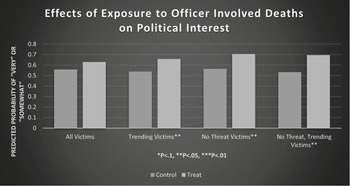
I show that exposure to deaths of high-visibility/low-threat Black victims causes Black respondents under age 40 to demonstrate statistically significantly higher political interest and self-reported voter turnout. Among the treatment group, who were exposed to deaths of high-visibility/low-threat Black victims only before they participated in the CMPS, 69.5% are expected to say that they are “somewhat” or “very” interested in politics, an increase of 16.2 percentage points over the control group, who were exposed to such victims only after they took the survey. With respect to voter turnout, 60.7% of respondents in the treated group who were exposed to deaths of high-visibility/low-threat Black victims before participating in the CMPS voted in the 2016 general election, compared with only 37.7% percent of those in the control group.
Importantly, these effects do not hold for analyses of interest and voting that do not account for victim visibility, race, or threat. This finding suggests that research that investigates the political response to officer-involved deaths without taking these important factors into account may underestimate the effects of these events because it analyzes only intention-to-treat effects, ignores the proximity of observers to victims, and assumes that observers blame the government for all officer-involved deaths.
This study and its findings contribute to the literature on policy feedback, relying heavily on seminal works in this area. It extends this literature by applying key concepts such as visibility and traceability to government actions that do not involve the provision of financial benefits. Understanding the effects of the visibility and traceability of officer-involved deaths on political interest and voter turnout is crucial for evaluating the public’s likelihood of holding politicians—particularly mayors, prosecutors, and police chiefs—responsible for problems in their police departments. By showing that visibility and traceability matter, this research clarifies the importance of police and government actors’ attempts to reduce transparency and reconstruct narratives around police and victim actions, thereby making the use of force by police part of the “submerged state” as well (Mettler Reference Mettler2011).
With respect to the literature on Black politics, this research highlights an additional mechanism encouraging Black political participation in a new generation. Black youth electoral participation has been increasing in recent elections (Rogowski and Cohen Reference Rogowski and Cohen2015). Progressives have argued that mobilization against police violence increased Black voter turnout in the November 2020 general election (Grim and Lacy Reference Grim and Akela2020). This research establishes that deaths of low-threat Black victims like George Floyd do increase turnout and political interest among young Black people. In particular, these findings show the continued relevance of the idea that bearing disproportionate social burdens (in this case race and age) can mobilize disadvantaged communities (Dawson Reference Dawson1994; Soss and Schram Reference Soss and Schram2007).
Review of the Literature
Two measures of political engagement are studied in this article: political interest and voter turnout. Political interest is the “willingness to pay attention to politics possibly at the expense of other phenomena” (Lupia and Philpot Reference Lupia and Philpot2005, 1122). Robison (Reference Robison2014, 16) helpfully separates interest into state and trait, defining situational interest as “a temporally bounded state involving increased attention, focus, and cognition concerning the object of interest.” Political interest is often a precursor to other important phenomena such as political knowledge and participation (Carpini and Keeter Reference Carpini and Keeter1996; Verba, Schlozman, and Brady Reference Verba, Schlozman and Brady1995). Verba and coauthors argue that political interest increases participation in politics (1995, 345). Brady, Schlozman, and Verba (Reference Brady, Schlozman and Verba1999) also find that politically interested people are easier to mobilize into politics.
Meanwhile, voting in elections depends on many factors. Verba, Schlozman, and Brady’s (Reference Verba, Schlozman and Brady1995) civic voluntarism model relies on differences in individual resources, attitudes, and motivations to explain participatory inequality in society. They argue that many people fail to participate because they cannot: they lack the resources such as time, money, and civic skills; they lack the sense of duty or connectedness that comes from mobilization; or their attitudes lead them to disconnect from politics entirely. The civic voluntarism model relies on rational choice assumptions about participation: individuals choose to participate in or abstain from politics based on whether they believe the benefits they receive from participation will outweigh the associated costs of activity (Downs Reference Downs1957).
Two factors influence the likelihood that an observer will engage politically in response to an officer-involved death: the visibility and traceability of the incident (Pierson Reference Pierson1993). These factors are vitally important; without them, punishing government actors for an outcome “becomes virtually impossible” (Arnold Reference Arnold1990, 48). Each is discussed next.
Visibility
Policy effects must be perceptible to generate a citizen response (Arnold Reference Arnold1990, 48). Pierson (Reference Pierson1993, 622) further refines this concept as visibility, the idea that “voters must experience some discernible outcome that leads them to inquire about the cause of this outcome.” Arnold (Reference Arnold1990, 49) argues that “without perceptible effects there is nothing to activate the search process” that would lead a citizen to find a cause.
In many instances, voters seeking to hold politicians accountable face information constraints and lack the knowledge they need to monitor government activity (Pierson Reference Pierson1993). The use of force by police, even lethal force, is particularly difficult for the public to assess. Neither police departments nor local governments willingly make information on officer-involved deaths readily available in most cases. The consensus is that there are no reliable, consistent data on policing with respect to the use of force, use of lethal force, complaints, or even Terry stops available over time and across the country. Existing data typically come from agency self-reports, FOIA requests, or, more recently, attempts to collect data by news or nonpartisan organizations. As a result, most officer-involved deaths lack salience and are not known widely to the public, despite the use of social media to publicize some incidents: fewer than half of the victims of officer-involved deaths examined for this study trended on Google in their local area at the time of their killing.
Several scholars argue that the informational deficits faced by the public can create incentives for politicians to manipulate the information available to voters to avoid being blamed for bad outcomes (Hacker and Pierson Reference Hacker and Pierson2005; Pierson Reference Pierson1993; Weaver Reference Weaver1986). The evidence suggests that police and cities work actively to make their use of lethal force less visible to the public, as these theories suggest. For instance, in the case of Laquan McDonald, who was killed by Chicago police in 2015, paying McDonald’s family millions of dollars for their silence and fighting the release of the dash cam video of his death were ways for the city to keep the story of McDonald’s death from getting out (Harcourt Reference Harcourt2015). Public officials also may obscure the use of force by blaming the death on a medical condition. George Floyd was killed by Minneapolis police officer Derek Chauvin in May 2020 after Chauvin knelt on Mr. Floyd’s neck for more than nine minutes. However, the initial statement released by the Minneapolis Police Department, titled “Man Dies after Medical Incident during Police Interaction,” denied that officers injured Mr. Floyd and failed to mention that officers used any force against him other than handcuffing him (Wade Reference Wade2021). More generally, the failure to provide data or to investigate police use of force contributes to the lack of public visibility (US Department of Justice 2017).
Despite these barriers to visibility, there are several ways that the public can become aware of deaths involving police operations. As Arnold (Reference Arnold1990, 49) notes, “Groups that suffer major costs under a particular governmental policy help to spread the word about how the incumbent contributed to their plight.” Organizations such as Black Lives Matter often serve this function. Even single individuals can help: the facts surrounding officer-involved deaths also may get out to the public through the actions of “networked microcelebrities,” who are citizen-journalists using their social media presence for “reporting on the events, advocating for the cause, attempting to attract attention to the event and often also portraying a first-person, in-the-middle-of-it account of a highly charged, personally high-stakes situation” (Tufekci Reference Tufekci2013, 848). The media can increase visibility, and news organizations do report on some police shootings or killings and have been doing so increasingly in recent years. Several news organizations, including the Washington Post, now maintain databases of officer-involved deaths.
Proximity, which can be thought of as an observer’s closeness to an outcome or how affected they are by an outcome, also increases visibility. One definition of proximity focuses on “whether those affected are part of a network” of other affected people (Pierson Reference Pierson1993, 622). Some people may learn about fatal incidents through social media, family, or community connections. To the extent that these experiences are shared among family, friends, and other interpersonal networks, the visibility of victims may be heightened, especially at the local level. However, when victims and their families lack extensive interpersonal connections, their killing still may not become known to the wider public.
Another definition of proximity, from Soss and Schram (Reference Soss and Schram2007, 121), focuses on whether incidents exist “as a tangible presence affecting people's lives in immediate, concrete ways versus existing as a distant object appraised for its effects elsewhere.” Proximity may be geographic, temporal, or social, such as by race, class, or gender. Experiencing negative effects of government actions “in immediate, concrete ways” is particularly effective for heightening visibility (121). Arnold (Reference Arnold1990, 51) claims that experiencing “large and perceptible costs, then, are the principal stimuli” leading citizens to hold voters accountable. Such disproportionate burdens heighten visibility (Mettler and Koch Reference Mettler and Koch2012). In particular, Black people are killed disproportionately by the police (Edwards, Esposito, and Lee Reference Edwards, Esposito and Lee2018), and such racial disproportionality in burdens has been shown to increase the visibility of government actions, especially among minority groups (Michener Reference Michener2019; Rosenthal Reference Rosenthal2020). A similar dynamic may be at play among young people, who also are killed disproportionately by police (Edwards, Esposito, and Lee Reference Edwards, Esposito and Lee2018). Finally, geographic proximity may make it more likely for those people who are closer to a shooting to know about it (Cohen et al. Reference Cohen, Gunderson, Jackson, Zachary, Clark, Glynn and Owens2019).
Traceability
Traceability is the ability of citizens to “link [an] outcome to some government action” (Pierson Reference Pierson1993, 622). According to Arnold (Reference Arnold1990, 48), “Identifiable governmental actions are the specific deeds that citizens believe caused the perceptible effects.” Traceability, like visibility, is malleable (Arnold Reference Arnold1990; Hacker and Pierson Reference Hacker and Pierson2005; Pierson Reference Pierson1993): it is “a subjective process that depends on what citizens believe about cause and effect” (Arnold Reference Arnold1990, 48). A key component of the traceability of an action or policy is its complexity; actions with long causal chains or multiple “stages or uncertainties” are less traceable (Pierson Reference Pierson1993). In fact, Arnold (Reference Arnold1990, 50) argues that “traceability is nearly impossible for any effects that stem from a multitude of complex governmental actions.”
With officer-involved deaths, the details make a difference to whether an incident is traceable to the fault of the individual officer or officers, the police department, or the city. At least two factors may affect the ability of citizens to trace government actions to a particular victim’s death: whether an officer used force to kill a person and whether the officer or the victim was the cause of the use of force. Both factors complicate the causal chain between deaths and government actions.
With respect to whether an officer used force to kill a person, an injury may seem obvious given that the person died. In a typical year, about three-quarters of officer-involved deaths involve lethal force such as a gunshot. Usually, these injuries are clearly the result of police action, though in situations where there are multiple shooters, there may be some doubt about who fired the fatal shot.
However, the situation is less clear when the person dies after an officer used nonlethal force, such as restraints or tasers (White et al. Reference White, Ready, Riggs, Dawes, Hinz and Ho2013). These causal chains often are complex because they involve multiple factors. Research shows that using tasers or restraints on people under the influence of drugs or in medical distress can exacerbate medical distress or even cause death, such that many departments restrict their use on people in crisis ( Pasquier et al. Reference Pasquier, Carron, Vallotton and Yersin2011; "Positional Asphyxia" 1995; US Department of Justice 2017). Official reports may attribute those deaths to the medical issues while minimizing the contribution of the restraint or shock to the death (White et al. Reference White, Ready, Riggs, Dawes, Hinz and Ho2013). For instance, excited delirium, a controversial medical condition “associated with severe agitation and autonomic arousal,” has been blamed for sudden deaths in custody, but many subjects whose deaths are attributed to excited delirium were restrained, tasered, or asphyxiated with chokeholds or knees to the neck (O'Brien and Thom Reference O’Brien and Thom2014; Truscott Reference Truscott2008).
Sometimes officer-involved deaths occur when officers do not use force, such as in car accidents. Often these causal chains are complex as well, making the deaths difficult to trace to officer actions. In some cases it is not clear that an officer directly caused the injury, and in some jurisdictions suspects who kill bystanders or passengers while fleeing police are charged with murder (“Sentencing Pushed Back” 2017). However, even when fleeing suspects hit bystanders during a police chase, cities may sometimes pay damages for liability.
As mentioned, most victims are killed by a gunshot or other injury at the hands of police. In these circumstances, for a death to be the fault of the officer or the government, it matters whether the death was justified. People can and do disagree vehemently about what constitutes a justified police killing and even whether such entities can exist at all. However, the prevailing legal regime has outlined that the dangerousness of the victim is the key component in determining whether a use of force, including lethal force, was justified.
In Tennessee v. Garner (1985), the Supreme Court found that an officer shooting a person to defend himself, other police officers, or another person from imminent danger is a legitimate use of lethal force; lethal force also may be used to prevent escape when “the officer has probable cause to believe that the suspect poses a significant threat of death or serious physical injury to the officer or others.” However, the Court clearly stated, “A police officer may not seize an unarmed, nondangerous suspect by shooting him dead,” even if he is fleeing. In contrast, 12 states still allow officers to use any force, even lethal force, to apprehend a felony suspect, regardless of dangerousness (Flanders and Welling Reference Flanders and Welling2015).
The Supreme Court further refined the use of force in Graham v. Conor (1989), retaining the emphasis on the danger posed by the person being arrested. In Graham, the Court articulated a three-prong test for evaluating whether police used appropriate force on a suspect. First, it is important to consider the “severity of the crime at issue”; second, “whether the suspect poses an immediate threat to the safety of the officers or others”; and third, “whether he is actively resisting arrest or attempting to evade arrest by flight.”
Even these supposedly clear legal standards are difficult to apply in practice, and reasonable people still disagree about whether a police action was justified. For instance, in Scott v. Harris (2007), police chased a driver for miles, eventually rear-ending him to disable his vehicle, paralyzing him in the resulting crash. Although everyone watched the same video of the chase and accident, the Court divided 8–1 in support of the police action, with one justice and several lower courts arguing that the use of force was unreasonable. An analysis by Kahan, Hoffman, and Braman (Reference Kahan, Hoffman and Braman2009) also showed that laypeople disagreed about whether the use of force was justified and found that observer characteristics, particularly race, shaped their responses to the case.
Further complicating the causal chain is the notion that perceptions of dangerousness often depend on factors such as the criminal background, race, or gender of the person who was killed. Such stereotypes about victims can influence whether people interpret police actions in any given case as just or unjust (Peffley and Hurwitz Reference Peffley and Hurwitz2010; Perkins and Bourgeois Reference Perkins and Bourgeois2006). These characteristics can make victims seem more or less sympathetic and more or less deserving of burdens and punishment, regardless of their actual behavior during an encounter with police (Schneider and Ingram Reference Schneider and Ingram1993; Zhang et al. Reference Zhang, Shah, Foley, Abhishek, Lukito, Suk, Kim, Sun, Pevehouse and Garlough2019).
Criminal background is an important factor shaping perceptions of whether the use of force was justified. It is built directly into the test articulated in Graham to the extent that the severity of the current offense is considered in terms of dangerousness. People who commit crimes are perceived negatively and as deserving of punishment and societal burdens (Schneider and Ingram Reference Schneider and Ingram1993; Zhang et al. Reference Zhang, Shah, Foley, Abhishek, Lukito, Suk, Kim, Sun, Pevehouse and Garlough2019). The evidence suggests that some members of the public are supportive of the use of lethal force even against people who are arrested for less dangerous offenses: Cullen and coauthors (Reference Cullen, Cao, Frank, Langworthy, Browning, Kopache and Stevenson1996) found that 15–20% percent of respondents would approve of police using deadly force to stop a person fleeing after stealing a purse, jewelry, or a car, and 40% would approve of using deadly force to stop a suspect fleeing after selling drugs or burglarizing a house (a scenario the Court explicitly deemed unacceptable in Garner).
Race is key to evaluations of officer-involved deaths as well. Early research has shown that African American suspects are perceived as more dangerous than white suspects, and racial stereotypes about Black people affect how white observers view police use of force (Dukes and Gaither Reference Dukes and Gaither2017). African American deaths also generate less sympathy on social media (Zhang et al. Reference Zhang, Shah, Foley, Abhishek, Lukito, Suk, Kim, Sun, Pevehouse and Garlough2019). Yet, recent research has shown that campaigns by Black Lives Matter have moved the public to view officer-involved deaths of Black victims with greater suspicion. Research subjects were more likely to view officer-involved deaths of Black victims as unjustified and to believe that officers were more guilty of errors when they shot Black victims (Huff, Alvarez, and Miller Reference Huff, Alvarez and Miller2018; Pica et al. Reference Pica, Sheahan, Pozzulo and Bennell2020).
Gender also is related to victim dangerousness. Female victims are constructed as defenseless and vulnerable, whereas maleness is associated with dangerousness (Hollander Reference Hollander2001). Race and gender can interact, such that gender operates differently for minority women than for white women in determining dangerousness.
Existing Literature on the Political Effects of Officer-Involved Deaths
The relationship between policing and political activity has received more scholarly attention in the wake of numerous high-profile demonstrations against police violence. The evidence so far supports the notion that at least the Black public mobilizes in response to police actions. Several studies suggest that communities do mobilize in response to police actions. The most famous document to link problem policing to Black mobilization is perhaps the 1968 Kerner Commission report. However, other work also finds “violations of one racial group by the other” such as rape, murder, assault, and police brutality (Lieberson and Silverman Reference Lieberson and Silverman1965, 887) and police brutality in particular (Bergeson 1982) responsible for the urban unrest of the 1960s and 1970s. More recent evidence supports the notion that aggressive practices, such as stop-question-and-frisk or the use of lethal force, can increase political engagement such as voter turnout, protest, and other activities (Ang and Tebes Reference Ang and Tebes2021; Enos, Kaufman, and Sands Reference Enos, Kaufman and Sands2019; Laniyonu Reference Laniyonu2019; Owens and Walker Reference Owens and Walker2018; Streeter Reference Streeter2019; Walker Reference Walker2014; Williamson, Trump, and Einstein Reference Williamson, Trump and Einstein2018).
However, some research does find that the use of force by police does not increase civic engagement. Recent work by Cohen and colleagues (Reference Cohen, Gunderson, Jackson, Zachary, Clark, Glynn and Owens2019) finds no relationship between exposure to officer-involved deaths and calls to 311 or 911 in Los Angeles. Zoorob (Reference Zoorob2020) also finds that exposure to police brutality has no effect on calls for service.
Hypotheses
I argue that, for observers to mount a political response to officer-involved deaths, they must overcome a high burden: they must know about the incident and blame police for it. Thus, for most observers, I expect that officer-involved deaths will not affect political interest or voter turnout. However, because visibility and traceability are highly malleable and depend on observer, victim, and incident characteristics, I expect that political engagement in response to officer-involved deaths will be more likely in certain scenarios. First, highly visible victims should be more likely to generate a response. Second, traceability matters, and the ability to place blame on officers rather than victims should lead to a citizen response. Finally, as Soss and Schram (Reference Soss and Schram2007) note, the proximity of the observer to the incident should increase visibility and traceability and should make a response more likely. Therefore, I expect the following:
H1: Officer-involved deaths of victims who do not pose a threat to officers will increase political interest and voter turnout.
H2: Officer-involved deaths of high-visibility victims will increase political interest and voter turnout.
H3: Observers who bear burdens of officer-involved deaths disproportionately should increase their political interest and voter turnout in response to officer-involved deaths.
Data, Research Design, and Methods
The data for this study primarily come from the 2016 Collaborative Multi-racial Post-Election Survey (CMPS). Questions for this survey were generated by a team of 86 social scientists. The survey was fielded using an online platform and was available in five languages. The size of the total sample was 10,145, and it oversampled racial and ethnic minorities, with sample sizes of 3,003 Latinos, 3,102 Blacks, 3,006 Asians, and 1,034 whites. The interviews were completed between December 3, 2016, and February 15, 2017. The main analysis includes only the Black sample of the CMPS.
Because it is unmatched by other surveys in providing measures of potentially confounding factors such as criminal justice involvement and crime victimization, along with dependent variables that are of interest to political scientists, the CMPS is the best survey for this analysis. Its large, nationally representative sample of racial minority groups also lends itself to analyzing a phenomenon that is somewhat rare, which is living in close proximity to an officer-involved killing. In addition, there is some evidence that the CMPS offers a representative national sample of Black Americans (Barreto et al. Reference Barreto, Frasure-Yokley, Vargas and Wong2018, 177). There are several demographic similarities between the CMPS and other samples of Black Americans with respect to income, partisan identification, homeownership, and other factors (177).Footnote 2 As shown in the online supplemental appendices C and D, Black CMPS respondents come from dozens of cities across the United States.
Previous research notes that the failure to account for differences across geographic units that might correlate with political and policing outcomes can lead to “an inaccurate estimate of both the causal effect of exposure to police violence and the direction of its association with civic engagement” because exposure to police violence is not random (Cohen et al. Reference Cohen, Gunderson, Jackson, Zachary, Clark, Glynn and Owens2019, 1113). Individual demographic factors such as race and class are obvious examples, but contextual factors such as the presence of social justice organizations or neighborhood poverty might matter too. As a result, simple comparisons of interest and turnout between respondents who were exposed to officer-involved deaths and those who were not would be biased, because such an analysis cannot account for differences between people who live in places where there have been officer-involved deaths and those where they have not occurred. It is not possible to expose people to officer-involved deaths randomly, “but one may be able to introduce such random variation with the use of a discontinuity,” such as the timing of criminal justice interventions relative to events such as elections (Burch Reference Burch2007, 171; see also Hahn, Todd, and Klaauw Reference Hahn, Todd and Van der Klaauw2001; Thistlethwaite and Campbell Reference Thistlethwaite and Campbell1960). Following this method, this analysis uses the timing of officer-involved deaths relative to survey participation as a way of randomly assigning survey respondents to treatment and control conditions. The assignment mechanism relies on the idea that, among the set of respondents who live in places with officer-involved deaths, the timing of the death is random. By comparing the political activity of respondents exposed to officer-involved deaths during the short time period before they took the survey with the respondents exposed only after they took the survey, it is possible to estimate the true causal effect of exposure.
Treatment Variables
The key causal variable, exposure to one or more officer-involved deaths, relies on data from the website of Fatal Encounters, which collects crowd-sourced and newspaper-collected information on officer-involved deaths. Official sources such as the FBI’s Supplemental Homicide Reports do not present a full and accurate portrait of officer-involved deaths across the United States. According to Legewie and Fagan (Reference Legewie and Fagan2016, 15), the Supplemental Homicide Reports are off by nearly 40% because the data are missing for 19.5% of cities and many cities underreport the number of incidents by nearly 30%. They find that the fatalencounters.org data failed to include only 3% percent of the cases that fit their definition of officer-involved deaths, a significant improvement over the federal data.Footnote 3 Legewie and Fagan excluded 17% of Fatal Encounters data because they did not fit their definition of officer-involved deaths. Similarly, my analysis, which looks at different years, excludes the 15% of incidents that Fatal Encounters attributes to suicides.
Creating the treatment variables required several steps. First, both previous research (Cohen et al. Reference Cohen, Gunderson, Jackson, Zachary, Clark, Glynn and Owens2019) and the theory suggest that geographic and temporal proximity will affect the political response, so this study is designed to look for effects only in the immediate vicinity of the incident (Soss and Schram Reference Soss and Schram2007). The first step calculates the number of officer-involved deaths of Black victims up to one mile of each respondent’s zip code boundary that took place up to one year before or one year after the date the respondent completed the CMPS. Next, I removed from consideration respondents who did not experience any officer-involved deaths either a year before or after they completed the survey and those who experienced officer-involved deaths in both time periods.
Visibility
Although actual exposure to a death cannot be tested directly with these data, it is possible to determine the visibility of a death more generally using Google Trends. Several studies have used Google Trends data as a measure of public attention to particular phenomena (Lee, Kim, and Scheufele Reference Lee, Kim and Scheufele2016; Semenza and Bernau Reference Semenza and Bernau2020). This service “analyzes a percentage of Google web searches to determine how many searches were done over a certain period of time.”Footnote 4 For any search term entered, Google Trends returns a number between 0 to 100 that indicates the popularity of that search term relative to others within a certain location and time period. Google Trends filters out terms that few people are searching for, such that “search terms with low volume appear as 0 for a given time period” or as not having enough data.
I entered each victim’s name and location into Google Trends to obtain the city and national scores. Incidents counted as “trending” if the city-level or national-level score was higher than 30; this identified victims who generated even a moderate level of interest. Based on this criterion, 45.5% percent of victims of officer-involved deaths in the Fatal Encounters database who died within one mile of any CMPS respondent a year before or after the respondent took the survey trended on Google.
Although this research design does not allow for the testing of exposure directly, it does allow us to distinguish among deaths by their visibility to a particular respondent. Constraining geographic proximity and, then within that constraint, looking only at deaths that garnered a lot of public attention should help alleviate concerns about intention-to-treat effects. If these two design features do not approximate exposure adequately, then there should be no difference in political effects between analyses that look at all deaths and those that look only at trending deaths.
Traceability
As the theory argues, the most important component of traceability with respect to officer-involved deaths involves victim and officer culpability. As noted in the literature review, observers may use many factors in determining whether they think officers were justified in using lethal force in a particular incident, including victim race, officer race, incident location, and victim gender. This study examines just two legally relevant dimensions: whether the victim was posing a serious threat to the safety of officers or bystanders when their death occurred and whether officers followed proper procedures during the encounter. Videos and court records, news reports, and official reports were used to code victim behavior into three categories: 1, if the victim was clearly not posing a threat to officers or others at the time of death, and 3, if the victim was posing a clear threat. The middle category, 2, is reserved for instances in which the victim may have engaged in some type of threatening behavior, but officers may have made a mistake or acted outside of protocol. Another way of considering this coding, from the perspective of the officers’ behavior, is that in categories 1 and 2, the officer bears some or all responsibility for the death of the victim; in Arnold’s language, the government’s role in the outcome is identifiable.
This threat assessment was completed for the victims who were killed within one mile of a CMPS respondent. Because perceptions of victim threat and officer responsibility can differ across observers, as the literature review describes, even in the presence of a rule or standard like that articulated by the Supreme Court, at least two coders coded each victim. The two coders’ ratings matched in 68.5% of cases. A victim is considered “low threat” in this analysis if any coder thought the victim was posing no threat to officers or others or thought the police were at least somewhat culpable for the victim’s death. To restate, victims are considered low threat if they were coded 1 or 2 by any coder. Using these criteria, 47.2% of victims were high threat, and 52.8% were low threat. At least one coder rated 23.85% of victims as 1, or no threat (see the online supplementary appendix for more information on the coding scheme).
The analysis varies exposure to victims based on threat level and visibility. Comparing the effects of exposure under these different circumstances should show the importance of accounting for visibility and traceability when estimating the political effects of officer-involved deaths. For each analysis, the resulting treatment variable is exposure to officer-involved deaths. Respondents who have value 1 on this treatment were exposed to officer-involved deaths before they took the survey, but not afterward. Respondents who score zero on this treatment are in the control group: they were exposed to officer-involved deaths after they took the survey, but not before. Thinking about the importance of social proximity, particularly race and age, the effects of the independent variables on the dependent variables are analyzed for Black respondents under age 40, which is the median age of the Black sample in the CMPS. The respondents represent a wide variety of places. For instance, for the analysis of political interest, the 166 respondents in the control group in the “All Black Victims” condition come from 91 cities, and the 207 respondents in the treated group come from 99 cities. In the “Low-Threat/High- Visibility Black Victims” condition, the 79 control respondents come from 43 cities, whereas the 95 treated respondents come from 35 cities (see the online supplementary appendix for more information on cities and sample sizes in this analysis, including those for the voter turnout analyses). For comparison, this analysis is repeated for young Black respondents exposed to victims of all races, Black respondents over age 40 exposed to Black victims, and non-Black respondents under age 40 exposed to Black victims and all victims.
Alternative Specifications and Robustness Checks
As with any analysis, it is important to consider how coding and modeling decisions affect the results. First, because the treatment and control groups contained a high number of respondents from Chicago and New York City, these analyses were repeated excluding respondents from these cities. Second, to be sure that the findings are not sensitive to the arbitrary choice of a one-mile radius, the analyses are repeated for a five-mile radius. Third, because some readers may be uncomfortable with discarding some observations in the experimental design, both dependent variables are analyzed over the full sample of young Black respondents: the causal variable of interest for this analysis is officer-involved deaths per capita within a mile of the respondent; a value of 0 means that the respondent was not exposed to deaths of Black victims within a year before taking the survey, with no consideration for whether they were exposed after taking the survey. Fourth, because setting the age cutoff at the median may seem arbitrary, the main analysis was conducted again with different age limits for the “young” sample—ages 30, 38, and 45. As shown later, the findings for these alternative specifications do not differ in terms of direction or statistical significance from those in the main analysis (results available on request).
Control Variables and Exchangeability of Treatment and Control
If the timing of the death relative to survey participation truly works as a random assignment mechanism, we should expect the treatment and control groups to be comparable across all dimensions that might affect exposure to officer-involved deaths, voter turnout, and political interest. As discussed previously, omitted variable bias often poses a problem for criminal justice research because many potentially confounding factors are unmeasured or unmeasurable. However, this study compared the treatment and control groups along an extensive set of demographic and contextual characteristics to be sure that they are similar with respect to the factors that might also be correlated with political interest, turnout, and exposure to officer-involved deaths.
At the individual level, the analysis considers indicators for race—Hispanic or Latino, Black, Asian, American Indian/Native American, and Other, with whites as the reference category (for the main analysis, all respondents are Black; however, some may have checked off additional categories as well). Respondents’ age, gender, education, employment status, marital status, parenthood, whether born in the United States, religiosity, external efficacy, organizational participation, and partisan identification all are considered in the analysis. For the analysis of election turnout, only US citizens are included. Most importantly, a scale of criminal justice contactFootnote 5 and an indicator of whether a person had been a victim of a crime in the past are included.
Contextual variables include information about demographics and electoral context. Each analysis considers the census-place-levelFootnote 6 proportion of the population that is unemployed, in poverty, Black, or a member of other racial/ethnic minorities, along with the proportion of housing units that are renter occupied (data for these variables come from the US Census Bureau for the year 2016). Previous research stresses the importance of organizations in shaping political opportunities so the place-level presence of law, politics, and civil rights organizations per capita is included.Footnote 7 Because 2016 is a presidential election year, the absolute value of the vote margin between the two major presidential candidates, Donald Trump and Hillary Clinton, is included to account for potential differences in partisan mobilization at the state level.Footnote 8
As Williamson, Trump, and Einstein (Reference Williamson, Trump and Einstein2018, 409) note, it is “easy to imagine that police-caused deaths correlate with a broader array of police behaviors, including patterns of overpolicing and police brutality.” This analysis accounts for the law enforcement context to distinguish the effects of officer-involved deaths from other aspects of law enforcement performance. With respect to preventing and solving crimes, I include the place crime rate—the total offenses reported to local police per capita—and information about the murder clearance rate of local police (murders for which a perpetrator had been arrested; Kaplan Reference Kaplan2021). Finally, to account for police misconduct, counts of unique scandals involving law enforcement collected by the National Police Misconduct Reporting Project of the CATO Institute are examined.Footnote 9 Accounting for these variables makes it possible to rule out mobilization in response to other aspects of policing, such as corruption, that may occur alongside the use of lethal force.
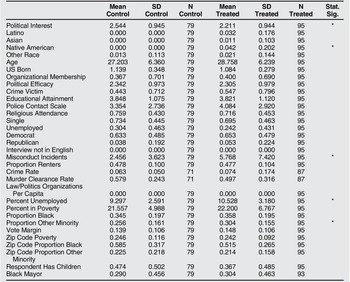
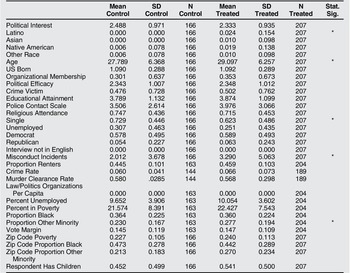
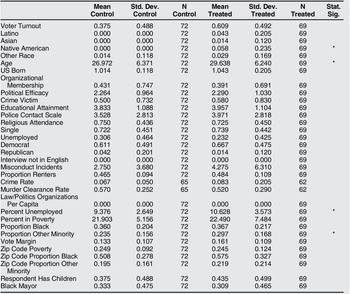
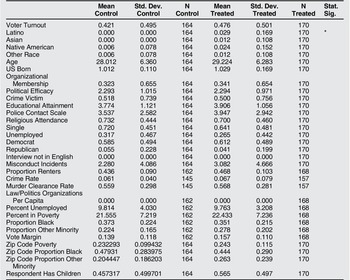
Using the timing of exposure to deaths as a random assignment mechanism does produce treatment and control groups that are exchangeable. As a randomization check, the means, standard deviations, and sample sizes of the treatment and control groups are presented in table 1 for Black respondents under 40 who experienced a police killing of a high-visibility, low-threat Black victim within a mile of their zip code and in table 2 for Black respondents under 40 who experienced any officer-involved death of a Black victim.Footnote 10 These analyses are repeated in tables 3 and 4, respectively, for voter turnout analyses (in which exposures between election day and the survey interview are deleted). Similar tables for the low-threat and high-visibility conditions are omitted for space considerations but are available on request. Notably, two-tailed t-tests on the treatment and control means show that the means are statistically significantly different between the treatment and control groups for the dependent variables, self-reported voter turnout, and political interest in the low-threat/high-visibility conditions (tables 1 and 3) but not in all victims’ conditions (tables 2 and 4). Two-tailed t-tests on the treatment and control means for each of the control variables show that means are statistically different across treatment and control groups for very few variables. The few observed differences could be an artifact of the sheer number of variables considered (the 5% threshold for statistical significance would lead us to expect some differences to be statistically significant by chance). However, of all the individual- or contextual- level control variables across the analyses, only age is correlated with both the treatment and self-reported voter turnout, and only in the low-threat/high-visibility analysis (mean difference = 2.66 years). None of the other control variables is correlated with both the treatment and either self-reported voter turnout or political interest in any analysis, which means that they can be dropped from further analysis without biasing the results (King, Keohane, and Verba Reference King, Keohane and Verba1994).
Comparison of Treatment and Control Groups Exposed to Low-Threat/High-Visibility Black Victims

Note: Significance based on two-tailed t-tests of mean differences. No control variables are correlated with both the treatment and the dependent variable.
Comparison of Treatment and Control Groups Exposed to All Black Victims

Note: Significance based on two-tailed t-tests of mean differences. No control variables are correlated with both treatment and dependent variable.
Comparison of Treatment and Control Groups Exposed to Low-Threat/High-Visibility Black Victims, Voter Turnout Analysis

Note: Significance based on two-tailed t-tests of mean differences. Only age is correlated with both treatment and dependent variable.
Comparison of Treatment and Control Groups Exposed to All Black Victims, Voter Turnout Analysis

Note: Significance based on two-tailed t-tests of mean differences. None of these control variables are correlated with both treatment and dependent variable
In any event, the comparability of the treatment and control groups when considering so many different kinds of variables lends credibility to the idea that the groups are comparable along other, unmeasured variables as well. It is difficult to think of other variables that may be correlated with assignment to the treatment and with political engagement that have not been accounted for here. Footnote 11 Omitted variable bias should not pose problems for the analysis if the assignment to treatment and control truly is random as it appears to be.
Methods
The study considered two dependent variables. First, political interest is measured by the CMPS question, “Some people are very interested in politics while other people can’t stand politics. How about you? Are you… (1) Very interested in politics; (2) somewhat interested; (3) not that interested in politics; or (4) not at all interested in politics?” Second, voter turnout is measured using the question “Did you vote in the November 2016 election” but adds unregistered but eligible voters back into the “no” category for a total of 8,737 valid responses.Footnote 12 Because of the randomization, it is appropriate to measure the effects of exposure by comparing the average response of the treatment group with that of the control group without controlling for additional covariates. However, because the dependent variables are ordinal and dichotomous, respectively, it is useful to deploy bivariate regression and then simulate the predicted probabilities for the responses.Footnote 13 Political interest is organized into four ordinal categories, so it is analyzed with ordered logistic regression.Footnote 14 Voter turnout is a dichotomous variable, where 1 = “Yes, I voted.”Footnote 15 As discussed previously, only one of the control variables in one analysis is correlated with both the treatment and the dependent variables, and including other covariates based on balance tests could introduce bias; therefore, it is unnecessary and inappropriate to include additional covariates in these models. Due to the complexity of the models, which may be difficult to interpret based on regression coefficients alone, the results are presented by simulating the predicted values of the dependent variables based on the estimated coefficients (King, Tomz, and Wittenberg Reference King, Tomz and Wittenberg2000).
Results
The results indicate support for hypotheses H1, H2, and H3: young Black respondents have higher political interest and self-reported voter turnout in response to officer-involved deaths that they perceive and trace to government action.Footnote 16 Analyzing the data produces clear evidence that exposure to officer-involved deaths of Black victims who posed little threat to officers or bystanders or where officers acted improperly increases political interest and self-reported voter turnout among Black respondents under 40. There is also evidence that visibility matters: exposure to trending victims, regardless of threat level, increases political interest and self-reported voter turnout. Also in line with the hypotheses, failing to distinguish incidents by their level of visibility or traceability leads to null findings for both interest and turnout.
Ordered logistic coefficients may be difficult to interpret, so the predicted probability of being “very” or “somewhat” interested in politics is presented for the treatment and control groups for each experimental condition in figure 1. First, the evidence reveals that young Black people are not responding indiscriminately to officer-involved deaths: the coefficient on the treatment variable in the “all Black victims” condition is not statistically significant, and the difference between the treatment and control groups is much smaller than in the other conditions. The control groups across the four conditions are remarkably similar regardless of the victim visibility or threat level; across conditions, about 53–55% of control group respondents are predicted to say they are “very” or “somewhat” interested in politics. However, the number of politically interested individuals in the treatment groups grows across the conditions based on victim threat and visibility. In the low-threat/high-visibility condition, 53.3% of the control group is predicted to be “very” or “somewhat” interested in politics, compared with 69.5% of the treatment group. Exposure to all trending and all low-threat Black victims also statistically significantly increases political interest, though the effects are smaller. In the “all Black victims” condition the gap between treatment and control is 7.1 percentage points, which is not statistically significant.Footnote 17
Effects of Exposure to Officer-Involved Deaths on Political Interest

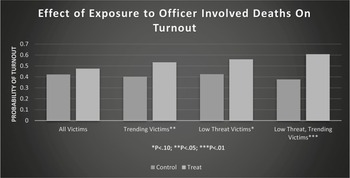
The pattern of results for self-reported voter turnout is similar to that of political interest: young Black respondents voted more when exposed to low-threat and/or high-visibility Black victims. Figure 2 shows the predicted probabilities of voting for the treatment and control groups of all the experimental conditions. As is the case with political interest, the growing difference in turnout between the treatment and control groups in the conditions that considered victim characteristics seems to be due to increased turnout in the treatment group. In the condition that considers exposure to all Black victims regardless or threat or visibility, the gap between the treatment and control groups is 8 percentage points and is not statistically significant.Footnote 18 In the group exposed only to low-threat/high-visibility Black victims, the turnout gap is predicted to be 23 percentage points and is statistically significant at p <.005. For trending Black victims, the treatment effect is positive and statistically significant at p <. 05, but for low-threat Black victims more broadly, the treatment effect is not statistically significant at p <.05 (p =.051).
Estimated Effect of Officer-Involved Deaths on Voter Turnout, by Victim Threat and Visibility

Further analysis reveals that the response of young Black people to officer-involved deaths of Black victims does not seem to generalize to other situations. Repeating the experiments with different respondents and victims shows that the effect of exposure to low- threat/high-visibility victims operates differently. First, the effects of exposure to low-threat/high-visibility victims on political interest in young Black respondents seem to go away in analyses of victims of all races; the effects on self-reported voter turnout remain the same in terms of statistical significance, albeit with slightly smaller effect sizes. Second, exposure to victims of officer-involved deaths does seem to affect young people of other races politically but in a different way: exposure to all Black victims, trending Black victims, and low-threat Black victims (but not low-threat/high-visibility Black victims) produces statistically significant increases in turnout, while political interest seems unaffected. Finally, exposure to victims of officer-involved deaths, regardless of victim race, threat, or visibility, has no statistically significant effect on interest or turnout among Black respondents over age 40.Footnote 19 More research is needed to further explore these patterns, particularly in light of the idea that social proximity may play a different role for these groups.
We can rule out several alternative explanations for the results. First, the data do not support the idea that increasing interest and turnout result from approval of the police action. In both treatment and control groups in all analyses, 70–75% of young Black respondents are expected to rank their local police as “fair” or “poor.” Regressions and t-tests do not show statistically significant differences in how young Black respondents exposed to low-threat/ high-visibility Black victims rate their local police relative to the control group.
Second, considering alternative specifications shows that the results are robust and lessens the concern that the findings are dependent on particular modeling choices. Exposure to low-threat/high-visibility victims still generates statistically significant increases in political interest and self-reported voter turnout, whereas analyses of exposure to all victims still show null effects on interest and turnout, even after excluding respondents from New York City and Chicago; changing the age limit from 40 to 30, 38, or 45; and extending the radius of exposure from one to five miles.Footnote 20 Moreover, as shown in the online supplementary appendix, exposure to low-threat, trending Black victims (measured as deaths per capita within one mile of the respondent’s zip code) increases political interest and self-reported voter turnout in the full sample of young Black respondents (although voter turnout is no longer statistically significant at traditional levels; p = 0.1). The same models, run with exposure to all officer-involved deaths of Black victims as the independent variable, still show no statistically significant effect of exposure on political interest or turnout.
Discussion and Conclusion
As is the case with many government actions, for people to respond to officer-involved deaths, such incidents need to be perceptible and linked to government action, at least in the minds of the public. This article has shown the importance of visibility and traceability in shaping at least two aspects of the public response to police use of lethal force: political interest and self-reported voter turnout. Black respondents under age 40 are more likely to pay attention to politics and vote after exposure to deaths of high-visibility Black victims who pose little threat to officers or bystanders. These factors also shape interest and turnout separately, although to a lesser extent than when considered together. These findings are robust to several modeling choices and specifications and cannot be explained away as the result of omitted variable bias or increasing support for local police.
This research shows that the political response to a burdensome government action is strongest among the people closest to it in terms of social proximity. Although racial linked fate is not tested here directly, this finding is consistent with this idea, but also with notions in the policy feedback literature that disproportionate burdens are more mobilizing. It is worth noting, however, that these limitations on mobilization are important for thinking about movement strategies going forward. As shown in the literature review, Black and young people are disproportionately likely to be killed by police. The fact that exposure to deaths of people of different races seems to mobilize Black youth less than other groups might make it difficult for activists to build lasting cross-racial coalitions against police violence. Similarly, the fact that exposure to deaths of Black people seems to operate differently for young people who are not themselves Black may affect coalition building as well.
As another limitation on the mobilization around police violence, these results confirm the conventional wisdom that the public is more likely to hold the government accountable for the deaths of “perfect victims” (Cineas Reference Cineas2021). Black lives do not matter equally, and the ways that victims are portrayed in the narratives surrounding their deaths are important for whether citizens hold the government accountable for their deaths. Because, as the literature review shows, visibility and traceability are malleable, activists and the media have an even more important role in helping publicize deaths and contest police narratives of victim behavior or dangerousness. Pushing back on official characterizations of victims could affect whether people exposed to officer-involved deaths attribute blame to the officer or to the victim, which as this article shows, could matter for engaging and mobilizing them politically.
Acknowledgements
The author would like to thank Justin Zimmerman, Andrene Wright, Michele Bueno Vasquez, and Dara Gaines for their research assistance and Reuel Rogers, Tabitha Bonilla, Al Tillery, Sally Nuamah, and Ezekiel Richardson for their comments.
Supplementary Materials
To view supplementary material for this article, please visit http://doi.org/10.1017/S1537592721003157.