Introduction
Severe Acute Respiratory Syndrome Coronavirus 2 (SARS-CoV-2), also known as Coronavirus Disease (COVID-19), originally appeared in Wuhan, China in December 2019. By March 2020, the World Health Organization (WHO) had declared a global pandemic after the virus spread to over 200 countries. A year after the initial detection of COVID-19, nearly 66.5 million cases have been reported globally, with over 1.5 million deaths. 1 The United States has remained a consistent leader in cases and fatalities, with over 14 million cases with nearly 280000 deaths as at December 7th, 2020. 1
Disease prevention strategies have relied upon population - level behavior change to reduce transmission, including social distancing recommendations. While local and regional mandates have varied throughout the United States, the fundamental recommendations regarding social distancing have remained consistent. According to guidelines published from the Centers for Disease Control and Prevention (CDC), social distancing includes maintaining a 6-foot distance in indoor and outdoor environments. 2 Practicing social distancing is advised due to the range respiratory droplets originating from an infected individual are able to spread to another person. 2 These recommendations further state that individuals should only run errands when necessary or when pick up or delivery is unavailable, avoid or significantly limit social activities and gatherings, and limit the number of people gathered from more than 1 household, always maintaining a 6-foot (or 2 meter) distance. 2 These guidelines are based on the means of COVID-19 transmission and community spread (respiratory droplets from person to person). Therefore, limiting in-person contacts can assist in limiting virus spread by decreasing the number of potentially infected individuals a person could come into contact with. 2
Although the importance of adhering to these social distancing recommendations has been persistently stressed to the U.S. population through media and public health guidelines, there continues to be ongoing concerns around lack of compliance. Furthermore, despite the critical need for research predicting health behaviors to reduce transmission during this time, there has been very little literature published to date that seeks to understand the relationship between social, psychological, and motivational factors predicting social distancing compliance in the U.S. Several international studies have sought to examine these constructs using the Health Belief Model (HBM), but very few have involved a U.S. population. Reference Clark, Davila, Regis and Kraus3–Reference Al-Sabbagh, Al-Ani and Mafrachi10 Due to the concerning rates of infection and mortality in the United States, research examining factors contributing to adherence or disregard for disease prevention strategies like social distancing is imperative.
Grounded in established social theory, the HBM has been commonly used as a framework to describe and predict health behaviors, especially those to prevent, screen for, or control illness in global contexts. Reference Clark, Davila, Regis and Kraus3,Reference Carico, Sheppard and Thomas11,Reference Glanz, Rimer, Viswanath, Champion and Skinner12 The model is based on the theory that individuals will take action or adopt health behaviors in order to avoid a health threat depending on individual perceptions of the framework’s core constructs: perceived susceptibility and severity of the illness, the benefits and barriers to behaviors, cues to action, and self-efficacy. Reference Clark, Davila, Regis and Kraus3,Reference Glanz, Rimer, Viswanath, Champion and Skinner12,Reference Siddiqui, Ghazal, Bibi, Ahmed and Sajjad13 The constructs investigated within this study (susceptibility, severity, and benefits) are briefly defined in Table 1 alongside corresponding survey questions for the constructs included in this survey. In addition to the core concepts, the HBM also recognizes that demographic, socioeconomic, psychological, and environmental variables, influence health behaviors and impact these core constructs. Reference Glanz, Rimer, Viswanath, Champion and Skinner12
Key HBM Constructs used in this study with corresponding definitions and survey questions

Since its conception in the 1950’s, the HBM has remained 1 of the most widely accepted frameworks in public health seeking to explain individuals’ adherence or avoidance of health behaviors on a global level. Reference Carico, Sheppard and Thomas11,Reference Glanz, Rimer, Viswanath, Champion and Skinner12 Historical examples of its application include vaccination studies, smoking cessation, engaging in high HIV-risk behaviors, Reference Glanz, Rimer, Viswanath, Champion and Skinner12 and compliance with medications. Reference Carico, Sheppard and Thomas11 Prior to COVID-19, the HBM was also used to assess the relationship between public knowledge and beliefs with preventative practices regarding communicable diseases. Reference Siddiqui, Ghazal, Bibi, Ahmed and Sajjad13 For example, 1 study by Siddiqui et al. exploring how these relationships applied to adoption of preventative health behaviors in the Dengue-endemic city of Karachi, Pakistan, concluded that HBM predictors such as perceived threat (susceptibility and severity) and self-efficacy were significantly associated with higher knowledge of Dengue Fever, which was highly associated with increased engagement in preventive practices. Reference Siddiqui, Ghazal, Bibi, Ahmed and Sajjad13
In the current context of the COVID-19 pandemic, the potential role of HBM concepts in increasing preventative health behaviors has been recognized worldwide. A rapid review of evidence applicable to quarantine adherence during disease outbreaks concluded that adherence can be affected by perceived risks and social norms, particularly, perceived benefits of precautionary measures and risk of disease. Reference Webster, Brooks, Smith, Woodland, Wessely and Rubin14 This review also discusses how, during past disease outbreaks such as Severe Acute Respiratory Syndrome (SARS) and Ebola, people were more likely to adhere to quarantine protocols when they believed it would reduce risk of transmission, and believed the disease to be risky in terms of severity of disease outcomes and transmission. Reference Webster, Brooks, Smith, Woodland, Wessely and Rubin14 Based on this literature, the HBM framework has been integrated into various global studies specific to COVID-19 prevention strategies and communication. A specific study has applied the HMB to better understand how individual perceptions impact engaging in positive public health practices during the pandemic. Reference Carico, Sheppard and Thomas11 The HBM has also been used to: predict intent to receive and pay for a COVID-19 vaccine in Malaysia, Reference Wong, Alias, Wong, Lee and Abubakar4 use COVID contact tracing apps in Belgium, Reference Walrave, Waeterloos and Ponnet5 understand public attitudes about physical distancing in Singapore, Reference Sesagiri Raamkumar, Tan and Wee6 and evaluate adherence to COVID-19 precautionary behavioral measures in China. Reference Tong, Chen, Yu and Wu7
Psychological components are often included in HBM frameworks, including clinical and subclinical mental health outcomes and personality traits as modifying factors. Reference Glanz, Rimer, Viswanath, Champion and Skinner12 Individuals may modify behaviors to avoid the psychological consequences of risk such as stress, anxiety and fear. Reference Mukhtar15 However, research thus far has focused on the psychological consequences of COVID-19 and social distancing rather than looking at mental health as a potential predictor of compliance. Reference Mukhtar15–Reference Zhao, Wong, Wu, Choi, Wang and Lam18 While psychological factors like stress and anxiety have not been specifically investigated within the HBM framework in the context of the COVID-19 pandemic, several sources have suggested that fear of COVID-19 may predict compliance with public health recommendations. Reference Harper, Satchell, Fido and Latzman19–Reference Al-Hasan, Khuntia and Yim21 Mental health during COVID-19 may relate to adoption of preventative health strategies during the pandemic, but further research is needed to investigate these relationships. Reference Mukhtar15–Reference Yıldırım and Güler17,Reference Al-Hasan, Khuntia and Yim21 Another study examined associations between compliance with social distancing and mental health symptoms in Hong Kong, and found that adoption of social distancing measures was associated with lower anxiety levels, Reference Zhao, Wong, Wu, Choi, Wang and Lam18 while a different 1 was conducted with an international sample in the United Kingdom, examined individual characteristics that contribute to prevention behaviors during the pandemic, and found that functional fear of COVID-19 predicted engagement in recommended behaviors such as hand washing and social distancing. Reference Harper, Satchell, Fido and Latzman19 Many of the items used to assess fear of COVID-19 in this study are comparable with anxiety measures according to the DSM-based definition. This suggests that psychological factors, like stress and anxiety, may impact how individuals adhere to social distancing recommendations. Reference Harper, Satchell, Fido and Latzman19
There is a current lack of research examining social, psychological, and motivational predictors of social distancing compliance in response to COVID-19 in the United States. HBM constructs, in addition to the psychological factors of stress and anxiety, may predict increased social distancing behaviors during the COVID-19 pandemic. With the U.S. consistently leading in cases and deaths, 1 evaluation of these factors appears increasingly important to inform current and future public health strategies. Therefore, the objective of this study was to investigate associations between HBM factors, specifically perceived threat as a motivator (susceptibility, severity), perceived response effectiveness (benefits of social distancing recommendations), psychological factors (COVID-19-related anxiety and stress), and social distancing compliance during the COVID-19 pandemic among a convenience sample of U.S. adults.
Methods
Procedure
The Mental Health and Wellbeing Survey during COVID-19 Pandemic received ethical approval from the Colorado Multiple Institutional Review Board (COMIRB Protocol #20-0676). Participants were originally recruited through convenience sampling using social media (i.e., Facebook and Instagram) at the beginning of the COVID-19 pandemic in the U.S. (April 1, 2020). Individuals were invited to participate in a longitudinal study assessing population mental health during the pandemic. Surveys were administered through the Research Electronic Data Capture system (REDCap) (Vanderbilt University, Nashville, USA) and participants clicked on a link in the advertisements to review and sign the electronic consent, and complete the survey. REDCap (Vanderbilt University, Nashville, USA) is a secure, web-based application designed to support data capture for research studies. Reference Harris, Taylor, Thielke, Payne, Gonzalez and Conde22 The final question on the survey asked participants if they were willing to complete future surveys, and if so, to provide their email addresses. Participants who consented to follow up were sent email invitations for Wave 2 of data collection 6 months after Wave 1. Once Wave 2 surveys were deployed, participants received 3 email reminders to complete the survey. Additional items were added to the Wave 2 surveys including variables pertaining to HBM constructs and social distancing compliance. The survey in Wave 2 contained 116 items. Participants were eligible to enter to receive a $50 gift card for completing the survey. The cross-sectional survey data collected between October and November 2020 was used to examine HBM factors to predict compliance with COVID-19 social distancing measures.
Measures
All variables were based on our conceptual model which was rooted in the HBM (see Figure 1). All HBM constructs were investigated as continuous variables for all analyses and are presented in Table 1.
HBM concepts applied to predicting compliance with social distancing recommendations.

HBM constructs
A single item was used to assess how participants perceived severity of COVID-19 which was scored using a Likert scale ranging from 0 = strongly disagree, to 4 = strongly agree. 23
Perceptions of susceptibility were measured with 2 items assessing participant concerns surrounding COVID-19. 23 These items were scored using a Likert scale ranging from 0 = not concerned at all, to 4 = very concerned (range = 0-8). Perceived benefit of current social distancing recommendations was measured using 6 questions all measured on a 4-item Likert scale. The questions asked participants how necessary and useful they considered a range of social distancing behaviors. Reference Rek, Freeman, Reinhard, Buhner, Keeser and Padberg24 Responses ranged from 0 = not at all useful, to 4 = very useful (range = 0 - 24).
Psychological predictors
The COVID-19 Anxiety Scale (CAD), a brief mental health screener for COVID-19 related anxiety, was used to assess anxiety directly related to the pandemic. This 5-item scale was previously validated and shown to be highly reliable (a = 0.93). Reference Lee25 The scale asked about activities related to anxiety via the question, ‘How often have you experienced the following activities over the last 2 weeks?’ and was scored with a Likert scale ranging from 0 = not at all, to 4 = nearly every day over the last 2 weeks (range = 0 - 20). The higher composite score indicated higher levels of COVID-19 specific anxiety. A single item measuring the current presence of stress was used with the question, ‘Stress means a situation in which a person feels tense, restless, nervous or anxious, or is unable to sleep at night because his/her mind is troubled all the time. Do you feel this kind of stress these days?’ Reference Elo, Leppänen and Jahkola26 Responses were recorded using a Likert scale with responses ranging from 0 = not at all, to 4 = very much (range = 0 - 4).
Outcome
Compliance with recommendations regarding social distancing during the pandemic was measured by adapting items from the CDC COVID-19 Community Survey Question Bank. 23 A 7-item questionnaire was used to assess, ‘how long have you been avoiding the following behaviors,’ and listed recommended social distancing behaviors, such as canceling in-person events and maintaining a 6-foot distance between oneself and others. The response options ranged from, 0 = I am not currently avoiding this behavior, 1 = less than 1 month, to 4 = 4 months or more. All items were aggregated resulting in a total sum score for each individual; higher composite scores indicate higher compliance for longer periods of time (range = 0 - 28).
Demographic characteristics
Age (1 = < 25 years of age, 2 = 25 - 44 years of age, 3 = 45 - 59 years of age, 4 = ≥ 60 years of age), Race (1 = White, 2 = Black, 3 = Asian, 4 = American Indian/Alaskan Native), Ethnicity (1 = non-Hispanic, 2 = Hispanic), Gender (1 = Female, 2 = Male), and Health Care Insurance (1 = Full Coverage, 2 = Partial or No Coverage, 3 = Medicaid/Medicare) were examined as predictors in the models.
Data Analysis
IBM SPSS Statistics for Windows, Version 26.0 (SPSS) (IBM, Armonk, New York) software was used for statistical analysis. Univariate and bivariate statistics were run to explore frequencies, descriptives, and correlations between variables. Hierarchical linear regression modeling was conducted to explore associations between demographic factors, HBM constructs, and social distancing compliance. First, demographic variables, including age, gender, ethnicity, and insurance status, were entered for the first block to investigate the associations between demographic characteristics and compliance. Race was dropped from the final model due to minimal variation in the sample (i.e., 95% white) (Model 1). Next, HBM constructs, including perceived susceptibility, severity, and perceived benefits, and the psychological factors of COVID-19 anxiety and stress, were entered in the second block (Model 2). Model 3 investigated interactions between anxiety and the significant HBM constructs from Model 2 (i.e., perceived susceptibility and perceived benefits). Model 4 investigated interactions between stress and the significant constructs from Model 2 (i.e., perceived susceptibility and perceived benefits). Adjusted R 2 values, coefficients, standard errors, and P - values for the linear regression models are presented. Alpha was set at 0.05.
Results
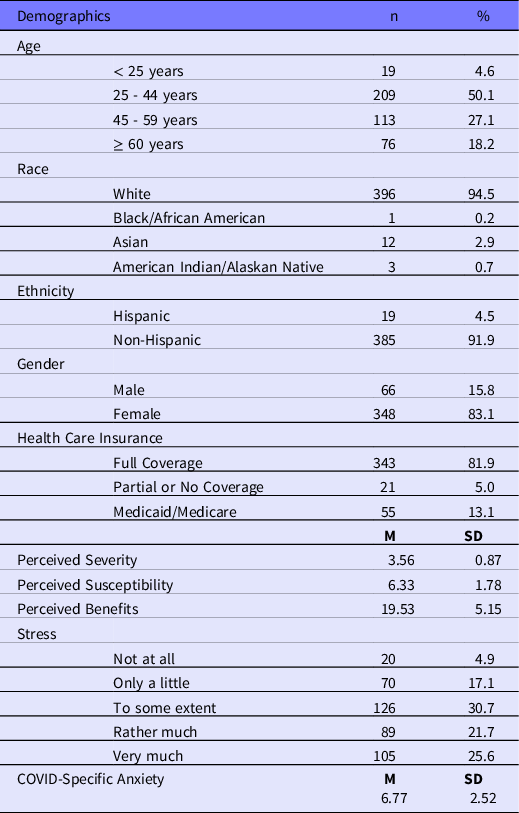
Demographic characteristics of the final analytical sample (n = 425) are displayed in Table 2. The final sample included 425 English-speaking adults in the United States, aged < 25 (5%), 25 -44 (50%), 45 - 59 (27%), and ≥ 60 (18%). The majority of the sample was female (83%). Most participants were white (95%) and non-Hispanic (92%). A smaller portion of participants identified as Hispanic (5%), Asian (3%), American Indian/Alaskan Native (1%), or Black/African American (0.2%). A total of 82% of the sample reported being fully insured, 5% reported partial or no insurance, and 13% reported receiving Medicaid or Medicare benefits.
Demographic Characteristics of Analytical Sample (n = 425)

Table 3 displays correlations between demographic variables that were examined as continuous variables (age), HBM constructs, and compliance with social distancing guidelines. Social distancing compliance was positively and significantly correlated with age (0.14, P < 0.01). perceived severity (r = 0.33, P < 0.01), perceived susceptibility (r = 0.45, P < 0.01), perceived benefits of recommendations (r = 0.64, P < 0.01), COVID-specific anxiety (r = 0.16, P < 0.01), and stress (r = 0.16, P < 0.01).
Correlations between key variables (n = 425)

**P < 0.01
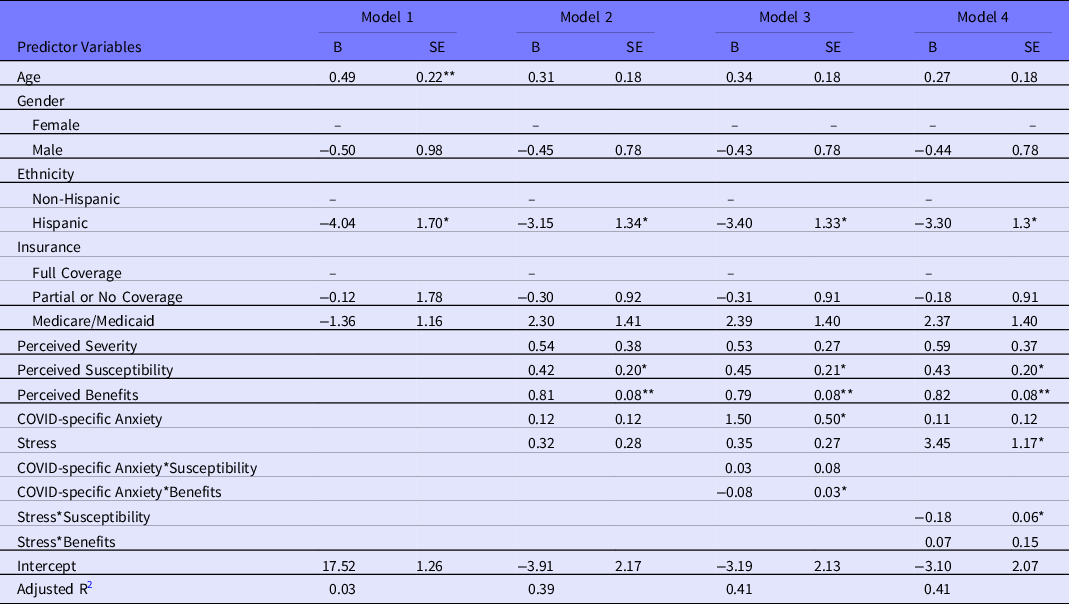
Data from the hierarchical linear regression models are presented in Table 4. Older age was associated with increase in compliance (b = 0.49, P < 0.01), but there were no significant associations found between gender and compliance. Hispanic individuals had statistically significantly lower levels of compliance with social distancing guidelines compared to non-Hispanic individuals (b = −4.04, P < 0.05). A 1 unit increase in perceived susceptibility was associated with a 0.42 increase in compliance (P < 0.05), and a 1 unit increase in perceived benefit was associated with a 0.81 increase in compliance (P < 0.01). Perceived severity and psychological factors (stress and COVID-specific anxiety) were not significantly associated with compliance after controlling for demographic variables and HBM constructs.
Linear regression models showing associations between demographic variables, health belief model key constructs, and compliance with social distancing measures (n = 425)

*P < 0.05
**P < 0.01
The interaction between COVID-specific anxiety and perceived benefits was significantly related to social distancing compliance; there may be stronger associations between perceived benefits and social distancing compliance among individuals reporting high anxiety (b = −0.08, P < 0.05). The interaction between stress and perceived susceptibility was significantly related to social distancing compliance; there may be stronger associations between perceived susceptibility and social distancing compliance among individuals reporting high stress (b = −0.18, P < 0.05).
Discussion
The COVID-19 pandemic has posed numerous challenges and has highlighted the need to advance research related to effective mitigation strategies including social distancing. The HBM provides a framework to help understand and describe predictors of population-level social distancing compliance. This study sought to fill a current gap in research by applying the HBM framework to understand how perceived susceptibility, severity, benefits, stress, and anxiety impact compliance with social distancing guidelines in the U.S., after controlling for demographic variables in a large convenience sample. These findings suggest that perceived susceptibility to COVID-19 and perceived benefits of social distancing measures are the most significant predictors of compliance with social distancing recommendations.
Perceived susceptibility and perceived benefits were found to be significantly associated with increased compliance to social distancing recommendations, but perception of severity did not have a significant effect. This is consistent with past findings; concluding that perceived benefits are most often associated with predictors of adherence to health behaviors, and that the ‘threat’ constructs of severity and susceptibility do not consistently predict behaviors. Reference Wong, Alias, Wong, Lee and Abubakar4,Reference Walrave, Waeterloos and Ponnet5,Reference Tong, Chen, Yu and Wu7–Reference Al-Sabbagh, Al-Ani and Mafrachi10,Reference Webster, Brooks, Smith, Woodland, Wessely and Rubin14 For instance, application of the HBM framework to predict intent to receive and pay for a COVID-19 vaccine in Malaysia found that high perceptions susceptibility and perceived benefits of receiving a vaccine were associated with increased intent. Reference Wong, Alias, Wong, Lee and Abubakar4 However, while intent to use a contact tracing app in Belgium was also significantly associated with perceived benefits of the app, it was not significantly associated with either of the ‘threat constructs. Reference Walrave, Waeterloos and Ponnet5
Stress and COVID-anxiety were not significantly associated with social distancing compliance in this study. Nevertheless, past studies have found that the psychological construct of fear, which may be highly correlated to anxiety, positively influenced social distancing behaviors, and had significant impacts on adoption of health behaviors. Reference Harper, Satchell, Fido and Latzman19,Reference Al-Hasan, Khuntia and Yim21 Psychological factors may also modify associations between HBM predictors and social distancing compliance. Findings from the current study suggest that there may be a stronger relationship between perceived benefits and social distancing compliance among individuals reporting high COVID-specific anxiety. Additionally, there may be a stronger relationship between perceived susceptibility and social distancing compliance among individuals reporting high stress. In this sample, there were significant, small to moderate positive correlations between COVID-19 related anxiety, stress and primary HBM predictors which may further explain some of these findings. Individuals who reported higher levels of anxiety and stress may perceive higher levels of susceptibility and greater benefits of social distancing measures, thus resulting in greater compliance with social distancing measures.
Limitations
This study includes several limitations to recognize and address in future research. First, it is acknowledged that the HBM is a complex model with numerous constructs. Due to concerns over survey length, we were unable to measure all HBM constructs in this study, so future work is needed to further investigate perceived barriers, cues to action, and self-efficacy as predictors of social distancing compliance. The addition of these constructs is particularly important when involving psychological factors and their impact on compliance with health behaviors, especially for the inclusion of possible associations between self-efficacy and psychological distress. Reference Yıldırım and Güler17 Furthermore, some of the HBM constructs that were included in this study were measured with single-item scales. Second, recruitment was conducted over social media and the survey was administered online. Therefore, the sample only includes those who have technology knowledge and internet access. Due to the convenience sampling methods, these findings cannot be generalized to the U.S. population, especially considering the predominantly white, female sample used in this study. Additionally, the cross-sectional nature of this research limits interpretations of causality. A more representative sample in the future would allow for investigation of additional demographic variables and modifying factors as predictors of social distancing compliance.
Conclusions
Despite the limitations described, the current study is informative in the application of the HBM framework to determine predictors of social distancing compliance behaviors specifically regarding communicable disease transmission in the U.S. The role of public health professionals during the COVID-19 pandemic includes examining methods to increase participation in behavioral interventions and compliance with such recommendations. These findings suggest that public health methods targeting perceived threat, and particularly perceived benefits of interventions or behaviors, may be most impactful with respect to social distancing compliance. Regardless of the success of future vaccines during this pandemic, continued research into health behavior compliance, with an emphasis on mental and behavioral health, is still needed in the subfields of public health disaster preparedness and response and population mental health. This need has been continuously illustrated by the ongoing difficulties in population compliance with disease prevention strategies like social distancing. Even when the COVID-19 threat begins to subside, the lessons learned during this time will be invaluable to the field in the future.
Conflict(s) of interest
The authors have no conflicts of interest to declare.