Introduction
Social anxiety disorder (SAD) is the marked fear or anxiety about social situations in which the individual may be exposed to the possible scrutiny of others (American Psychiatric Association, 2013). It affects a sizeable proportion of the population, with an estimated lifetime prevalence of 12.1% and a 12-month prevalence of 7.1% in the USA (Ruscio et al., Reference Ruscio, Brown, Chiu, Sareen, Stein and Kessler2008). Other countries report similar 12-month rates (Iancu et al., Reference Iancu, Levin, Hermesh, Dannon, Poreh, Ben-Yehuda and Kotler2006); such as 4.7% in Australia (Slade, Johnston, Oakley Browne, Andrews, & Whiteford, Reference Slade, Johnston, Oakley Browne, Andrews and Whiteford2009), 5.1% in New Zealand (Ministry of Health, 2012), and up to 7.9% in European nations (Wittchen et al., Reference Wittchen, Jacobi, Rehm, Gustavsson, Svensson, Jönsson and Steinhausen2011). The average onset age for SAD is early adolescence (Ollendick & Hirshfeld-Becker, Reference Ollendick and Hirshfeld-Becker2002), with the condition generally following a chronic and unremitting course across the life span (Albano & Hayward, Reference Albano, Hayward, Ollendick and March2004).
Despite the prevalence and chronic course of SAD, there is often limited time and resources to provide treatment (Goldin et al., Reference Goldin, Morrison, Jazaieri, Brozovich, Heimberg and Gross2016). The National Institute for Health and Care Excellence (NICE, 2013) recommends individual cognitive behaviour therapy (CBT) as the first-line treatment. Further support for this recommendation was provided by a recent meta-analysis of 101 trials of psychological and pharmacological interventions for SAD (n = 13,164) (Mayo-Wilson et al., Reference Mayo-Wilson, Dias, Mavranezouli, Kew, Clark, Ades and Pilling2014). A corresponding economic analysis similarly reported that individual CBT (based on the Clark and Heimberg models) was the most cost-effective (Mavranezouli et al., Reference Mavranezouli, Mayo-Wison, Dias, Kew, Clark, Ades and Pilling2015). While there are a number of alternative approaches to delivering CBT, such as internet-based and intensive treatments, results of the Mayo et al. review concluded that individual CBT, including cognitive therapy based on Clark and Wells (Reference Clark, Wells and Heimberg1995) model, consistently demonstrated the greatest effect sizes. Furthermore, that group CBT compared favourably with individual approaches (Mayo-Wilson et al., Reference Mayo-Wilson, Dias, Mavranezouli, Kew, Clark, Ades and Pilling2014). However, despite the reported effectiveness of group-based CBT, this treatment approach does have potential limitations, for example, lack of individualisation in terms of treatment plans and strength of resulting therapeutic relationships (Hauksson, Ingibergsdóttir, Gunnarsdóttir, & Jónsdóttir, Reference Hauksson, Ingibergsdóttir, Gunnarsdóttir and Jónsdóttir2017; Sochting, Reference Sochting2014).
Clark and Wells (Reference Clark, Wells and Heimberg1995) Cognitive Therapy for Social Anxiety Disorder (hereinafter referred to as CT-SAD) uses a wider range of therapeutic procedures, which aim to reverse the maintaining processes specified in the Clark and Wells model (Clark et al., Reference Clark, Ehlers, Hackmann, McManus, Fennell, Grey and Wild2006). For example, participants identify and test cognitive predictions during behavioural experiments where safety behaviours are dropped and later feared outcomes are intentionally carried out. Feared outcomes may include sweating, talking about a possibly boring topic, or pausing during the conversation. Additional exercises encourage the participant to transfer their attention from themselves to the external environment in order to identify information that challenges their negative self-beliefs and to reduce self-focused attention.
Reflecting the demand for treatment coupled with limited health service resources, there has been increasing interest in examining the effectiveness of alternative ways of delivering this therapy, for example in a group format (McCarthy, Hevey, Brogan, & Kelly, Reference McCarthy, Hevey, Brogan and Kelly2013). Some services have noted that there may be benefits of group treatment including the normalisation of symptoms within a peer group, a social context within which skills can be practised, the opportunity to learn from others, social pressure to comply with treatment and homework, and for some services, the group format may be a better fit with respect to staff and financial resources (McEvoy, Reference McEvoy2007; Wersebe, Sijbrandij, & Cuijpers, Reference Wersebe, Sijbrandij and Cuijpers2013).
Given the robust evidence base for Clark and Wells CT-SAD, it is not surprising that it is now the focus of attention in regard to effectively adapting it for group intervention (Stangier, Heidenreich, Peitz, Lauterbach, & Clark, Reference Stangier, Heidenreich, Peitz, Lauterbach and Clark2003). However, only a limited number of studies have adapted CT-SAD into varying forms of group therapy, with differing degrees of adherence to CT-SAD and its treatment protocol. One study of 71 adults with SAD evaluated individual cognitive therapy, with a predominant CT-SAD treatment focus, in comparison to a group version of this programme (Stangier et al., Reference Stangier, Heidenreich, Peitz, Lauterbach and Clark2003). While both protocols aligned closely to CT-SAD, they did incorporate additional, specific cognitive work focussed on targeting assumptions, which is not part of Clark's CT-SAD standard protocol. Both treatments resulted in significant improvement in social anxiety on the Social Phobia Scale (SPS; Mattick & Clarke, Reference Mattick and Clarke1998), Social Interaction Anxiety Scale (SIAS; Mattick & Clarke, Reference Mattick and Clarke1998), and Social Phobia and Anxiety Inventory (SPAI; Turner, Beidel, Dancu, & Stanley, Reference Turner, Beidel, Dancu and Stanley1989). However, the individual format showed larger effect sizes at post-treatment: 0.90, 0.85, and 1.77 for the SPS, SIAS, and SPAI, respectively, for individual versus 0.53, 0.53, and 0.60 for the group (Stangier et al., Reference Stangier, Heidenreich, Peitz, Lauterbach and Clark2003). On measures of mood, using the Beck Depression Inventory (BDI-II; Beck, Steer, & Brown, Reference Beck, Steer and Brown1996), the group version showed significant improvement, whereas the individual format did not. The authors concluded that individual therapy was more effective than the group version in reducing the symptoms of social anxiety but noted that the therapists had limited training and that the study should be considered exploratory.
A further longitudinal study of 252 participants with SAD examined the effectiveness of a community-based group intervention, based on CT-SAD (McCarthy et al., Reference McCarthy, Hevey, Brogan and Kelly2013). However, McCarthy et al.'s intervention included some adaptations that were not consistent with Clark's CT-SAD protocol, such as cognitive restructuring and positive data logs. Measures were collected pre-treatment, post-treatment, and at 12 months’ follow-up and showed significant reductions in SAD symptoms and general mood measures. As the majority of participants were self-referred, findings may have been impacted by a less avoidant and more motivated subset. Further, while the Stangier et al. (Reference Stangier, Heidenreich, Peitz, Lauterbach and Clark2003) and McCarthy et al. (Reference McCarthy, Hevey, Brogan and Kelly2013) studies investigated CT-SAD in a group format and demonstrated positive findings, both studies indicated limitations relating to therapists, participants, and included variations from Clarks’ standard CT-SAD protocol. Nonetheless, these findings support the proposition that CT-SAD can be incorporated into group treatment settings with positive outcomes.
A final point, Shafran et al. (Reference Shafran, Clark, Fairburn, Arntz, Barlow, Ehlers and Wilson2009) highlighted the commonly held criticism that CBT research trials may not be generalisable to routine settings and emphasised that this assumption may act as a barrier to the dissemination of evidence-based CBT. Shafran et al. highlighted that there was increasing evidence that research trials’ findings are applicable to routine clinical care settings. Accordingly, Gunter and Whittal (Reference Gunter and Whittal2010) recommended that further effectiveness studies (i.e. non-research centre outcomes) were required to contribute to the argument that CBT for anxiety disorders should be widely disseminated.
Based on the saliency of this topic area and limitations of previous research, the current study examined the effectiveness of Clark's CT-SAD protocol developed into a group therapy intervention (GCT-SAD) in a routine, clinical setting with patients who had not responded to psychological and pharmacological interventions in the community. Based on the substantial evidence for the CT-SAD approach in an individual format at reducing the symptoms of anxiety, improving mood, and reducing self-focused attention and safety behaviours, it was hypothesised that we would find similar effectiveness results for a newly developed, group format in an outpatient clinic.
The following research hypotheses were tested that after group treatment: (1) there would be a statistically significant decrease in social anxiety symptoms in participants, as measured by the SPS and the SIAS (Mattick & Clarke, Reference Mattick and Clarke1998); (2) there would be a statistically significant decrease in depression symptoms in participants, as measured by the BDI-II (Beck et al., Reference Beck, Steer and Brown1996); (3) there would be a decrease in measures of self-focused attention and safety-seeking behaviours (as measured using one item of the Social Phobia Weekly Summary Scale (SPWSS; Clark et al., Reference Clark, Ehlers, McManus, Hackmann, Fennell, Campbell and Louis2003) and the Subtle Avoidance Frequency Examination (SAFE; Cuming et al., Reference Cuming, Rapee, Kemp, Abbott, Peters and Gaston2009), respectively, as these are key therapy targets in the CT-SAD model of therapy); and (4) there would be a reduction in the measure of impaired functioning from the Work and Social Adjustment Scale (WSAS; Hafner & Marks, Reference Hafner and Marks1976).
Method
Design
This study analysed changes in SAD symptoms, depressive symptoms, self-focused attention, use of safety behaviours, and impaired functioning. Pre-treatment and post-treatment scores were compared using a quasi-experimental within-subjects design. Dependent variables analysed were SPS and SIAS scores, BDI-II scores, one item (c) of the SPWSS, SAFE scores, and WSAS scores.
Participants and Setting
Patients under the care of the Anxiety Disorders Service (ADS), Canterbury District Health Board, New Zealand, were included in this study, which took place over 4 years (2010–2014). The ADS is a government-funded public mental health service that follows a stepped care approach encouraging General Practitioners (GPs) to treat mild anxiety presentations with psychoeducation and moderate anxiety being offered counselling, community support workers, or medication. ADS only accepts referrals for adults (aged 18–65) with moderate/severe anxiety disorders who have not responded to pharmacological and counselling interventions in the community. All patients had a 90-min clinical assessment, semi-structured, interview conducted by a senior clinician (i.e. clinical psychology, mental health nurse, social worker, and occupational therapist) with substantial experience in assessing and treating anxiety disorders. This was followed by a review with a multidisciplinary team under the lead of a consultant psychiatrist for corroboration of a DSM-IV diagnosis.
After patients were assessed and accepted into the service, they were offered group or individual treatment; our research focus was only on those who accepted group treatment. GCT-SAD inclusion criteria required participants to have a primary diagnosis of SAD, to be suitable and willing to be involved in group treatment, and to be able to read English. Participants with substance dependence were not accepted into the service. Those with an acute risk of suicide were treated with individual therapy.
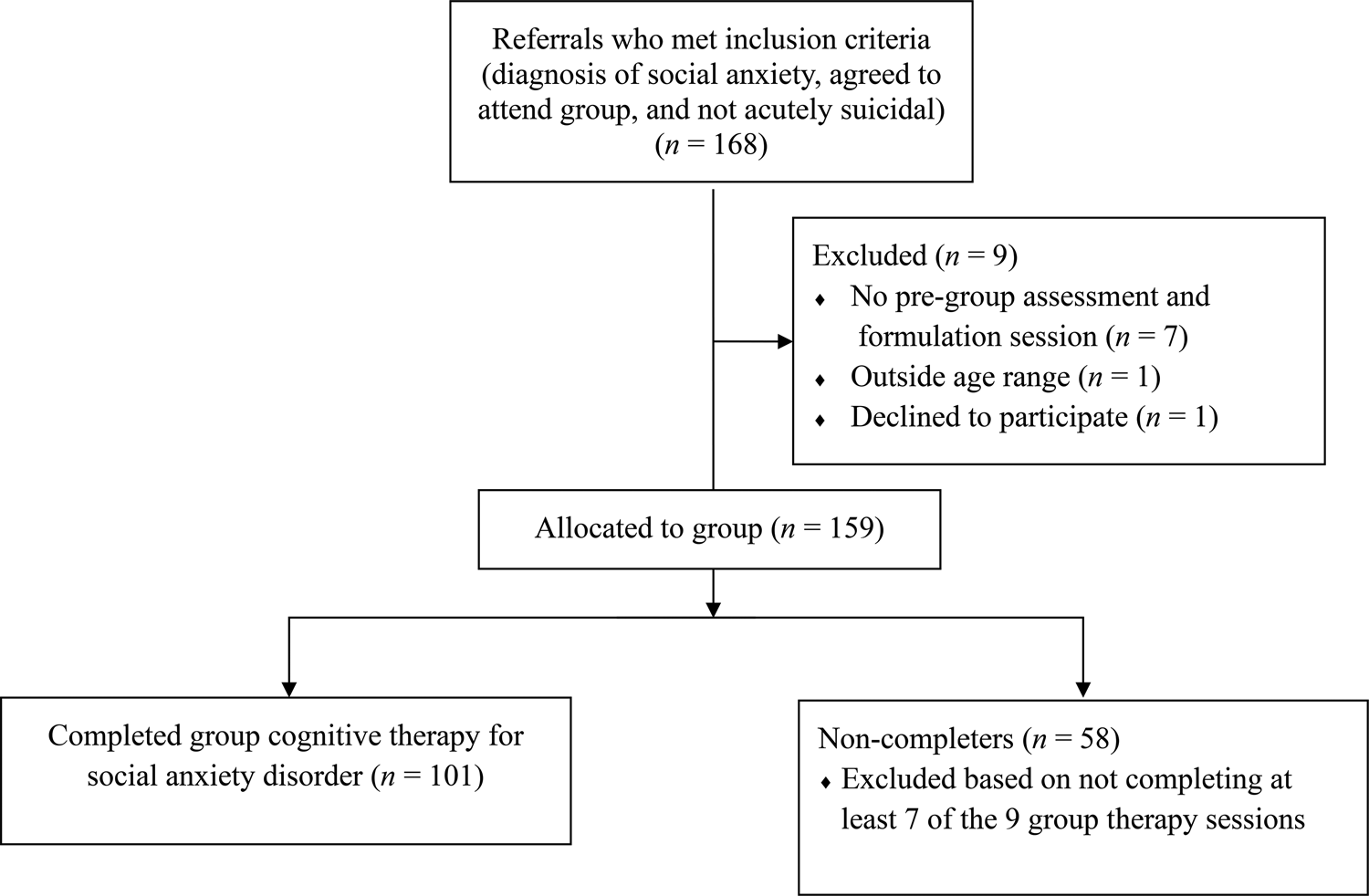
The patients were not randomised into groups but entered them as they became available. Some patients were initially hesitant to participate in group therapy; however, clinicians provided education about the group to dispel misconceptions and demystify treatment, normalised their apprehension, and socialised patients to the approach. From a sample of 168 patients who fulfilled the inclusion criteria, 9 were excluded from the current research (e.g. declined to participate in research, no pre-treatment session), resulting in a final sample of 159 who fulfilled the inclusion criteria. Of note, the participants in this study were affected by earthquakes which started in Christchurch from 2010. The first treatment group occurred between two major earthquakes and the remaining groups were exposed to ongoing aftershocks that occurred from 2010 onwards with diminishing frequency.
Procedure and the Group Treatment
Prior to treatment, participants attended an individual, 50-min, cognitive behavioural assessment and formulation session. This session further confirmed the DSM-IV diagnosis of SAD, explained what GCT-SAD would involve, and developed their own personalised version of the Clark and Wells (Reference Clark, Wells and Heimberg1995) model of SAD and set treatment goals. Informed written consent for treatment and research, and pre-treatment questionnaires were completed at this time.
Participants then attended nine weekly, 4-h sessions of GCT-SAD, with groups consisting of seven to nine participants. Two clinicians (i.e. clinical psychologist, registered nurse, social worker, and occupational therapist) specialising in the cognitive behavioural treatment of anxiety disorders were allocated to each group. At least one of the clinicians had run at least two SAD groups previously and had previous experience in using the Clark and Wells treatment modules (Clark et al., Reference Clark, Deale, Grey, Liness, Murray, Turner and Wild2004). All clinicians received supervision from senior clinical psychologists from within the team who were well versed in Clark's approach. In addition, the senior clinical psychologists provided additional group training on Clark's SAD approach and techniques to the ADS therapists running the groups. Group content was reviewed with the team over time to maintain adherence to the treatment model.
The GCT-SAD programme was based on a series of modules that were originally developed for a self-study assisted version of the treatment (Clark et al., Reference Clark, Deale, Grey, Liness, Murray, Turner and Wild2004) and were further adapted by the ADS for group therapy. The modules were given to participants at the beginning of treatment as a reference for the content to be covered in the group and they were asked to complete the relevant modules as part of their weekly homework. GCT-SAD content included: socialising people to the Clark and Wells model; psychoeducation about anxiety and cognitive therapy; letting go of self-focused attention; attention training; reducing the use of safety behaviours; dropping of worry before entering social situations and going over past events; improving self-image; and lastly, developing a therapy blueprint. Substantial time throughout GCT-SAD was focused on behavioural experiments personalised to each individual to test out cognitive predictions and reduces safety behaviours and avoidance, and in vivo behavioural experiments were conducted during some sessions. These included practising conversations while utilising external focus, visiting malls, and experiments where the person purposefully drew attention to themselves or acted in ways they believed to be unacceptable or that did not fit with their social rules (e.g. making a mistake, saying something disagreeable, or wearing silly hats). Participants were videoed giving speeches or other individually targeted behavioural experiments and these were played back to facilitate belief change through viewing themselves objectively in comparison to their internal, distorted self-image. Homework was integral; participants worked on behavioural experiments relating to their individual goals, practised skills they had learnt, re-watched their videos, and completed the relevant modules. Within 1–2 weeks of each groups’ completion, participants met with a group therapist to review their progress. Post-treatment questionnaires were completed individually.
Ethical approval for the study was provided by the New Zealand Health and Disability Ethics Committee (Ethics ref: URA/10/04/027).
Measures
Social Phobia Scale (SPS; Mattick & Clarke, Reference Mattick and Clarke1998) and Social Interaction Anxiety Scale (SIAS; Mattick & Clarke, Reference Mattick and Clarke1998) were used to measure social anxiety. These widely used scales measure performance and interaction anxiety, respectively. The 20-item SPS measures the fear of being observed by others, while the 19-item SIAS measures fears of general social interaction. Both scales adopt a 5-point response scale (0 = not at all true to 4 = extremely true). Thus, high scores represent greater levels of social anxiety. Both the SPS (α = 0.89) and SIAS (α = 0.93) have high internal reliability (Cox, Ross, Swinson, & Direnfeld, Reference Cox, Ross, Swinson and Direnfeld1998).
Beck Depression Inventory-II (BDI-II; Beck et al., Reference Beck, Steer and Brown1996) measures depressive symptoms for the past 2 weeks, with 21-items rated on a 4-point response scale (0 = I do not feel unhappy to 3 = I am so unhappy that I can't stand it). Levels of severity are indicated as Minimal 0–13; mild 14–19; moderate 20–28; and severe 29–63. The reliability and validity of the BDI-II are well established, with an internal reliability of 0.86 and test–retest reliability of 0.93 (McEvoy, Reference McEvoy2007).
Social Phobia Weekly Summary Scale; item c (SPWSS; Clark et al., Reference Clark, Ehlers, McManus, Hackmann, Fennell, Campbell and Louis2003). A single item from the 6-item SPWSS was used: ‘For social situations in general, please choose a number from the scale below to show the extent to which your attention was focused on yourself or on the external situation in the last week’. The item was scored on a 9-point scale (0 = entirely externally-focused to 8 = entirely self-focused) with higher scores representing a more self-focused attention. The SPWSS has good internal consistency (α = 0.81) and is sensitive to treatment effects (Clark et al., Reference Clark, Ehlers, McManus, Hackmann, Fennell, Campbell and Louis2003, Reference Clark, Ehlers, Hackmann, McManus, Fennell, Grey and Wild2006).
Subtle Avoidance Frequency Examination (SAFE; Cuming et al., Reference Cuming, Rapee, Kemp, Abbott, Peters and Gaston2009) was used to measure the frequency of social safety behaviour use. The SAFE is a 32-item measure, adopting a 5-point response scale (1 = never to 5 = always). The three main factors within this scale are given as follows: Inhibiting/restricting behaviours designed to avoid attracting attention (e.g. ‘remain silent’ and ‘avoid eye contact’); active behaviours aimed at enhancing self-presentation (e.g. ‘rehearse sentences in your mind’); and physical symptom management behaviours (e.g. ‘wear clothes or make-up to hide blushing’). The scale shows high internal reliability 0.95, and clear convergent and divergent validity (Moscovitch et al., Reference Moscovitch, Rowa, Paulitzki, Ierullo, Chiang, Antony and McCabe2013).
Work and Social Adjustment Scale (WSAS; Hafner & Marks, Reference Hafner and Marks1976) was employed to measure the degree of interference caused by symptoms. The WSAS is a 5-item measure, adopting a 9-point response scale (0 = not at all to 8 = very severely). The 5-items include work, home management, social leisure activities, private leisure activities, and family and relationships. The scale has a possible total score of 40, with scores above 20 suggesting moderate to severe pathology (Mundt, Marks, Shear, & Greist, Reference Mundt, Marks, Shear and Greist2002). The measure has shown adequate test–retest reliability of 0.73 (Mundt et al., Reference Mundt, Marks, Shear and Greist2002), and good internal consistency 0.80 (Allen et al., Reference Allen, White, Barlow, Shear, Gorman and Woods2009).
For the current sample, questionnaire internal consistencies (with the exception of the WSAS α = 0.67) were all satisfactory (SPS α = 0.92, SIAS α = 0.84, BDI-II α = 0.92, SPWSS α = 0.73, SAFE α = 0.88). The Cronbach's alpha for the WSAS, a 5-item scale, may have been due to the limited number of items in the scale. The value of the alpha is dependent on the number of items in the scale and as the number of items in a scale increases the alpha will increase (Field, Reference Field2013). Furthermore, the WSAS has shown good internal reliability in other studies (Allen et al., Reference Allen, White, Barlow, Shear, Gorman and Woods2009). Therefore, it was decided to leave the questionnaire intact rather than deleting items in an attempt to increase the alpha.
Data Analyses
SPSS (version 24) was used for statistical analyses. The self-reported data consisted of anxiety levels as represented by scores on the SPS and SIAS; depression levels as represented by BDI-II scores; levels of self-focus as reported by the item c score of the SPWSS scale; levels of safety-seeking behaviours as represented by SAFE scores; and functioning as represented by the WSAS. Data were manually entered into SPSS. To ensure accuracy of data entry, a 10% audit, comparing the original data set provided by the ADS against the SPSS data set, was conducted. With regard to missing data, scale data were included if 95% or more of the scale had been completed. While there is little consensus in the literature regarding an acceptable missing data cut-off rate (Dong & Peng, Reference Dong and Peng2013), Bennett (Reference Bennett2001) maintains that when the amount of missing data is greater than 10%, statistical analyses may be biased. Therefore, the exclusion rate of 5% or less was considered to be an acceptable range. Adjustments for missing data, for participants with missing data but not excluded, were made using a prorated methodology.
Data screening was conducted to ensure that appropriate assumptions were met. The Shapiro–Wilk test indicated a possible breach in normality in one instance, SPS post-treatment; however, visual inspection of the normal Q-Q plot and histogram for this scale confirmed normality. Furthermore, it was noted that care must be taken when using the Shapiro–Wilk test on larger sample sizes as significant results may occur for even slight deviations (Field, Reference Field2013). In consideration of the robustness of the data, there was no need to conduct transformations.
Dependent samples t-tests require normality of the differences between the scores on each dependent variable. All variables showed appropriate skewness and kurtosis values. Furthermore, the difference scores between all variables were normally distributed, as assessed by visual inspection of the normal Q-Q plots. Nine outliers were detected, as assessed by visual inspection of box plots. Inspection of these values did not reveal them to be extreme and they were kept in the analysis.
Pre-treatment completer/non-completer group equivalence on demographic and psychological measures was assessed by t-tests and Chi-square analysis as appropriate. Paired samples t-tests were used to compare differences pre- and post-treatment in completers’ scores. An a priori decision was to define completion as an adequate dose of therapy as attendance of at least seven out of nine treatments sessions based on previous research at the ADS and studies on group therapy (Bell, Colhoun, Carter, & Frampton, Reference Bell, Colhoun, Carter and Frampton2012; Sloan, Feinstein, Gallagher, Beck, & Keane, Reference Sloan, Feinstein, Gallagher, Beck and Keane2013). To ensure that effect sizes were not artificially inflated due to experimental mortality type effects, effect sizes were calculated using both completers’ and intention-to-treat (ITT) data. In accordance with previous research (e.g. McEvoy, Reference McEvoy2007), effect sizes were computed using the formula: (pre-treatment mean – post-treatment mean)/pre-treatment standard deviation. Effect sizes magnitude interpretations were based on Cohen's d, with d = 0.20 considered small effect, d = 0.50 considered medium effect, and d = 0.80 considered large effect (Cohen, Reference Cohen1988). Power (1−β) was set at 0.80 and alpha at 0.05.
Results
Sample Characteristics
Participants (n = 159) were classified into completers and non-completers (see above definition); 101 (64%) participants were deemed treatment completers (N = 101, M age = 34.1 years, SD age = 10.8 years, range 19–59 years; 53% female), and 58 (36%) participants were deemed non-completers (M age = 33.6 years, SD age = 10.1 years, range 20–59 years; 52% female) (see Figure 1). Of the non-completers, 14 participants had droppedout after the initial assessment; a further seven after session 1; five after session 2; five after session 3; eight after session 4; six after session 5; and 13 after session 6. Of the completer group, 80% were NZ/European, 5% Maori, and 15% other. Nearly, a third of completers, 28%, were cohabitating or married, 66% had a high school education, 16% had tertiary education, 13% had a trade or technical certificate, and 5% had primary education only. Additionally, 45% of completers were unemployed. Reflecting the severity and treatment-resistant state of the participants, all were on psychotropic medication, predominantly anti-depressants, two-thirds of whom did not change their medication during the course of GCT-SAD. Of the treatment completers, 84% participants reported no comorbidities, 4% reported generalised anxiety disorder, 4% panic disorder with agoraphobia, 3% depressive disorder, 3% obsessive-compulsive disorder, 1% panic disorder, and 1% reporting obsessive-compulsive disorder with a generalised anxiety disorder.
Flowchart of participant attrition.

Completers (n = 99) were not significantly different from non-completers (n = 58) on any demographic or psychological measure (p > .05). Reasons cited for attrition from the study were psychosocial issues (lack of transport, loss of housing, finding work, and illness), or psychological issues (too anxious to attend).
Descriptive Statistics
This study analysed changes in SAD symptoms, depressive symptoms, self-focused attention, use of safety behaviours, and impaired functioning. Pre-treatment and post-treatment scores were compared using a quasi-experimental within-subjects design. Dependent variables analysed were SPS and SIAS scores, BDI-II scores, one item of the SPWSS, SAFE scores, and WSAS scores.
Pre-Treatment and Post-Treatment Comparisons
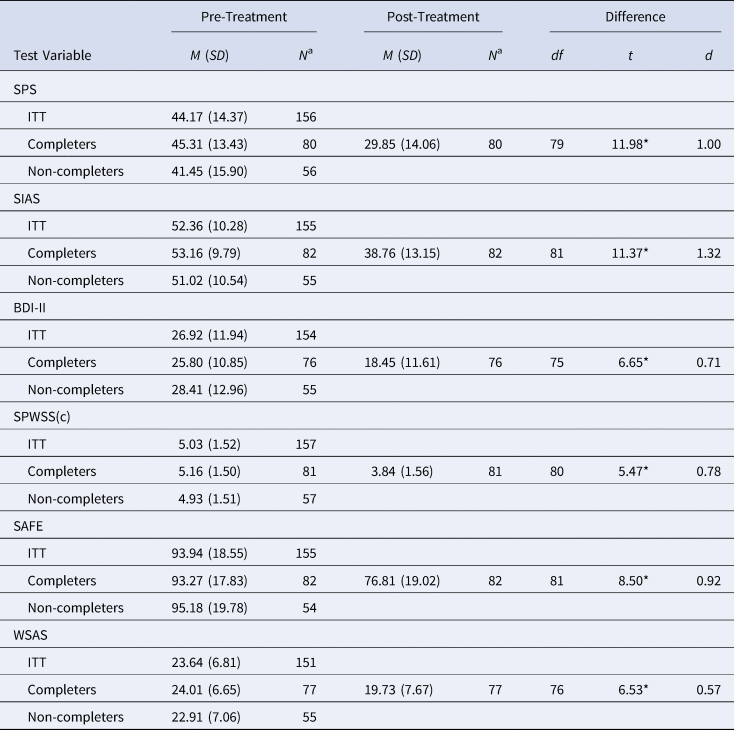
Means and standard deviations for all dependent variables, pre- and post-treatment are shown in Table 1. Mean scores of 45.31 and 53.16 on the SPS and the SIAS, respectively, indicate high levels of social anxiety. BDI-II mean score of 25.8 indicate moderate levels of depression and 24.01 on the WSAS suggest moderately severe pathology which gives an indication of the severity of this sample.
Pre- and Post-Treatment Means and Standard Deviations for Dependent Variables, and Completer and Intention-to-Treat Effect Sizes

Note. SPS = Social Phobia Scale; SIAS = Social Interaction Anxiety Scale; BDI-II = Beck Depression Inventory II; SPWSS (c) = Social Phobia Weekly Summary Scale Item c; SAFE = Subtle Avoidance Frequency Scale; WSAS = Work and Social Adjustment Scale. Effect sizes were calculated using an Intention-to-Treat (ITT) approach including all participants’ data; pre- and post-treatment means (standard deviations) were calculated using completers’ data only. Initial group equivalents between those that went on to be completers and those who were non-completers was assumed by non-significant (p > .05) independent t-tests at pre-treatment.
a While 101 participants gave useful data at both pre and post, not all participants provided responses across all measures at both time points, thus n < 101. Further, not all ITT (N = 159) and non-completers (n = 58) provided responses at pre-treatment.
* p < .001.
Significant and meaningful improvements (as indicated by moderate to large effect sizes) were demonstrated on all measures. The results demonstrated that overall the GCT-SAD participants had statistically significant decreases in symptoms of social anxiety (SPS and SIAS; large effect sizes), depression (BDI-II; medium effect size), self-focused attention (SPWSS item c; medium effect size) and safety behaviours (SAFE; large effect size) and significant improvement in occupational, social, and domestic functioning (WSAS; medium effect size).
Discussion
The aim of the current study was to determine the effectiveness of Clark and Wells CT-SAD developed into a group therapy intervention, GCT-SAD, in a routine clinical setting. It was hypothesised that after group treatment: (1) there would be a statistically significant decrease in social anxiety symptoms in participants; (2) there would be a statistically significant decrease in depression symptoms in participants; (3) there would be a decrease in measures of self-focused attention and safety-seeking behaviours; and (4) there would be a reduction of impaired functioning. The present findings strongly suggest that this therapy format was effective with individuals suffering from severe SAD (with large effect size). The specific SAD measures demonstrated greater change than the general mood measures, with the largest gains on the SPS (d = 1.0) and SIAS (d = 1.32) scales. This result does raise the question of whether the other measures of BDI-II, SPWSS(c), SAFE, and WSAS were not so sensitive to change, or that the treatment did not produce such large improvements for those symptoms as compared to SAD symptoms. Based on the reported utility of the measures, we were confident that the result was more due to the effect of intervention, rather than insensitive measurement issues.
Regarding our first hypothesis, there was a significant decrease in SAD. These improvements are noteworthy as the participants had not responded well to previous treatments; the participants for this investigation were only accepted as referrals if they had moderate/severe anxiety disorders and had not responded to pharmacological and counselling interventions in the community. It is also important to note that the participants’ high baseline levels of social anxiety were comparable to other studies (Clark et al., Reference Clark, Ehlers, McManus, Hackmann, Fennell, Campbell and Louis2003; Gaston, Abbott, Rapee, & Neary, Reference Gaston, Abbott, Rapee and Neary2006; Mörtberg, Karlsson, Fyring, & Sundin, Reference Mörtberg, Karlsson, Fyring and Sundin2006; Stangier et al., Reference Stangier, Heidenreich, Peitz, Lauterbach and Clark2003). These high baseline levels of severity potentially allowed more room for improvement, consequently, making it easier to get larger effect sizes; although baseline severity does not always have a linear relationship with the degree of improvement (Kirsch et al., Reference Kirsch, Deacon, Huedo-Medina, Scoboria, Moore and Johnson2008). Nevertheless, the effect sizes were as high, or higher than, other group treatment studies. For example, Furukawa et al. (Reference Furukawa, Nakano, Funayama, Ogawa, Ietsugu, Noda and Akechi2013), SPS d = 0.92, SIAS d = 0.98; Gaston et al. (Reference Gaston, Abbott, Rapee and Neary2006), SPS d = 1.10, SIAS d = 1.00; McCarthy et al. (Reference McCarthy, Hevey, Brogan and Kelly2013), SPS d = 0.87, SIAS d = 0.97; McEvoy (Reference McEvoy2007), SPS d = 0.80, SIAS d = 1.00. Furthermore, GCT-SAD compared favourably to several individual studies for SAD (e.g. Lincoln et al., Reference Lincoln, Rief, Hahlweg, Frank, von Witzleben, Schroeder and Fiegenbaum2003, SPS d = 0.88, SIAS d = 0.86; Stangier et al., Reference Stangier, Heidenreich, Peitz, Lauterbach and Clark2003, SPS d = 0.90, SIAS d = 0.85). However, GCT-SAD did not achieve the large effect sizes demonstrated across various outcome measures in 3 CT-SAD research trials (e.g. Mayo-Wilson et al., Reference Mayo-Wilson, Dias, Mavranezouli, Kew, Clark, Ades and Pilling2014) suggesting that GCT-SAD could be further improved. Overall, results indicate that our version of GCT-SAD is effective for significantly reducing anxiety symptoms in severe and treatment-resistant patients.
Anxiety and depressive disorders frequently occur together (Spijker, Muntingh, & Batelaan, Reference Spijker, Muntingh and Batelaan2020); therefore, pragmatically it is important when measuring the effectiveness of anxiety treatment to evaluate treatments’ impact on depression. Thus, with regard to the second hypothesis, the treatment process significantly decreased participants’ levels of depression. At pre-treatment, participants were in the moderately depressed range (20–28), with a BDI-II mean of 25.80, compared to other group and individual studies where participants started treatment with a mild BDI score (14–19; Lincoln et al., Reference Lincoln, Rief, Hahlweg, Frank, von Witzleben, Schroeder and Fiegenbaum2003; Mörtberg et al., Reference Mörtberg, Karlsson, Fyring and Sundin2006; Stangier et al., Reference Stangier, Heidenreich, Peitz, Lauterbach and Clark2003). At post-treatment, participants BDI-II scores had shifted to a mild level with a moderate effect size of 0.7 which is consistent with findings from other group treatment studies (McCarthy et al., Reference McCarthy, Hevey, Brogan and Kelly2013; McEvoy, Reference McEvoy2007; Mörtberg et al., Reference Mörtberg, Karlsson, Fyring and Sundin2006; Stangier et al., Reference Stangier, Heidenreich, Peitz, Lauterbach and Clark2003) and provides further evidence that directing treatment at an anxiety disorder often improves comorbid depression (Spijker et al., Reference Spijker, Muntingh and Batelaan2020). Effect sizes were lower for depression than social anxiety measures, likely due to GCT-SAD targeting anxiety symptoms rather than mood but nonetheless suggests that as peoples’ social anxiety improves their mood may also improve to a lesser degree.
In relation to the third hypothesis, there were significant decreases in self-focused attention and safety-seeking behaviour associated with the improvement in social anxiety measures. CT-SAD specifically targets these maintaining factors as their reduction appears to assist in contradicting inaccurate negative beliefs and may reduce the possibility of feared outcomes occurring. It is likely that some of the specific procedures that have shown to be effective in reducing the symptoms of SAD in other studies utilising the Clark and Wells approach (Clark et al., Reference Clark, Ehlers, Hackmann, McManus, Fennell, Grey and Wild2006), such as video feedback, experiential demonstration of the adverse effects of self-focused attention and safety behaviours, and imagery modification, have had similar effects in GCT-SAD. Reduction in self-focused attention had a moderate effect size and does not compare well with the Mörtberg, Hoffart, Boecking, and Clark (Reference Mörtberg, Hoffart, Boecking and Clark2013) study that had a large effect size for the SPWSS item c. While baseline levels of self-focus were similar in both studies, it is important to note the Mörtberg et al. (Reference Mörtberg, Hoffart, Boecking and Clark2013) efficacy study utilised an individual therapy approach over 16 weeks versus our group treatment duration of 9 weeks. The specific individual focus and a longer timeframe to practise the skill may explain the difference in the effect size between the two studies. However, this highlights that improving the method of cognitive therapy's focus on reducing self-focused attention in a group format needs further development and consideration.
The significant decrease in safety behaviours resulted in a large effect size in our study. As well as preventing effective processing of the social situation, it has been proposed that a reduction in safety behaviours may reduce self-focus (Bögels & Mansell, Reference Bögels and Mansell2004; Clark & Wells, Reference Clark, Wells and Heimberg1995; Rapee & Heimberg, Reference Rapee and Heimberg1997), although no mediational analysis was conducted in the present study to confirm this possibility.
Regarding the fourth hypothesis, there were significant decreases in functional impairment following treatment, with a moderate effect size. This clinical characteristic is predictive of a stable, persisting course of SAD (Beesdo-Baum et al., Reference Beesdo-Baum, Knappe, Fehm, Höfler, Lieb, Hofmann and Wittchen2012), and a reduction indicates the possibility of a return towards healthy functioning. SAD is known to have a relatively early age of onset and is associated with significant impairment in work and social functioning (Rapaport, Clary, Fayyad, & Endicott, Reference Rapaport, Clary, Fayyad and Endicott2005). While our study looked at changes pre- and post-treatment, allowing for perceived, self-reported improvement to be measured, it would have been useful to have had a clinical measurement of functioning to support these results.
Importantly, our findings for the effectiveness of a group version of CT-SAD (i.e. GCT-SAD) in a routine outpatient clinic were comparable to previous effectiveness and routine care treatment studies (McCarthy et al., Reference McCarthy, Hevey, Brogan and Kelly2013; McEvoy, Reference McEvoy2007). Our effect sizes for all measures were towards the higher scores found in previous research. This is notable, given that all patients had not responded to previous treatment for SAD and although it is unlikely that they would have received prior evidence-based treatment for SAD, it may have reduced the placebo effect prior to their treatment at the ADS. Furthermore, they were also exposed to a significant natural disaster, including aftershocks, while experiencing SAD and during their treatment.
Limitations and Future Directions
Strengths of the current study were that it used a population of clinically referred participants with SAD who had not responded to previous treatments, it had a large sample size, and treatments were conducted in a naturalistic, routine care setting. These factors are encouraging for generalisability of our results.
Several limitations, however, must be considered. First, this study was impacted by a number of disruptions; the first group occurred between two major earthquakes, there were ongoing aftershocks throughout the treatment process for all groups, resulting in sessions being conducted in a range of settings due to the loss of the initial treatment building, and the location of non-clinic behavioural experiments had to be moved due to damage to the inner city. It is possible that these disruptions and other earthquake-related consequences contributed to the dropout rate of 36.5%. While high dropout rates are not uncommon in the SAD literature (Bados, Balaguer, & Saldaña, Reference Bados, Balaguer and Saldaña2007; Fedoroff & Taylor, Reference Fedoroff and Taylor2001) with some studies reporting dropout rates as high as 43.8% (Bados et al., Reference Bados, Balaguer and Saldaña2007), a number of trials by Clark and colleagues, and other researchers, have demonstrated lower dropout rates (Clark et al., Reference Clark, Ehlers, McManus, Hackmann, Fennell, Campbell and Louis2003, Reference Clark, Ehlers, Hackmann, McManus, Fennell, Grey and Wild2006; McCarthy et al., Reference McCarthy, Hevey, Brogan and Kelly2013). However, Clark et al. (Reference Clark, Ehlers, Hackmann, McManus, Fennell, Grey and Wild2006) considered completers as attending at least half of the therapy sessions available; whereas, in the present study, we defined completers as completing seven of nine (75%) sessions. Thus, different definitions of completers may contribute to the variability of dropout rates. Nevertheless, further attention needs to be given to improving treatment retention in future SAD group therapy contexts. Also, given the constrictions on the extent of information given at referral, the exact nature of previous psychological treatments was unable to be determined. In future, gathering this information may be informative in terms of dropout characteristics and in determining for whom GCT-SAD may be most appropriate.
Secondly, the number of ADS patients who declined group treatment following their initial assessment is not known. Individual or group treatment is decided collaboratively between the patient and the therapist and is affected by a number of factors including clients’ availability for the group timetable, group start dates and clients’ ability to wait, and clients’ preference for individual or group format. However, because ADS’ process does not require group treatment as the first treatment offered, it is difficult to quantify the number who actually chose individual over group treatment. Consequently, this should be recorded more accurately in future studies.
Thirdly, this study did not have a control group and was not a randomised controlled comparison of individual compared with group treatment; therefore, caution should be exercised in interpreting the current results. Fourth, all data were self-reported and self-focused attention was measured by only one item. Although the use of self-report scales is common in clinical practice, such measures may be subject to biased responding (Sato & Kawahara, Reference Sato and Kawahara2011) and future research could benefit from the addition of clinician-rated scales. Fifth, as there was no follow-up data, the results only show short-term effects and do not allow for any conclusions regarding the maintenance of treatment gains. Future studies, including follow-up results, would assist in understanding the longer-term impact of this form of group treatment. Future research with larger samples could also control for depression when evaluating changes in the severity of social anxiety symptoms.
Lastly, although the treatment was manualised and the team had ongoing processes for supervision and training, there were no formal measures of therapy fidelity or therapist drift.
Conclusions
Given the large sample size and positive results, this study suggests that GCT-SAD is effective in routine, clinical care and with severe and treatment-resistant patients. Furthermore, our findings contribute to the growing literature supporting that outcomes from SAD research trials are generalisable to clinical practice. In addition, while it appears that our GCT-SAD format, most closely aligns to Clark's cognitive therapy approach in comparison to other studies, there is scope for improvement, and research into the mediators of group treatment would be useful, particularly further research into anticipatory and post-event processing and self-focus, as these have been found to be key mediators in previous research (Hedman et al., Reference Hedman, Mörtberg, Hesser, Clark, Lekander, Andersson and Ljótsson2013). Lastly, it was noted that GCT-SAD effect sizes were lower than CT-SAD effect sizes previously reported, and further comparisons between GCT-SAD and CT-SAD in a routine, the clinical setting may be advantageous for the ongoing improvement and development of the group protocol.
Acknowledgements
The authors thank all of the participants of this study and the support staff at the Anxiety Disorders Service and Dr Ben Lane at USC for research assistance. We are grateful for the valuable feedback on earlier drafts of this manuscript from Professor David M. Clark and Dr Nick Grey. Thank you to David, Nick, and their colleagues Alicia Deale, Sheena Liness, Hannah Murray, Cynthia Turner, and Jennifer Wild for kindly allowing the ADS use of their cognitive therapy for social anxiety resources.
Financial Support
This research received no specific grant from any funding agency, commercial or not-for-profit sectors.
Declaration of interest
None of the authors of this paper has any conflict of interest with respect to this publication.