
1. Taxation: What is and What Ought to be
Which formal requirements ensure that fiscal policy adheres to a standard of justice? This query has two implications: that current tax policies fail standards of justice and, more fundamentally, that “justice” delivers us a basis for the normative assessment of tax policy. This article critically examines these assumptions.
Taxation is an essential aspect of government action that can be used to attain various goals. The basic justification, about which we can presume there is widespread consensus, concerns the sponsoring of public goods provided by levies that adhere to some standard of fairness or efficiency.Footnote 1 Additionally, the literature promotes taxation to achieve goals such as environmental protection, employment stimulation, health protection, and the correction of all sorts of market failures.Footnote 2 Whether one takes the first, minimalist, stance or attributes more extensive policy goals to public authorities, Western tax systems fail to live up to their raison d’être. Tax lawyers, economists, and philosophersFootnote 3 generally recognize that the structure of prevailing tax systems does not adhere to taxation’s normative foundations. The legitimacy crisis associated with tax law that “becomes increasingly unresponsive to legitimate policy goals and increasingly out of touch with justice”Footnote 4 has recently attracted attention within the tax literature.Footnote 5 One of the driving observations here is indeed the interplay between private groups and policymakers and the emergent fiscal exceptionalism and the complexity of the system.Footnote 6
In this regard, Richter et al find a correlation between tax lobbying and the effective tax rate: when US firms increase their lobbying expenditures by 1% in a given year, they reduce their effective tax rates by an average of 0.5 to 1.6 percentage points the following year.Footnote 7 Another study confirms that fiscal lobbying is currently one of the most profitable businesses: Alexander et al estimate the return on investment from political influence on the US Job Creation Act (2004) to be as high as 22,000%, meaning that every dollar invested in lobbying yields a return of $220.Footnote 8 Brown et al found that investing in relationships with tax policymakers (e.g., via political action committee support) results in future tax benefits.Footnote 9
Various sources like the UK’s House of Commons Committee of Public AccountsFootnote 10 and the Corporate Europe ObservatoryFootnote 11 show that there is systematic entanglement between legislators and the private interests of wealthy individuals and corporations (so-called proactive tax planning) through big accounting or lobbying firms. The Center for Responsive PoliticsFootnote 12 confirms the interaction between public lawmaking and private interests, for instance by revealing that 38 out of 44 Apple lobbyists previously held government jobs. This policy structure might indicate why, in the last decade, there has been a rise in legislative measures like the “excess profit” tax scheme, “patent boxes,” “controlled foreign company,” “foreign tax credit,” and “active financing exemption,” which help multinationals and wealthy individuals slash their global tax debt. Furthermore, it is important to note that Western regimes have “democratized” fiscal exemptions, and by converting large proportions of votes into political power, many factions of the constituency have been happy recipients of fiscal rewards, such as mortgage interest deductions, tax cuts on company cars, and stock options.
Wagner, discussing the entanglement between private interest and fiscal policy, states that “at this point, fiscal politics enters to generate the proverbial flood of exceptions and exemptions that creates a tax code so large that no one can read it and which creates nearly a unique tax liability for each taxpayer.”Footnote 13 Tax lawyer Allison Christians describes the state of affairs as follows: “Special interests consistently exert influence on tax policy discourse through their advisors and within a broad spectrum of discrete and pooled capacities. This results in tax policy as favorable as possible to those who have the resources to shape it.”Footnote 14 Hargreaves Heap connects the emerging complexity with a failure to achieve any public policy goals: “About the only thing we can say with much confidence about our currently complex tax systems is that they spawn an industry of tax accountants, lawyers and lobbyists who game the system for the benefit of their clients, who are mainly rich.”Footnote 15
But why would this specific interaction between the division of tax liability and private interest fail the standard of justice? I employ a contractarian-constitutionalist perspective on justice, according to which the fundamental rules and institutions that form the basis of the state need to be understood as part of an exchange of agreements between participating members of society.Footnote 16 The essential test that the prevailing basic political institutions face is whether they could have been contracted by (rather than imposed on) rational individuals.Footnote 17 Moreover, individuals in a setting of constitutional choice accept limitations on their liberty (i.e., rules that involve coercion) when doing so advances their interests, and this exchange makes them better off.Footnote 18 As constitutional choice revolves around rules with a general and quasi-permanent application, contracting individuals are relatively uncertain regarding their future position under the different choice options and thus of the personal effect of various alternatives.Footnote 19 Choosing behind a “veil of uncertainty,” no party is able to tailor its specific position and unanimous agreement is likely to revolve around rules but these components are also generalized criteria of “fairness” and “efficiency.”Footnote 20 This does not require a rule that each participant has to win simultaneously.Footnote 21 Rather, over the whole set of political actions, its working properties must be “broadly acceptable”Footnote 22 regardless of participants’ specific positions, for instance in terms of political power.
Looking through this constitutional window, tax policy, at least in the United States and Europe, embodies an “anything goes” regime, a political jungle in which well-organized subgroups of society are successfully fighting for controversial privileges at the expense of (the welfare of) their fellow citizens. A constitutional choice, however, would never select procedures that enable subsets of the constituency to realize “fiscal gains” at the expense of those outside the ruling coalition.Footnote 23 Choosing rules behind a veil of uncertainty, constitutional contractors have no accurate knowledge about their position in the future political game, so unanimity will be reached around rules that lead to outcomes “all can live with.”Footnote 24 Given this perspective of justice, I investigate the requirements for political rulemaking in order to shield the resulting policy from manipulation by affluent organizations and multinationals (who “buy” the policy they find profitable), more modest economic parties (which extract public resources via their influence over voting procedures), and politically well-organized economic players (e.g., unions, farmers, and lawyers) that are close to the decision-making process. Given the political reality as sketched at the start, and given the increasing attention paid to the justice of Western tax systems, I explore the following question:
Which procedural requirements can turn tax policy—currently a domain with winners and losers and rules that reflect the self-interest of one group over that of others—into a procedure that leads to outcomes that are acceptable to a wide range of positions, including those outside the realm of power?
The rest of this article is divided into three parts. Section 2 sets up a behavioral model that analyzes the legislative dynamics arising under a simplified version of our current tax system. In particular, tax exemptions under a weak majority-rule requirement are expected to lead to fiscal exploitation, inefficient public spending, and rising general taxation levels. Section 3 investigates how the constitution can protect the legislative machinery from penetration by specific interests and shape the legislative stage to be more oriented toward the goals of all citizens. In particular, I argue that in order to liberate taxation from fiscal exploitation and to reconcile taxation and public finance with the general interest, taxation should follow the precepts of generality, of which tax uniformity is the best account. The conclusive section connects the findings of this article with traditional theories of justice and explains the nature of a nonideal and procedural view on justice.
2. The Political Economics of Tax Exemptions
Looking at how to improve real-world decision processes in fiscal matters, recommendations of justice commence with a descriptive analysis.Footnote 25 If we want to carry the requirements of justice to the political level, we need to trace the empirical elements that characterize political reality.Footnote 26 Modeling the political world that is actually deciding on the issue at stake requires taking into account at least two matters. First, distributive decisions are never unilateral choices. In democracies, the division of fiscal obligations “emerges” from a complex interaction of various individuals.Footnote 27 The second aspect is that these parties are self-interested. Though a thorough description of the controversial tax rules that typify our current tax codes is beyond the scope of this article, the introduction reveals that individuals and groups adopt various strategies to influence fiscal politics in order to acquire private gains.Footnote 28 The introduction of the “self-interestedness assumption” within the fiscal processFootnote 29 means two things.Footnote 30 First, concerning benefits (i.e., public spending), the members of a society are expected to influence the political process to acquire the type of public goods they desire and to maximize the amount.Footnote 31 Second, in terms of costs (i.e., taxation), people will avoid expenses they do not want and try to minimize their liabilities. This necessarily means that, under the assumption that their consumption of public goods remains equal, citizens will try to minimize their tax share.Footnote 32
2.1. Legislative Patterns under a Simplified Majority Constraint
In my search for the proper constraints for rulemaking, the following step models how individuals will behave under one type of fiscal decision rule. Moreover, I focus on a much-celebrated constraint in Western politics: the majority requirement. Under this requirement, for a tax policy to be legitimate, it needs to be approved by a majority of the voters. The operation of fiscal exemptions under this requirement deserves particular attention. As was done in Buchanan and Tullock’s Calculus of Consent and later workFootnote 33 from which I draw inspiration, I employ four simplifications.Footnote 34 First, I assume a situation of direct democracy, in the sense that each citizen can vote on the legislation in question. This enables us to avoid dealing with the specific complexities of representative democracy, which are touched upon under 2.2. Second, I assume no constitutional control over the produced legislation: I isolate the emerging patterns under the majority rule. Third, I assume that a strict spending policy prevails: the production of public goods creates an equal value for each citizen. So, I focus on the taxing part of the “fiscal exchange.”Footnote 35 Lastly, in order to focus on the particular incentives that different groups face, I limit the imaginary polity to three political and economic groups.Footnote 36 How this stark and simplified model is valid for understanding real-world problems, as mentioned in the introduction, is discussed in Section 3.2.
Imagine now the following situation: A township has liberated itself from external dominance and is free to organize its own public system. Its spending policy is assumed to generate an equal amount of goods (for instance, security, general road maintenance, or a basic income) for each citizen.Footnote 37 The township’s funding decisions are to be decided by an unrestrained majority rule: policies that are supported by more than half of the inhabitants (i.e., 51%) are implemented. The township has an economic product of 100,000 and can be socioeconomically divided into three subgroups: 20 entrepreneurs, each of whom earns 2,000 (40,000 total); 20 fishermen (earning 1,750 each or 35,000 total) and 20 workers (1,250 each or 25,000 total). For reasons of simplicity, I assume no economic growth. Due to the inheritance of previous legislation, a flat tax of 20% currently prevails; it raises 20,000 for the government. Governmental activity is not purely redistributive but produces genuine “public” goods, meaning their consumption creates a benefit for each citizen. The value of the public goods is estimated at 23,000. Given the assumption of an equal benefit throughout the constituency, this means we assume a gross value of 383 per capita.
From a public choice perspective, the levying part of this fiscal exchange would be particularly unstable. Ab initio, the entrepreneurs, workers, and fishermen all agree to taxation to provide some public goods: they all calculate some public provision of security, general road maintenance, or a basic income to exceed possible costs. However, this initial prospectus gets trumped by the opportunity to offset the costs onto the minority. While all parties could benefit from cooperation, each individual party could benefit maximally by shifting the costs of the public goods onto the other party. The sketch of various coalitions hereunder is indicative, for successive cycles of majorities, which can be predicted to minimize their tax debt by using fiscal exemptions, will tend to emerge.
A first coalition is made between the fishermen and the workers (see Table 1). Forming a government—called “labor”—they put the general tax up to 22% (exacting 8,800 from the entrepreneurs) but lower taxation for themselves to 19%. The general revenue during coalition labor is now 20,200, but the members of the majority contribute proportionally less.
After a four-year term, the entrepreneurs manage to convince the workers to form a new alliance, called “freedom” (see Table 2). They increase general taxation to 25% (extracting 8,750 from the fishermen), but “in order for the economy to prosper,” they opt for specific measures: the workers (4,750) maintain the tax break from labor, but the entrepreneurs (7,600) get a “freedom break” of up to 19% and can henceforth minimize their fiscal costs. Due to the extra contributions from the minority, overall revenue increases, but this only causes a small increase in spending value, to 23,500, or 391 per capita.
The next term is ruled by a new coalition between the fishermen and the workers (see Table 3). Their project is called “social justice.” To raise the level of basic income, they put a “fairness tax” of 32% (12,800) on entrepreneurs, and the fishermen (7,000) and workers (5,000) get a “fairness exemption” down to 20%. The additional revenue—now 24,800—creates a value of 24,000, or 400 per capita. Collective action is a societal loss but is profitable for members of the majority, who pay 12,000 but consume 16,000.Footnote 38 This is in sharp contrast with the entrepreneurs, who pay 12,800 but consume only 8,000.
Before the township loses its sovereignty due to bad economic results and internal struggles over fiscal issues, a final coalition, called “green,” is made between entrepreneurs and fishermen (see Table 4). Their tax program abolishes both the “fairness exemption” for workers and the higher basic income and introduces a general “environmental tax” of 35% (extracting 8,750 from the workers). However, to give entrepreneurs the leeway to adopt new ecological techniques, they get a tax break of 22% (8,800). The fishermen (7,000) are able to retain their “fairness exemption” in this government. These fiscal measures do not create any surplus, and the value of public spending falls back to 23,000 (383 per capita). At this stage, public policy ceases to be beneficial, even for the majority, since it consumes 15,333 but contributes 15,800. Nonetheless, the coalition is soothed by the facts that the fishermen maintain their tax breaks and the entrepreneurs better their situation sharply: whereas they lost 4,800 under the “social justice” scenario (paid 12,800, consumed 8,000), this cost is now minimized to 1,134.
These cycles of coalitions are no pure “prediction” of reality. The specific numbers—for instance the income level of each group and the rates that they will opt for—can and will differ in reality. However, this example is indicative of particular policy patterns that will occur to a greater or lesser extent when self-interested parties act under a weak majoritarian restraint:
1. Since there is no substantive constraint, each party is tempted by a “take-all” scenario. Under the hypothesis of an equal benefit model, self-interested agents are incentivized to engage in fiscal exploitation, meaning they build coalitions until a majority has been formed and realize profits by transferring the cost of public goods to the minority.Footnote 39 This is exemplified by the labor coalition (Table 1).
2. This dynamic leads to a situation in which Pareto-inferior public activities become profitable for majority coalitions.Footnote 40 Since the (fiscal) revenue exceeds the spending value, at the societal level, collective action is loss-making for the community. Nonetheless, as the fiscal burden can be shifted onto those out of power—i.e., there is fiscal exploitation—public action continues to be cost-effective for those in government. This is illustrated by the “social justice” coalition (Table 3).
3. The practice of discriminatory taxation generates poor spending decisions.Footnote 41 When judging incremental public investments, the ruling majority will appreciate only its own marginal costs. Since these costs can be minimized due to externalization via tax exemptions, there is an incentive for deficit spending. For instance, the tax reform from the “social justice” coalition is not profitable, as total revenue (24,800) exceeds total spending value (24,000), yet it appears so for the majority (see Table 3).
The image of majoritarian winners and minoritarian losers is only part of the picture. When we take into account the occurrence of various cycles, the institutionalization of tax benefits as exemplified by successive governments creates a dynamic whereby over time everybody loses—even those in the majority.Footnote 42 Moreover, everybody will be in the minority at some point and thus become subject to fiscal extraction. What is more, the game established by tax exemptions under a weak majoritarian constraint creates a “downward spiral.” As mentioned by HayekFootnote 43 and Gaus,Footnote 44 majorities lack incentives to explicitly consider the long-term significance of their decisions. In the competitive and aggressive competition for tax exemptions, the biggest threat is being in the minority.Footnote 45 Shortsightedness is rational, and the agents of each successive government have a strong incentive to transfer the burden onto others. In the long run, this “rational” succession of tax exemptions, ever-rising tax rates, and public overinvestment (due to the externalization of costs) could render the provision of public goods a negative-sum game, leading to a situation in which all members will lose in absolute terms, though they will lose relatively different amounts.Footnote 46 Within each “game” (i.e., one-shot majoritarian coalitions), parties will compare their tax level with what it was in the former government and with that of the other group rather than with point 0 or some economic optimum. Within a dynamic perspective, this leads to the point at which majorities do not even gain in absolute terms, but simply profit by avoiding an even bigger loss. Public policy, instead of creating advantages for each member, turns into a game of cost minimization. This is illustrated by the “green” coalition (Table 4).
2.2. Legislative Patterns in a Complex Majoritarian Democracy
Why would rational participants be hopelessly trapped in the game? After all, individuals have a certain interest in avoiding fiscal exploitation, as they are aware that political gain in this round can be met with severe extraction in the next one.Footnote 47 The incentive to overcome the dilemma is strengthened by the long-term destructive effects of exploitative majorities. Indeed, empirical workFootnote 48 suggests that groups are actually creative and often solve social dilemmas by setting up complex arrangements that monitor and sanction the use of common resources. For two reasons, prevailing politics do not solve the conflict. Emergent individual strategies are determined by the number of individuals. Because of the intimate relationship between one’s own behavior and the expected choices of others, small groups foster cooperation.Footnote 49 However, with an increase in the size of the group, individuals become anonymous parts of big entities and realize that their own “ethical” choices do not increase the probability that others will follow the norm.Footnote 50 Hence, the possibility of enforcing cooperative strategies through social interaction diminishes starkly in a polity of millions of people.Footnote 51 The incentive to defect further increases as the number of factions grows. In a three-group game, the fiscal duty of each party and the costs of fiscal exploitation are both identifiable and substantial. As society becomes more complex, majority legislation is expected to take the form of a compromise between various successful groups and to involve adopting a list of tax benefits that result in huge profits for the beneficiaries and small costs for everyone else.Footnote 52 Self-governance through communication and informal sanctioning becomes highly unlikely in a complex legal order in which an interminable range of exemptions, obtained by unidentifiable individuals, exerts marginal and incalculable costs on the total group.Footnote 53 This effect is exacerbated by the institution of representative democracy, whereby individuals secure their interests indirectly by trading votes for fiscal favors.Footnote 54 This “exchange” decreases the chances of monitoring, as information asymmetry results in a situation in which the vast majority has no knowledge of the fiscal rules or their destructive effect.
So, reality is no doubt more complex than the model, but, unfortunately, not in the sense that we could expect a solution to emerge endogenously. The behavior of political agents and subsequent legislative patterns are functions of the rules that define when a valid agreement has been reached.Footnote 55 Moreover, any system in which economic matters are decided by anything less than unanimity, in the absence of any other constitutional requirement, creates the possibility of private gains for some at the expense of others.Footnote 56 Our model showed how in a direct democracy, citizens themselves find partners with whom to build a majority that adopts various fiscal privileges for the respective groups, the costs of which can be shifted to the rest of the constituency. The introduction described how, in a representative democracy, citizens influence legislation indirectly, through their exchanges with politicians. Rather than “a majority” dominating “a minority,” representative democracy generates specific subgroups that influence majority legislation in a highly unequal way.Footnote 57 It is within this framework that we should situate the political advantage for powerful lobby organizations and voting groups with strategic importance (e.g., the median voter). The result is fiscal legislation in the form of a laundry list of exemptions for all interest groups decisive in the political process.
Whether consisting of two homogeneous blocks (as in the model under 2.1.) or multiple smaller voting or lobby groups (as described in the introduction), our analysis remains constant. The open-endedness of the majority rule regarding the specific division of fiscal shares facilitates fiscal exploitation, meaning decisive groups adopt various fiscal privileges, the costs of which will be shifted to the rest of the constituency.Footnote 58 This pressure for private gains from majoritarian procedures helps us understand the prevailing fiscal institutions described by the tax literature.Footnote 59 In particular, the aggressive struggle for benefits, the emergence of the booming lobbying industry, the segregation of the electorate into voting blocs, the ability of small interest groups to capture concentrated benefits while dispersing marginal costs, a chaotic tax code riddled with a maze of exemptions and deductions, and the appearance of many loopholes are patterns generated by an unrestrained majority rule. In the emergent state of legal anarchy, a general distrust in (fiscal) politics complicates the situation even further.Footnote 60
3. Tax Uniformity as a Constitutional Tool
3.1. The Quest for Justice: Enter the Constitutional Perspective
An unrestrained majority rule creates winners and losers, at best. This analysis brings us back to our main aim: to create a sphere of fiscal politics that is immunized against these exploitative activities and generates acceptable results for all participants.Footnote 61 While each member of the township might contribute to fiscal exploitation at the political level, the constitutional level requires a system of collective action that cultivates prosperity and promotes the overall interests of all participants.Footnote 62 To help answer our core question, it is useful to refocus on the problematic case. Looking at both the township and current fiscal politics, there are two crucial elements at work.
First, each player has knowledge of his or her own situation. The township and our society are composed of interest groups that are formed around particular characteristics such as income and type of business. Economic characteristics are prevalent, and members with equal legal (workers, entrepreneurs, functionaries, or unemployed groups) or economic (earning power) status will coalesce into separate political parties, factions within a party, lobby groups, or more informal interest groups. Cartels will thus revolve around a shared characteristic, which will form the benchmark for each faction to calculate the potential payoffs of the political measures at stake. As evident in the situations of fiscal anarchy described above, each group will isolate its situation in order to calculate its profit on a particular issue.
The observation of this process relates to Rawls’s “veil of ignorance,” behind which rational agents would be ignorant about their social position, income, talent, ethnicity, or view of the good life.Footnote 63 The “original position” distinguishes itself from the township and our societies because, due to a lack of knowledge regarding their own economic or ethical interests, individuals in the original position cannot advance proposals tailored to their personal situation.Footnote 64 Instead, these individuals are optimally positioned to choose the principles of justice, meaning that “no one is able to design his principles to favor his particular condition.”Footnote 65 Rawls’s contribution indicates that from a contractarian-constitutional perspective, procedures, where dominant partisan interests determine the division of the fiscal burden, are not acceptable.
Rawls models an imaginary constitutional choice process populated by participants who are blinded on whether they are workmen, fishermen, or entrepreneurs. Here, constitutional principles are chosen within a more realistic contractual setting, in which participants are aware of whether they are workmen, fishermen, or entrepreneurs. The veil of uncertainty is not generated by setting up “imaginary subjects,” but rather by the nature of constitutional choice. Due to their quasi-permanent nature, constitutional rules create relative uncertainty for the individual with respect to his or her specific position under the operation of the prospective alternatives and thus with respect to the precise effect of the constitutional alternatives on his or her future situation.Footnote 66 Logically uncertain about their future position and the personal effect of various alternatives, contractors will search for constitutional rules that generate fiscal outcomes acceptable to a broad range of positions.Footnote 67 Another nuance relates to the content of the agreement. Whereas Rawls identifies the conclusive principle that ought to regulate the distribution of economic shares in society, I examine which procedural constraints could improve the democratic choice process when its members are deciding on a distributive issue. Following Buchanan,Footnote 68 desired end-state distributions of income, for instance, those maximizing the amount of goods for the least advantaged, do not represent the first aim, and the test that follows will not impose a cardinal distributive formula. I merely aim to “discover” practical procedures for democratic decision processes to promote outcomes that are acceptable to all positions, irrespective of the substantial conception of justice that will drive their future factions.Footnote 69
While modeling decision-makers as ignorant of their position, talent, and view of the good life is theoretically powerful, it remains a thought experiment: participants deciding on the distribution of fiscal shares are not actually choosing behind a veil of ignorance. Thus, while looking for procedural regulations that could enhance the operation of real-world decision processes, collective decisions will be made by people with knowledge of their own situations. Nonetheless, a second element is at stake in real-life situations and in the township. Not only do people tread on the political level with knowledge of themselves, they also form cartels around rules that cover this particular situation. What defines the individual calculus in the political arena is not only participants’ knowledge of themselves, but equally the responsiveness of legislation to this situation. The type of legislation that emerges in the township—and in our current tax codes—distinguishes between locational, professional, financial, industrial, and behavioral elements. Indeed, where thought experiments rule out knowledge regarding personal characteristics, these elements are brought into existing politics as decisive yardsticks for the application of rules. It is one thing to accept that people enter the political arena as real people, with knowledge of their circumstances and goals, but it is quite another to accept that these particularities are objectively embedded in the law as decisive conditions for the differential application of a rule. This leaves us with one remaining possibility: cutting the string on the rules side. The rule requirement that deserves attention is not that rules are created by people who are ignorant of their characteristics, but rather that the rules themselves do not refer to such characteristics and hence apply to all members equally.Footnote 70
3.2. The Virtues of Generality in Taxation
The range of options that arises when parties negotiate on legislation is a product of the procedural rules that define a valid agreement. And a participant’s calculus can be expected to revolve around such options that emerge on the horizon of possible agreements. But what if the object of that calculus (i.e., prospective legislation) is required to be indifferent to any personal, economic, or worldview-like characteristics and to apply to all members of a given jurisdiction equally?
3.2.1. Generality as an ethical certificate
This generality requirement builds a minimal ethical standard into legislation.Footnote 71 It precludes the assignment of privileges, where those in charge take advantage of their momentous power to promote only their liberty or restrict only the behavior of others.Footnote 72 Whereas majority rule will always imply that rulers have powers over legal subjects, the constraint at stake assures that the rulers respect the notion of formal equality—and thus create rules that apply to all members equally. The type of agreements that will subsequently govern society will be reciprocal: the legislative rights and duties will be distributed equally to both the majority and minority. For instance, if an Islamophobic party wishes to limit Muslims’ freedom of speech, it has to limit freedom of speech for all worldviews equally. The demand that governments and legislators formulate universal maxims rather than discriminatory measures rules out the most severe forms of injustice that the rather amoral majority rule could produce.Footnote 73
3.2.2. The meaning of generality in tax matters
The normative demand to think of legislation that would be desirable as a universal law is more than a pure deontic maxim. The fundamental precept that decisions generated by the subset of persons that make up the government need to “apply equally” to everybody is intended to promote the interests of those who are outside that membership, alongside the contractarian-constitutional demands outlined in the introduction. Nonetheless, the precise translation of generality into tax matters remains unresolved.Footnote 74 To engender outcomes acceptable to all positions, decisive majorities can only pass tax rules that do not distinguish between personal circumstances and apply equally throughout the constituency.Footnote 75 But how do we operationalize that demand? Furthering on the dominance of income taxation in many legal systemsFootnote 76 and hypothesizing on a broadly defined tax base (i.e., one that includes all persons and forms of income), I analyze the constraint that majorities “need to tax income equally”: what proposition demands universal application here?Footnote 77 I explore three options: (1) an equal rate, asking the same proportion from each participant; (2) an equal absolute number, asking the same amount of money from each participant; or (3) an equal progressive structure, applying the same system of differentiated rates for different income brackets to each participant. The alternative patterns in fiscal outcomes this generates will be illustrated by going back to the township.
1. Tax uniformity
I define generality as tax uniformity or the equal-rate principle (rather than, for instance, an equal absolute contribution or progressive rate structure). A majority can impose any tax rule as long as it consists of a tax rate that applies to all members’ incomes equally. Each faction is now determined to calculate its preferred policy within the confines of a strictly uniform applied rate.
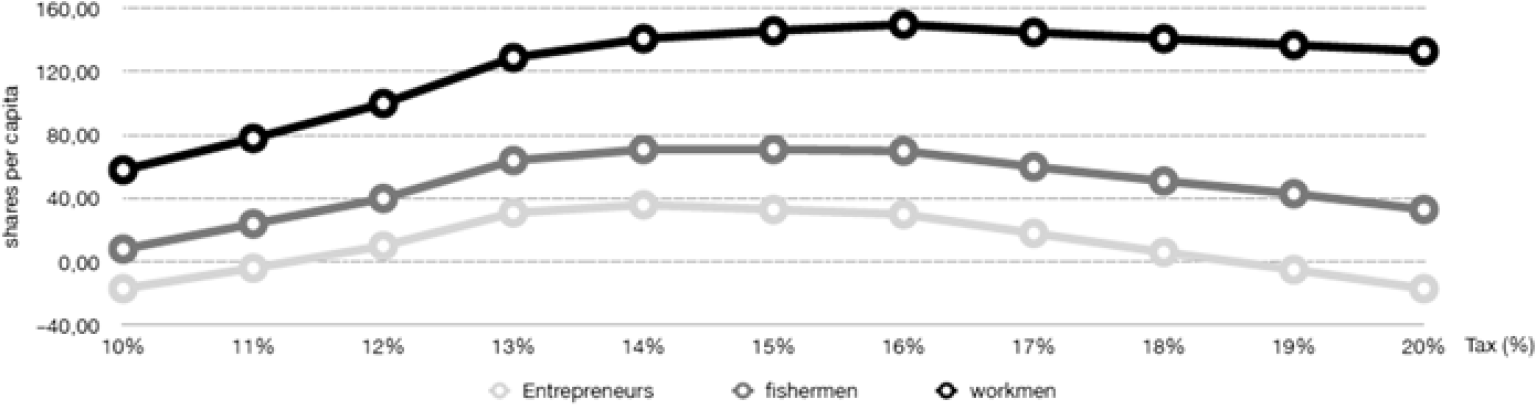
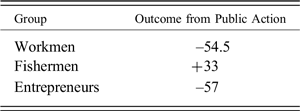
Figure 1 shows the consequence of the strict symmetrical distribution of tax shares: a tax rate that is profitable for one group tends to create acceptable results for other groups as well.
Distributive options under tax uniformity

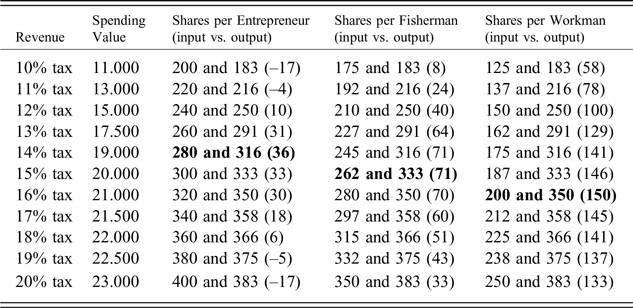
Table 5 depicts the feasible options for each group for a certain rate, under the general observation of both increasing and decreasing value of public goods.
Coalition Labor

Coalition Freedom

Coalition Social Justice

Coalition Green

Distributive options under tax uniformity

Note: Optimal tax level for each group is indicated in bold.
As discussed previously, under the unrestrained majority rule, an interminable range of legislative measures can potentially produce payoffs for each group. Moreover, each majority formed could literally “invent” endless legislation to improve its situation. Table 5 reveals how the landscape of possible political agreements for coalitions is sensibly limited by the uniformity restraint. Moreover, uniformity demands strict symmetrical contributions from all members: when a proportion of income is exacted from one member of society, the same share will be imposed on other members. This crucially alters the legislative dynamic in three ways:
1. The optimal tax rate for each group is not undetermined or dependent on how much one can make others pay but appears a priori as a given number (i.e., the “single-peaked preference,” which is indicated in bold for each group in Table 5). Crucially, this preference automatically determines the tax duty for the other groups. The workmen’s preference does not depend on in-game negotiations: their desired rate is 16%, and uniformity will force them to propose 16% for the entrepreneurs as well.
2. It is particularly remarkable that the preferred tax rates for the three different groups tend to congregate around the same point. Where in the previous situation the range between different rate levels greatly enlarged (e.g., entrepreneurs paying 35%, the rest contributing 22%), the confines of uniformity limit this range to only 2% (between 14 and 16, see Table 5, marked in bold). It is easy to see how any majority coalition would put taxation within that range. Henceforth, the majority under a generality will more heavily favor the median voter’s preference.Footnote 78
3. Whereas under an unrestrained majority rule the optimal options for one group represent severe losses for another group, here the optimal numbers for each group separately are also profitable options for the other group. Moreover, the “minimum optimum” (entrepreneurs favoring 14%) and the “maximum optimum” (workers favoring 16%) both include profitable options for all the other groups (see Table 5).
Naturally, the precise economic effects of uniformity undisputedly depend on the distribution of income throughout the population, the preferences of others regarding the activities of the state, and the value of the public goods produced. These will vary over time and place, so the members of both the township and other political communities (like us) have an interest in the general working properties of uniformity:
1. Uniformity minimizes fiscal exploitation. No player can abuse its political power by purely taking from the relatively powerless. With a symmetrical distribution of tax shares, any rise in taxes on minorities will be paralleled by an equal proportionate rise in tax shares on the player’s own group (see Figure 1). Due to this incentive-aligning quality, uniformity promotes a rudimentary form of fairness: those decisive in the fiscal process will treat others in ways they would like to be treated themselves.Footnote 79
2. The majority will extend the size of the budget only to the point at which their marginal benefits equal their marginal taxes.Footnote 80 Since governments now properly internalize their costs, overall, loss-making projects (see coalition “social justice”) are equally costly for majorities and overinvestment is discouraged.Footnote 81
3. Although there is no assurance that each application will always be beneficial to each income group, since such benefits depend on specific political-economic particularities, uniformity, as a general rule, promotes positive-sum games. Under the symmetrical assignment of tax shares throughout the constituency, options that appear profitable to the government have a relatively high chance of being beneficial to those outside the realm of power (see Figure 1). As such, the uniform application of tax rates throughout the constituency promotes general efficiency, as it spurs majorities to opt for policies that hinge on the direction of the Pareto frontier.Footnote 82
Constitutional choice is a setting where individuals have imperfect knowledge of their position under future applications of a rule. Because of this lack of identified interest, they will opt for rules compatible with general notions of criteria of “fairness” and “efficiency.” Tax uniformity satisfies that constitutional test: it minimizes the risk of fiscal rulemaking where some can realize fiscal gains by putting high burdens on others and, conversely, promotes policy whereby a broad range of individuals can profit from public finance.
2. Lump-sum taxation
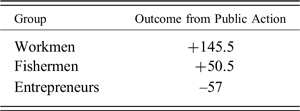
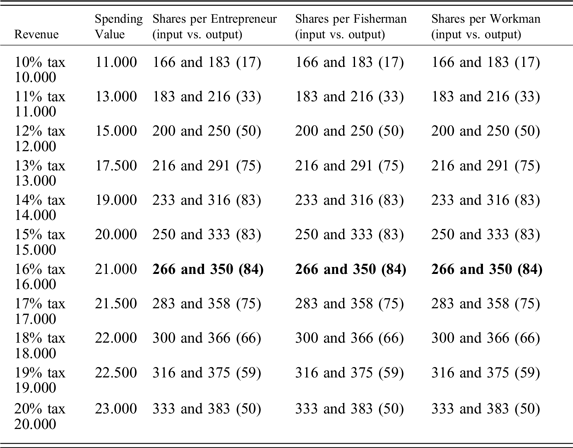
The second option is the equal distribution of an absolute number, often coined “lump-sum taxes.” The expected outcomes are a function of the rules defining how majorities can make valid fiscal legislation. Looking at the township, which pattern of outcomes can be predicted when majorities are restrained by the universal distribution of an absolute number? In Table 6, the rows represent the same spending value (and thus gross individual benefits) from public action as in the previous option, yet now this is generated by the universal exaction of an equal amount of money (see “input” in Table 6, indicating the same number for each group in each row).
Distributive options under lump-sum taxation
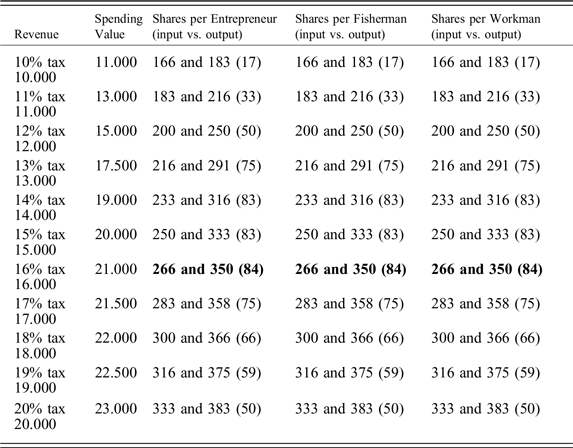
Note: Optimal tax level for each group is indicated in bold.
Distribution Under Progressivity

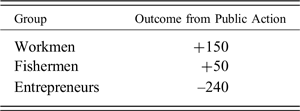
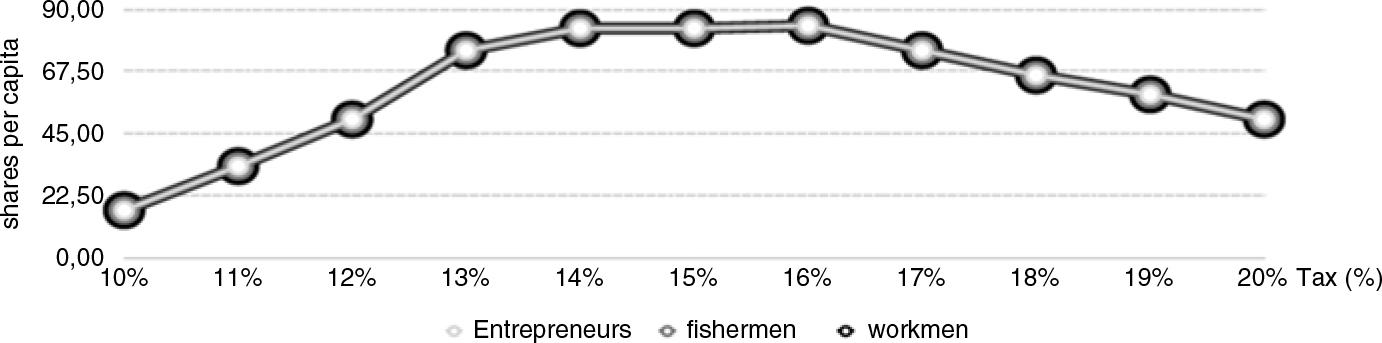
Figure 2 shows the consequence of demanding an equal absolute number from each group: each tax policy generates the same absolute amount of net benefits for each group.
Distributive options under lump sum taxation

Table 6 depicts the feasible options for each group for lump-sum taxation, under the general observation of both increasing and decreasing marginal utility (see “spending value”) of public goods. The optimal tax level for each group—a contribution of 266—is indicated in bold.
The distributional outcomes generated by lump-sum taxes have much in common with those generated by uniform taxation. The optimal tax level for each group is single-peaked (each group has only one best option), and discretion over another’s tax liability is foreclosed: what is optimal for one group automatically generates the tax duty for the other groups. Even more, the optimal tax level now is simply the same for each group (266, the equivalent of a 16% tax in the previous example). Lump-sum contributions put taxation on a par with markets, as taxes function as “shadow prices for goods and services provided by the state”Footnote 83 and henceforth limit overinvestment.Footnote 84
Yet a careful analysis of Table 6 reveals that some change did occur. The optimal tax level under lump sum taxes asks 266 from each group. Compared to a uniform tax, which generates the same output value for each member (350; see 16% row in Table 5), lump-sum taxation involves a tax cut for entrepreneurs of 54 (they pay 320 under a uniform tax) and a tax raise up to 66 for workmen (who pay 200 under the uniform tax). From a comparative perspective, a lump-sum tax acts as a transfer of liabilities to the lower-income groups. But even when assessed on its own merits, taxation in absolute numbers fails to hold up as “equal treatment.” Due to its insensitivity regarding how much a person earns, taxation in absolute numbers is harsh on the workmen: 250 out of 1,250 vs. 250 out of 2,000 for the entrepreneurs.Footnote 85 Although no one can precisely draw the curve, most people believe in the soundness of diminishing marginal utility of income: the first dollar earned has a higher subjective value than the 2,000th dollar earned.Footnote 86 Admitting the variance in interpersonal utility curves, at a general level, one can nonetheless state that under lump-sum taxes, the lower an individual’s income flow, the more value they will transfer to the common fund.Footnote 87 Because of this, the first working property of lump-sum taxes is—again, generally speaking—that they create at least some distributional bias in favor of the higher-income groups. A second operational element is, however, more relevant to the current discussion. Not only do lump-sum taxes entail a distributional bias, at the extreme, they empower the richest group to squeeze the lowest-income groups dry. Even in our fairly income-even township, the entrepreneurs and fishermen can put the tax at 1,250, to the detriment of the workmen. Now imagine the workmen earn 1,000, the fishermen 20,000 and the entrepreneurs 50,000. Here, the latter two groups can put the lump sum at 1,000, thereby expropriating all income from the workmen without experiencing severe losses themselves. Interestingly, such an unfair practice is ruled out under uniformity: taking everything from the workmen is checked by the prospect of being stripped oneself.Footnote 88 Hence, due to the unequal effect (caused by its blindness regarding how much a person earns), not only will a lump-sum tax realize distributive gains for the higher-income groups, when they fall outside the dominant coalition, lump-sum taxes put the lowest-income groups at the political mercy of the rest of the constituency. From a contractarian-constitutional perspective, when selecting procedures leading to outcomes that are acceptable to various positions, parties will want to prevent this risk.
3. Progressive taxation
The higher one’s income flow, the less one is affected by an absolute contribution. But does this search for an equal burden (relative to one’s holdings) not demand us to go further than a universal rate structure?Footnote 89 Does 250 realize the same burden for someone who earns 1,000 as 2,500 does for someone who gains 10,000? Indeed, the negative marginal utility of income has also been advanced to justify progressive taxation: the higher the income, the less one sacrifices, and thus the higher the required marginal rate.Footnote 90 Additionally, if not a translation of equal treatment, progressive taxation’s justification lies in redistribution. We do not need to treat people equally, we need to favor the least fortunate by progressive rates on the more fortunate, arguably an application of the demands of fairness.Footnote 91
Whether advanced as an application of the “equal treatment” doctrine—i.e., as a means to realize an equal relative burden on the higher and lower incomes—or to operationalize redistribution, two preliminary nuances are in place regarding these foundations of progressive rates. There is a difference between the distribution of income and well-being, more broadly construed. The latter also includes nonpecuniary benefits like health, a happy family life, leisure, and bodily integrity. Not only do nonpecuniary benefits not move in lockstep proportion with measurable income, but these components are also skewed across persons.Footnote 92 While a flat tax will ask 10 times as much from someone with 10 times the income, no one would insist that taken pecuniary and nonpecuniary sources of utility together, this person is 10 times better off. Flat taxes, applicable only to one source of well-being, income, will be particularly harsh on those who have a lot of it; hence, flat taxes will realize a systematic redistribution from the high-income groups to the rest.Footnote 93 Additionally, even if we assume that the pecuniary tax base is a perfect indication of well-being, flat taxes, simply by asking multiple times the amount from the higher incomes, may well be redistributive. As became apparent in the township, the most likely option (a rate of 15%) generates a net benefit of 33 for the entrepreneurs versus 146 for the workmen (see Table 5). In a polity with a fairly equal division of income, a flat tax yields 4.5 times as much benefit for the lower than for the higher income groups. If marginal utility is the justification for progressive rates, the dollars the workmen earn would need to yield more than 4.5 times as much subjective value as the dollars the entrepreneurs earn. As other scholars underline,Footnote 94 for the equal-burden principle to require progressive rates, the marginal utility curve would need to decrease in a rather impressively sharp fashion. In any case, the utility of income will decrease far more slowly than the utility for specific goods, as it has to be measured by the utility of the most desired good yet unpurchased.Footnote 95 Hence, uniform taxation may well be sufficient to satisfy the equal-sacrifice principle.
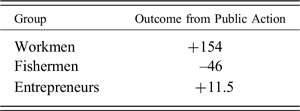
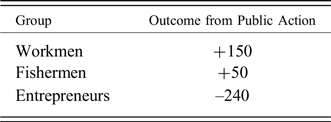
Our main worry is different. Even given a case for progressive rates, whether founded in equal treatment or redistribution, this paper distinguishes between theoretic ideals and expected outcomes once tax rules are unleashed in political reality. It is possible that those deciding on the distribution of tax incidence will be dedicated to the principle of marginal utility and the doctrine of equal sacrifice when voting on tax brackets and tax rates. They might also be inspired by theoretic schemes of redistribution, stating the point at which the richer classes should transfer higher amounts to the common fund. But I started with the observation that political groups are often driven by more profane considerations. Progressivity crucially alters the nature of the alternatives that appear on an individual’s calculus. In particular, the deviation from the equal-rate principle and the ability to tax other groups at higher rates “open up the risk that the system of taxation will be abused and perverted and thus transformed into an instrument of confiscation that some individuals can wield against others.”Footnote 96 Going back to the township, the constraint of progressivity allows the workmen and fishermen to, say, put a rate of 15% on the “first” 1,750 any person earns and a universal rate of 76% on the second bracket, above 1,750. Note that this would create exactly the same distribution as under the “social justice” coalition: workers pay 5,000, fishermen 7,000, and entrepreneurs 12,800, with societal overinvestment and severe losses for the entrepreneurs reoccurring in the public domain. Table 7 shows distribution shares with a spending value of 400 per capita.
Adam Smith raised the requirement that the “tax which each individual is bound to pay ought to be certain, and not arbitrary.”Footnote 97 In this regard, our example above signals progressivity’s weaknesses compared to the uniformity account. Moreover, the legislative liberty to tax different income brackets at different rates will generate asymmetrical distributions of tax shares between different income groups. As the choice of one’s own tax liability does not automatically determine the excise applicable to other income groups, politically dominant coalitions are now at liberty to realize gains by surtaxing others. As the example suggests, progressivity incentivizes lower- and middle-income groups to maximize profits by shifting the burden of public action onto the high-earning minority.Footnote 98 This reignites, albeit to a more limited degree, the issues against which uniformity appeared as a check. While uniformity realizes efficiency, fairness, and a limited form of redistribution at minimal discretionary costs, progressivity opens up the fiscal powers, and with it the risk for fiscal exploitation, overinvestment, and inefficiency (meaning the rule does not promote outcomes that are beneficial to all members). Nonetheless, compared with the practice of fiscal exemptions and the prevailing legal arrangements, progressive rates, when applied universally, clearly represent an improvement. First, groups are only allowed to differentiate the applicable rate on the basis of one element: income. Second, the differentiation of fiscal duties is clearly limited, as it only applies to a proportion of the income of a specific group; that is, the portion that exceeds a specific benchmark cutoff, here 1,750. This means that under progressivity, fiscal extraction becomes more visible as it demands comparatively high rates. In current politics, progressive rates on all income would be a step toward more generality and represents a reasonable account of generality.Footnote 99
The essential question that remains is thus whether risk-averse contractors with limited knowledge about their future position prefer the “political security” of not being discriminated against or the economic benefits and the “limited” redistributive effects offered by uniformity, or whether they opt for “socioeconomic security” for low- and middle-income groups to benefit from the distributive bias delivered by progressivity at the costs of extended fiscal powers. Answering this question requires gauging both the negative (e.g., desincentivizing effects of progressive rates) and positive (e.g., redistribution might boost the opportunities of the least fortunate) spillovers of both institutions, and thus falls outside the scope of this article. The true answer may even be beyond the scope of theory, as the trade-off it implies can be performed only by real people. After all, rational choice models are nothing but a simulation of real choice.
4. On distributive justice and taxation
Fried is right: to the extent that distributive justice is about proclaiming philosophical ideals, tax uniformity fails to be any account of justice. The insensitivity that tax uniformity generates with respect to each person’s biological endowmentFootnote 100 or height of incomeFootnote 101 seems to run against the core of many theories of justice. That said, Amartya Sen claims that theorizing about justice needs to focus on how social structures actually work—not on how we imagine they work in thought experiments.Footnote 102 This paper builds on political reality and behavioral insights that indicate that fiscal decision-making is no pure realization of a philosophical ideal, but often results from the attempts of individuals who are decisive in the process to attain their own self-interest. On this account, tax justice is not something “out there” waiting to be objectified by a benevolent policymaker. If tax justice is ever to be realized, it will “emerge” from a process in which multiple mainly self-interested agents settle the distribution of tax shares against a prevailing set of rules. I intended to find procedural constraints that are “robust” to deal with self-interested political action and yield results compatible with rudimentary conceptions of fairness and efficiency. Justice, according to this nonideal account, is not some independent ideal but relates to the internal quality of the very rules that will determine how that process takes place. Theorizing on fiscal justice involves screening which effect competing tax rules will exert on those who are in a position to determine the distribution of fiscal shares. Rules that are “just” are the ones that generate outcomes that are “broadly acceptable” and appear beneficial to all prospective positions.
This article illustrates how generality-as-uniformity satisfies this constitutional test, as it generates fiscal outcomes that benefit those inside and outside the realm of power, alongside generalized criteria of fairness and efficiency (displayed in Figure 1 and Table 5). Due to its built-in constraint, these working properties flow endogenously from the rule itself, whereby fiscal harm to others is likely to damage the rule-maker. Choosing behind a veil of uncertainty, generality-as-uniformity thus assures participants that those deciding on the distribution of fiscal shares will produce a policy pattern acceptable to all players, regardless of their position. To the extent that distributive justice entails assuring an outcome that “all can live with,”Footnote 103 tax uniformity stands as an account of justice. In that regard, Fried is wrong.