

1 Introduction and background
1.1 Historical developments
From its first literary appearance in 1375, until the mid 1500s, Scots was the dominant language variety of Scotland. Some characterise it as a fully functioning language with an emerging standard and a wealth of literature (Romaine Reference Romaine1982; Devitt Reference Devitt1989; Pollner Reference Pollner2000; Douglas Reference Douglas2001); others suggest that English and Scots existed on a linguistic continuum (Aitken Reference Aitken1984a; Görlach Reference Görlach1996; Kniezsa Reference Kniezsa1997; Kopaczyk Reference Kopaczyk2012), with a large common lexical core (Meurman-Solin Reference Meurman-Solin1993). Regardless, the ‘heyday’ of Scots (Murison Reference Murison1979: 8-9) was disrupted by various social and political developments in the sixteenth to eighteenth centuries and Scottish Standard English (SSE) developed as the new nationwide standard. This anglicised standard became preferred in the professional arena and most written genres.
The rise of SSE has been linked to a number of sociohistorical events that occurred during the sixteenth to eighteenth centuries. In particular; printing (Devitt Reference Devitt1989; Kniezsa Reference Kniezsa1997; King Reference King1997; Douglas Reference Douglas2001), religious upheaval (Aitken Reference Aitken1979, Reference Aitken1984a; Bugaj Reference Bugaj2004; Millar Reference Millar2005; Lawson Reference Lawson2014) and the Union of the Crowns (Aitken Reference Aitken1979; Pollner Reference Pollner2000; Douglas Reference Douglas2001) have been identified as keystones in the anglicisation of Scots. Yet it is easy to view events as a historical narrative leading up to some ultimate goal: in this case, the union of two nations (Kopaczyk Reference Kopaczyk2012). The period was by no means harmonious, and Scottish society was far from homogeneous in its feelings towards the Union. It seems unlikely that all sections of society rapidly shunned Scots (Meurman-Solin Reference Meurman-Solin1993). Indeed, institutions at a purely local level tended to resist anglicising tendencies, regarding vernacular features as prestigious (Meurman-Solin Reference Meurman-Solin1993; Kopaczyk Reference Kopaczyk2012). Despite the suddenness of the political and social changes facing the people of Scotland at this time, the switch from Scots to English is reported to have been more gradual, with overlapping processes of divergence and convergence to/from Scots throughout this time period. For instance, Meurman-Solin (Reference Meurman-Solin1997) has shown that while some contemporary texts displayed a rapid decrease in Scots variants, others showed an increase. Authors made the switch from Scots to anglicised forms at different times for different Scots features. Indeed, the prevalence of a ‘mixed dialect’ (McClure Reference McClure1983; Aitken Reference Aitken1984a) or ‘mixed speech’ (Meurman-Solin Reference Meurman-Solin1997) has been observed throughout seventeeth-century Scots literature.
The decline of written Scots and the subsequent rise of SSE has been extensively documented thanks to a wealth of literary material spanning a sizeable historical time frame. This research has revealed a complex combination of social, political and textual constraints operating on the emergence of SSE.
1.2 Previous studies
The first large-scale study on the anglicisation of Scots was undertaken by Devitt (Reference Devitt1989), who looked at five Scots variables and their anglicisation across text type (genre) and time. She suggested that the set conventions and expectations surrounding different text types could explain their levels of anglicisation. Following this, Meurman-Solin (Reference Meurman-Solin1989a, Reference Meurman-Solin1989b, Reference Meurman-Solin1989c, Reference Meurman-Solin1992, Reference Meurman-Solin1993, Reference Meurman-Solin1997, Reference Meurman-Solin2003) has undertaken by far the most detailed analysis of Scots and SSE. Utilising the extensive Helsinki Corpus of Older Scots (HCOS), she has been able to produce a wealth of research that examines with greater breadth the complex historical factors at play than previous small-scale studies. She characterises the rise of SSE as alternating between periods of rapid and slow change (Reference Meurman-Solin1993), and has revealed considerable heterogeneity in the appearance of features across text, time period and author (Meurman-Solin Reference Meurman-Solin1989b, Reference Meurman-Solin1989c, Reference Meurman-Solin1993). A range of different social and contextual factors have been explored in her research, including text type (Reference Meurman-Solin1992), audience (Reference Meurman-Solin1992, Reference Meurman-Solin1997), style (labelled ‘contemporaneity’) (Reference Meurman-Solin1989c) and text medium (printed or manuscript) (Reference Meurman-Solin1992, Reference Meurman-Solin1997). These factors may act independently or in conjunction, and various conservative or innovative forces were particularly relevant at different times in the move to standardisation (Meurman-Solin Reference Meurman-Solin1992, Reference Meurman-Solin1993).
In most quantitative work on the history of Scots, specific social factors are correlated with particular linguistic features in a piecemeal way. This creates an artificial and arbitrary sense of the separateness of these social constraints on the changes which took place, and has resulted in differing and sometimes conflicting claims concerning the key factors constraining or facilitating the anglicisation of Scots. For example, Devitt (Reference Devitt1989) only examined the correlations between genre and time, which may have disguised patterns stemming from other sociohistorical factors. Meurman-Solin (Reference Meurman-Solin1993) has focused mainly on text type, although she has acknowledged that other socially conditioned factors such as audience could have influenced anglicisation. Furthermore, both these authors base their conclusions on a discussion of descriptive statistics rather than by means of a stepwise multiple regression, which would compute the significance of one independent variable (e.g. genre) while explicitly controlling for the effects of all other known independent variables (e.g. audience, text medium, style).
Romaine (Reference Romaine1982) recognised the untapped potential of using regression modelling in the diachronic study of Middle Scots. Using the variable rule program VARBRUL (Sankoff Reference Sankoff1975), Romaine found that alongside linguistic environment, stylistic constraints in particular influenced <wh-> relative deletion. Romaine (Reference Romaine1982) was able to observe the effects of multiple (rather than individual) predictors on historical data simultaneously, representing a significant step forward in historical Scots research. However, since this publication in 1982, there have been considerable advances in statistical modelling of variable data. For instance, Romaine (Reference Romaine1982) was only able to examine one set of extralinguistic constraints at a time (so called ‘fixed effects’), because in the original VARBRUL program there was no way to explore interactions between the independent variables (or ‘factor groups’). Furthermore, there was no way to account for the seemingly random variation that is always present in a dataset, which could be attributed to the idiolect of particular authors or the trajectory of change of individual words (for more on this and the constraints of VARBRUL, see Johnson Reference Johnson2009). Indeed, Romaine (Reference Romaine1982: 207) herself noted that ‘the multivariate analysis may conceal as much as it can reveal’. Despite the advances made by Romaine (Reference Romaine1982), research on Scots has not moved in the direction of incorporating newer and more sophisticated methods of statistical modelling (although see Smith (Reference Smithforthcoming) for a statistical analysis of spelling variation in fifteenth-century Scots).
The need for approaches utilising not only greater statistical accuracy, but also the capacity to recognise the multifarious and heterogeneous nature of historical data, is becoming clear. Previous studies on Scots have not adopted techniques that adequately come to grips with the huge variability of diachronic corpora, nor the antipodal pressures stemming from local and supraregional interests. Yet this has become more achievable with modern methods of modelling variation, creating greater scope to pinpoint possible factors influencing a particular instance of language change. We argue that by adopting current statistical modelling techniques, we can reach a better explanatory account of the factors which promoted or inhibited language change in Scotland. Accordingly, we adopt some of these newer empirical methods as we re-examine variation in the orthographic clusters <quh-> and <wh-> occurring in relative and interrogative pronouns, in the HCOS.
2 Methods
2.1 Circumscribing the variable
The Scottish orthographical variant <quh-> corresponds to the initial <wh-> cluster in English, in relative and interrogative pronouns such as which, where, what, whom, which in Old Scots were represented as quhilk, quhere, quhat, quhom. During the seventeeth century <quh-> came to be replaced with the anglicised variant. However, spelling practices were not standardised during the sixteenth and seventeeth centuries and there was substantial variation in this variant, including <qu->, <qw->, <qwh-> and <qh->, though <quh-> was by far the most common. Furthermore, during the switch to <wh->, ‘transitional’ spellings combining a mixture of Scots and English orthographic variants have been identified (Kniezsa Reference Kniezsa1997; Beal Reference Beal1997). However, Laing & Lass (Reference Laing and Lassforthcoming) suggest that the different spellings were not purely the result of orthographic variation but corresponded to specific phonological realisations distinguishing Scottish and northern English dialects from southern English. Evidence from various historical corpora suggests the orthography represented a phonological distinction between northern [kw] for <qu-> spellings, [xh] for <quh-> (which later changed to [hw] after historical processes of lenition occurred), and southern [w] for <wh-> (Laing & Lass Reference Laing and Lassforthcoming). Thus the change from <quh-> to <wh-> may not be purely orthographic, but also reflective of historical phonological changes taking place, coupled with the influence of English on Scots. In this article we will not explore the phonological implications of this change, basing our examination purely on orthographical variation. However, the distinction is important to keep in mind.
<quh-> has been included in many studies, no doubt due to its emblematic nature as a Scots variant that underwent clear and unambiguous anglicisation. However, Lass & Laing (Reference Lass and Laing2016) and Laing & Lass (Reference Laing and Lassforthcoming) have identified the various spelling variants of ‘qu’ occurring in Early and Late Middle English, and Kniezsa (Reference Kniezsa1997) has noted that <quh-> was the usual spelling for the extreme north of England as well.Footnote 2 Nonetheless, it seems <quh-> was vastly preferred for Older and Middle Scots, unlike Old and Middle English (Lass & Laing Reference Lass and Laing2016).
Studies that have specifically examined <quh->/<wh-> have noted the categorical nature of the switch. Devitt’s (Reference Devitt1989) analysis pinpointed the year 1600 as pivotal; use of <quh-> decreased dramatically whilst <wh-> moved from 17 to 83 per cent usage. Most of Devitt’s (Reference Devitt1989) texts exhibited categorical use of <wh-> or <quh-> and diffusion across texts was strongly suggestive of an s-curve pattern of change. Meurman-Solin’s (Reference Meurman-Solin1997) analysis of the HCOS also suggested a rapid decrease in <quh-> and rise in <wh->, though right up until 1700 there is considerable oscillation across texts. It seems that either <quh-> or <wh-> was preferred in a text, rather than any kind of variable usage (Devitt Reference Devitt1989; Meurman-Solin Reference Meurman-Solin1997). Though both studies have indicated similar results, Meurman-Solin’s findings are of most interest as this study will also seek to use the HCOS to analyse the <quh-> cluster.
The data for this project come from the Helsinki Corpus of Older Scots (HCOS; 1995). This corpus of 850, 000 words of running text is the largest computer-readable corpus of Older Scots texts. It contains edited texts or early prints from a wide range of genres including Acts of Parliament, local records, trial proceedings, sermons, pamphlets, scientific and educational treatises, histories, biographies, diaries and private letters. Using AntConc (Anthony Reference Anthony2015, version 3.5.0) to search the HCOS text files, the clusters <qu->, <quh->, <qw->, <qwh-> and <wh-> <vh-> and <hw> were included in the search string. We included all the more common variants of ‘qu’ and ‘wh’ to incorporate a wider range of variation, given that orthographic practices were variable at the time (and phonological changes were also taking place, see Lass & Laing Reference Lass and Laing2016). The vast majority of tokens were <quh-> and <wh-> with very few hits for the remaining clusters (38 tokens altogether). These were subsequently relabelled as <quh-> or <wh-> and merged with the respective datasets. The results were then circumscribed; ambiguous or unknown tokens were checked using the online Dictionary of Scottish Language (DSL; www.dsl.ac.uk) and invalid tokens were removed. Incomplete tokens, often marked wh~ in the corpus, were deleted. Furthermore, <quh-> was used categorically before 1570 so we also removed all tokens occurring between 1450 and 1569. This left 7,759 potential sites of variation to explore.
A number of extralinguistic variables are encoded into each text file in the HCOS, including publishing date, audience, contemporaneity (the style of the writing), text medium [printed, manuscript], literary medium [script, speech-based, written], the author’s rank, age and sex, interactiveness (whether the text was designed to engage the reader or simply state facts), and relationship to the addressee [intimate, distant] (for letters). However, the amount of available information varies widely for different texts and a degree of manual annotation was often necessary. For example, in the case of court proceedings, the texts were carefully read to try to determine the author of each token produced. If the variant came from a speaker who was being directly quoted, they were marked as author, but if the variant came from a scribe who was narrating the series of events, the author was listed as ‘unknown’.
The HCOS has been divided into four time periods: 1450-1500, 1500-70, 1570-1640 and 1640-1700. Meurman-Solin (Reference Meurman-Solin1989a) acknowledges that the time periods of the corpus do not correspond to key diachronic developments in the history of Scots; rather they have been chosen to match the time periods of the Helsinki Corpus of English Texts (Rissanen et al. Reference Rissanen, Kytö, Kahlas-Tarkka, Kilpiö, Nevanlinna, Taavitsainen, Nevalainen and Raumolin-Brunberg1991). While this may be convenient for comparing developments in the history of English and the history of Scots, it is not driven by how the data themselves pattern over time. When we are examining the variation and change of a single linguistic variable, we should perhaps be mindful that the variable itself may have its own textual history. To avoid distorting or disguising that, we need a better way to model variation over time. Accordingly, this study employs the technique of Variability-Based Neighbour Clusters (Gries & Hilpert Reference Gries and Hilpert2008) to explore change over time in <quh-> and <wh->, which we explain in the course of the next section.
3 Analysis
3.1 VNC
Historical analyses of language variation and change tend to describe trajectories of change using pre-set, equal-length time periods that are artificially imposed on the data, as a result of subjective categorisation made by corpus compilers (as is the case in the HCOS) or based on well-established time periods that have been defined by key sociohistorical changes (Gries & Hilpert Reference Gries and Hilpert2010). Yet sectioning the data into convenient year-frames can disguise or overlook trends, painting an incomplete picture of the subtle changes that may characterise the trajectory of any one variant. Trends, turning points and slopes can all be altered or missed when such categorisation is applied (Gries & Hilpert Reference Gries and Hilpert2010). Traditional period divisions can also mask non-linear developments, and this periodization can discourage research across these convenient boundaries (Nevalainen Reference Nevalainen2006). Furthermore, sectioning the data according to major historical events ignores the time lag that may ripple through language change.
Gries & Hilpert (Reference Gries and Hilpert2010) thus developed a statistical method to section temporal data: Variability-Based Neighbour Clusters (VNC). This can be used to determine coherent temporal stages as well as conservatively identify data points as outliers. In the model, data are fed into the algorithm which then determines which data points cluster most closely together. Clusters are defined by a high level of within-group similarity and low level of across-group similarity. The measurement of similarly can be set to generate clusters that constitute a relatively homogenous period of interest. The data, rather than the researcher, determine the temporal stages, hence the periods are derived directly from the phenomenon under investigation (Gries & Hilpert Reference Gries and Hilpert2010). This is a step towards a more accurate, quantitatively constructed analysis of historical data by removing the need for arbitrary divisions, such as those imposed in the HCOS.
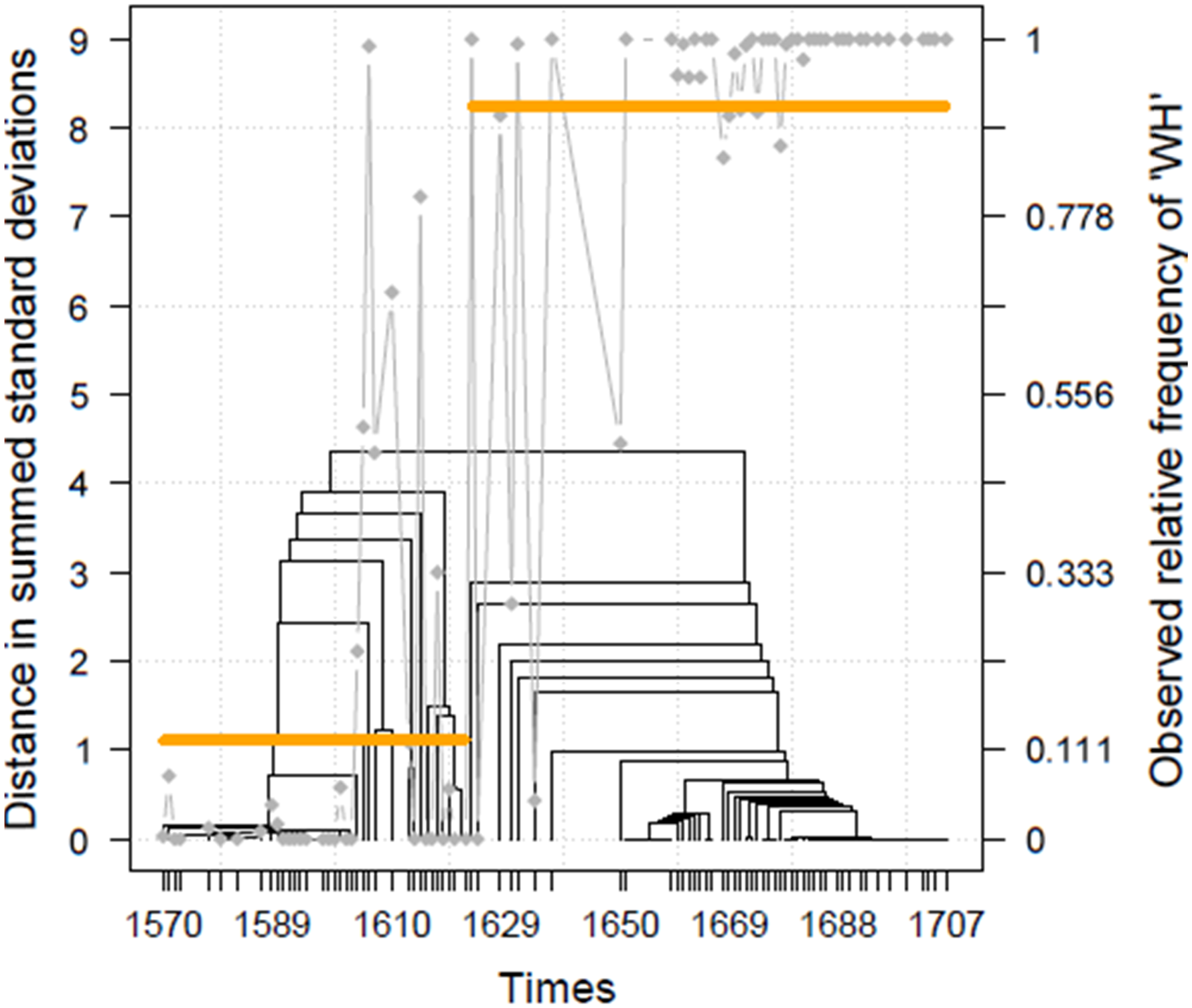
The first stage of this research was to run a VNC analysis on the quh ~ wh variable data to explore how the frequency of <wh-> clustered over time. The VNC algorithm is available as an R (version 3.1.2, R Core Team, 2012) script, which was kindly sent to us by Stephan Gries (p.c). The results of this analysis are presented in the dendrogram in figure 1.
Dendrogram produced by VNC analysis showing change from <quh-> to <wh-> over time

The y-axis indicates the difference in standard deviations from the mean frequencies of <wh-> in each of the merged temporal files. The x-axis indicates chronological year from 1570 to 1707. Hierarchical clustering algorithms typically cluster similar data together; the difference here is that the clustering algorithm also pays attention to the time depth of the data so that the clusters are grouped not only by similarity in variability, but also similarity in time. The two main clusters in this data are highlighted in yellow. Finally, the graph is overlaid with raw data – each dot represents the frequency of <wh-> within a single text in the HCOS and this is charted on the z-axis. The pattern shown in the graph here is largely what we would expect from previous descriptions of quh ~ wh variation. There are minor differences in standard deviation initially due to relative uniformity in choice of variant. However, the standard deviations quickly increase in size during the seventeeth century indicating the period of the most variability. Finally, within the last thirty years, there is a drop in standard deviation again and levels return to the pre-1589 levels, suggesting categoricity has been more or less achieved. One thing to notice from the raw data is how little variability exists within individual texts. Even during the seventeeth century, at the height of the change from <quh-> to <wh->, it appears that there is very little intratextual variation. The two clusters found by the VNC analysis (cluster 1: 1570-1623; cluster 2: 1624-1708) indicate that there was an almost binary switch from using <quh-> to <wh-> over a fairly short period of time (1600-50). Individuals, in general, were exhibiting near categorical use of either <quh-> or <wh->.
This dataset contains far fewer clusters than we perhaps might expect of a language change in progress, and certainly fewer than the VNC analysis undertaken by Gries & Hilpert (Reference Gries and Hilpert2010) for -(e)th in the Parsed Corpus of Early English Correspondence (Nurmi et al. Reference Nurmi, Taylor, Warner, Pintzuk and Nevalainen2006). However, Gries & Hilpert (Reference Gries and Hilpert2010) examined a variable that underwent gradual and inconsistent variation over the course of two centuries. The change from <quh-> to <wh-> in Scots on the other hand reflects the artificial and socially conditioned imposition of one language standard over an emerging one, within a few decades of the Union. The period of instability was short-lived and there is little evidence for several periods of rapid then slow change (Meurman-Solin Reference Meurman-Solin1993). Rather, the model suggests there was a single, rapid switch from <quh-> to <wh->.
3.2 Multiple regression
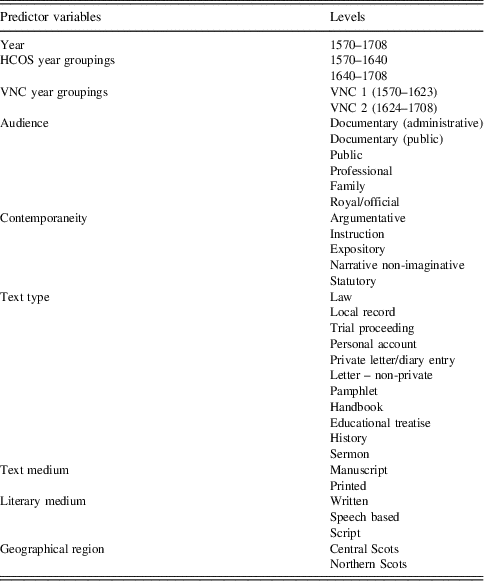
Next, binomial mixed-effect models were fit to the data by hand (see Baayen et al. Reference Baayen, Davidson and Bates2008) using the lme4 package (version 1.1-10; Bates et al. Reference Bates, Maechler, Bolker and Walker2015) in R with the bobyqa optimizer (Powell Reference Powell2009) to aid model convergence issues. This was done to determine which extralinguistic factors played a role in driving the change to <wh->. The dependent variable was a binomial variable distinguishing between the spellings <wh-> and <quh-> (coded as either quh- or wh-). <wh-> was set to the default as the present standard variant and so the data presented here show the log-odds of the <wh-> form. The fixed effects initially coded as independent predictors of variation between <quh-> and <wh-> are presented in table 1.
Predictors of variation included in the statistical model predicting variation in <wh-> in Scots between 1570 and 1708

Some of the levels within the predictor variables presented in table 1 are self-explanatory (e.g. whether the text was from the Central or Northern region of Scotland). But others require a little more explanation.
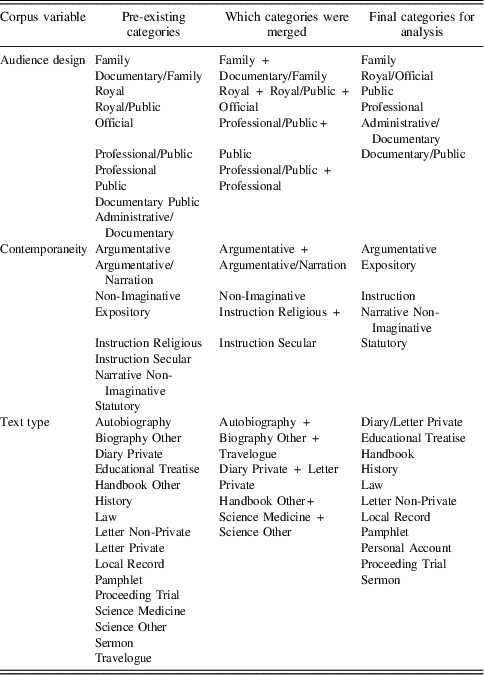
Audience was grouped into six categories: Documentary (Administrative), Documentary (Public), Public, Professional, Family and Royal/Official. Documentary (Administrative) refers to texts that were factual rather than imaginative, intended only to be read by the people involved in the transaction. These texts included local records and Acts of Parliament. Documentary (Public) also refers to non-imaginative texts though these were intended for or available to the public. In the corpus they consist entirely of histories and trial proceedings. Public texts cover a range of text types that could be instructive, fictional or argumentative, but not informational as the documentary texts are. These include travelogues, sermons, pamphlets and handbooks. Professional refers to academic literature, in this case scientific and medical treatises. Family refers to letters and correspondence addressed to family members, and Royal/Official refers to correspondence between members of the Scottish gentry and between the gentry and royal family.
contemporaneity also needs some clarification. This was grouped into five categories: argumentative, instructive, expository, narrative non-imaginative and statutory. Argumentative texts were literature involving some form of debate or discussion such as trial procedings or pamphlets. Instruction refers to texts intended as guides or directives but with specific audiences in mind. These audiences were either the faithful or royalty, for whom guides were produced concerning correct religious or princely behaviour. Expository texts refer to infomative texts such as scientific treatises or handbooks, intended to enlighten the audience on a particular topic. Narrative non-imaginative texts is by far the largest category in the corpus, and refers to all non-fiction texts that involve an element of time, including history books, private diaries, bio- and autobiographies (labelled for our purposes as Personal Account) and travelogues. Finally, Statutory refers to all texts with a legal element, such as local records and law treatises.
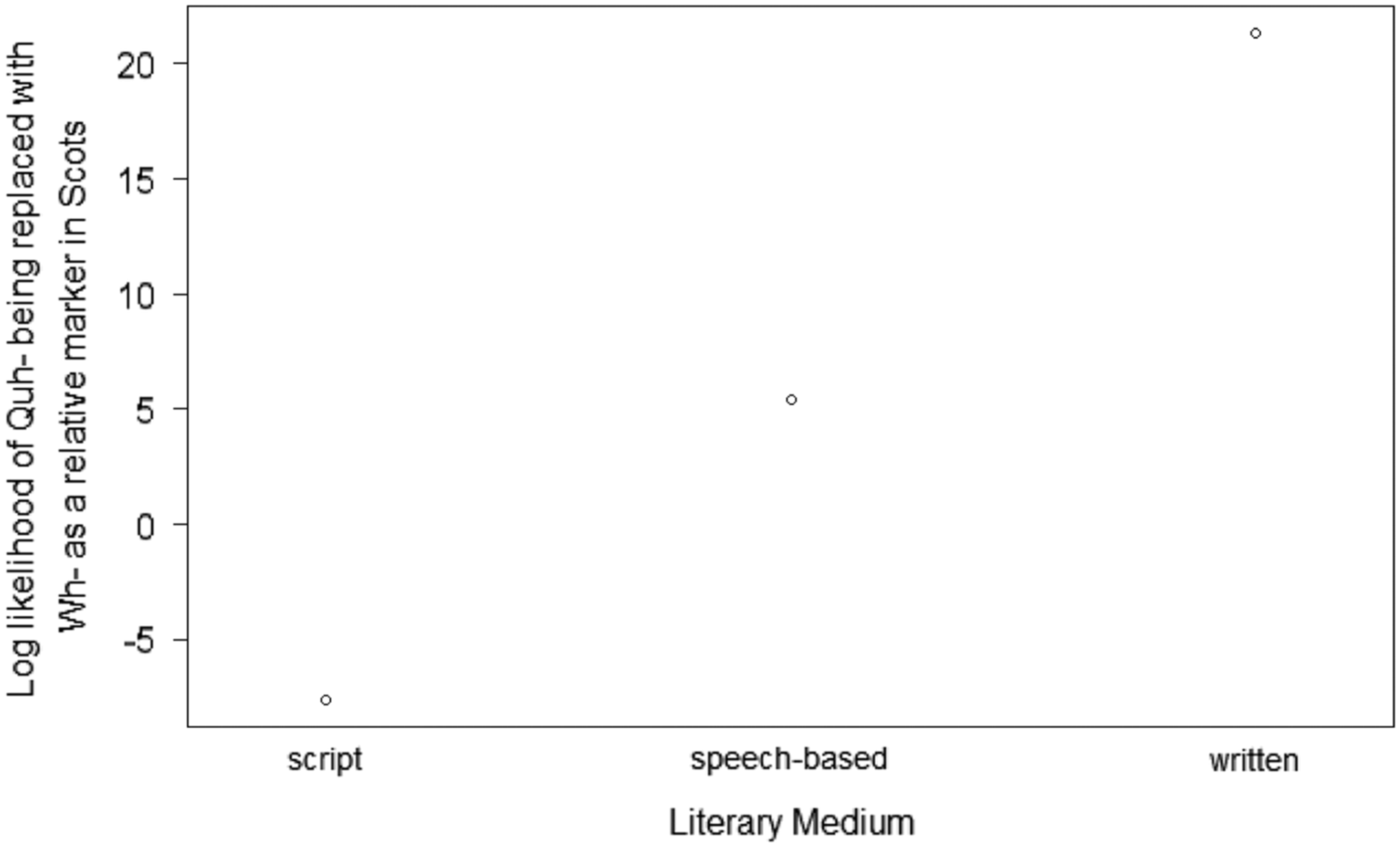
Within literary medium there are three categories: written, speech-based and script. Written refers to the vast majority of documents in the HCOS and encompasses a wide range of text types. Speech-based refers mostly to trials proceedings in which the defendant is (supposedly) directly quoted, and church proceedings. Script refers to religious sermons spoken by preachers to their local congregations. These would have been written in the style of a speech or address, to be delivered in church to a lay audience.
First, a series of models were generated to explore how best to model time as a predictor in these models. Four simple mixed-effect logistic regression models were run, each having as a predictor one particular method of partitioning time: (i) year as a linear predictor; (ii) the HCOS time periods; (iii) year as a non-linear variable; and (iv) the VNC method of chunking the data over time. All four of these models failed to converge and this is most likely because of the uneven spread of the data over time (i.e. the data are not distributed evenly over each year because we are dealing with historical data; there will be some years with no data points, and others with very many data points). Attempting to build models with time (any of the four methods described above) as a predictor also led to model convergence issues. Since we know that the change from <quh-> to <wh-> took place during this time period, it is less important to incorporate some measure of time as a predictor of variation, and so we removed any measure of time in order to achieve a better statistical model of the data, and one which allows us to explore the social predictors of variation more easily.
Next, before continuing with model fitting, we checked for collinearity between the predictor variables using the vif.mer function in R.Footnote 3 Perhaps unsurprisingly, text type, contemporaneity (style) and Audience were all highly correlated. Three models were created with each of the collinear factors entered as the only predictor of variation (i.e. one model explored the extent to which Text Type was a predictor of <wh-> in the HCOS, another model looked at Contemporaneity, and other correlated <wh-> with Audience). χ2 likelihood tests compared Akaike information criterion (or AIC; Akaike Reference Akaike1974) and Bayesian information criterion (or BIC; Schwarz Reference Schwarz1978) values for each of these models. There were no significant differences between these models, but the AIC/BIC values were marginally lower for the model with Audience so this was selected as the best fixed effect for the social factor addressing style/audience design.
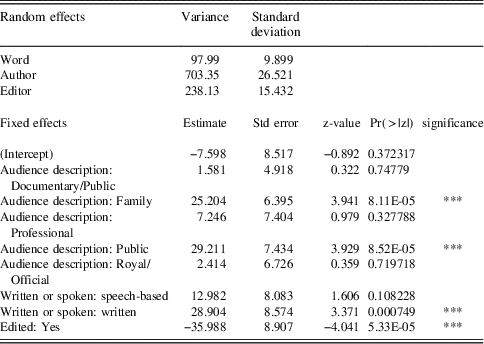
The model was then incrementally expanded to include more extralinguistic factors. At each stage of expansion, the AIC and BIC values were compared with previous models using χ2 likelihood tests to determine whether the fit of the model was improving. This continued until the model failed to find any more significant predictors of variation. Model convergence issues were encountered when two-way interactions were tested so only the fixed effects are presented here. Random intercepts for Author and Word were included, as well as for Editor (since for the vast majority of texts there is another potential source of random variability that we can account for by including editor as a random effect).Footnote 4 By-author random slopes were checked but could not be included because this led to further model convergence issues. The final statistical model showing the predictors to significantly constrain variation in <quh->/<wh-> is reported in table 2.
Logistic mixed effects regression model of factors predicting the use of <wh-> in Scots between 1570 and 1708 (N=7,759)

The estimate is the coefficient estimated by the model – this measures the strength and direction of the relationship between two variables, using the intercept as a reference. The standard error is the error of the estimate, and the z-value is a measure of standard deviation (thus measures closer to zero will be closer to the mean – in this case the intercept). The probability value Pr(>|z|) reports the likelihood that the correlation between the dependent variable and predictor variable is due to chance.
It is clear that the anglicised variant <wh-> is significantly affected by three factors, reflecting the interweaving influences of extralinguistic constraints. The various audience categories also exhibit considerable variability, suggesting audience had a great influence on the variation observed for <wh->. Of course, the effects presented here are unlikely to be the only significant features; author-specific characteristics such as gender or rank may have been important too but the data for these social characteristics are patchy in the HCOS so it wasn’t possible to include these as predictors. We now discuss each of these significant constraints on the rise of <wh-> in Scots.
4 Results and discussion
4.1 Audience
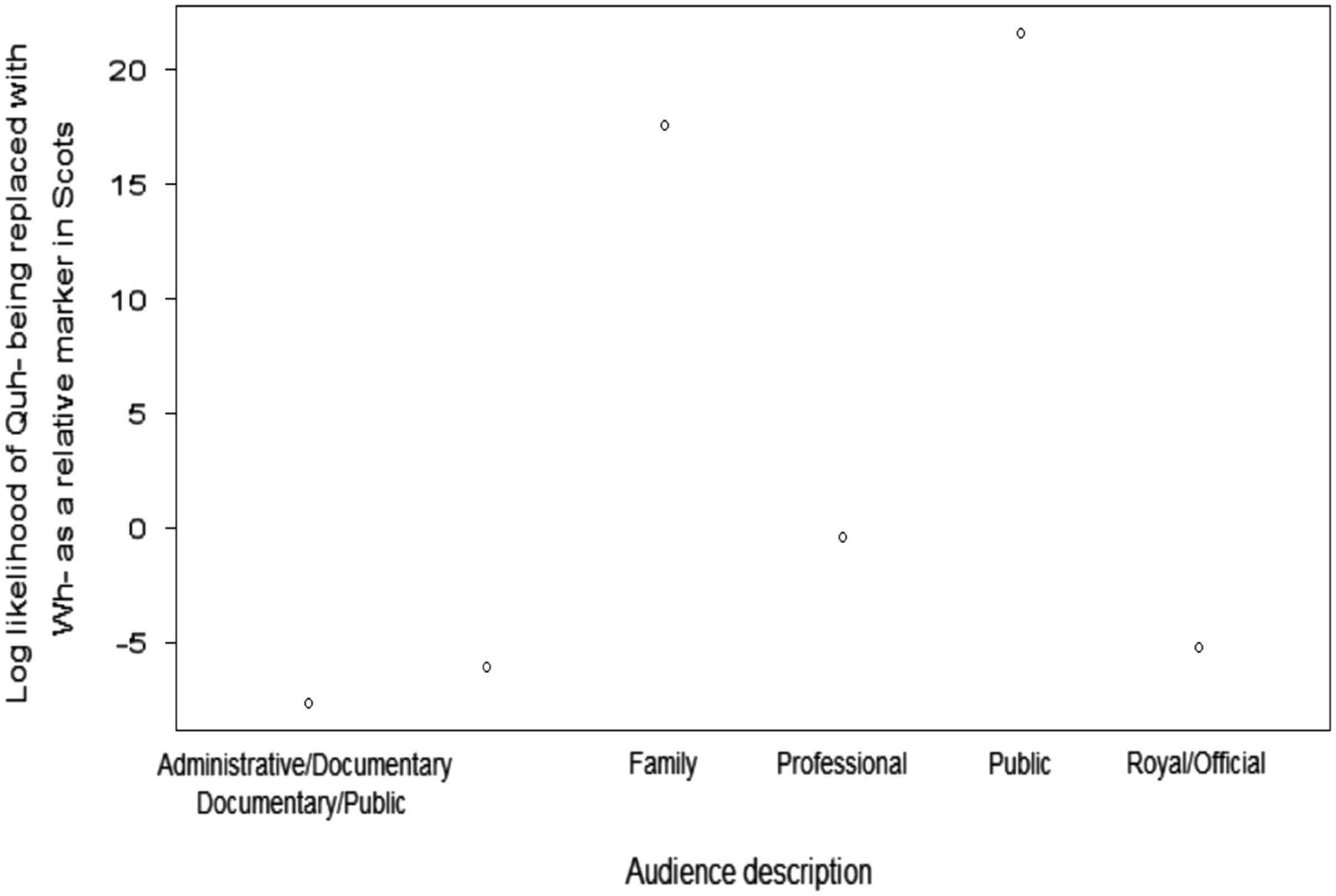
Audience reflected substantially more variation across its factor levels than contemporaneity, supporting its validity as a conditioning factor of anglicisation. Figure 2 depicts the likelihood of the variable being realised as <wh-> (y-axis) across different audience types (labelled on the x-axis). The higher the value on the y-axis, the more likely that the variant would be realised as the incoming, anglicised <wh-> form. There is a clear cline in Audience from a near-categorical preference for Scots <quh-> to an increasing degree of <wh-> forms, suggesting different audiences encouraged or constrained the use of <wh->. However, anglicisation was clearly strongest in texts addressed to the public.
Model output showing likelihood of <wh-> across different audience categories in the Helsinki Corpus of Older Scots (1570–1708)

The preference for the anglicised variant in the Public category is hardly surprising. Meurman-Solin (Reference Meurman-Solin1993) has suggested that authors of such texts may have been motivated to reach a wider audience, to enjoy the benefits offered by ‘high’ society whilst also maintaining the profitability of printing. The Union evidently increased opportunities for social advancement and focused the gentry’s attention away from Edinbugh towards London (Lawson Reference Lawson2014). Parties were no longer concerned solely with their Scots audience but also with readers outside Scotland’s borders. Public access could best be achieved through use of the incoming standard, allowing authors greater scope than if they restricted themselves to purely Scots forms and styles (Meurman-Solin Reference Meurman-Solin1993). Thus, texts aimed at the public can be expected to incorporate anglicised forms the most, and this is indeed the case.
It is equally unsurprising to find that texts coded as Administrative/Documentary are the least anglicised out of all the audience types. This category has the strongest negative correlation with Public, and figure 2 implies almost zero deviance from the standard Scots <quh-> form. This result is hardly unexpected given that such texts were never intended to be read by the public, but rather by various bureaucratic officials who did not need to be influenced, persuaded or appealed to in any way. Meurman-Solin (Reference Meurman-Solin1992, Reference Meurman-Solin1994) has noted that genres with no particular addressee tend to remain linguistically conservative and this is reflected here. Furthermore, Scots differed from English in the legal arena in that it had a different professional terminology. By following set conventions, scribes guaranteed the reliability and transparency that records required (Bugaj Reference Bugaj2004, Reference Bugaj2005; Kopaczyk Reference Kopaczyk2012, Reference Kopaczyk2013; Cruickshank Reference Cruickshank2013). This included the prepositional phrase fragment witness of ye quhilk/quhilkis ((the) witness of (the) which), which could possibly explain the extended life of the <quh-> spelling in legal discourse (Kopaczyk Reference Kopaczyk2013). Indeed, Meurman-Solin (Reference Meurman-Solin1989c) found no definite change in trials and law, with <quh-> variants resisting anglicising tendencies longer than other features. These codified expressions may be part of the reason for its retention, but without economic and social pressure to convert to anglicised forms, it seems unlikely that there was much appeal to do so regardless.
Texts directed at a Professional audience, which consisted of scientific and medical texts, are more anglicised than Administrative/Documentary but still largely conservative. This may be indicative of the changing demands of the professional audience during this time. Scotland had a relatively long-established scholarship that was recognised beyond its borders. Certainly during the fourteenth and fifteenth centuries Scotland produced a great deal of leading work in various fields (Bald Reference Bald1926). Unlike English scholarship, which was conducted in Latin or French, Scottish scholars had already begun to publish some works in the vernacular earlier on, especially when publishing for a wider audience (Bugaj Reference Bugaj2004, Reference Bugaj2005). These processes would have inhibited a large-scale influx of anglicised forms initially. Yet it appears anglicisation did catch on; as England began to produce scientific literature in the vernacular, new expectations and preferences regarding the language of scholarship were formed. Scots scholars and scientists seeking to publish their work for the wider academic community would have been pushed to employ an anglicised form, rather than Scots. Nevertheless, it appears these changes were somewhat (though not significantly) slower to reach completion than the changes occurring to texts intended for the public. Hence, we see an increased level of <wh-> for this audience type relative to Administrative/Documentary texts.
It is quite surprising, however, to find texts addressed to the Family to be the second most anglicised, whilst Royal/Official texts are not particularly anglicised at all. This would seem to contradict our expectations; the familiarity, intimacy and codified conventions of personal communication would predict the continued use of Scots forms, whilst the London-based monarchy would be expected to encourage anglicisation. Texts falling under the Family category consist largely of letters sent back and forth between the gentry in London and their family members back home. The landed gentry spent an increasing part of their time in London following the Union, in order to partake in the new social opportunities that were formed as a consequence. These surroundings may have influenced their language use accordingly, whilst family members writing to noblemen could hardly fail to be aware of their addressees’ shift to the capital of the Southern English standard. The changing social situation may thus account for why these texts are more anglicised than their Adminstrative/Documentary counterparts. However, without full demographic and personal information regarding the addressee and author of these texts, such possibilities must remain speculative for now.
The conservative nature of texts addressed to a Royal/Official audience is more difficult to explain. This category contains letters and works written to/for King James VI of Scotland (James I of England) as well as works by the monarch himself. Scots was perhaps used with the Scottish king to develop a sense of in-group identity and intimacy in order to gain trust. Despite King James VI’s residence in London and his kingship over both Scotland and England, his origins were Scottish and those writing to him could hardly fail to be aware of this. Unlike the wider public, the recipient here (King James VI) was familiar with Scots and thus there was perhaps little need to adopt anglicised forms. Furthermore, James himself was aware of the delicate state of the Scots language and its decline. Indeed, he wrote a treatise urging distinctiveness and championing the vernacular in particular rhetorical situations (Jack Reference Jack1997). Being in the ultimate position of power, there was also less need for James VI to anglicise in order to move upwards in social circles. Again, however, such explanations are simply possibilities and this could certainly warrant further investigation.
It appears that one audience type in particular accelerated the anglicisation of Scots: Public. To some extent this may be because other audience types had a fixed format that was more or less constant, regardless of exterior political and social changes. The wider public, however, was fluid. This was not a fixed set of individuals but a constantly shifting norm that changed with the times, and at a rapid pace. The Union of 1603 increased the audience pool dramatically and thus change was not only preferred, it was necessary. However, this is not to say that all Scots people unanimously adopted English once the Union was complete. Indeed, some viewed the anglicising trend as profoundly unpatriotic and distasteful (Jones Reference Jones1997a; Cruickshank Reference Cruickshank2013). The majority, however, had little choice if they wished to perpetuate their work beyond a purely Scots audience, and thus pragmatic concerns dictated their writing style. Nevertheless, one must be cautious in interpreting the entire literary development of Scots using only these data. This is simply the path of one orthographic variant across a select number of texts during a particular time in Scots history. It is too simplistic to suggest that <quh->/<wh-> variation can act as a proxy for the displacement of Scots by the new incoming standard. At most, it is suggestive of wider changes and patterns that were affecting Scots during this time, though each incoming variant may have its own specific path and manifestations.
These data do indicate, however, that it is audience rather than text type that perhaps needs to be investigated in more detail. This differs from previous analyses which have simply assumed that text type is the most important predictor of variation (Aitken Reference Aitken1979; Devitt Reference Devitt1989; Meurman-Solin Reference Meurman-Solin1989b, Reference Meurman-Solin1992, Reference Meurman-Solin1993, Reference Meurman-Solin1994; Görlach Reference Görlach1998). Although Meurman-Solin (Reference Meurman-Solin1993) has argued that Audience was an important influence in the use of anglicised variants, text type has remained the central component of her examinations. Indeed, she has suggested that ultimately audience and style describe text type rather than acting independently of it (2003). Yet the results presented here suggest quite the opposite.
Furthermore, relying on text type is problematic given the difficulty in trying to circumscribe individual genres. There is little information available on how text types were understood by their authors in the sixteenth century. It is not clear whether the codified expectations and textual format argued to have influenced certain genres had yet been consolidated, perhaps allowing them a certain level of flexibility that is not always acknowledged in historical analyses. Instead it appears that historical research –at least that examining Scots – needs to begin on a more basic, fundamental level: with the readers of the text who ultimately determined its use and dissemination through society. Indeed, the effect of audience over text type and contemporaneity is perhaps not so surprising; the audience could well dictate the appropriate style and format of a text to a certain extent, playing the ultimate role in a text’s final production.
Despite the value of audience as a predictor variable, it is highly unlikely that a single factor drove forward the change, given the number of conditioning factors that can operate on any instance of language change. The mixed-effects regression model also identified literary medium (written, spoken, script) as a signficant effect that interacted with and drove the changeover to <wh->.
4.2 Literary medium
Figure 3 plots the likelihood of <wh-> (y-axis) in the three literary mediums present in the HCOS (x-axis). It is clear that Written texts behave significantly differently to Scripts, reflecting a clear preference for <wh->, though both Written and Speech-based texts exhibit higher levels of the incoming variant than Script.
Likelihood of <wh-> across different literary mediums in the Helsinki Corpus of Older Scots (1570–1708)

The tendency for Written texts to prefer the anglicised variant is not so surprising, given that writing is an inherently conscious act, but the proportion of anglicisation in Speech-based texts is unexpected. This runs contrary to earlier research, which has stressed that spoken language was the last to anglicise (MacQueen Reference MacQueen1957; Aitken Reference Aitken1979, Reference Aitken1997; Beal Reference Beal1997). Whilst this result may be suggestive of the changing times in Scots speech, and the underlying phonological processes that affected this variant in Middle English (Lass & Laing Reference Lass and Laing2016), it seems unlikely these processes alone can explain the high levels of <wh-> that occurred so rapidly after the Union. Instead, the result we see here is more likely the result of scribal tendencies, though there may have been influence from sound changes that were already underway at this point. The temporal structuring of the data suggests we are seeing a sudden change in spelling practices rather than a mass convergence in the speech of the Scots. Scribes may have applied their own editing practices, which will remain forever unknown to us, whilst their alteration of the orthographic information did not alter the semantic content of the trial. The scribe noting down the defendent’s speech could switch to using <wh-> while still preserving quite faithfully what was said. Despite the perceived trend, however, Speech-based texts did not differ greatly from Scripts; the mixed-effects model indicated that the relationship between the two was only weakly significant.
The position of Script as less anglicised than Speech-based texts is also an interesting case. The result here seems to contradict Aitken’s (Reference Aitken1979) claim that sermons were partly modelled on Biblical English following the Reformation. This also suggests that not all religious writings were equally anglicised after 1560. Indeed, Tulloch (Reference Tulloch1997) has argued that Scots tended to be preserved in sermons and religious texts that were aimed specifically at Scots audiences, and this appears to be the case here. Despite use of the English Bible and Psalter, preachers may have recognised the local nature of their audience, who would have felt alienated by purely English use in their local parish. Furthermore, these texts were not intended to be seen by anyone other than the preacher. Thus, given that sermons were intended to be read aloud, and there was no particular motivation to anglicise the texts, such considerations might lead the clergy to favour the variant that was orthographically (and possibly phonologically) Scots. Audience is key in explaining this trend, as a textual analysis that categorised sermons under ‘religious texts’ on the other hand would fail to observe the differences between local sermons and religious treatises that were directed at the wider audience abroad.
4.3 Edited
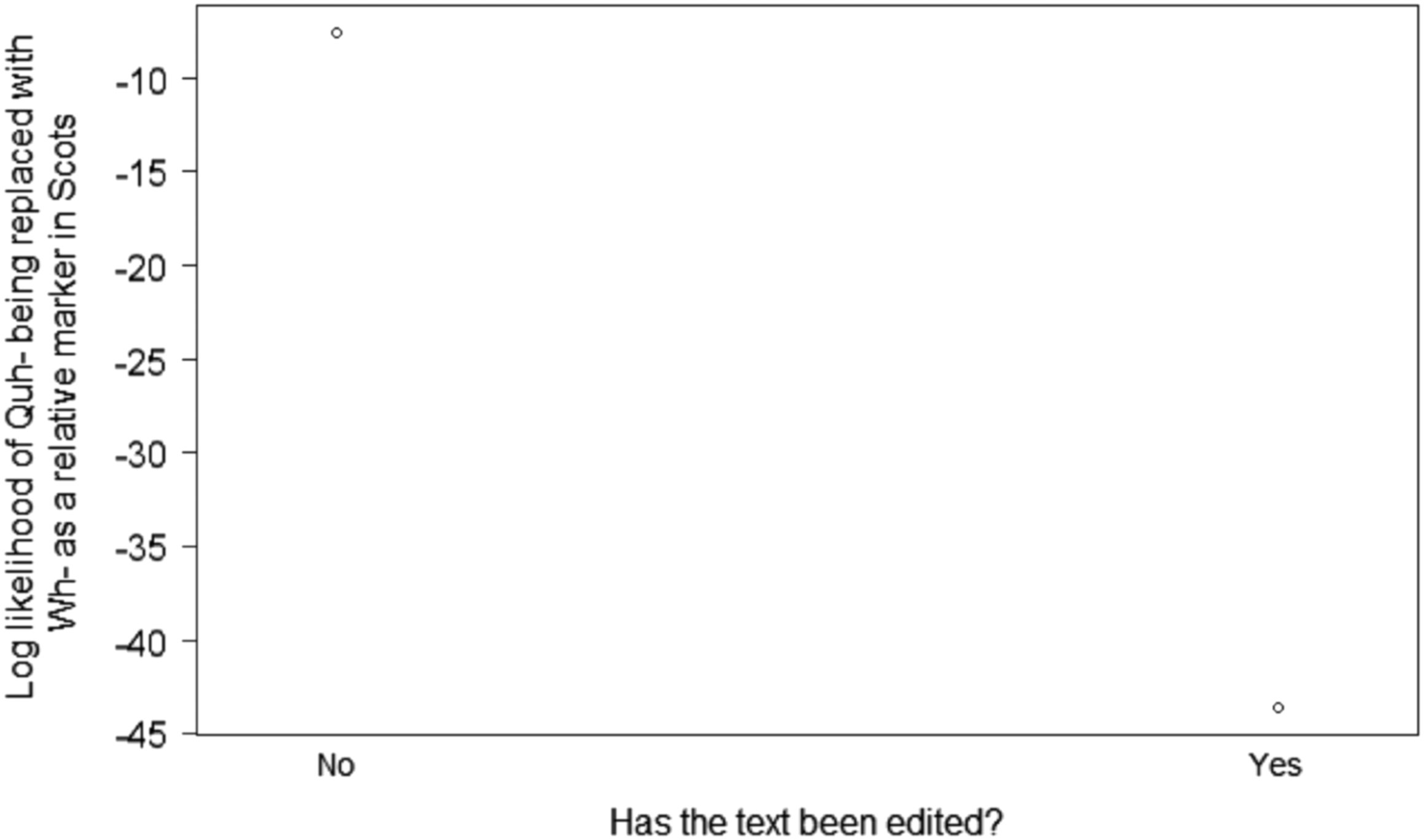
Finally, the mixed-effects regression model identified Edited (whether the text was edited or not) as a signficant effect that interacted with and drove the changeover to <wh->. Figure 4 plots the likelihood of <wh-> (y-axis) in Edited and Unedited texts present in the HCOS (x-axis). There is a clear preference for <quh-> in Edited texts whilst Unedited texts exhibit a higher level of <wh->.
Likelihood of <wh-> across different literary mediums in the Helsinki Corpus of Older Scots (1570–1708)

This is a surprising effect as it manifests in opposite ways to what we would expect, and is perhaps counterintuitive. Indeed, earlier studies have suggested that editors would have played a standardising role in Middle Scots, choosing the anglicised variant more often (Devitt Reference Devitt1989: Meurman-Solin Reference Meurman-Solin1993, Reference Meurman-Solin2003). Meurman-Solin (Reference Meurman-Solin1993) has claimed that many editors within the corpus modernised spellings, and any changes made were consistently in favour of anglicised variants. Yet relatively little is known about the practices and procedures involved in preparing a text for printing and publication (Meurman-Solin Reference Meurman-Solin1993). The role of the editor and the extent of their input will remain forever unknown to us. However, our previous results suggest authors were aware of the orthographic difference, and the presence of the anglicised variant was often an explicit choice made by the author, rather than the product of subconscious interference from English. This may explain in part the anglicisation of unedited texts, which could easily have been undertaken by the author themselves.
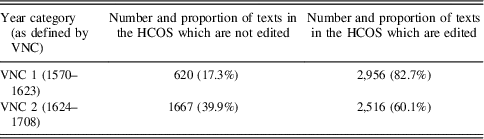
This does not adequately explain, however, why edited texts are much less anglicised in the corpus, but the selection process behind the texts in the corpus provides a possible clue. Texts in the corpus are split into two basic categories: texts of which the earliest or contemporary printed version has been used, and texts printed in the nineteenth and twentieth centuries, edited from earlier manuscripts (Meurman-Solin Reference Meurman-Solin1993). The first group contains edited, but also unedited, texts printed during the time period in question, whereas the second group comprises entirely of edited prints that were produced much later on but ‘chosen for their linguistic value’ (Meurman-Solin Reference Meurman-Solin1993: 140). It may be that texts reflecting a higher prevalence of Scots features were favoured for this second group, as well as a preference for manuscripts produced early on in the change. This could lead to a higher proportion of Scots features within edited texts overall. There is evidence that later editions produced during the seventeenth and eighteenth centuries reflected a more uniform mode of spelling (Meurman-Solin Reference Meurman-Solin1993). As English became increasingly codified as the language of print, editors and authors alike often decided to modernise spellings in the direction of the anglicised variants (Meurman-Solin Reference Meurman-Solin1993). However, this change did not take off overnight, and thus a selection criteria based on early productions of works could see comparatively low levels of anglicisation. Furthermore, there is a much higher proportion of non-edited texts occurring later in the HCOS, when the switch from <quh-> to <wh-> was already well underway, while there is a higher proportion of edited texts from earlier in the time frame, when <quh-> to <wh-> was still very variable (see table 3).
The number and proportion of texts which are edited, compared with those which are not, cross-tabulated with year group (as defined by the VNC analysis; see table 1)

There are therefore a number of possible explanations for why there is less <wh-> in edited texts than we might expect
4.4 Random intercepts
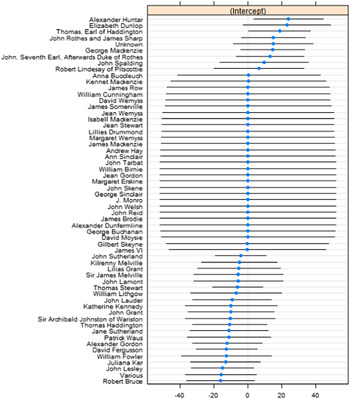
Finally, it is interesting to consider the role of the individual author producing the texts. Recent work in sociolinguistics has shown the value of inspecting random intercepts from a mixed-effect regression model to explore the role of individual speakers in leading or lagging behind in specific changes in progress (Drager & Hay Reference Drager and Hay2012; Watson & Clark Reference Clark and Watson2016). When predictor variables are included in a regression model as random effects, rather than fixed effects, each level within that predictor (e.g. each author in this case) is assigned a value (called the random intercept) and the value is calculated based on how much unexplained variance there is for that level (i.e. that author) in the model. Drager & Hay (Reference Drager and Hay2012) showed that, in a corpus of speech, individual speakers with the lowest intercepts were those that were not adopting the innovation and those with the highest intercepts were leading the speech community towards the new variants. These effects are over and above those that are reported in the model as main effects (in other words, exploring the random intercepts does nothing to change the main effects within our model: audience, literary medium and edited texts are still significantly influencing the shift from <quh-> to <wh->). With this in mind, we can explore the random effects to find out which of these authors were using more or less <wh-> than expected. The random intercepts for Author are plotted in figure 5.
Random intercepts for Author where known in all texts from the Helsinki Corpus of Older Scots (1570–1708). Multiple authors are marked as ‘various’ and texts where the author was anonymous are marked as ‘unknown’

The line down the centre of figure 5 signals the position of zero. Individual authors who fall somewhere along that line are not using more or less of <wh-> than would be expected from the model, once other predictors have been accounted for. Those with values to the left of the line are using less <wh-> than expected and those with values to the right of the line are using more <wh-> than would be expected for them.
A brief examination of some of these authors yields interesting case studies. Thomas Hamilton, First Earl of Haddington (1563–1637), reflects innovative language use. He was on very good terms with James VI and also served Charles I. He was appointed to manage the finances of Scotland, and later took on influential roles in the Privy Council and government. Following the Union, English quickly became the common language of the kingdom and monarchy, thus his connections with the Parliament and monarchy may explain why he chose to adopt the incoming standard at a greater rate than expected. George Mackenzie (1636–91) also exhibits higher-than-expected use of <wh->. Mackenzie was a lawyer and Lord Advocate, and a member of the Scottish Parliament and Privy Council of Scotland. He was the minister responsible for the persecuting policy of Charles II in Scotland against the Presbyterian Covenanters, and also opposed the dethronement of James II. Again, his royalist loyalties are clear and this commitment to the monarchy and the unified kingdoms of England and Scotland may have encouraged use of the national standard. In addition, Mackenzie did not share the separatist, autonomous opinions of his Covenanting contemporaries or have any qualms about persecuting his fellow countrymen. Furthermore, Mackenzie and Haddington, through their careers, would have had greater exposure to the English standard given their proximity to its centre of influence. Such factors (above and beyond those already found in the model) may be responsible for why we see a greater use of <wh-> in the linguistic repertoire of these individuals.
On the other hand, Lord Archibald Johnston of Wariston (1611–63) reflects conservative language usage. He took a major role in writing the Scottish National Covenant in 1638, which effectively undermined the established church supported by the monarchy, and was a key facilitator in negotiating the peace treaties of Berwick in 1639 and Ripon in 1640. These treaties, ending the first and the second Bishops’ Wars between England and Scotland, were a humiliating defeat for King Charles I, who had to make considerable concessions to Scotland as a result. Johnston opposed royal intervention in Scottish affairs, particularly regarding the ecclesiastical structure of Scotland, and publicly spoke out against royal proclamations regarding the Church and Parliament. He opposed monarchical control of state appointments and probably drew up the Act of Classes (1649) which banned royalists from holding public office in Scotland. Johnston was clearly anti-royalist, nationalistic and firmly focused on Scotland and its right to maintain its ancient legal and ecclesiastical structures. This political ideology could explain why his use of <quh-> is higher than expected, particularly given that Johnston was writing after the switch had largely taken place. Interestingly, Johnston’s political life reflects the exact opposite of Mackenzie; he supported the very movement Mackenzie sought to crush, and their language usage is similarly contrary. William Fowler (1560–1612) is another individual who is more conservative than the model would predict. Fowler was a makar (a royal bard), writer, courtier and translator, becoming part of a literary circle around King James VI. Fowler produced poetry, sonnets, treatises and pamphlets that were commended by the king himself. Scottish vernacular literature was one of few literary arenas less influenced by the prestige variety of the South, and Scots features could persist far longer in such works than in other written domains. Thus, Scots features were permitted in Fowler’s works despite being intended for the public.
Again, it is difficult to say with absolute certainty which factors influenced the idiosyncrasies of particular historical actors. However, by exploring random intercepts we are able to see which individuals are leading the change and who lags behind, indicating interesting trends and the highly individual nature that language change can assume once the analysis is broken down to the micro-level.
One final point to notice about the results presented here is that there was no significant effect for printed texts. Printing has been argued by various scholars (Bald Reference Bald1926, Reference Bald1927; MacQueen Reference MacQueen1983; Meurman-Solin Reference Meurman-Solin1993; Kniezsa Reference Kniezsa1997) to have had an influential role in anglicising Scottish works, yet the model failed to find a significant difference between handwritten manuscripts and those that were printed. This may suggest that printing had little effect on the <wh-> variant, or that the significance of audience is so great that it overrides a discernible difference between the two textual mediums. This is something that would warrant further investigation.
4.5 Overview
In summary, the trends found through mixed-effects modelling (rather than purely descriptive statistics) highlight the value of analysing multiple competing influences operating on the rise of <wh->. Previous analyses of <quh-> ~ <wh-> in the HCOS have perhaps overestimated the effect of text type and printing on the processes of anglicisation. Yet, by utilising mixed-effects modelling, relationships that would otherwise remain hidden within the larger framework of historical literature can be uncovered, validated and linked to identifiable sociohistorical changes. Of course we understand that this is a study of a single variant and its patterning in the decline of written Scots and rise of SSE. In order to confirm whether the trajectory and the significant effects identified here hold for the anglicisation of Scots during 1570–1708 in general, we need to explore more linguistic variables. This might indicate which factors were influential across the board for anglicisation, and which were specific to different variants. Such an analysis would also indicate whether most Scots variants underwent a sudden, binary switch or whether some were more prone to variable use by the same author. The latter might indicate Scots variants that were perhaps linguistically or orthographically less salient. Alongside this, a study examining SSE beyond 1708 would also be enlightening. This could indicate whether there were variants that took longer to reach categoricity, or whether other factors became more important in conditioning the variation later on.
5 Concluding remarks
Our main contribution in this article is to show that by incorporating modern statistical methods that are used frequently in the analysis of contemporary corpus data (Hay et al. Reference Hay, Pierrehumbert, Walker and LaShell2015; Gries Reference Gries2016) we can reach a clearer understanding of the factors which drove language change in the history of Scots. In historical linguistics generally, we understand that this is not new – work on the history of English has employed these techniques for some time (Nevalainen Reference Nevalainen2006; Nevalainen & Raumolin-Brunberg Reference Nevalainen and Raumolin-Brunberg2003; Hinneburg et al. Reference Hinneburg, Mannila, Kaislaniemi, Nevalainen and Raumolin-Brunberg2007; Gries & Hilpert Reference Gries and Hilpert2010), but they have been slow to catch on in work on Scots. Previous accounts of language change have continued to rely on descriptive statistics. We hope to have shown that by allowing the data to demonstrate the importance of certain social factors, rather than arbitrarily imposing the focus of the investigation or presupposing the importance of a social factor, we have presented a different picture of this instance of historical language change. Specifically, while previous work has pinpointed text type as central to the shift from <quh-> to <wh-> in Scots, our work shows that in fact it is audience that seems to have been a more impotrant predictor of variation.
Furthermore, we follow Gries & Hilpert (Reference Gries and Hilpert2008, Reference Gries and Hilpert2010, Reference Gries and Hilpert2012) in calling for scholars of the history of Scots (as they have for scholars of the history of English) to avoid sectioning historical data into convenient time periods as this can disguise or overlook trends in the trajectory of language change. Our work suggests that the shift to the anglicised variant occurred rapidly and was a largely binary switch in the minds of most authors. This indicates that the change was not the result of a gradual process of natural language change or increasing pressure from England over time, but the sudden, artificial imposition of one emerging standard over another.
Of course, we are presented with a finite snapshot of the past in limiting ourselves to one corpus and one variable; ‘corpora are always incomplete models of some linguistic reality’ (Gries & Hilpert Reference Gries and Hilpert2010: 297). Unfortunately, historical data will always be limited in this way. Nonetheless, modern, statistical analyses can bring us as close as currently possible to a more thorough understanding of underlying diachronic developments, and their manifestation in a particular variety at a particular time.
APPENDIX
The original category labels of the Helsinki Corpus of Older Scots, and the new categories after regrouping of similar levels