


Introduction
During the past decade media attention has frequently focused on the contribution of consanguinity to genetic disorders, particularly in immigrant communities from South Asia, the Middle East and North Africa (Bittles, Reference Bittles2012). An estimated 50–60+% of marriages in the UK Pakistani community are consanguineous, with first cousin unions especially common (Darr & Modell, Reference Darr and Modell1988; Bundey et al., Reference Bundey, Alam, Kaur and Mir1990; Bhopal et al., Reference Bhopal, Petherick, Wright and Small2014), and causative associations between consanguineous marriage and congenital anomalies have been reported as part of the ongoing Born in Bradford study (Sheridan et al., Reference Sheridan, Wright, Small, Corry, Oddie and Whibley2013). However, rather than the entire community being at equivalent risk, specific inherited disorders may be largely restricted or unique to particular families or sub-communities (biraderi) (Bittles, Reference Bittles2008; Corry, Reference Corry2014), reflecting founder mutations and genetic drift.
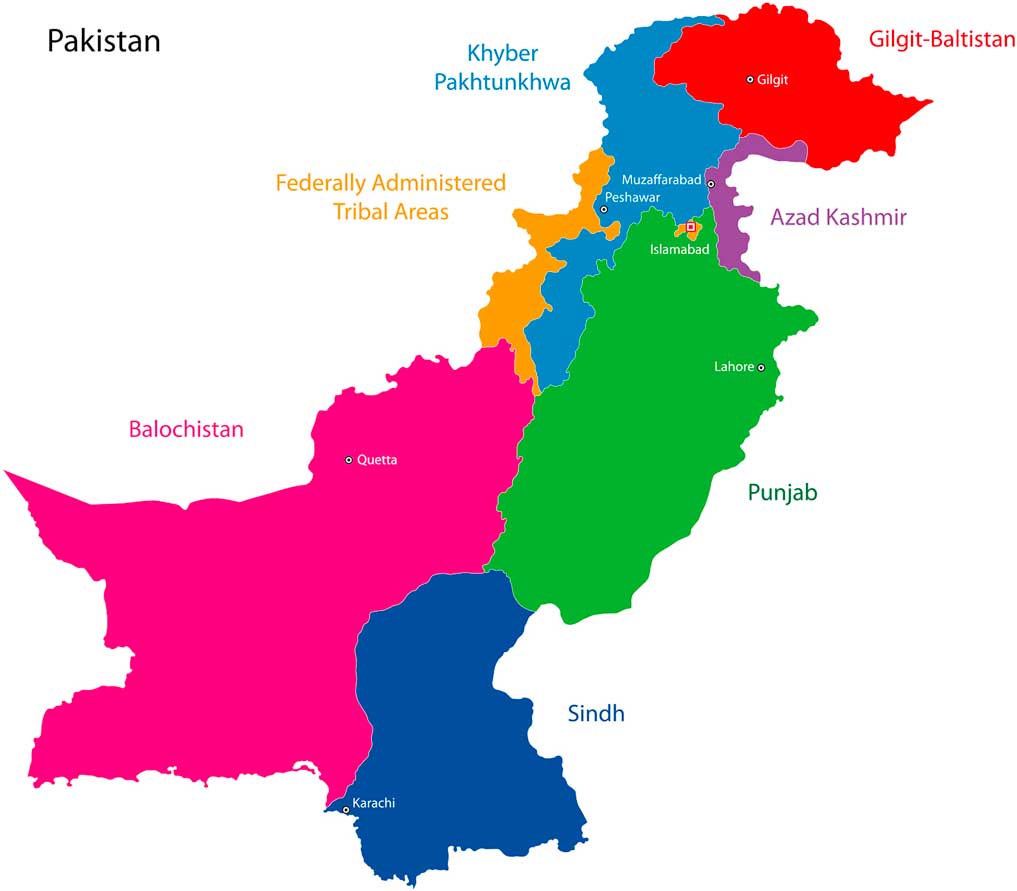
The principal aim of this review is to describe and define the background socio-demographic and population genetic structures of the UK Pakistani community, and more broadly the populations from which they originated in South Asia. The grandparental and parental generations of the UK Pakistani community mainly originated in the Mirpur region of Azad Jammu and Kashmir (hereafter Azad Kashmir) during the 1950s, with additional emigration from the southern Kotli district in Azad Kashmir, the Attock region of northern Punjab province, and from the Chhachh region on the border of Punjab and Khyber Pakhtunkhwa provinces (McLoughlin, Reference McLoughlin2006; see Fig. 1). A study conducted during 2010 confirmed the ongoing popularity of consanguineous unions in Mirpur (Jabeen & Malik, Reference Jabeen and Malik2014), with 62.2% of marriages contracted between spouses related as second cousins or closer, equivalent to a mean coefficient of inbreeding (α)=0.0348.
Map of the provinces of Pakistan, and the location of Azad Kashmir.
From a genetic perspective, many of the terms used in the medical and social science literature to describe population sub-structure in Pakistan and in the large Muslim population of India are vague, with frequently overlapping definitions that are of limited applicability in epidemiological and genetic classifications. However, more positively, there are censal data on population sub-structure dating back to the late 19th century and covering regions which either overlap with, or are adjacent to, the locations from which most of the UK Pakistani community migrated. Information of this nature offers the possibility of generational depth when assessing present-day population genetic stratification, and disease predisposition and/or incidence.
Definitions of caste, zat, quom and biraderi
Definitional problems and confusion can arise in attempting to differentiate between the terms caste, quom, zat and biraderi, and less commonly tribe, clan, gotra and rishtidar, which individually and collectively have been used to describe social status and traditional social/occupational groups in South Asian populations, and in some cases to define varying degrees of kinship (see Appendix 1 for a glossary of terms used). In many instances researchers have used the terms inter-changeably, sometimes in a descriptive manner but mostly without clear accompanying definitions. Spelling inconsistencies in the application of Urdu terms in English language publications also can add to the general lack of cohesion, e.g. with biraderi, baraadri, baradari, biradari, biradri, bradari, braderi and quom, qaum, quam variously used.
The term caste is still widely applied to define traditional social and occupational groupings in Pakistani society (Sikand, Reference Sikand2004; Lyon, Reference Lyon2013). However its use can be misleading in Muslim societies since, strictly speaking, caste refers to hereditary social and occupational stratification within Hinduism (i.e. jati), and in Islam no such hereditary intra-faith boundaries should exist. The problem has been described in terms of a clash between Qur’anic egalitarianism and Muslim social practice (Sikand, Reference Sikand2004). But in English language publications it also may reflect a partial default to a general form of terminology widely used to describe the populations of the Indian sub-continent during the pre-Independence colonial period, e.g. in the 1881 and 1891 Censuses of India for Punjab and the Northwest Frontier Province (Rose, 1911–Reference Rose1919; Ibbetson, Reference Ibbetson1916), and in the 1921 Census of India for Punjab and Delhi (Middleton & Jacob, 1922–Reference Middleton and Jacob1923).
As previously indicated, some commentators regard the terms caste and biraderi as similar, i.e. implying hierarchical ranking and indicative of a form of social stratification that is determined by family background, occupation and work (Lyon, Reference Lyon2002; Metcalf & Rolfe, Reference Metcalf and Rolfe2010), or even treat them as synonymous (Sikand, Reference Sikand2004), while others draw a distinction between the two (Bittles et al., Reference Bittles, Sullivan and Zhivotovsky2004). Perhaps more surprisingly, endogamous marriages within sub-groups of the Pakistani community in the UK have been described in terms of caste divisions (Samad & Eade, Reference Samad and Eade2002; Overall et al., Reference Overall, Ahmad, Thomas and Nichols2003), and in the Bradford community caste has been referred to as impacting on the everyday lives of its Muslim population (Azam, Reference Azam2006; Blakey et al., Reference Blakey, Pearce and Chesters2006).
The terms zat, quom and biraderi also have been used inter-changeably to describe endogamous communities in Pakistan (Nazir, Reference Nazir1993; Gazdar, Reference Gazdar2007; Kabeer et al., Reference Kabeer, Mumtaz and Sayeed2010), including Azad Kashmir (Loureiro, Reference Loureiro2012), but with some variation according to geographical location and ethnicity (Gazdar, Reference Gazdar2007). Thus in Khyber Pakhtunkhwa Province (KPK, formerly the Northwest Frontier Province) and Balochistan different communities are generally referred to as clans and tribes, whereas the term quom is more commonly used in the border area between western Punjab and Khyber Pakhtunkhwa, and zat is the more usual term in the Lahore region of eastern Punjab (Lyon, Reference Lyon2002). Although zat and quom membership are both acquired by birth, are endogamous and are indicative of social status, they are in fact different concepts, with zat status not subject to change and endogamy regarded as obligatory, whereas an individual’s quom could change according to occupation and endogamy is preferential rather than enforced (Wakil, Reference Wakil1970; Nazir, Reference Nazir1993).
In Punjabi urban centres quom membership now principally serves as a form of social identity rather than a direct indicator of occupation and hence economic status (Donnan, Reference Donnan1988; Weiss, Reference Weiss1991). As with zat status, membership of a biraderi is acquired at birth and is regarded as immutable, the requirement for biraderi endogamy is strict, and in Punjab it has been described as the key institution of kinship (Alavi, Reference Alavi1972). Critically from a genetic perspective, biraderi status specifically implies membership of a closed patrilineal kinship group (Alavi, Reference Alavi1971, Reference Alavi1972; Fricke et al., Reference Fricke, Syed and Smith1986; Khan, Reference Khan2000; Zaman, Reference Zaman2008; Khan, Reference Khan2010; Mohmand, Reference Mohmand2011; Ajaz et al., Reference Ajaz, Ali and Randhawa2015), resulting in significant differences between the genomic profiles of co-resident biraderi (Wang et al., Reference Wang, Sullivan, Ahmed, Chandler, Zhivotovsky and Bittles2000). In the UK context it has been suggested that some individuals not directly related to the patrilineage may be admitted as ‘honorary’ kinship members (Bolognani, Reference Bolognani2006; Bolognani et al., Reference Bolognani, Khawaja, Khan and Waheed2009), albeit with no specific information on how recent or widespread this practice might be.
Biraderi: definition and membership benefits and obligations
The term biraderi is believed to be derived from the Persian word birader (brother) (Korson, Reference Korson1971; Weiss, Reference Weiss1991; Hussain, Reference Hussain2005), which has given rise to the widespread definition in English of a biraderi as a ‘brotherhood’, or alternatively as a fraternity, kinship, clan, patrilineal extended family or patrilineal descent group. The definitional boundaries of a biraderi often are imprecise and have been described as being ‘as large as the distance at which one can recognize one’s relatives’ (Wakil, Reference Wakil1970). In practice all of the inhabitants of a small rural settlement may belong to a single biraderi, while families from many different biraderi can be co-resident in larger towns, but with members of specific biraderi preferring to live alongside each other in particular localities (Nadvi, Reference Nadvi1997).
Besides the traditional role of the biraderi as a mutual social support and coping system, e.g. serving as a welfare agency, arranging loans for members, and assisting in employment or with accommodation (Seebohm et al., Reference Seebohm, Henderson, Munn-Giddings, Thomas and Yasmeen2005), financial help can also be provided to members with a major illness, and to their families (Meulemans et al., Reference Meulemans, Mortelmans, Liefooghe, Mertens, Zaidi, Solangi and De Muynck2003). For this reason, poorer and rural families tend to be more dependent on the biraderi and to cleave more closely to the attendant rights and obligations of membership (Hooper & Hamid, Reference Hooper and Hamid2003; Mohmand, Reference Mohmand2011). By comparison, some financially successful families may attempt to elevate their social status by claiming membership of a related but higher status biraderi, e.g. surgical instrument manufacturers in Sialkot, Punjab, who were members of the Lothar (blacksmith) biraderi but claimed to be Mughal on the grounds that historically their families had been swordsmiths (Nadvi, Reference Nadvi1997).
Assistance with marriage arrangements (Nadvi, Reference Nadvi1997; Cameron, Reference Cameron2006), including contributions towards the dowries of poorer families within the membership (Zaman, Reference Zaman2008), is an especially important facet of biraderi influence. Within the UK Pakistani community the biraderi act as significant intermediaries in transnational marriage arrangements (Shaw, Reference Shaw2000, Reference Shaw2009, Reference Shaw2014; Cameron, Reference Cameron2006; Hasan, Reference Hasan2009). Indeed, it has been proposed that besides family obligations and cultural preferences, a major reason for the continuation of transnational marriages between the UK and Pakistan is the requirement to marry within the biraderi when there is a shortage of potential UK-resident partners from whom to choose (Samad & Eade, Reference Samad and Eade2002). Intra-biraderi marriage is perceived as a matter of izzat, which usually is defined in terms of family honour but also encompasses the concepts of family status and prestige (Azam, Reference Azam2006). From the wider biraderi perspective, the assistance provided in facilitating transnational marriages reciprocally serves to maintain and strengthen links with the international network of members of the biraderi resident in different countries, especially Pakistan (Cameron, Reference Cameron2006; Shaw, Reference Shaw2014). As in Pakistan (Hooper & Hamid, Reference Hooper and Hamid2003; Mohmand, Reference Mohmand2011), support for biraderi candidates in elections has been expected in overseas Pakistani communities, which in the UK has led to a number of cases of alleged electoral impropriety and fraud (Michael, Reference Michael2004; Baston, Reference Baston2012; White, Reference White2012).
There is a basic dichotomous hierarchy within the Muslim biraderi/caste system of the Indian sub-continent (Sikand, Reference Sikand2004; Aarzo & Afzal, Reference Aarzo and Afzal2006; Ara et al., Reference Ara, Itrat-un-Nisa, Siddique and Afzal2007), with the two main social/occupational groupings based on their ethnic and geographical origins, i.e. Ashraf, ‘noble castes’ with Arab, Central Asian, Iranian and Afghan origins versus Ajlaf, who were regarded as of inferior social status and predominantly were local converts to Islam (Fricke et al., Reference Fricke, Syed and Smith1986; Ahmad, Reference Ahmad2003). This quasi-ethnic division is said to have reflected adherence to the concept of kaf’aa, which requires equality between marriage partners, with the choice of a spouse from outside one’s kaf’aa discouraged if not forbidden (Sikand, Reference Sikand2004).
Although the terms Ashraf and Ajlaf have been applied in the Pakistani province of Punjab (Fricke et al., Reference Fricke, Syed and Smith1986), a somewhat different, more overtly socioeconomic, sub-division also exists between the zamindar (literally ‘land owners’) with 23 sub-groups identified, and kammi (‘servant classes’) with fifteen distinct sub-groups (Ahmad, Reference Ahmad1977). However, in Punjab there is an additional internal ranking within the ‘upper class’ zamindar in which sub-communities (biraderi) such as the Syed and Awan occupy the pre-eminent social positions (Shami et al., Reference Shami, Grant and Bittles1994), which has led to an effective threefold division into Ashraf (‘nobles’), zamindar and kammi being proposed (Shaw, Reference Shaw2000). A fourth hierarchical sub-division also has been suggested, the Mussalli, many of whom converted from the Hindu Chuhray community to Christianity in the 19th century (Beall, Reference Beall2006) and continue to occupy lower social and occupational status as sweepers (Gazdar & Mallah, Reference Gazdar and Mallah2011).
Inter-biraderi marriage has been rare in Pakistan and India, and in UK South Asian Muslim communities, in part because of social stratification between biraderi (Kabeer et al., Reference Kabeer, Mumtaz and Sayeed2010), with limited social mixing (Mohmand & Gazdar, Reference Mohmand and Gazdar2007), although marital alliances can be arranged with families in other biraderi that rank higher in social and economic terms (Nadvi, Reference Nadvi1997; Shaw, Reference Shaw2015). Lesser attention has been paid to the social hierarchies within biraderi, but in addition to differences associated with geographical location they may explain the multiple biraderi subdivisions that were noted in the 1921 Census of India for Punjab and Delhi, with 1013 sub-divisions recorded in the Awan biraderi/‘caste’ alone, 581 in the Mussalli, and 1068 within the Sheikh (Middleton & Jacob, 1922–Reference Middleton and Jacob1923). Social and economic considerations that reflect this internal hierarchy are nonetheless important when intra-biraderi marriages are being considered, with parents generally unwilling to accept marriage proposals from a family of lower socioeconomic or social class background (Azam, Reference Azam2006).
Discussion
Irrespective of consanguineous marriage, sub-division of a population into multiple endogamous sub-communities predictably results in greater intra-community genetic homogeneity and the increased expression of specific recessive disease genes (Overall et al., Reference Overall, Ahmad, Thomas and Nichols2003; Bittles, Reference Bittles2010). Failure to allow for the effects of historical population stratification could readily lead to questionable disease associations (Leslie et al., Reference Leslie, Winney, Hellenthal, Davison, Boumertit and Day2015), especially in South Asian populations characterized by longstanding religious and social sub-divisions (Bittles, Reference Bittles2005). Therefore in planning and conducting socio-demographic, epidemiological and genetic studies within the UK Pakistani community, assessment of the results in terms of biraderi membership would be an appropriate starting point (Bittles, Reference Bittles2013; Corry, Reference Corry2014). At the same time there should be a recognition that individuals and families in some study communities may be more familiar with alternative descriptive terms, including caste, zat or quom.
From a future gene pool perspective, and in terms of genetic education and genetic counselling programmes, it would be important to further investigate claims that the strength of biraderi social control has been weakening among younger members of UK Pakistani communities (Y Care International, 2014), including less rigid strictures being imposed on marriage with non-biraderi members (Michael, Reference Michael2004; Azam, Reference Azam2006; Shaw, Reference Shaw2014). Preliminary cross-generational results from the Born in Bradford study cohort (Wright et al., Reference Wright, Small, Raynor, Tuffnell, Bhopal, Cameron and Fairley2013) indicate that this trend has indeed become apparent in a number of biraderi but not in others (N. A. Small et al., under review).
It would be highly improbable that a major decline in intra-biraderi marriage in Bradford would not be accompanied, or even exceeded, by a reduction in the prevalence of consanguineous marriages within the Pakistani community, which now appears to be the case in Bradford (Bhopal et al., Reference Bhopal, Petherick, Wright and Small2014), having previously been reported in the smaller Norwegian Pakistani community (Grjibovski et al., Reference Grjibovski, Magnus and Stoltenberg2009). If these trends are significant in extent, they should result in reduced expression of recessive disease genes in future generations and hence lead to a decline in the prevalence of specific recessive disorders (Campbell et al., Reference Campbell, Rudan, Bittles and Wright2009). Further, if there is a concomitant reduction in completed family sizes that, in turn, would result in fewer marriageable cousins and an accompanying reduction in consanguineous unions (Bittles, Reference Bittles2012; Barakat & Basten, Reference Barakat and Basten2014).
From a wider societal viewpoint, findings (and interpretations) of this nature should serve to defuse the emotional and often poorly informed ‘consanguinity debate’ that has dogged health care planning and provision within the UK Pakistani population (Dyer, Reference Dyer2005; Salway et al., Reference Salway, Ratcliffe, Ali and Bibi2012; Darr et al., Reference Darr, Small, Ahmad, Atkin, Corry, Benson, Morton and Modell2013). Similar controversies in other Western European countries have resulted in the introduction of civil legislation equating consanguineous marriage with ‘forced marriage’, e.g. among Turkish, North African and Middle Eastern migrants in Denmark (Liversage & Rytter, Reference Liversage and Rytter2015) and the Netherlands (De Koning et al., Reference De Koning, Storms and Bartels2014). Further, more detailed investigations and clarification of the overall influence of consanguinity and population stratification on the incidence and distribution patterns of genetic disorders are clearly merited, and overdue.
Acknowledgments
The authors are grateful to colleagues and members of the Pakistani origin community in Bradford for advice on the glossary in this article. In particular, they would like to acknowledge Dr Aamra Darr, Shahid Islam and Qamar Zaman for their detailed comments. Any remaining errors or misunderstandings are the responsibility of the authors.
Appendix: A Brief Glossary of Terms
Ajlaf: lower social class Muslims of Indian sub-continent origin.
Ashraf: upper social class Muslims of predominantly Arab, Afghan or Iranian origin.
Awan: endogamous Ashraf paternal lineage, people who worked the land and were associated with the zamindar class.
Biraderi (also baraadri, baradari, biradari, biradri, bradari, braderi): a closed patrilinear kinship group indicating ‘brotherhood’ and denoting socio-occupational status.
Caste: English term denoting the Hindu jati system. Members of each caste are socially equal, united in religion, and not in social contact with other castes.
Chuhra (masc.) Chuhri (fem.) Chuhray (plu.): amongst the lowest of all occupation groups, involving sweeping, manual scavenging, cleaning toilets, taking away the ‘night soil’. Used colloquially as a word to insult people.
Gotra: exogamous Hindu patrilineage, clan.
Izzat: concept of family honour, status and prestige, commonly used as ‘respect’.
Jati: endogamous Hindu patrilineage, defining socio-occupational status at birth.
Kafa’a: concept of marriage between equals.
Kammi: a term used to collectively describe the lower strata of the Quom system – the Kammi Quoms consist of artisans and service workers such as barbers, carpenters and loom workers.
Lothar (also more commonly Lohar in the Azad Kashmir community): blacksmith.
Quom (also qaum, quam): endogamous patrilineage, historically based on occupation. Quom is broader than biraderi and also is subject to social status difference, i.e. there are ‘high’ and ‘low’ Quoms.
Mughal: endogamous Ashraf patrilineage, originally denoting Mongol origin.
Mussalli: a kammi quom where the main occupations involve undertaking menial work, for example slaughtering animals and providing service and support to others ‘higher’ quoms (this group are higher than the Chura).
Rajput: Hindu converts to Islam, martial background.
Rishtidar (also rishtedar, rishtedaar): kinship, a person who is a relation of mine. Rishtidari is the collective noun for kinship.
Shaikh (also more commonly Sheikh in the Azad Kashmir context): agricultural and now business community, also linked with clerics. Hindu converts to Islam.
Syed (also Sayed, Sayyid): endogamous Ashraf paternal lineage, direct descendant of the Prophet Muhammad.
Zamindar: landholder and landowner.
Zat: endogamous clan-based patrilineage group.



