Introduction
Patients with untreated hearing loss are at increased risk of depression and anxiety, and are less likely to participate in social activities than patients with hearing aids.1 With appropriately aided hearing, patients' emotional and psychological wellbeing, and social functioning, can be improved.Reference Crandall2 Unfortunately, in some patients, traditional air conduction hearing aids are not beneficial, because of anatomical difficulties such as microtia, chronically discharging ears or poor air conduction.
Bone conduction hearing systems are a well-established method of aiding hearing in patients with both conductive and sensorineural hearing loss, and have been in use for over three decades. These systems provide a solution for patients who are unable to benefit from traditional devices. Since their initial development, there have been many advances in both the surgical approach and in the technology surrounding bone conduction hearing systems. This is an area of medicine that is rapidly developing. The current review aimed to summarise the recent developments and consider future possibilities.
Search strategy
A PubMed search was performed by studying all review articles published between 2000 and 2014.
Bone-anchored device types
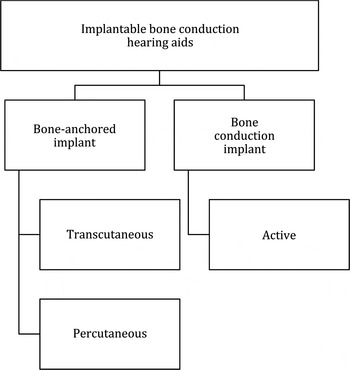
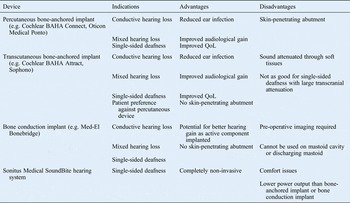
All devices work in a similar way by transferring sound energy directly through the skull to the cochlea (Table I). Broadly speaking, they can be categorised into bone-anchored implants, which require an external active device (e.g. the BAHA, defined as ‘bone-anchored hearing aid’ (Cochlear, Centennial, Colorado, USA), the Ponto (Oticon Medical, Askim, Sweden) and the Sophono system (Sophono, Boulder, Colorado, USA)), and bone conduction devices, which enable the active components to be implanted (e.g. the Bonebridge (Med-El, Innsbruck, Austria)) (Figure 1). Middle-ear implants provide an alternative for some patients; however, these are beyond the scope of this article.
Types of bone conduction implants.

Comparison of devices based on indications, advantages and disadvantages

BAHA = bone-anchored hearing aid; QoL = quality of life
Bone-anchored hearing
The key principles of bone-anchored hearing devices are osseointegration and direct bone conduction.Reference Albrektsson, Brånemark, Hansson and Lindström3 The titanium oxide surface of the device is highly biocompatible and as such it integrates with the osteocytes, resulting in a stable interface. This enables sound to propagate directly through the skull, reducing the dampening effect of the subcutaneous tissues and skin. This process, which was first described by Brånemark and colleagues (as cited in Dutt and ProopsReference Dutt and Proops4), can take anywhere from six weeks to three months.
The use of bone conduction hearing aids started as early as the eighteenth century,Reference Berger5 with the use of penetrating implants initially described in 1977.Reference Tjellström and Granström6 It was a further 10 years before the devices became available commercially. Since then, techniques for fitting and device technology have evolved considerably. The first device on the market was the BAHA, initially marketed by Entific Medical Systems (Gothenburg, Sweden) who were subsequently taken over by Cochlear in 2005. Most data on bone conduction devices are based on the BAHA.
Several studies have supported the audiological gain that can be achieved with BAHAs. In a single-centre review, audiological outcomes for 34 patients with BAHAs were compared to the pre-operative thresholds attained with an air conduction aid.Reference Mylanus, van der Pouw, Snik and Cremers7 Mean free-field thresholds were examined, and a significant difference was found in favour of the BAHA at 1 kHz (p < 0.01) and 8 kHz (p < 0.001) of 6 dB and 12 dB respectively. This study, which only analysed patients with a conductive loss, also revealed that over 60 per cent of patients had a clear preference for the BAHA with regard to its ability to reduce ear infections, improve sound quality and lead to fewer follow-up clinic appointments. In a more recent study comparing the use of traditional hearing aids to the BAHA, patients again expressed a clear preference for the BAHA system, which was associated with no canal occlusion, reduced otitis externa and improved cosmetic appearance.Reference Iwasaki, Hashimoto, Nagura, Takebayashi and Mizuta8
Indications for bone-anchored devices
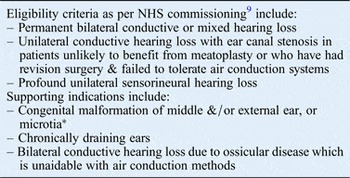
There are multiple indications for bone-anchored devices, as demonstrated in Table II. In summary, there are traditionally two key indications: unilateral deafness and an inability to wear a conventional hearing aid.
Indications for bone-anchored hearing devices

*A study found that patients with congenital ear disorders are able to get the most benefit out of these hearing systems (compared with other patient subgroups).Reference McLarnon, Davison and Johnson10 NHS = National Health Service
Most regions in the UK currently fund only unilateral implants. However, it is well documented that bilateral implantations with the resultant binaural hearing leads to improved speech intelligibility, sound localisation and stereophonic perception.Reference Bosman, Snik, van der Pouw, Mylanus and Cremers11
Bone-anchored implants
The percutaneous BAHA is the original model of implant, which, as stated above, has been associated with excellent audiological outcomes. Despite this, there are two main issues with these devices: skin-related complicationsReference Bosman, Snik, van der Pouw, Mylanus and Cremers11 and cosmetic appearance (the screw is permanently on display). Both the surgical technique and the abutment design have evolved considerably over the years with an aim to reduce these problems.
Surgical technique
Initially, the surgical technique involved a two-stage approach with extensive soft tissue reduction. Further surgical advances allowed implant insertion as a single-stage procedure. However, the surgery still required creation of a split skin graft with extensive soft tissue reduction, and predisposed patients to skin complications.Reference Husseman, Szudek, Monksfield, Power, O'Leary and Briggs12
The largest published retrospective study investigating complication rates was performed in Manchester, UK, in 2010, in which 602 patients with BAHA devices (all percutaneous) were reviewed and rates compared with previously published results.Reference Hobson, Roper, Andrew, Rothera, Hill and Green13 The overall complication rate was 23.9 per cent, which compared favourably to the previously recorded rates of 8–59 per cent. Using a large patient database, technique and grade of surgeon were reviewed to see if there were any influencing factors on patient outcomes. Common complications included soft tissue overgrowth (affecting 8 per cent of cases), skin infection (5 per cent), abutment dislodgement (4 per cent) and osseointegration failure (less than 1 per cent). Revision surgery was required by 12.1 per cent of patients; in 52 per cent of these cases, this was a result of soft tissue problems.
The surgical technique has further evolved and we are now able to insert the BAHA implant through a linear scalp incision under local anaesthesia without any soft tissue reduction. A recent study evaluated 34 patients undergoing a linear incision single-stage technique and found that this technique was associated with minor skin reactions similar to rates seen previously.Reference Husseman, Szudek, Monksfield, Power, O'Leary and Briggs12 In this case series, there were no problems with soft tissue overgrowth or implant failures. A further study directly compared the linear incision technique to the traditional skin flap technique, investigating over 100 procedures.Reference Mudry14 It was found that, after a three-month follow-up period, the linear incision group without soft tissue reduction had significantly lower rates of soft tissue problems.
Abutment design
Abutment modification is one step that can be taken to reduce soft tissue problems. In a single-centre study investigating the techniques used for revision surgery, it was found that the use of a longer 8.5 mm abutment prevented the need for any further surgery.Reference Pelosi and Chandrasekhar15 The authors concluded that the use of a longer abutment should be a first-line management option for soft tissue overgrowth.
The company Cochlear have introduced the DermaLock abutment (BA400). The BA400 has a hydroxyapatite coating, which promotes both soft tissue integration and temporal bone osseointegration. Pre-clinical studies have demonstrated excellent results, with a significant reduction in soft tissue complications; however, further studies are needed.Reference Larsson, Wigren, Andersson, Ekeroth, Flynn and Nannmark16
Cosmetic concerns
Despite the evolution of the surgical procedure and the excellent results that can be achieved with the percutaneous BAHA, not all patients that are appropriate candidates will go ahead with implantation. In one study of 100 patients referred for consideration of a BAHA device, 11 per cent refused implantation despite meeting the audiological criteria.Reference Zawawi, Kabbach, Lallemand and Daniel17 The main reason for this was cosmetic concerns, with the percutaneous abutments deemed unsightly, in addition to the need for daily care around the implant site.
Transcutaneous systems
Cosmetic concerns have led to the development of transcutaneous devices. The company Cochlear have introduced the BAHA Attract system, which combines the BAHA BI300 single point of transmission with a magnet-to-skin contact area. The entire implant and magnet are placed subcutaneously, and the sound processor is held in place over the scalp by the subcutaneous magnet. Such a system can deliver up to 24-dB improved sound when compared to a multi-screw system18 and its positioning means no issues with daily care.
Similarly, the Sophono system was introduced in 2013, again offering a transcutaneous solution. In a study performed by the company, investigating 39 patients over 4 years, it was found that the average pure tone average values increased by 31 ± 7 dB, with the word recognition score increasing by 60 ± 25 per cent when compared to pre-operative rates.19 Furthermore, there were no long-term skin complications (over a 12–30-month follow-up period).
Although these transcutaneous solutions provide users with a discrete attachment, concerns have been raised about sound quality. One single-centre study compared the Sophono Alpha 1 with the percutaneous BAHA system, reviewing 12 patients (aged 5–12 years).Reference Hol, Nelissen, Agterberg, Cremers and Snik20 Six patients were fitted with the BAHA system and six with the Sophono transcutaneous system. Similar rates of skin reactions were demonstrated, but audiological outcomes were better with the percutaneous BAHA system (15-dB improved output). The authors concluded that although the Sophono system offers cosmetic advantages, the impact of transcutaneous coupling on audiological outcomes is unlikely ever to compare to direct conduction via a percutaneous route.
This being the case, the indications for transcutaneous devices are not as broad. Patients with single-sided deafness with large transcranial attenuation are unlikely to gain sufficient benefit from a transcutaneous device.21
Bone conduction implants
One of the newer devices on the market currently is the Bonebridge transcutaneous bone conduction implant system by Med-El. The Bonebridge is a partially implantable hearing system composed of the external audio processor and the implant. As an active bone conduction implant, it enables sound transmission directly to the inner ear via bone conduction.
This device, which allows the skin to be left intact, differs from traditional devices as the transducer (active component) is permanently implanted under the skin, enabling the external component to be smaller in size. In theory, this set up should reduce the dampening effect demonstrated with traditional transcutaneous BAHA systems, thus improving audiological outcomes. In a cadaveric study comparing the BAHA Classic-300 to a bone conduction implant, similar results were achieved for the bone conduction implant, with slightly lower distortion at speech frequencies.Reference Håkansson, Eeg-Olofsson, Reinfeldt, Stenfelt and Granström22
These results have been reproduced in a similar study comparing the BAHA BP100 to the Bonebridge system.Reference Huber, Sim, Xie, Chatzimichalis, Ullrich and Röösli23 Methods included a comparison of cochlear promontory acceleration on cadaveric specimens and assessment of pure tone hearing thresholds in hearing adults with a simulated hearing loss. Again, similar results were found. The authors therefore concluded that the bone conduction implant could be considered as an alternative to the traditional BAHA.
A more recent study investigated the Bonebridge in only three patients, two with conductive hearing loss and one with single-sided deafness.Reference Hassepass, Bulla, Aschendorff and Maier24 The study findings demonstrated improved audiological data. The two patients with conductive hearing loss showed the greatest improvement, with an increase in speech perception thresholds from 37 dB to 14 dB six months post-operatively. Clearly, larger studies are required to review this gain properly.
Although these devices offer a solution to the cosmetic concerns of the percutaneous BAHA and the reduced audiological gain of the transcutaneous BAHA system, there are still some issues associated with them.
During assessment, patients need to undergo a computerised tomography scan of the temporal bones to determine the size of the mastoid cavity. The floating mass transducer component of the Bonebridge implant is 1 cm in diameter and 1.6 cm in depth; hence, pre-operative imaging of the temporal bones allows the clinician to assess whether there is sufficient space to insert the floating mass transducer into the cavity. In cases where the mastoid cavity dimensions are not favourable, the sigmoid sinus or middle fossa dura may need to be decompressed.
More importantly, these devices cannot be placed into a discharging mastoid or an open mastoid cavity, which affects a large proportion of eligible BAHA patients. The device can, however, be placed behind the mastoid, but this exposes a significant area of dura which is not something that the majority of surgeons would be comfortable in doing.
Modern technology
Wearable technology is a massively expanding area and will undoubtedly increase in the healthcare sector. The application of wearable devices in rehabilitation for monitoring activity, recording observations and alerting of hazards has already been described.Reference Bonato25 Such technology could also be linked into hearing rehabilitation solutions.
Companies are continually developing their technology and keeping up to date with other personal devices. Most systems now have the benefit of integrated wireless technology, which enables patients to stream sound directly to the processor from multiple devices, including computers and mobile phones, thus reducing the need for body-worn wireless connection devices.
The SoundBite hearing system from Sonitus Medical (San Mateo, California, USA) is a relatively new alternative to the above-mentioned devices, although it is currently only marketed for single-sided deafness. This hearing system can enable direct bone conduction, without the need for surgery, through the use of a removable device that transmits sound through the teeth. In a recent multicentre prospective study investigating audiological outcomes and patient experience, these devices significantly improved ease of communication and background noise (p < 0.001).Reference Gurgel and Shelton26 Clear benefits include the avoidance of an operation. However, there have been reports of problems with acoustic feedback when not fitted correctly, and the device has been demonstrated to produce a significantly lower power output when compared to the BAHA and bone conduction implants. This means that their role, particularly in mixed conductive hearing loss cases, may be limited.Reference Kompis and Caversaccio27
Conclusion
As highlighted above, this is an area of medicine that is evolving rapidly. Developments in surgical technique have led to a minimally invasive approach, enabling bone conduction implantation to be performed under local anaesthetic as day-case surgery. Device technology has advanced, and companies are continually developing new abutments and options to tackle complications as they arise.
We anticipate a move away from the no soft tissue reduction devices (Oticon Ponto and Cochlear BAHA Connect) and the passive transcutaneous devices (Cochlear BAHA Attract and the Sophono system) to active transcutaneous devices of which the Med-El Bonebridge is currently the only one on the market. This newest generation of implant could offer patients a solution to cosmetic concerns, with minimal soft tissue reactivity and excellent audiological results. However, larger studies are required to determine their benefits.