


The emergence of democracy from dictatorship is puzzling at first sight. Such transitions replace the dominance of an individual or narrow group with a broader sharing of power. Incumbents suffer an unambiguous loss—one that, given the initial imbalance, they should have been able to prevent. And yet democratization happens.
A number of theories purport to explain why. Elites are said to embrace democracy as a way to commit to future income redistribution, forestalling revolution (Acemoglu and Robinson Reference Acemoglu and Robinson2006), motivate citizens to fight foreign attackers (Ticchi and Vindigni Reference Ticchi and Vindigni2008), or nudge future governments away from patronage (Lizzeri and Persico Reference Lizzeri and Persico2004). One elite faction might liberalize to win support against its rivals (Llavador and Oxoby Reference Llavador and Oxoby2005). Or democracy might represent a “great compromise” between deadlocked social groups (Rustow Reference Rustow1970), perhaps formalized in a “pact” (O’Donnell and Schmitter Reference O’Donnell and Schmitter1986, 37–9).
One thing these arguments share is the assumption that incumbents democratize intentionally. Given prevailing conditions, rulers think doing so is in their interest. Surrendering or dividing power is the cost they have to pay to prevent revolution, field an army, improve public services, sideline an elite challenger, or limit social conflict. In Huntington’s (Reference Huntington1991, 108) words, for democracy to emerge “some political leaders have to want it to happen or be willing to take steps … that may lead to it happening.” Or, as Rustow (Reference Rustow1970, 355) puts it, democratization requires a “deliberate decision on the part of political leaders.” democratization requires a “deliberate decision on the part of political leaders.” While not all accounts share this assumption, the deliberate choice approach has been influential.Footnote 1
Examining all cases of democratization between 1800 and 2015, I document that some may, indeed, fit each of these arguments. Certain incumbents—such as King Frederick VII of Denmark, who accepted constitutional monarchy in 1848—have quite consciously chosen reform.
But most cases look messier. To Lord Derby, Disraeli’s 1867 franchise bill seemed “a leap in the dark.” This phrase has been used to describe Bismarck’s 1871 reform and those of Franco’s heirs in Spain (Anderson Reference Anderson1993; Hopkin Reference Hopkin1999, 162). Italy’s Giolitti made a “jump in the dark” in 1912, while Poland’s rulers after World War I took a “leap into the dark.”Footnote 2 Historians show one ruler racing to “take ship for England from a lonely beach,” after rebels seized his palace.Footnote 3 Another fled to exile without his medicine or glasses; many have ended up in jail.Footnote 4 Asked whether he was moving left or right, one bemused authoritarian confessed to “going around in circles.”Footnote 5 France’s Louis-Philippe in 1848 was, in Tocqueville’s (Reference Tocqueville1964, 86–7) phrase, “like a man awakened at night by an earthquake … knocked flat before he had understood.” Chaos, myopia, and miscalculation loom larger in these accounts than do rational decisions.
In this paper, I conjecture that democracy often emerged not because incumbent elites chose it but because, while seeking to prevent it, they made critical mistakes. To explore this, I examined each of 316 historical episodes that qualify as democratization under eight definitions.Footnote 6 From a range of sources, I composed a synopsis of each, noting key facts and interpretations of historians and analysts. I evaluated whether each deliberate-choice argument could explain what happened and also whether significant mistakes by incumbents contributed. Based on the strength of evidence, I rated my confidence in each judgment on a five-point scale from “very probably yes” to “very probably no,” and recorded the reasoning and evidence behind each.
Depending on the democratization measure, the historical evidence “probably” or “very probably” fit each intentionalist theory in from 1–2% of the cases (nudging governments to reduce patronage) to 12–24% of the cases (compromise between deadlocked groups). In 22–39%, it “probably” or “very probably” fit at least one of these. However, mistakes appeared far more significant. One or more incumbent missteps “probably” or “very probably” contributed to the outcome in 67–85% of the cases.
The type of mistake varied, but many involved hubris. Some leaders—like Louis-Philippe—underestimated the strength of opposition, failed to compromise or repress until too late, and were overthrown. Their revolutionary successors then introduced reforms. Others—like Augusto Pinochet in Chile—overestimated their popularity, called an election or referendum, failed to manipulate sufficiently, and lost, splitting the elite and empowering opponents. Certain incumbents—such as Leopoldo Galtieri in Argentina—began military conflicts, expecting victory, but lost not just the battle but political power, as colleagues defected and rivals mobilized. Still others slid—like Mikhail Gorbachev after 1985—down the “slippery slope,” making concessions intended to strengthen the regime that in fact undermined it. In all of these cases, the ruler meant to retain authority. But his misstep destroyed the status quo. In another scenario, others in the ruling group miscalculate. They choose a leader—like Juan Carlos or Adolfo Suárez in post-Franco Spain—whom they trust to preserve the system but who destroys it.
Of course, not all incumbent errors lead to democratization. And those that do initially trigger only the authoritarian regime’s failure; democracy emerges if other conditions permit. Nor is democracy a mistake for those empowered by it. While understanding why leaders make mistakes is important, and I offer thoughts on this in the final section, this project—examining just cases in which democratization occurred—has limited purchase on that question. I make no general causal claims. What I do argue, based on an exploratory study of the historical evidence, is that in most democratizations to date rulers did not mean to cede power; democracy emerged when they failed to choose the course most likely to avoid it.
That democratic transitions involve uncertainty is not a new discovery. O’Donnell and Schmitter (Reference O’Donnell and Schmitter1986, 2–4) emphasized the atmosphere of confusion in which decisions are made. They mentioned in passing some missteps I examine here. For Przeworski (Reference Przeworski1991, 14), democratization is itself “an act … of institutionalizing uncertainty.” He showed how misperceptions can lead liberalizers down what I call the “slippery slope” (Przeworski Reference Przeworski1991, 66). I demonstrate the enduring aptness of these insights. But I also push the point further. While myopia and miscalculation feature in both these works, their main focus is on how transitions can emerge from rational negotiation. In the dominant narrative, regime “softliners” strike deals with opposition moderates against incumbent “hardliners.” Capoccia and Ziblatt (Reference Capoccia and Ziblatt2010, 938) also note the “potential causal importance of political mistakes, misperceptions, and unintended consequences on both strategic behavior and institutional outcomes” but do not pursue this observation.
My argument relates to several additional literatures. Certain works have sought to check aspects of the Acemoglu and Robinson (Reference Acemoglu and Robinson2006) argument against the historical record. Art (Reference Art2012) examined 16 Western democratizations from the nineteenth and early twentieth centuries, exploring whether fear of revolution prompted franchise expansions. He found significant evidence in only two of the 16 and ambiguous support in another three. Haggard and Kaufman (Reference Haggard and Kaufman2012, Reference Haggard and Kaufman2016) studied 78 “third wave” democratic transitions (and 25 reversions) between 1980 and 2008 and found about half occurred amid “distributive conflict,” one element of Acemoglu and Robinson’s (Reference Acemoglu and Robinson2006) argument. They did not assess the key claim of this argument—that reforms commit elites to future redistribution. Analyzing 348 franchise extensions, Przeworski (Reference Przeworski2009) showed that these were more frequent after political unrest.Footnote 7 Aidt and Jensen (Reference Aidt and Jensen2014), in a narrower European sample, found franchise expansions increased after revolutionary events anywhere in Europe, a plausible proxy for revolutionary threat. I also find unrest was common before democratization; however, few episodes fit other elements of Acemoglu and Robinson’s (Reference Acemoglu and Robinson2006) account.
Methodologically, the paper is an exercise in congruence analysis, a technique for “drawing inferences from the (non-)congruence of concrete observations with specified predictions from abstract theories to the relevance or relative strength of these theories” (Blatter and Blume Reference Blatter and Blume2008, 325). It also seeks to contribute to the “historical turn” in democratization studies (Capoccia and Ziblatt Reference Capoccia and Ziblatt2010; Kreuzer Reference Kreuzer2010).
The next section reviews deliberate choice and unintentional explanations of democratization and clarifies what I mean by democratization by mistake. Subsequent sections discuss the method of analysis and present the results. The final section discusses the findings and conclusions.
CONCEPTUAL FRAMEWORK
Democratization by Choice
What might induce authoritarian rulers to surrender or share power? Various arguments suppose they do so deliberately. In one approach, democracy emerges from a bargain, usually between rich and poor. Some see democratic institutions as the enforcement mechanism (Acemoglu and Robinson Reference Acemoglu and Robinson2006). The poor wish to expropriate the rich. Usually, they cannot coordinate, but occasionally some shock such as an economic crisis galvanizes them into revolt. The wealthy would like to coopt the rebels by promising future income. However, both sides know the rich will be able to renege. Establishing a parliament and enfranchising the poor creates a mechanism to enforce such promises, preventing revolution.
This account has several observable implications. Democratization should follow or coincide with anti-elite mobilization—protests, strikes, other mass actions—motivated by economic or redistributive demands. In response, incumbents should incorporate the poor into politics, for instance, giving them voting rights. These reforms should, in turn, increase redistribution from rich to poor and prompt the poor to demobilize. And—since democracy supposedly makes the commitment credible—the rich should not cancel redistribution or reimpose autocracy soon afterwards.Footnote 8
Acemoglu and Robinson (Reference Acemoglu and Robinson2006, 38–9) also suggest two variants featuring the middle class. If the threat comes from the middle class—or the poor require its leadership—it may suffice to enfranchise the former, creating “partial democracy.” Alternatively, if redistribution to the middle class also benefits the poor, allowing the middle class to choose policy may appease the poor without alienating the rich.
A second bargain concerns national defense. When their country is attacked, the rich need citizens to take up arms. By granting political rights, they motivate the poor to fight—and, afterwards, to put their weapons away. Democracy triumphed in Europe, Weber wrote, because the elite needed “the cooperation of the non-aristocratic masses and hence put arms, and along with arms political power, into their hands” (Ferejohn and Rosenbluth Reference Ferejohn and Rosenbluth2017; Ticchi and Vindigni Reference Ticchi and Vindigni2008; Weber Reference Weber1927, 324–5). This requires that democratization occur around the time of war or significant threat of it. The elite must consciously choose to extend rights—and to those needed to fight, or, later, those it seeks to demobilize.
Another approach traces democracy not to compacts between rich and poor but to splits within ruling circles. Lizzeri and Persico (Reference Lizzeri and Persico2004) view democratization as a way growth-oriented factions incentivize officials to buy support with public goods rather than patronage. Since public goods are non-rival, their usefulness for attracting votes increases with the electorate’s size. Broadening the franchise prompts politicians to substitute public goods for transfers. Evidence might include claims by reformers that democratization would reduce patronage or corruption.
Alternatively, political reforms might reflect partisan competition. One party might enfranchise new voters to boost its support against a rival (Collier Reference Collier1999; Ghosal and Proto Reference Ghosal and Proto2009; Llavador and Oxoby Reference Llavador and Oxoby2005; Przeworski Reference Przeworski, Schmitter, Whitehead and O’Donnell1986, 56). In this case, the record should show reformers expected to benefit electorally.
A third approach sees democracy as a peace-making device. It emerges, according to Rustow (Reference Rustow1970, 352–5), as a “great compromise” after “prolonged and inconclusive political struggle” between social forces. These might be elite and masses, social classes, or ethnic groups. In some cases, groups conclude an explicit “pact” that defines rules to resolve conflicts (O’Donnell and Schmitter Reference O’Donnell and Schmitter1986, 37–9). Observable implications include a history of “prolonged and inconclusive” conflict and reconciliation between factions that coincides with democratization.
In all these accounts, democracy is consciously chosen by the ruling group or some subset of it. But is that how democratization typically occurs? Consider another possibility.
Unintended Democratization: Previous Literature
Another tradition sees democratization not as a choice of the incumbent elite but as something that occurs after the old elite is overthrown. From Marx to Barrington Moore, writers have described parliamentary rule as resulting from a bourgeois revolution that displaced—or at least weakened—an agrarian aristocracy.Footnote 9 More recently, Huntington (Reference Huntington1991) distinguished between, first, transitions the elite initiated or negotiated with outsiders, and, second, “replacements,” in which democracy followed the incumbents’ forcible eviction.
I document that such replacements did occur in up to 49% of democratizations. I also examine why they did. Class theorists relate this to economic development and the evolving social structure. While these may matter, they rarely explain the exact timing and mode of transition. I explore how incumbents’ errors contribute.Footnote 10 Although structural factors may make revolution more likely and determine what comes after, leaders’ missteps often light the fuse. Indeed, among democratizations that followed the incumbent’s overthrow, my data suggest the revolt was almost always triggered or rendered lethal by a mistake.
A second literature, although presenting democratization as a deliberate choice, emphasizes the confused environment in which it occurs. O’Donnell and Schmitter (Reference O’Donnell and Schmitter1986, 3–4) noted the importance of “elements of accident and unpredictability, of crucial decisions taken in a hurry with very inadequate information.” I document how right these authors were. Still, in their account, ignorance and uncertainty are primarily obstacles to democratization rather than catalysts of it. Regime reformers must overcome such problems to unite with moderate outsiders. It takes “the talents of specific individuals (virtù)” to defeat the vagaries of fortuna (O’Donnell and Schmitter Reference O’Donnell and Schmitter1986, 5). In my argument, fortuna is not an obstacle but the hero of the story: reform occurs when fortuna overcomes the virtù of autocracy’s defenders.
In recent work, Weyland (Reference Weyland2008; Reference Weyland2012; Reference Weyland2014) shows how bounded rationality, cognitive heuristics, and loss aversion explain various political decisions. For instance, Louis-Philippe’s overthrow in 1848 France led citizens elsewhere to expect similar outcomes in their quite different settings. They took to the streets—only to be crushed. Weyland shows how citizens’ mistakes caused democratization attempts to fail, in both 1848 and the Arab Spring. I show here how leaders’ mistakes explain democratization successes.
The closest parallel to my argument is Przeworski (Reference Przeworski1991, 63–6), who describes two paths to democracy based on “mistaken assumptions.” In both, incumbents introduce partial reforms that then get out of hand. In the first, hardliners misread their reformist allies, thinking they favor preserving the regime when in fact they prefer full democratization. In the second, (reformist) incumbents overestimate their ability to halt a revolution midway by threatening repression. These correspond to two of the 10 types of mistakes I identify: empowering secret democrats within the regime and making inopportune concessions that lead to a “slippery slope.” I show that the first probably or very probably occurred in 7–12% of democratizations, and the second in 8–12%.Footnote 11
I build on these various works. While authors such as Przeworski have noted particular errors, I situate these in a broader spectrum of miscalculations and missteps and propose a typology rooted in theories of authoritarian governance. I document the contribution of 10 varieties of mistake, across settings and eras, and show how the balance has shifted over time. The results suggest that in most cases—and far more than prominent deliberate-choice arguments can explain—rulers’ missteps were critical to the mechanism that produced regime change.
Democratization by Mistake
But first, what constitutes a mistake? By this I mean the choice of a course of action or inaction, the expected payoff of which is less than that of another feasible course, where expectations are based on objective probabilities. In short, a mistake is a non-optimal choice.
Mistakes come in two main forms. A mistake of information occurs when actors choose non-optimal actions because they have incorrect or imprecise beliefs. The actor’s reasoning may be perfect. “We must not say,” Cicero wrote, “that every mistake is a foolish one” (Taylor Reference Taylor1918, 481). But this reasoning is based on faulty information. A mistake of calculation occurs when, despite accurate and precise beliefs, actors optimize incorrectly. They fail to see that a different action yields a higher expected payoff.
Not all actions with undesired outcomes are mistakes. One may lose a gamble that was, nevertheless, optimal ex ante. Or, faced with only bad options, one may choose the “lesser evil.” Conversely, an action may be a mistake even if all options were bad. All that is required is that one other feasible course have a higher expected payoff. It might seem odd at first to call a choice that is logical given current beliefs a “mistake.” Hindsight, in the cliché, comes with 20/20 vision. But “mistakes of information” do, in fact, conform with common usage and dictionary definitions.Footnote 12 The sentence “If I’d known X, I wouldn’t have made that mistake” makes perfect sense.
Democratization by mistake occurs if the regime becomes democratic because of one or more mistakes by the authoritarian incumbents.Footnote 13 Of course, democratization results from a series of actions rather than a single choice. To say a mistake led to democratization is not to say that all the ruler’s actions, including his last as ruler, were non-optimal—only that at least one important action in the chain was.Footnote 14 Finally, I do not assume leaders always prioritize retaining power. If they democratize because they expect to dominate under a competitive order (Slater and Wong Reference Slater and Wong2013) or in order to avoid bloodshed, that is not a mistake.
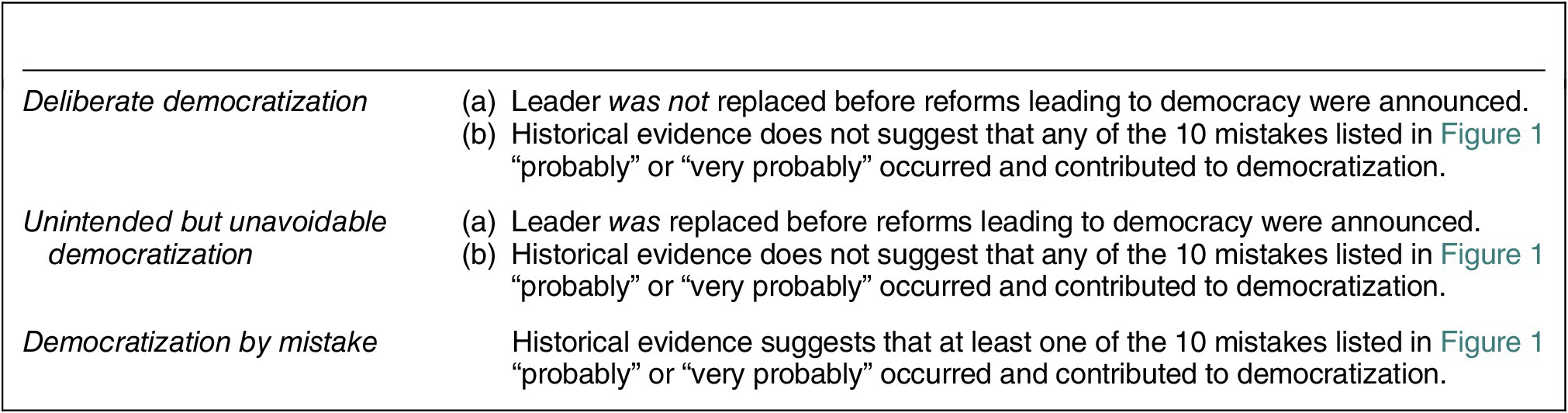
Thus, transition can occur by three paths: a deliberate choice by the incumbent—deliberate democratization, a failure by the incumbent to prevent democratization despite choosing optimal actions—unintended but unavoidable democratization, and a failure to prevent it after at least one non-optimal action—democratization by mistake. Empirically, it is hard to distinguish unintended but unavoidable democratization from deliberate democratization unless the incumbent was overthrown before political reform began. If all reform announcements came after the incumbent’s overthrow, reforms did not occur because he intended them. If, additionally, he made no clear mistakes, the democratization can be considered not just unintended but also from his perspective unavoidable. If, on the other hand, the incumbent was not overthrown and made no clear mistakes leading to democratization, I conservatively classify the case as deliberate.
More concretely, what do such mistakes of authoritarian rulers look like? To identify departures from optimality, one must know what the optimal strategy for preserving an autocratic regime is. Recent literature decomposes this into three key tasks. First, the ruler must deter or defeat challenges from domestic outsiders; Svolik (Reference Svolik2012) calls this the problem of “authoritarian control.” Second, he must avoid conflict among insiders—the problem of “authoritarian power-sharing” (Svolik Reference Svolik2012). Third, he must manage relations with foreign actors. Mistakes are non-optimal actions in pursuit of these three tasks. Figure 1 disaggregates further.
Typology of Paths to Democracy

The main tactics for controlling domestic outsiders are co-optation and repression (often combined with surveillance and censorship). Broadly speaking, incumbents can use these non-optimally in four ways. They may make excessive or poorly targeted concessions that in fact strengthen opposition (Rasler Reference Rasler1996). Partial reforms, in some settings, increase pressure for more, pushing leaders down the proverbial “slippery slope.” Or rulers may fail to make concessions that would have divided and weakened the opposition or co-opted new allies (Goldstone and Tilly Reference Goldstone, Tilly and Aminzade2001, 188). Likewise, excessive or poorly targeted repression can backfire, exposing the regime’s brutality and inciting the previously apathetic to revolt (Sutton, Butcher, and Svensson Reference Sutton, Butcher and Svensson2014). Or, rulers may fail to repress—or monitor, or censor—the opposition in ways that could have deterred or disrupted its challenges (Tilly Reference Tilly1978).
Besides misusing carrots and sticks, autocrats can discredit themselves through domestic policy failures—destabilizing the economy, hiking food prices, tolerating extreme corruption, and so on (for such policies to be a mistake, a superior alternative must have been feasible). Overconfident leaders may also call an election or referendum, only to find they are less popular than believed. Such revelations embolden the opposition and often prompt insider defections. A related mistake is to falsify results so brazenly that it provokes rebellion. Incumbents may have no better option. But if they could have increased their survival odds by postponing, canceling, or never calling the election; campaigning more effectively; or manipulating results more adroitly, then the action constitutes a mistake.
Besides controlling the population, rulers must control other insiders. Internal conflict often triggers regime breakdown. Mistakes by incumbents can cause this in three main ways. First, the leader may avoidably antagonize key members of the ruling coalition such as the Church or business elite, weakening his position. Second, he may alienate some in the armed forces or security services, reducing repressive capacity or prompting a coup. Third, a dictator may choose as his successor—or insiders may select as leader—a covert reformer who undermines the regime or an incompetent who fails to defend it.
The third challenge is to manage international relationships. A common mistake, in this regard, is to enter or initiate military conflict—and do poorly. This may end in invasion or, at least, discredit the ruler domestically, prompting elite defections and mass protests. As always, failure only indicates a mistake if avoiding the conflict or commanding more intelligently would have increased survival odds.
Since democratizations consist of processes rather than single events, each episode may contain more than one mistake. One may lead to another—for instance, alienating the army may result in the non-optimal use of repression—or an underperforming leader may err in multiple ways. Similarly, actors in deliberate choice cases may have multiple motives—perhaps seeking to end a long confrontation while increasing their faction’s support. Complicating matters further, mistakes may combine with elements of deliberate choice (hence, the dashed arrows in Figure 1). In Spain, Franco and his cronies entrusted future power to individuals disloyal to the regime (a mistake), who later democratized by forging a multilateral pact (deliberate choice). I still label an episode “democratization by mistake” if—as in the Spanish example—the incumbent deliberately chose reform only after prior mistakes.
METHOD
Identifying Cases
How one defines democratization depends on how one thinks about democracy. One tradition places political regimes on a continuum from pure autocracy to pure democracy (Bollen and Jackman Reference Bollen and Jackman1989). Democratization is then any reform that moves the country a certain distance in the democratic direction (some label this “political liberalization”). I call this a directional definition. A second tradition sees democracy as a binary category—either a system is one or it is not; democratization is then a reform, however large or small, that moves the country across the definitional threshold (Przeworski et al. Reference Przeworski, Alvarez, Cheibub and Limongi2000). I call this a qualitative definition. A third hybrid concept combines the first two. Such definitions require both a certain movement in the democratic direction and the crossing of some qualitative threshold.
Which definition is appropriate depends on the purpose (Collier and Adcock Reference Collier and Adcock1999). Fortunately, we need not privilege one here. I adopt definitions of each type and show that similar conclusions follow whichever is used. I use two directional definitions: (a) an increase of six or more points on the 21-point Polity2 scale, completed within three years (P), and (b) an increase of 0.3 within three years on the Varieties of Democracy (V-Dem) electoral democracy index, which runs from 0 to 1 (V).Footnote 15 My first qualitative definition employs the data of Boix, Miller, and Rosato (Reference Boix, Miller and Rosato2013)(BMR). They define democracy as a system in which elections are free and competitive, the head of government is either directly elected or answerable to an elected parliament, and at least half the male population can vote.Footnote 16 Democratization is a change from non-democracy to democracy. Two additional definitions come from the Lexical Index of Electoral Democracy database (LIED), which identifies objective thresholds for different levels of electoral democracy (Skaaning, Gerring, and Bartusevičius Reference Skaaning, Gerring and Bartusevičius2015). Specifically, LIED4 records when a country began holding at least “minimally competitive, multiparty elections for legislature and executive” (movement from < 4 to ≥ 4 on the index); LIED5 records when a country began holding such elections with at least “full male suffrage” (movement from < 5 to ≥ 5).Footnote 17 Finally, my first hybrid definition adopts Polity’s concept of “major democratic transition.”Footnote 18 This occurs when (a) Polity2 rises by six or more points within three years and (b) Polity2 moves from [-10, 0] to (0, 10] or from (0, 6) to [6,10] (MDT). My second, more demanding, hybrid definition requires that (a) Polity2 rises by six or more points within three years, and (b) Polity2 end at 6 or higher (MDT6). A final hybrid definition consists of an increase of 0.3 within three years on V-DEM’s electoral democracy index that ends with a rating of “democratic” on V-DEM’s ordinal electoral democracy index (V+).
The broad coverage of these datasets permits the examination of all democratizations between 1800 and 2010 (BMR) or 2015 (Polity IV, LIED, V-DEM). Applying these definitions yields a preliminary list of 316 cases. For various reasons, 46 turn out not to coincide with any identifiable democratic reform (see “Notes on Excluded Cases,” in the online appendix). Excluding these leaves 270 episodes—74–153 fitting directional definitions, 131–183 qualitative definitions, and 51–139 hybrid definitions; as is evident, the cases overlap (Table A1).
Sources and Classifications
My method here was congruence analysis (Beach and Pedersen Reference Beach and Pedersen2016, 269–301; Blatter and Blume Reference Blatter and Blume2008; Møller Reference Møller2017). The goal was to check whether historical evidence in particular cases matched the observable implications—usually about causal mechanisms—of given theories. The main theories examined were the deliberate-choice theories discussed in the “Democratization by Choice” section. At the same time, I explored the role of incumbent mistakes. For each case, I examined the mechanism that led to democratization and evaluated whether available evidence suggested that this included only optimal incumbent choices or at least one significant mistake. If the latter, I classified the mistakes by using the typology of Figure 1.
For each episode, I prepared a synopsis of events and historians’ interpretations.Footnote 19 I assessed the evidence for each observable implication of each deliberate-choice theory. To increase analytic transparency, I articulated the reasoning behind each nontrivial judgment in an accompanying table, along with relevant quotations from sources (Moravcsik Reference Moravcsik2014). The same tables summarize evidence of mistakes. Based on the historical evidence, I classified cases into the three paths of Figure 1; Table 1 shows the criteria that were used.
Criteria Used to Classify Cases of Democratization Into the Three Paths

The more than 2,000 sources included history books and articles, newspapers, magazines, web publications, diplomatic cables, biographies, memoirs, diaries, and published interviews of participants, in multiple languages and formats. I sought a range of sources for each case, following leads suggested by the sources themselves to locate missing information or resolve apparent disagreements. Each type is vulnerable to particular biases. Historians may be influenced by their political beliefs or worldview. Newspapers and magazines target specific audiences. Memoirs and interviews, while offering unique insight into actors’ motivations, are distorted by self-justification (because admitting mistakes is embarrassing, this should work against the conjecture that mistakes mattered). Private diaries are less self-serving but may be partial, episodic, or esoteric. Temporally proximate primary sources are more likely to contain direct observation and unfiltered evidence of actors’ thinking (Lieberman Reference Lieberman2010, 41). Still, heeding Kreuzer’s (Reference Kreuzer2010, 383) call to “take not only history, but also historians seriously,” I also studied historical interpretations.
I adopted standard techniques to combat potential biases (e.g., Howell and Prevenier Reference Howell and Prevenier2001). First, for each source I considered, based on identity of producer and context, what type of bias was plausible and discounted evidence that aligned with that bias, often noting this in the synopsis source notes. Second, I used multiple sources to cross-check facts and compare interpretations.
To minimize confirmation bias, Møller and Skaaning (Reference Møller and Skaaning2018, 4) recommend “giving less weight to historical works of other social scientists and to work by historians with similar theoretical claims as the one under consideration.” For each source, I therefore recorded in a table whether it embraced some social science theory—and, if so, how this related to those I examined. I relied mostly on atheoretical sources and discounted (or excluded) those committed to a theory similar to the one I was examining. I also heeded Møller and Skaaning’s recommendations to attend to possible differences in the meaning of concepts across eras and contexts and to prioritize sources that incorporated updated evidence.
As suggested by Lieberman (Reference Lieberman2010, 45), I graded the quantity and quality of sources available for each case and incorporated these judgments into the analysis. Specifically, I classified the materials as (a) “a lot of information—no serious disagreement on relevant points,” (b) “moderate amount of information—no serious disagreements on relevant points,” (c) “significant disagreement or ambiguity among sources on some relevant points, or key pieces of information lacking,” or (d) “very little information.” I then checked whether results would differ excluding cases with inferior source material.
Beyond the quantity and quality of source material, the evidence may be clearer in some cases than others. Therefore, I also recorded an estimate of my confidence in each conclusion (on a five-point scale: 1 = “very probably no,” 2 = “probably no,” 3 = “maybe/unclear,” 4 = “probably yes,” and 5 = “very probably yes”). Presenting results, I focused on the proportion graded 4 or 5 (“probably” or “very probably” yes), but in the tables I also list the proportions for narrower (just 5) and broader (≥3) criteria.
Throughout, I sought to trace mechanisms that linked incumbents’ actions to the outcome. But the analysis also employed counterfactual reasoning. To call an action a mistake, in my definition, implies that some alternative course would have increased the regime’s survival odds. Counterfactuals are sometimes considered controversial because it is hard to evaluate evidence for and against something that did not happen. Yet, as scholars increasingly recognize, it is almost impossible to discuss history in causal terms without entertaining counterfactuals (Bunzl Reference Bunzl2004; Tetlock and Belkin Reference Tetlock and Belkin1996).Footnote 20 The question is rather how to distinguish “appropriate” or “grounded” counterfactuals from less pertinent ones.
Some have suggested a few principles. To be useful, counterfactuals should clearly define the starting point, outcome, and mechanism connecting the two (clarity or transparency). This mechanism should be consistent with well-established theoretical and empirical generalizations (theoretical and empirical consistency). The posited change should be possible in isolation (feasibility of manipulation). It should be consistent with background conditions and mechanism (cotenability) as well as with established facts about the historical setting (minimal rewriting). Finally, the counterfactual starting point and outcome should be close together in time (temporal proximity) (Bunzl Reference Bunzl2004; Fearon Reference Fearon1991; Levy Reference Levy2015; Rohlfing Reference Rohlfing2012; Tetlock and Belkin Reference Tetlock and Belkin1996).
In this project, the counterfactual always refers to the incumbent choosing the optimal feasible action (O) instead of the mistake (M). Let D denote democratization and C all other contextual factors. The counterfactual outcome is the achievement of a lower probability of democratization: P(D|O,C), where P(D|O, C) < P(D|M,C). Here, clarity requires a precise statement of the mistake, counterfactual, and mechanism. In each synopsis table, I provide these. Some of the other principles will hold almost automatically here, for several reasons. Since the types of “mistakes” were themselves derived from prevailing theories and empirical generalizations about how dictators maintain power, the mechanisms are rooted in these same theories and generalizations (theoretical and empirical consistency). Other principles are implicit in my definition of mistake. If an alternative could not be chosen in isolation, or if background conditions precluded it, then it could not be considered “feasible” (feasibility of manipulation, cotenability).
The final two criteria are less automatic. Minimal rewriting rejects counterfactuals that imply major reconstruction of antecedent facts and processes. When the mistake is a simple choice by the leader, imagining him choosing differently rarely requires much alternative prior history. However, when the mistake is a broader failure of the ruling elite to implement some policy, rewriting may not be so minimal. For roughly 7% of putative mistakes, I judged the counterfactual might require significant changes to preceding history; I coded these as not mistakes. The temporal proximity requirement says the counterfactual antecedent (here, O) and the counterfactual outcome (P(D|O,C)) should be close together in time. In fact, the effect here is instantaneous: the probability of democratization changes from P(D|C) to P(D|O, C) as soon as O occurs. So, under a literal interpretation, temporal proximity always holds. The change is also instantaneous between the actual antecedent (M) and actual outcome—from P(D|C) to P(D|M,C). However, I adopted an intuitive adaptation of the criterion which required that the mistake, M, and actual democratization, D, be close together in time. As a rule of thumb, I called a case proximate if the start of regime change occurred within three years after the mistake and checked the results excluding all nonproximate cases.Footnote 21
While I often refer to a single “incumbent,” authoritarian regimes are not unitary. Scholars generally distinguish between a leader and other members of a ruling elite group. While most mistakes are made by the leader, with or without other elite members, a few are made by the elite alone (e.g., when the elite appoint a suboptimal leader). In the synopses, I noted which case applied, and I examined how patterns change excluding mistakes made without the leader’s involvement.
The appendix includes the coding instructions. Throughout, I sought to be conservative, recording “maybe/unclear” when in doubt. However, limited inferences often seemed reasonable. Various incumbents were deposed—and killed or exiled—by coups that a little more surveillance or attention to military grievances could have prevented. In other cases, “emperors” advertised their “nakedness,” as when Ceausescu’s state television showed demonstrators booing the dictator days before his overthrow (broadcasting live was reckless). Some leaders openly admit error. Mikhail Gorbachev, asked in 2011 whether he had made any mistakes in office, listed five (Steele Reference Steele2011). Turkey’s General Evren later lamented not having created a pro-military party after the 1980 coup. “We made a mistake,” he confessed. “We’ve walked this sheep to market and now we are presenting the meat to somebody else” (Pope and Pope Reference Pope and Pope1997, 155). Quick reversals of policies that had proved costly also provide prima facie evidence of error. Meanwhile, accounts of contemporaries offer insight into incumbents’ thinking. Tocqueville portrays Louis-Philippe as obtusely blundering into revolution. Louis-Philippe’s son, the Prince of Joinville, described his father as “at an age at which a man no longer accepts criticism” (Bourgeois Reference Bourgeois1919, 285–6). Such sources sometimes identify feasible alternatives. For instance, Tocqueville warned of rising popular anger and proposed concessions he thought would preserve stability (Tocqueville Reference Tocqueville1964, 32–3).
Major redundancy should increase confidence in the coding. Among incumbents who “probably” or “very probably” made at least one mistake, about two-thirds made two or more and one-third three or more. Thus, I could have rejected one or even two “mistakes” for many cases without invalidating the overall classification. It would take a comprehensive reinterpretation of multiple episodes to challenge the conclusion that missteps were important.
As an additional check, I had a research assistant code a randomly selected 5% of the cases (14 episodes), using the same sources but without seeing my synopses or results. Table A2 shows the correspondence between our ratings. Of these 14 cases, I had coded 12 as “democratization by mistake,” one as “unintended but unavoidable,” and one as “deliberate democratization.” The second coder also classified 12 as “democratization by mistake,” but judged both of the other two “deliberate democratization.” Intercoder agreement measures were high, ranging from 0.79 to 0.93. Agreement was sometimes lower for particular types of mistake, but this was usually because the second coder saw more mistakes than I had, which suggests that my classifications were, indeed, relatively conservative.
The ultimate test, as with any historical research, will be examination by critical readers. To maximize transparency, the synopses (covering more than 2,300 pages) include lengthy quotations from sources. Sources are fully annotated with page numbers and web addresses where possible. To illustrate, Table A3 and Box 1 in the appendix show the coding—and associated reasoning—for one example.
PATTERNS OF DEMOCRATIZATION
Aggregate Patterns
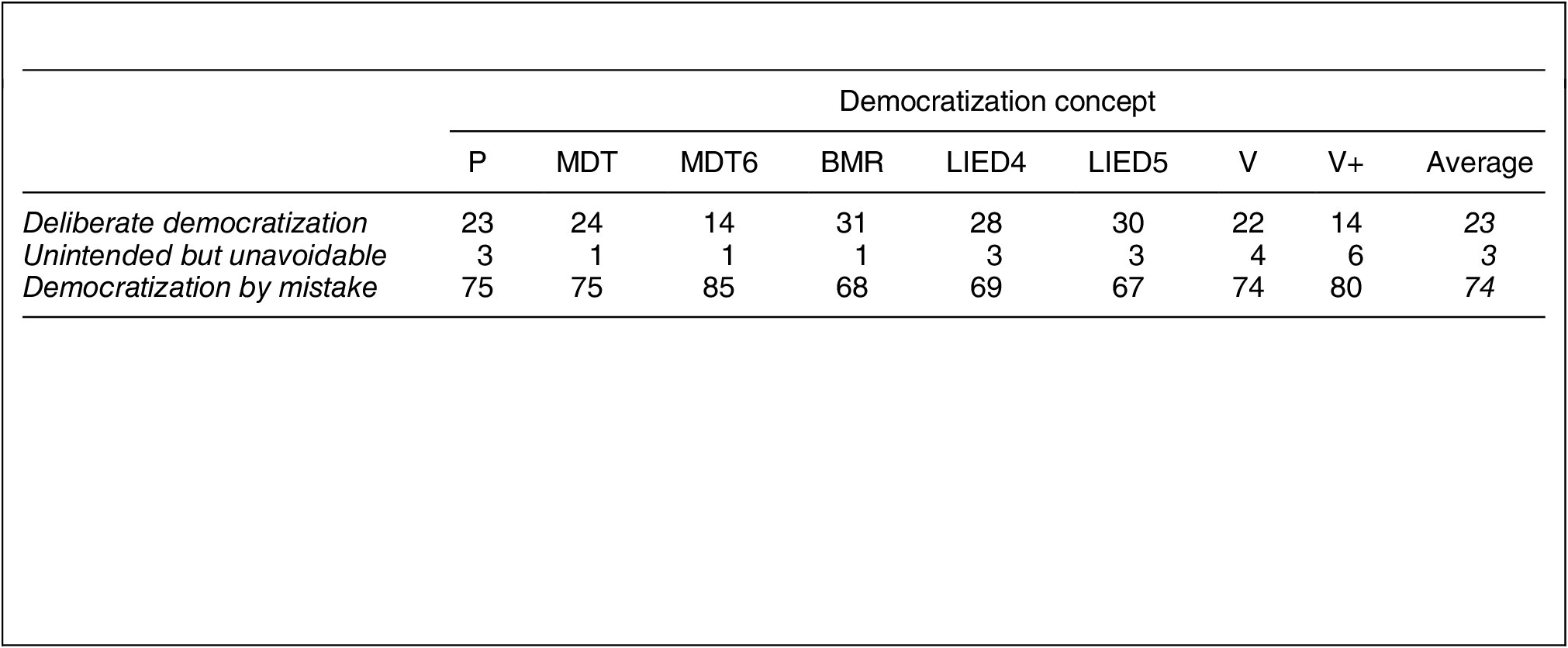
Table 2 shows how the cases break down among deliberate democratization, unintended but unavoidable democratization, and democratization by mistake. Here, I focus on the percentage of cases in which a given classification “probably” or “very probably” fit available evidence. Depending on the democratization indicator, from 14% to 31% of the cases were deliberate and from 1% to 6% were unintended but unavoidable. However, the vast majority—almost three-quarters on average—followed at least one significant mistake.
Paths of Democratization (Percentage of Cases)

Note: Source—author’s assessments. See online appendix for historical sources. P: increase of six or more points on the Polity2 scale, completed within three years; MDT: major democratic transition under Polity definition; MDT6: major democratic transition ending at Polity2 ≥ 6; BMR: Boix, Miller, Rosato (Reference Boix, Miller and Rosato2013) definition; LIED4: transition to minimally competitive, multiparty elections (LIED); LIED5: transition to at least full male franchise (plus minimally competitive, multiparty elections) (LIED); V: increase of at least 0.3 on the V-DEM electoral democracy index (v2x_polyarchy) within 3 years; V+: increase of at least 0.3 on the V-DEM electoral democracy index (v2x_polyarchy) within 3 years, ending as “democratic” (e_v2x_api_5C ≥ 0.75). Deliberate democratization: incumbent was not overthrown before reforms announced and democratization was not “very probably” or “probably” a consequence of some significant mistake or mistakes by the incumbent. Unintended but unavoidable: incumbent was overthrown before reforms announced and democratization was not “very probably” or “probably” a consequence of some significant mistake. Democratization by mistake: incumbent “very probably” or “probably” made at least one significant mistake that increased the odds of democratization.
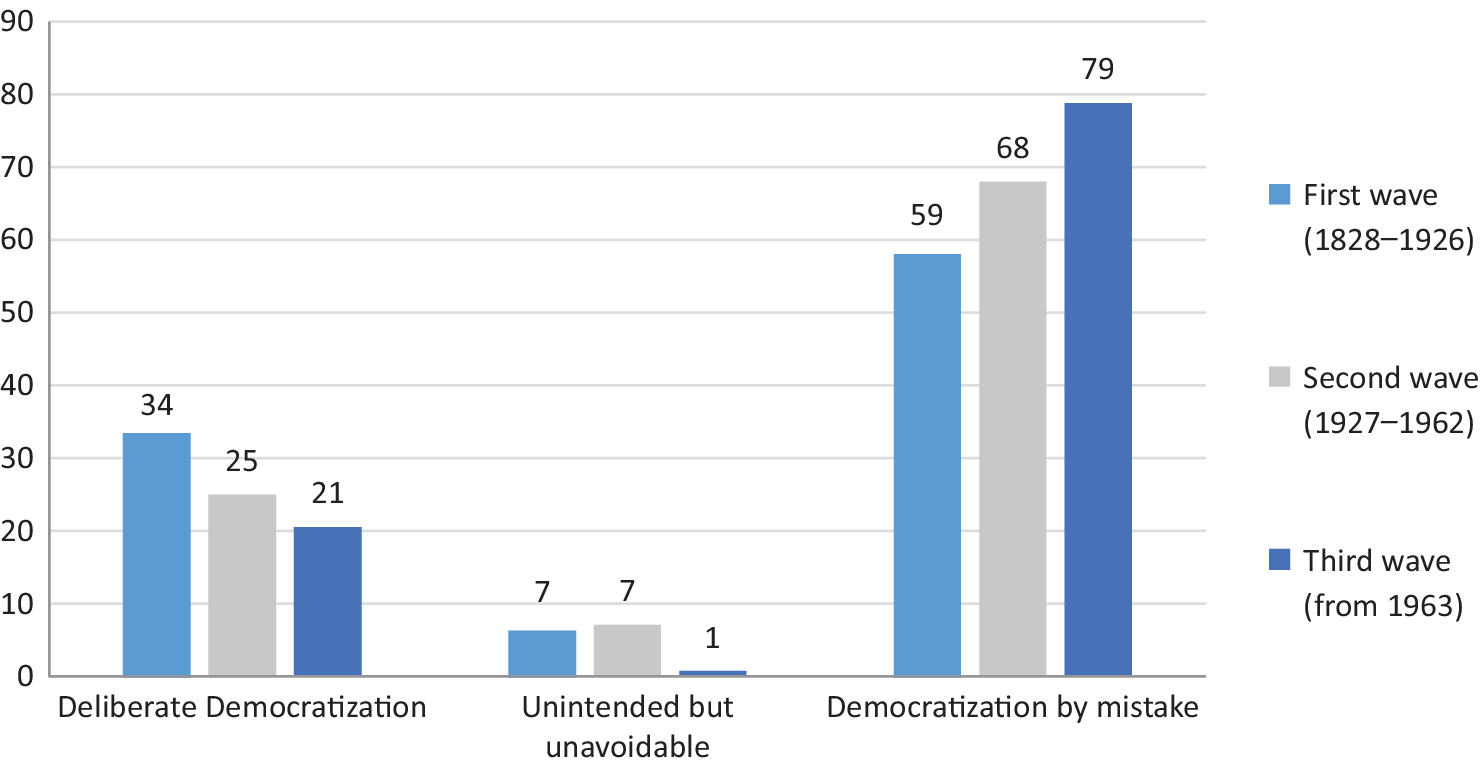
Figure 2 shows how the breakdown changed across the three waves of democratization. I use Huntington’s (Reference Huntington1991) periodization: 1st wave: 1828–1926; 2nd wave: 1927–1962; 3rd wave: from 1963.Footnote 22 Two observations suggest themselves. First, the frequency of deliberate democratization has fallen over time, while that of democracy by mistake has increased. Second, in all periods, democratization by mistake accounted for a large majority of the cases.
Paths of Democratization Over Time (Percentage of Cases)

Deliberate Choice
In 23% of the cases on average, the incumbent appeared to choose democracy deliberately (Table 2). These do not correspond exactly to instances of the five deliberate choice theories discussed in the “Democratization by Choice” section, for two reasons. First, one of the five theories applies in only about one-third of the “deliberate democratization” cases in Table 2. In two-thirds, leaders democratized deliberately for other reasons—foreign occupation, international pressure, among others. Second, the five deliberate choice arguments sometimes do apply in cases where the incumbent stumbled into democratization after a mistake (19% of the cases on average). For instance, Chile’s General Pinochet, after his humiliating referendum defeat, spent the next years negotiating protections for the military. At least one of the five deliberate choice theories “very probably” or “probably” fit the evidence in 29% of the cases, averaging across the eight democratization indicators (Figure 3 and Table A4).
Democratizations in Which Deliberate Choice Arguments “Probably” or “Very Probably” Fit Historical Evidence (Percentage of Cases)

Credible Commitment to Redistribution
South Africa in 1994 “very probably” fits this story. The Afrikaner elite may indeed have feared revolution, and the transition agreement explicitly included redistribution. In another 3–5% of the cases, the evidence is “probably” consistent. For instance, in Belgium in 1848 a Liberal government, alarmed by socialist agitation and food riots, broadened the franchise to coopt the lower and middle bourgeoisie, splitting them from the radicals (Witte, Craeybeckx, and Meynen Reference Witte, Craeybeckx and Meynen2009, 55–6). Before the passage of Britain’s Third Reform Act of 1884, rural demonstrations had alarmed “some of the more nervous minds” in parliament (Hayes Reference Hayes1982, 276). Other “probable” cases include Malawi (1993–4), South Korea (1987–8), and Sweden (1917–9).
Why does this plausible-sounding argument not fit more often? Like other scholars (Aidt and Jensen Reference Aidt and Jensen2014; Haggard and Kaufman Reference Haggard and Kaufman2012, Reference Haggard and Kaufman2016; Przeworski Reference Przeworski2009), I found that mass unrest did frequently precede democratization; historical accounts mentioned popular mobilization in 75–84% of cases. However, mass unrest can lead to democracy by paths other than the one that Acemoglu and Robinson (Reference Acemoglu and Robinson2006) describe. Some incumbents, rather than reforming to preempt revolution, are overthrown by one (recall Huntington’s “replacements”). New incumbents then do the democratizing.Footnote 23 In 1848 Paris, the journalists, socialist agitators, middle class notables, and romantic poets who declared the republic were hardly the July Monarchy’s elite. Moreover, some popular mobilizations have nothing to do with redistribution; in Armenia in 1997–8, a nondemocratic leader fell over policy on Nagorno-Karabakh. In other cases, what triggered unrest was military defeat or electoral fraud. Even when protesters have redistributive demands, the incumbent does not always democratize to commit to redistribution. Sometimes reforms seek to reduce redistribution. The rich overthrow left-wing dictators to protect their wealth (Ansell and Samuels Reference Ansell and Samuels2014). Or political reform may substitute for material benefits. Poland’s Communists thought incorporating Solidarity might “get opposition support for … painful measures (particularly price rationalization)” (Domber Reference Domber, Stoner and McFaul2013, 68). New democratic leaders often do not redistribute to the mobilized groups—and these groups do not demobilize. In short, many episodes superficially resembling Acemoglu and Robinson’s (Reference Acemoglu and Robinson2006) account actually followed a different logic.
Motivating Citizens to Defend in War or Civil War
Up to 8% of the cases showed evidence of this. Giolitti’s franchise extension is often linked to Rome’s Libya campaign: “In 1912, as Italy’s conscript soldiers faced death in the Libyan desert, it was impossible to deny them the vote any longer” (Clark Reference Clark1984, 188). In 1984 El Salvador, the junta’s limited reforms sought to buy citizens’ help against an insurgency. As President Duarte put it, “officers were afraid the armed forces might not be able to put out the fires of revolution. To save the armed forces, they would have to break their alliance to the oligarchy and realign with political forces that could win popular support” (Duarte and Page Reference Duarte and Page1986, 97).
Although elites rarely democratized for this reason, war mattered in other ways. Some had freer institutions imposed on them after losing. Take Hungary in 1920. “The French insisted on the formation of a ‘democratic’ government,” General Horthy sniffed. “Against my emphatic advice, Károlyi submitted to this demand” (Horthy Reference Horthy and Simon2000, 120). Japan and the Philippines installed democracy under United States occupation. Oddly enough, France democratized in 1871 after defeat by an authoritarian power. Bismarck feared an agreement with unelected leaders would not last. “Negotiating with this Government, can we hope to achieve something solid?” he asked Thiers. “[T]o treat of peace, an Assembly elected by the nation is better than a restoration of the Empire” (Thiers Reference Thiers1915, 35, 76).
Elsewhere, military defeat delegitimized an incumbent. Argentina’s Falklands War hastened its transition not because the generals wished to reward conscripts but because their failure discredited them. In the longer run, war may advance democracy by “building administrative capacity, boosting the economy, or integrating the nation,” although support remains equivocal. Among 38 cases in which war preceded democratization, historical evidence suggested that war caused the reforms in only five and was “ambiguous or dubious” in 12 (Mansfield and Snyder Reference Mansfield, Snyder, Kier and Krebs2010, 25).
Nudging Governments away from Patronage
In December 1875, the Turkish reformer Midhat Pasha complained of widespread corruption.
[T]he service of the State was starved, while untold millions were poured into the Palace, and the provinces were being ruined by the uncontrolled exertions of governors who purchased their appointments… . The only remedy … lay, first, in securing a control over the sovereign by making the Ministers—and especially as regarded the finances—responsible to a national popular Assembly
(Midhat Reference Midhat1903, 80).The next year, a new sultan enacted a constitution guaranteeing personal liberty and rule of law, with a bicameral parliament. This appears to fit the Lizzeri and Persico (Reference Lizzeri and Persico2004) argument.Footnote 24 Even interpreting loosely, I found few others—1% to 2%. Early nineteenth century Britain may fit, as Lizzeri and Persico suggest. In Bolivia in 1880, mining elites hoped civilian government would attract investment in railways. But examples are rare.
Recruiting New Voters to Out-Compete Elite Rivals
The United Kingdom’s Third Reform Act is among the 3–8% of the cases that “probably” or “very probably” fit the elite competition argument. Historians have characterized Gladstone’s bill to enfranchise rural householders as a piece of “cold political calculation” (Wright Reference Wright1970, 13), which his colleague Joseph Chamberlain believed “would give the Liberals a majority in the next elections” (Jones Reference Jones1972, 28). Others include Luxembourg (1919), the Netherlands (1897), and Sweden (1911).
A “Great Compromise” between Deadlocked Factions
Evidence for this exists in 12–24% of the cases. These include classic “democratization pacts” such as Venezuela’s 1958 “Pact of Punto Fijo,” Colombia’s “National Front” agreements of 1956–8, and Uruguay’s 1984 “Naval Club Agreement” (O’Donnell and Schmitter Reference O’Donnell and Schmitter1986, 37–47; Przeworski Reference Przeworski1991, 90). I accept Rustow’s (Reference Rustow1970) characterization of Sweden’s 1911 reform as a “great compromise,” although a pactless one. Additional examples include Poland (1989), the Netherlands (1917), and Comoros’s Fomboni Accord (2000).
Change over Time and Robustness
Do these arguments fit better in particular periods? Table A5 and Figure A2 analyze the three “waves” of democracy separately. The arguments perform somewhat better in the first wave. Even then, no single argument can explain more than one-fifth of the cases (averaging across democratization indicators). In 54%, evidence supports none of the five arguments. By the third wave, the commitment to redistribution, party competition, motivation for war, and reducing patronage stories almost never work, although “great compromises” contribute about one time in six.
Many “democratizations” were subsequently reversed. Do deliberate choice arguments better explain those that proved permanent? Table A6 includes only cases where the democracy score never fell below the level achieved at democratization (P, MDT, and V definitions), which never reverted to non-democracy (BMR), or never fell below the threshold (LIED, MDT6, V+). Results are similar. Could they be distorted by inadequacies in the sources? One rough check is to exclude episodes for which sources were relatively meager. Table A7 shows only the 66–77% of the cases with sources that I graded A or B (meaning “no serious disagreement on relevant points” and “a lot” or “a moderate amount” of information). Again, results change little.
Democratization by Mistake
How often did democratization follow from incumbents’ errors? Figure 4 (and Table A8) summarize the findings. In 74% of the episodes on average (67–85%), the path to democratization “probably” or “very probably” included one or more incumbent mistakes.
Democratizations “Probably” or “Very Probably” Caused in Part by Incumbents’ Mistakes (Percentage of Cases)

Controlling Domestic Outsiders
Carrots and Sticks
Incumbents undermined their position by offering excessive or poorly targeted concessions in 8–12% of the cases. Take Mikhail Gorbachev. His memoirs make clear that he was seeking a kind of humane socialism, led by a reinvigorated Communist Party, within unchanged borders (Gorbachev Reference Gorbachev1996). But his reforms created conflicts he could not manage. Others who slid down the “slippery slope” include Turkey’s General Evren, who complained that opposition parties “sprang up like mushrooms” after he relaxed his grip (Pope and Pope Reference Pope and Pope1997, 155), and General Abboud, who thought free debates would allow Sudanese students to let off steam. Weeks later, he was a private citizen, buying oranges in the suq (Collins Reference Collins2008, 81).
Others refused all concessions when a timely compromise could have defused unrest (9–15% of the cases). Recall Louis-Philippe, who turned a series of reform banquets into a revolution by vetoing even mild reforms. Thiers, his premier, pleaded with him to add “fifty or a hundred thousand new electors.” “Impossible!” he retorted. “I cannot part with my majority” (Senior Reference Senior1878, 6). Instead, he parted with his crown. Mali’s Moussa Traoré accused ministers of “panicking for nothing” when they warned of unrest and rejected even retractable promises that might have calmed rioters (Jeune Afrique Reference Afrique2011). Compromises might not have saved either regime; but, if made early enough, they would have improved the odds.
In the right circumstances, violent repression can crush opposition. In the wrong ones, it backfires, catalyzing protest, prompting insider defections, or intensifying foreign pressures (Sutton, Butcher, and Svensson Reference Sutton, Butcher and Svensson2014). In Bangladesh in 1990, the shooting of several students and one professor sparked nationwide demonstrations that led to the arrest of President Ershad for corruption (Crossette Reference Crossette1990). Such counterproductive violence preceded 16–29% of democratizations. Conversely, failing to use repression—or surveillance or censorship—can also doom the incumbent (10–15% of the cases). Leaders are assassinated in plots they failed to detect. They go on vacation as unrest spreads, or they neglect to police protests, which then metastasize into revolutions.
Major Policy Failures
In 15–23% of the episodes, some domestic policy blunder discredited the incumbent or alienated key groups. Economic mismanagement and ostentatious corruption are common examples, but there are many. Leaders mishandle defense against insurgencies or foreign attacks, bungle responses to natural disasters, and increase government salaries at times of hardship. Baby Doc Duvalier probably regretted his decision to televise his wife’s opulent “May Ball” to his country’s hungry citizens. It provoked immediate riots (Powers Reference Powers2012, 227).
Mishandling Election or Referendum
Authoritarian leaders call elections and referenda, hoping to demonstrate strength or bolster their legitimacy (Gandhi and Lust-Okar Reference Gandhi and Lust-Okar2009). Yet some overestimate their popularity and fail to manipulate adequately. Insiders quarrel among themselves, weakening their candidates. After an electoral defeat, the elite often splits or abandons the dictator. The opposition, energized by the result—or, alternatively, by evidence of fraud—acquires a focal point around which to mobilize.
Such electoral miscalculations preceded 19–27% of democratizations. Pinochet, certain he would win his plebiscite, was “stunned and enraged” when he lost, roaring, “It’s a big lie … . Here there are only traitors and liars!” (Constable and Valenzuela Reference Constable and Valenzuela1991, 309; Muñoz Reference Muñoz2008, 199). Other junta members say he demanded a state of emergency; blaming him for the crisis, they refused (Spooner Reference Spooner1994, 243–4). Sometimes overconfident incumbents deliberately underdo electoral manipulation or invite international monitors to legitimize their expected victory. Pinochet’s team, “shaken by the spectacle of the Philippine dictator Ferdinand Marcos’s disgrace in the fraudulent 1986 elections” thought “their best defense was to make fraud impossible” (Constable and Valenzuela Reference Constable and Valenzuela1991, 304). Others overdo it. In Guatemala’s 1944 congressional election, government candidates received about 4,000 more votes than had been cast; disgusted officers overthrew the dictator (Stanfield Reference Stanfield, McManus and Schlabach2004, 20). Additional victims of electoral missteps include: Nicaragua’s Sandinistas (1990)Footnote 25, Poland’s Communists (1989)Footnote 26, and Senegal’s Abdou Diouf (2000).Footnote 27
Managing Regime Insiders
Splitting the Civilian Elite, Leading to Victory of Outsiders
Many democratizations involve divisions within the ruling elite (O’Donnell and Schmitter Reference O’Donnell and Schmitter1986, 19). Often, such rifts could have been avoided. Sometimes, a leader’s actions split the regime’s civilian supporters, prompting defeat by outsiders (12–22% of the cases). For example, the “active support of the Church had been a factor in [Argentine strongman Juan] Perón’s victory in 1946” (Crassweller Reference Crassweller1996, 270). Yet, in a “critical mistake,” Perón picked a fight with the bishops in 1955 (Rock Reference Rock1987, 317). “The battle with the Church accomplished what ten years of political opposition by Perón’s enemies had singularly failed to do: it united them for a moment” (Crassweller Reference Crassweller1996, 276). Other dictators alienate colleagues through narrow cronyism or by mishandling succession plans. In Kenya, President Moi handed victory to the opposition in 2002 when he backed the then untested Uhuru Kenyatta, bypassing heavyweights of his party, who promptly defected. Bulgaria’s Todor Zhivkov disastrously angered defense minister Dobri Dzhurov with his “gangsterism and his incessant efforts to advance the career of his wastrel son, Vladimir” (Harden Reference Harden1990).
Avoidably Alienating Army or Security Forces
A second danger (19–30% of the cases) is to alienate the regime’s enforcers. Often, this could have been prevented by more sensitive leadership, better surveillance, or reassignments. Serbia’s young officers, feeling dishonored by King Aleksandar Obrenović’s marriage to a disreputable woman, murdered him in 1903. General Stroessner infuriated army colleagues by grooming his distrusted son Gustavo to succeed him; then, in a “grave strategic error,” he reshuffled disloyal officers without removing their command of troops (Lewis Reference Lewis2006, 180). They quickly ousted him.
Delegating to a Covert Democrat—or Weak Regime Defender
A third mistake often involves not the ruler but other insiders. In 7–12% of the cases, insiders chose a leader apparently committed to preserving the regime—who undermined it. Some were always secret reformers, others became them, and still others were merely particularly ineffective.
In Spain, Generalisimo Franco packed corporatist bodies with hardliners to preserve dictatorship after his death. As he said, “Everything is tied up, and well tied” (Cercas Reference Cercas2012, 30). But he made two mistakes. First, he chose Prince Juan Carlos as successor. As King, Juan Carlos sought to preserve not the Francoist state but the monarchy, which he thought required modernizing political institutions. Second, Franco noted the “dangerous” ambition of a certain careerist, Adolfo Suárez, yet permitted his rise (Cercas Reference Cercas2012, 301). As Juan Carlos’s prime minister, Suárez dismantled the autocracy.
To colleagues who appointed him General Secretary, Gorbachev also came to seem a traitor. “We believed in Gorbachev for a very, very long time,” wrote one Politburo member, Vitaly Vorotnikov. “Alas, we realized what was happening far too late” (Dobbs Reference Dobbs1997, 262). In Taiwan, furious Kuomintang veterans expelled the reformist president Lee Teng-hui from the party after his term ended (Kagan Reference Kagan2007, 12). Other “traitors” include B. J. Habibie, Suharto’s hand-picked successor in Indonesia, who “had never intimated any special fondness for liberal democracy” (Horowitz Reference Horowitz2013, 43) but whose reforms undermined the Golkar bosses and generals.
Dealing with Foreign Actors
Finally, leaders blunder in the international arena (in 14–25% of the cases). Some start military conflicts, expecting to rally citizens behind them, but then lose, humiliating the country and splitting the regime (Oakes Reference Oakes2012). Argentina’s General Galtieri was determined not to democratize. “In the last fifty years other military procesos … took the wrong path and thought elections were the solution to the political problem,” he said in 1981, “[W]e must not make the same mistake” (Stohl Reference Stohl1987, 229).
He made a different one. Invading the Falklands, Galtieri hoped to divert attention from economic and human rights problems and restore military honor (Robben Reference Robben2007, 313). Critically, he assumed Britain would not fight. “Personally, I judged any response from the English scarcely possible, indeed absolutely improbable,” he recalled afterwards (Rock Reference Rock1987, 378). In fact, Prime Minister Margaret Thatcher sent a fleet to reclaim the islands. Argentina’s surrender three months later prompted violent protests, which divided the military and forced Galtieri’s resignation. His successor, General Bignone, saw no option but a retreat to the barracks.
Other international mistakes include the Greek colonels’ provocation of Turkey over Cyprus in 1974, Paraguay’s war with Brazil in 1864, and Idi Amin’s invasion of Tanzania in 1978. Not all are military. Some, like President Bakiyev of Kyrgyzstan, provoke a neighbor to destabilize their regime with propaganda, trade tariffs, or sanctions. Others, like Guinea-Bissau’s General Antonío Indjai, antagonize the United States by trafficking drugs (Shaw Reference Shaw2015).
Change over Time and Robustness
Mistakes were important in all waves, and their importance generally increased over time (Table A9, Figure A3). On average, democratization by mistake increased from 59% of the cases in the first wave to 79% in the third. In the first wave, leaders blundered most in foreign policy (usually through reckless bellicosity), domestic policy, and in failing to conciliate domestic actors. Later, the focus shifted to alienating the armed forces, counterproductive violence, and electoral miscalculations. The role of mistakes is slightly higher—81% on average—focusing on just high information cases (Table A10) and about the same—77% on average—among democratizations that proved to be permanent (Table A11).
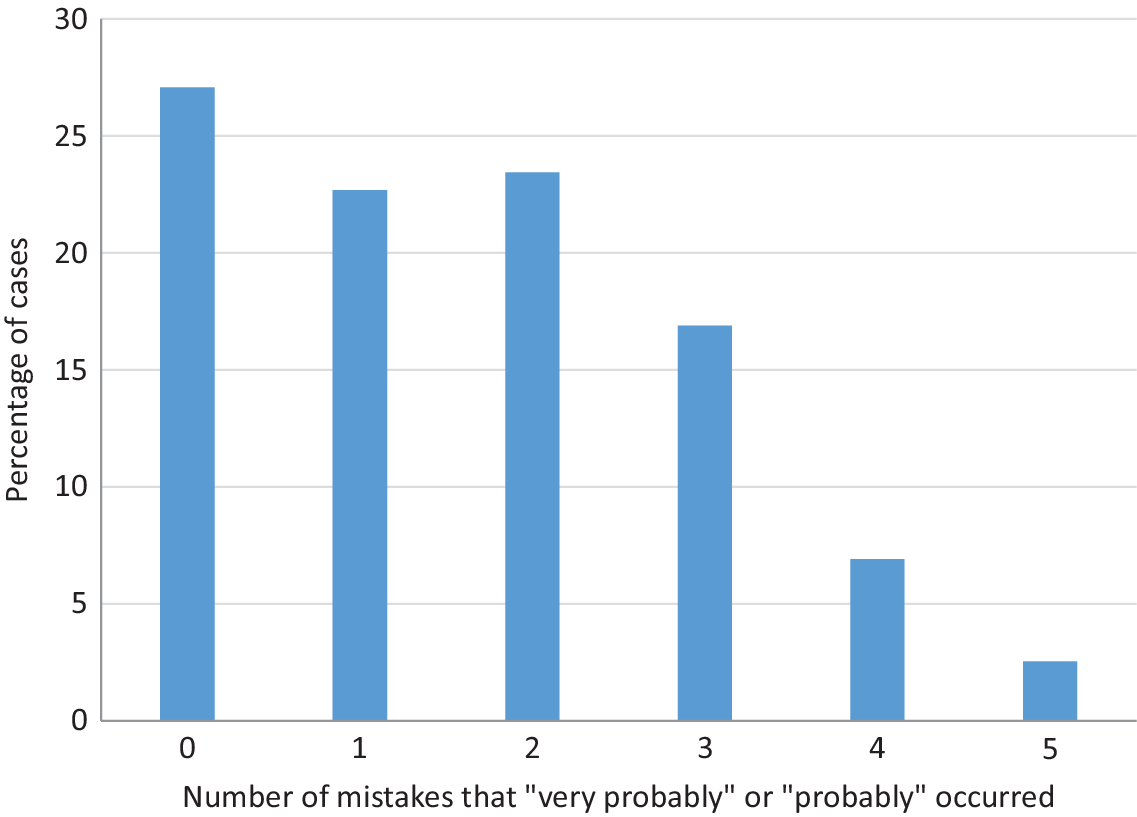
Table A12 excludes the roughly 10% of mistakes—most often domestic or foreign policy failures—that were not temporally proximate (occurring within three years of regime change). Democratizations by mistake fall from 74% to 71% of the cases. Table A13 counts only mistakes in which the central leader himself participated, excluding, for instance, cases in which the elite selected a covert democrat as leader. Again, aggregate results change little. One reason such recodings have little effect is the noted redundancy in errors. Blunders were often multiple. In 50% of the cases, the incumbent made two or more mistakes; in 10%, the incumbent made four or more (Figure 5).
Number of Mistakes per Democratization Episode

Finally, some draw a sharp distinction between “democratizations,” which end in democracy, and “political liberalizations,” which merely soften an authoritarian regime. While the MDT6, BMR, LIED4, LIED5, and V+ definitions already capture just “democratizations” in this sense, the Polity, MDT, and V definitions combine democratizations with political liberalizations. Table A14 shows results for just political liberalizations (that is, significant, concentrated increases on the Polity2 or V-DEM electoral democracy scale that do not cross the democracy threshold). Mistakes are slightly less frequent than for democratizations—61–63%—but still fit far more often than deliberate choice arguments—16–17%.
CONCLUSIONS
Since the early 1800s, democracy has spread to almost 60% of countries. Scholars have wondered whether political rights were more often “conquered” or “granted” (Przeworski Reference Przeworski2009). Was power wrenched from the elite by a rising class or bestowed from above out of enlightened self-interest? Evidence reviewed here suggests a third possibility. Often, elites fumbled power into the hands of their adversaries. Neither conquered nor granted, democracy emerged after an incumbent blundered and lost control. Structural factors, strategic choices, and sometimes luck did the rest.
Given the high stakes, it seems puzzling at first that so many autocrats miscalculate. Yet, their task is incredibly hard. They must calibrate repression and concessions, manage elites, pay and promote enforcers, detect disloyalty, and deter foreign rivals without provoking them. And they must do all this day after day. Acquiring accurate information is challenging. Polls mislead if fear lowers response rates or prompts preference falsification. Attitudes can change suddenly. Apparently solid support when a semi-free election is called can become an opposition landslide as informational cascades unfold. Previously loyal agents defect amid their own cascades (Rundlett and Svolik Reference Rundlett and Svolik2016). From this perspective, the puzzle is not that many autocrats fail eventually but that some survive so long.
Two caveats require mention. First, the limited purchase of deliberate-choice arguments does not render them irrelevant. They do fit certain well-known cases, especially in the first wave. And, as noted, mistakes sometimes combine with elements of deliberate choice. Still, the scope remains narrow. The 22–39% of the episodes that fit the five deliberate-choice arguments already includes cases that began from incumbent mistakes. Deliberate-choice cases without ruler missteps constitute only 6–15%.
Second, the frequency of errors does not mean rationalist methods such as game theory are not useful. On the contrary, to identify mistakes requires a prior conception of optimal action; the typology I develop derives from a rationalist view of authoritarian governance. Rather, the findings suggest the need to take seriously—as some existing models do—the severe and sometimes self-inflicted information constraints under which rulers operate and to consider approaches (such as trembling hand perfection) that incorporate the possibility of off-equilibrium-path play.
Recognizing the role of mistakes in democratization is important for several reasons. First, it casts new light on the last two centuries. The processes generating democracy’s spread were complex. This paper’s findings should remove any temptation to oversimplify these into a “Whig history” narrative of enlightened elite compromises.
More generally, the results have implications for theories of regime change. Some theories relate democratization to characteristics of countries—economic development, inequality, international integration (“structure”). Others focus on actions of players in the political game (“agency”). Most scholars now agree neither is by itself sufficient. While structural factors may explain why countries become democratic, choices of political actors help determine when and how they do so.
Recent papers suggest that certain events—economic crises, violent coups, leader turnover—serve as triggers, activating the pro-democratic effect of economic development (Kennedy Reference Kennedy2010; Miller Reference Miller2012; Treisman Reference Treisman2015). I conjecture that incumbent mistakes can also serve as triggers. Indeed, they may prove to be a common cause of the others. As the synopses show, economic crises, violent coups, and leader turnover—although sometimes exogenous—often result directly from incumbent errors.
One way to understand such structure-agency interactions is in terms of a model with multiple equilibria. Structural variables determine what equilibria are possible. For some values of these, both authoritarian and democratic equilibria exist. Which occurs may depend on coordination and beliefs, which respond to contingent actions. A major mistake by the ruler can prompt sudden belief changes, undermining a previous coordination scheme. When structural parameters permit only a democratic or authoritarian equilibrium, such missteps, at most, prompt leader turnover. But when parameters are intermediate, the same errors can tip participants from one mode of politics to the other.
Methodologically, the findings suggest the value of investigating posited causal mechanisms in individual cases (Kreuzer Reference Kreuzer2010). Rough proxies can mislead. For instance, in 75–84% of the cases the Acemoglu and Robinson (Reference Acemoglu and Robinson2006) argument would pass a test that looked just for anti-elite mobilization. Requiring consistency with the other observable implications, however, lowers the pass rate to 4–6%. Do elites enfranchise citizens to persuade them to defend the country? Democratization did occur at times of war, civil war, or serious threat in 23–45% of the cases. But in less than 5%, political rights were granted to motivate those needed to fight (or demobilize).
Further research may uncover what factors—individual or structural—make mistakes more likely. Developing a theory about when mistakes occur and when they matter is an important challenge for future research. Both leaders’ age and tenure may contribute. Age increases odds of mental impairment. It also raises issues of succession, with their associated dangers. However, age also discourages risk-taking, which could reduce mistakes (Truett Reference Truett1993). Tenure might have contrasting effects. Experience accrues with years in office and more competent incumbents will survive longer, so new leaders should make more mistakes. Consistent with this, dictators are most likely to lose power early on (Bueno de Mesquita and Smith 2010, 941). However, hubris and informational filters tend to develop over time, so the relationship could be nonlinear, with mistakes likelier both early and late in a leader’s tenure.
Some subtypes of authoritarian regimes may be more prone to blunders. Those with collective leadership—some single-party and military regimes, oligarchical proto-democracies—may vet policies better than personalistic dictatorships or monarchies do (Weeks Reference Weeks2014). (Single-party regimes are particularly resilient (Geddes Reference Geddes1999, 132).) Those that hold elections risk mismanaging them, although not holding elections has its own drawbacks. Major economic or political turbulence may increase errors. Confronting crises, leaders may risk potentially destabilizing innovations. Social change makes it harder to discern the optimal mix of concessions and repression. Rulers facing complex international threats are more likely to blunder abroad.
Mistakes matter also for other institutional reforms. Rational accounts of electoral rule selection have sparked debate (Boix Reference Boix2010; Cusack, Iversen, and Soskice Reference Cusack, Iversen and Soskice2010; Kreuzer Reference Kreuzer2010). Such accounts have trouble explaining why in early twentieth century Western Europe and postcommunist Eastern Europe incumbents often “supported electoral rules that later eliminated them from politics” (Andrews and Jackman Reference Andrews and Robert W2005, 65). Another possible example is the spread of human rights treaties. That egregious abusers would ratify these is puzzling at first glance. Perhaps reputational gains or access to foreign aid offset any risk. But leaders might simply fail to anticipate the consequences. The year before his plebiscite, Pinochet’s government signed the United Nation’s Convention against Torture. Eleven years later, it was used against him. African leaders whose countries supported the creation of the International Criminal Court were among its early targets. “[I]n a period of rapid flux,” writes Sikkink (Reference Sikkink2011, 40), “states may misunderstand the implications of their actions. They make mistakes.”
Future studies could explore the role of mistakes in other types of regime change. As well as facilitating democratization, errors can trigger democratic breakdowns. Failures in the interwar period often occurred because participants “were mistaken in their analysis of the situation” (Linz Reference Linz1978, 81). The fatal missteps of democratic leaders—domestic policy failures, concessions that embolden the opposition, appointment of covert (or overt) regime opponents—clearly overlap with those of autocrats.
Supplementary Materials
To view supplementary material for this article, please visit http://dx.doi.org/10.1017/S0003055420000180. Replication materials can be found on Dataverse at: https://doi.org/10.7910/DVN/PYRVKV.







Comments
No Comments have been published for this article.