


%20--%3e%3c!DOCTYPE%20svg%20PUBLIC%20'-//W3C//DTD%20SVG%201.0//EN'%20'http://www.w3.org/TR/2001/REC-SVG-20010904/DTD/svg10.dtd'%3e%3csvg%20version='1.0'%20id='Layer_1'%20xmlns='http://www.w3.org/2000/svg'%20xmlns:xlink='http://www.w3.org/1999/xlink'%20x='0px'%20y='0px'%20width='64px'%20height='64px'%20viewBox='5.5%20-3.5%2064%2064'%20enable-background='new%205.5%20-3.5%2064%2064'%20xml:space='preserve'%3e%3cg%3e%3ccircle%20fill='%23FFFFFF'%20fill-opacity='0'%20cx='37.785'%20cy='28.501'%20r='28.836'/%3e%3cpath%20fill='%23595959'%20d='M37.441-3.5c8.951,0,16.572,3.125,22.857,9.372c3.008,3.009,5.295,6.448,6.857,10.314%20c1.561,3.867,2.344,7.971,2.344,12.314c0,4.381-0.773,8.486-2.314,12.313c-1.543,3.828-3.82,7.21-6.828,10.143%20c-3.123,3.085-6.666,5.448-10.629,7.086c-3.961,1.638-8.057,2.457-12.285,2.457s-8.276-0.808-12.143-2.429%20c-3.866-1.618-7.333-3.961-10.4-7.027c-3.067-3.066-5.4-6.524-7-10.372S5.5,32.767,5.5,28.5c0-4.229,0.809-8.295,2.428-12.2%20c1.619-3.905,3.972-7.4,7.057-10.486C21.08-0.394,28.565-3.5,37.441-3.5z%20M37.557,2.272c-7.314,0-13.467,2.553-18.458,7.657%20c-2.515,2.553-4.448,5.419-5.8,8.6c-1.354,3.181-2.029,6.505-2.029,9.972c0,3.429,0.675,6.734,2.029,9.913%20c1.353,3.183,3.285,6.021,5.8,8.516c2.514,2.496,5.351,4.399,8.515,5.715c3.161,1.314,6.476,1.971,9.943,1.971%20c3.428,0,6.75-0.665,9.973-1.999c3.219-1.335,6.121-3.257,8.713-5.771c4.99-4.876,7.484-10.99,7.484-18.344%20c0-3.543-0.648-6.895-1.943-10.057c-1.293-3.162-3.18-5.98-5.654-8.458C50.984,4.844,44.795,2.272,37.557,2.272z%20M37.156,23.187%20l-4.287,2.229c-0.458-0.951-1.019-1.619-1.685-2c-0.667-0.38-1.286-0.571-1.858-0.571c-2.856,0-4.286,1.885-4.286,5.657%20c0,1.714,0.362,3.084,1.085,4.113c0.724,1.029,1.791,1.544,3.201,1.544c1.867,0,3.181-0.915,3.944-2.743l3.942,2%20c-0.838,1.563-2,2.791-3.486,3.686c-1.484,0.896-3.123,1.343-4.914,1.343c-2.857,0-5.163-0.875-6.915-2.629%20c-1.752-1.752-2.628-4.19-2.628-7.313c0-3.048,0.886-5.466,2.657-7.257c1.771-1.79,4.009-2.686,6.715-2.686%20C32.604,18.558,35.441,20.101,37.156,23.187z%20M55.613,23.187l-4.229,2.229c-0.457-0.951-1.02-1.619-1.686-2%20c-0.668-0.38-1.307-0.571-1.914-0.571c-2.857,0-4.287,1.885-4.287,5.657c0,1.714,0.363,3.084,1.086,4.113%20c0.723,1.029,1.789,1.544,3.201,1.544c1.865,0,3.18-0.915,3.941-2.743l4,2c-0.875,1.563-2.057,2.791-3.541,3.686%20c-1.486,0.896-3.105,1.343-4.857,1.343c-2.896,0-5.209-0.875-6.941-2.629c-1.736-1.752-2.602-4.19-2.602-7.313%20c0-3.048,0.885-5.466,2.658-7.257c1.77-1.79,4.008-2.686,6.713-2.686C51.117,18.558,53.938,20.101,55.613,23.187z'/%3e%3c/g%3e%3c/svg%3e)
%20--%3e%3c!DOCTYPE%20svg%20PUBLIC%20'-//W3C//DTD%20SVG%201.0//EN'%20'http://www.w3.org/TR/2001/REC-SVG-20010904/DTD/svg10.dtd'%3e%3csvg%20version='1.0'%20id='Layer_1'%20xmlns='http://www.w3.org/2000/svg'%20xmlns:xlink='http://www.w3.org/1999/xlink'%20x='0px'%20y='0px'%20width='64px'%20height='64px'%20viewBox='5.5%20-3.5%2064%2064'%20enable-background='new%205.5%20-3.5%2064%2064'%20xml:space='preserve'%3e%3cg%3e%3ccircle%20fill='%23FFFFFF'%20fill-opacity='0'%20cx='37.637'%20cy='28.806'%20r='28.276'/%3e%3cg%3e%3cpath%20fill='%23595959'%20d='M37.443-3.5c8.988,0,16.57,3.085,22.742,9.257C66.393,11.967,69.5,19.548,69.5,28.5c0,8.991-3.049,16.476-9.145,22.456%20C53.879,57.319,46.242,60.5,37.443,60.5c-8.649,0-16.153-3.144-22.514-9.43C8.644,44.784,5.5,37.262,5.5,28.5%20c0-8.761,3.144-16.342,9.429-22.742C21.101-0.415,28.604-3.5,37.443-3.5z%20M37.557,2.272c-7.276,0-13.428,2.553-18.457,7.657%20c-5.22,5.334-7.829,11.525-7.829,18.572c0,7.086,2.59,13.22,7.77,18.398c5.181,5.182,11.352,7.771,18.514,7.771%20c7.123,0,13.334-2.607,18.629-7.828c5.029-4.838,7.543-10.952,7.543-18.343c0-7.276-2.553-13.465-7.656-18.571%20C50.967,4.824,44.795,2.272,37.557,2.272z%20M46.129,20.557v13.085h-3.656v15.542h-9.944V33.643h-3.656V20.557%20c0-0.572,0.2-1.057,0.599-1.457c0.401-0.399,0.887-0.6,1.457-0.6h13.144c0.533,0,1.01,0.2,1.428,0.6%20C45.918,19.5,46.129,19.986,46.129,20.557z%20M33.042,12.329c0-3.008,1.485-4.514,4.458-4.514s4.457,1.504,4.457,4.514%20c0,2.971-1.486,4.457-4.457,4.457S33.042,15.3,33.042,12.329z'/%3e%3c/g%3e%3c/g%3e%3c/svg%3e)
I. Introduction
The progressive authorisation of insect-based foods under the European Union’s novel food regulatory framework represents one of the more significant, and least examined, intersections between food innovation policy and animal welfare law. Between 2021 and 2023, the European Food Safety Authority (EFSA) issued positive safety opinions for Tenebrio molitor larvae,Footnote 1 Acheta domesticus,Footnote 2 and Alphitobius diaperinus,Footnote 3 authorisations that collectively open the EU market to products derived from billions of individual arthropods reared under industrial conditions. The market for insect-based food products was identified over a decade ago as a significant emerging sector,Footnote 4 and the 2021–2023 authorisations confirm the realisation of that trajectory within the EU regulatory space.
At first sight, the welfare of insects used for food production may appear a paradoxical or premature regulatory concern. Yet this perception mirrors earlier stages in the legal development of animal welfare itself. Questions that are now firmly embedded in EU law, including the welfare of farm animals during transport and slaughter, or the recognition of animal sentience as a legally relevant condition, were once treated as peripheral to market regulation and food production. The history of animal welfare law is therefore also a history of progressive epistemic expansion: categories of suffering initially regarded as scientifically uncertain, economically inconvenient, or legally external have gradually entered the field of regulatory concern. Insect welfare should be understood within this trajectory. Its current marginality does not prove its irrelevance; it reveals the limits of a regulatory architecture designed before this form of mass animal production became a concrete internal market phenomenon.Footnote 5 This trajectory can be traced through an identifiable sequence of legal milestones. The Council of Europe’s 1976 Convention for the Protection of Animals kept for Farming Purposes was among the first international instruments to articulate welfare standards for animals raised in production systems.Footnote 6 The European Community subsequently incorporated comparable substantive standards into Council Directive 98/58/EC concerning the protection of animals kept for farming purposes.Footnote 7 Welfare regard was elevated to the status of primary law only two decades later, first through the Protocol on the Protection and Welfare of Animals annexed to the 1997 Treaty of Amsterdam, and then, in materially strengthened form, through Article 13 TFEU following the Treaty of Lisbon, developments examined in detail in Section V below. Sector-specific secondary legislation, including the instruments governing the protection of animals during transport and at the time of killing, extended detailed welfare requirements to particular stages of animal use only in the following decade. Each step in this sequence displays the same structural pattern now observable in the insect welfare context: an initial period in which welfare concerns are regulatorily inadmissible, followed by gradual recognition once accumulating scientific and normative argument rendered continued exclusion increasingly untenable.
Each of these authorisations rests on a scientific assessment rigorously limited to risks relevant to human health: allergenicity, microbiological contamination, toxicological profiles and compositional characteristics.Footnote 8 Questions concerning the welfare of the authorised species, whether they suffer during rearing, stunning or killing; whether they experience something morally significant when subjected to aversive conditions; and whether regulatory indifference to these questions is defensible, are not merely unanswered. They are not asked.
This article argues that the absence of insect welfare from EU novel food authorisation is not a gap that could be remedied by better science or more comprehensive assessment guidelines. It reflects a structural feature of the regulatory architecture: a form of what the article terms jurisdictional epistemic closure, by which legally defined institutional mandates simultaneously allocate regulatory competence and determine the epistemic conditions under which uncertainty can be recognised as legally actionable. Insect welfare uncertainty does not fail to enter the authorisation process because it has been assessed and found irrelevant. It fails to enter because the regulatory epistemology governing EFSA’s mandate has no category to receive it.
The argument is developed from a perspective informed by both legal scholarship and veterinary science. The latter matters because the central empirical question, whether insects experience something morally akin to pain or suffering, is not merely a matter of philosophy but one that veterinary and comparative biology have begun to address with increasing methodological sophistication. The insights of veterinary welfare science, which has long operated with uncertainty about the phenomenological experience of non-verbal patients, offer analytical resources that legal scholarship on risk governance has not yet fully engaged.
The article proceeds as follows. Section II situates EFSA’s assessment mandate within the broader architecture of EU novel food regulation and its underlying epistemic presuppositions. Section III develops the concept of jurisdictional epistemic closure, situates it in relation to existing frameworks from science and technology studies and administrative law, and in subsection III.3 identifies the specific contribution it makes beyond those frameworks. Section IV examines the scientific evidence on insect sentience and its regulatory irrelevance, drawing on the nociception–sentience distinction as understood in veterinary science. Section V analyses the taxonomic scope of Article 13 TFEU and its relationship to the Novel Food Regulation, including the significance of Protocol No 33 to the Treaty of Amsterdam. Section VI documents the epistemic filtering that occurs in EFSA’s insect novel food opinions. Section VII examines the capacity of the precautionary principle to address the problem. Section VIII identifies the normative implications of the analysis, grounded in Article 13 TFEU, and assesses the available reform possibilities. Section IX concludes.
II. The novel food regulatory framework: mandate, architecture and epistemic presuppositions
Regulation (EU) 2015/2283 establishes a centralised pre-market authorisation system for foods not consumed to a significant degree within the Union prior to 15 May 1997.Footnote 9 Under Articles 6 to 12, applicants must demonstrate, on the basis of available scientific evidence, that the novel food does not pose safety risks to human health, is not nutritionally disadvantageous compared with equivalent conventional foods, and does not mislead consumers. The regulation does not require applicants to address the animal welfare implications of production methods.
Scientific assessment is conducted by EFSA pursuant to Article 11. The provision is unambiguous: EFSA’s opinion must cover whether the novel food is safe. “Safe,” in the context of the Novel Food Regulation, means safe for human consumption. Ethical, environmental and animal welfare considerations are not within EFSA’s mandate under this instrument.Footnote 10 This exclusion, however, should be understood as a limitation of EFSA’s assessment mandate, not as a determination of the legal irrelevance of animal welfare within the authorisation process as a whole. EFSA is required to answer the scientific question submitted to it under the Novel Food Regulation,Footnote 11 which concerns the safety of the novel food for human consumption. The Commission, by contrast, acts at the risk management stage and operates within a broader legal framework, including Article 13 TFEU and the general principles of EU food law. The institutional separation between risk assessment and risk management therefore cuts both ways. It prevents EFSA from unilaterally expanding its scientific mandate, but it also prevents the Commission from treating EFSA’s silence on welfare as evidence that welfare is legally irrelevant. This delineation is not unique to novel food law; it reflects the broader institutional architecture of EU food safety governance established by Regulation (EC) 178/2002, which codified the principle of risk analysis as a tripartite process of assessment, management and communication.Footnote 12
The functional separation of risk assessment (assigned to EFSA) from risk management (retained by the Commission and Member States) is understood to serve both epistemic and legitimacy purposes. Epistemically, the separation is designed to insulate scientific judgment from political pressure; in practice, however, a substantial body of scholarship, most notably in the aftermath of the BSE crisis, documents that this insulation is frequently incomplete. Legitimacy-wise, it enables the Commission’s authorisation decisions to claim scientific grounding whilst preserving political discretion on policy trade-offs.Footnote 13 Majone identified this bifurcation as a defining feature of the European regulatory state: expertise-based depoliticisation serves simultaneously as a governance strategy and as a source of institutional authority.Footnote 14
What is less commonly observed is that this separation also performs an epistemic function that precedes and conditions the separation itself. By assigning to EFSA only those questions pertaining to human health risk, the regulatory design determines in advance which forms of scientific uncertainty can generate regulatory obligations. Uncertainties that are not encodable as human health risks, however scientifically real and ethically significant, cannot be translated into authorisation conditions through EFSA’s institutional channel. The architecture does not merely divide competence; it defines what competence is about.
III. Jurisdictional epistemic closure: concept, context and distinctive contribution
1. Existing analytical frameworks
The claim that regulatory institutions shape the knowledge they produce is well established in the literature on co-production and science and technology studies. Jasanoff’s foundational account of co-production holds that the ways in which political communities know the natural world are inseparable from the ways in which they organise their social and political lives.Footnote 15 Applied to risk regulation, this thesis implies that EFSA’s opinions do not simply report pre-existing facts about food safety; they constitute food safety as a specific type of regulatory object, shaped by EFSA’s institutional position, methodological commitments and mandate boundaries.Footnote 16
Wynne’s typology of uncertainty offers a complementary resource.Footnote 17 Wynne distinguishes between risk (probabilities quantifiable), uncertainty (outcomes specifiable but probabilities unknown), indeterminacy (causal chains irreducibly open), and ignorance (unknown unknowns). Regulatory systems, Wynne argues, tend to translate all forms of uncertainty into the first category, risk, because risk is the only form that their methodological apparatus can process. Wynne characterises this as a form of institutional closure, though he does not connect it systematically to the legal dimension of institutional mandates.
Stirling’s work on “opening up” and “closing down” in technology appraisal further illuminates the mechanisms through which institutional framing determines what counts as relevant knowledge.Footnote 18 Gieryn’s concept of boundary work describes how scientific communities demarcate the zone of legitimate expertise, in part by excluding questions that would complicate that zone’s coherence.Footnote 19 Fisher’s analysis of risk regulation as administrative constitutionalism identifies the constitutional dimensions of regulatory epistemology, arguing that the procedures through which regulatory knowledge is produced are themselves politically and constitutionally significant.Footnote 20
2. The jurisdictional dimension: legal mandates as epistemic mechanisms
The concept of jurisdictional epistemic closure developed in this article engages with but moves beyond these frameworks. The existing literature identifies the sociological, institutional, procedural and cognitive dimensions of epistemic closure in risk governance. What it does not sufficiently foreground is the specifically legal mechanism through which closure is accomplished and sustained: the formal allocation of jurisdiction and the legal doctrine of ultra vires.
Legal mandates are not merely administrative assignments of competence. They are constitutive determinations of what a regulatory body is empowered, and therefore obligated, to know. Peel has observed that the specification of the scientific questions to be addressed in a risk assessment is itself a normative act, one that simultaneously privileges certain forms of harm and forecloses others.Footnote 21 The jurisdictional dimension adds a further element: the closure is not merely sociological or procedural, but legal. A mandate-bound regulator that addressed questions outside its mandate would be acting ultra vires, regardless of the scientific interest or ethical urgency of those questions. The ultra vires constraint transforms what is elsewhere an institutional tendency into a structural legal impossibility within the scope of any given mandate.
Jurisdictional epistemic closure thus describes a regulatory condition in which: (a) a legally defined mandate delimits the scope of admissible uncertainty; (b) this delimitation is presented as a neutral allocation of competence rather than a substantive determination about relevance; and (c) the closure is self-reinforcing, because challenges to the epistemic boundary are processed as institutional competence questions rather than as scientific or normative ones.
3. Distinguishing jurisdictional epistemic closure from adjacent concepts
A rigorous deployment of the concept requires its differentiation from the existing frameworks that it engages. Five distinctions are necessary.
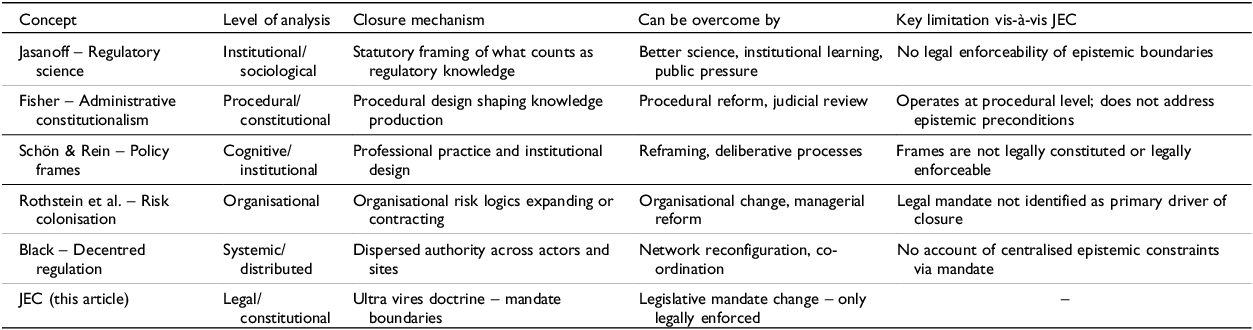
First and most importantly, Jasanoff’s concept of regulatory science, knowledge produced to fulfil statutory requirements, is the closest intellectual predecessor.Footnote 22 The present concept extends Jasanoff’s account by foregrounding the mechanism that makes regulatory science’s epistemic boundaries legally enforceable: the ultra vires doctrine. For Jasanoff, the boundary between regulatory science and research science is institutionally and sociologically produced. For the present account, it is additionally legally enforced: a regulator producing knowledge outside its statutory mandate is not merely departing from institutional expectations but is acting unlawfully. This has practical consequences. In Jasanoff’s account, epistemic boundaries can in principle be shifted by superior science, public pressure or institutional learning. In the present account, they cannot be shifted by any of these means alone, only by changes to the legal mandate itself.
Second, Fisher’s administrative constitutionalism focuses on how regulatory procedures are constitutionally significant, on the distribution of authority and accountability in the process of producing regulatory knowledge.Footnote 23 Jurisdictional epistemic closure operates upstream: it concerns not how knowledge is produced but what can count as knowledge at all within a given regulatory framework. Fisher’s constitutional lens is applied to the procedural level; the present concept operates at the level of epistemic preconditions.
Third, Schön and Rein’s concept of policy frames identifies the cognitive and institutional structures that determine what counts as a relevant problem and an admissible form of evidence.Footnote 24 Frames are produced through professional practice and institutional design. Jurisdictional epistemic closure adds that regulatory frames in EU administrative law are not merely cognitive but legally constituted: they are embedded in statutory mandates and enforced through mechanisms that institutional actors cannot unilaterally override.
Fourth, Rothstein, Huber and Gaskell’s theory of risk colonisation analyses how organisational risk logics expand or contract within regulatory systems, driven by organisational pressures.Footnote 25 Jurisdictional epistemic closure identifies a different causal mechanism: formal legal mandates, rather than organisational logics, as the primary determinant of what is legible as risk. The two accounts are complementary rather than competitive (see Table 1).
Jurisdictional epistemic closure and adjacent concepts: key distinctions. The final row identifies the distinctive contribution of the present concept. JEC = jurisdictional epistemic closure.

Table 1. Long description
A table comparing different concepts of jurisdictional epistemic closure and adjacent concepts. The table has six rows and five columns. The columns are labeled Concept, Level of analysis, Closure mechanism, Can be overcome by, and Key limitation vis-à-vis JEC. The rows are labeled with different concepts: Jasanoff – Regulatory science, Fisher – Administrative constitutionalism, Schön & Rein – Policy frames, Rothstein et al. – Risk colonisation, Black – Decentred regulation, and JEC (this article). Each row provides details under the respective columns. For example, the first row under Jasanoff – Regulatory science lists Institutional/sociological under Level of analysis, Statutory framing of what counts as regulatory knowledge under Closure mechanism, Better science, institutional learning, public pressure under Can be overcome by, and No legal enforceability of epistemic boundaries under Key limitation vis-à-vis JEC. The table provides a comparative analysis of how different concepts address jurisdictional epistemic closure and their respective limitations.
Fifth, Black’s account of decentred regulation emphasises the distributed character of regulatory authority across multiple actors and sites.Footnote 26 The present analysis focuses on how formal legal mandates establish centralised epistemic constraints within distributed systems. Szajkowska’s analysis of the constitutional framework for risk analysis in EU food law, in particular the tension between mutual recognition and the production of authoritative scientific opinion, provides a necessary disciplinary point of engagement for any account of EFSA’s institutional knowledge boundaries.Footnote 27
What jurisdictional epistemic closure distinctively adds is the identification of legal enforceability as the mechanism that qualitatively transforms institutional epistemic closure into structural legal impossibility. This implies that reform must occur at the level of the legal mandate, not at the level of scientific capacity or institutional willingness.
IV. Insect sentience: the scientific debate and its regulatory irrelevance
1. The neurobiological evidence
The question of whether insects experience pain or suffering in any morally relevant sense is one of the most contested in contemporary comparative biology. The traditional position, authoritatively stated by Eisemann and colleagues in 1984, held that insects lack the neuroanatomical structures, in particular, the cortical and limbic systems, regarded as necessary substrates for conscious pain experience, and that their responses to noxious stimuli are better characterised as reflexive withdrawal behaviours than as evidence of subjective suffering.Footnote 28
Over the past decade, this position has been significantly complicated. Barron and Klein have proposed, on the basis of insect neuroanatomy and behaviour, that the midbrain-equivalent structures of insects, in particular the central complex, may support a form of primary consciousness capable of generating subjective experience of affective states, including negative states associated with noxious stimulation.Footnote 29 Klein and Barron have subsequently argued more directly that insects have the capacity for subjective experience,Footnote 30 a claim that has generated substantial debate in the animal cognition literature. Tye, approaching the question from the philosophy of mind, has argued that insects likely satisfy the representationalist conditions for phenomenal experience, though he acknowledges significant philosophical uncertainty.Footnote 31
Birch and colleagues have introduced the concept of sentience as a multi-dimensional property, resisting binary attributions and proposing analysis along axes including valenced experience, flexible learning and self-referential processing.Footnote 32 Birch has separately argued that a realistic possibility of sentience should trigger a precautionary regulatory response: the burden of establishing the absence of morally relevant experience should fall on those who deny sentience rather than on those who assert it.Footnote 33 The significance of the Birch team’s 2021 review for decapod crustaceans and cephalopods, which formed the scientific basis for the UK Animal Welfare (Sentience) Act 2022, illustrates the regulatory tractability of sentience evidence when institutional frameworks are designed to receive it. Footnote 34,Footnote 35
The current state of the science with respect to insects is, to use Wynne’s taxonomy, one of indeterminacy rather than mere uncertainty.Footnote 36 It is not simply that probabilities are unquantifiable; it is that the conceptual and methodological apparatus for generating the relevant probabilities is itself contested. This distinguishes the insect welfare question from the kinds of uncertainty, data gaps, variability, methodological limitations, that EFSA’s guidance on uncertainty analysis is designed to address.Footnote 37
2. The nociception–sentience distinction: a veterinary science perspective
Veterinary clinical reasoning has long operated with the distinction between nociception and pain. Nociception refers to the detection and neural transmission of noxious stimuli, a process that can occur at spinal or ganglionic level without involving conscious awareness. Pain, by contrast, is understood as a subjective, affective experience that requires some form of central processing generating a negative phenomenological state.Footnote 38 This distinction is foundational in veterinary anaesthesia and welfare assessment: an animal under general anaesthesia continues to exhibit nociceptive responses, but is presumed not to experience pain. The clinical relevance of pain management, as distinct from mere reflexogenic blockade, depends on the assumption that some species have the capacity for the latter.
In veterinary practice, uncertainty about sentience has historically been resolved through precautionary protocols rather than through deferral pending epistemic resolution. Fish are nonetheless covered by welfare requirements in many jurisdictions, including under the EU’s own Regulation (EC) 1099/2009 on humane slaughter,Footnote 39 despite the fact that their sentience remains contested relative to mammals. The Five Domains model of animal welfare, which has progressively replaced the older Five Freedoms framework in veterinary and welfare science contexts, explicitly incorporates affective states, both negative and positive, as core welfare parameters, and applies them even in species where the phenomenological substrate of those states is uncertain.Footnote 40 ,Footnote 41 The operational principle is that where the capacity for negative affective experience cannot be excluded, welfare considerations should apply as a precautionary minimum.
The application of this precautionary veterinary logic to the regulatory context is illuminating. It demonstrates that regulatory systems are in principle capable of accommodating welfare uncertainty without requiring its resolution: precautionary welfare requirements can be imposed on the basis of a realistic possibility of sentience rather than a demonstrated certainty. The EU’s novel food framework does not operate on this logic, however, not because welfare uncertainty is scientifically greater in the case of insects than in the case of fish, but because the regulatory mandate has not been designed to receive welfare considerations as inputs at any epistemic threshold.
V. Article 13 TFEU: taxonomic ambiguity, legislative history and regulatory consequences
The primary EU legal provision concerning animal welfare is Article 13 of the Treaty on the Functioning of the European Union, which requires the Union and Member States, when formulating and implementing specified Union policies, including the internal market, agriculture, research and transport, to “pay full regard to the welfare requirements of animals,” recognising that “animals are sentient beings.”Footnote 42 Article 13 contains no taxonomic qualification. On its face, it applies to all animals.
This absence of taxonomic qualification is legally significant. Article 13 TFEU should not be read as a static provision, limited to the species that were already the object of welfare legislation at the time of its adoption. Its formulation is programmatic in structure but prescriptive in function: it does not merely codify an existing regulatory perimeter, but sets a normative direction for EU action by requiring the Union and the Member States to pay full regard to animal welfare when formulating and implementing the listed policies.Footnote 43 The relevant legal trigger is therefore not membership of a predetermined zoological class, but the welfare requirement arising from the recognition of animals as sentient beings. This is particularly important in fields characterised by evolving scientific knowledge. Where evidence concerning sentience develops, the obligation to pay full regard to animal welfare cannot remain frozen by earlier legislative assumptions. Article 13 TFEU therefore operates as a dynamic normative clause within EU animal welfare law.
The legislative history of Article 13 is instructive for the interpretation of its scope. Its direct precursor is Protocol No 33 on Protection and Welfare of Animals, annexed to the Treaty of Amsterdam of 1997.Footnote 44 The Protocol employed identical language requiring regard to animal welfare requirements “as sentient beings,” but appeared in protocol form rather than as a treaty article. When the Lisbon Treaty incorporated the substance of Protocol No 33 into the body of the TFEU, it strengthened the provision both formally, by elevating it from a protocol to a treaty article, and substantively, by extending its application to “formulating and implementing” Union policies. The legislative history does not reveal any deliberate exclusion of invertebrate species from the scope of the provision; the omission of taxonomic qualification appears consistent with the view that the provision’s reach is determined by sentience evidence rather than by predetermined taxonomic categories.
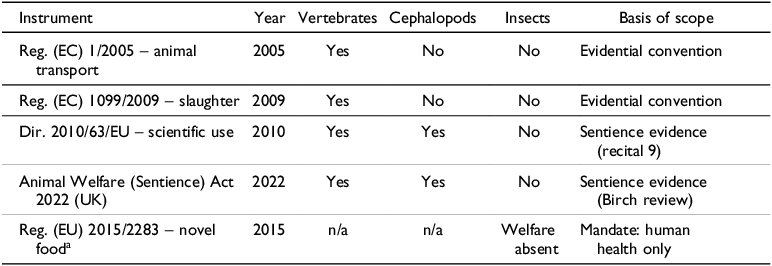
The implementing instruments adopted pursuant to or alongside Article 13 and its predecessor have generally been limited in their substantive scope to vertebrate species.Footnote 45 Radford has documented this pattern in the British and European legal tradition, noting the absence of any affirmative finding that invertebrates lack morally relevant experience, the limitation to vertebrates reflects evidential convention rather than normative determination (see Table 2).Footnote 46 Directive 2010/63/EU on the protection of animals used for scientific purposes represents a significant exception: its protections are extended to cephalopod molluscs, expressly on the basis that scientific evidence demonstrates their capacity for pain, suffering, distress and lasting harm.Footnote 47 This extension demonstrates that the taxonomic scope of EU welfare protection is legally sensitive to sentience evidence, and that the exclusion of insects from protective instruments is not constitutively fixed but potentially revisable in light of evolving scientific knowledge.
Taxonomic scope of selected EU animal welfare instruments and comparators. Columns indicate whether each instrument extends substantive welfare protection to vertebrates, cephalopod molluscs and insects. Basis of scope indicates the legal or evidential rationale for taxonomic delimitation.

Table 2. Long description
A table comparing the scope of various EU animal welfare instruments across different animal groups. The table has six rows and five columns. The columns are labeled Instrument, Year, Vertebrates, Cephalopods, Insects, and Basis of scope. The rows are as follows: Row 1: Instrument, Reg. (EC) 1/2005 – animal transport; Year, 2005; Vertebrates, Yes; Cephalopods, No; Insects, No; Basis of scope, Evidential convention. Row 2: Instrument, Reg. (EC) 1099/2009 – slaughter; Year, 2009; Vertebrates, Yes; Cephalopods, No; Insects, No; Basis of scope, Evidential convention. Row 3: Instrument, Dir. 2010/63/EU – scientific use; Year, 2010; Vertebrates, Yes; Cephalopods, Yes; Insects, No; Basis of scope, Sentiency evidence (recital 9). Row 4: Instrument, Animal Welfare (Sentiency) Act 2022 (UK); Year, 2022; Vertebrates, Yes; Cephalopods, Yes; Insects, No; Basis of scope, Sentiency evidence (Birch review). Row 5: Instrument, Reg. (EU) 2015/2283 – novel food; Year, 2015; Vertebrates, n/a; Cephalopods, n/a; Insects, Welfare absent; Basis of scope, Mandate: human health only.
a Art. 13 TFEU applies to this instrument as an internal market measure (Art. 114 TFEU legal basis). The absence of welfare assessment reflects a mandate limitation, not a normative determination that insect welfare is irrelevant to the authorisation procedure.
This trajectory also shows that the legal perimeter of animal welfare has never been entirely static. EU and national systems have traditionally centred protection on vertebrate animals, but the inclusion of cephalopods in Directive 2010/63/EU and the growing regulatory attention to decapod crustaceans in other jurisdictions demonstrate that legal categories can evolve when scientific evidence concerning sentience becomes sufficiently salient. Insects occupy the next contested frontier of this process. Their exclusion from existing welfare regimes should therefore be understood as a provisional regulatory settlement rather than as a definitive normative judgment.
The relationship between Article 13 TFEU and the Novel Food Regulation requires explicit analysis. The Novel Food Regulation was adopted on the legal basis of Article 114 TFEU, which empowers the Union to harmonise measures for the establishment and functioning of the internal market. The internal market is one of the policy domains to which Article 13 TFEU expressly applies. It follows that the Commission, when exercising its implementing powers under the Novel Food Regulation, including in particular the adoption of authorisation decisions under Article 12, is legally required by Article 13 to pay full regard to the welfare requirements of any animals that can be characterised as sentient within the meaning of that provision. The Court of Justice has affirmed in cases concerning animal transport that the welfare obligations of EU secondary legislation in the listed domains are substantive in character and not merely programmatic, though the taxonomic scope of Article 13 itself in relation to invertebrates has not been directly adjudicated.Footnote 48 Whether insects currently fall within the scope of the obligation is a question of evidential assessment that remains formally open; what is analytically significant is that Article 13’s obligation, in principle, extends to the novel food authorisation procedure.
The taxonomic ambiguity of Article 13 thus has a concrete regulatory consequence: it means that the insect welfare question is not legally irrelevant to the Commission’s risk management discretion. The structural absence of welfare considerations from EFSA’s opinions does not resolve this question; it merely means that the Commission acts on incomplete information when exercising the discretion that Article 13 requires it to exercise with welfare regard.
VI. EFSA assessments and the human health filter in practice
An examination of EFSA’s opinions on the three currently authorised insect novel foods illustrates with precision how jurisdictional epistemic closure operates in the institutional register. Each opinion follows a structurally identical format: scope delimitation, description of the production process, hazard identification relevant to human health (allergenicity, microbiological hazards, novel constituents, potential for accumulation of environmental contaminants), an evaluation of nutritional composition and an overall safety conclusion.
Each opinion opens with an explicit delimitation of scope. The Tenebrio molitor opinion states that the assessment covers only the safety of the novel food for the target population.Footnote 49 The Acheta domesticus opinion specifies that “animal welfare and environmental aspects, as well as the effects of the novel food on the environment are outside the scope of this opinion.”Footnote 50 The Alphitobius diaperinus opinion is materially identical.Footnote 51 These delimitations are presented as functional clarifications, defining what the opinion covers, rather than as substantive exclusions of potentially relevant considerations. This presentational choice is itself analytically significant: it frames the mandate boundary as a technical parameter of the assessment rather than as a normative determination about what regulatory reasoning should encompass.
Uncertainty, in EFSA’s operational vocabulary, is addressed through the authority’s dedicated guidance on uncertainty analysis.Footnote 52 That guidance operationalises uncertainty as limitations in knowledge relevant to the assessment question, which is to say, relevant to human health risk. Uncertainty about insect welfare is not rendered invisible by deliberate suppression; it is rendered non-existent as a regulatory category by the prior definition of the assessment object, which leaves no conceptual space for the admission of welfare uncertainty as uncertainty in any legally actionable sense. This is jurisdictional epistemic closure in operation.
The practical consequence of this structure is that the insect welfare question, however significant it may become in the scientific literature, however prominently it may feature in public debate about the ethics of insect protein, cannot generate regulatory outputs through the novel food authorisation channel. As Alemanno has observed, EFSA’s epistemic authority rests on its capacity to produce stabilised scientific knowledge within a legally defined domain; knowledge produced outside that domain does not carry the same institutional weight.Footnote 53 Conversely, knowledge that cannot be produced as EFSA knowledge carries no regulatory weight at all within the authorisation framework, regardless of its scientific credibility.
VII. The precautionary principle and its epistemic preconditions
One might suppose that the precautionary principle, the foundational instrument of EU risk regulation for managing scientific uncertainty, could resolve the problem identified in the preceding sections. If insect sentience is uncertain, and if uncertainty about potentially serious harm is precisely the condition that precaution is designed to address, then precautionary welfare requirements might seem a natural regulatory response. The analysis of this article suggests that this inference, however intuitive, is mistaken.
De Sadeleer’s authoritative account of the precautionary principle identifies its constitutive elements: the existence of a scientifically plausible, even if unconfirmed, risk; the potential for serious or irreversible harm; and the availability of preventive measures proportionate to the level of protection sought.Footnote 54 The Commission’s 2000 Communication on the precautionary principle confirms that its application “presupposes that potentially dangerous effects … have been identified, and that scientific evaluation does not allow the risk to be determined with sufficient certainty.”Footnote 55 A prior risk assessment, however inconclusive, is therefore a legal precondition for precautionary action.
The case law of the General Court consistently confirms this requirement. In Pfizer, the Court confirmed that precautionary measures may be adopted where “there is scientific uncertainty as to the existence or extent of risks to human health,” but held that a prior risk assessment identifying the plausibility of harm is legally necessary before such measures are adopted.Footnote 56 In Artegodan, the Court affirmed that precautionary measures may be based on an inconclusive risk assessment but may not be based on the complete absence of any risk assessment.Footnote 57 Precaution extends the regulatory response to uncertainty; it does not create the conditions for its own application.
The difficulty with applying these principles to insect welfare is not that the scientific evidence is too thin, Birch’s argument that a realistic possibility of sentience should trigger precautionary consideration is structurally compatible with the Court’s case law.Footnote 58 The difficulty is antecedent: precaution operates within the epistemic framework of an existing risk assessment, and the Novel Food Regulation and EFSA’s mandate have constituted “risk” as a concept limited to human health consequences.Footnote 59 Insect welfare concerns are not a form of uncertainty to which the precautionary principle can respond; they are a form of indeterminacy that has no established standing as a regulatory input in this context.
The claim advanced here is thus stronger than the observation that precaution is underutilised in the insect welfare context. It is that precaution, as a legal instrument, presupposes the epistemic framework that jurisdictional closure renders constitutively incomplete. Jasanoff’s insight that regulatory science is produced to fulfil statutory requirements captures the same structural point: a scientific framework designed to answer questions about human health risks cannot, without structural change to its mandate, be made to answer questions about insect welfare.Footnote 60 Recognising this antecedent condition is the necessary first step for any productive reform deliberation.
VIII. Normative implications: the unimplemented mandate of Article 13 TFEU
A clarification of the article’s analytical and normative dimensions is required before proceeding to reform possibilities. The concept of jurisdictional epistemic closure is offered as an analytical tool: it describes a structural condition of mandate-bound regulatory systems rather than diagnosing a pathology in need of cure. The article’s normative argument is distinct from its analytical claim. It is grounded not in the concept of jurisdictional epistemic closure but in the positive law of Article 13 TFEU. As demonstrated in Section V, Article 13 imposes on EU institutions, when implementing internal market measures, a legal obligation to pay full regard to the welfare requirements of animals recognised as sentient. If insects possess or plausibly possess sentience within the meaning of that provision, then the Commission’s obligation under Article 13 is triggered when it exercises risk management discretion under Article 12 of the Novel Food Regulation. The normative problem is that the current regulatory design structurally prevents the Commission from fulfilling an obligation that primary EU law already imposes on it. That is the gap that reform must address.
1. A complementary welfare advisory mechanism
The most structurally significant reform achievable without legislative amendment of the Novel Food Regulation would be the establishment of a complementary welfare assessment mechanism, operating outside EFSA’s current mandate but feeding into the Commission’s risk management decision under Article 12. The legal architecture for such a mechanism is available in principle. Article 31 of Regulation (EC) 178/2002 authorises EFSA to produce scientific output at the request of the European Parliament, the Commission, or a Member State.Footnote 61 Article 31 authorises the Commission to request scientific output specifically from EFSA; it does not, on its own, provide a legal basis for commissioning a distinct external body, and two pathways should accordingly be kept separate. The first operates within Article 31 itself: a Commission request could direct EFSA, through its Scientific Committee or a dedicated ad hoc working group reconstituted with animal welfare expertise, to produce an advisory opinion on the welfare implications of insect novel food production as a supplementary basis for the Commission’s Article 12 decision. This is not a reference to the network of Article 36 organisations, which assist EFSA within the same human-health-oriented mandate and would not, without more, resolve the jurisdictional limitation identified above. The second pathway lies outside Article 31 altogether: the Commission could instead constitute an external advisory mechanism, for example a Commission expert group established under its general rules governing such groups, whose output would feed into the Commission’s risk management discretion via Article 6(3) of Regulation (EC) 178/2002, discussed below. Either pathway would supplement, rather than replace, EFSA’s existing safety assessment; the choice between them is a matter of institutional design that this article does not need to resolve. This mechanism would not alter the authorisation criteria established by the Novel Food Regulation; it would supplement the scientific basis of the Commission’s discretionary judgment with welfare considerations that are currently structurally absent.
A proportionate regulatory response would not require the suspension of insect-based novel food authorisations. The issue is not whether uncertain welfare concerns should automatically prevail over food innovation, but whether they should remain wholly invisible in the authorisation process. A gradual approach could include three cumulative steps: disclosure of rearing and killing methods;Footnote 62 systematic collection of welfare-relevant production data; and the development of non-binding welfare guidance for insect farming pending a clearer legislative framework. Such measures would not resolve the question of insect sentience, but they would prevent regulatory silence from hardening into normative indifference.
The legal basis for the Commission to take welfare considerations into account in the exercise of its risk management function is grounded in the General Food Law framework. Article 6(3) of Regulation (EC) 178/2002 provides that risk management “shall take into account the results of risk assessment, and, in particular, the opinions of the Authority … other factors legitimate to the matter under consideration and the precautionary principle where the conditions laid down in Article 7(1) are relevant.”Footnote 63 Read in conjunction with Article 13 TFEU’s primary law obligation of welfare regard, Article 6(3) provides an operative basis for treating the output of a complementary welfare assessment as a relevant input into the Commission’s discretion when it adopts implementing acts relating to insect novel foods. The Farm to Fork Strategy has further signalled the Commission’s intention to broaden the evaluative frameworks applied to food system authorisations to include sustainability and welfare dimensions, strengthening the political basis for such an interpretive move.Footnote 64
2. Labelling requirements as a transitional measure
A second reform, achievable within the Commission’s existing implementing powers under Article 9 of the Novel Food Regulation,Footnote 65 would introduce welfare-related labelling requirements as conditions of authorisation for insect novel foods. Article 9 empowers the Commission to specify conditions of use, designation and labelling requirements as part of an authorisation decision. Read in conjunction with the general food information framework established by Regulation (EU) 1169/2011, which requires that food information not mislead consumers as to the characteristics or production method of a food,Footnote 66 conditions could be imposed requiring disclosure of the stunning or killing methods used in insect production.
This approach does not resolve the epistemic closure problem, it does not constitute insect welfare as a regulatory object for assessment purposes, but it would create a market information mechanism enabling informed consumer choice and generating producer incentives for welfare-improving practices.
3. The scope of available reform
Neither of the reform possibilities identified above overcomes jurisdictional epistemic closure in the sense developed by this article. A more fundamental reform, constituting insect welfare as a first-order regulatory question subject to mandatory assessment within the novel food authorisation procedure, would require legislative amendment of the Novel Food Regulation to expand the scope of EFSA’s mandate. The political economy of such a reform makes its realisation in the near term unlikely. The value of the analytical framework developed here is precisely that it identifies the level at which reform must occur to be structurally effective: not at the level of scientific methodology, institutional goodwill or risk assessment guidance, but at the level of the legal mandate that determines the epistemic conditions of the regulatory system.
IX. Conclusions
This article has developed and applied the concept of jurisdictional epistemic closure to explain a specific and consequential feature of EU novel food regulation: the structural absence of insect welfare from the authorisation process for insect-based novel foods. The concept identifies the mechanism through which formal legal mandates simultaneously allocate regulatory competence and determine the epistemic conditions under which uncertainty can be constituted as a legitimate regulatory object. Its distinctive contribution relative to existing frameworks lies in identifying the ultra vires doctrine, the legal enforceability of mandate boundaries, as the mechanism that transforms institutional epistemic tendencies into structural legal impossibilities.
Four substantive findings emerge from the analysis. First, the scientific debate about insect sentience represents a form of indeterminacy, in Wynne’s sense, that is not merely unresolved but is structurally incompatible with the risk assessment framework applied to novel food authorisation. Second, the precautionary principle does not offer a route to regulatory recognition of insect welfare concerns, because it presupposes a prior risk assessment within the mandate-bound epistemic framework that the Novel Food Regulation has not been designed to provide. Third, the veterinary science perspective, specifically the clinical distinction between nociception and sentience, and the precautionary welfare logic of the Five Domains model, demonstrates that the obstacle to accommodating welfare uncertainty in novel food governance is jurisdictional rather than methodological. Fourth, the normative gap identified by the analysis is grounded in positive law: Article 13 TFEU’s unimplemented mandate of welfare regard applies, in principle, to internal market measures including the Novel Food Regulation, and Article 6(3) of the General Food Law framework provides the Commission with an existing operative basis for treating welfare considerations as legitimate inputs into its risk management discretion.
The analysis has implications that extend beyond the specific case of insect welfare. As novel food technologies proliferate, including cultivated meat, precision fermentation and synthetic biology applications, the EU’s risk assessment framework will increasingly encounter forms of uncertainty that do not map onto human health risk categories. Insect welfare is therefore not an eccentric or isolated concern, but an early example of a broader regulatory challenge: the need to ensure that emerging forms of food production do not remain outside the field of legal concern merely because existing mandates were designed around older categories of risk.
The concept of jurisdictional epistemic closure invites regulatory designers and scholars to ask, at the point of mandate design, not merely whether a proposed assessment framework is scientifically sound but whether the legal mandate governing the assessment has been designed to pose the right questions. Article 13 TFEU reinforces this need by requiring animal welfare to be treated as a dynamic consideration within the implementation of internal market measures. A proportionate response would not require the abandonment of food innovation, but the creation of institutional channels through which welfare-relevant uncertainty can become visible to risk managers.
The two inquiries are equally important, and only the second has the capacity to address what is structurally, rather than incidentally, absent from the regulatory field.
Competing interests
The author declares none.

 Open access

