INTRODUCTION
Palliative care is essential for enhancement of the quality of life of patients and their families as they confront the problems associated with a life-threatening disease (Greer et al., Reference Greer, Jackson and Meier2013). There has been substantial growth in the availability of palliative care services, but these services are underutilized or used ineffectively (Hui et al., Reference Hui, Elsayem and de la Cruz2010; Gazelle, Reference Gazelle2007). Although growing evidence supports that early palliative care leads to greater satisfaction with high-quality care (Temel et al., Reference Temel, Greer and Muzikansky2010; Bakitas et al., Reference Bakitas, Lyons and Hegel2009; Greer et al., Reference Greer, Jackson and Meier2013), the referral to palliative care often occurs too late in the cancer trajectory (Bruera & Hui, Reference Bruera and Hui2010).
Study results indicated that a minimum three-month length of stay (LOS) is needed to maximize the benefits of palliative care for all involved (Rickerson et al., Reference Rickerson, Harrold and Kapo2005; Christakis & Lamont, Reference Christakis and Lamont2000), but most cancer patients in South Korea are referred late in the progression of their illness (Baek et al., Reference Baek, Shin and Choi2011; Lee et al., Reference Lee, Yang and Lee2014). A number of studies have identified the barriers to timely referral (Rodriguez et al., Reference Rodriguez, Barnato and Arnold2007; Keating et al., Reference Keating, Landrum and Rogers2010), and have also investigated correlations between LOS and a variety of variables (e.g., patient characteristics, referring physician and healthcare setting characteristics (Christakis & Escarce, Reference Christakis and Escarce1996; Lamont & Christakis, Reference Lamont and Christakis2002; McCarthy et al., Reference McCarthy, Burns and Ngo-Metzger2003).
Family members of a terminally ill cancer patient commonly experience psychological deteriorations and physical burdens associated with caregiving (Bevans & Sternberg, Reference Bevans and Sternberg2012). The role of family caregivers (FCs) as decision makers becomes very important during the cancer care continuum, especially if a patient is too incapacitated to express his end-of-life (EOL) decisions, including referral to a hospice care unit. Many patients in Korea tend to shift decision making to family members. This leads to more aggressive care because FCs regard keeping a hopeful attitude as one of their critical roles (Kwon et al., Reference Kwon, Shin and Lee2009).
Few studies have examined the associations between FC-related factors, particularly emotional status, and LOS. The recognition of this relationship may be helpful for palliative care team discussions about an EOL care plan, which could ultimately guide optimum care strategies for terminally ill cancer patients. We identified factors related to LOS in a palliative care unit and focused on the emotional status of the FCs of terminally ill cancer patients.
METHODS
Design and Recruitment
This retrospective cohort study was based on counseling reports prepared by two social workers who were serving as palliative care team coordinators at a tertiary cancer center (Incheon Regional Cancer Center, Incheon, South Korea). Coordinators organize the combined roles of other teammates (e.g., physician, nurse, and volunteer). They provide an extra layer of support by providing services such as counseling for issues related to the socioeconomic burdens associated with a cancer diagnosis. They also monitor the emotional status of patients and/or FCs.
Within days of referral to our unit, a semistructured interview was routinely conducted with the primary FC, the one who provided the most assistance to the patient. All patients had progressive advanced cancer and were judged by physicians to be likely to die within months. Interview audits linked with medical records were performed in April of 2014 to retrieve information about the deaths that occurred during the period from October of 2012 to March of 2014.
We identified 201 counseling reports in which interviewees consented to disclosure of information. Of those, the final analysis was restricted to the 198 pairs for which patient survival data were available. The study was approved by the institutional review board (IRB) of Gachon University, Gil Medical Center. Patient and caregiver informed consent requirements were waived by the IRB because this study involved only chart and report review, without any patient identification or intervention.
Data Collection and Processing
The information obtained from the semistructured interviews included the patient's demographic characteristics (e.g., marital status, religion, and educational level); whether the patient knew that they were terminally ill; and the current emotional status of both patient and caregiver. Emotional status was assessed using a model modified from the one introduced by Elisabeth Kübler-Ross (Kübler-Ross, Reference Kübler-Ross1969). The categories included acceptance, anxiety, depression, denial, anger, and feelings of guilt. Data on patient age, sex, cancer site, time from cancer diagnosis, and healthcare insurance were obtained from the medical record database. LOS was defined as the period between date of palliative care enrollment and the date of death.
Marital status was classified as “married” or “unmarried.” The “unmarried” category included “single” and “divorced/separate/widowed.” Religious preference was classified as “no religion” or “professing a religion.” The categories for religious affiliation included non-Catholic Christians, Buddhists, and Catholics. Educational level was categorized as “middle school or lower” or “high school or beyond.” Type of National Health Insurance was categorized as “ordinary employee” or “low-income household.” Emotional status was categorized as “acceptance, anxious/depressed, and denial/anger.”
Statistical Analyses
We utilized Kaplan–Meier survival analysis and the log-rank test to examine associations between median LOS and the associated variables. We used a Cox proportional hazards model to estimate the hazard ratios (HRs) for associations between the variables and LOS. Each factor that was statistically significant at the level of p < 0.05 in the univariate analysis was entered into the final model to estimate adjusted HRs (aHRs). Using a stepwise variable selection procedure, we obtained a best-fit multivariate Cox regression model. All statistical analyses were performed using SPSS statistical software (version 16.02; SPSS, Chicago). Values of p < 0.05 (two-tailed test) were considered to be statistically significant.
RESULTS
LOS by Characteristics
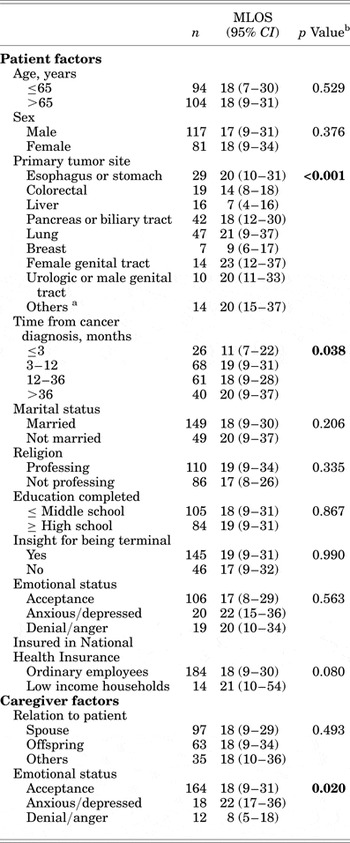
The results for the characteristics and for LOS by characteristics are presented in Table 1. The mean age and median LOS of the patients were 65.8 years and 18 days, respectively. Of the 198 patients, 59.1% were male and 52.5% above 65 years of age. The most common cancer sites were the lung (23.7%), pancreaticobiliary duct (21.2%), and upper gastrointestinal tract (14.6%). Nearly 50% (47.5%) of patients had been diagnosed within a year of admission for palliative care, and 75.9% were aware of their terminal status. Most of the caregivers were at the stage of acceptance (84.5%) that the patient was dying, and 73.1% of the patients indicated that they had accepted their own death.
Length of stay in a palliative care cancer unit, by patient and caregiver characteristics

MLOS = median length of stay (days).
a Includes hematological malignancies and head and neck cancer, inter alia.
b By log-rank test.
There were significant differences in median LOS according to cancer site (p < 0.001) and time from cancer diagnosis (p = 0.038). The emotional status of caregivers was also significant (p = 0.02). The results for the Kaplan–Meier curves are depicted in Figure 1.
Kaplan–Meier survival curves for cancer patients, by emotional status of primary caregiver.

Factors Related to LOS in the Palliative Care Unit
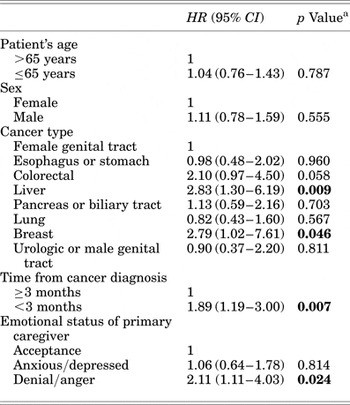
The results for the multivariate analysis using Cox's proportional hazard model are presented in Table 2. This analysis of age, sex, and other selected variables from Table 1 revealed that liver (aHR = 2.83) and breast (aHR = 2.79) cancer (vs. female genital tract), < 3 months from cancer diagnosis (aHR = 1.89), and denial/angry status of the FC (vs. acceptance stage; aHR = 2.11) were independently associated with a shorter LOS.
Factors related to shorter length of stay in a palliative care cancer unit

HR = hazard ratio; CI = confidence interval.
a By multivariate Cox proportional analysis.
DISCUSSION
We identified the factors related to LOS in a palliative care unit. We found that there was a significant association between FC emotional status and LOS. Compared with an acceptance status, a denial or angry status of FCs was associated with a shorter LOS (i.e., later referral to the unit). Late referral to palliative care results in lower satisfaction with the care services and limits the range and benefits of these services (Rickerson et al., Reference Rickerson, Harrold and Kapo2005; Earle et al., Reference Earle, Park and Lai2003; Waldrop & Rinfrette, Reference Waldrop and Rinfrette2009; Kapo et al., Reference Kapo, Harrold and Carroll2005). Our results suggested that physicians and palliative care providers should adjust the timepoint at which support is provided to some patients.
The results of our study should be interpreted cautiously. The overall emotional status of the sample population was likely to be a consequence of the delayed response to the deteriorating performance of the patients (Lau et al., Reference Lau, Downing and Lesperance2006; Younis et al., Reference Younis, Milch and Abul-Khoudoud2009), rather than the reverse. That is to say, a shorter LOS reflected the relationship between delayed referrals and poorer performance status. Many studies suggest that caregivers tend to be more aggressive about delaying the death of the patient than the patients want for themselves (Yun et al., Reference Yun, Han and Park2011; Phipps et al., Reference Phipps, True and Harris2003; Sonnenblick et al., Reference Sonnenblick, Friedlander and Steinberg1993). There is also considerable pressure from relatives and the surrounding community to extend life as long as possible (Yun et al., Reference Yun, Han and Park2011). We hypothesize that the significant results for FC emotional status could be partially explained by disparities between the preferences of the FC and patient condition. Many Korean caregivers value their role and feel a great responsibility to care for ill family members (Kwak & Salmon, Reference Kwak and Salmon2007). Becoming aware that death may occur sooner than expected might evoke a feeling of anger or denial. Anxiety or depression might have also been expressions indicating acceptance of death.
It is possible that the FC's emotional status could conversely affect the quality of the patient's care (Hodges et al., Reference Hodges, Humphris and Macfarlane2005), but the median LOS was too short to examine this causal relationship. Prospective studies begun at an earlier stage that include rigorous assessment of the patient's prognosis (or function) are warranted.
The results of some studies have suggested that LOS varies substantially according to cancer type, even after adjustment for potential confounders (Christakis, Reference Christakis1994; Christakis & Escarce, Reference Christakis and Escarce1996). These results are consistent with ours. However, this finding seems to reflect the contribution of the referring physician or departmental factors, not underlying biological mechanisms. The evidence consistently indicates the presence of a strong effect of physician factors (e.g., perception for hospice care, referring experience and its outcome, ability of prognostication) on LOS (Lamont & Christakis, Reference Lamont and Christakis2002; Christakis & Lamont, Reference Christakis and Lamont2000; Stillman & Syrjala, Reference Stillman and Syrjala1999; Casarett & Quill, Reference Casarett and Quill2007; Vig et al., Reference Vig, Starks and Taylor2010; Daugherty & Steensma, Reference Daugherty and Steensma2002).
We also found that a short timeframe (<3 months) from the cancer diagnosis was independently associated with a shorter LOS. A qualitative study of caregivers who had experienced a short hospice utilization (<2 weeks) revealed that 44% of patients are diagnosed within a month prior to death (Waldrop, Reference Waldrop2006). Assuming that a shorter time from diagnosis to hospice enrollment indicates a more advanced stage of cancer, it is possible that patients die shortly after referral to the unit.
This study had several limitations. First, the results are not necessarily generalizable to other populations. Study participants had already been referred to a single palliative care unit as patient–FC pairs. Many more patients experience death while receiving conventional cancer care treatment. It is also possible that the variables related to shorter LOS could have been unique to the referral setting or culture (Younis et al., Reference Younis, Milch and Abul-Khoudoud2007; Kwak & Salmon, Reference Kwak and Salmon2007). Second, the data represented a snapshot of a moment in time of the emotional status at time of referral to the unit. While acceptance of dying is integral to hospice care, other moods can be regarded as transitional psychological states (Zimmermann, Reference Zimmermann2012). Third, we depended on the FC's estimation of the patient's personal status. However, the results of a previous study indicated that, with respect to patient quality of life, there is a higher correlation between the patient's ratings and the caregiver's impressions (Awadalla et al., Reference Awadalla, Ohaeri and Gholoum2007). Most of the patients in the study population were too weak to communicate with an interviewer, and Korean people would consider it inappropriate to have the EOL discussion with ill family members (Kwak & Salmon, Reference Kwak and Salmon2007).
Despite these limitations, our study results underscored the importance of assessing family caregivers' emotions at the time of referral to the palliative care unit. If these preliminary findings are confirmed by future large-scale longitudinal studies, we believe that they might be used by palliative care providers to develop plans for optimum cancer care.
DISCLOSURE AND ACKNOWLEDGMENTS
This study was supported by the senior-friendly product R&D program funded by the Ministry of Health and Welfare thorough the Korea Health Industry Development Institute (HI14C1435).