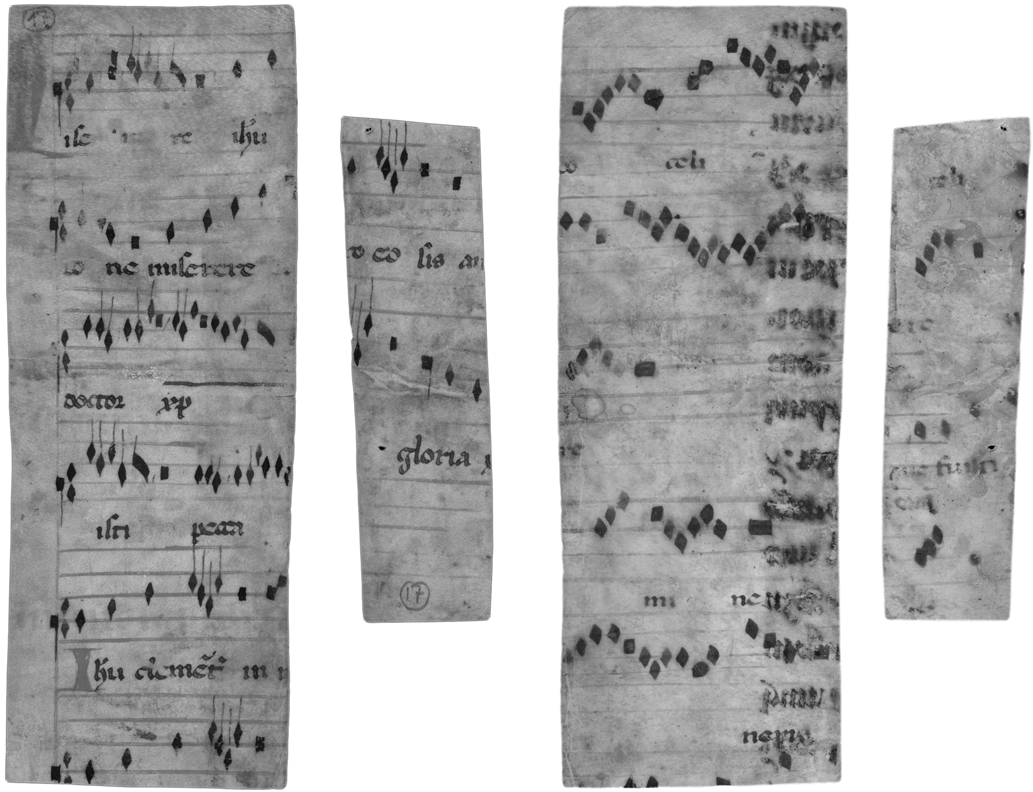
A research team of the project El canto llano en la época de la polifonía Footnote 1 is currently working in collaboration with the Digital Image Archive of Medieval Music (DIAMM) on the digitization of medieval polyphonic music manuscripts in Spanish libraries and archives. In January 2010, the team visited the private archive of Manel MundóFootnote 2 at BarcelonaFootnote 3 with the aim of taking images of the Ars Antiqua fragment reported in 1980 by Maricarmen Gómez Muntané.Footnote 4 When Mundó shared with us his folder of manuscript fragments, it turned out that the collection contained another jewel: a musical fragment, previously unknown to and unrecognised by scholarship (Fig. 1). This source, inventarised by Mundó as ‘Fragment 17’ (hereafter: Mundó 17), consists of two parchment snippets (17a and 17b) which probably belonged to a musical manuscript from the first half of the fourteenth century. Fragment 17a, the larger of the two snippets measures 151 mm×55 mm, while the dimensions of its companion fragment 17b are 98 mm×27 mm. As Mundó's own notes reveal, he had acquired the manuscript in 1967 from an antiquarian in the street-market known as “El Rastro”, in Madrid. According to Mundó's transcript, the seller had stated that ‘it comes from Villalba Herrera, Santa Maria del Cister de Burgos’ (Proc. de Villalba, Herrera).Footnote 5
Montserrat, Biblioteca del Monestir MS 1519 (Mundó 17).

Despite its fragmentary condition and the small size of its visible surface, Mundó 17 proves to be a source of significant interest. First, it offers new insights into the use and dissemination of mensural notation on the Iberian Peninsula during the first half of the fourteenth century, a period which is still relatively obscure in the history of Spanish music. Second, the manuscript adds another item to the brief list of surviving Ars Nova sources from Castile. Finally, it contains an unexpected concordance for a singular type of liturgical repertoire: the Mozarabic preces, supposed to lack written transmission from the twelfth to the early sixteenth centuries.
Codicological observations
One of the most distinctive codicological features of the fragment is its extraordinary thinness. The parchment is no more than 0.1 mm thick, thereby retaining a remarkable degree of pliability and suppleness. The fine quality of the parchment suggests that the fragments probably came from a bound book, rather than from a more workaday type of source such as an independent gathering, libellus or pecia.
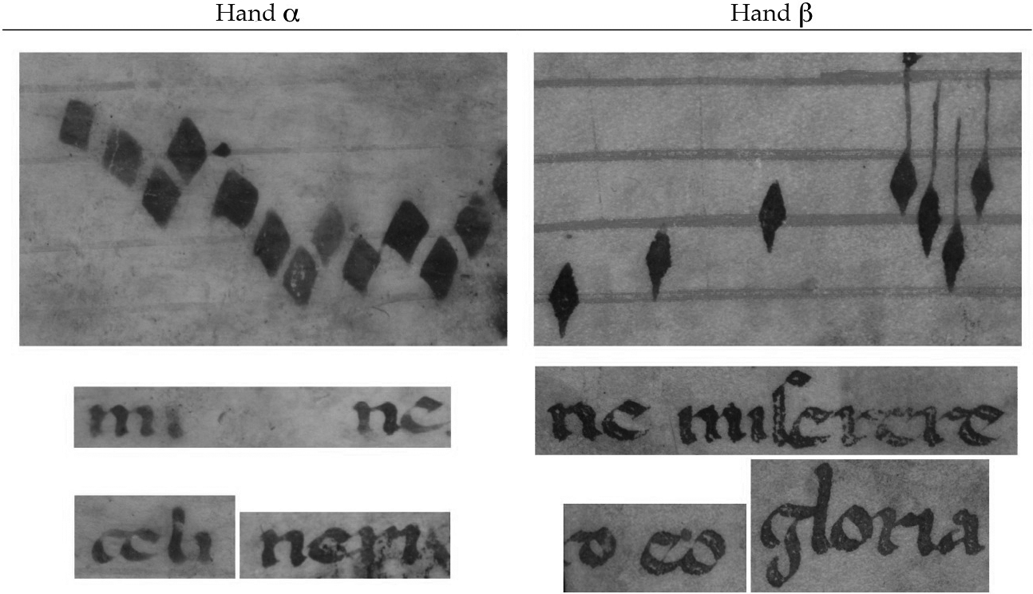
Although the parchment surfaces evidently have an uncommon degree of finish, it is possible to distinguish hair and flesh sides. On the flesh sides, both fragments present music written in an old mensural system that employs ‘undifferentiated’ semibreves and puncta separationis, characteristics of Petronian notation (as will be demonstrated below). The hair sides, on the other hand, preserve parts of another piece written in Ars Nova notation. Characteristic variants of notational features, including the ductus of rhomboid figures, allow for the discernment of different scribes on two sides of the original folio: the flesh side shows the work of Scribe α, who used Petronian notation, the hair side was copied by Scribe β in Ars Nova notation. An analogous distinction of hands is recognisable on the level of textual calligraphy. Although both scribes employed a Gothic literaria rotunda characteristic of the later thirteenth and fourteenth centuries,Footnote 6 there are subtle differences that confirm the change of hand. Still, their close resemblance (Fig. 2) suggests that the scribes may have been active within a relatively short space of time.
Comparison of hands.
The ink used on both sides of the fragments is a minimally corrosive ferrum galicum. Despite the extraordinary thinness of the parchment, the ink leaves no corrosion marks when detached and there is scarcely any bleedthrough. The low acidity of the ink could well have been a characteristic of the scriptorium that supplied the scribes' materials, which in turn would be consistent with the closeness of both hands.
The inks on the two sides of the fragments have slightly different shades of colour, yet there is no change in shade between text and music on the same side of the folio. This would seem to indicate that in each case the same person copied text and music. Scribe β copied the text before the music, and evidently did so without giving particular thought to the separation of the syllables. He obviously knew the music, or at least saw the musical notation before him while copying the text, since he was careful to leave enough space for melismas. However, some divergences between text and music had to be corrected later through the introduction of small separating lines between notes in order to clarify the alignment of notes and syllables.
Both scribes also seem to have drawn their own staves. The nib of Scribe β's pen had a slight irregularity resulting in the uneven distribution of ink, visible as a light groove in the middle of the stroke, although the lines as such always retained the same thickness (about 0.6 mm). This distinctive feature is found in the staves and vertical guidelines as well as in the text on the hair side. Hence, everything on this side was written with either the same pen or a very similar one. The strokes of Scribe α, however, never exhibit irregularities of this kind. Yet the thickness of the staff lines varies from 0.33 to 1.25 mm, even within one and the same stroke, suggesting that the scribe employed some kind of brush and applied varying degrees of pressure while writing.
In sum, two different scribes are at work on the fragment, working with different tools, yet sharing some resemblances (calligraphy, ink composition) that appear to tie them chronologically as well as culturally.
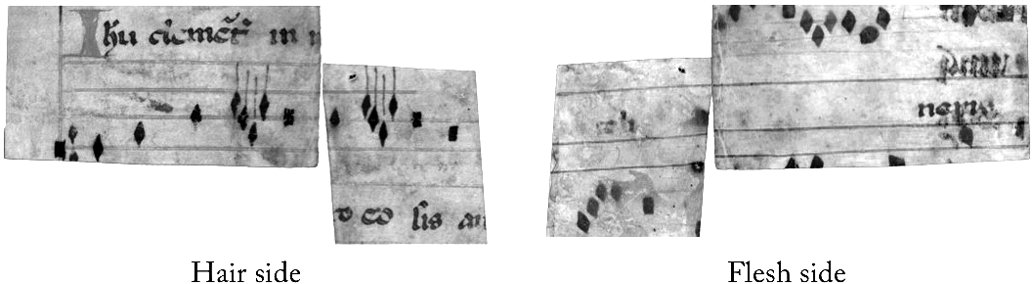
Since the staves were drawn without rastrum on both sides, the internal spacing between lines is always irregular. Fortunately, the last three lines of fragment a align perfectly with the first three lines of fragment b on the hair side. The position of the fragments relative to one another is confirmed by a similar alignment on the flesh side. Thanks to this circumstance it is possible to establish the precise position of the fragments within the original folio.
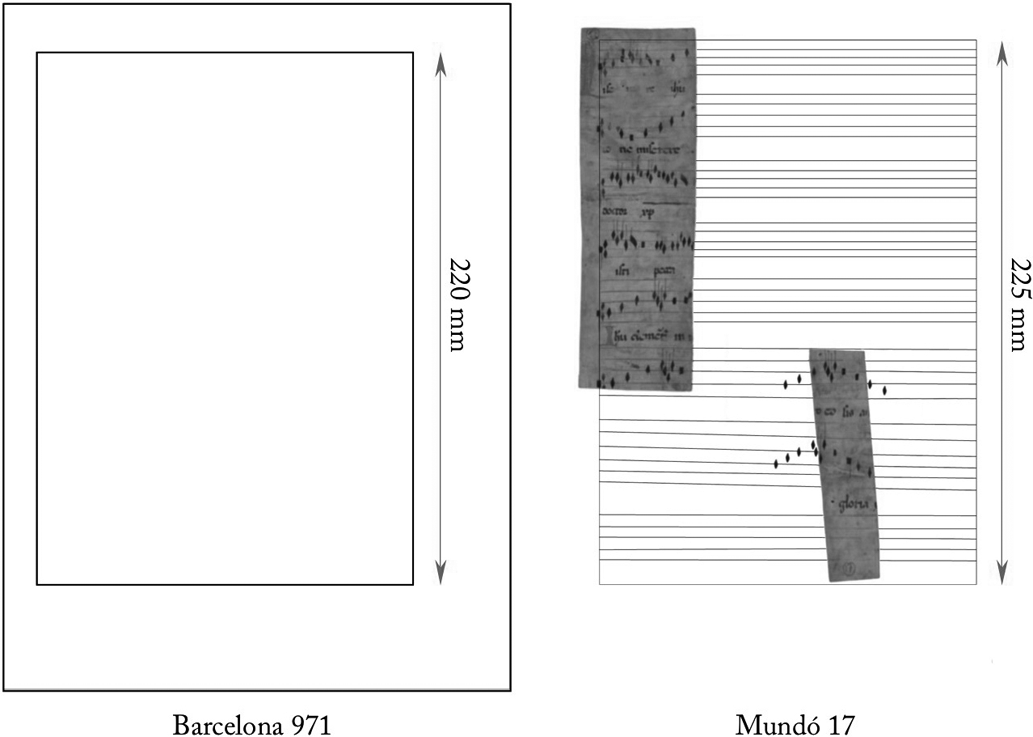
According to our reconstruction, there were eight staves to the page, with a writing block of about 225 mm in height, equivalent of quarto format. Fig. 4 shows a tentative reconstruction of the original format. This is based on proportions observed in other fourteenth-century musical manuscripts of the same size, such as the ‘Barcelona Mass’ manuscript (Barcelona, Biblioteca de Catalunya, M971). The writing block of the latter (220 mm×155 mm) is comparable in height to that of Mundó 17. As will be demonstrated below, the musical structure of Ihesu clementis suggests that fragments a and b were located about 3 or 5 cm apart.
Staff matches between the fragments. On the hair side, red lines have been digitally enhanced in order to heighten their visibility.
Reconstruction of the original format.
After the original manuscript had fallen out of use, it was dismembered and used as a reinforcement or filler in the binding of a book. Offsets of the facing page on the flesh side of fragment a still bear witness to this process. While sixteen lines of a text column are recognisable, only the opening letters of every line can be made out. Even when the image is rotated by 180 degrees and flipped horizontally, only a few words or isolated syllables are decipherable (hum, cus, laudi, iudes, facto, man, iustic). Unfortunately, this constitutes insufficient evidence for an identification of the text.
On the flesh side of the two fragments there are traces of staves, text fragments and musical notes.Footnote 7 The staff traces are clearly of the same type as those drawn by Scribe α, and the text, although illegible, looks similar to Scribe α's hand in size and type of calligraphy.
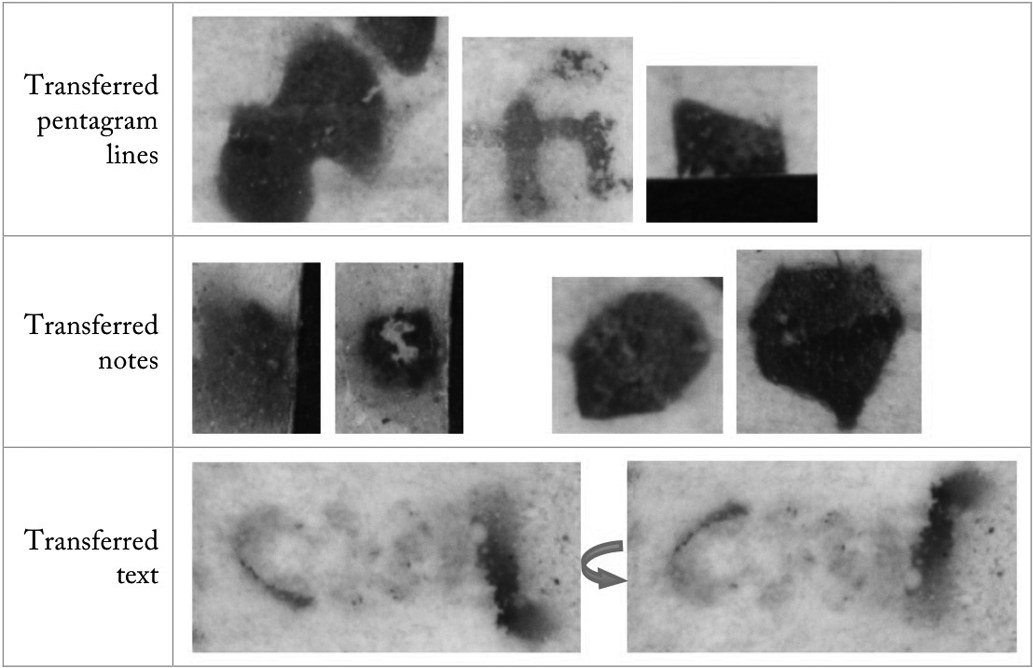
Some of the offsets originated after the manuscript was dismembered, and these snippets were glued together for the purpose of binding reinforcement. This is confirmed by a small portion of transferred text in inverse position (180°+horizontal flip). Yet, the superposition of some other marks with the text column (see Fig. 5) suggests that these could have been transferred before the dismembering of the original manuscript. Accordingly, the flesh side would originally have faced another folio with music copied by the Scribe α.
Transferred ink marks.
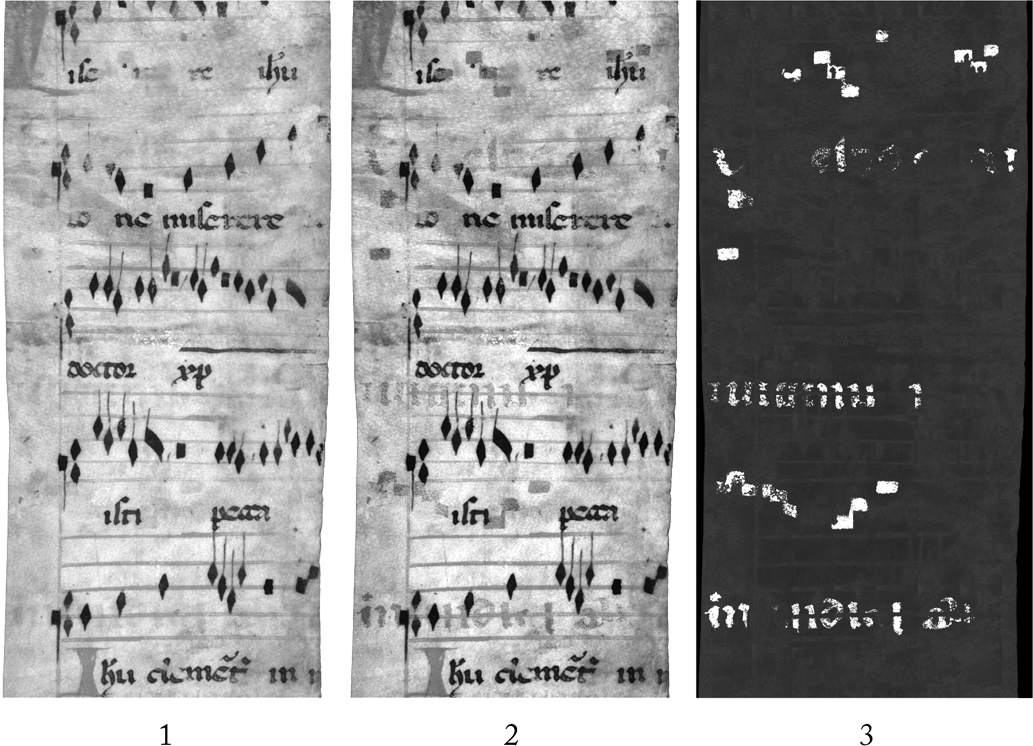
Finally, it should be noted that the hair side of Mundó 17 contains a palimpsest, that is, an earlier layer of writing which had been erased in order to re-use the same parchment surface for new musical material (i.e. the material copied by Scribe β). The high-resolution images provided by DIAMM allow a partial digital reconstruction of the earlier layer (Fig. 6). Although the traces of the erased writing are faint and incomplete, they are sufficient to identify at least the kind of notation and repertoire: plainchant. The older layer of writing was copied by a hand different from Scribes α and β. ‘Hand A’, as this hand will be referred to, is characterised by a markedly larger size. Together with the fact that text and music started before the left margin drawn by Scribe β, this points to ‘large’ quarto as the format of the original book. The flesh side, by contrast, seems to have been blank before it was used by Scribe α.
Digital restoration of the palimpsest.
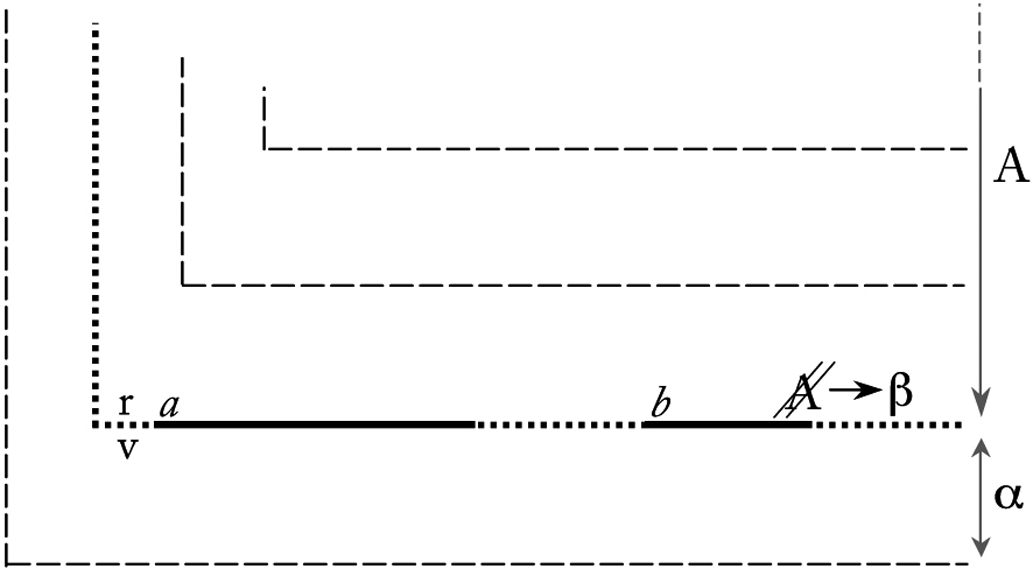
Upon consideration of all the described codicological evidence, the history of the codex to which Mundó 17 had belonged can be imagined as follows: the fragment had once formed part of a relatively large liturgical book, containing plainchant repertoire in square notation (Hand A). Towards the end of the book (or of one of its gatherings), Scribe α used some empty residual folios for the copying of mensural pieces in Petronian notation. At a later stage, Scribe β decided to add music in Ars Nova notation, yet in the absence of sufficient empty space he was forced to erase material from the main corpus of the book (that of Hand A). The diagram in Fig. 7 shows a possible location of the fragments at the end of the original liturgical book or one of its gatherings. The hair side would have been the last recto used by the main scribe of the codex (Hand A) and the flesh side would have been the first verso of a number of residual folios that remained blank until used by Scribe α.
Hypothetical codicological scheme.
This reconstruction is admittedly hypothetical and does not rule out other possibilities. In fact, the actual scenario may have been much more complex than the above interpretation of the evidence suggested. The main corpus of the book could well have been written by several scribes, and the ‘Hand A’ could conceivably have belonged to a secondary scribe; examples such as Madrid 1361 show how several different secondary scribes erased each other's work in order to make room for new additions.Footnote 8 Nonetheless, it seems clear that the contributions of α and β do not represent a single, unified stage in the ‘preparation’ of a book destined to contain mensural music, but rather constituted addenda to a liturgical codex.
Musical content
Flesh side
On the Iberian Peninsula, sources containing Petronian notation are extremely rare. So far, the only known example is a brief treatise on mensural notation in the Archive of the Cathedral in Barcelona, MS 23 (Barcelona 23), copied in the mid-fourteenth century.Footnote 9 This Catalan treatise is lavishly illustrated with musical examples, including the incipit of the motet Aucun ont trouvé by Petrus de Cruce. The anonymous author explains the rudiments of mensural music by presenting the rules of modal notation, Petronian notation, and the Ars Nova system of mimimae and the quatre prolacions. The musical material copied by Mundó 17's Scribe α bears uncanny resemblance to an example of Barcelona 23 (fol. 2v), which demonstrates how the same brevis can be divided into two to eight semibreves. Significantly, Mundó 17 organises its own figures in groups of three, four, five, six and even seven semibreves separated by puncti or breves.
The relationship between Mundó 17 and the example in Barcelona 23 runs deeper than the visual appearance of the notation (Fig. 8). The melodic contours, too, are strikingly similar. Both feature extensive passages in conjunct motion, with changes in melodic direction after progression through a third or fourth, and frequent trill-like oscillations. Since the example in Barcelona 23 was specially created in order to demonstrate the division in two, three, four, five, six, seven and eight semibreves, it does not necessarily correspond to any real musical piece. Yet, its melodic figuration suggests that the author of the treatise (or of the examples) had in mind the kind of repertoire transmitted by Scribe α in Mundó 17. This raises the intriguing possibility that Mundó 17 is the earliest known Spanish musical source to employ the Petronian notational system described in the Barcelona treatise and thus to provide a concrete musical context to its theoretical descriptions.
Comparison between Mundó 17 and Barcelona 23.
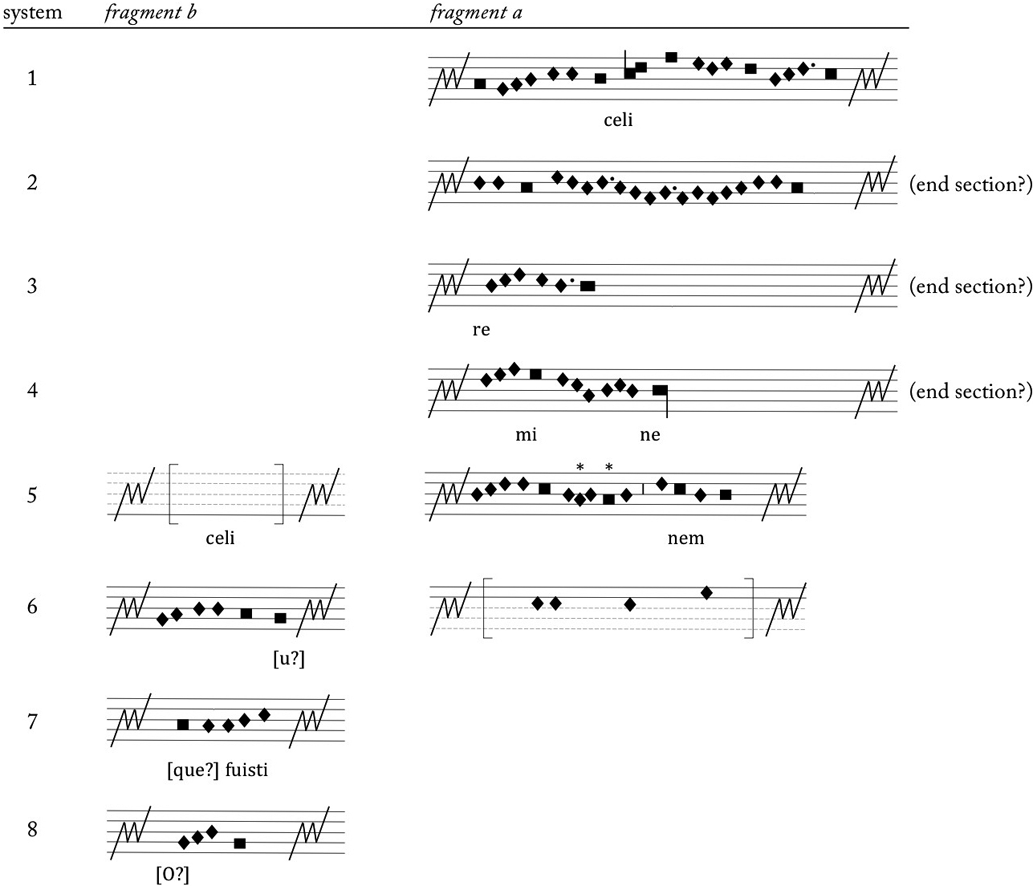
The transcription of the fragment poses immense difficulties. Setting aside the matter of its rhythmic interpretation, the small amount of surviving music does not permit even the discernment of the mode in which it was conceived. Moreover, the visible portions of the text (‘celi’, ‘-re’, [do]-‘mine’, ‘-nem’, ‘que fuisti’) prove too fragmentary for an identification of the original text. A valuable clue is found at the end of lines 2, 3 and 4, where the scribe left some space without any music or text. This gives them the appearance of section endings. One may imagine, therefore, that the flesh side contained several monophonic intonations (Fig. 9).
Mundó 17, diplomatic transcription of the flesh side.
Hair side
The hair side of Mundó 17 contained at least two sections of the same piece, each of them beginning with a red capital letter (lines 1 and 5). The complete array of Ars Nova notational devices is employed, including minimae in minor prolation, breves, semibreves and ligatures cum opposita proprietate. At first sight, the music has the appearance of a cantus line or the duplum of a motet. Closer examination, however, reveals the piece as a monophonic composition. This is supported, among other things, by the low tessitura, which leaves little or no room for a tenor line.
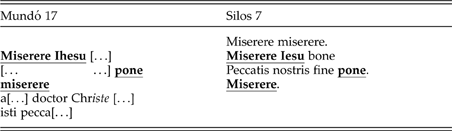
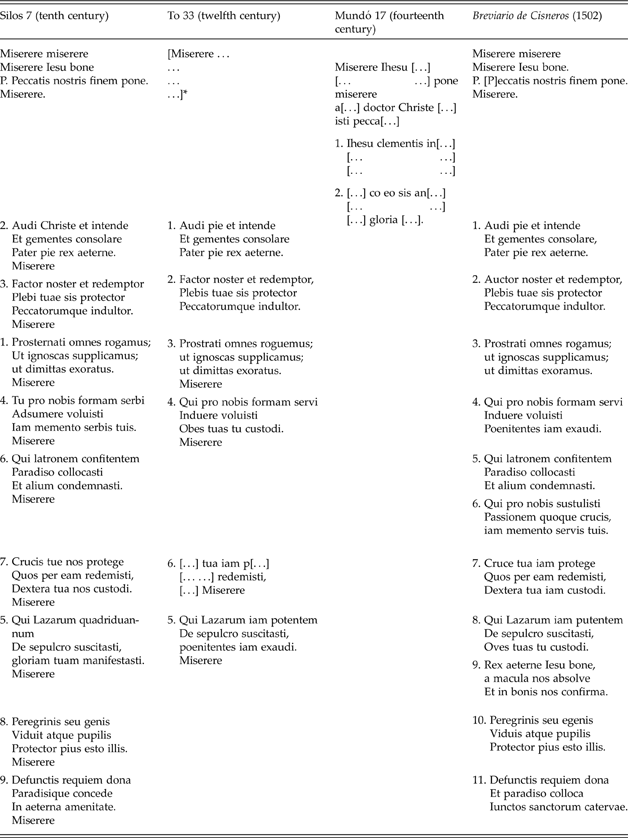
Perhaps the most intriguing feature of this fragment is its text. While only few syllables are legible, they could be identified as stemming from the Mozarabic preces. More concretely, these Hispanic penitential prayers show a strong correspondence with the prayer Miserere, miserere. Miserere Iesu bone transmitted in three other manuscripts: Silos 7 (tenth century, without music),Footnote 10 Toledo 33.3 (twelfth century, music in neumatic notation),Footnote 11 and the so-called Breviario de Cisneros Footnote 12 (sixteenth ccentury, printed book without music).Footnote 13
Text concordance
A comparison between these sources makes apparent that Mundó 17 contains otherwise unknown verses to the Miserere prayers (see Appendix, Table 2). Such additions are not surprising per se, since the preces are variable and interchangeable prayer invocations. Toledo 33.3, the only musical source concordant with Mundó 17, even transmits a different melody.Footnote 14 This is not an unusual feature of the Mozarabic repertoire either, since pieces transmitted in the most recent sources, such as the sixteenth-century Cisneros choirbooks,Footnote 15 often have no apparent melodic connection with their presumed models from the tenth and twelfth centuries.Footnote 16
As is well known, the Cisneros choirbooks resulted from an early sixteenth-century project designed to support the Mozarabic liturgy by recording its melodies in ‘modern notation’.Footnote 17 For centuries, the Mozarabic community had performed and transmitted its repertoire orally or just by ‘reading’ the traditional Hispanic neumes. While the history of the Mozarabic chant and its survival through the centuries is beyond the scope this article,Footnote 18 it is worth underlining the great lacuna of written sources from the late twelfth century (or early thirteenth) to the beginning of the sixteenth century. Moreover, sources predating the early thirteenth century were notated in traditional Hispanic neumes, which to date have not been successfully transcribed. So far, it was assumed that the first man to attempt to preserve Mozarabic melodies in a different notation was Juan Vazquez de Cepeda, Bishop of Segovia, who in 1436 commissioned a copy of the ‘old books’ for the foundation of the monastery of Santa María de Aniago (Valladolid) ‘transcribing its texts and melodies into modern notation’.Footnote 19 Unfortunately, Cepedas's books cannot be located today and may well have been lost.
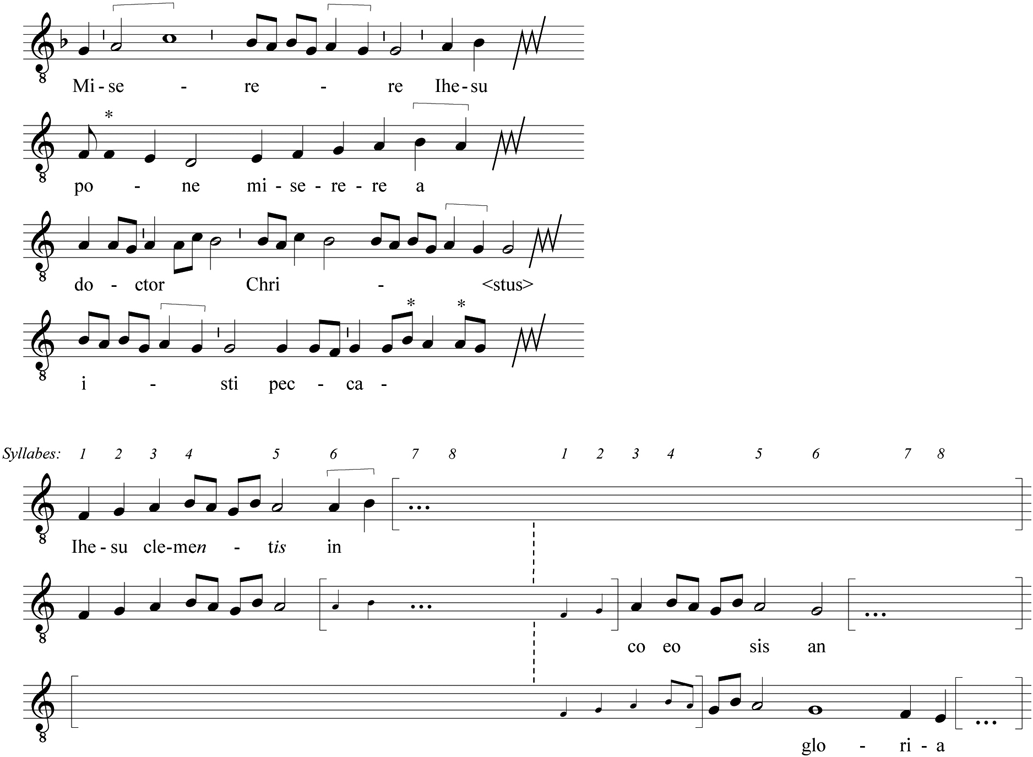
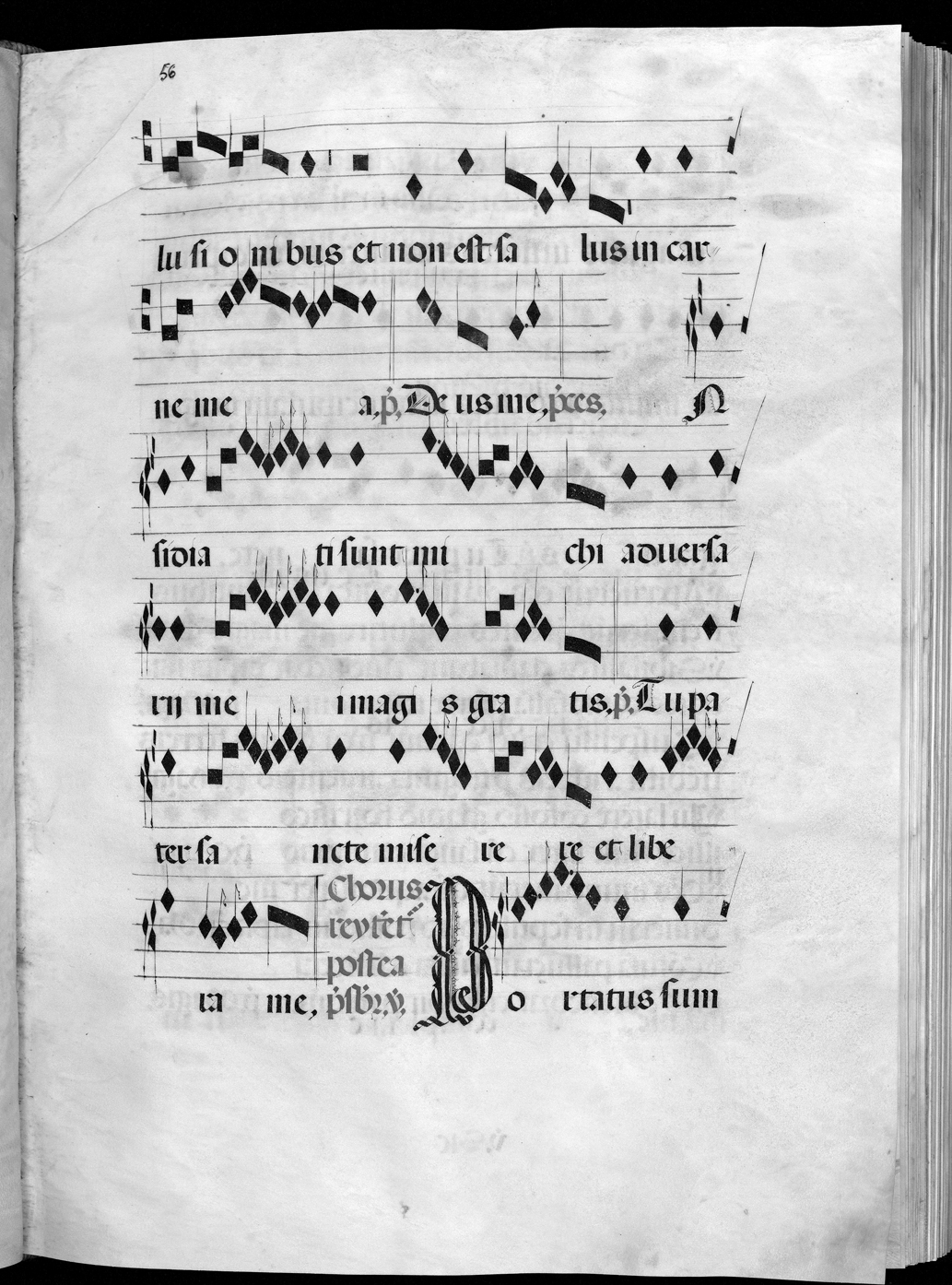
The melodies of the preces in the Cisneros choirbooks and in medieval sources (as far as they can be determined from the neumatic notation) are characterised by a simple musical structure based on constantly repeating brief melodic formulas. This feature corresponds directly to the poetic structure of the verses and the insistent character of penitential prayers. The entire repertoire contained in the Cisneros choirbooks is written in black mensural notation employing minimae and semiminimae (see Fig. 12, printed as Appendix). While there are no specific concordances between Mundó 17 and the Cisneros choirbooks, the preces of both are very similar in style, structure and notation to those found in the latter. Moreover, the two sources show the same kinds of rhythmic patterns and repetitions. Fig. 10 demonstrates how the section Ihesu clementis could fit with the preces verse structure.
Mundó 17, transcription of the hair side.
That repertoire closely related to that of the Cisneros choirbooks already circulated in a very similar form and notation in the fourteenth century is of great historical significance. The fragment Mundó 17 may provide tangible evidence for the kind of exemplars Cisneros used for the compilation of his choirbooks. This would help to explain why such cantorales are written in a musical notation archaic by the standards of the sixteenth century. It is tantalising to speculate whether the lost books of Cepeda from 1436 might have looked similar to Mundó 17. However this may be, the discovery of the Mundó fragment makes it clear that Cepeda was not the first to write music for the Mozarabic rite in ‘modern’ notation. For all it seems, Mundó 17 originated as a liturgical monastic manuscript, whose empty folios were used for the copying of pieces that were normally transmitted in other types of manuscripts. The Mozarabic preces in particular may otherwise have been disseminated in libelli or independent gatherings that are no longer extant.
In sum, the fragment Mundó 17 deserves historical attention for two major reasons: as the only known practical source from the Iberian Peninsula to use Petronian notation and as a precious testimony of Mozarabic preces with music from the intermediate stage between the manuscripts of the Hispanic rite and the compilation of the Cisneros choirbooks in the sixteenth century.
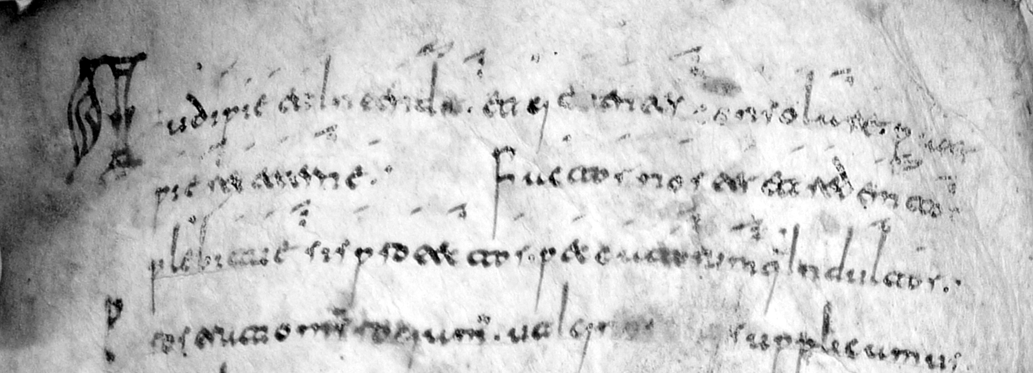
Toledo 33, fol. 45v.
Cisneros's Choirbook I, fol. 56r.
Appendix
Textual comparison of the surviving sources of the Miserere prayers