Adolescence is marked by increases in psychosocial maturity that are reflected in improvements in temperance (the ability to curb impulsive and aggressive behavior), perspective (the ability to see things from multiple temporal and social vantage points), and responsibility (the ability to function autonomously; Steinberg & Cauffman, Reference Steinberg and Cauffman1996). On average, temperance, perspective, and responsibility develop steadily across the adolescent years, with growth slowing as youth transition into early adulthood (Monahan, Steinberg, Cauffman, & Mulvey, Reference Monahan, Steinberg, Cauffman and Mulvey2009, 2011). Evidence also suggests that there is significant variability in the degree and rate of development of psychosocial maturity across adolescence and young adulthood, with some youth showing greater or faster gains and others exhibiting little or very slow growth in maturity over time (Monahan et al., Reference Monahan, Steinberg, Cauffman and Mulvey2009, Reference Monahan, Steinberg, Cauffman and Mulvey2011).
The extant literature on the development of psychosocial maturity suggests that normative variations in social context may contribute to individual differences in the development of temperance, perspective, and responsibility. For example, exposure to positive parent–child relationships, prosocial peers, and nurturing school and extracurricular contexts are each linked to greater psychosocial maturity during the adolescent years (Steinberg, Chung, & Little, Reference Steinberg, Chung and Little2004). Less is known about how normative development proceeds in atypical contexts, a central question within the study of developmental psychopathology. The current study investigates how the development of psychosocial maturity is affected by incarceration, a highly atypical context. Studies of normative psychosocial development among incarcerated young people are almost nonexistent, even though this is not an uncommon experience among poor, ethnic minority male adolescents in America (National Council on Crime and Delinquency, 2007).
The juvenile justice system handles more than 1.6 million delinquency cases each year (Snyder & Sickmund, Reference Snyder and Sickmund2006). Annually, approximately 72,000 youth are incarcerated in the United States (Sickmund, Sladky, Kang, & Puzzanchera, Reference Sickmund, Sladky, Kang and Puzzanchera2008). Given the existing research on contextual contributors to positive psychosocial development, there is good reason to believe that incarceration has a lasting, adverse impact on the developing adolescent. Although the challenges and stresses of incarceration would tax the faculties of even those most adept at coping with adversity, adolescent offenders face this situation with the added disadvantage of immaturity. Incarceration separates youth from their parents at a time in development when youths' well-being (Helsen, Vollebergh, & Meeus, Reference Helsen, Vollebergh and Meeus2000) and acquisition of coping skills (Patterson & McCubbin, Reference Patterson and McCubbin1987) are still influenced heavily by the family. Simultaneously, adolescents perceive their relationships with friends to be increasingly important (Helsen et al., Reference Helsen, Vollebergh and Meeus2000), and incarcerated adolescents are placed in an environment where their only peer group is composed of other antisocial youth. Compounding the social isolation from typical contexts is the high rate of psychological disorder among adolescent offenders (Teplin, Abram, McClelland, Dulcan, & Mericle, Reference Teplin, Abram, McClelland, Dulcan and Mericle2002), which may render them particularly vulnerable to the stresses of incarceration.
Although all adolescents who are incarcerated share certain basic experiences (e.g., separation from parents and friends, restrictions on autonomy), incarceration itself is a heterogeneous category that includes a wide range of placements. Juvenile facilities vary considerably in their degree of security and, at least in principle, in the degree to which they offer rehabilitative services. Although rehabilitation is one of the stated purposes of the juvenile justice system, today's punitive “adult time for adult crime” climate has transformed many juvenile justice facilities into places designed mainly (or exclusively) for punishment and incapacitation (Scott & Steinberg, Reference Scott and Steinberg2008).
The goals of many juvenile correctional institutions (secure or not) often run counter to the successful development of psychosocial maturity. That is, strategies that are adaptive for successful social functioning in life outside of facilities that promote the development of psychosocial maturity may be maladaptive for life on the inside. For example, incarcerated individuals “do well” if they obey without questioning the rules, even when many rules do not make sense or are not fairly enforced (Kummerlowe, Reference Kummerlowe and Flanagan1995). Incarcerated individuals undergo repetitive and restrictive routines that are regulated by extensive and rigid rules. Consequently, they may lose the ability to cope with the demands of an outside world that lacks rigid structure (Irwin & Owen, Reference Irwin, Owen, Liebling and Maruna2005). Moreover, if incarcerated youths are discouraged from expressing concerns, this may interfere with coping efforts, such as seeking social support, which in turn could impede adjustment (Shulman & Cauffman, in press). Because adolescence is a time when youth develop increasing temperance, perspective, and responsibility, it stands to reason that in contexts where these skills are not practiced and may be actively discouraged, adolescents may have limited ability to attain these psychosocial capacities. Spending a great deal of time in an incarcerated context may have an especially detrimental impact.
Whereas most research on adolescent development would lead one to hypothesize that incarceration would have adverse consequences for the development of psychosocial maturity, there is an alternative view that needs to be acknowledged. Some proponents of the incarceration of juvenile offenders view incarceration as a form of rehabilitation, one that may positively impact the growth of maturity. Although these writers acknowledge that a primary purpose of this sort of sanction is punishment, they also believe that the regimentation and harsh discipline characteristic of incarceration environments is precisely what juvenile offenders need in order to develop self-control and responsibility. For instance, one website promoting the use of boot camps notes that, “if you yell and yell at these troubled teens and discipline [them], they will generally straighten out. Angry, aggressive, defiant and oppositional teens might improve under the strict, intense, military-style environment of a boot camp” (Teen Boot Camps, 2011).
Although there are multiple types of secure confinement, the two most common settings for juvenile offenders are secure facilities and residential treatment facilities. There are notable differences between these two settings. Secure settings tend to be oriented more toward punishment and less toward rehabilitation. These facilities operate on strict schedules and tend to provide few or no services to youth in their care. In contrast, residential treatment facilities tend to be more rehabilitation oriented, providing youth with a secure, but more residential, life style with greater flexibility of scheduling and independence. In general, residential treatment facilities tend to offer youth access to, and require participation in, more rehabilitative services, such as schooling, counseling, and drug and alcohol treatment (Mulvey, Schubert, & Chung, Reference Mulvey, Schubert and Chung2007). Undoubtedly, within each of these categories, there are variations in quality and access to services, but generally secure facilities are characterized by a more extreme departure from the typical experiences of adolescence than are residential treatment facilities. As such, it may be the case that the type of setting a youth spends time in, not only how long they spend time locked up, has important implications for how incarceration shapes the development of psychosocial maturity.
Moreover, although it is possible that the type of incarceration setting and length of time incarcerated may impact the development of psychosocial maturity, the age of the adolescent may moderate whether or how a youth is affected by incarceration and the quality of the facility. Given that psychosocial maturity develops rapidly throughout adolescence, with growth slowing as youth transition into early adulthood (Monahan et al., Reference Monahan, Steinberg, Cauffman and Mulvey2009, Reference Monahan, Steinberg, Cauffman and Mulvey2011), it could be that earlier confinement may be more detrimental, because this is precisely the time when gains in psychosocial maturity are most likely to occur. Conversely, it could be that as psychosocial capacities develop throughout adolescence and early adulthood, incarceration at any point in this developmental period impacts subsequent psychosocial maturity. Understanding developmental variability in vulnerability to the effects of incarceration on psychosocial maturity is an important question, with implications for both juvenile justice policy and practice.
Because correctional facilities vary considerably in their institutional climate, as well as the availability and quality of the rehabilitative treatments they offer, it is likely that the characteristics of a given facility will also moderate whether there are detrimental effects of incarceration. Programs that utilize a familylike setting (i.e., with a parental unit in charge of a small number of youths), have small staff to youth ratios, do not sever inmates' ties to family and community, and provide professional counseling are more successful at keeping recidivism low (Caldwell, Skeem, Solekin, & Van Rybroek, Reference Caldwell, Skeem, Solekin and Van Rybroek2006; Rosner, Reference Rosner1990). Educational and vocational services are also important, because for some youth these facilities are the only sources of such training (Chung, Little, & Steinberg, Reference Chung, Little, Steinberg, Osgood, Foster, Flanagan and Ruth2005). Facilities that offer higher quality environments, regardless of whether they are secure or nonsecure, may have differential effects on youth development than those with lower quality environments.
In order to investigate how the experience of incarceration affects the development of psychosocial maturity, it is necessary to follow longitudinally a sample of adolescents and young adults in which a large proportion are likely to become incarcerated. The present study utilizes a sample of serious juvenile offenders, who are precisely those youth most likely to experience incarceration, and asks how incarceration experiences shape patterns of psychosocial development from midadolescence into early adulthood. In addition to examining how incarceration generally impacts psychosocial development, we also investigate how incarceration in different types of settings (i.e., secure facilities vs. residential treatment facilities) may differentially affect adolescent psychosocial development. Furthermore, we investigate how the age of an adolescent and the characteristics of a given facility, such as subjective feelings of safety, moderate the association between time spent incarcerated and the development of psychosocial maturity.
Given the absence of prior research on this topic, there is little guidance with respect to the formulation of specific hypotheses. It is reasonable to expect that, because of their harsher environment and relative absence of rehabilitative services, secure settings are relatively more detrimental to the development of psychosocial maturity than residential treatment facilities. In contrast, it could be that any disruption of the normative socialization experiences of adolescence (at home, with peers, or in school) is harmful to psychosocial development. Similarly, although it could be that the effects of incarceration on psychosocial development are cumulative, such that greater total time incarcerated during adolescence is linked with suppressed development of psychosocial development, it could also be that incarceration experiences substantially impact psychosocial maturity only in the short term. Finally, it could be that the age of an adolescent or the characteristics of a facility affect psychosocial development more than the type of facility or length of time incarcerated per se.
The present analyses are based on a 7-year longitudinal study of serious adolescent offenders, and the effects of incarceration on the development of psychosocial maturity from ages 14 to 25 are examined. We address four specific research questions. First, we examine how total time incarcerated during this developmental period affects psychosocial maturity. Second, we examine the short-term impact of incarceration on psychosocial functioning. Third, we investigate whether the effects of incarceration are moderated by the age of the adolescent at the time of incarceration. Fourth and finally, we test whether the impact of incarceration on subsequent psychosocial development varies based on the type and quality of the facility. We examine each of these research questions disaggregating secure facilities from residential treatment facilities. The longitudinal nature of this study allowed for multilevel testing of within- and between-individual differences in the development of psychosocial maturity. Furthermore, the scope of data detailing youth facility experiences provided a rich source of information for investigation of the effects of institutional characteristics on the individual trajectories of psychosocial maturity.
Method
Participants
The participants were 1,171 male adolescents in a larger prospective study of male and female serious juvenile offenders in two major metropolitan areas (for study details, see Schubert et al., Reference Schubert, Mulvey, Steinberg, Cauffman, Losoya and Hecker2004; there were not enough females in the sample to examine the questions of interest in the present study). This study enrolled 14- to 17-year-old adolescents who had been adjudicated of a felony offense, a serious property crime, a misdemeanor weapons offense, or a misdemeanor sexual assault. The proportion of male participants with drug law violations was capped at 15%. Of 2,008 youths eligible for the study, 1,692 were located and contacted with recruitment information. Parental consent and youth assent were obtained for 80% (N = 1,355) of the youths contacted, 1,171 of whom were males and therefore were included in the present investigation.
The majority of participants were from lower socioeconomic status backgrounds, with fewer than 3% of the adolescents having parents who graduated from college. Only 14% of the participants lived with both biological parents, 33% lived with a single mother (never married, divorced, or widowed), 17% lived with a biological mother and a stepfather, 20% lived with another adult relative, 5% lived with a single biological father, 4% had no adult in the home, and the remaining 7% lived in other arrangements. Forty-two percent of the participants were African American, 34% were Hispanic, 19% White, and 5% other or biracial.
Procedure
Following a referral of eligible adolescents by the juvenile court, a trained interviewer contacted adolescents and their guardians to ascertain their interest in participation. After the appropriate consents and assents had been obtained, an interviewer met with an adolescent in a facility, the juvenile's home, or another location in the community. Adolescents were paid $50 for their participation in the baseline interview (when allowed by facility rules) and, in order to minimize attrition, compensation for the follow-up interviews increased gradually over time to a maximum of $150. All recruitment and assessment procedures were approved by the institutional review boards of the participating universities.
The first (baseline) interview was conducted over 2 days in two 2-hr sessions. The interviewer and participant sat side by side at a computer while the interviewer read the questions aloud to avoid any problems due to difficulties with reading. Participants were reinterviewed every 6 months for the 3 years following the baseline interview; after 36 months, participants were interviewed annually for the remaining 4 years of the study (a total of 11 interviews prospectively over 7 years). Retention in the sample was excellent: 60% of individuals completed all 11 interviews, 18% completed 10 interviews, 8% of individuals completed 9 interviews, 5% of individuals completed 8 interviews, 3% of individuals completed 7 interviews, 2% of individuals completed 6 interviews, 2% of individuals completed 5 interviews, and 4% of individuals completed fewer than 4 interviews.
Measures
Of interest in the present report are measures of psychosocial maturity, incarceration in a secure facility or a residential treatment facility, characteristics of incarceration settings, and covariates that may impact whether youths were likely to be incarcerated or not.
Psychosocial maturity
Psychosocial maturity is conceptualized as consisting of three separate components: temperance, perspective, and responsibility, each of which has two elements (Steinberg & Cauffman, Reference Steinberg and Cauffman1996). In addition to the three components, we also create a global psychosocial maturity measure that combines the dimensions of temperance, perspective, and responsibility. Temperance is assessed by impulse control and suppression of aggression; perspective includes consideration of others and future orientation; and responsibility includes personal responsibility and resistance to peer influence. Four measures, described subsequently, were used to create these six indicators of psychosocial maturity, which are combined into the three conceptual dimensions of psychosocial maturity: the Weinberger Adjustment Inventory (Weinberger & Schwartz, Reference Weinberger and Schwartz1990), which includes subscales that assess impulse control, suppression of aggression, and consideration of others; the Future Outlook Inventory (Cauffman & Woolard, Reference Cauffman and Woolard1999), which was used to derive a measure of future orientation; the Psychosocial Maturity Inventory (Greenberger, Josselson, Knerr, & Knerr, Reference Greenberger, Josselson, Knerr and Knerr1975), which includes a scale that assesses personal responsibility; and the Resistance to Peer Influence measure (Steinberg & Monahan, Reference Steinberg and Monahan2007).
Three subscales of the Weinberger Adjustment Inventory were used: impulse control (e.g., “I say the first thing that comes into my mind without thinking enough about it”), suppression of aggression (e.g., “People who get me angry better watch out”), and consideration of others (e.g., “Doing things to help other people is more important to me than almost anything else”). Participants assessed how accurately a series of statements matched their own behavior (on a 5-point scale, from false to true). Each subscale was found to have adequate reliability (Cronbach α) and good fit to the baseline data (confirmatory factor analysis): impulse control (eight items; α = 0.76, normed fit index [NFI] = 0.95, comparative fit index [CFI] = 0.95, root mean square error of approximation [RMSEA] = 0.07), suppression of aggression (seven items; α = 0.78, NFI = 0.96, CFI = 0.97, RMSEA = 0.06), and consideration of others (seven items; α = 0.73, NFI = 0.98, CFI = 0.99, RMSEA = 0.04).
The Future Outlook Inventory is an eight-item measure that includes items from the Life Orientation Task (Scheier & Carver, Reference Scheier and Carver1985), the Zimbardo Time Perspective Scale (Zimbardo, Reference Zimbardo1990), and the Consideration of Future Consequences Scale (Strathman, Gleicher, Boninger, & Edwards, Reference Strathman, Gleicher, Boninger and Edwards1994). The inventory asks participants to rank the degree to which each statement reflects how they usually act, on a scale of 1 (never true) to 4 (always true). The future orientation score was calculated as the mean of responses from each item (e.g., “I will keep working at difficult, boring tasks if I know they will help me get ahead later”). The scale showed good reliability and an excellent fit to the baseline data (α = 0.68, NFI = 0.96, CFI = 0.97, RMSEA = 0.03).
The Psychosocial Maturity Inventory (Greenberger et al., Reference Greenberger, Josselson, Knerr and Knerr1975) includes a 30-item, reverse-scored subscale that assesses personal responsibility (e.g., “If something more interesting comes along, I will usually stop any work I'm doing”). Individuals respond on a 4-point scale from strongly disagree to strongly agree. Personal responsibility was calculated as the mean across all 30 items. The measure showed excellent reliability and an adequate fit to the baseline data (α = 0.89, NFI = 0.82, CFI = 0.87, RMSEA = 0.04).
Finally, the measure of Resistance to Peer Influence (Steinberg & Monahan, Reference Steinberg and Monahan2007) assesses the degree to which adolescents act autonomously in interactions with their peers. Participants are read two conflicting statements (e.g., “Some people go along with their friends just to keep their friends happy” and “Other people refuse to go along with what their friends want to do, even though they know it will make their friends unhappy”) and are asked to choose the statement that most closely reflects their behavior. Next, participants are asked to rate the accuracy of the statement (i.e., “sort of true” or “really true”). Each item is scored on a 4-point scale, ranging from 1 (really true) for the characterization indicating less resistance to influence to 4 (really true) for the characterization indicating more resistance to influence; answers of sort of true are assigned a score of 2 (if associated with the less resistant option) or 3 (if associated with the more resistant option). Ten such items are presented to participants. Each item explores a different dimension of peer influence (e.g., going along with friends, saying things one does not really believe), and one resistance to peer influence score was computed for this measure by averaging scores on the 10 items. The measure showed good internal consistency and fit to the baseline data (α = 0.73, NFI = 0.92, CFI = 0.94, RMSEA = 0.04).
Confirmatory factor analysis (with baseline data) evaluated the structural validity of the psychosocial maturity construct, with the three first-order factors (i.e., temperance, responsibility, and perspective) and the second-order global psychosocial maturity factor. The confirmatory factor model had a good fit: χ2 (6) = 26.47, p < .001; NFI = 0.97, CFI = 0.98, RMSEA = 0.06 (0.04, 0.08). Consequently, the temperance, perspective, responsibility, and total psychosocial maturity scores were created using the factor scores from the confirmatory factor analysis model.
Incarceration
Two types of incarceration settings were of interest: confinement in a secure facility and confinement in a residential treatment facility. At each interview, individuals completed a life calendar where they reported the number of days in each month since the prior interview that they had been incarcerated and gave the name of each facility they had spent time in since the last interview. Interviewers began the life calendar by asking the youth to identify major life events, such as the birth of a child, that had occurred since the prior interview. Participants were then asked if they had been involved in an activity since the last interview (e.g., “Were you incarcerated at all?”). If the respondent's answer was positive, the interviewer went through the recall period month by month to determine in what month(s) the activity occurred. If a youth had a problem remembering the exact month of an occurrence, the interviewer would use major life events or information from other activity domains to help narrow the date (e.g., “Did this happen around your birthday? Or was it closer to when you moved to Penn Avenue?”). If a youth endorsed being in multiple facilities in the recall period, the number of days was recorded for each facility. Previous research suggests that retrospective data gathered using life calendar methods is accurate (Freedman et al., Reference Freedman, Thornton, Camburn, Alwin and Young-Demarco1988) and that the data structure of the life calendar fits the structure of respondents' autobiographical memories well (Belli, Reference Belli1998). For example, Caspi and Amell (Reference Caspi and Amell1994) found that life events reported 3 years earlier matched the retrospective life history calendar data with over 90% accuracy. As such, the life calendar data collection method can provide a more continuous and complete representation of life events than is possible with other interview or questionnaire measures.
The variables that assessed incarceration in secure and residential treatment facilities were created from the life calendar data. The research staff classified each facility that was named in the interview as a secure setting or a residential treatment facility. We distinguished between the secure and residential treatment facilities based on the orientation of the facility. Confinement settings where incarceration, not rehabilitation, is the stated goal were classified as secure facilities. These included detention centers (i.e., juvenile correctional facilities that are used both as short-term preadjudication placements or as more permanent postadjudication and disposition placements), jails (i.e., typically local juvenile facilities that hold youth until trial or for relatively short sentences after trial), and prisons (i.e., usually state-run facilities that hold people for a longer term after conviction). A very small proportion of secure settings included federal adult detention centers and Immigration and Naturalization Services detention centers.
Confinement settings that have a stronger focus on rehabilitation and providing services to residents were classified as residential treatment facilities. These facilities typically provide a range of services that are often centered on a specific model of intervention (e.g., peer culture, physical challenge). Some facilities focus more specifically on mental health treatment and target mentally ill adolescents. These settings usually provide a more intensive assignment to therapy and other treatment activities. Although all residential treatment facilities provide a residential program within a structured environment, they vary with respect to their security and access to the community.
Based on youth responses on the life calendar data, we calculated four incarceration variables: (a) the total proportion of time incarcerated in secure settings across all years of data collection; (b) the total proportion of time incarcerated in residential treatment facilities across all years of data collection; (c) recent secure incarceration, that is, the proportion of time since the last interview spent in a secure facility (as opposed to being in a different setting or on the streets; a time-varying covariate); and (d) recent residential treatment facility incarceration, that is, the proportion of time since the last interview spent in a residential treatment facility (as opposed to being in a different setting or on the streets; also a time-varying covariate).
The first two variables, total proportion of time in a secure setting and total proportion of time in a residential treatment facility are grand-mean centered in each analytic model. Thus, these variables test the effects of relatively more or relatively less incarceration over the course of the 7-year study (secure or residential treatment facility) compared to other youth in the sample. Specifically, these variables allow a test of how being incarcerated more or less in a given setting impacts the development of psychosocial maturity over the course of the study.
The second two variables, the time-varying covariates that reflect the proportion of time since the last interview spent in a facility, indicate recent incarceration in a secure setting and recent incarceration in a residential treatment facility. These variables represent the fluctuations in incarceration that occur throughout the course of the study and allow a test of how relatively more or less incarceration in the previous recall period for an individual is linked with immediately subsequent developmental changes in psychosocial maturity.
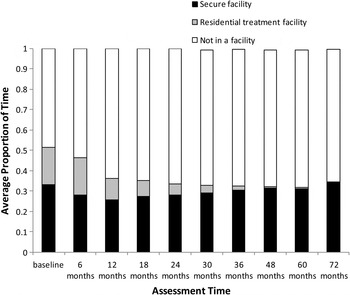
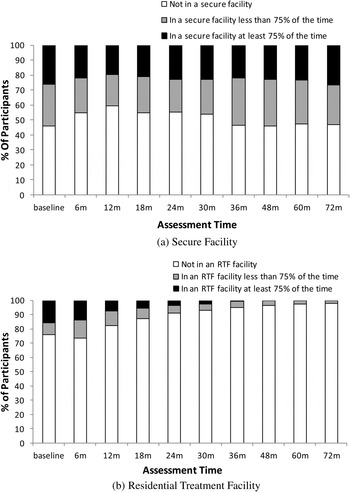
Over the course of the study, youths spent on average 23 months (SD = 23) in a secure facility and 4 months (SD = 7) in a residential treatment facility. (Note that these stays are not necessarily consecutive and can follow any possible pattern of incarceration in secure settings, residential facilities, or street time across the 7 years of the study.) Youths could report any possible combination of street time, incarceration in a secure facility, and incarceration in a residential treatment facility. Figure 1 illustrates the proportion of each recall period that youth, on average, reported being in a secure facility, a residential treatment facility, or in no facility. Figure 2 illustrates how much of the recall period was spent in either a secure facility (Figure 2a) or a residential treatment facility (Figure 2b). At each time point, approximately half of the sample reported incarceration for some amount of time in a secure setting during the relevant recall period. Across time, 20% to 27% of youth reported being incarcerated in a secure setting for 75% of the recall period or more; 21% to 32% of youth reported being incarcerated in a secure facility for less than 75% of the recall period. Few youths were placed in residential treatment facilities. Over the 7-year period, only 2% to 24% of the sample reported time spent in a residential treatment facility during a given recall period; and there is a notable decline in placement in residential treatment facilities as youth aged, reflecting the greater use of treatment facilities in the juvenile justice system than the criminal justice system.
The average proportion of time spent in each facility type.

The incarceration in (a) secure facilities or (b) residential treatment facilities over time.

Characteristics of incarceration setting
If a youth endorsed confinement in a facility, either a secure facility or a residential treatment facility, he reported on six characteristics of each facility (adapted from Mulvey, Schubert, & Odgers, Reference Mulvey, Schubert and Odgers2010): (a) the number of mental health services received in the facility, (b) the number of training services received in the facility, (c) the presence of a caring adult, (d) the presence of reentry planning, (e) perceived facility danger, and (f) the degree of contact with antisocial peers. These variables were assessed with respect to each facility a youth reported staying in since the prior interview.
The Number of Mental Health Services is a 7-item checklist that assessed youth attendance of treatment services such as drug and alcohol treatment, psychological therapy, anger management, or group therapy. The Training Services Checklist is the 2-item checklist that assessed whether job and school training was received by the youths. Reentry planning is a single-item variable that assessed whether youths have had a person assigned to them to help make arrangements for their return to the community. The Presence of the Caring Adult is a 7-item checklist that assessed the presence of an adult figure in the facility that youths admire, can get advice from, or could depend on for help. The Perceived Facility Danger is a 2-item scale that assessed how safe youths felt (on the scale from 1 = in danger all of the time to 5 = in danger none of the time; reverse coded) from other youths and staff in the facility. Finally, the Peer Delinquency Scale (adapted from Thornberry, Lizotte, Krohn, Farnworth, & Jang, Reference Thornberry, Lizotte, Krohn, Farnworth and Jang1994) is a 12-item scale that assessed how many of youths' peers (on a scale from 1 = none of them to 5 = all of them) engaged in a variety of antisocial activities such as fighting and theft.
In order to ascertain the accuracy of youths' reports on the facility characteristics, we computed intraclass correlation coefficients (ICCs) for each of the six facility characteristics. For these analyses, we analyzed youths' responses for 421 secure and residential treatment facilities. Each facility, on average, received 12 (SD = 33) participants over the course of the study. Given the wide range of the number of participants per facility, the ICC model that analyzed the complete data included many empty cells (e.g., a model for one facility that has 100 participants/coders and five other facilities that have 10 participants/coders contains 450 empty cells out of 600 total cells), making it impossible to compute the reliability coefficients. Thus, we had to constrain the ICC analyses to a maximum of 30 participants/coders for each facility. The resulting ICCs were 0.92 (p < .001) for the mental health services variable, 0.96 (p < .001) for the training services variable, 0.90 (p < .001) for the caring adult variable, 0.88 (p < .001) for presence of the reentry planning variable, 0.34 (p = .15) for the perceived facility danger variable, and 0.32 (p =.19) for contact with antisocial peers. These results indicate excellent agreement for objective markers of facility characteristics (i.e., presence of mental health, training, reentry services, and caring adults) and lower agreement for variables that assess youth perceptions of facility danger and extent of contact with antisocial peers.
Based on the results of an exploratory factor analysis, the six characteristics were divided into either negative facility features (consisting of the perceived facility danger and peer delinquency scales) or positive facility features (consisting of the number of mental health services, the number of training services, reentry planning, and the presence of the caring adult checklists). If youth reported stays in multiple facilities (i.e., multiple types of secure facilities), the responses on scales were aggregated across facilities and weighted by the proportion of time spent in each facility. Responses were calculated separately for secure facilities and residential facilities. Thus, four total variables were calculated: (a) negative facility features in secure facility(ies), (b) negative facility features in residential treatment facility(ies), (c) positive facility features in secure facility(ies), and (d) positive facility features in residential treatment facility(ies).
Covariates
The number of arrests prior to the baseline interview (coded from official records), age at first arrest, parental education (ranging from 1 = some grade school to 9 = professional or graduate school), parental arrest history (coded as 0 = neither parent arrested, 1 = one parent arrested, and 2 = both parents arrested), mental health symptoms, and youth intelligence were utilized as controls in all models. This accounted for how prior offending, familial offending, and demographic characteristics may impact whether a youth is incarcerated and, if so, sentenced to time in a secure facility or a residential treatment facility. Mental health symptoms were assessed using the Brief Symptom Inventory (Derogatis & Melisara, Reference Derogatis and Melisaratos1983), a 53-item self-report inventory assessing the degree to which participants have been bothered (0 = not at all to 4 = extremely) in the past week by various symptoms. Intelligence was assessed using the Wechsler Abbreviated Scale of Intelligence (Wechsler, Reference Wechsler1999). This measure produces an estimate of general intellectual ability based on two subtests; the vocabulary test consists of 42 items that require the participant to orally define four images and 37 words presented both orally and visually and the matrix reasoning test consists of 35 incomplete grid patterns that require the participant to select the correct response from five possible solution choices. This test has been normed for individuals 6 to 89 years of age.
Plan of analyses
Multilevel models were used to identify the average trajectories of the development of each dimension of psychosocial maturity (temperance, perspective, and responsibility) as well as global psychosocial maturity. For all analyses, observations were modeled as a function of participant age centered at age 14, the age of the youngest participant in the study. All models controlled for the number of prior arrests at baseline, age at first arrest, ethnicity, mental health symptoms, intelligence, parental education, and parental arrest history.
Next, multilevel modeling was used to examine the effects of the total proportion of incarceration time across the entire study period in either a secure facility or a residential treatment facility on psychosocial maturity. This model tested how relatively more or less time in a secure facility or a residential treatment facility impacted (a) the level of psychosocial maturity and (b) the development of psychosocial maturity over time. Because both the amount of time spent in secure and residential treatment facilities were entered into each model simultaneously, the estimates for secure incarceration can be interpreted as the effects of time spent in a secure confinement when incarceration in a residential treatment facility equals zero and, conversely, the estimates for the residential treatment incarceration can be interpreted as the effects of time spent in a residential treatment facility when incarceration in a secure facility equals zero. In other words, the results estimate the effects of time in confinement in each respective facility type relative to no incarceration.
Subsequently, we tested how recent incarceration in the prior recall period (i.e., the time interval since the last interview) impacted the level of psychosocial maturity at the end of the recall period (i.e., the current interview date). This modeling strategy allowed us to separate the effects of having high versus low rates of incarceration at any point during the study from the effects of having high versus low rates of incarceration in the given assessment period.
Next, we investigated if the effects of recent incarceration in a secure facility or a residential treatment facility were moderated by the age of the adolescent (i.e., if recent incarceration was more detrimental to psychosocial maturity for younger or older individuals). Finally, we tested if the effects of recent incarceration in a secure facility or a residential treatment facility were moderated by the quality of the facilities where a youth spent time in that period (i.e., the negative or positive features of those facilities). Appendices A through C provide the statistical formulas for the analyses that were completed.
Results
Growth of psychosocial maturity from adolescence to early adulthood
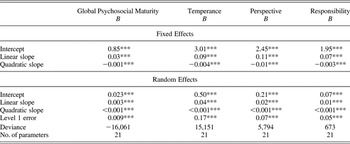
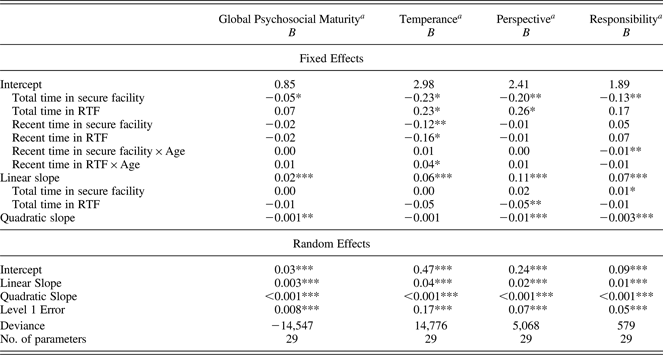
We first identified the average trajectories of the development of temperance, perspective, responsibility, and global psychosocial maturity from adolescence to early adulthood (see Table 1). The pattern of growth was identical for global psychosocial maturity and each dimension of psychosocial maturity. Growth models indicated a significant intercept, significant linear growth term, and significant quadratic growth term. On average, individuals increased in psychosocial maturity across adolescence, with gains in psychosocial maturity slowing as youth transitioned into early adulthood. It is important that there was significant individual variability both in the level of maturity (i.e., intercept) and the developmental rate of change (linear and quadratic rates of growth) over age (for more details, see Monahan et al., Reference Monahan, Steinberg, Cauffman and Mulvey2011).
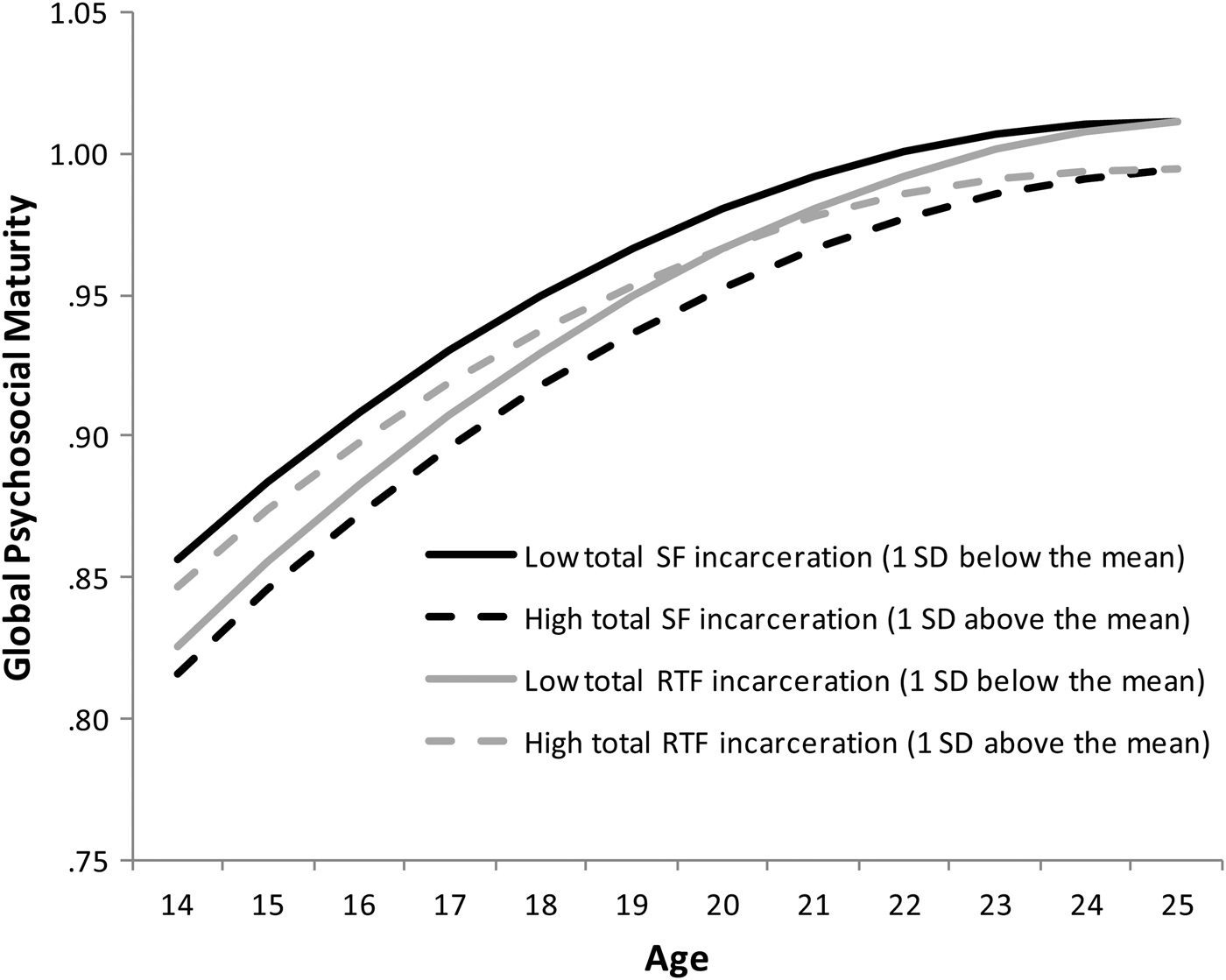
The impact of the total incarceration in a secure setting and residential treatment facility on global psychosocial maturity.

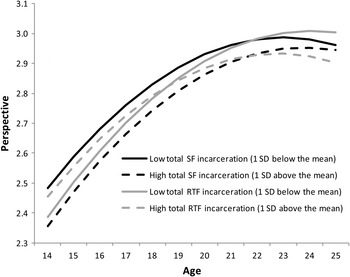
The impact of the total incarceration in a secure setting and residential treatment facility on perspective.

Unconditional multilevel models of global psychosocial maturity, temperance, perspective, and responsibility

***p < .001.
The impact of total time incarcerated in secure facilities and residential treatment facilities on psychosocial maturity
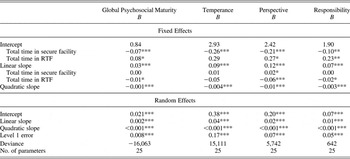
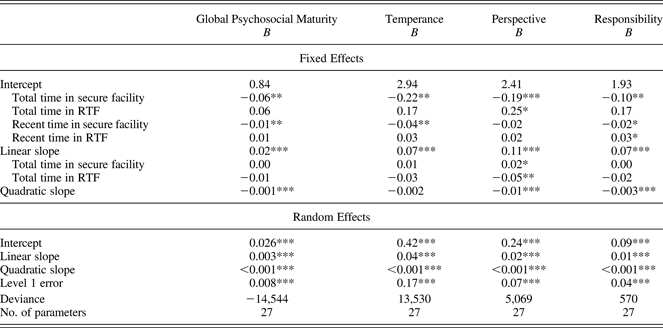
We next evaluated if the total proportion of time incarcerated in a secure facility or a residential treatment center over the 7-year study period explained individual variation in the (a) level or (b) rate of change of global psychosocial maturity, temperance, perspective, and responsibility (see Table 2). As a reminder, these and subsequent models estimated the effects of confinement in each respective facility type relative to no incarceration. Figure 3 illustrates the impact of the total proportion of time incarcerated in secure and residential treatment facilities on global psychosocial maturity. (The pattern of results is nearly identical for temperance and responsibility, but not perspective. For parsimony, we only illustrate this effect with global psychosocial maturity.) Figure 4 illustrates the impact of the total time incarcerated in secure and residential treatment facilities on perspective.
Impact of total time incarcerated in secure facility or RTF on global psychosocial maturity, temperance, perspective, and responsibility

Note: RTF, residential treatment facility. Total time in secure facility and total time in RTF variables are grand mean centered.
*p < .05. **p < .01. ***p < .001.
Compared to youths who were not incarcerated, those who spent more time in secure facilities over the course of the study evinced lower levels of psychosocial maturity at age 14. Greater time spent incarcerated in secure settings over the course of the study, however, was unrelated to the development of global psychosocial maturity, temperance, or responsibility from adolescence to early adulthood. It was unexpected, however, that youths who spent more time incarcerated in secure facilities had faster increases in perspective during the adolescent years than youths who were not incarcerated. As a result, the initial differences in perspective for youths who spent longer versus shorter time in a secure facility disappear by age 25 (see Figure 4).
In contrast to the effects of total confinement in a secure facility, youths who spent more time in residential treatment centers evinced higher levels of global psychosocial maturity, perspective, and responsibility at age 14. However, youths who spent more time incarcerated in a residential treatment facility over the 7-year study also demonstrated slower developmental gains in these measures of psychosocial maturity. As can be seen in Figures 3 and 4, the relative standing of youth incarcerated in a residential treatment setting for long versus short time changes over the age span of the study. Longer residential treatment facility incarceration at age 14 is associated with higher psychosocial maturity. This incarceration-related gain in psychosocial maturity disappears between the ages 18 and 20. After age 20, however, a longer total time in a residential treatment facility is associated with lower psychosocial maturity. Total time in residential treatment facilities was not associated with changes in temperance.
The impact of recent incarceration in secure facilities and residential treatment facilities on psychosocial maturity
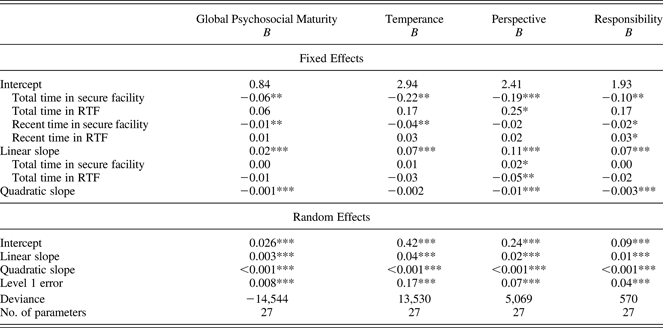
Next we investigated how incarceration in either a secure facility or a residential treatment facility during the time period immediately preceding the interview was associated with global psychosocial maturity, temperance, perspective, and responsibility (see Table 3). As in prior analyses, the effects of recent incarceration are tested compared to no incarceration.
Impact of recent time incarcerated in secure facility or RTF on global psychosocial maturity, temperance, perspective, and responsibility
Note: RTF, residential treatment facility.
*p < .05. **p < .01. ***p < .001.
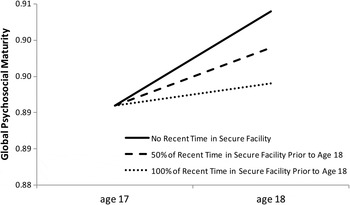
When youths had recently spent a greater amount of time in a secure facility, they evinced lower levels of global psychosocial maturity, temperance, and responsibility (but not perspective). That is, greater time spent in a secure setting appeared to arrest the development of global psychosocial maturity, temperance, and responsibility at the subsequent age. To illustrate this effect, Figure 5 shows the effect of being incarcerated in a secure facility 0% of the time since the prior interview, 50% of the time since the prior interview, and 100% of the time since the prior interview between ages 17 and 18 on global psychosocial maturity. The pattern of results is identical for other ages in the sample and for temperance and responsibility (in addition to global psychosocial maturity). For parsimony, we only show the effect at age 18 for global psychosocial maturity.
The impact of recent incarceration in a secure facility on global psychosocial maturity.

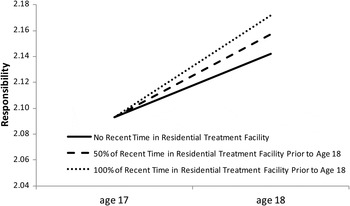
In contrast, recent time spent in a residential treatment facility (i.e., the amount of time spent in a residential treatment facility during the time period immediately prior to the interview) was not associated with subsequent maturity one way or the other, except in the case of responsibility. Longer incarceration in a residential treatment facility appeared to have a positive effect on subsequent responsibility, with longer time spent in a residential treatment facility associated with subsequently higher levels of responsibility. Figure 6 illustrates the effect of being incarcerated in a residential treatment facility 0% of the time since the prior interview, 50% of the time since the prior interview, and 100% of the time since the prior interview between ages 17 and 18 on responsibility. Note that this same pattern is found at all other ages in the sample.
The impact of recent incarceration in a residential treatment facility on responsibility.

We also tested if the effects of recent incarceration in a secure setting or in a residential treatment facility were sustained over time (i.e., if the effects of recent incarceration were sustained at later time points). The results indicated that the detrimental effects of incarceration in a secure setting on global psychosocial maturity, temperance, and responsibility and the positive effect of recent incarceration in a residential treatment facility on responsibility are only found immediately after that period of incarceration.Footnote 1
Age as a moderator of the impact of recent incarceration in secure facilities and residential treatment facilities on psychosocial maturity
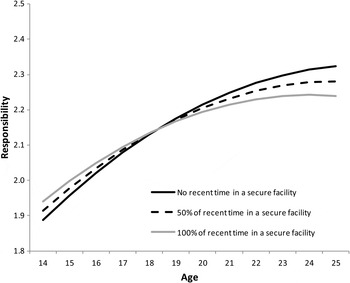
Next we investigated if the impact of recent incarceration in secure facilities or residential treatment facilities was moderated by the age of the individual (see Table 4). Specifically, we tested if incarceration in secure settings or residential treatment facilities might have stronger effects on psychosocial maturity if they occurred relatively earlier or later in development. The results indicated that age moderated the short-term effects of incarceration in a secure facility on responsibility and the short-term effects of incarceration in a residential treatment facility on temperance. Figure 7 demonstrates age-related changes in the short-term effect of incarceration in a secure facility on responsibility. Longer secure facility incarceration at age 14 is associated with higher subsequent responsibility. However, this incarceration-related boost in responsibility disappears by age 18. After age 18, incarceration in a secure facility leads to short-term declines in responsibility, however.
The effect of recent incarceration in a secure facility on responsibility at each age.

Age as a moderator of recent time incarcerated in secure facility or RTF on global psychosocial maturity, temperance, perspective, and responsibility
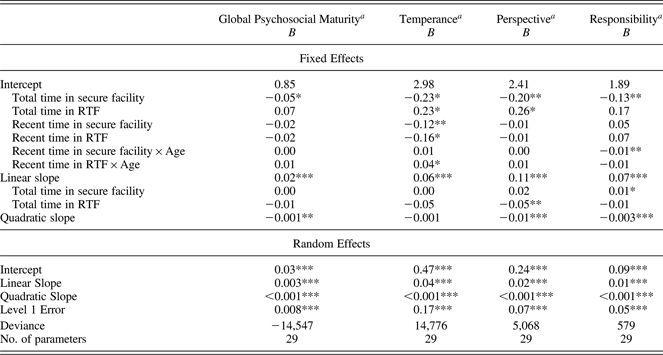
Note: RTF, residential treatment facility.
aIn order to aid model convergence, the interaction terms for the secure facility and RTF quality variables were tested in two separate models.
*p <. 05. **p < .01. ***p < .001.
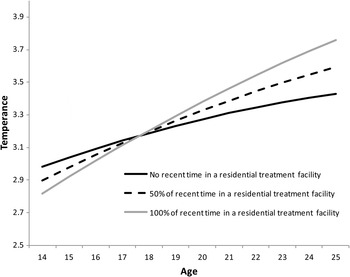
A different pattern of results emerged with respect to the short-term effects of residential treatment incarceration on temperance (Figure 8). In this case, longer incarceration in a residential treatment facility is associated with lower subsequent temperance among younger youths. This incarceration-related decline in temperance disappears by at 18, after which incarceration in a residential treatment facility is associated with increases in temperance. There were no other significant age-related interactions, indicating that the short-term negative effects of incarceration in a secure setting on global psychosocial maturity and temperance and the positive short-term effects of incarceration in a residential treatment facility on responsibility noted previously are consistent across age.
The effects of recent incarceration in a residential treatment facility on temperance at each age.

Facility quality as a moderator of the impact of recent incarceration in secure facilities and residential treatment facilities on psychosocial maturity
Finally, we tested if the impact of recent incarceration in a secure facility or a residential treatment center on subsequent level of global psychosocial maturity, temperance, perspective, and responsibility were moderated by the quality of the facility (i.e., if youths stayed in secure settings or residential treatment facilities with more negative features or more positive features).
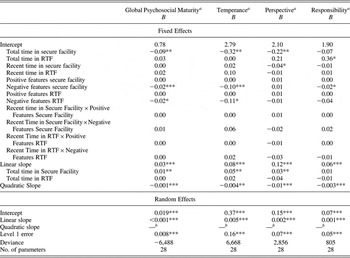
Although negative facility features were related to psychosocial maturity (main effects), neither positive nor negative facility features moderated the link between incarceration time and subsequent maturity (see Table 5).Footnote 2 Confinement in secure settings with more negative features was associated with lower subsequent levels of global psychosocial maturity, temperance, and responsibility compared to no incarceration. Similarly, incarceration in residential treatment centers with more negative features was associated with lower subsequent levels of global psychosocial maturity and temperance (relative to no incarceration), but not perspective or responsibility. Positive features of secure facilities and residential treatment facilities were unrelated to any of the subsequent measures of psychosocial maturity. However, the aspects of the facility context (either positive or negative) did not moderate the short-term effects of incarceration on the development of psychosocial maturity, suggesting that the length of time spent in a certain type of incarcerated setting and the characteristics of a given facility independently impact psychosocial maturity.
Facility context as a moderator of recent time incarcerated in secure facility or RTF on global psychosocial maturity, temperance, perspective, and responsibility

Note: RTF, residential treatment facility.
aIn order to aid model convergence, the interaction terms for the secure facility and RTF quality variables were tested in two separate models.
bThe variance component was omitted to aid model convergence.
*p < .05. **p < .01. ***p < .001.
Discussion
Little is known about the impact of incarceration on normative adolescent development. Given the existing literature on what facilitates positive development of psychosocial maturity, we would expect that the incarceration environment would impede the development of psychosocial capacities. Incarceration is an extreme departure from the normative adolescent socialization experience and has contextual features that may be reasonably hypothesized to lead to stunted development of psychosocial maturity. Specifically, because incarceration limits youths' opportunities to practice responsible judgment and places them exclusively among deviant peers, who are unlikely to be models of mature temperance, responsibility, or perspective, it is reasonable to hypothesize that the extreme socialization experience of incarceration may impact the development of psychosocial maturity.
Our results provide evidence that, in the short term, secure incarceration impacts the development of psychosocial maturity in ways consistent with such hypotheses. Incarceration in a secure facility was associated in the short term with a slowing of gains in global psychosocial maturity, temperance, and responsibility. It is surprising that the negative effect of incarceration in a secure setting increased with age. It is interesting, however, that we generally failed to observe meaningful sustained differences in maturity as a function of the total amount of time spent in secure confinement throughout the 7-year study period.
Taken together, the short- and long-term effects suggest that although secure incarceration impedes psychosocial development, the net effect is not cumulative and is short lived. It is notable that “total time incarcerated” reflects the number of months confined, but not the specific timing (so among youths confined for 2 years, some may have been confined during Years 1 and 2, whereas others may have been confined during Years 6 and 7, and still others may have been confined for multiple shorter periods). Thus, although the lack of an observed relation between the total number of months incarcerated in a secure setting and the net change in psychosocial maturity over 7 years indicates that the negative effects of incarceration observed in the short term may not be sustained in the long term, the average length of secure confinement (23 months) was relatively short compared to the overall study period, indicating that most subjects spent the majority of the time in nonconfined settings during which they (apparently) recovered from the negative impact of incarceration on their psychosocial maturity. It is also important to note that we found no support for the notion that incarceration in harsh settings promotes the development of self-control or responsibility, as has been asserted by proponents of boot camps and other similar institutions.
In contrast to our findings for secure incarceration, we find long-term negative effects of incarceration in residential treatment facilities on psychosocial maturity. Youths who spent a greater proportion of time incarcerated in a residential treatment facility over the course of the study showed slower net growth in psychosocial maturity, perspective, and responsibility. Thus, although youths placed in residential treatment facilities evinced higher age-14 scores on these three measures of psychosocial maturity, they reached young adulthood with lower global psychosocial maturity, perspective, and responsibility scores. The short-term effects of incarceration in a residential treatment facility were contrary to our expectations; that is, incarceration in a residential treatment facility temporarily bolsters the development of responsibility and temperance (among older youths).
We also find that youths who spend greater time in secure settings evince lower psychosocial maturity to begin with, whereas those who spend more time in residential treatment facilities report higher initial psychosocial maturity. It is likely that this reflects sorting at the time of adjudication, where judges make decisions about assignment to more or less punitive incarceration settings based on their (or their probation officers') perceptions of youths' temperance, perspective, and responsibility. Although we control for the history of prior offenses, our information is limited to the type and number of prior offenses, not the details of the offense. It may be that juveniles who are more impulsive, short-sighted, and susceptible to peer influence offend in ways that the courts perceive as especially dangerous, requiring longer incarceration in a secure setting.
Contrary to our original expectations, youths who spent more time in a secure setting showed faster overall growth of their perspective-taking abilities. However, this effect appears to be a function of longer-incarcerated youths catching up to nonincarcerated youths over time, rather than a true facilitative effect, because, as noted earlier, incarcerated youths begin with lower initial perspective scores. This pattern of findings may reflect regression to the mean, rather than a genuine positive effect of the secure confinement (especially given the observed short-term negative effects). Thus, we are hesitant to draw firm conclusions from this observation. Further research is necessary to understand this effect.
It is important to note that our failure to find a long-term stunting effect of incarceration in a secure setting does not definitively prove the absence of such an effect. Our findings may have been influenced by several factors. First, participants in this study were between the ages of 14 and 17 at the onset of the study. Given that two-thirds of the participants in this sample had previous arrest records prior to the beginning of the study, many of them had experienced incarceration prior to their baseline interview. It is possible that a youth's earliest incarceration experiences have the most profound effect on his trajectory of psychosocial maturity and that subsequent incarcerations have more limited effects. This may explain our ability to find a long-term negative effect for incarceration in the residential treatment facilities but not the secure facilities (where youths are more likely to have had previous incarceration experiences). Studies that include younger participants or are restricted to first-time offenders would be needed to confirm this. Second, because youths who receive the harshest placements are the least mature to begin with, they may have a poor psychosocial prognosis, regardless of their incarceration experiences. Finally, because youths who receive longer sentences in secure facilities are more immature to begin with, their regression to the mean might have masked any underlying effect of incarceration on the psychosocial maturity slope.
The effects of secure incarceration on the development of psychosocial maturity are apparent, however, when we consider the short-term impact of being locked up. Incarceration in secure confinement appears to temporarily disrupt the development of temperance and responsibility. Even though these effects are short term, it does not mean that they are not important. That youths who are the most immature to begin with receive the longest sentences in secure confinement, coupled with the finding that secure confinement disrupts their psychological functioning even further, has implications for public safety. If youths leave secure confinement even more impulsive and susceptible to peer influence, they have an elevated risk of rearrest, consistent with previous research associating harsher punishment with increased recidivism (Loughran, Mulvey, Schubert, Fagan, Piquero, & Losoya, Reference Loughran, Mulvey, Schubert, Fagan, Piquero and Losoya2009). Because repeat offenders are subject to harsher sentences, the short-term effects of incarceration may initiate a deleterious spiral, wherein the most immature youths are treated in ways that further dampen the development of psychosocial maturity.
Although the present study is strengthened by its longitudinal design, focus on a unique population, and highly detailed data on incarceration experiences, it is nevertheless limited in several respects. First, the present analyses were designed specifically to examine the effects of incarceration on psychosocial maturity. Whether incarceration affects juveniles' mental health, legal socialization, educational attainment, and other outcomes are important questions that are beyond the scope of this article. Second, because of the naturalistic nature of the study, we cannot completely disentangle the effects of incarceration from preexisting individual differences in psychosocial maturity. However, our finding that recent incarceration in secure settings is associated with a short-term decline in psychosocial maturity was tested over and beyond the youths' individual trajectories of psychosocial maturity, adding greater confidence to these findings. Third, our study relied on self-report measures both of facility experiences and psychosocial maturity. We are confident that our assessment of incarceration is as accurate as possible because of careful use of the life calendar method as well as our familiarity with the facilities (recall that confined youths were interviewed in the facility, so we had ample opportunity to corroborate youths' descriptions), but we have no similar validation of our self-report measures of psychosocial maturity (i.e., correlation with behavioral measures of similar constructs). However, we have no reason to expect that these reports are biased in ways that would create the particular patterns of findings observed here. Fourth and finally, we do not know if, given our sample, we observed a restricted range of psychosocial maturity or a different rate of change in psychosocial maturity that might have been observed among nonantisocial youth. However, given that the focus of the present study was to examine how incarceration impacts the development of psychosocial maturity, it is difficult to imagine finding a sample that would be more appropriate to study.
Despite these limitations, the results of our analyses have important implications for policy and practice. Given society's reliance on incarceration for its putative impact on public safety, incarceration will likely remain a reality for a considerable proportion of American youths, and disproportionately so for youths of color. However, our study indicates that steps can be taken to reduce the iatrogenic effects of incarceration on psychosocial maturity and to improve public safety by reducing recidivism. Such efforts should include enhanced efforts to ensure safe incarceration contexts. Future study is needed to test whether such efforts cannot only protect youths from the short-term negative effects of incarceration but also have an additional benefit of reducing juvenile offending.
Appendix A
Formulas of unconditional growth models
Level 1:

Level 2:
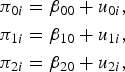
where Y ti is the outcome variable (i.e., global psychosocial maturity, responsibility, perspective, or temperance), for youth i at time t; β00 is the intercept, which is the value of the outcome at age 14; β10 is the linear rate of growth over age; and β20 is the quadratic rate of growth over age. Coefficients u 0i through u 2i (where significant) allowed for the estimation of variability in youth developmental trajectories of the outcome variables.
Appendix B
Formula of conditional growth model: Testing the impact of recent incarceration on psychosocial maturity
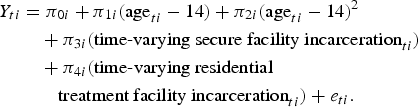
Level 1:
Level 2:
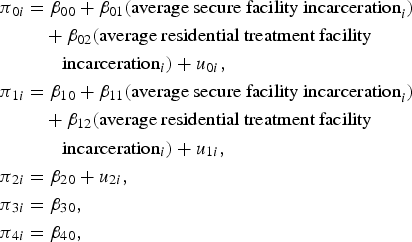
where β30 and β40 are the effects of incarceration in a secure facility and/or residential treatment facility during the preceding assessment interval on subsequent psychosocial maturity score, and β01 through β12 are the effects of the average amount of incarceration in a secure facility and a residential treatment facility over the course of the study on the psychosocial maturity intercept and slope. Thus, β30 and β40 estimate the immediate effects of incarceration on psychosocial maturity, β01 and β11 test whether less mature youths also tend to be incarcerated for longer times over the course of the study, and β02 and β12 examine whether youths with longer cumulative incarceration experiences tend to experience stunted development of psychosocial maturity.
Appendix C
Formula of conditional growth model: Testing the facility context as a moderator of the impact of recent incarceration on psychosocial maturity
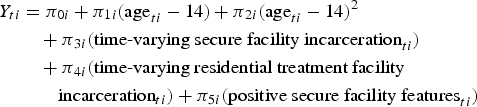
Level 1:
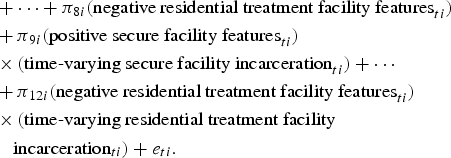
Level 2:

where β50–β80 represent the direct effect of the positive and negative features of secure and residential treatment facilities, and β90–β120 represent their interaction with the effect of stay for each of those two respective facility types.