1. Introduction
The choice of word order in speech production is influenced by a large array of factors, which are partly correlated with each other (Bresnan et al. Reference Bresnan, Cueni, Nikitina, Baayen, Boume, Krämer and Zwarts2007). A class of phenomena influencing the choice of word order relates to information structure. Several studies demonstrate that given information is more likely to precede new information (Clark & Haviland Reference Clark, Haviland and Freedle1977 and subsequent work). Another relevant factor relates to the inherent properties of referential expressions: Animate referents are more likely to precede inanimate referents (Bock & Warren Reference Bock and Warren1985, Prat- Sala Reference Prat-Sala1997, Scheepers Reference Scheepers1997, Branigan & Feleki Reference Branigan, Feleki, Hahn and Stoness1999, Prat-Sala & Branigan Reference Prat-Sala and Branigan.2000, Prat-Sala et al. Reference Prat-Sala and Branigan.2000, Scheepers et al. Reference Scheepers, Hemforth, Konieczny, Hemforth and Konieczny2000, van Nice & Dietrich Reference van Nice, Dietrich, Härtl and Tappe2003, Bornkessel et al. Reference Bornkessel, Zysset, Angela, Friederici, von Cramon and Schlesewsky2005). Beyond that, some linearization preferences are attributed to specific verbs. At least some of these preferences are not just idiosyncratic properties of individual lexical items; rather they appear with verb classes that share particular thematic properties. Experiencer-object verbs (often called psych verbs, for example, frighten, please, concern) are among the most intensively investigated of such verb classes, showing linearization preferences that crucially differ from the properties of canonical transitive verbs (compare Ferreira Reference Ferreira1994, Scheepers et al. Reference Scheepers, Hemforth, Konieczny, Hemforth and Konieczny2000, Verhoeven Reference Verhoeven2009, Lamers & de Schepper Reference Lamers and de Schepper2010).
The crucial claim is that particular preferences in linearization are attributed to the relational properties of the arguments, that is, experiencer-object verbs differ from canonical transitive verbs due to their thematic properties. The experiencer role is assigned to a participant who undergoes an event that affects consciousness, that is, an event involving emotion, cognition, volition, perception, or bodily sensation. Since consciousness is a prerequisite for being an experiencer, the experiencer is by definition animate. In contrast to an agent, an experiencer does not have control over the event. Next to the experiencer role many experiencer verbs license a stimulus argument; the stimulus is a rather heterogeneous role comprising the cause, target or subject matter of an experiential situation and can be either animate or inanimate (see Pesetsky Reference Pesetsky1995).
In German, experiencer-object verbs appear in two different casemarking subclasses, namely those taking a dative-marked experiencer argument such as gefallen ‘please’ and those with an accusative experiencer argument such as interessieren ‘concern’. Dative psych verbs are often analyzed as showing a basic dative-before-nominative order (for example, Lenerz Reference Lenerz, Viethen, Bald and Sprengel1977, Primus Reference Primus, Lang and Zifonun1996, Fanselow Reference Fanselow2001, Reference Fanselow2003, Haider & Rosengren Reference Haider and Inger2003, Haider Reference Haider2010). The word order properties of accusative psych verbs are not uncontroversial. With respect to basic word order, some accounts treat them on a par with dative psych verbs (Lenerz Reference Lenerz, Viethen, Bald and Sprengel1977, Haider & Rosengren Reference Haider and Inger2003, Bayer Reference Bayer2004), while other accounts consider them as canonical transitive verbs with a higher nominative argument (Fanselow Reference Fanselow, Stiebels and Wunderlich2000).
Knowing that several linearization principles, such as animate-first, given-first, and experiencer-first, depend on each other to some extent, the empirical question is whether there is a possible independent influence of thematic roles. This is the challenge of the present article, which presents a large-scale corpus study designed to detect the influence of verb classes on linearization. The article proceeds as follows: Section 2 summarizes the crucial assumptions about the coding of argument structure and the linearization of arguments in German, and outlines the positions that have been taken regarding experiencer verbs in the previous literature. The research questions are presented in detail in section 3, while the design of the corpus study is explicated in section 4. The following sections report the findings of the corpus study: Section 5 investigates the frequencies of pronominal realization of subject and object arguments of the investigated verbs; section 6 examines word order as dependent on the animacy, thematic role, and definiteness of the verbal arguments; section 7 analyzes the choice of active versus non-active verb forms in light of the same factors. The results outlined in these sections are discussed in detail in section 8, while section 9 provides general conclusions and highlights the findings of the present study.
2. Background on the Grammar of Experiencers
2.1. The Syntax of Experiencer Verbs
Experiencer-object verbs, also called psych verbs, constitute a special class of verbs whose syntactic structure has been argued to differ from that of canonical transitive verbs.Footnote 1 Starting with the seminal paper by Belletti & Rizzi (Reference Belletti and Rizzi1988), several analyses have been proposed to account for the peculiar syntactic properties of psych-verbs (see Grimshaw Reference Grimshaw1990, Bouchard Reference Bouchard1995, Pesetsky Reference Pesetsky1995, Reinhart Reference Reinhart, Hastings, Jackson and Zvolenszky2001, Landau Reference Landau2010, among others).
Three classes of experiencer verbs have generally been distinguished (Belletti & Rizzi Reference Belletti and Rizzi1988): One class includes experiencer-subject verbs, for example, love, hate, fear, etc., which code the experiencer as subject and the stimulus as object. Two other classes include experiencer-object verbs that code the experiencer either as an accusative object (for example, frighten, annoy, concern) or a dative object (for example, appeal to), while the stimulus functions as the subject. In the sense of Bickel Reference Bickel2004, object-experiencers are so-called downgraded experiencers, including experiencer arguments coded by structural means normally used for objects, such as dative or accusative case, and adpositional marking.
In many languages, among them German, it has been observed that experiencer-object arguments display subject-like properties, often called psych properties. These properties include peculiarities in nominalization, reflexivization, passivization, extraction, binding, and argument linearization, among others (see Grewendorf Reference Grewendorf1989, Wunderlich Reference Wunderlich1997, Fanselow Reference Fanselow, Stiebels and Wunderlich2000, Haspelmath Reference Haspelmath, Aikhenvald, Dixon and Onishi2001, Klein & Kutscher Reference Klein and Kutscher2002, Bayer Reference Bayer2004). Crucial for the purposes of this article, experiencer-object verbs display particular linearization preferences: For instance, in German it has been shown that both orderings (SSTIM ≺ OEXP and OEXP ≺ SSTIM) are equally acceptable with accusative experiencer-object verbs, while with dative experiencer-object verbs there is a preference for an early realization of the experiencer as opposed to the stimulus (Haupt et al. Reference Haupt, Schlesewsky, Roehm, Angela and Bornkessel-Schlesewsky2008:84, confirming earlier observations from Lenerz Reference Lenerz, Viethen, Bald and Sprengel1977, Hoberg Reference Hoberg1981, Primus Reference Primus, Kailuweit and Hummel2004).
The subject-like behavior of some object-experiencers can be accounted for by assuming that dative and (at least some) accusative experiencers occupy a higher position than the nominative stimulus in the derivational structure of the clause. Works such as Belletti & Rizzi Reference Belletti and Rizzi1988 propose an unaccusative analysis for both dative and accusative experiencer-object verbs, where the experiencer occupies a higher position in the VP than the stimulus. Since Belletti & Rizzi's (Reference Belletti and Rizzi1988) original proposal, several adaptations of this analysis have been proposed. Among the most important is Pesetsky Reference Pesetsky1995, which identifies the potential causal nature of the accusative experiencer-object verbs and explains their argument linking by assuming that the causer originates in a higher position than the experiencer.
The more recent analysis in Landau Reference Landau2010 combines the insights of both approaches: In this analysis, all stative experiencer-object verbs (dative and accusative) receive an unaccusative account, while the eventive accusative experiencer-object verbs with causative/agentive readings have a higher causer argument and a lower experiencer argument. Analyses of German experiencer-object verbs in general follow the unaccusative approach, either for the dative verbs only (Wegener Reference Wegener and Vuillaume1998, Fanselow Reference Fanselow, Stiebels and Wunderlich2000, Reference Fanselow2003) or extending it to the accusative verbs as well (Grewendorf Reference Grewendorf1989).
Crucially, the noncanonical properties of the experiencer-object verbs depend on case and agentivity. While experiencer verbs selecting a dative experiencer are necessarily nonagentive, verbs that select an accusative experiencer can be either agentive or nonagentive: The verb is agentive if the stimulus has control over the event, and this configuration is only possible with animate stimuli (see example 1a versus 1b).
- (1)
a. Maria ärgerte Peter (absichtlich).
‘Maria annoyed Peter (intentionally).’
b. Marias Fragen ärgerten Peter (⋆absichtlich).
‘Maria's questions annoyed Peter (⋆intentionally).’
c. Maria interessierte Peter (⋆absichtlich).
‘Maria concerned Peter (⋆intentionally).’
d. Marias Fragen interessierten Peter (⋆absichtlich).
‘Maria's questions concerned Peter (⋆intentionally).’
The distinction between ±agentive and strictly nonagentive experiencer-object verbs depends on the particular verb. While verbs such as ärgern ‘annoy’ and überraschen ‘surprise’ have agentive and non-agentive readings depending on the context and the animacy of the stimulus, a few verbs such as interessieren ‘concern’, freuen ‘please’, or wundern ‘astonish’ are strictly nonagentive. With such verbs, an animate stimulus cannot be interpreted as agentive, that is, as bringing about the event denoted by the verb (see examples 1c,d).
Noncanonical syntactic behavior of experiencer objects manifests itself only under nonagentive readings of experiencer-object verbs; under agentive readings experiencer objects display canonical syntactic behavior (see Arad Reference Arad1998a, Reference Arad1998b; Landau Reference Landau2010). Since agentivity is restricted to animates (as shown in 1), an interaction with animacy is observed consistently in these phenomena.
2.2. Diathesis Relations
One of the peculiarities of transitive experiencer-object verbs is their behavior with respect to passivization. In German, regular passives are prototypically dynamic and agentive (see Zifonun Reference Zifonun and Hoffmann1992). This property interacts with the agentivity of experiencer-object verbs in such a way that a regular eventive passive (by means of the passive auxiliary werden ‘become’) of a ±agentive experiencer-object verb can only be formed under the verb's agentive reading. Thus, a regular passive is only grammatical with an animate stimulus, as in 2a, and not with an inanimate stimulus, as in 2b. Nonagentive experiencer-object verbs such as interessieren ‘interest’ do not form such a passive at all.
(2)

Next to the regular passive, German has a stative adjectival passive formed with the copula and the passive participle, also illustrated in example 2. A stative passive can be formed from ±agentive experiencer-object verbs with either an animate or an inanimate stimulus, as in 2a and 2b, respectively. Similarly, stative passives do not require an agentive interpretation, and hence nonagentive experiencer-object verbs such as interessieren ‘interest’ may form a stative passive, in which the stimulus is expressed as a prepositional adjunct (not a passive agent), as in 2c.
In many languages, transitive (accusative) experiencer-object verbs are more or less systematically related to anticausative (=deagentive) experiencer-subject verbs. This also applies to German, evidenced by verb pairs such as interessieren ‘concern’ ∼ sich interessieren ‘be concerned’, freuen ‘please’ ∼ sich freuen ‘be pleased’, ängstigen ‘frighten’ ∼ sich ängstigen ‘be frightened’, wundern ‘astonish’ ∼ sich wundern ‘be astonished’, ärgern ‘bother’ ∼ sich ärgern ‘be bothered’, etc. In these cases, anticausativization is marked by the reflexive marker sich.
For the present investigation, diathetic alternations are relevant insofar as a choice among alternative diathetic forms is possible in order to express the same situation. It has been shown in previous studies that the choice of voice is influenced by several factors, such as animacy, thematic role, salience or givenness (see, for example, Ferreira Reference Ferreira1994, Tomlin Reference Tomlin, Downing and Noonan1995, Prat-Sala Reference Prat-Sala1997, van Nice & Dietrich Reference van Nice, Dietrich, Härtl and Tappe2003, Skopeteas & Fanselow Reference Skopeteas, Fanselow, Zimmerman and Féry2009 on German). The special property of experiencer-object verbs is that transitive experiencer-object verbs alternate with intransitive anticausative experiencer-subject verbs, for example ‘x worries y’ versus ‘y worries about x’ (Belletti & Rizzi Reference Belletti and Rizzi1988, Pesetsky Reference Pesetsky1995, Reinhart Reference Reinhart, Hastings, Jackson and Zvolenszky2001, among others).Footnote 2 It is not clear whether the choice between these latter alternations depends on the factors that have been reported to influence the choice of voice in general (such an investigation is presented in section 7).Footnote 3
2.3. The Source of Experiencer-First Effects
The challenge in the investigation of experiencer-object verbs is to determine the source of the exceptional behavior of that group of verbs. As a starting point, two extreme positions are formulated in 3. Whether the syntactic explanation in 3a or the functional explanation in 3b holds true is an empirical question, and it is very likely that the answer to this question will not be the same for all subsets of experiencer-object verbs.
(3)
a. Syntactic hypothesis: The peculiarities of experiencer-object verbs in linearization are the result of their thematic structure.
b. Functional hypothesis: The peculiarities of experiencer-object verbs in linearization result from the impact of factors affecting linearization (such as animacy and topicality).
The hypothesis in 3a corresponds to the core claim of syntactic accounts of experiencer verbs (see section 2.1) that explain the exceptional properties of these verbs as a reflex of the syntactic derivation of experiencer objects. Under the alternative hypothesis in 3b, at least some properties of experiencer verbs are explained by the functional properties of their arguments, that is, their animacy properties (Bouchard Reference Bouchard1995), and/or their discourse prominence and its correlates in topicality (Haspelmath Reference Haspelmath, Aikhenvald, Dixon and Onishi2001, Bickel Reference Bickel2004).
The relevance of animacy for the linearization of experiencer and stimulus has been demonstrated convincingly in diverse experimental studies. The rate of an early realization of the object-experiencer, either through object preposing or through passivization, increases significantly in asymmetric animacy constellations, that is, when the stimulus is inanimate (see Ferreira Reference Ferreira1994, Scheepers et al. Reference Scheepers, Hemforth, Konieczny, Hemforth and Konieczny2000, Verhoeven Reference Verhoeven2009, Lamers & de Schepper Reference Lamers and de Schepper2010). However, as outlined in section 2.1, the factors (in)animacy and (non)agentivity affect the behavior of accusative object-experiencer verbs and thus need to be systematically separated. As this has not been done in most studies, the contribution of each of these two factors to the resulting pattern cannot be identified in those cases.
Similarly, the relational properties of the participants of psych verbs, that is, their involvement in the event in terms of thematic roles, have been tested for their impact on syntactic construction. Experimental studies show that experiencers tend to be realized early in the clause, or in a higher syntactic function. Evidence for an early realization of the experiencer through passivization has been reported for English in production and comprehension studies (see Ferreira Reference Ferreira1994, Piñango Reference Piñango, Grodzinsky, Shapiro and Swinney2000, Cupples Reference Cupples2002). For languages such as German, Dutch, and Modern Greek, experimental as well as corpus studies report prominence effects of object experiencers related to word order (for example, Primus Reference Primus1994, Scheepers Reference Scheepers1997, Hoberg Reference Hoberg1981, Scheepers et al. Reference Scheepers, Hemforth, Konieczny, Hemforth and Konieczny2000, Bornkessel Reference Bornkessel2002, Kempen & Harbusch Reference Kempen, Harbusch, Pechmann and Habel2004, Lamers Reference Lamers, Los and van Koppen2007, Bornkessel-Schlesewsky & Schlesewsky Reference Bornkessel-Schlesewsky and Schlesewsky2009, Verhoeven Reference Verhoeven2009, Bader & Häussler Reference Bader and Häussler2010, Lamers & de Hoop, Reference Lamers, de Hoop, MacWhinney, Moravcsik and Malchukovforthcoming). These effects are reminiscent of the animacy effects and indeed may be in part due to the fact that experiencers frequently outrank stimuli in the animacy hierarchy.
Finally, prominence effects of experiencers in terms of early occurrence and high syntactic function have been related to the so-called natural topicality of the experiencer vis-à-vis the stimulus (Haspelmath Reference Haspelmath, Aikhenvald, Dixon and Onishi2001, Bickel Reference Bickel2004). However, this observation has been essentially made on intuitive grounds, and systematic empirical evidence for this claim is still pending (one exception being the small corpus study on dative experiencer verbs in Nepali in Ichihashi-Nakayama Reference Ichihashi-Nakayama and Genetti1994).
2.4. German Clause Structure and Word Order
The finite verb in declarative main clauses in German obligatorily surfaces in the second position in the clause, which determines two clausal domains: i) the middlefield, that is, the domain following the finite verb and preceding the (potential) nonfinite verb, and ii) the prefield (Spec, CP), namely the position preceding the finite verb, which has to be filled by exactly one constituent.
Argument order in the middlefield has been shown to be influenced by factors such as animacy, thematic role, definiteness, focus, case, etc. (see Lenerz Reference Lenerz, Viethen, Bald and Sprengel1977, Hoberg Reference Hoberg1981, Bader & Häussler Reference Bader and Häussler2010, and many more). Argument order variation within the middlefield has been explained as resulting from scrambling (Webelhuth Reference Webelhuth1995, Müller Reference Müller1999) or as reflecting alternative base generated orders (Haider Reference Haider1993, Heck Reference Heck2000, Fanselow Reference Fanselow2001). Furthermore, argument order in the middlefield is constrained (independently of the abovementioned factors) when nominative (unstressed) personal pronouns are involved: These obligatorily occupy the position immediately following the finite verb (C0) whenever they are realized in the middlefield.
The prefield is obligatorily filled, which induces formal movement of the first eligible element within the middlefield (see Frey Reference Frey, Valéria and Susanne2006). The first eligible constituent is the highest one, that is, the subject constituent or a constituent scrambled past the subject; since the operation that displaces this constituent to the prefield is purely formal (that is, semantically vacuous), it does not involve any semantic or pragmatic features in addition to those that triggered the scrambling of the highest middlefield constituent. Next to formal movement, two further possibilities to fill the prefield have been identified: base generation of certain adverbials and A-bar movement, the latter indicating a contrastive interpretation of the moved material.
The profound difference between argument order in the prefield and the middlefield has been empirically proven in a number of studies, most recently in Bader & Häusler Reference Bader and Häussler2010. This study shows that object occurrence in the prefield is mainly driven by information structure, while object preposing (early position of the object; object < subject) in the middlefield is due to lexical-semantic reasons (including both verb semantics and animacy of the verbal arguments). Furthermore, it is shown that the order object < subject is rare with accusative objects and more frequent with dative objects, when both arguments are lexical NPs. With accusative objects, the order object < subject is significantly more frequent in the prefield than in the middlefield, while the difference between the clausal domains is not significant with dative objects (Bader & Häussler Reference Bader and Häussler2010:727).
In sum, argument order in the prefield versus the middlefield is governed by different rules, and thus these domains of clause structure need to be considered separately in a study of argument order in German.
3. Research Questions
The central question of the present study is whether the fronting of the experiencer arguments relates to their thematic properties, or whether it is reducible to other properties that are characteristic of these arguments. Experimental studies in languages such as German, Dutch, English, or Greek show that the fronting of experiencer-objects is a genuine property of these arguments since it is also manifested in configurations that do not involve asymmetries in terms of animacy or information structure (see Ferreira Reference Ferreira1994, Scheepers et al. Reference Scheepers, Hemforth, Konieczny, Hemforth and Konieczny2000, Verhoeven Reference Verhoeven2009, Lamers & de Schepper Reference Lamers and de Schepper2010). Experiencer objects frequently outrank the corresponding subjects on the animacy hierarchy. Since animates are more likely to be discourse topics, I assume that a proportion of fronted experiencer-objects is certainly fronted for discourse-related reasons.
Thus, the question at issue is to what extent the phenomenon of experiencer-object fronting is explained by the mediation of further factors—such as animacy and information structure—that have an impact on linearization. The abovementioned studies tested the impact of animacy on linearization and subject choice with experiencer verbs. Naturalistic data provide another rich source of potential evidence for the impact of discourse-related factors and hence should be considered in answering the research question.
In order to identify the discourse-related factors that may induce experiencer-object fronting, one needs to empirically test the assumption that experiencers are likely discourse topics. The answer to this question would determine the course of further investigation: If one wants to claim that experiencer fronting is just one of several phenomena that relate to the preferred discourse function of experiencers, one needs to show that the assumption about the discourse status of experiencers is valid. The next aim is to disentangle the sources of the experiencer-fronting effects: It has to be examined to what extent experiencer fronting is independent from animate-first or given-first effects. Finally, and assuming that experiencer-first effects exist, one should address the question whether these effects relate to a preference for the early realization of the experiencer role, and whether this preference can be satisfied by a marked word order or by a diathetic alternation of the verb. The research questions of this study are summarized in 4.
- (4)
a. Are experiencer-objects likely discourse topics?
b. Is there an experiencer-first effect, and if so, is it independent from other semantic and pragmatic asymmetries?
c. Is the frequency of noncanonical orders with experiencer-object verbs part of a general preference for the earlier realization of experiencers?
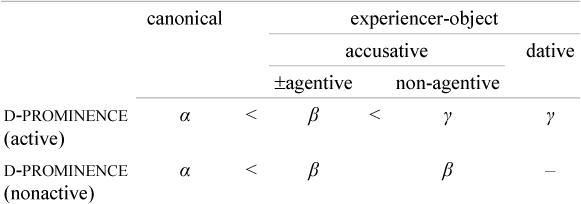
There are different classes of experiencer-object verbs, and there is no reason to expect that these classes would exhibit a uniform behavior with respect to the phenomena at issue. In particular, I compare canonical transitive verbs with dative and accusative experiencer-object verbs. Within the latter group of verbs, I examine nonagentive experiencer-object verbs and experiencer-object verbs that are not specified for agentivity (see section 2.1). Several empirical situations may become relevant to the questions in 4: i) If the crucial feature lies in case marking, then one expects a contrast between dative objects and accusative objects (experiencers and patients; see case model in 5); ii) if the crucial feature relates to the undergoer argument, then one expects experiencer objects (bearing any case) to contrast with patients (see undergoer model in 5); iii) if the crucial feature relates to the thematic properties of the actor, that is, the agent/stimulus, then one expects a contrast between the verbs that can be agentive and the verbs that exclude an agentive interpretation (see actor model in 5). The models in 5 are postulated in an abstract manner that I apply to different phenomena: The symbol “<” stands for an asymmetry in the occurrence of an experiencer-relevant property.
(5)
The basic models in 5 account for the three possible splits between the four categories at issue. Complex empirical situations are also possible, as exemplified in 6, implying that more than one factor in 5 is at issue.
(6)
In order to answer the questions in 4, I examined a large corpus of written German. The methodological decisions for the sampling procedure, the annotation of the data, and the data analysis are presented in section 4. The following sections delineate the corpus data: Section 5 presents the frequencies of personal pronouns and their implications for the question in 4a. Section 6 deals with the question in 4b and examines the frequencies of word orders. Finally, section 7 is devoted to the question in 4c and examines the frequencies of diathetic alternations within the verb classes at issue. Section 8 discusses the implications of the observations based on the corpus for the research questions of this article.
4. Method
4.1. Relation to Prior Corpus Studies
There is a long history of quantitative corpus studies on German word order that constitute the empirical background of the present study. Hoberg Reference Hoberg1981 is the first study in this spirit examining written texts (from the Mannheimer Corpus) that shows a clear asymmetry between SO and OS sentences in written German. This study identifies the crucial role of animacy, case (different behavior of accusative and dative arguments), and the particular word order preferences of pronouns in determining word order distributions in the German middlefield.
Similar results are contributed by the later and larger corpus study in Kempen & Harbush Reference Kempen and Harbusch2005, which investigates determinants of word order variation in the NEGRA II and the TIGER corpus. An addition to the importance of pronominal realization and case for argument order in the middlefield, these authors identify animacy, definiteness, and referential ease as triggers for argument reordering. Another large recent corpus study on word order in German (based on the newspaper corpus of the IDS) is Bader & Häussler Reference Bader and Häussler2010. This study pays particular attention to the factors determining OS order, which are investigated based on a special OS corpus composed for this purpose. The authors show, among other things, that OS order in the middlefield is triggered by lexical-semantic factors, such as animacy and verb semantics. In contrast, OS order with O realization in the prefield is due to discourse-related constraints (such as topic-first) and lexical-semantic factors in equal measure.
Next to these large-scale studies, there are a number of corpus studies addressing more specific questions. Some of them focus on more specific argument constellations or factors. The scope of others is limited to specific syntactic domains, that is, prefield or middlefield (see, for example, Primus Reference Primus1994, Heylen & Speelman Reference Heylen, Speelman, Archer, Rayson, Wilson and McEnery2003, Kempen & Harbush Reference Kempen, Harbusch, Pechmann and Habel2004, Weber & Müller Reference Weber and Müller2004, Heylen Reference Heylen2005).
The present work contributes to this rich research paradigm by focusing on the role of different verb classes in determining word order variation. By observing argument order in relation to particular verb classes, I want to be able to formulate more fine-grained statements about the influence of argument properties on word order preferences in speech production. Based on intuition data, syntactic studies have claimed that the thematic properties of the arguments have an impact on argument order. The aim of the present corpus study is to examine whether these claims are confirmed by speech production as reflected in corpora. Some differences have already been reported in previous studies (see, for example, Bader & Häussler Reference Bader and Häussler2010 on the identification of particular verbs and verb classes such as experiencer-object verbs being associated with OS order; see also Lenerz Reference Lenerz, Viethen, Bald and Sprengel1977 for this observation). The present study examines exactly these differences using a rich database and disentangles the effects of the thematic properties of the arguments from the effects of other relevant factors. In addition, the present study examines the impact of factors that have an influence on linearization with respect to the choice of subject along with the choice between active and passive voice: It has been shown that passive formation provides an alternative to the canonical configuration in which the actor precedes the undergoer (see Mathesius Reference Mathesius and Vachek1975, Prat-Sala Reference Prat-Sala1997, van Nice & Dietrich Reference van Nice, Dietrich, Härtl and Tappe2003 on German).
4.2. Choice of Verbs
In order to answer the research questions in 4, I compared the constructional behavior among verbs belonging to four different verb classes. The focus of the present study is on experiencer-object verbs, for which the experiencer constituent may be either an accusative or a dative object. Accusative experiencer-object verbs are further divided into ±agentive and nonagentive, since this distinction is crucial for syntactic assumptions (see section 2.1). In sum, there are three interesting classes of experiencer objects: Experiencer objects of ±agentive transitive verbs, experiencer objects of nonagentive transitive verbs, and dative experiencer-objects. The behavior of the verbs that belong to experiencer-object verb classes was compared with that of canonical transitive verbs in order to detect deviations from the neutral pattern.
For each of these classes, I examined 10 sample verbs. There are not many dative experiencer-verbs in German. For the purposes of this study, I selected the verbs in 7 from a larger group of 33 verbs mentioned in the literature (Klein & Kutscher Reference Klein and Kutscher2002). I excluded verbs occurring rarely in written texts (for example, dämmern ‘begin to dawn on somebody’, stinken ‘be cheesed off with’) and verbs with frequent homonymic forms (for example, auffallen ‘catch someone's eye’, entfallen ‘slip someone's mind’).Footnote 4
(7) Dative experiencer-object verbs
behagen ‘be to so.'s liking’, einfallen ‘come to mind’, einleuchten ‘make sense to so.’, gefallen ‘please’, imponieren ‘impress’, leidtun ‘feel bad about’, missfallen ‘displease’, nahegehen ‘affect so.’, schmecken ‘taste’, widerstreben ‘be reluctant to’
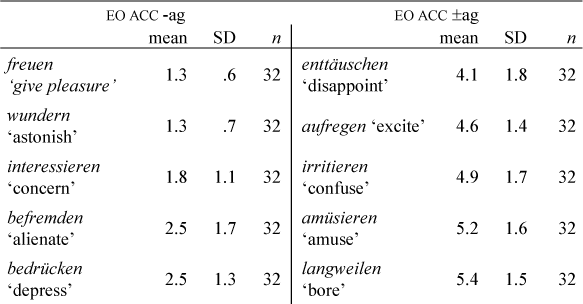
The subclassification of accusative experiencer-object verbs in ±agentive and nonagentive is not uncontroversial. Speakers (and linguists) vary in their intuitions about the semantic properties of individual verbs. For this reason, I created an inventory of 20 accusative experiencer-object verbs and conducted an acceptability test for the division of this inventory into two subgroups. Native speakers of German were instructed to judge the well-formedness of control-test sentences on a 1-to-7 estimation scale (1=very bad; 7=very good; see illustrative example with the experiencer-object verb erstaunen ‘astonish’ in 8). The experiment was performed online (created with OnExp 1.2; http://onexp.textstrukturen.uni-goettingen.de/). Each speaker was presented with all 32 verbs and asked to evaluate each verb once. The test sentences were pseudo-randomized. Thirty-two native speakers participated in this study in July 2013 (20 female, age range: 17–52, age average: 25.7).
(8)
The obtained results are summarized in table 1. In the following analyses, the 10 verbs with the higher scores are classified as EO ±agentive verbs, while the 10 verbs with the lower scores are classified as EO -agentive verbs.
Agentivity of accusative experiencer-object verbs.

The canonical transitive verbs in this study serve as a control group. It is crucial that I do not make generalizations about the typical behavior of canonical transitive verbs but examine whether particular properties are associated specifically with experiencer-object verbs or whether they equally apply to other verbs, without an experiencer object. For this purpose, I selected the verbs in 9.
(9) Canonical transitive verbs
beeinträchtigen ‘impair’, behindern ‘hinder’, blenden ‘blind’, infizieren ‘infect’, heilen ‘cure, remedy’, retten ‘rescue’, schützen ‘protect’, vergiften ‘poison’, wecken ‘wake’, zerquetschen ‘squash’
These verbs occur within similar animacy configurations as experiencer-object verbs, that is, they occur with an animate undergoer and allow for an animate or inanimate actor. They involve the affectedness of an animate undergoer, but in contrast to experiencer-object verbs, they do not denote a cognitive or emotional process that takes place within the consciousness of the affected animate entity.
4.3. Sampling
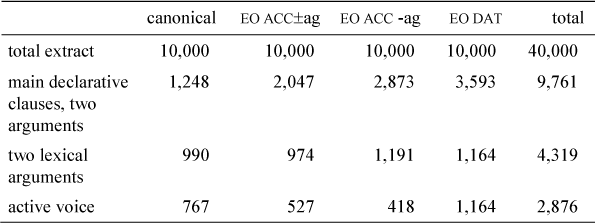
I extracted a dataset of 40 (verbs)×1,000 (tokens)=40,000 tokens from the IDS corpus (COSMAS-Database, Corpus W-öffentlich, containing a total of 2,291,520,000 word forms).Footnote 5 The tokens for each verb were extracted by using the randomization function of the web interface on lemma-based queries for each verb. Further properties of the data in order to identify the critical datasets for the hypotheses at issue were manually annotated. I restricted the sample to main declarative clauses with two (lexical, pronominal or clausal) arguments, in which the respective verb occurs in a finite form (including infinitives and participles only if they are part of a periphrastic tense form, for example, future and perfect). This excludes occurrences of the target verbs in subordinate clauses, questions, exclamatives, headlines, etc., as well as sentences in which the verbs at issue occur without two overtly realized arguments. For experiencer-object verbs in particular, I excluded nonexperiential occurrences of the verbs in the inventory. The subset of valid tokens contains 9,761 sentences (24.4% of the entire dataset). This is shown in the second row of table 2 (classified according to verb class).
Categories in the corpus.
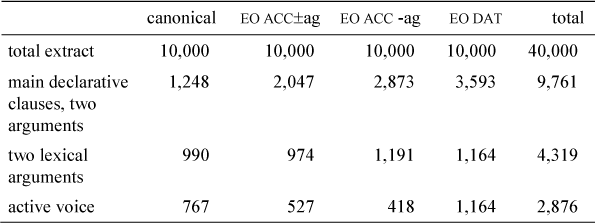
To test the hypotheses, in section 7 I use the subset of tokens that display two arguments realized as lexical noun phrases, which is a dataset of 4,319 sentences (44.2% of the tokens with two arguments). This is shown in the third row of table 2. In section 6, I examine the word order option within the subset of active clauses in this dataset, which comprises 2,876 sentences (66.6% of the sentences with two lexical arguments). This is shown in the fourth row of table 2.
4.4. Annotation and Data Analysis
The valid tokens were annotated for word order, diathesis, and two properties of noun phrases, namely, animacy and NP-type. Two word order properties are relevant for the purposes of this study, namely, the order between subjects and objects/nonsubjects and the field in which these arguments appear. With respect to the relative order, I distinguish between sentences in which the subject precedes the object (SO) or vice versa (OS), as shown in 10a,b versus 10c,d. My use of the term subject (S) is in line with the traditional understanding of the term in German grammar, that is, it is always the nominative argument. Crucially, this is not a claim about the syntactic status of non-nominative experiencers (see section 2.1). The notion of object (O) comprises objects of canonical verbs as well as accusative or dative (object) experiencers. Furthermore, I use the term nonsubject for agent and stimulus phrases in nonactive constructions (for example, Die Malerin ist von den Naturgestalten fasziniert ‘The paintress is fascinated by the natural figures’) or in constructions with anticausative experiencer verbs (for example, Die Staatssicherheit interessiert sich für den Regisseur ‘National security is interested in the producer’). The factor field refers to the position of the arguments in the clausal domains determined by the finite verb. I distinguish two cases that are relevant for German syntax (see section 2.4): Either both arguments are in the middlefield of the clause, that is, they follow the finite verb (see 10b,d), or one argument (S or O) occupies the prefield, that is, the syntactic position preceding the finite verb (see 10a,c).
(10)
The feature diathesis has two possible values in my scheme, namely “active” and “nonactive” (see 11). The verbs in the sample occur in either active or nonactive forms, except for the dative EO verbs that only occur in the active. The nonactive value comprises dynamic passives of transitive verbs (Er wurde enttäuscht ‘He was disappointed’), stative passives (Er ist enttäuscht ‘He is disappointed’) as well as anticausatives (Er interessiert sich für etwas ‘He is interested in something’).
(11)
With respect to the inherent properties of the arguments, I concentrate on two features that are crucial for the research questions in 4 and can be annotated in a large corpus, namely, animacy (animate versus nonanimate) and NP-type (pronominal versus lexical; definiteness of lexical NPs). A factor that is known to have an influence on German word order and is not included in my annotation scheme is information structure, in particular focus and topic (see section 2.4). Although these concepts are certainly crucial for the choice of word order in German, the annotation of observational data for information structural categories is by no means straightforward. They can be approximated by indirect measures, most importantly by the availability of a referent in the preceding text (Givón Reference Givón1994, Weber & Müller Reference Weber and Müller2004, Gundel et al. Reference Gundel, Hedberg, Zacharski, Branco, McEnery and Mitkov2005, Bresnan & Hay Reference Bresnan and Hay2008). However, they cannot be unambiguously determined by contextual cues, since speakers have the choice between different information structures under identical contextual conditions. In the present large-scale corpus study, I did not annotate the contextual categories. The distinction between definiteness levels is expected to be an indicator of contextual influences: Definiteness correlates with givenness, such that definite descriptions are more likely to apply to given referents than indefinite descriptions.Footnote 8
animacy properties are known to play an important role in word order and are necessary for my annotation scheme because they enable to disentangle the effects of animacy and the pure effect of experiencer-objects (see research question in 4b). I annotated animacy as a binary feature for each argument with the following values: “animate” and “inanimate” referent. So-called metonymically used animates such as institutions, organizations, etc. that participate in the same events as animate beings and may exercise control over events as conscious entities (for example, Verband ‘organization’, Behörde ‘public authority’, Firma ‘company’, Regime ‘regime’, etc.) were annotated as ‘animates’ (see also Bader & Häussler Reference Bader and Häussler2010:730, who show that this class of NPs behaves like animates).
NP-type refers to the distinction between lexical and pronominal NPs and the definiteness levels of lexical NPs. Pronominal NPs contain personal pronouns. The reason for separating this category is that personal pronouns follow particular word order rules in German that do not hold for other types of NPs. Furthermore, I distinguished between local (1st or 2nd person) and nonlocal (3rd person) pronouns, and I also annotated 3rd person expletives. Lexical NPs are classified into definite and indefinite. Definite NPs contain NPs with definite articles (for example, der ‘the’), demonstratives (for example, dieser ‘this’), definite quantifiers (for example, jeder ‘every/each’), possessive pronouns (for example, mein ‘my’) as well as proper nouns without a determiner. Indefinite NPs comprise NPs with indefinite articles (for example, ein ‘a’), indefinite quantifiers (for example, einige ‘some’, viele ‘many’) as well as bare common noun NPs (see Bader & Häussler Reference Bader and Häussler2010:738 for a similar classification).
In the annotation of animacy and definiteness at the NP level, I restrict the analysis to the distinctions between lexical NPs (pronominal NPs are dealt with separately, because they are only relevant for a subset of my research questions). The distinctions of animacy and definiteness relate to prominence scales as indicated in 12 (see Comrie Reference Comrie1981 and Dahl & Fraurud Reference Dahl, Fraurud, Fretheim and Jeanette1996 for animacy; Gundel et al. Reference Gundel, Hedberg and Zacharski1993, Fraurud Reference Fraurud1990 for definiteness).
(12)
The central issue is how these scales are mapped onto the thematic role hierarchy actor > undergoer (see Foley & Van Valin Reference Foley and Van Valin1984, Dowty Reference Dowty1991). There are three logical possibilities for the status of actor and undergoer with reference to these scales: In 13a, the actor outranks the undergoer on a prominence scale. In 13b, both actor and the undergoer have equal status on a prominence scale. In 13c, the undergoer outranks the actor on a prominence scale.
(13)
The basic assumption is that deviations from the canonical pattern are expected whenever the prominence scales in 12 are disharmonically mapped onto the thematic role hierarchy (Aissen Reference Aissen1999). In particular, in the present study I investigate the effect of disharmonic mapping onto the choice of subject and onto the choice of word order. For this reason, I distinguish between two classes of sentences (separately for animacy and definiteness): sentences that represent disharmonic mapping between the prominence scale and the thematic role hierarchy, and sentences that do not represent disharmonic mapping in this respect. The resulting permutations of animacy and NP-type at the clause level are exemplified in 14.
(14)
In sections 5–7, I present the findings of the corpus study with respect to the research questions in 4. For the statistical analysis, I used the same procedure in all sections. Corpus frequencies are analyzed through generalized logit mixed models. In each phenomenon at issue, I start with the question of which verb class model in 5 and 6 reaches the maximal goodness of fit in the data. I answer this question by comparing the alternative verb class models with a maximal specifi-cation of the fixed and random factors at issue. Model selection is based on the AIC values and on the results of log-likelihood tests on the goodness-of-fit of the compared models. After selecting the optimal verb class model, I conducted a backwards selection procedure by testing whether removing particular fixed factors or interaction effects has a significant impact on the informativity of the model, based again on the AIC-values and the results of the log-likelihood tests. Calculations were made with the function glmer of the R-package lme4 (Bates et al. Reference Bates, Maechler and Bolker2011).
5. Experiencers and Discourse-Prominence
There is a well-known asymmetry in the preferred discourse status of the verbal arguments: Subject constituents typically introduce the topic of the utterance (Lambrecht Reference Lambrecht2000), which follows from the preference for subjects to express the running topic in a maximally coherent discourse chain (see a clear formulation of this principle in Centering Theory, Walker et al. Reference Walker, Joshi, Prince, Walker, Joshi and Prince1998). The reflex of this preference in discourse is the empirical observation that subject constituents are, more frequently than object constituents, either dropped or realized as pronominal NPs—depending on the available options in the grammar at issue (Du Bois Reference Du and John1987, Gordon et al. Reference Gordon, Grosz and Lilliom1993, Poesio Reference Poesio2008). This background motivates a straightforward prediction for the frequencies of pronominal arguments in the present data. Since the topic at issue in a discourse chain is preferably realized as subject, pronominal subjects are expected to occur more frequently than pronominal objects, as shown in 15.
(15)
The crucial question for my purposes is how the arguments of experiencer-object verbs behave with respect to the frequency of pronominal realization (see 4a). If experiencers are particularly prominent in discourse (see Haspelmath Reference Haspelmath, Aikhenvald, Dixon and Onishi2001, Bickel Reference Bickel2004:77), then experiencer-object verbs are expected to show the mirror image of canonical transitive verbs as far as the pronominal realization of their arguments is concerned: Pronominal objects are predicted to be more common than pronominal subjects. The cases at issue are exemplified in 16. The notion of discourse prominence should be understood as high activation of the referent through the context or the discourse situation, such that it can be identified as the content of a pronominal expression (Gundel et al. Reference Gundel, Hedberg and Zacharski1993).
(16)
The distinction between lexical and pronominal NPs is coded in the present data (see NP-type in section 4.4). In order to examine the difference between canonical verbs and classes of experiencer-object verbs, I queried the proportions of pronominal arguments in the valid data (9,761 sentences with two overtly realized arguments, that is, 19,522 arguments; see table 2). The hypothesis relates to the preference for topics to be realized as subjects in a discourse chain. The local pronouns (1st and 2nd person) are not informative for this hypothesis, since they are not necessarily continuous topics. Furthermore, the hypothesis relates to referential uses of the 3rd person and not to 3rd person expletive pronouns (see also Speyer Reference Speyer2007:87). For this reason, local person pronouns (545 subjects and 2,349 objects) and expletive uses of the 3rd person pronoun (1,070 tokens found in subjects) were excluded from this analysis. The properties of the remaining tokens (15,558 arguments) are reported below.
The relevant data lie in the frequency of referential pronouns relative to all 3rd person NPs (see figure 1; counts are listed in appendix A). The left panel presents the results for active clauses, in which the subject is the actor constituent (that is, the agent of canonical verbs or the stimulus of EO verbs). The right panel presents the results of nonactive clauses, in which the subject is the undergoer constituent (that is, the patient of canonical verbs or the experiencer of EO verbs). The canonical verbs make up the baseline in order to estimate the properties of experiencer-object verbs. The pattern observed within this verb class confirms the expectations: Subjects of canonical verbs are more frequently realized as pronouns than objects, both in active voice (left panel) and nonactive voice (right panel).
All experiencer-object classes show a mirror image of the canonical transitive verbs in the active voice. The object (experiencer) is more frequently realized as a pronoun than the subject (stimulus). The same asymmetry between experiencers and stimuli is maintained in the nonactive voice, which suggests that—in contrast to canonical transitive verbs—the information state of the arguments of experiencer-object verbs (as reflected in pronominalization) does not account for the choice of voice. Independent of the diathetic realization of the verb, the most frequently pronominalized argument is the experiencer (either as object or as subject).
Relative frequencies of 3rd person pronouns.
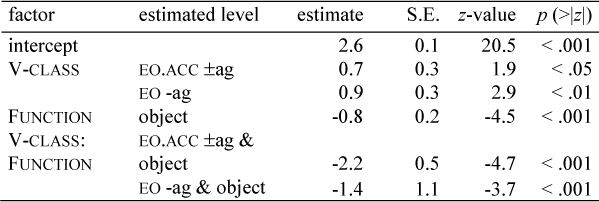
In order to examine the validity of the observations in figure 1, I fitted a generalized logit mixed model on the choice of pronominal versus nonpronominal arguments with function (subject; object), and verb class as fixed factors, and verb as a random factor (including the intercept and slope with function). Since verbs with dative experiencer-objects only appear in the active voice, it is not possible to fit a single statistical model to the entire dataset including all verb groups in both voice options. For this reason, I report separate models for the active and nonactive data.
As a first step, I compared the alternative models of verb class in 5 and 6. The maximal goodness-of-fit for the active data was reached by the actor & undergoer model, that is, the threefold contrast “canonical versus EO accusative (±agentive) versus EO accusative/dative (-agentive)” verbs (AIC=7,110.4, df=9 compared to AIC=7,113.2, df=11 of the case & actor & undergoer model that contains all contrasts; a log-likelihood test reveals that the actor & undergoer model does not result in a significant loss of information). The estimates of the actor & undergoer model for the active data are given in table 3. A log-likelihood test on the goodness of fit reveals that the interaction effect between verb class and function cannot be removed from the model, since the loss of information in a model without this interaction effect is significant (χ Footnote 2(2)=42.4; p<.001).
Pronominalization in active clauses
In the nonactive clauses, the maximal goodness of fit is reached by the undergoer model, which captures the contrast between patients (canonical verbs) and experiencers (both classes of experiencer-object verbs) (AIC=2,281.4, df=7 compared to AIC = 2,284.7, df=9, of the actor & undergoer model; a log-likelihood test reveals that the loss of information of the model with the fewer parameters is not significant).Footnote 9 Log-likelihood tests reveal that the interaction between verb class and function is not significant, whereas both factors have significant main effects (a comparison between a model with two main effects and a model without function: χ Footnote 2(1)=63.1; p<.001; between a model with two main effects and a model without verb class:χ 2(1)=4.6; p<.05). The estimates of the model with the maximal goodness of fit are given in table 4.
Pronominalization in nonactive clauses.

The findings confirm the prediction that 3rd person pronouns are more frequent as subject constituents of canonical verbs, which reflects the preference for encoding the running topic through the subject in a maximally coherent discourse chain. The difference between active and nonactive voice replicates previous findings on the asymmetry in the contextual properties of voice (see, in particular, corpus studies in Givón Reference Givón1994). The novel contribution of the presented data is that this generalization is restricted to canonical verbs, since experiencer-object verbs show a preference for 3rd person pronominal experiencers independent of their syntactic realization as nominative or non-nominative constituents (in nonactive or active voice, respectively). This conclusion is justified by the significant interaction effect between verb class and function in the active clauses.
The frequencies of pronominal realization of 3rd person arguments in the present corpus confirm that experiencer arguments relate more frequently than stimulus arguments to referents that are highly activated in discourse. This discourse preference implies that experiencers are more likely discourse topics than stimulus arguments. Having thus established the discourse-prominence of experiencers, which holds independent of their grammatical realization as subject or object, I am now in the position to examine the sources of the grammatical behavior of experiencers in more detail.
6. Experiencer-First and Word Order
This section examines the question of whether experiencer-object verbs possess different word order properties from canonical transitive verbs; (see research question 4b). It has been shown that experiencer-objects display subject-like properties in several languages—among other things, they occur in the subject position in languages like Icelandic (see discussion in section 2.1). For German in particular, a large number of studies on word order claim that dative experiencers precede nominative arguments (Lenerz Reference Lenerz, Viethen, Bald and Sprengel1977, Hoberg Reference Hoberg1981, Primus Reference Primus1994, Fanselow Reference Fanselow, Stiebels and Wunderlich2000, Reference Fanselow2003). Regarding accusative experiencers, the empirical situation is less clear. There is, however, experimental evidence that accusative experiencers have different linearization properties than accusative patients (Scheepers Reference Scheepers1997, Scheepers et al. Reference Scheepers, Hemforth, Konieczny, Hemforth and Konieczny2000, Haupt et al. Reference Haupt, Schlesewsky, Roehm, Angela and Bornkessel-Schlesewsky2008). The exceptional behavior of experiencer objects has been attributed to their nonagentive readings. Thus, the distinction between nonagentive and ±agentive accusative verbs may be relevant for word order phenomena (see Arad Reference Arad1998a, Reference Arad1998b; Landau Reference Landau2010; and also section 2.1).
In the present corpus, deviations from canonical word order occur in all verb classes, as illustrated in 17. I expect to learn from the corpus frequencies whether the likelihood for these deviations to occur is equal across verb classes or not. If different verb classes behave differently, the question will be which model in 5 and 6 may capture these differences.
(17)
The relevant subcorpus for the questions addressed in this section is the set of sentences with a verb in active voice and two lexical noun phrases (2,876 sentences; see table 2). Personal pronouns follow particular rules in German syntax, and since the goal of this study is to investigate the effect of verb classes on word order, the linearization preferences of personal pronouns are left out of consideration. A general inspection of the frequencies of the constructions in 17 confirms the hypothesized scale in the full verb-classmodel containing all three contrasts between the four groups. The overall proportions of OS order are as follows: i) canonical verbs (26 out of 767 tokens; 3.4%); ii) EO accusative ±agentive verbs (95 out of 527 tokens; 18.03%); iii) EO accusative nonagentive verbs (101 out of 418 tokens; 24.2%); iv) EO dative verbs (448 out of 1,164 tokens; 38.5%). These proportions descriptively confirm that verb class plays a role.
Three relevant factors must be considered before drawing any generalization from these data. As already stated in research question 4b, I need to know whether the effect of particular types of arguments on word order is a direct effect of the thematic properties of the arguments at issue or whether it can be traced back to other semantic and contextual properties of this type of arguments. In the present dataset, semantic properties are represented by animacy, which involves a clear differentiation between experiencers and patients, since the former are by definition animate, while the latter are not necessarily so. Contextual properties can be approximated by definiteness under the assumption that it correlates with givenness (see section 4.4). Given that animate-first and given-first effects have been established in previous studies, the crucial issue is whether experiencer-first effects can be traced back to these more general principles. The third relevant factor is field, namely, the distinction between prefield and middlefield, since these two domains of the German clause possess different properties (see section 2.4).
The proportion of OS order in the corpus are summarized in figure 2 (see counts in appendix B). These data indicate that the order in which the object (O) precedes the nominative subject (S) is generally more frequent with experiencer-object verb classes. Furthermore, the effects are stronger in the middlefield than in the prefield. Disharmonic animacy (undergoer outranks actor in animacy hierarchy) has a clear impact on the proportion of OS order among accusative experiencer verbs: This order is more likely in the middlefield than in the prefield. The effects of definiteness are less clear and not uniform across verb classes.
Choice of order (active clauses).
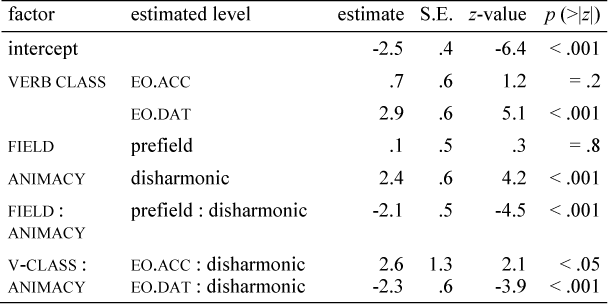
I fitted a generalized logit mixed model in this subset of the corpus data and started with a maximal model with order as a dependent variable, all possible interaction effects of verb class, animacy, definiteness, and field as fixed factors and verb as random factor (including the intercept and slopes of verb with the fixed factors animacy, definiteness, and field). As a first step, I compared the alternative models of verb class in 5 and 6. The model with the maximal goodness of fit is the case & undergoer model, that is, the threefold contrast canonical versus EO accusative versus EO dative verbs. The model that ignores the contrast between two subclasses of accusative experiencers (depending on agentivity) is more appropriate for the data (AIC=2,470.0 compared to AIC=2,475.7 of the case & actor & undergoer model that contains all possible contrasts) and does not display a significant loss of information (a log-likelihood test with df=7 results in a chi-square value that does not correspond to a significant p-value). This means that there is no evidence that the contrast between two subclasses of EO accusative verbs is a necessary parameter for understanding the word order frequencies in the corpus. The goodness-of-fit of this model is also significantly better than the corresponding values of the models with less parameters, that is, the case model (χ 2(7)=30.7, p<.001), the actor model(χ 2(7)=36.6; p<.001) and the undergoer model (χ 2 (7)=25.3; p<.001). Hence, a further reduction of the verb class distinctions is empirically not justified.
The findings of the model comparison indicate that the distinction between the two subclasses of EO accusative verbs in the lexicon does not have a significant impact on the word order frequencies. This result does not lead to the conclusion that agentivity does not play a role, since one cannot estimate the exact frequency of agentive and nonagentive occurrences of the ±agentive verbs. The fact that ±agentive verbs do not differ from –agentive verbs in word order may be due to the fact that the nonagentive occurrences of the former verb class are particularly frequent. Hence, the precise conclusion is that the lexical distinction between two subclasses of EO accusative verbs (and not the distinction between agentive and nonagentive uses) does not play a significant role in the choice of word order.
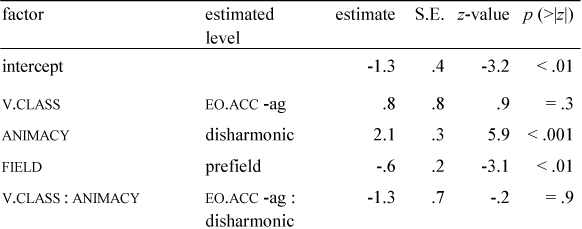
Below I present an analysis of the data in terms of the case & undergoer model, that is, ignoring the subclasses of accusative experiencer verbs. Based on a backwards selection procedure, I removed all interaction effects that do not significantly affect the informativity of the model and came up with a final model containing three interaction effects: verb class andanimacy (log-likelihood test: χ 2(2)=13.4; p<.01), verb class and field (log-likelihood test: χ 2(2)=13.9; p<.001), field and animacy (log-likelihood test: χ 2(1)=9.1; p<.01).Footnote 10 All interactions with definiteness as well as the main effect of this factor could be removed from the model without significant loss of information. The final model containing the three significant interaction effects displays a standard error inflation, which is due to collinearity of the factors verb class and field. Standard error inflation does not disappear through centering; hence, the interaction effect between verb class and field is not informative in these data and has to be removed from the model. The estimates of the final model are listed in table 5.
Model estimates for the choice of order.
In sum, the presented findings indicate that three classes of verbs behave differently with respect to the frequency of OS order: canonical verbs, experiencer-object accusative verbs, and experiencer-object dative verbs. Verb class effects interact with animacy, which means that the effect of the individual verb groups varies across animacy options (disharmonic versus other). This interaction effect, as well as the main effect of verb class in these data indicate that the influence of verb classes on word order is not reducible to animacy. Visual inspection of the data shows that the fronting of dative experiencers is generally independent of animacy, while the fronting of accusative experiencers occurs much more frequently if the experiencer outranks the stimulus on the animacy hierarchy. Canonical verbs generally occur infrequently in the OS order (across animacy levels).
The question is whether the effect of case on the word order frequencies with respect to experiencer-object verbs can be accounted for through the potential thematic role ambiguity, due to case syncretism. Relevant in this respect are the clauses without disharmonic animacy (see animacy: other in figure 2). Thematic roles of the arguments in these clauses are not disambiguated by animacy. These clauses display a contrast between dative and accusative verbs, since OS order only rarely occurs with the latter verb class. Structurally ambiguous clauses are frequent with accusative objects in German: A nominative-accusative contrast is only available in the masculine singular paradigm of determiners (der ‘def.m.sg.nom’ versus den ‘def.m.sg.acc’; ein ‘indef.m.sg.nom’ versus einen ‘indef.m.sg.acc’), adjectives (groβe(r) ‘big.(in)def.m.sg.nom’ versus groβen ‘big.m.sg.acc’) and a subset of nouns (for example, Mensch ‘human.m.sg.nom’ versus Menschen ‘human.m.sg.acc’).
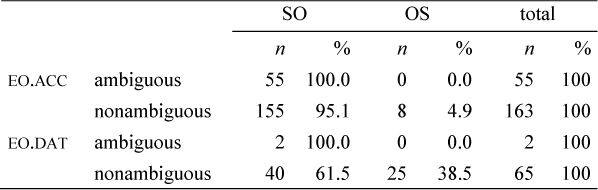
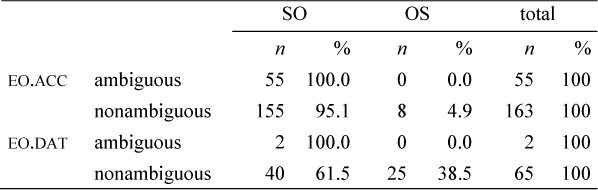
In addition, verbal agreement can disambiguate the thematic roles if the subject and object differ in number. All other cases are structurally ambiguous and can be only disambiguated through the context (see 18a). In the 218 clauses with two lexical NPs that do not differ in animacy (both in the prefield and in the middle field), 55 (25.2%) structurally ambiguous clauses were found (see table 6). All these clauses are disambiguated by contextual cues, and in all clauses, the subject is the first argument. Ambiguity is rare with EO dative verbs: It arises if neither argument has a determiner, as is the case with proper nouns, and the two arguments do not differ in number, as in 18b. In this corpus, there were found 2 structurally ambiguous clauses (2.9%) out of a total of 67 clauses with an EO dative verb having two lexical animate arguments (see table 6). In both sentences, the first argument is interpreted as nominative based on contextual cues.
(18)
The frequencies in table 6 lead to the following conclusions. Structural ambiguity is more frequent with accusative (25.2%) than with dative (2.9%) verbs. Furthermore, structural ambiguity has an influence on word order, since all structurally ambiguous clauses in the present corpus are disambiguated in favor of nominative-first clauses based on contextual cues. However, the role of ambiguity does not explain the different frequencies of OS order with accusative and dative EO verbs. In the subset of nonambiguous clauses, the OS order is significantly more frequent with dative verbs (38.5%) than with accusative verbs (4.9%); χ 2=42.3, p<.001.
Ambiguity and word order.Footnote 11
Definiteness did not have a significant effect in this dataset: The frequencies in figure 2 suggest that initial objects with EO accusative ±agentive verbs in the middlefield and EO dative verbs in the prefield occur more frequently under disharmonic definiteness. However, since the effects related to definiteness are not significant, this conclusion is empirically not justified. The relevant result for my considerations is that the effect of verb classes on word order cannot be reduced to an effect of definiteness.
Finally, the data reveal a difference between prefield and middlefield in accordance with the established assumptions about German clausal syntax: The data in figure 2 (in particular, top panels) show that similar effects appear in the middlefield and in the prefield, while the effects are greater in the middlefield. This is in line with the view of German syntax, according to which effects of semantic asymmetries show up in the middlefield. However, this observation cannot be validated statistically due to the collinearity between these factors.
7. Experiencer-First and Choice of Subject
The analysis in section 6 has shown that fronted non-nominative arguments occur more frequently with experiencer-object verbs than with canonical verbs, and that this difference cannot be reduced to further asymmetries in animacy or definiteness. The next question is whether the observed word order phenomena are due to a general preference for linearizations in which the experiencer role occurs earlier in the clause.
Another strategy to deviate from the linearization of an active clause that is alternative to the fronting of non-nominative arguments is the choice of a diathetic alternation. This allows the early occurrence of the lower argument of the active clause in the canonical word order of the non-active clause. The verbs in the present sample occur in forms that license different argument structures in the corpus, for example, stative or dynamic passives, deagentives, etc. (see discussion in section 2.2). Diathetic alternations are not just linearization options; they also possess additional semantic properties, meaning that active and nonactive voice do not have the same extension. It is clear that diathetic alternations such as the stative passives cannot be chosen for any type of propositional content in which the corresponding active occurs. However, the critical assumption for the comparisons below is that there is a subset of propositional contents that can be described with either diathetic form. In this subset, the choice of voice in speech production is possibly influenced by linearization preferences (see discussion in section 1).
What I expect to learn from the corpus frequencies is to what extent the factors determining the choice of order also have an influence on the choice of voice. Illustrative examples from the corpus are given in 19. The choice of voice can only be observed with accusative object verbs (either canonical or experiencer-object verbs) that possess counterparts in which the undergoer (patient or experiencer) is realized as a subject. Dative verbs do not have diathetic alternations of this type. I restrict my observations to the subset of data with two lexical arguments (see table 2, third row).
(19)
The choice of voice was examined in the subset of tokens with two lexical arguments (4,319 clauses in table 2), excluding the dative EO verbs (1,164 clauses) that only occur in active voice. The obtained proportions in the remaining (4,319–1,164=)3,155 clauses are presented in figure 3 (see counts in appendix C). The proportions in the upper panels reveal that animacy plays an important role: The likelihood of a verb with an undergoer subject increases when the undergoer is higher in the animacy hierarchy than the actor (disharmonic animacy). This pattern is observed for all verb classes, except for the nonagentive EO verbs in the prefield. The proportions in the lower panels indicate that definiteness does not have a consistent effect on the choice of voice. The proportions of nonactive forms vary among verb classes: i) canonical verbs: 22.5% (223 nonactive out of total 990); ii) EO ±agentive verbs: 45.9% (447 nonactive out of total 974); iii) EO nonagentive verbs: 64.9% (773 nonactive out of total 1191). The proportions of nonactive forms also differ between the two clausal domains: i) middlefield: 52.6% (340 nonactive out of total 646); ii) prefield: 43.9% (1103 nonactive out of total 2509) (see detailed counts in appendix C).
Effects in the choice of subject.
I fitted a generalized logit mixed model in this subset of the corpus data. I started with a maximal model with diathesis as a dependent variable, the fourfold interaction between verb class, animacy, definiteness, and field as fixed factors, and verb as random factor (including intercepts and slopes with the fixed factors—except for verb class). First, I compared the three reasonable verb-class models (see 5 and 6), namely, the undegoermodel, the actormodel, and the actor & undergoer model, which is the full model with respect to these data.Footnote 12 The maximal goodness-of-fit is reached by the actor model (AIC=3,115.9, df=26 compared to AIC=3,127.4, df=34 of the full model; a log-likelihood test reveals that the actor model does not result in a significant loss of information). This result implies that the distinction between canonical verbs and EO ±agentive verbs is unnecessary for the understanding of the choice of diathesis.
After adopting the actor model, I examined whether all factors, that is, verb class, animacy, definiteness, and field, and their interactions are indispensable parameters of the model (based on model comparison; see section 4.5). All interactions containing definiteness as well as the main effect of this fixed factor can be removed from the model without significant loss of information. However, removing the threefold interaction effect between verb class, animacy, and field produces a significant effect in the log-likelihood test (χ 2(1)=4.1; p<.05; comparing a model with only the interaction at issue with a model without any threefold interaction). The parameters of the final model, which contains this interaction and all embedded effects, are presented in table 7.
Parameters of the model for the choice of subject.
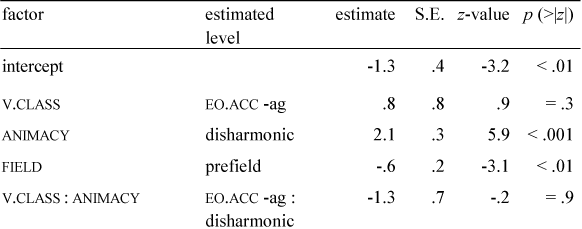
In sum, the data dealing with the choice of subject reveal a contrast between nonagentive verbs and potentially agentive verbs (which comprise canonical and EO ±agentive verbs). The statistical findings reveal a threefold interaction between verb class, animacy, and field. This accounts for the fact that nonagentive verbs occur very frequently in nonactive forms across animacy levels in the prefield data, while all other verb classes involve an asymmetry in animacy. The observed difference cannot be straightforwardly accounted for under the current assumptions about German syntax. A source of differences between clausal domains (prefield versus middlefield) is the fact that two overtly realized arguments may be adjacent in the middlefield, but not if one of them is realized in the prefield. The processing difficulties that arise from the adjacent realization of syntactic entities of the same type (Richards Reference Richards2010) can potentially provide an explanation for the higher frequencies of nonactive voice in the middlefield.
It is reported that OV languages display an intransitive verb bias accounted for through the processing difficulty of XYV linearizations (Ueno & Polinsky Reference Ueno and Polinsky2009). The fact that EO nonagentive verbs display a higher proportion of nonactive voice is in line with the view that earlier realization of the experiencer is more likely if the stimulus is not agentive. However, the fact that nonagentive verbs interact with animacy only in the middlefield is a result that cannot be easily accommodated given the known facts about German syntax. Since the prefield is the clausal domain that hosts topics and foci (see section 2.4), this result suggests that the choice of experiencers for these functions is independent from the animacy of the stimulus with nonagentive verbs. Taking into account that the overall frequency of nonactive voice is highest with this verb group, it may be the case that this general preference overrides further distinctions in some parts of the dataset.
A final issue is the interaction between choice of subject and choice of word order. The word order properties of the active clauses were discussed in section 6. To the extent that the choice of a nonactive subject is an alternative strategy for fronting the lower argument, noncanonical word order is not expected to occur with nonactive voice. However, the complementarity of voice and order is limited, since voice alternations may be accompanied by semantic differences, as discussed in section 2.2, that is, the choice between active and nonactive voice as alternative linearization options only holds for a subset of the possible situations.
The proportions of orders depending on voice are presented in figure 4 (see counts in appendix D). These frequencies reveal an interaction between verb classes and voice. With canonical verbs, the proportion of noncanonical order in passive voice (oblique agent preceding subject) is higher than the corresponding proportion of noncanonical order (object preceding subject) in active voice. With EO verbs, the proportion of noncanonical order with nonactive verb forms (nonsubject preceding subject) is lower than the proportion of noncanonical order (object preceding subject) in active voice. A generalized logit mixed model reveals that this interaction is highly significant (log-likelihood test, χ 2(2)=63.7; p<.001, comparing a model that involves the interaction with a model without the interaction effect). Furthermore, the contrast between the three verb classes cannot be captured by a simpler model that only contrasts canonical and EO verbs (log-likelihood test, χ 2(2)=7.9; p<.05).
Voice and word order.
The interaction in figure 4 can only be interpreted if one considers the fact that active and nonactive versions are not just linearization options. If this were the case, one would expect that the nonsubject constituent would not be fronted in nonactive voice, since in this case the thematic roles are linearized in the same way as in the unmarked expressions in active voice and with canonical order. If one takes into account that the choice of voice is—at least in part—determined by semantic factors independent from linearization (see section 2.2), the difference between canonical and EO verbs in figure 4 is just a further confirmation of the phenomenon observed through word order of active clauses (section 6): Canonical verbs display a preference for fronted agents, which is reflected in the higher proportion of noncanonical order in the passive voice; EO verbs display a preference for fronted experiencers, which is reflected in the higher proportion of noncanonical order in the active voice.
8. General Discussion
The corpus facts presented in the previous sections generally give affirmative answers to the questions outlined in section 3. Section 5 has shown that experiencer-object verbs differ from canonical verbs with respect to the distribution of referential third person pronouns. While these pronouns occur more frequently as subjects of canonical verbs, they occur more frequently as objects of EO verbs. This finding answers the question in 4a, that is, it provides evidence that experiencer objects are likely discourse topics (in contrast to objects of canonical transitive verbs). In section 6, I presented evidence from word order frequencies that experiencer-first effects are present in the corpus and that they are independent from other related effects, such as animate-first or given-first. A significant interaction between verb class and animacy provides evidence for the independency of the experiencer-first effect (see research question in 4b): If the thematic properties of experiencers were reducible to animacy, it would have been possible to explain the obtained word order frequencies in terms of animacy alone. A close look at the descriptive data suggests that a part of this interaction is due to the contrast between accusative and dative EO verbs: While the effect of EO accusative verbs on noncanonical word order can be reduced to an animacy effect, this is not the case for EO dative verbs. A further part of this interaction relates to the difference between accusative EO verbs and canonical verbs: While disharmonic animacy induces marked word order in the former class of verbs, it does not have the same effect with the latter. Finally, section 7 has shown that disharmonic animacy has an impact on the choice of subject (and the corresponding diathetic form of the verb), and that this impact is different for EO nonagentive verbs, in contrast to canonical verbs and EO ±agentive verbs.
The major influence in the choice of order and the choice of subject comes from animacy asymmetries. The role of animacy in German syntax has been demonstrated in several experimental and corpus studies (for example, van Nice & Dietrich Reference van Nice, Dietrich, Härtl and Tappe2003, Grewe et al. Reference Grewe, Bornkessel, Zysset, Wiese, von Cramon and Schlesewsky2006, Bader & Häussler Reference Bader and Häussler2010). The facts of the present study give further support to these previous findings. Bader & Häussler (Reference Bader and Häussler2010) show that disharmonic animacy correlates with a higher frequency of OS order. They further report a difference between accusative and dative objects, such that OS order is generally more frequent with the latter type of object.
The results presented in section 6 are in line with these observations. In both studies, dative verbs behave similarly, showing a clear OS preference in middlefield sentences under the disharmonic animacy condition, while OS order in the other animacy constellations is less frequent, but clearly noticeable. In the dative prefield data, the number of OS sentences is smaller though still considerable. However, in contrast to the data presented here, which do not show an animacy effect for dative verbs in the prefield, the comparable data in Bader & Häussler Reference Bader and Häussler2010 do show such an effect. The accusative verbs in Bader & Häussler Reference Bader and Häussler2010 demonstrate an overall clear preference for SO structures, which is similar to that of the canonical transitive verbs in the present corpus. However, in contrast to my data, Bader & Häussler's (Reference Bader and Häussler2010) data from the middlefield and the prefield show a (small) animacy effect with transitive verbs. The fact that there is no object preposing with canonical transitive verbs in my middlefield data may be due to the fact that the overall frequency of sentences with disharmonic animacy was rather low (9 sentences). Furthermore, as Bader & Häussler (Reference Bader and Häussler2010:757) emphasize, preposing of lexical accusative objects in the middlefield occurs mainly due to lexical-semantic reasons, which are visible with the EO verbs in my data. Very rarely does it occur for the discourse reason of focusing the subject in preverbal position (Haider Reference Haider1993).
Definiteness does not have a significant effect in my data. This is in line with the fact that effects of definiteness are generally weaker (see also previous corpus studies on German word order). Weber & Müller (Reference Weber and Müller2004) report that clauses with indefinite subjects and definite objects occur in 8.5% of their SVO data (50 out of 591 sentences) and in 8.7% of their OVS data (48 out of 549 sentences). In Bader & Häussler's study (Reference Bader and Häussler2010:739), definiteness plays a role with dative verbs in the middlefield, but is not considered to be a trigger of object-fronting with accusative verbs. Similarly, the descriptive facts of the present study suggest no definiteness effect: In the overall middlefield results, the OS order occurs in 41.9% of the disharmonic definiteness data and in 37.8% of the other cases (see totals in appendix B.3). The difference in the prefield data is smaller and in the opposite direction: 19.9% for the disharmonic data, 20.5% for the other data.Footnote 13 However, since definiteness does not have a significant effect in the statistical model, the validity of these observations is not empirically justified.
The difference between prefield and middlefield is established in German syntax. Following the findings from earlier corpus studies such as Bader & Häussler Reference Bader and Häussler2010, asymmetries in the semantic and thematic representation of the arguments are expected to have a straightforward impact in the middlefield, while prefield constituents should be additionally influenced by further factors—in particular, information structure. The word-order findings of the present study confirm these expectations: Both clausal domains show the same general tendencies triggered by animacy and thematic asymmetries, but the effect in the middlefield is more pronounced. The comparison between clausal domains also involved an unexpected result presented in section 7: The frequency of nonactive voice with nonagentive EO verbs depends on animacy in the middlefield, but not so in the prefield (see discussion in section 7).
The main issue in the three substudies presented in this article was to identify and explain differences in the structural behavior between verb classes. Statistical analyses started with a comparison between the verb-class models that were hypothesized to account for the obtained data. The models with the maximal goodness-of-fit are summarized in table 8. Discourse prominence, as reflected in the frequency of pronominal reali-zation (see Gundel et al. Reference Gundel, Hedberg and Zacharski1993), reveals a contrast between canonical and experiencer-object verbs and an additional influence of agentivity in the active voice. Order frequencies indicate a difference between canonical and experiencer-object verbs and an additional role of case-marking (accusative versus dative). Frequencies of nonactive forms are accounted for through the contrast between nonagentive verbs and the other verb classes.
Verb-class models with maximal goodness-of-fit.
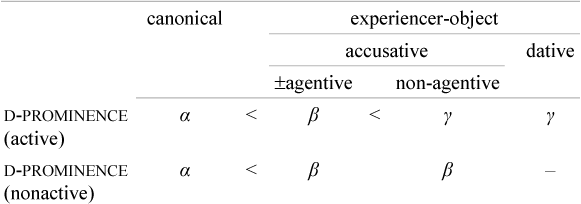
The findings in table 8 show that verb classes display different contrasts depending on the phenomenon at issue. The data from discourse prominence imply that subjects of verbs in active or nonactive voice generally refer to highly activated referents, while experiencer-object verbs show the mirror image in the active voice. The discourse prominence data in the active voice involve an additional effect of agentivity, probably reflecting the fact that at least in a subset of their occurrences, ±agentive verbs behave like canonical verbs. Agentivity is also crucial for the choice of voice. Nonagentive verbs generally display a higher proportion of nonactive forms, which overrides animacy contrasts in the prefield. The word order facts differ in that the crucial distinction does not relate to agentivity but to case-marking (accusative versus dative). This finding cannot be accounted for through the greater likelihood of ambiguity between nominative and accusative NPs in German (see table 6).
The word order effects involve two contrasts: Canonical verbs and EO accusative verbs differ in that only the latter group comes with object-first order in disharmonic animacy configurations; EO accusative and EO dative verbs differ in that the object-first order is independent of animacy with the latter group. This is in line with the view that the dative-before-nominative order is basic with EO dative verbs (for example, Lenerz Reference Lenerz, Viethen, Bald and Sprengel1977; Primus Reference Primus, Lang and Zifonun1996; Fanselow Reference Fanselow2001, Reference Fanselow2003; Haider & Rosengren Reference Haider and Inger2003; Haider Reference Haider2010), while the accusative-before-nominative order has to be triggered (by animacy in this data). The data from the choice of voice show that the early realization of experiencers is most frequent with nonagentive verbs, that is, there is a general preference for realizing the experiencer-argument early in the clause if it does not compete with an agent. This preference is alternatively fulfilled by the choice of voice or the choice of order with the EO accusative verbs. The complementarity between order and voice is empirically supported by the results in figure 4 for EO accusative verbs. EO dative verbs do not provide a nonactive option, which probably accounts for the difference in the frequencies of object-fronting between nonagentive accusative and dative verbs in the present corpus (Lamers & de Schepper Reference Lamers and de Schepper2010, Lamers & de Hoop, Reference Lamers, de Hoop, MacWhinney, Moravcsik and Malchukovforthcoming).
Summing up, I assume that animate-first effects relate directly to the linearization of the arguments in the utterance (and not strictly to the constituent order). Such effects are expected to have an impact on the choice of subject as well as on the choice of word order. This intuition is confirmed by the fact that animacy-first effects are reflected in the choice of nonactive voice with all classes (whereas the exceptional behavior of the nonagentive verbs in the prefield is an additional phenomenon not captured by my assumptions).
Experiencer-first effects reflect the discourse prominence of experiencers, which applies to all experiencer-objects classes, as shown by the findings in the frequency of pronouns. The word order facts show a significant difference between initial patients and initial experiencers, which implies that an experiencer-first effect on word order exists (which is part of the main effect of verb class and the interaction effect between verb class and animacy). There is an additional empirical finding distinguishing accusative from dative experiencers: Initial experiencers are very frequent across animacy configurations with the latter group, but restricted almost entirely to disharmonic configurations with the former. The fact that this difference relates to case suggests that the source of the difference does not lie in the semantics of the different experiencer-object subclasses. The fact that the experiencer-first order is very rare with nondisharmonic configurations (which practically contain two animates) for accusative experiencer-object verbs possibly reflects a blocking effect: The accusative-nominative order is difficult to process in the absence of lexicosemantic cues (animacy asymmetry) for the disambiguation of thematic roles.
Finally, I address the question of what consequences the empirical results of the present study have for assumptions about the basic order of EO verbs as a pure reflex of constituent structure. Assumptions about constituent structure are based on a large array of phenomena not dealt with in the present study (in particular, evidence for asymmetries relating to the hierarchical clause structure, such as binding or scopal phenomena). Corpus frequencies are relevant for testing the predictions of syntactic analyses of this type. More specifically, a word order that reflects the basic configuration in the syntax does not need to be licensed by a trigger, whereas an order that results from some reordering operation is expected in a lexicosemantic or contextual configuration in which this operation is licensed.
Most dative-object verbs in my data are experiencer-initial (across animacy levels). Thus, these data are consistent with the assumption that the basic order of dative-object verbs involves a higher experiencer and that this experiencer appears early in the utterance without a contextual trigger. A theory based on this assumption must accommodate the fact that experiencers also frequently appear early in sentences with accusative experiencer-object verbs, but not so with canonical verbs (which means that this latter effect cannot be accounted for by animacy alone). A theory assuming that the basic order of all experiencer-object verbs involves an initial experiencer must account for the fact that this generalization does not fit in with the data of accusative experiencer-object verbs in nondisharmonic animacy configurations. The data pattern obtained in these configurations is predicted by the additional assumption of blocking due to case reasons.
9. Conclusion
This article presented a corpus study of experiencer-object verbs in German. Based on the frequencies of pronominal realization, it provided evidence that the objects of these verbs are discourse prominent. Word order frequencies reveal that the effect of experiencer objects interacts with animacy. Dative EO verbs occur in the OS order independent of animacy, and accusative EO verbs occur in the OS order mostly if this order is licensed by animacy. Both classes contrast with canonical verbs in which the OS order appears less frequently under identical conditions. Animacy effects also appear in the choice of voice. However, voice frequencies do not distinguish EO verbs from canonical verbs, but rather nonagentive from potentially agentive verbs.
These findings are consistent with the previous research on the linearization properties of experiencer-object verbs in German. Previous accounts based on acceptability judgments already observed the difference between these classes of experiencer-object verbs. While the dative-first order is analyzed as basic for dative EO verbs, the accusative-first order has been a source of controversies. The results of the present corpus study support the intuition that these classes behave differently. Assuming that corpus frequencies are informative for the necessity of licensing noncanonical word order, this study supports accounts restricting the exceptional behavior to dative verbs (for example, Fanselow Reference Fanselow, Stiebels and Wunderlich2000).
The reported verb class effects are relevant for the research on word order frequencies in corpora. The SO/OS frequencies in German text corpora have been the subject of numerous corpus studies. The present study shows that the role of verb class in determining word order is not negligible. This result has important methodological consequences: Word order generalizations must be tested against the impact of different verb classes, and the role of individual verbs is at least a very reasonable random factor for word order studies to consider.
APPENDIX A: Frequency of Pronouns
A.1 Referential pronouns out of total third person NPs in active clauses
A.2 Referential pronouns out of total third person NPs in non-active clauses
APPENDIX B Word Order Frequencies (Active Clauses)
B1. Animacy and verb class (middlefield)
B2. Animacy and verb class (prefield)
B3. Definiteness and verb class (middlefield)
B4. Definiteness and verb class (prefield)
APPENDIX C Frequency of the Choice of Undergoers as Subjects
C1. Animacy and verb class (middlefield)
C2. Animacy and verb class (prefield)
C3. Definiteness and verb class (middlefield)
C4. Definiteness and verb class (prefield)
APPENDIX D Frequency of Word Orders per Voice
(NS= non-subject precedes subject; SN= subject precedes non-subject)