The effects of word frequency have garnered increased attention, with questions ranging from frequency's role in sound change (Bybee, Reference Bybee2002; Labov, Reference Labov2010) to its interaction with the perceptual apparatus (Hay, Warren, & Drager, Reference Hay, Warren and Drager2006; Koops, Gentry, & Pantos, Reference Koops, Gentry and Pantos2008). Hybrid models of phonology and exemplar dynamics (Pierrehumbert, Reference Pierrehumbert2002, Reference Pierrehumbert2006, Reference Pierrehumbert2016) place focus on the interface between traditional internal constraints and the cognitive effects of frequency. Pierrehumbert (Reference Pierrehumbert2006, Reference Pierrehumbert2016) proposed that a phonological level within the grammar intertwines with the experiential component of word-specific storage. Early studies implement lexical frequency in an attempt to determine whether an effect exists (Dinkin, Reference Dinkin2008; Labov, Reference Labov2010) or whether it moderates known internal factors (Guy, Reference Guy2007; Walker, Reference Walker2012). Work on English t/d deletion has shown mixed results for the effect of overall lexical frequency (Guy, Reference Guy2007; Walker, Reference Walker2012), but tests of frequency of occurrence in specific phonological environments showed positive results (Bybee, Reference Bybee2002). A strong correlation has been found (Bybee, Reference Bybee2002) between certain word classes (e.g., past-tense verbs) and occurrence in environments that disfavor deletion (e.g., before vowels), thereby creating an observable pattern in the aggregate for word classes. Since this early work, more attention has been paid to the proposed interactive connection between internal constraints and frequency (Brown & Raymond, Reference Brown and Raymond2012; Clark & Watson, Reference Clark and Watson2011; Erker & Guy, Reference Erker and Guy2012; Guy, Hay, & Walker, Reference Guy, Hay and Walker2008; Raymond, Brown, & Healy, Reference Raymond, Brown and Healy2016). The question of interaction between internal constraints and frequency bears further examination, however, since we now have more robust methods in the sociolinguistic toolbox and larger samples with which to tease apart the complex relationship between sociolinguistic variation and word frequency.
To test this relationship requires a variable with well-studied internal constraints to allow for the clearest possible analysis of their interaction with overall frequency. In this respect, the English variable of unstressed word-final (ING) provides a good test case, as its internal constraints are both familiar (Cofer, Reference Cofer1972; Fischer, Reference Fischer1958; Houston, Reference Houston1985; Labov, Reference Labov2001) and mostly consistent across communities (Houston, Reference Houston1985). Many recent investigations of frequency have asked whether frequency plays a role in driving sound change (Bybee, Reference Bybee2002, Dinkin, Reference Dinkin2008; Labov, Reference Labov2010). By contrast, (ING), like t/d deletion, is not a variable undergoing regular sound change, so an investigation of (ING) allows for both a better understanding of frequency's connection to (ING) and frequency's effect on variables not undergoing sound change. I hope to further elucidate the process by which individuals choose and produce variants of (ING), contributing more broadly to our understanding of how applicable functional accounts of phonology and morphology (Bybee, Reference Bybee1999; Hay & Baayen, Reference Hay and Baayen2005; Johnson, Reference Johnson, Johnson and Mullennix1997) are to the variationist paradigm. I will begin with a review of the internal constraints on (ING) and the arguments for their location within the linguistic system, as well as reviewing important social factors, given that (ING) is highly socially marked (Hazen, Reference Hazen2008). I then briefly move to the literature on usage-based phonology and exemplar theory, as well as recent empirical work testing the theoretical claims made by these theories. Following the review of the literature, I present the results of my analysis of speakers’ use of (ING) within the Raleigh Corpus (Dodsworth, Reference Dodsworth2013; Dodsworth & Kohn, Reference Dodsworth and Kohn2012), testing the effects of internal constraints, word frequency, and frequency in particular linguistic environments across apparent time. Within this corpus, rates of –ing versus –in are changing over time while internal constraints remain constant, due to socially motivated retreat from Southern-marked features (Dodsworth & Kohn, Reference Dodsworth and Kohn2012, Forrest, Reference Forrest2015). Results show an interactive effect between both word frequency and age and word frequency and frequency in phonological environments favoring an –ing realization, which I discuss in light of recent exemplar-based theories of linguistic variation.
BACKGROUND
Internal and social constraints governing (ING)
One of the most oft-studied variables in the sociolinguistic literature, (ING) has a number of documented social effects that persist across communities and across apparent time, perhaps most prominently in the marked stylistic variation within speakers. Often used as a canonical example of a marked stable variable, (ING) shows strong stylistic differences, with the most casual styles showing higher rates of –in than more formal styles (Labov, Reference Labov1966, Reference Labov2001). As would be expected from the presence of style-shifting effects, (ING) also has strong connotations of socioeconomic status, as lower-socioeconomic status speakers use higher overall rates of the –in variant than do their middle-class or upper-class counterparts regardless of class typology employed (Forrest, Reference Forrest2015; Labov, Reference Labov1966; Reid, Reference Reid and Coupland1978; Shuy, Wolfram, & Riley Reference Shuy, Wolfram and Riley1968; Trudgill, Reference Trudgill1974). The variable often has some differences attributable to the sex of the speaker, as well, but whether females or males use more of the –in variant depends on the community under investigation (Wald & Shopen, Reference Wald, Shopen, Clark and Rosa1985). For American English varieties, men tend to use more of the –in variant than women do (Labov, Reference Labov2001), so a higher rate of –in for men is reasonable to expect for the corpus under investigation.
The internal constraints governing (ING) have received equally thorough attention. Preceding phonological context has shown progressive dissimilation in some cases (Cofer, Reference Cofer1972; Hazen, Reference Hazen2008), where velar consonants preceding the (ING) coda tend to favor an –in variant,Footnote 1 but these results have been somewhat inconsistent across corpora (Wagner, Reference Wagner2012). Similarly, many studies have identified a pattern of assimilation to following consonants (Forrest, Reference Forrest2015; Houston, Reference Houston1985; Kendall, Reference Kendall2013; Wagner, Reference Wagner2012), with precoronal environmentsFootnote 2 favoring –in and prevelar environmentsFootnote 3 favoring –ing. However, Tagliamonte (Reference Tagliamonte2004) argued that this assimilation to the following environment is restricted to nominals, and Hazen (Reference Hazen2008) proposed that (ING) in fact shows no true assimilation to following consonants. Finally, prepausal environments strongly favor –ing variants, controlling for other social and internal factors (Forrest, Reference Forrest2015; Kendall, Reference Kendall2013).
Initial studies of (ING) posited a purely phonological explanation (Labov, Reference Labov1972), but since Houston's (Reference Houston1985) historical tracing of the –ing/-in alternation to the Old English suffixes “–inge” and “–inde,” the grammatical category of the word in which (ING) occurs is recognized as an important factor. Most studies of (ING) from the past few decades acknowledge some degree of grammatically governed variation (Forrest, Reference Forrest2015; Hazen, Reference Hazen2008; Houston, Reference Houston1985; Labov, Reference Labov2001; Wagner, Reference Wagner2012), but the operationalization of these grammatical categories tends to be somewhat opaque and inconsistent (Tamminga, Reference Tamminga2014). Labov (Reference Labov2001) proposed a grammatical category hierarchy governing the use of the –in variant generally followed by subsequent research, where progressives favor –in the most, followed by gerunds, nouns, and adjectives, respectively. While the number of categories and the boundaries between them differ slightly from study to study, they generally reveal that more verbal grammatical categories favor –in while more nominal categories favor –ing.
In view of both the persistence of phonological constraints in many studies (Forrest, Reference Forrest2015; Hazen, Reference Hazen2008; Wagner, Reference Wagner2012) and recent findings about the primacy of phonological constraints in t/d deletion, another canonically stable variable (Hazen, Reference Hazen2011; Tagliamonte & Temple, Reference Tagliamonte and Temple2005), a remaining question is the level of linguistic structure (morphological vs. phonological) at which speakers process (ING). Tamminga (Reference Tamminga2014, Reference Tamminga2016), while acknowledging the difficulty in teasing apart the evidence, proposed a conception of (ING) as two separate variables, one morphological and one phonological, on the basis of priming. Monomorphemic and root-attached cases of (ING) (roughly corresponding to what are traditionally coded as nominal forms) do not show priming effects from verbal/quantifier forms, suggesting that individuals classify nominal forms differently from verbal forms of (ING) within the grammar. Providing further evidence for the separateness of morphology and phonology, previous tokens of /ŋ/ do not show a priming effect if they do not occur within the (ING) morpheme itself (Tamminga Reference Tamminga2014, Reference Tamminga2016), ruling out the possibility of gestural priming at the phonological level.
Initial exploration of both priming and frequency effects on (ING) (Abramowicz, Reference Abramowicz2007) found no consistent frequency effect, but the corpus was relatively small (574 tokens). Furthermore, given Tamminga's (Reference Tamminga2014, 2016) findings surrounding morphological and lexical priming of (ING), it is worth reopening the cognitive question of frequency effects and their possible interaction with grammatical categories in the production of (ING). In fact, frequency effects could add to our understanding of the phonological and morphological constraints on (ING) through the implementation of usage-based frameworks.
Exemplar theory in usage-based phonology and morphosyntax
Theories of usage-based phonology, exemplar theory among them, represent applications of functionalist schools of thought to theoretical phonology (Bybee, Reference Bybee1999; Pierrehumbert, Reference Pierrehumbert2002), arguing fundamentally that language use shapes cognitive representation of speech sounds. Instead of formal rules governing the production of allophones, as in lexical phonology (Guy, Reference Guy1991a, Reference Guy1991b) or optimality theory (Prince & Smolensky, Reference Prince and Smolensky2008), speakers generalize across remembered tokens of words in their social and linguistic context (Pierrehumbert, Reference Pierrehumbert2006) to construct a phonological system. Where traditional phonological conceptions assume some degree of persistent stability to hierarchies within speaker grammar, usage-based theories highlight the plasticity of individual-level phonological systems, since speakers constantly reconstruct phonology from stored tokens (Johnson, Reference Johnson, Johnson and Mullennix1997). Experimental psycholinguistic research has identified evidence for the use of both word-specific and social context in the evaluation of a phonetically ambiguous utterance in the context of a merger in progress (Hay, Warren, & Drager, Reference Hay, Warren and Drager2006). These results have been replicated with different social priming mechanisms and different linguistic variables; social priming affects linguistic perception of the /ɪ/ vowel by New Zealanders (Hay, Nolan, & Drager, Reference Hay, Nolan and Drager2006) and encourages classification into a primed social category (Hay & Drager, Reference Hay and Drager2010). As a whole, the experimental literature supports the predictions of exemplar theory in its argument for an intertwining of the social and phonetic information within the linguistic perception system (Koops et al., Reference Koops, Gentry and Pantos2008).
Within corpus work, due to the prominence of the lexical item in usage-based approaches, operationalization of exemplar dynamics often takes the form of word frequency (Bybee, Reference Bybee2002). Corpus-driven study confirms that frequent words have shorter durations, even in otherwise homophonic contexts (Gahl, Reference Gahl2008). When tested on sociolinguistic variables, however, studies assessing the effects of lexical frequency often return mixed results. Early applications of usage-based phonology to t/d deletion returned either strongly (Bybee, Reference Bybee2002) or moderately (Guy, Reference Guy2007; Guy et al., Reference Guy, Hay and Walker2008) positive results for word frequency. These results have since been questioned with the application of more complex statistical modeling (Walker, Reference Walker2012), with lexical frequency showing no significant effect when also controlling for phonological environment, morphological differences, and random speaker and word effects. Similarly contradictory results have appeared in studies surrounding the interaction of lexical frequency and vowel changes, with Labov (Reference Labov2010) finding that frequent words did not lead in vowel shifts for the fronting of GOAT and GOOSE or the raising of the BAT vowel in Philadelphia. Despite the inclusion of lexical items as fixed effects in the model, only a handful of words in each sound change attain significance, leading Labov to question the prominence of lexical diffusion in all cases of sound change. On the other hand, some studies using exemplar-theoretic perspectives find word-specific information important for the identification of words in sound changes (Hay et al., Reference Hay, Nolan and Drager2006) or that overall lexical frequency actually affects a word's phonetic realization during sound change (Hay, Pierrehumbert, Walker, & LaShell, Reference Hay, Pierrehumbert, Walker and LaShell2015).
While much of the work dealing with lexical frequency and usage-based approaches concerns phonology, morphosyntactic variables experience similar lexically driven effects. Usage-based theories of morphology take a similar stance to those of phonology, arguing for the abstraction of morphological units and rules from stored lexical items (Blevins, Reference Blevins2006; Hay & Baayen, Reference Hay and Baayen2005), foregrounding the importance of the word as a unit of storage. Long-term morphological change in the regularization of English past-tense marking exhibits a lexical frequency effect, whereby less frequent verbs experience the regularization before more frequent words (Bybee, Reference Bybee1985; Lieberman, Michel, Jackson, Tang, & Nowak, Reference Lieberman, Michel, Jackson, Tang and Nowak2007). The shielding of higher-frequency irregular verbs is suggested to be a result of the higher degree of lexical storage for frequent irregular forms (Bybee, Reference Bybee1985), and a similar argument has been made for the maintenance of irregular English plurals (Anshen & Aronoff, Reference Anshen and Aronoff1988). High collocation frequency can also potentiate the loss of morphological boundaries altogether, resulting in phonetic reduction and grammaticalization (Bybee, Reference Bybee2010; Diessel, Reference Diessel2007; Rácz, Pierrehumbert, Hay, & Papp, Reference Rácz, Pierrehumbert, Hay, Papp, MacWhinney and O'Grady2015). The variable (ING) evidences this very process, with the grammaticalization of “going to” to “gonna” as a future marker (Poplack & Tagliamonte, Reference Poplack and Tagliamonte2000).
The exemplar theory framework has been previously applied to (ING) with no consistent effect of lexical frequency emerging from the models run on the entire dataset (Abramowicz, Reference Abramowicz2007). However, for the same reasons that Abramowicz (Reference Abramowicz2007) gave, exemplar theory provides a compelling framework for explaining some of the variable's idiosyncrasies. The pronominal forms “something” and “nothing” have often been noted to behave differently than other nominals do (Houston, Reference Houston1985; Labov, Reference Labov2001), which can be explained by lexical entrenchment within a usage-based framework. If these words have different environmental or overall frequency than other nominal forms, then it would not be unexpected for speakers to have a separate cognitive representation of these words than for other nominals. The implementation of lexical frequency may also help to clarify where within the grammar the variable (ING) resides. A great deal of evidence points to (ING) having a strong morphological component (Houston, Reference Houston1985; Tamminga, Reference Tamminga2014), but the predictions of an exemplar-driven model for a morphological variable with stable variation are somewhat unclear. No clear analogical process exists with (ING) as there does with other frequency-driven morphological changes (Lieberman et al., Reference Lieberman, Michel, Jackson, Tang and Nowak2007). However, extending the findings from phonology to morphological variables, speakers should store exemplars of words with either the –in or –ing morpheme just as they would a phonetic realization, meaning that a word's frequent context should affect the realization of (ING), even outside of that context (Guy et al., Reference Guy, Hay and Walker2008).
From a phonological perspective, the presence of a monotonic lexical frequency effect (Bybee, Reference Bybee2002; Dinkin, Reference Dinkin2008; Phillips, Reference Phillips1984) would suggest a steady lenition bias affecting the realization of (ING). There is some evidence to suggest that the use of –in over –ing is at least partially a lenition process, if we extend the importance of lenition (or reduction in general) to variability rather than sound change exclusively. The substitution of /n/ for /ŋ/ could be characterized as lenition, since /n/ requires less articulatory effort in terms of tongue positioning (Abramowicz, Reference Abramowicz2007). There is also evidence to suggest that vowel quality plays a substantial role in the classification of tokens of (ING) (Yuan & Liberman, Reference Yuan and Liberman2011). Following velars tend to raise F2 of the preceding vowel in the transition to the consonant (Thomas, Reference Thomas2010), so the higher F2 may be an important perceptual cue to identify an –ing variant. Yuan and Liberman (Reference Yuan and Liberman2011) proposed that the tense/lax distinction in the high front vowels plays a prominent role in perception of (ING) variants, and following velars would have the effect of making a vowel sound slightly “tenser,” perhaps cueing perception of a given utterance as –ing instead of –in. Given the connection between lexical frequency, vowel duration, and lenition, misperception of tokens in everyday use may occur due to the shortening of more frequent words.
In the following analysis of the role of frequency in shaping the distribution of (ING), a few key results are predicted by a usage-based model:
Hypothesis 1: Lexical frequency will have a significant main effect on the outcome of (ING)
If indeed (ING) has some component of lenition, higher lexical frequency should show a general tendency toward the lenited variant—in this case, toward –in.
Hypothesis 2: Words will be sensitive to their most frequent contexts
Within exemplar theory, if a word tends to be heard within an environment favoring one variant over the other (e.g., favoring –in 75% of the time), then the nature of word-specific storage should predict that this skewed distribution will affect the word in all environments. Essentially, a word that frequently occurs in environments that favor –in will show a tendency to exhibit more instances of –in even outside of these contexts. Previous literature has conceptualized continuous measures of a word's context of occurrence as frequency in a reductive context or frequency in a favorable context (FFC) (Brown & Raymond, Reference Brown and Raymond2012; Raymond & Brown, Reference Raymond and Brown2012; Raymond et al., Reference Raymond, Brown and Healy2016) and has shown a significant effect of this measure on the outcomes of t/d deletion, Spanish fricative reduction, and Spanish initial f-/h- words.
Hypothesis 3: Lexical frequency will interact with year of birth, reflecting entrenchment of older forms
Since the Raleigh community is quickly moving toward a different norm for overall rates of –in, lexical frequency should have a moderating effect on the rate at which certain words approach the new community norm. With the entrenchment process preserving the older form, exemplar theory would predict a magnified effect of lexical frequency as dialect contact proceeds, similar to lexical frequency's effect during regular sound change (Hay & Foulkes, Reference Hay and Foulkes2016; Hay et al., Reference Hay, Pierrehumbert, Walker and LaShell2015).
Hypothesis 4: Lexical frequency will potentiate the effects of context of occurrence
In short, higher overall lexical frequency for a word will amplify the effect of FFC. For example, a word that both has a high lexical frequency and occurs frequently in a context favoring –in variants will show a higher percentage of –in variants in all contexts compared to a word with low lexical frequency. For episodic word storage to have an effect on the production of a given word, two things are required: first, a skewed distribution toward one variant or phonetic realization, and second, enough stored exemplars for the shape of the distribution to actually affect a speaker's own production. Without a skewed distribution, speakers’ productions should be cognitively unaffected, and without a moderate to high level of lexical frequency, speakers will not have enough data to extrapolate word-specific norms. After addressing these four hypotheses related to the predictions of exemplar theory, I will also assess the role of collocations and individual phonological differences in the production of (ING), determining whether their effects interact with other frequency-driven phenomena.
DATA AND METHODS
The data for this study are drawn from a corpus of conversational interviews in Raleigh, North Carolina (Dodsworth & Kohn, Reference Dodsworth and Kohn2012), from which I selected 132 speakers. Each speaker lived in Raleigh from age 5 or younger until age 18, with no absences longer than 2 years during that span. The area has been the site of large-scale dialect contact over the past few decades, and the traditional features of the Southern Vowel Shift (Labov, Ash, & Boberg, Reference Labov, Ash and Boberg2006) have been receding to the point where many of the youngest speakers in the corpus bear little evidence of the SVS. Speakers in the Raleigh area have also reduced their use of the –in variant over apparent time, retreating from the stigmatized form in tandem with the retreat from Southern-associated vowels (Forrest, Reference Forrest2015). In both the case of the SVS and that of (ING), it is important to note that neither of these changes constitutes a traditional sound change, instead representing dialect levelling in the area from extensive demographic transformations (Dodsworth & Kohn, Reference Dodsworth and Kohn2012). Therefore, despite changing rates of –in and –ing due to social pressure, the contact situation should not affect the grammatical constraints (Forrest, Reference Forrest2015). To control for these changing rates, however, year of birth will be included in statistical models to account for variable overall rates of –in or –ing over time. The sample contains a balanced distribution for year of birth in an attempt to capture any variation between generations of speakers, with birth-years ranging from 1923 to 1996. Similarly, the sample was roughly balanced for sex and education, since these factors can also affect choice of variants for (ING), and controls for these factors are included in statistical models.
Coding (ING)
I coded each token of (ING) impressionistically as either –in or –ing,Footnote 4 excluding monosyllabic tokens (“bring,” “sting”) in view of speakers’ invariant use of –ing in these environments (Wolfram, Christian, & Center for Applied Linguistics, Reference Wolfram and Christian1976). If the realization was not easily determinable, the token was excluded. I additionally coded for following place of articulation (bilabial, coronal, labiodental, pause, velar, vowel) and lexical category (adjective, gerund, noun, participle, progressive). The lexical category distinctions align closely with recent work on (ING) (Hazen, Reference Hazen2008; Labov, Reference Labov2001) and are consistent with previous work on (ING) in this corpus (Forrest, Reference Forrest2015). Other lexical coding schemas, rooted in morphosyntactic analysis, have been proposed to capture the verbal/nominal distinction without the occasionally vague definitions of traditional categories (Tamminga, Reference Tamminga2014). All schemas distinguish between verbal and nominal forms, an important distinction for (ING). For this analysis, I excluded the pronominal tokens of (ING) (something, nothing, everything, anything) and prepositional tokens (during). These categories have so few lexical items that disentangling lexical frequency from grammatical conditioning is not feasible. Lastly, any assimilated tokens (“gonna,” “tryna”) were excluded from analysis. For both cases, it would be difficult to say how much these forms have been lexicalized, which would muddy any investigation of lexical frequency when measured in tandem with the longer “goin’ to” and “tryin’ to” forms. For the “tryna” form, I excluded any tokens where I did not hear an audible stop burst between the /n/ and the following vowel, supplemented by inspection of the spectrogram in borderline cases. The difficulty of distinguishing the /ai/ glide from the vowel in (ING) makes the judgement between “tryin’ to” and “tryna” more difficult than “gonna,” but the preservation of a stop (corresponding to the /t/ in “to”) between /n/ and the coda vowel of “to” was taken to indicate assimilation of the –in form rather than a different lexical form.
Measuring frequency
Several different implementations of lexical frequency have appeared in variationist analysis, reflecting the questions inherent to measuring it and using it in multivariate analysis. The first major question is deciding from which corpus to derive lexical frequency data. In the sociolinguistic tradition, the two main corpora for this purpose have been Francis and Kucera (Reference Francis and Kucera1982) and CELEX (Baayen, Piepenbrock, & Gulikers, Reference Baayen, Piepenbrock and Gulikers1996). The choice of corpus hinges first and foremost on the need to approximate the expected frequency of words in the variety and community under study. Given a large enough corpus, lexical frequency data drawn from the corpus under study would, in theory, most accurately approximate lexical frequency in the community (Walker, Reference Walker2012), so I include measures drawn from the Raleigh corpus. As a comparison, I also draw from SUBTLEX (Brysbaert & New, Reference Brysbaert and New2009), a very recently compiled corpus of American movie and television subtitles totaling 51 million words, in an attempt to most accurately reflect the current state of spoken American English. Psycholinguistic study comparing SUBTLEX to CELEX and other corpora finds more variance in lexical decision times captured by SUBTLEX (Brysbaert & New, Reference Brysbaert and New2009), suggesting a better representation of spoken language than other measures. While the inclusion of other measures of word frequency would allow for direct comparison to other studies, many issues have been raised concerning the current accuracy of Francis and Kucera (Reference Francis and Kucera1982) as a measure of word frequency (Burgess & Livesay, Reference Burgess and Livesay1998; Zevin & Seidenberg, Reference Zevin and Seidenberg2002), and CELEX has seen limited use in the literature. Therefore, I limit my calculation of measures of lexical frequency to the Raleigh corpus and the SUBTLEX corpus.
The second problem in implementing lexical frequency for quantitative analysis is the calculation of frequency on the basis of corpus data. Raw lexical frequency counts form the foundation of any measurement, but the inclusion of raw lexical frequency makes model specification and comparison between studies very difficult. Sociolinguistic studies often implement categorical distinctions between different levels of lexical frequency using groupings of different levels of raw lexical frequency (Abramowicz, Reference Abramowicz2007; Bybee, Reference Bybee2002) or indicators of top-frequency words in a given corpus (Dinkin, Reference Dinkin2008). However, testing an exemplar-theoretic perspective with a categorical lexical frequency measure undermines the gradient conception of phonology intrinsic to the approach. A normalized continuous distribution better serves the theoretical goal of testing exemplar-based predictions concerning lexical frequency effects. To this end, I follow the lead of Walker (Reference Walker2012) and the psycholinguistic literature on lexical frequency (Brysbaert & New, Reference Brysbaert and New2009; Zevin & Seidenberg, Reference Zevin and Seidenberg2002) in implementing a base-10 logarithmically transformed measure of lexical frequency into the models. A logarithmic transform helps to rein in extremely frequent words while still revealing nuanced distinctions among low-frequency words.
To account for the interactive effect of phonological/grammatical environment and lexical frequency, I calculated a percentage measure for each word's occurrence in grammatical environments that highly favor the –in variant and phonological environments that highly favor the –ing variant, termed FFC grammatical (FFCgram) and frequency in a disfavorable context, phonological (FDCphon), respectively (Brown & Raymond, Reference Brown and Raymond2012; Raymond & Brown, Reference Raymond and Brown2012; Raymond et al., Reference Raymond, Brown and Healy2016). This is an effort to capture the compounding effect that internal constraints could have on the variants of (ING) heard by listeners, which may then affect the resulting exemplar cloud of an individual word independently of the constraints themselves (Bybee, Reference Bybee2002). A similar approach has been taken in the past when measuring frequency for t/d deletion, either using a categorical variable of the most common phonological context (Guy et al., Reference Guy, Hay and Walker2008) or a continuous likelihood measure (Raymond et al., Reference Raymond, Brown and Healy2016) in regression analysis. Other studies have operationalized the connection between lexical frequency and grammar for morphosyntax as an interaction between overall word frequency and the internal constraints themselves (Erker & Guy, Reference Erker and Guy2012), finding that lexical frequency can potentiate certain changes in constraints after reaching a threshold. However, since word-specific phonetics (Pierrehumbert, Reference Pierrehumbert2002) (or word-specific morphological forms, as may be the case here) should operate somewhat independently of the internal constraints system in terms of word storage, the continuous likelihood measure should more closely align with the predictions of exemplar theory.
As an illustration of the dynamic interaction between lexical frequency, word distributions, and internal constraints within a usage-based framework, consider the word “meeting.” “Meeting” can occur both as a noun (“I had to go to a meeting”) and as a progressive (“They're meeting me at noon”). If, theoretically, the word “meeting” occurred 80% of the time as a progressive, which favors –in, exemplar theory (Bybee, Reference Bybee1999; Pierrehumbert, Reference Pierrehumbert2006) would predict that the 20% of occurrences in the noun context would be affected in kind. Verbal environments tend to favor the –in variant, so the resulting exemplar cloud for the word “meeting” becomes heavily populated with forms that contain this variant. A speaker's future productions of “meeting” draw back to this skewed exemplar cloud regardless of the context of production, resulting in a higher rate of –in even in disfavoring contexts. The same would hold true for phonological environments favoring –ing, which would then affect a given word even in other phonological contexts. For grammatical constraints, FFCgram environments were defined as the verbal forms (progressives and participlesFootnote 5 ). FDCphon environments for the following phonological environment variable were defined as tokens in prevelar and prepausal position. These were calculated from frequencies only in the interview corpus, as any part-of-speech coding available in other corpora would not align with the coding for (ING), due to idiosyncrasies in the coding schema.
Descriptive statistics and lexical frequency distributions
After all exclusions described, 13,167 tokens remained in the sample with a mean of 100 tokens per speaker. A handful of words did not occur in the SUBTLEX corpus; these fell into two sets. The first set included words that were extremely new, too recent for SUBTLEX despite its relative currency. These words were technology- and culture-related verbs such as “Skyping,” “Facebooking,” and “telecommuting.” The second set were hyphenated adjectives that SUBTLEX did not record as distinct from their stems, including “eye-opening” and “life-changing.” Of these words, only “Skyping” had more than one occurrence in the corpus. Since no frequency value could be calculated for these words, I imputed a value of 1 to include them in calculations of internal constraints and speaker random effects.
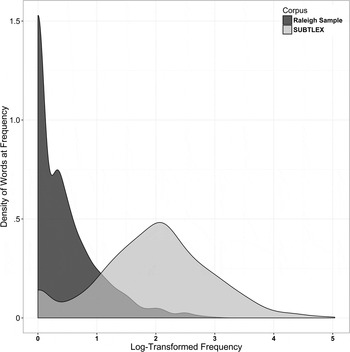
Given the high productivity of the (ING) suffix—any verb can take the suffix, in theory—a reasonable concern is that the density distribution for lexical frequency will have a long right tail, indicating some very rare verbs.
However, the density distributions in Figure 1 show that major skew only occurs in the results of corpus frequency, not SUBTLEX frequency. In fact, the distribution drawn from SUBTLEX looks approximately normal, lending some credence to the measure for statistical analyses. The skew in the corpus measure, when compared to the shape of the SUBTLEX measure, seems to be a result of the much lower token count rather than any substantial differences in usage. The corpus measure shows the central peak and downslope characteristics of the other distribution, but it simply does not have enough tokens to show the fine-grained distinctions in low-frequency words apparent in SUBTLEX.
Word density at levels of frequency by word corpus ((ING) words only).

Statistical modeling
The relationships among (ING), lexical frequency, and context of occurrence were assessed using mixed-effects logistic regression (using the lme4 package; Bates, Maechler, Bolker, & Walker, Reference Bates, Maechler, Bolker and Walker2017) in R (R Core Team, 2017). I use the reported Akaike information criterion (AIC) for each model (Burnham & Anderson, Reference Burnham and Anderson2004) to assess model fit, with lower AIC values indicating progressively better fit. For all models, a random intercept was included for both speaker and word, to control for interspeaker variation and word-specific effects, respectively. For an investigation of frequency effects, a random term for word is necessary to separate out the unique effects of individual words, especially those that make up an inordinate amount of the corpus, since unbalanced data can lead to misspecification of the strength and significance of fixed effects (Walker, Reference Walker2012). To assess which lexical frequency measure better fit the data, I ran two series of models, one with the corpus measure of lexical frequency and one using SUBTLEX. For each sequence of models, I added the same variables after the addition of lexical frequency and then selected the lowest AIC value as the best-fitting model for the corpus, thus indicating which measure performs best as a predictor within the model. Model fit statistics show that the lexical frequency measure derived from the SUBTLEX corpus fits the data better than one derived from the Raleigh corpus itself, and this difference in model fit persists through the addition of all subsequent variables.
In an attempt to address the degree of individual variation in the effect of phonological environment, I further included a random slope term for following place of articulation by speaker, which provides information as to whether there exists a great deal of individual variation in estimates. Though a fixed effect for phonological environment may achieve significance in the model, a random slope term can give more information as to how much individuals differ in their coefficient for a given place of articulation. If phonological constraints on (ING) differ from speaker to speaker due to individual differences in coarticulatory bias, the random slope term will evidence that fact.
Both model sets began with a base model of internal and social factors as fixed effects plus a random intercept for word and a random slope between speaker and following phonological environment. I included both following place of articulation and lexical category of token as internal constraints, but with some slight modifications from the initial coding schema. Since only coronal, velar, and pausal environments can be expected to have an effect on the realization of a token of (ING), I collapsed the remaining levels (bilabial, labiodental, vowel) into an “other” category. Similarly, progressive and participle tokens receive similar ranking in this community (Forrest, Reference Forrest2015), so I collapsed these lexical category levels into a “verbal” category to streamline the analysis. The social factors included in the model were sex, year of birth (centered and scaled), and education. Education was defined as a categorical variable with four levels: no college, two-year-college, college, and graduate.Footnote 6 Though priming (Tamminga, Reference Tamminga2016), lexical predictability (Seyfarth, Reference Seyfarth2014), and bigram frequencies (Raymond et al., Reference Raymond, Brown and Healy2016) have been suggested as having an effect on either (ING) or frequency more generally, the structure of the dataset did not allow for a fine-grained coding along these lines. For the following models 1 to 5, I added one additional term to each model, in numerical order. Models 6 to 13 test different permutations of interactions among lexical frequency, internal constraints, FFCgram, and FDCphon:
-
1. Base model (internal constraints and social factors)
-
2. Lexical frequency
-
3. Lexical frequency/year of birth interaction
-
4. FFCgram
-
5. FDCgram
-
6. FFCgram/grammatical constraints interaction
-
7. FDCphon/following phonological context interaction
-
8. FFCgram/grammatical constraints and FDCphon/following phonological context
-
9. Lexical frequency/FFCgram interaction
-
10. Lexical frequency/FDCphon interaction
-
11. Lexical frequency/FFCgram and lexical frequency/FDCphon interaction
-
12. Lexical frequency/FFCgram and FDCphon/following phonological context
-
13. Lexical frequency/FDCphon and FFCgram/grammatical constraints
Since rates of (ING) are changing over time in the Raleigh area (Forrest, Reference Forrest2015), I included an interaction term between speaker year of birth and lexical frequency to determine whether frequency's effects also changed over time. Additionally, under a usage-based phonological framework, we would expect an interaction between the frequency of individual words and FFC measures, since certain contexts would result in higher frequencies of either –in or –ing. After the inclusion of the basic terms for FFCgram and FDCphon, I included increasingly complex interaction terms among overall lexical frequency, FFCgram, and FDCphon. According to the fourth prediction for the model results, we would expect an amplified effect from frequent grammatical/phonological context as overall lexical frequency increases, so an interaction term should capture any effect that exists. Previous research examining FFC and internal constraints finds that FFC interacts with the effects of internal constraints (Raymond et al., Reference Raymond, Brown and Healy2016), so permutations of FFC/constraints interactions are also tested for model fit.
RESULTS
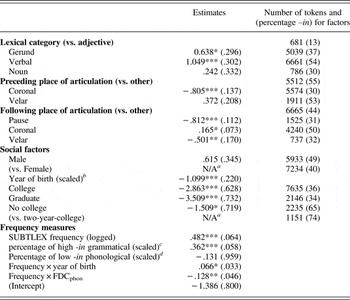
The best-fitting model to the data was determined via comparison of AICc model fit statistics for all possible models fit to the dataset. AICc represents the modified AIC value with a correction for finite sample sizes and therefore a greater penalty for including additional predictor variables in the model. The best-fitting model to the data overall was between model 10 (lexical frequency/FDCphon interaction) and model 11 (both lexical frequency/FDCphon interaction and lexical frequency/FFCgram interaction). However, upon examination of the residual deviance in both of these models, the addition of the extra interaction between lexical frequency and FFCgram provided virtually no reduction in deviance (<.2), leading to the selection of model 10 as the best candidate model. Therefore, I use the model including only an interaction term between lexical frequency and FDCphon for all subsequent analyses, with results displayed in Table 1.
Regression results for best-fitting model predicting –in
Observations: 13,167 (overall percentage – in 44.0%)
Log likelihood: −5,106.1 Akaike information criterion: 10,272.1
Bayesian information criterion: 10,496.7

Notes: *p < .05; **p < .01; ***p < .001.
a No estimates are calculated for reference levels.
b Mean year of birth = 1961, SD = 18 years.
c Mean percentage of high -in grammatical = 50.6%, SD = 30.5%.
d Mean percentage of low -in phonological = 17.2%, SD = 16.1%.
Frequency effects on (ING)
Hypothesis 1: Lexical frequency has an effect on the realization of (ING)
The regression model report in Table 1 shows the significant effect of a number of frequency measures within the final model, which I will discuss following the predictions laid out by exemplar theory. First and foremost, the model shows that the effect of lexical frequency persists even when including random terms for word and speaker and controlling for both internal and social factors. This effect is not one of borderline significance, as the standard error (.064) remains very low when compared with the substantial effect size (.482), even with the inclusion of additional frequency-based measures in the final model. For this community, the results strongly support that lexical frequency has a significant effect on the use of variants for (ING), with more frequent words having more likelihood of an –in variant, as expected. The addition of lexical frequency, however, does not affect the internal grammatical constraints governing (ING), which maintain their significance in the final model.
This result follows the predictions of the model but does not constitute enough evidence to support an exemplar-theoretic perspective on its own. Within the exemplar theory literature, frequent words tend to lead in reductive sound changes due to the repeated application of phonetic bias (Pierrehumbert, Reference Pierrehumbert, Bybee and Hopper2001, Reference Pierrehumbert2002; Hay & Foulkes, Reference Hay and Foulkes2016). However, alternative theories (e.g., hyper-/hypoarticulation) can just as easily explain the phonetic bias toward lenition in highly frequent words. The lexical frequency effect may simply be the result of speakers paying less attention to a full gestural articulation of high-frequency words, since they should be more predictable in context. Independent of any exemplar operations, this process would lead to the result illustrated here—that of frequent words exhibiting bias toward the lenited variant. To confirm exemplar processes beyond lenition bias requires an investigation of frequency effects beyond a basic fixed effect.
Hypothesis 2: Words will be sensitive to their most frequent contexts
If the predictions of exemplar theory truly hold for (ING), then a word's frequent context of occurrence should have an effect even when that environment is not present. To that point, both FFCgram and FDCphon, which measure a word's context of occurrence, improve model fitFootnote 7 and operate in the expected direction.Footnote 8 The effect of these variables, though a good deal smaller than the effect size of lexical frequency, lend credence to a usage-based interpretation of how speakers decide which variant of (ING) to produce in any given utterance. Those words that frequently occur in verbal environments tend to favor –in even more than the grammatical constraints would initially suggest, pointing toward a snowball effect of listeners storing tokens and using them as a basis for future production. Since speakers tend to use more instances of the –in variant for words in verbal environments, speakers hear more of this variant for that word, thereby using the –in variant for that word more often in all contexts, not just verbal contexts. The same process occurs in reverse with disfavorable phonological environments; words that occur frequently in a prevelar or prepausal context tend to have more variants of –ing overall. All things considered, these variables provide strong evidence for an interpretation of frequency along the lines of Pierrehumbert's (Reference Pierrehumbert2002, Reference Pierrehumbert2006) conception of exemplar dynamics, and they are consistent with both Guy et al.’s (Reference Guy, Hay and Walker2008) and Raymond et al.’s (Reference Raymond, Brown and Healy2016) results for t/d deletion. Speakers store exemplars of these words with either –in or –ing, which in turn affects their use of these words in other contexts, independent of internal constraints.
Hypothesis 3: Lexical frequency will interact with year of birth
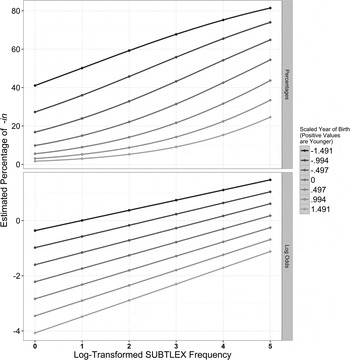
Since the Raleigh area is undergoing a socially motivated shift away from –in due to dialect levelling, high-frequency words should show an entrenchment effect, lagging behind the general movement toward –ing in the community. The graphs in Figure 2 display the results of the interaction between year of birth and overall lexical frequency that captures this effect, and the outcomes are shown in both log odds and predicted percentage of –in. The x-axis represents logged units of overall lexical frequency, and the individual lines represent the changing effect of lexical frequency for different age cohorts.
Age/lexical frequency interaction results as both predicted percentage of –in and log odds.

The interaction shows a significant difference in the effect of lexical frequency for different generations of speakers in Raleigh, beyond a simple transposition of the line to reflect lower overall rates of -in. The oldest speakers, represented by the top line in the graph, show a much shallower slope for lexical frequency than the youngest speakers do (the bottom line). Lexical frequency has an effect for speakers of all ages, but the difference between high- and low-frequency words becomes more pronounced for the youngest speakers. Taking the overall decrease in rates of the –in variant over time for the younger speakers in the corpus into account, an exemplar-driven approach provides a compelling explanation for the apparent increase in the importance of lexical frequency over time. If younger speakers intend to produce fewer –in variants overall, the most frequently heard words may be more resistant to this shift, since rates of –in are so high for these words to start. With so many exemplars of these words using the –in variant, speakers may be more strongly primed to use –in regardless of each speaker's aggregate rate. Conversely, words with low overall lexical frequency would have very few exemplars to bias speakers toward a specific variant, allowing for younger speakers to drop the rates of –in for these words more dramatically.
The low-frequency lead over apparent time exhibited in this dataset bears similarity to other types of changes, namely morphological leveling (Lieberman et al., Reference Lieberman, Michel, Jackson, Tang and Nowak2007) and push-chain vowel shifts (Hay et al., Reference Hay, Pierrehumbert, Walker and LaShell2015). Unlike the former case, however, the change toward the –ing variant is not the same sort of process as past-tense levelling, and (ING) certainly has no implication in a chain shift. Instead, the sociolinguistic contact situation within the community is shifting the rates of –in to more closely align with mainstream norms, resulting in the preservation within speaker exemplar clouds of previous norms in the most frequent words. Critically, the behavior of lexical frequency over time runs opposite the predictions of a leniting sound change, where we would expect high-frequency words to lead in the direction of community change (Bybee, Reference Bybee2002; Pierrehumbert, Reference Pierrehumbert, Bybee and Hopper2001).
Hypothesis 4: High lexical frequency will potentiate the effects of context of occurrence
In addition to differences over the course of apparent time, lexical frequency should also moderate the effect of FFC measures, both grammatical and phonological. However, only the interaction between FDCphon and lexical frequency improves model fit, contrary to the predictions of an exemplar-theoretic approach. The main effect of frequent grammatical environment (FFCgram) does improve model fit, but the interaction between this variable and lexical frequency shows no improvement.
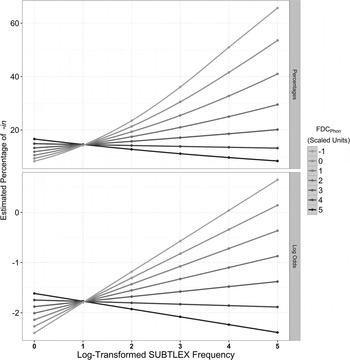
The interaction between lexical frequency and phonological environment, on the other hand, operates as expected. Figure 3 visualizes this interaction, where the x-axis represents logged units of lexical frequency, the y-axis represents both predicted percentage variants of –in and log odds coefficients, and each line represents a different scaled value of FDCphon, the measure of a word's percentage occurrence in prevelar and prepausal phonological environments (mean = 17.2%, SD = 16.1%).
FDCphon/lexical frequency interaction results as both predicted percentage of –in and log odds.
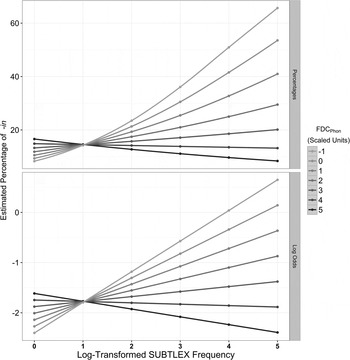
The interaction illustrates that a snowball effect occurs when increasing overall lexical frequency combines with varying levels of FDCphon. Words near the highest level of frequency show a dramatic gap between those that primarily occur in disfavorable (i.e., prevelar and prepausal) contexts and those that do not—a difference of over 40% more variants of –in. On the other hand, when examining the behavior of relatively infrequent words, we see that the FDC measure matters a great deal less. In fact, words at the lowest end of the frequency spectrum actually show a reversal of the pattern. Taking into account error overlap, this reversal likely does not constitute a real effect, but it does illustrate that the effects of FDCphon only take hold at higher levels of overall lexical frequency. These stark differences at opposite ends of the frequency continuum highlight the importance of lexical frequency in potentiating the effects of environmental occurrence through the population of the exemplar cloud. For highly infrequent words, the FDC measure matters very little, due to few (if any) exemplars of that word being stored in a speakers’ memory. A speaker is unlikely to encounter these rare words with any regularity, if they ever hear them at all, meaning that no skew in exemplar distribution could possibly exist. Only for words with moderate-to-high frequency do differences in preferred environments of occurrence seem to truly take hold.
The variable effect of both FDCphon and raw lexical frequency provides further evidence that frequency in general does not have a purely monotonic effect on linguistic variables. Lexical frequency interacts with word context, which in turn moderates the effect of lexical frequency. A word that occurred roughly 80% of the time in disfavorable phonological contexts (approximately four scaled units), for example, would follow a nearly flat trajectory on the graph, where the effects of lexical frequency and FDCphon effectively cancel each other out. Contrast this behavior with words that never occur in disfavorable phonological contexts (the top line in Figure 3), where lexical frequency matters a great deal. Despite the interactive effects of FDCphon, in most cases lexical frequency still exerts a slight, steady pull toward higher rates of –in, likely due to the proposed lenition process at work either in the consonant (Abramowicz, Reference Abramowicz2007) or vowel (Yuan & Liberman, Reference Yuan and Liberman2011) in (ING). Even for words that primarily occur in prevelar or prepausal contexts, predicted to have low rates of –in within the framework of internal constraints, we would still expect a lenition bias to have some effect on realization when duration shortens for very frequent words.
Ultimately, the effects of all the frequency measures provide strong evidence for a usage-based interpretation of (ING), combined with phonological internal constraints. Lexical frequency on its own shows a steady bias toward the –in variant, but frequency's effects on other constraints illustrate the complexity of speaker's procedural storage of exemplars. The importance of a word's frequent contexts, net of the phonological/grammatical constraints for an individual utterance, suggests that listeners store individual tokens of words as both Bybee (Reference Bybee1999) and Pierrehumbert (Reference Pierrehumbert2006) proposed. The changing effect of lexical frequency in apparent time demonstrates the entrenchment effect of high-frequency words (Pierrehumbert, Reference Pierrehumbert2002, Reference Pierrehumbert2006), as these words maintain the disfavored –in form more frequently even for the youngest speakers in the corpus. Lastly, the interaction between lexical frequency and grammatical environment of occurrence shows lexical frequency as a potentiator of other usage (storage) effects. Lexical frequency has some effect on its own, but much of its effect on variation comes from its reflection of a speakers’ exposure. When speakers have a large pool of remembered utterances from which to draw, they can draw more strongly on these procedural storage mechanisms, rather than rule-like abstractions (Pierrehumbert, Reference Pierrehumbert2006, Reference Pierrehumbert2016).
Collocations and individual phonological differences
In addition to the frequency effects predicted by exemplar theory, previous work on collocations (Bybee, Reference Bybee2006, Reference Bybee2010; Rácz et al., Reference Rácz, Pierrehumbert, Hay, Papp, MacWhinney and O'Grady2015; Torres Cacoullos & Walker, Reference Torres Cacoullos and Walker2009) assigned them a prominent role in frequency-driven linguistic processes, especially grammaticalization. In addition, frequent collocations may create artificial effects in the aggregate, much like individual speakers or words can skew community-level results without controls for random intercept. As a case in point, previous work with this corpus showed a stronger effect for following coronals (Forrest, Reference Forrest2015) that weakens with the inclusion of the random intercept term for word and random slope for following phonological environment by speaker used in the models for this study. However, both following velars and pauses retain most of their strength after controlling for these additional factors. This fact bears further discussion, since some previous studies (Kendall, Reference Kendall2013; Wagner, Reference Wagner2012) have found a significant effect attributed to phonological constraints, while others (Hazen, Reference Hazen2008; Tamminga, Reference Tamminga2014) have not. The weakening of the effect of following coronals in this dataset suggests that some of the previous variation explained by phonological factors was in fact due to word-specific and speaker-specific differences. When including word-specific factors with regard to (ING), a variable that has produced grammaticalized forms of some high-frequency collocations already (e.g., “gonna,” “tryna”), we might expect collocations to be responsible for some of the effects that were previously assigned to phonological factors.
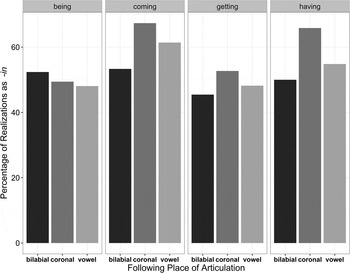
To illustrate the behavior of certain word-specific collocations, Figure 4 shows the variants of (ING) in different phonological environments for 4 of the top 10 most frequent words in the corpus, “being,” “coming,” “getting,” and “having.” In an attempt to address the process by which frequent collocations may shape phonological variation, the first two words have a low incidence of the “verb-ing + to” collocation and the latter two words primarily occur in these environments. Additionally, they all have a relatively balanced distribution of data in different phonological environments to allow for a comparison of the effect of following coronals between the two classes of word. Since the most data for each of these words occurs in the progressive forms, only tokens used as progressives are displayed in Figure 4. Phonological environment categories are also reduced to bilabial, coronal, and vowel for display because the other environments had so few tokens that their percentages exhibited significant skew.
The effect of collocations on highly frequent words.

There exists somewhat of a difference between the words highly collocated with “to” (the two words on the right) and those with a much lower frequency of this collocation with regard to the effect of following coronals. The words that have a high frequency of collocation with “to” (“getting” and “having” in this example) show a tendency toward more –in realizations in precoronal environments, but those with few instances of the “verb-ing + to” collocation show mixed results. “Being” does not favor –in more for precoronal occurrences than neutral environments, suggesting that at least part, but not all, of the effect of following coronals may be explained by frequent collocations. Instead of a pure effect of following coronals on the realization of (ING), what may be occurring is a combined effect of collocations and phonological environment. However, collocations do not seem to be responsible for the effect of following velars or pauses on (ING), since they both maintain their strength in the regression model and have no clear high-frequency collocations that could be driving the effect. Breaking down the differences in log-odds coefficients for individuals may shed some light on how these environments differ from coronals.
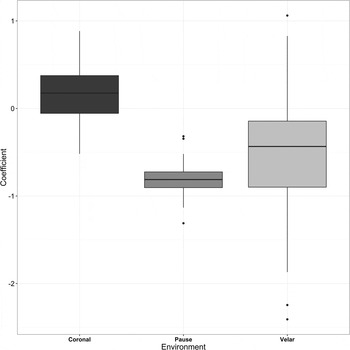
The random slope term included in the mixed-effects model accounts for individual differences in the treatment of following place of articulation, thereby showing how much the phonological effects differ from speaker to speaker. For a traditional phonological constraint, speakers should show consistency in the direction, if not the exact degree, of particular phonological environments. In this scenario, all individuals have a constraint governing the choice of variant for (ING) that operates in the expected direction—coronals favor –in while velars and pauses favor –ing. If instead there exists a wide amount of variation at the individual level for the direction of a given constraint, then the results would point more toward a phonetic, coarticulatory explanation, partially explaining the cross-community differences with regard to phonological environment's effect on (ING). Figure 5 presents boxplots of the coefficients affecting the realization of (ING) for individual speakers, split into following coronals, pauses, and velars.
Individual speaker coefficients for phonological environment.

For all of the following environments, the important point to note is whether the coefficients for individuals are positive or negative. Coronals, for example, have a relatively small distribution, but a very large number of speakers have coefficients for following coronals that cross into the negative range, meaning that these speakers favor –ing in environments with following coronals, rather than –in. The distribution of the individual coefficients shown here suggests that, despite the aggregate level effect in the expected direction, the effect of following coronals shows a great deal of individual-level variability. Similarly, while the median coefficient value for following velars is negative, individuals show a high degree of variability from the center of the distribution, much wider than that of coronals. Of the speakers in the corpus, 24 individuals show a positive coefficient for following velars, meaning that they favor –in rather than –ing in these environments. Though not as extreme a difference as for following coronals, these individuals compose a little over 18% of the corpus, and they provide further evidence that the effects of following place of articulation may be more gradient at the speaker level.
Pauses are the only following environment that shows a consistent pattern across all speakers in the community, but both articulation and other factors may play a role in creating this effect. From an articulatory standpoint, we might expect more consistency in articulation for prepausal environments, since no coarticulatory factors play a role (Baker, Archangeli, & Mielke, Reference Baker, Archangeli and Mielke2011). Individuals may vary in how much they coarticulate during running speech, but with prepausal (ING) environments allowing the gesture to move to completion, speakers should have no interference in this regard. Second, prepausal tokens may represent an environment in which speakers pay a greater degree of attention to speech, since they occur before a pause (Kendall, Reference Kendall2013). Kendall (Reference Kendall2013) showed that higher rates of articulation favor the –in variant over average or slow rates of articulation, which he attributed to a relationship between language production and cognitive processes. Therefore, there exists both an articulatory and cognitive process at work in this environment, which may explain the greater degree of speaker consistency with regard to pauses’ effect on the realization of (ING).
DISCUSSION
The significant effects for lexical frequency and all of its interactions found within this dataset provide support for a usage-based interpretation of the variable and an exemplar-theoretic account of variation more generally. For each of the four major hypotheses presented, the data confirms the predictions of exemplar theory. In the case of overall lexical frequency, its effect on the realization of (ING), even while taking into account internal constraints and frequency's interactive effects, suggests that lenition plays a partial role in the realization of (ING). When lexical frequency does have an effect on its own, the result tends to be one of stable lenition, as Dinkin (Reference Dinkin2008) and others (e.g., Philips, Reference Phillips1984) proposed. I would not argue that lenition is the primary force behind (ING)’s variation; the evidence overwhelmingly points to the grammatical constraints at the morphological level to have the most influence over speakers’ production. Indeed, whatever lenitive process exists for (ING) appears to be relatively minor, given the inconsistency of findings surrounding phonological constraints, the shape of variation across apparent time, and the variation within the phonological constraints of individuals. When examining lexical frequency's interaction with year of birth, it is somewhat difficult to extrapolate what force frequency exerts independently of the contact situation. The oldest age cohort likely reflects the effects of lexical frequency before any contact-induced social change, and in these speakers’ case, lexical frequency has only a small effect. Likewise, examining the individual variation in following phonological environment shows wide variability, suggesting any lenitive effects are tied to speakers’ individual tendencies toward coarticulation (Baker et al., Reference Baker, Archangeli and Mielke2011), rather than an intrinsic property of (ING).
The significant effect of both phonological and grammatical environment of occurrence provide strong evidence in favor of an exemplar-theoretic account, replicating the findings of previous research (Guy et al., Reference Guy, Hay and Walker2008; Raymond et al., Reference Raymond, Brown and Healy2016) concerning t/d deletion. Without some theorization of an episodic storage mechanism within speakers’ cognition, a word's contextual distribution within phonological environments should have no effect at all. Within a purely generative paradigm, each realization of a word is agnostic to those that have been previously heard or uttered, with no word-specific details affecting a speakers’ production. However, the persistent effect of the FDCphon measure requires some inclusion of episodic memory within the model of speaker grammar. Speakers, net of the context of an individual utterance, use the prior distribution of variants they attach to each word as a factor influencing their production. The larger the skew toward –in-favoring environments for a given word, the greater the bias toward productions of –in for all contexts.
The interaction between FDCphon and overall lexical frequency provides evidence not only for exemplar theory, but specifically for a hybrid model of (morpho)phonology (Pierrehumbert, Reference Pierrehumbert2006, Reference Pierrehumbert2016). The effect of FDCphon stems from a mechanism of word-specific storage, drawing back to a speaker's memory of previous utterances of the same word. However, in cases where words have very low lexical frequency, speakers would have no word-specific detail to inform their production. In these cases, they would need to rely solely on morphophonological abstraction to determine the constraints on production, in turn requiring the possession of such rules within the grammar. Conversely, for higher-frequency words, the effect of FDCphon exerts a stronger pull on the distribution of words. At high frequencies, exemplar clouds are densely populated and exert a constant bias, operating in line with the shape of the distribution. For the phonological environment phenomenon, lexical frequency acts as a catalyst (Erker & Guy, Reference Erker and Guy2012), causing other exemplar-driven forces to become prominent. One additional point to note is the low likelihood of an –in realization at very low lexical frequency for all levels of FDCphon. This avoidance of –in may result from speakers’ desire for clarity due to the use of an uncommon word, therefore treating –ing as the more articulate form.
Lastly, the interaction between lexical frequency and year of birth exhibits an effect that operates in the opposite direction of changing social pressures to use lower rates of –in overall. Over the course of apparent time, the effect of lexical frequency strengthens, with high-frequency words shifting toward –ing much more slowly than their low-frequency counterparts do. The slower rate of change for high-frequency words results from an entrenchment force, since most exemplars heard for these words would likely still use –in. Due to the infrequent exemplars of low-frequency words, however, individuals show a much sharper decline in the use of -in in these cases, creating the more pronounced effect of lexical frequency for the younger speakers in this dataset. An increasing importance for lexical frequency in apparent time has been observed over the course of both vowel chain shifts (Hay et al., Reference Hay, Pierrehumbert, Walker and LaShell2015) and leniting changes (Hay & Foulkes, Reference Hay and Foulkes2016), and this dataset shows the same effect present during contact-induced change. Despite the different motivation for the start of linguistic change (phonetic bias/misperception vs. social stigma), (ING) shows similar effects to other linguistic variables with regard to the effect of lexical frequency over the course of change.
CONCLUSION
This paper provides support for a usage-based interpretation of (ING) in light of robust frequency and frequency-moderated effects on different aspects of the variable. From an exemplar-theoretic perspective, this paper provides evidence that exemplar storage exerts some effect on the choice of variant for (ING), as word-specific events affect future realizations of words. It is rare to see a morphological variable, even if it has phonological components as well, undergo a substantial change in a short period of time, but this case study suggests that morphological change may operate in a similar fashion to phonetic or phonological variables with regard to frequency effects. Similarly, this study suggests that, like perceptual or coarticulatory sound change, socially driven change shows effects from lexical frequency over the course of the change. It would be overstating the case to argue that all contact-induced change would proceed as (ING) does in Raleigh, but at the very least the mechanisms that underlie exemplar theory (e.g., entrenchment and lexical frequency) operate as expected during social change. Lastly, the stable lexical frequency effect and individual variation in coarticulation point toward the need for a deeper investigation of the phonetic cues that separate –in from –ing. The evidence presented here suggests a small lenition bias within the variable, separate from morphological components.