Implications
Surgical castration causes acute pain-induced distress in piglets. It would be beneficial to pig welfare and the swine industry to develop commercially viable ways to reduce the pain-induced distress caused by castration; however, applying topical anesthetic on the wound caused by surgical castration was not effective in eliminating or even reducing the pain response to castration in pigs. More research is needed to evaluate other methods of analgesia that could be used to alleviate the pain caused by castration in piglets that is practical to implement on farms or to find alternatives to surgical castration to prevent boar taint.
Introduction
Surgical castration of male piglets is a common management practice carried out on commercial swine farms to prevent the occurrence of boar taint and aggressive behavior. However, the procedure of surgical castration causes acute pain-induced distress, which is an animal welfare concern (McGlone et al., Reference McGlone, Nicholson, Hellman and Herzog1993; Prunier et al., Reference Prunier, Mounier and Hay2005; Carroll et al., Reference Carroll, Berg, Strauch, Roberts and Kattesh2006). Negative public perception concerning castration without the use of analgesics or anesthetics is increasing (Giersing et al., Reference Giersing, Ladewig and Forkman2006; Svendsen, Reference Svendsen2006). Alternatives to castration include slaughtering pigs before they reach sexual maturity (Dunshea et al., Reference Dunshea, Colantoni, Howard, McCauley, Jackson, Long, Lopaticki, Nugent, Simons, Walker and Hennessy2001), using immunocastration techniques, sperm sexing for selection of female offspring and genetic selection for pigs with low levels of boar taint. Over the last decade there has been a trend of increasing carcass weights of pigs, which is likely to result in an increase in the incidence of boar taint (EFSA, 2004). Immunocastration products are currently not approved for use in the United States by the Food and Drug Administration (FDA), and in countries where the use of immunocastration drugs are approved, it is still uncertain how acceptable this technique would be for the consumers (Valeeva et al., Reference Valeeva, Backus and Baltussen2009). Currently, alternatives such as sperm sexing are still in the experimental stages and are not ready for implementation on farms (EFSA, 2004; von Borell et al., Reference Von Borell, Baumgartner, Giersing, Jäggin, Prunier, Tuyttens and Edwards2009). Therefore, it would be beneficial to the welfare of the pig and the swine industry to develop commercially viable ways to reduce the pain-induced distress caused by castration in piglets.
The usefulness of local and general anesthetics, and analgesics to reduce the pain-induced distress caused by castration in piglets has been assessed in the literature. Neither orally administered aspirin (a non-steroidal anti-inflammatory drug) nor butorphanol (a synthetic opioid analgesic) reduced the behavioral response of pigs to surgical castration (McGlone et al., Reference McGlone, Nicholson, Hellman and Herzog1993). The sedative effects of injected or induced general anesthetics can last from 2 to 50 min (McGlone et al., Reference McGlone, Nicholson, Hellman and Herzog1993; Walker et al., Reference Walker, Jäggin, Doherr and Schatzmann2004; Hodgson, Reference Hodgson2006; Axiak et al., Reference Axiak, Jäggin, Wenger, Doherr and Schatzmann2007; Hodgson, Reference Hodgson2007). This prolonged recovery period from anesthesia could increase the risk of crushing of the piglet by the sow and reduce feeding opportunities, which is suggestive that general anesthesia is not a practical form of pain relief for young pigs on the farm. A local anesthetic given before castration has been shown to reduce and even eliminate the cortisol response to castration in several species, including lambs (Dinniss et al., Reference Dinniss, Mellor, Stafford, Bruce and Ward1997; Molony et al., Reference Molony, Kent, Hosie and Graham1997) and calves (Fisher et al., Reference Fisher, Crowe, Alonso de la Varga and Enright1996; Stafford et al., Reference Stafford, Mellor, Todd, Bruce and Ward2002). Local anesthetic was also shown to prevent the reduction in nursing and lying (without contact) behaviors in piglets in response to castration (McGlone and Hellman, Reference McGlone and Hellman1988), and piglets given a local anesthetic before castration vocalized less during castration than those not given an anesthetic (White et al., Reference White, DeShazer, Tressler, Borcher, Davey, Waninge, Parkhurst, Milanuk and Clemens1995; Leidig et al., Reference Leidig, Hertrampf, Failing, Schumann and Reiner2009). However, the disadvantages to using a local anesthetic include the time and stress caused by needing to repeatedly handle piglets; once to administer the local anesthetic and the second time to castrate the animal. The second disadvantage is the use of needles. There is currently a trend for large commercial swine producers to move away from administering injections using needles to ensure that broken needles are not found in the meat. Therefore, developing a method of alleviating the pain-induced distress caused by castration without the use of needles or repeated handling would be positive for pigs and producers.
The topical application of local anesthesia is used in both human and veterinary medicine as a form of pain relief for surgical or endoscopic procedures in the ear, nose, mouth, pharynx, larynx and other sites. A topical anesthetic can be applied painlessly as a spray, liquid or gel, which makes it easy and practical to administer. Therefore, a topical anesthetic may be suitable as a practical on-farm method of pain relief for piglets after castration. Topical anesthetics have been shown to work effectively in reducing the pain associated with lacerations and open wounds in young children (Young, Reference Young2007). A topical anesthetic administered (spray or gel) to both the scrotum and the tail stump wound after surgical castration and tail docking in lambs reduced wound hyperanalgesia (Lomax et al., Reference Lomax, Dickson, Sheil and Windsor2010) and the peak cortisol response (Paull et al., Reference Paull, Lee, Colditz and Fischer2009) to these procedures as compared with lambs not given the anesthetic. Primary and secondary hyperanalgesia and pain-related behaviors were reduced in lambs given a topical anesthetic after museling as compared to lambs given a placebo (Lomax et al., Reference Lomax, Sheil and Windsor2008). Literature in other species suggests that the topical application of a local anesthetic may be an effective and practical method to administer pain relief to piglets after castration on the farm. Therefore, the objective of this study was to evaluate the use of two topical anesthetics (short- and long-acting) to alleviate the pain-induced distress caused by castration in piglets by using a multidisciplinary approach incorporating both physiological and behavior indices of distress including cortisol, hematology, stress vocalizations and behavior.
Material and methods
Animals
The piglets used in this study were PIC USA genetics using the Camborough-22 sow line. Sows were fed a diet to meet or exceed NRC nutrient requirements (1998). Water was provided ad libitum. All animal procedures were approved by the Texas Tech University Animal Care and Use Committee.
Experiment 1: physiological response to castration
Forty weight-matched piglets were allocated to one of four treatment groups. Treatments included: (i) sham castration (CON; n = 10), (ii) surgical castration (CAS; n = 10), (iii) castration and short-acting local anesthetic applied topically to the castration wound (SHORT; n = 10) and (iv) castration and long-acting local anesthetic applied topically to the castration wound (LONG; n = 10). All the four treatment groups were represented in each litter that was tested and 10 litters in total were used in this study. The piglets were randomly allocated to treatments within each litter.
At 3 days of age (±2 days), four male piglets from one litter were allocated to one of the four treatment groups. All experimental piglets were removed from the sow and taken to an adjoining room separated by a closed door, so as not to disturb the remaining sows and piglets in the farrowing room. Treatments were applied in a random order within each litter.
Piglets in the CAS treatment group were restrained between the legs of the person performing the procedure to expose the anogenital region of the piglet. A scalpel was used to make an incision on each side of the scrotum, the testicles were then freed from the surrounding tissue and the testicles pulled. Iodine disinfectant was sprayed onto the castration wound. Sham-castrated piglets were handled and restrained for approximately 30 s in the same manner as the CAS piglets, but without any cutting. Piglets in the SHORT treatment group were castrated in the same manner as the CAS piglets, except that a short-acting anesthetic (Cetacaine®, Cetylite Industries, Inc., Pennsauken, NJ, USA) was sprayed topically onto the spermatic cords before the cords were cut and onto the skin at the edge of the castration wound. The topical anesthetic was applied to the spermatic cords by inserting the application nozzle of the spray bottle into the scrotal wound and then applying the anesthetic to the spermatic cords as the applicator nozzle was being removed. This method of application was chosen so that the spermatic cords would receive the anesthetic before their retraction into the body cavity after the testes were severed. Cetacaine® (14% Benzaine, 2% Butamben and 2% Tetracaine hydrochloride) is a fast-acting topical anesthetic containing a local anesthetic that lasts approximately 30 to 60 min. Finally, piglets in the LONG treatment group were castrated in the same manner as the CAS piglets, except that a long-acting anesthetic (Tri-Solfen, Animal Ethics, VIC, Australia) was administered topically onto the spermatic cords before the cords were cut and onto the skin at the edge of the castration wound. Tri-Solfen comes in gel form, and therefore it was administered using a syringe (without a needle) for easy application and 0.5 cc was applied to each spermatic cord. Tri-Solfen (40.6 g/l lignocaine, 4.5 g/l bupivacaine, 24.8 mg/l adrenaline and 5.0 g/l cetrimide) consists of a short-acting (lignocaine hydrochloride) and long-acting (bupivacaine hydrochloride) local anesthetic, a vasoconstrictor (adrenaline tartrate) and an antiseptic agent (cetrimide). Treatments were random, and therefore the treatment order did not confound.
Immediately before (baseline), and 30, 60, 120 and 180 min after castration, piglets were held in a supine position and 2.5 ml blood obtained by anterior vena cava puncture. Blood was collected into vacutainers containing EDTA. Blood samples were placed on ice before analysis. Whole blood was analyzed to determine white cell counts and differential leukocyte counts (Cell-Dyn® 3700, Abbott Laboratories, Abbott Park, IL, USA) and the neutrophil to lymphocyte (N : L) ratio was calculated by dividing the percentage of neutrophils by the percentage of lymphocytes. Blood samples were then centrifuged at 660 × g for 20 min and plasma was collected and stored at −20°C for further analysis. Cortisol was analyzed using a commercially available enzyme immunoassay kit (Assay Designs, Ann Arbor, MI, USA).
Experiment 2: behavioral response to castration
At 3 days of age (± 2 days), 36 male piglets were allocated to one of four treatment groups: (i) sham castration (CON; n = 9), (ii) surgical castration (CAS; n = 9), (iii) castration and short-acting local anesthetic applied topically to the castration wound (SHORT; n = 9) and (iv) castration and long-acting local anesthetic applied topically to the castration wound (LONG; n = 9). All the four treatment groups were represented in each litter that was tested and nine litters in total were used in this study. Piglets were randomly allocated to treatments within each litter. Treatments were administered in the same manner as described in experiment 1 (see above). Treatments were applied in a random order within each litter.
Camcorders (DCR-SR85, Sony, NY, USA) were used to record vocalizations during castration. Vocalizations were analyzed using an automatic stress call monitoring system (STREMODO, Forschungsinstitut für die Biologie landwirtschaftlicher Nutztiere, Dummerstorf, Germany). STREMODO analysis of stress vocalizations of pigs has been used previously to assess the response of pigs to surgical castration with and without pain relief (Puppe et al., Reference Puppe, Schön, Tuchscherer and Manteuffel2005; Leidig et al., Reference Leidig, Hertrampf, Failing, Schumann and Reiner2009). The percentage of stress vocalizations in response to handling and during the procedure was analyzed for each treatment.
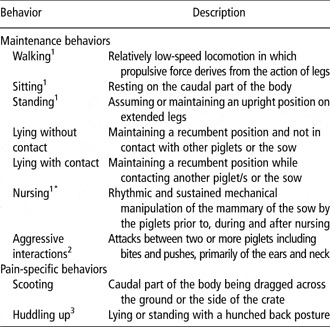
Sixty minutes before castration, the experimental piglets were individually marked with a heavy-duty marking pen (Super mark pen, Fearing International Ltd, Northampton, UK) using a series of lines in the cross-sectional plan or colors to differentiate among individual pigs for easy identification. After 30 min of recording piglet behavior, all experimental piglets were removed from the sow and taken to an adjoining room separated by a closed door, so as to not disturb the remaining sows and piglets in the farrowing room. Piglets were then castrated or handled depending on which treatment group they were allocated to. After castration, the piglets were returned to the sow and the behavior of each individual pig was recorded using 1 min scan-samples (live observations) for 180 min, giving a total of 180 data points. The observer sat directly behind the sow to prevent disturbing her as much as possible, but still giving the observer a complete view of all piglets in the farrowing crate. The observer was blind to the treatments. The behaviors and postures measured are described in Table 1.
Description of behaviors

1 Hurnik et al. (Reference Hurnik, Webster and Siegel1995).
2 McGlone (Reference McGlone1985).
3 Moya et al. (Reference Moya, Boyle, Lynch and Arkins2008).
*Nursing in this study refers to nursing and massaging, as it is difficult to differentiate between these two behaviors.
Body weight (BW) and wounding healing
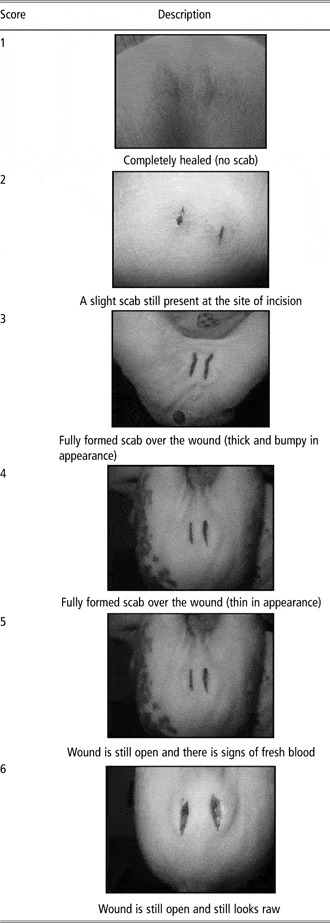
All piglets from the behavior and physiology experiments were weighed before and 24 h after castration. All piglets were observed daily for the first 14 days after castration and wound healing scored to assess any detrimental effects (ex. abscesses) caused by any of the castration methods assessed. Wounds were scored from 1 to 6, with one being completely healed (no scab) and six still showing signs of fresh blood (Table 2).
Description of wound healing score

Statistical analyses
All data were tested for constant variance and departures from normal distribution. Data lacking normality were transformed logarithmically using log10. Data that required transformation included leukocyte counts, cortisol concentrations, percentage of stress vocalizations, all behavioral data and wound healing scores. Data were subjected to analysis of variance using the mixed model procedure of SAS version 9.1 (SAS Inst., Inc., Cary, NC, USA). Each litter contained all the four treatments. Ten litters were used in the physiological response experiment and nine litters were used in the behavioral response experiment. The piglet was the experimental unit. The model had a repeated structure on time allowing incorporation of heterogeneity of variances across time. For physiological measures, the main fixed effects were treatment and time. Litter was a random effect. The interactions between treatment and time and treatment and litter were included in the model. The model had a repeated structure on time allowing incorporation of heterogeneity of variances across time. Behavioral data were also analyzed using analysis of variance using the mixed model procedure of SAS. The 210-min behavior observation period was divided into seven 30-min periods. For behavioral measures, the main fixed effects were treatment and period. Litter was a random effect. The interactions between treatment and period and treatment and litter were included in the model.
Results
Blood leukocyte counts and differentials
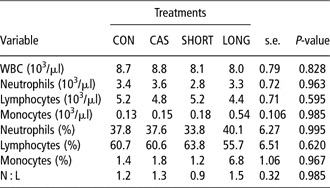
Leukocyte counts and differentials did not differ (P > 0.05) in pigs given a topical anesthetic after castration compared with sham-handled piglets or piglets castrated without an anesthetic (Table 3). There was no time by treatment interaction (P > 0.05) for any of the leukocyte counts or differentials measured.
Comparison of leukocyte counts and percentages (LSM ± s.e.) of piglets castrated with and without anesthetic or sham castrated

WBC = total white blood cell count.
N : L = neutrophil to lymphocyte count.
Treatments: sham castration (CON; n = 10), surgical castration (CAS; n = 10), castration and short-acting local anesthetic applied topically to the castration wound (SHORT; n = 10) and castration and long-acting local anesthetic applied topically to the castration wound (LONG; n = 10).
Cortisol
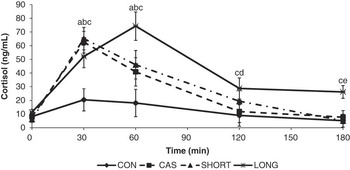
Cortisol concentrations were elevated (P = 0.06) in piglets castrated surgically compared with CON piglets 30 and 60 min after castration (Figure 1). Cortisol concentrations were elevated (P < 0.06) in SHORT piglets 30 and 60 min after castration compared with CON piglets (Figure 1). Cortisol concentrations were elevated (P < 0.05) in LONG piglets 30, 60, 120 and 180 min after castration compared with CON piglets and greater (P < 0.05) at 120 min after castration compared with CAS piglets (Figure 1). At no time point was the cortisol response to castration with either short- or long-acting topical anesthetic reduced (P > 0.05) compared with piglets castrated without an anesthetic.
Cortisol concentrations (LSM ± s.e.) before and 30, 60, 120 and 180 min after sham castration or castration with and without a topical anesthetic in piglets. Treatments: sham castration (CON [⧫]; n = 10); surgical castration (CAS [▪]; n = 10); castration and a short-acting local anesthetic applied topically to the castration wound (SHORT [▴]; n = 10), and castration and a long-acting local anesthetic applied topically to the castration wound (LONG [★]; n = 10). At each time, least square means accompanied by ‘a’ signifies that CON differs from CAS, ‘b’ signifies that CON differs from SHORT, ‘c’ signifies that CON differs from LONG, ‘d’ signifies that CAS differs from LONG and ‘e’ signifies that SHORT differs from LONG at P = 0.06.

Behavior
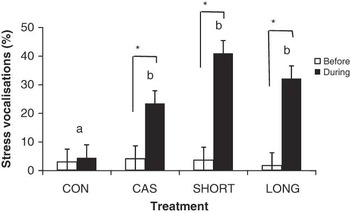
The percentage of stress vocalizations were similar (P > 0.05) among treatments during handling before castration (Figure 2). The percentage of stress vocalizations was greater (P < 0.05) during castration compared with the percentage of stress vocalizations recorded in response to handling alone. The percentage of stress vocalizations occurring during the administration of the treatments was greater (P < 0.05) in CAS, SHORT and LONG compared with CON piglets. There was no difference (P > 0.05) in the percentage of stress vocalizations among CAS, SHORT and LONG piglets during castration.
The percentage of stress vocalizations (LSM ± s.e.) before (pre) and during (during) administration of the treatment. Treatments: sham castration (CON; n = 9); surgical castration (CAS; n = 9); castration and a short-acting local anesthetic applied topically to the castration wound (SHORT; n = 10); and castration and a long-acting local anesthetic applied topically to the castration wound (LONG; n = 10). For each treatment, least square means accompanied by a * signifies that pre differed from during at P < 0.05. At each time (pre or during), least square means accompanied by different letters differs at P < 0.05.

Piglets castrated without the topical administration of a local anesthetic to the wound spent more time (P < 0.05) lying without contact compared with piglets given a short- or long-acting topical anesthetic after castration. The time spent lying without contact did not differ (P > 0.0.5) among control piglets and piglets castrated with or without an anesthetic (CON: 1.1 ± 0.51, CAS: 1.7 ± 0.51, SHORT: 0.8 ± 0.51 and LONG: 0.3 ± 0.51). There was no time by treatment interaction (P > 0.05) for the time spent lying without contact. There was no time by treatment interaction (P > 0.05) for any other behaviors measured.
BW and wound healing
BW change did not differ (P > 0.05) among treatments 24 h after castration or control handling (CON: 0.29 ± 0.052, CAS: 0.23 ± 0.051, SHORT: 0.22 ± 0.051 and LONG: 0.16 ± 0.052).
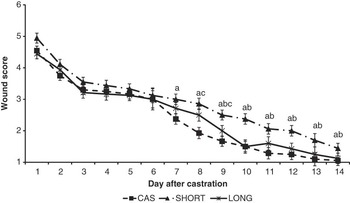
Wound healing scores were greater/worse (P < 0.05) among SHORT piglets compared with CAS piglets 7 to 14 days after castration (Figure 2). Wound healing scores were greater (P < 0.05) in SHORT piglets compared with LONG piglets 9 to 14 days after castration (Figure 2). Wound healing scores decreased (P < 0.001) over time regardless of treatment (Figure 3).
Daily wound healing scores (LSM ± s.e.) of piglets after castration with and without a topical anesthetic. Treatments: surgical castration (CAS [▪]; n = 10); castration plus a short-acting local anesthetic applied topically to the castration wound (SHORT [▴]; n = 10), and castration plus a long-acting local anesthetic applied topically to the castration wound (LONG [★]; n = 10). At each time, least square means accompanied by a ‘a’ signifies that SHORT differs from CAS, ‘b’ signifies that SHORT differs from LONG and ‘c’ signifies that CAS differs from LONG at P < 0.05.

Discussion
Surgical castration is the most commonly used technique to castrate piglets. Previous studies have shown that surgical castration can cause physiological and behavioral changes in piglets indicative of acute distress (McGlone et al., Reference McGlone, Nicholson, Hellman and Herzog1993; White et al., Reference White, DeShazer, Tressler, Borcher, Davey, Waninge, Parkhurst, Milanuk and Clemens1995; Haga and Ranheim, Reference Haga and Ranheim2005; Prunier et al., Reference Prunier, Mounier and Hay2005; Carroll et al., Reference Carroll, Berg, Strauch, Roberts and Kattesh2006). Until a practical alternative to surgical castration is developed, there is a need to develop practical on-farm pain relief for piglets during castration. Local anesthesia has been used as a method to reduce the physiological and behavioral response to surgical castration in piglets (McGlone and Hellman, Reference McGlone and Hellman1988; White et al., Reference White, DeShazer, Tressler, Borcher, Davey, Waninge, Parkhurst, Milanuk and Clemens1995; Leidig et al., Reference Leidig, Hertrampf, Failing, Schumann and Reiner2009) and other species (Fisher et al., Reference Fisher, Crowe, Alonso de la Varga and Enright1996; Dinniss et al., Reference Dinniss, Mellor, Stafford, Bruce and Ward1997; Molony et al., Reference Molony, Kent, Hosie and Graham1997; Stafford et al., Reference Stafford, Mellor, Todd, Bruce and Ward2002). However, it is impractical to use an injectable local anesthetic as a pain relief on the farm due to the increased time and stress caused by the need to repeatedly handle animals, once to administer the local anesthetic and the second time to castrate the animal. Therefore, in this study, we wanted to determine if administering a local anesthetic topically to the castration wound would be a practical solution to reduce the pain-induced distress caused by castration in piglets.
Topical anesthesia is used in both human and veterinary medicine as a form of pre- and post-procedural pain relief. Topical anesthetics can be applied painlessly as a spray, liquid or gel, which makes them easy and practical to administer. The anesthetic effects of topical anesthesia act more rapidly when the anesthetic is applied to the mucous membranes compared with intact skin, as intact skin acts as a diffusion barrier (Huang and Vidimos, Reference Huang and Vidimos2000). Topical anesthetics have been shown to work effectively to reduce the pain associated with lacerations and open wounds in young children (Young, Reference Young2007). In this study, a topical anesthetic was applied to the castration wound rather than the skin before castration to provide post-procedural pain relief rather than pain relief from the immediate acute pain caused by making the scrotal incision. A topical anesthetic was not applied to the skin before the scrotal incision was made due to the time it would take for the anesthetic to take effect, which would result in the same impracticalities as associated with using an injectable anesthetic (repeated handling). A short-acting topical anesthetic, Cetacaine®, was chosen because it consists of a fast-acting local anesthetic that lasts approximately 30 to 60 min and is available commercially. A long-acting topical anesthetic, Tri-Solfen, was chosen because it consists of a fast-acting and long-acting anesthetic as well as a vasoconstrictor, and antiseptic. Tri-Solfen was also shown to be effective in reducing the post-procedural pain caused by surgical castration and tail docking (Paull et al., Reference Paull, Lee, Colditz and Fischer2009; Lomax et al., Reference Lomax, Dickson, Sheil and Windsor2010) and museling (Lomax et al., Reference Lomax, Sheil and Windsor2008) in lambs.
Changes in leukocyte numbers and percentages can occur in response to acute stress in pigs (Hicks et al., Reference Hicks, McGlone, Whisnant, Kattesh and Norman1998; Niekamp et al., Reference Niekamp, Sutherland, Dahl and Salak-Johnson2007; Sutherland et al., Reference Sutherland, Bryer, Davis and McGlone2009). This phenomenon is known as leukocyte trafficking and is thought to reflect the redistribution of leukocytes to lymph nodes, bone marrow and skin (Dhabhar, Reference Dhabhar2002). Leukocyte trafficking is thought to represent an adaptive response that may increase immune surveillance during stressful situations (Dhabhar, Reference Dhabhar2002). In this study, leukocyte counts, percentages or the neutrophil to lymphocyte ratio were not affected by surgical castration with or without an anesthetic in piglets. Leukocyte counts and the neutrophil to lymphocyte ratio increased in lambs surgically castrated, but applying a topical anesthetic to the castration wound did not reduce this change in leukocyte numbers (Paull et al., Reference Paull, Lee, Colditz and Fischer2009). The pain-induced distress caused by surgical castration, with or without an anesthetic, did not simulate leukocyte trafficking in 3-day-old piglets 3 h after castration, but it would be interesting to determine if surgical castration has long-term effects on the immune system of pigs.
Surgical castration causes an increase in cortisol concentrations in piglets for up to 120 min after castration (Prunier et al., Reference Prunier, Mounier and Hay2005; Carroll et al., Reference Carroll, Berg, Strauch, Roberts and Kattesh2006; Moya et al., Reference Moya, Boyle, Lynch and Arkins2008). In this study, castration caused elevated cortisol concentrations in piglets for up to 120 min after this procedure was performed. Application of a short- or long-acting topical anesthetic to the spermatic cords and scrotal wound after castration was unsuccessful at reducing the cortisol response to surgical castration. The peak cortisol response (at 30 min) was reduced in lambs given a long-acting topical anesthetic (Tri-solfen) after surgical castration and tail docking compared with lambs that did not receive anesthesia (Paull et al., Reference Paull, Lee, Colditz and Fischer2009). In this study, the cortisol concentrations were numerically lower in piglets given a long-acting topical anesthetic after castration compared with piglets castrated without anesthesia, 30 min after castration. However, 60 min after castration, the cortisol concentrations were numerically higher in piglets given a long-acting topical anesthetic compared with piglets castrated without anesthesia. It is possible that Paull et al. (Reference Paull, Lee, Colditz and Fischer2009) missed the peak cortisol response in lambs that received a topical anesthetic after castration as they collected blood at 0.5, 6, 12, 24 and 48 h after castration. This research suggests that the short- or long-acting topical anesthetics used in this study were not sufficient to reduce the pain-induced distress caused by surgical castration in piglets. This could be explained by the post-procedural pain relief provided by the anesthetic being overshadowed by the pain perceived during castration or that the anesthetic or the application of the anesthetic was not adequate to reach the source of the pain.
The measurement of vocalizations has been shown to be a reliable non-invasive measure of distress in pigs in response to different stressors (Hillmann et al., Reference Hillmann, Mayer, Schön, Puppe and Schrader2004; Schön et al., Reference Schön, Puppe and Manteuffel2004; Puppe et al., Reference Puppe, Schön, Tuchscherer and Manteuffel2005). In this study, piglets experiencing surgical castration vocalized more than piglets that were manipulated in a similar manner as castrated piglets, but were not cut. The percentage of stress vocalizations was approximately five times greater in castrated than handled piglets, suggesting that these piglets were experiencing acute pain in response to castration. The vocal response to castration in piglets, using the same analytical software (STREMODO) that was used in this study, has been previously described in the literature (Puppe et al., Reference Puppe, Schön, Tuchscherer and Manteuffel2005; Leidig et al., Reference Leidig, Hertrampf, Failing, Schumann and Reiner2009). In this study, piglets given a short- or long-acting topical anesthetic post-surgery vocalized at a similar level as piglets that were not given any anesthesia. This result is not surprising, as the topical anesthetic would not have had time to take effect at the time of castration. It is possible that the application of a topical anesthetic would have actually caused increased pain and distress to piglets as applying the topical anesthetic required more manipulation of the spermatic cords and the procedure took longer; however, the percentage of stress vocalizations were only numerically higher in piglets given topical anesthesia compared with pigs castrated without anesthesia.
Piglets castrated without an anesthetic spent more time lying without contact compared to castrated piglets that received an anesthetic. Taylor et al. (Reference Taylor, Weary, Lessard and Braithwaite2001) found that piglets spent less time lying after castration compared with control piglets, but they did not differentiate between lying with and without contact. McGlone and Hellman (Reference McGlone and Hellman1988) observed that piglets castrated without anesthesia spent more time lying away from the heat lamp than control piglets. Local anesthetic administered either using a needle and syringe (McGlone and Hellman, Reference McGlone and Hellman1988) or topically as in this study appeared to reduce abnormal lying behaviors in piglets as compared with piglets castrated without anesthesia. Nursing behavior was reduced in pigs after castration by 8.6% (McGlone and Hellman, Reference McGlone and Hellman1988). In this study, there was no difference in nursing behavior among castration treatments. Change in BW over the 24-h period following castration did not differ among pigs castrated with and without a topical anesthetic and control-handled pigs, suggesting that the distress caused by these procedures was not sufficient to reduce nursing behavior over the 24-h period to the extent to which BW was affected. None of the other behaviors measured were affected by castration treatment. These results are similar to Carroll et al. (Reference Carroll, Berg, Strauch, Roberts and Kattesh2006) who did not observe any behavioral difference in piglets in response to castration for up to 2 h after castration.
Wound healing was scored in all piglets daily after castration to determine whether either of the anesthetic treatments would have an effect on wound healing, which could possibly lead to complications if these agents were used on the farm. Wound healing scores were similar among piglets castrated and piglets castrated and then given a long-acting topical anesthetic; however, wound healing appeared to be slightly delayed in piglets given a short-acting topical anesthetic. Certain local anesthetic agents have been shown to reduce wound healing after a surgical incision, possibly due to altering mechanisms involved with collagen production and also by causing tissue necrosis at the site of the injection (Morris and Tracey, Reference Morris and Tracey1977; Chvapil et al., Reference Chvapil, Hameroff, O’Dea and Peacock1979; Vasseur et al., Reference Vasseur, Paul, Dybdal and Crumley1984). In other studies, infiltration of a local anesthetic (lidocaine) into a surgical wound produced significant histopathologic changes (Drucker et al., Reference Drucker, Cardenas, Arizti, Valenzuela and Gamboa1998), but did not substantially alter wound healing (Sinclair et al., Reference Sinclair, Cassuto, Högström, Lindén, Faxén and Hedner1988; Drucker et al., Reference Drucker, Cardenas, Arizti, Valenzuela and Gamboa1998). Procaine was shown to retard wound healing, but this response appeared to be related to the concentration of the anesthetic administered (Morris and Appleby, Reference Morris and Appleby1980). Bupivacaine showed reduced epithelial growth and increased the cytotoxicity of fibroblasts and keratinocytes ex vivo in a dose–dependent manner with the highest concentrations having the greatest effect (Harris et al., Reference Harris, Bainbridge, Jordan and Sharpe2009). In this study, delayed wound healing in SHORT piglets could be related to the amount/concentration of the anesthetic applied to the wound. The long-acting topical anesthetic used in this study contained two different types of local anesthetic, but did not appear to cause a delay in wound healing. The long-acting topical anesthetic also contained a vasoconstrictor and an antiseptic, which may account for the differences in wound healing among piglets given the short- v. the long-topical anesthetic after castration. The long-acting topical anesthetic did not cause any delay in wound healing when used in lambs after mulsing; in fact, it increased wound contraction rates in lambs after mulsing compared with lambs mulsed without (Lomax et al., Reference Lomax, Sheil and Windsor2008). Even though the delay in wound healing was only slightly increased in SHORT piglets compared to the other castration treatment groups, more research would be required to determine the practicality and efficacy of using this short-acting topical anesthetic to alleviate the pain caused by castration in piglets.
In this study, a topical anesthetic was not effective at eliminating the pain response to castration as measured by cortisol, hematology, vocalizations and behavior, and therefore more research is needed to evaluate other methods of analgesia that could be used to alleviate the pain caused by castration in piglets that is practical to implement on the farm or to find alternatives to surgical castration to prevent boar taint.
Acknowledgments
This research was funded by the National Pork Board, Des Moines, Iowa, USA. The authors thank Cody Lamar for his assistance with this project.