INTRODUCTION
In recent decades, no-take marine protected areas (MPAs) have become a popular concept for protecting commercial fish species (see reviews in Russ, Reference Russ and Sale2002; Halpern, Reference Halpern2003). Because of their aesthetic appeal, MPAs are also attractive to numerous visitors (Milazzo et al., Reference Milazzo, Chemello, Badalamenti, Camarda and Riggio2002). To improve management policies and conservation measures we need to understand the use of space by commercial fish species (Parsons et al., Reference Parsons, Babcock, Hankin, Willis, Aitken, O'Dor and Jackson2003; Wetherbee et al., Reference Wetherbee, Holland, Meyer and Lowe2004) and the impacts of human activities on their behaviour (Milazzo et al., Reference Milazzo, Chemello, Badalamenti, Camarda and Riggio2002, Reference Milazzo, Badalamenti, Vega Fernández and Chemello2005).
The spangled emperor, Lethrinus nebulosus (Forsskål, 1775), is widely exploited in the Indo-Pacific region (Carpenter & Niem, Reference Carpenter and Niem2001) and is the most important commercial shore fish in New Caledonia (Loubens, Reference Loubens1980; Randall, Reference Randall2005). In the South Lagoon Marine Park of New Caledonia, large individuals (>50 cm) are common in shallow water within the mooring areas of all MPAs. This behaviour is unusual compared to unprotected areas and suggests that human presence within MPAs attracts individuals and modifies their natural behaviour.
The recent introduction of moored data-logging acoustic receivers has provided new opportunities for tracking marine organisms (Heupel et al., Reference Heupel, Semmens and Hobday2006; Chateau & Wantiez, Reference Chateau and Wantiez2007). Despite its abundance and importance to fisheries, there is a lack of species-specific data on the biology and behaviour of L. nebulosus and a need to understand the impacts of human activities on fish behaviour. This justifies the study of a few specimens of L. nebulosus in the mooring area of a MPA. The objectives of this study were: (1) to describe the fish residency behaviour in the mooring area on different time scales; and (2) to formulate hypotheses on the factors influencing the behaviour.
MATERIALS AND METHODS
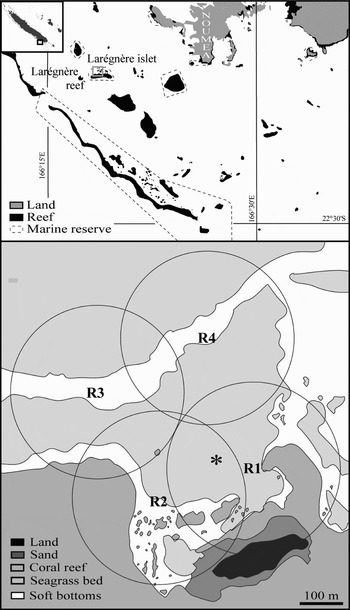
The study was conducted in the mooring area of the Larégnère marine protected area located in the South Lagoon Marine Park of New Caledonia (Figure 1). Larégnère MPA (8.5 km2) surrounds a coralline island located in the middle of the lagoon, 10.5 km from the coast and 7.4 km from the barrier reef. Fishing and collecting are prohibited in this MPA with active enforcement of park regulations. The mooring area, located in a sea grass bed with scattered associated coral heads, is enclosed by the islet reef to the south and soft bottoms to the north.
Study area and location of the receivers (R1–R4) in the mooring area of the Larégnère marine protected area. Circles indicate the detection area of each receiver. *, location of capture and release of the fish.

From 30 November 2004 to 16 June 2005, four Vemco VR2 omnidirectional data-logging hydrophones were deployed in 3–6 m depth around the mooring area of the Larégnère marine protected area (Figure 1). Hydrophones were located in open sand areas to minimize acoustic shadows that might occur in structurally complex areas. A 200 m radius functional range was measured during testing operations (Chateau, unpublished results). The area covered by the hydrophone network was 50 ha (Figure 1). The fish were tagged with Vemco ultrasonic V8SC-6L-R256 coded transmitters (length: 20 mm; diameter: 9 mm; weight in water: 2 g), tested prior to use. The delay between two pulses varies randomly between 60 and 180 seconds to avoid code collision. The approximate life of the transmitter is 229 days.
Six L. nebulosus (FL: 34–54 cm) were caught in the study site, using barbless hooks and lines. The fish were anaesthetized with clove oil at 0.2 ml·l−1(Durville & Collet, Reference Durville and Collet2001) and an ultrasonic transmitter was surgically implanted into the fish abdominal cavity (Wagner & Cooke, Reference Wagner and Cooke2005). No mortality occurred during this process. Transmitter weight in the water never exceeded 0.4% of the fish body weight. The 6 fish were released near reef shelters to limit their stress and possible attack by large predators. During the monitoring period, underwater observations (more than 30 dives) were made to observe the fish behaviour in the study area.
The automated VR2 tracking system records continuous data on the presence of tagged fish through an array of hydrophones. Because the transmitter does not pulse regularly, a fish detected by at least one receiver during a 10-minute period was assumed to be present in the mooring area for that period. Data collected during the first 24 hours were considered to represent an acclimatizing period, and were not included in the analyses.
Comparisons were performed using the t-test, one-way ANOVA or two-way ANOVA without replication in the case of homoscedasticity (Bartlett test, P > 0.05). When an ANOVA was significant (P ≤ 0.05), a Tukey–Kramer test was performed to identify the source of the difference. Non-parametric tests (Wilcoxon–Mann–Whitney and Kruskal–Wallis) were used in the case of heteroscedasticity (Bartlett test, P ≤ 0.05). When a Kruskal–Wallis test was significant (P ≤ 0.05), a Steel–Dwass post hoc test was performed to identify the source of the difference. Spearman rank correlation was used to test the links between daily detection and wind speed (data provided by the Météo France Station). A cluster analysis (Ward clustering method, standardized Euclidian distance) was performed on the hourly detection data in order to identify the different detection patterns of the fish in the study area. The Chi-square test was used to compare the detection patterns between fish.
RESULTS
Detection within the study area varied greatly between fish, ranging from less than 0.2% to 67.5% of the monitored period. The 3 smallest individuals (34, 35 and 49 cm FL) remained less than 6 hours in the mooring area and were not detected during the rest of the monitored period. One of them was detected nine months later (23 August 2005) by a receiver located near Larégnère reef but 1.7 km from the present study area. The three larger individuals (No. 4 51 cm, No. 5 52 cm and No. 6 54 cm FL) were regularly detected in the study site during the monitored period (169 days), and their daily and hourly variations are analysed hereafter.
Daily variations of detection
During the 169 days of the survey, the fish were detected in the mooring area for 9 days (5.3%; fish No. 4), 76 days (45.0%; fish No. 6) and 114 days (67.5%; fish No. 5). They were detected together in only 5 days in January. No fish was detected in the study area for 44 days (26%). There was a significant positive correlation between the daily presences of the 3 fish in January (Spearman rank correlation, P ≤ 0.05) and the daily presence of fish No. 5 and fish No. 6 throughout the survey (Spearman rank correlation, P ≤ 0.001). However, when the fish were present in the mooring area, mean daily detection was significantly different between individuals (Kruskal–Wallis test, P ≤ 0.01). The presence was significantly lower for fish No. 5 (136 minutes per day) than fish No. 4 (156 minutes per day) and fish No. 6 (196 minutes per day) (Steel–Dwass post hoc test, P ≤ 0.01).
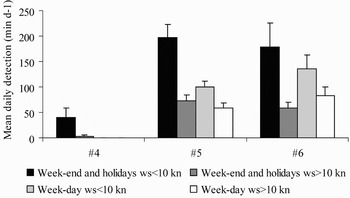
The daily detection of fish No. 4, No. 5 and No. 6 varied significantly with the wind speed in the area (two-way ANOVA without replication, P ≤ 0.05). The daily detection was higher when the mean daily wind speed was below 15 kn (75.4% to 85.7% of the detection). For the three fish No. 4, No. 5 and No. 6, these differences were still higher when wind speed was less than 10 kn in the morning during weekends and school holidays (one-way ANOVA, P ≤ 0.001; Tukey–Kramer test, P ≤ 0.001 for fish No. 4 and No. 5 and P > 0.05 for fish No. 6) (Figure 2).
Comparison of the mean daily detection (minutes d-1) of fish No. 4, No. 5 and No. 6 between weekdays and weekends (and school holidays) when the wind speed was lower or higher than 10 kn. ws, wind speed; error bars represent +SE.

Hourly variations of detection
There was a highly significant positive correlation between the mean hourly detection of the 3 fish in January (Spearman rank correlation, P ≤ 0.001) and a highly significant positive correlation between the mean hourly detection of fish No. 5 and fish No. 6 for the overall survey period (Spearman rank correlation, P ≤ 0.001). There was no significant difference in mean hourly detection between fish No. 4 (6.5 minutes), No. 5 (5.8 minutes) and No. 6 (8.3 minutes) (one-way ANOVA, P ≥ 0.05).
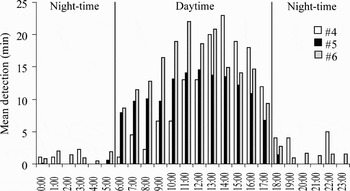
The mean hourly detection was significantly higher during daytime (89% to 98.5%) than at night (1.5% to 11%) for the 3 fish (Wilcoxon–Mann–Whitney tests, P ≤ 0.001) (Figure 3). There was no significant difference of the mean hourly detection during daytime between fish (Kruskal–Wallis test, P > 0.05) (Figure 3). In contrast, the mean hourly detection at night was significantly different between fish (Kruskal–Wallis test, P ≤ 0.01) (Figure 3). It was lower for fish No. 5 (0.2 minutes per hour) than for fish No. 6 (1.4 minutes per hour) (Steel–Dwass post hoc test, P ≤ 0.001) and fish No. 4 (1.5 minutes per hour) (Steel–Dwass post hoc test, P > 0.05).
Mean hourly detection (minutes h-1) of fish No. 4, No. 5 and No. 6 during the survey period.

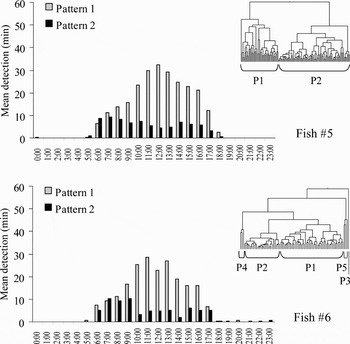
Two patterns of detection (P1 and P2) were identified for fish No. 5 and fish No. 6 in the mooring area (χ2; P ≥ 0.05) (Figure 4). These patterns were diurnal and observed each day fish No. 5 was present (100%) and 91% of the days for fish No. 6. P1 presented a peak of presence between 11 am and 1 pm (Figure 4). The mean wind speed observed during this pattern was 10.5 kn for fish No. 5 and 12 kn for fish No. 6. P2 corresponded to a sporadic presence, the mean detection per hour being less than 8 minutes for fish No. 5 and less than 11 minutes for fish No. 6 (Figure 4). The mean wind speed observed during this pattern (12.8 kn for fish No. 5, 14.2 kn for fish No. 6) was significantly higher than the mean wind speed observed during P1 (Wilcoxon–Mann–Whitney tests, P ≤ 0.05). Three minor patterns (P3, P4 and P5) (7 days) were identified for fish No. 6. These patterns corresponded to high detection during daytime (24 to 60 minutes per hour) and at night (5 to 24 minutes per hour). They occurred exclusively during weekends, usually when wind speed was lower than 10 kn (86% of the days).
Major patterns of detection (P1 and P2) of fish No. 5 and No. 6 identified by cluster analyses on the hourly detection.

DISCUSSION
Residency behaviour in the mooring area
The underwater observations began in June 2004 during the study set up. Large individuals (>50 cm) were regularly observed in the mooring area until September 2004. These large fish left the mooring area between September and mid-November, during the reproductive period of this species in New Caledonia (Loubens, Reference Loubens1980; Egretaud, Reference Egretaud1992). Similar observations have been reported in the mooring areas of 3 other marine protected areas of the South Lagoon Marine Park (Signal, Amédée and Maître) during the same year, and in the mooring area of the Larégnère marine protected area in 2005 and 2006 (South Lagoon Marine Park Authorities, unpublished results).
The smallest fish (No. 1, No. 2 and No. 3) remained less than 6 hours in the mooring area. Fish death (predation and poaching), failure of tags or departure from the mooring area could explain the end of the detection of a fish. An argument for the latter hypothesis was the detection of fish No. 2 nine months later (23 August 2005) by another receiver located near Larégnère reef (1.7 km from the study area).
The second group of fish (No. 4, No. 5 and No. 6) was regularly detected in the area. These large fish were caught after the reproductive period of this species in New Caledonia (Loubens, Reference Loubens1980). The three fish were present in the mooring area during daytime, with few exceptions (7 days) when fish No. 6 was detected at night. Egretaud (Reference Egretaud1992) suggested that L. nebulosus migrates daily from resting areas to feeding grounds (into deeper water) at sunset. The absence of the fish in the area at night indicates that the monitored fish could use the study site as a resting area during the day. Similar diurnal patterns were observed for fish that did not necessarily come into the area on the same days. Regular detection of large fish in this shallow area (<10 m depth) contrasts with the observations of Williams & Russ (Reference Williams and Russ1994) who indicated that L. nebulosus move into deeper water as they age. These observations suggest that environmental factors are not the only influences on residency behaviour of the monitored fish in the mooring area of Larégnère.
Which factors influence residency behaviour?
Daily presence of the fish was higher when wind speed was low during the weekends. Moreover, their presence was higher between 11 am and 2 pm (lunchtime). Underwater observations confirmed these results. When present in the mooring area, the groups of L. nebulosus are generally observed at midday around the mooring sites occupied by boats (authors and South Lagoon Marine Park Authorities, unpublished results). This behaviour could indirectly reflect an effect of human presence in the mooring area. A regular survey of human presence in Larégnère MPA indicated that the number of boats in the mooring area is significantly higher (up to 40 boats) during weekends and school holidays when the wind speed is low (<10 kn in the morning), than during weekends and school holidays when the wind speed is high (>15 kn in the morning) or during working days (0–4 boats) (Sarramégna, Reference Sarramégna2000; South Lagoon Marine Park Authorities, unpublished results).
Human activities are concentrated on the islet and in the mooring area (South Lagoon Marine Park Authorities, unpublished results). In these areas, most people feed the fish after lunch with their leftovers. These activities could attract the fish to the area and affect their behaviour. This is supported by Sweatman (Reference Sweatman1996), who suggested that fish feeding operations could result in higher local population levels of L. nebulosus at provisioning sites on the Great Barrier Reef. Milazzo et al. (Reference Milazzo, Badalamenti, Vega Fernández and Chemello2005) showed that fish feeding influenced fish assemblages within the Ustica marine protected area (Mediterranean Sea) and could attract different species, producing larger aggregations. Similarly, Cole (Reference Cole1994) recorded fish feeding impact on Pagrus auratus behaviour in a marine protected area of north-east New Zealand. Underwater observations in the study area suggested a similar behaviour for other large fish species such as sharks (e.g. Negaprion acutidens), trevallies (e.g. Caranx ignobilis) and snappers (e.g. Lutjanus argentimaculatus) (Chateau, unpublished results).
In New Caledonia, Egretaud (Reference Egretaud1992) suggests that L. nebulosus changes its feeding behaviour during the reproductive period, with a large proportion of empty stomach in fish about to reproduce. This observation could explain the absence of fish during the reproduction period (no feeding stimulus and/or migration to spawning area). It also suggested that feeding activities did not modify the reproductive cycle of this species.
The present study indicates that the monitored fish present in the mooring area during daytime have a feeding activity even though this species typically feeds at night (Egretaud, Reference Egretaud1992). Newsome et al. (Reference Newsome, Lewis and Moncrieff2004) report similar observations on 3 species of rays and Nelson (Reference Nelson1995) indicates that the feeding times of stingrays have been profoundly modified by tourism activities at Stingray City (Grand Cayman, Caribbean). The usual absence of L. nebulosus in the mooring area at night could reflect daily migrations from resting areas to feeding grounds, as observed by Egretaud (Reference Egretaud1992). It suggests that feeding activity during daytime does not modify this nycthemeral cycle.
Since fish feeding is popular in MPAs, further investigation on the impacts of this activity is urgently required (Milazzo et al., Reference Milazzo, Badalamenti, Vega Fernández and Chemello2005). The present study suggested that feeding could have an impact on the behaviour of L. nebulosus. Ecological consequences could arise from the non-natural aggregations of predator species due to human activities (Sutherland, Reference Sutherland1996). An increase in the density of such predators could, in the long term, affect local populations of invertebrate and fish species, as a result of direct competition for food or habitat, and a higher level of predation within a small area (Milazzo et al., Reference Milazzo, Badalamenti, Vega Fernández and Chemello2005). Consequently, management policies and conservation measures should include measures to control feeding activities within MPAs to limit their impact on the ecosystem.
ACKNOWLEDGEMENTS
Financial support for this study was provided by the ZoNéCo Program. The authors would like to thank Marc Soria (IRD Réunion Island) for the acoustic equipment. We sincerely thank the South Province of New Caledonia for its technical support. Olivier Chateau would like to express very special thanks to Branco Ma-Kim, Pablo Chavance, Pascal Blazer, Xavier Neyrat and Pascal Pagand for their help during the study. We thank the anonymous referees for constructive comments on the manuscript.