1. Introduction
Solar flares are often accompanied by coronal mass ejections (CMEs), which are generally understood within the framework of magnetic reconnection models (Shibata & Magara Reference Shibata and Magara2011). Large CMEs have profound impacts on planetary environments and even pose risks to human civilization (Cliver et al. Reference Cliver, Schrijver, Shibata and Usoskin2022). The occurrence of CMEs is well known for the Sun, but remains poorly understood for other stars (see review by Namekata et al. Reference Namekata, Maehara and Honda2022a; Veronig et al. Reference Veronig, Dissauer and Kliem2025). The recent discovery of more than 6,000 exoplanets has underscored the importance of investigating stellar space weather, including stellar CMEs (Airapetian et al. Reference Airapetian, Barnes and Cohen2020). While many efforts to detect stellar CMEs have been directed toward M dwarfs (e.g., Vida et al. Reference Vida, Kriskovics and Oláh2016; Honda et al. Reference Honda, Notsu and Namekata2018; Maehara et al. Reference Maehara, Notsu and Namekata2021; Notsu et al. Reference Notsu, Kowalski and Maehara2024; Inoue et al. Reference Inoue, Enoto and Namekata2024; Kajikiya et al. Reference Kajikiya, Namekata and Notsu2025), young Sun-like stars (G dwarfs) are of particular importance as they provide natural analogues of the early Sun-Earth system, offering key insights into how Earth-like planetary atmospheres developed and how conditions for the emergence of life may have arisen. These young Sun-like stars exhibit extremely high levels of magnetic activity, frequently producing so-called “superflares’’ with energies exceeding 10
 $^{33}$
erg (e.g., Güdel Reference Güdel2007; Maehara et al. Reference Maehara, Shibayama and Notsu2012; Notsu et al. Reference Notsu, Maehara and Honda2019; Okamoto et al. Reference Okamoto, Notsu and Maehara2021; Namekata et al. Reference Namekata, Maehara and Honda2022b). A key open question is whether such energetic events are accompanied by massive CMEs capable of substantially influencing planetary atmospheres and even stellar mass and angular momentum evolution.
The primary objective of our project is to characterize stellar CMEs from young Sun-like stars. To this end, we have been conducting a five-year (132-night) multi-wavelength monitoring campaign since 2020, taking advantage of the flexible scheduling capabilities of the 3.8m Seimei Telescope/KOOLS-IFU (R
 $\sim$
2000) in Japan. Our strategy is to identify Doppler-shifted signatures in the H
 $\alpha$
line as indicators of filament and prominence eruptions. We focus on two nearby G dwarfs, EK Dra (G1.5V, age
 $\sim$
50-125 Myr) and V889 Her (G0V, age
 $\sim$
25 Myr), which are among the best proxies for the young Sun. These data are complemented by optical photometry from TESS (600–1000 nm), soft X-ray monitoring with NICER (0.5-3 keV), and magnetic field mapping through Zeeman Doppler imaging with TBL/NARVAL in France. Together, these coordinated observations provide an unprecedented dataset for investigating the occurrence and properties of CMEs on young Sun-like stars.
2. Discovery of Stellar Filament Eruptions
First we succeeded in detecting a superflare on EK Dra with an energy of
 $2 \times 10^{33}$
erg through simultaneous H
 $\alpha$
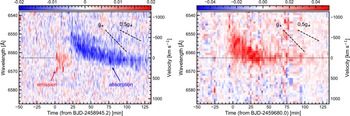
spectroscopy and TESS white-light photometry on April 5, 2020. In the post-flare phase, we detected a blueshifted absorption component with a velocity of
 $510~\mathrm{km~s^{-1}}$
(Figure 1, left), providing the first clear evidence of a stellar filament eruption on a Sun-like star (Namekata et al. Reference Namekata, Maehara and Honda2022c). To address the question of what such stellar eruptions look like, we performed a Sun-as-a-star analysis of H
 $\alpha$
line profiles during solar eruptive events. The spectral variations observed in these solar eruptions closely resemble those identified in EK Dra, leading us to conclude that stellar filament eruptions represent large-scale analogues of solar filament eruptions. A pseudo two-dimensional (2D) MHD simulation by Ikuta & Shibata (Reference Ikuta and Shibata2024) also supports this view and suggests that it can eventually lead to steller CMEs. Compared to typical solar eruptions (a few hundred km s
 $^{-1}$
and
 $\lesssim10^{17}$
g), stellar eruptions are faster, more massive, and carry greater kinetic energy, indicating that their impact on interplanetary space would be far more severe than what humans have experienced on the present-day Earth.
Dynamic spectrum of H
 $\alpha$
line. Left: filament eruption (blueshifted absorption, adapted from Namekata et al. Reference Namekata, Maehara and Honda2022c); Right: prominence eruption (blueshifted emission, Namekata et al. Reference Namekata, Airapetian and Petit2024a)
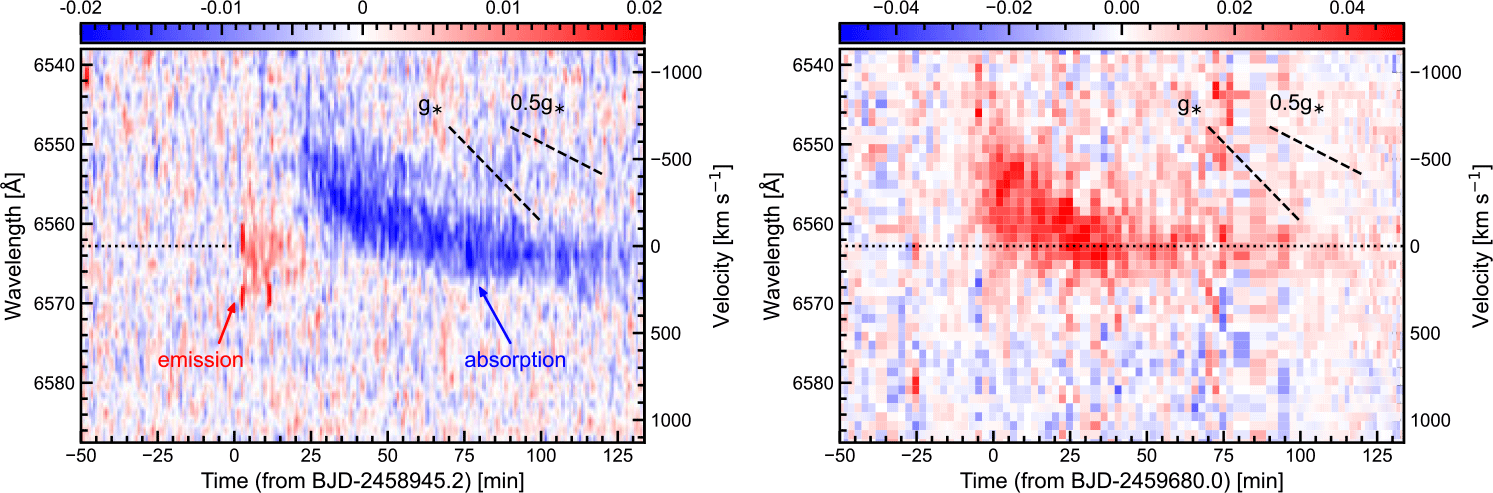
Figure 1 Long description
Two heatmaps depict the dynamic spectrum of the H-alpha line during stellar events. Panel A: The left heatmap shows a filament eruption with blueshifted absorption. The x-axis represents time in minutes from BJD-2458945.2, and the y-axis represents wavelength in angstroms and velocity in kilometers per second. The heatmap features annotations for emission and absorption regions, with labels for g* and 0.5g*. Panel B: The right heatmap shows a prominence eruption with blueshifted emission. The x-axis represents time in minutes from BJD-2459680.0, and the y-axis represents wavelength in angstroms and velocity in kilometers per second. This heatmap also includes annotations for g* and 0.5g*.
3. Multiwavelength Signatures of Stellar CMEs
Another EK Dra’s superflare on April 10, 2022 with an energy of
 $1.5 \times 10^{33}$
erg exhibited a blueshifted H
 $\alpha$
emission component with velocities of 400–
 $690~\mathrm{km~s^{-1}}$
(Figure 1, right), indicating an off-limb prominence eruption extending beyond the stellar surface (Namekata et al. Reference Namekata, Airapetian and Petit2024a). Nearly simultaneous NICER X-ray observations revealed possible coronal X-ray dimming, which is a different CME signature representing the evacuation of coronal material (Harra et al. Reference Harra, Schrijver and Janvier2016; Veronig et al. Reference Veronig, Odert and Leitzinger2021), detected about two hours later of the H
 $\alpha$
prominence eruption (Namekata et al. Reference Namekata, Airapetian and Petit2024a). Although the possible coronal dimming is just a upper limit of evacuated mass, it is intriguing to see that the estimated prominence mass (
 $\sim 10^{19}$
–
 $10^{20}$
g) was significantly larger than the evacuated coronal mass (
 $\sim 10^{17}$
–
 $10^{18}$
g).
4. Data-Driven Models
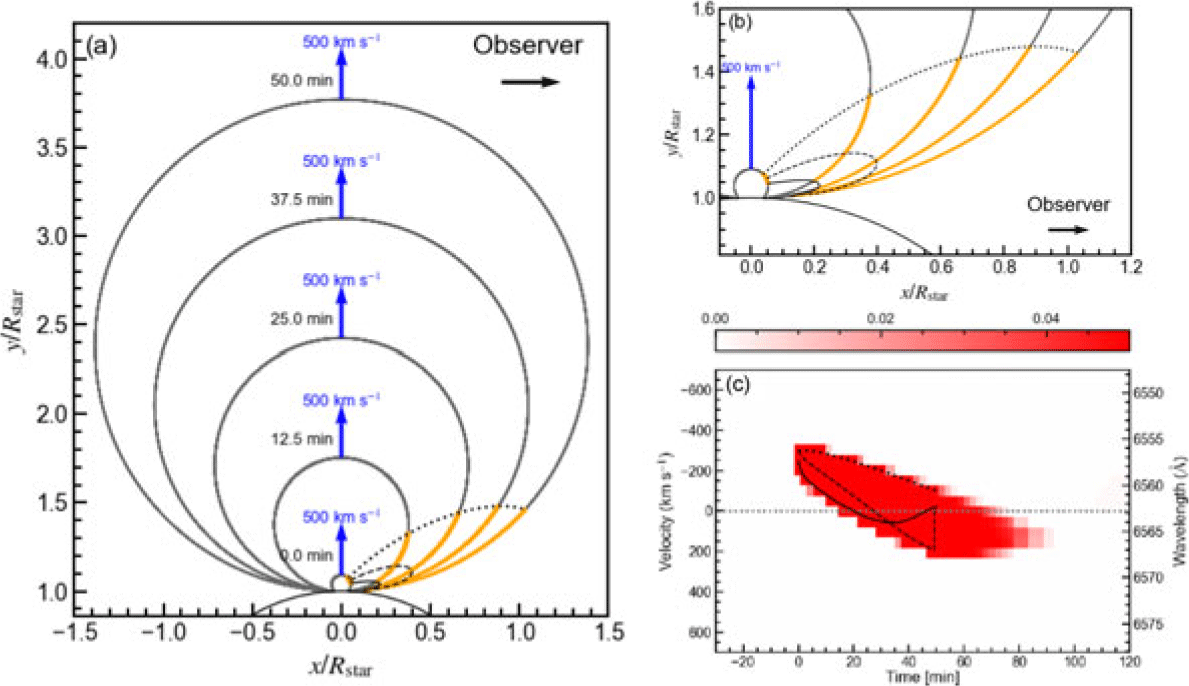
Two data-driven models were employed to investigate the prominence eruption in Section 3 (Namekata et al. Reference Namekata, Ikuta and Petit2024b). One method is the one-dimensional free-fall model. A parameter survey of ejection angles using this simple model indicated that the prominence was launched at an angle of approximately
 $20^{\circ}$
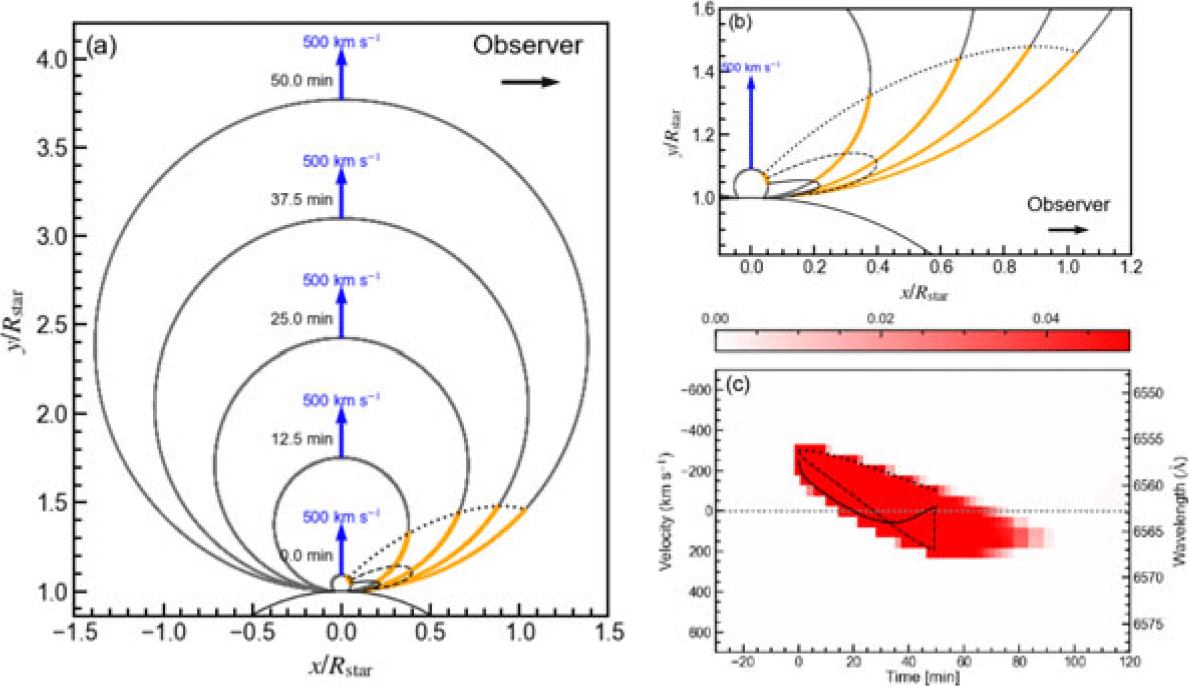
from near the stellar limb. Building on this result, we performed a pseudo 2D MHD simulation based on Ikuta & Shibata (Reference Ikuta and Shibata2024)’s model, employing a self-similar expansion model based on solar physics to describe the erupting prominence, as in Figure 2(a,b). The simulation successfully reproduced the observed H
 $\alpha$
spectra (Figure 2(c)), suggesting that stellar prominence eruptions can be explained by solar model, and while the prominence itself decelerates, the magnetic loop can continue to expand to be stellar CMEs.
(a,b) Assumed geometry in a pseudo 2D MHD model of magnetic loop expantion (black lines) and prominence material (orange). (c) Simulated H
 $\alpha$
dynamic spectrum.
5. Magnetic Environment of Eruptions
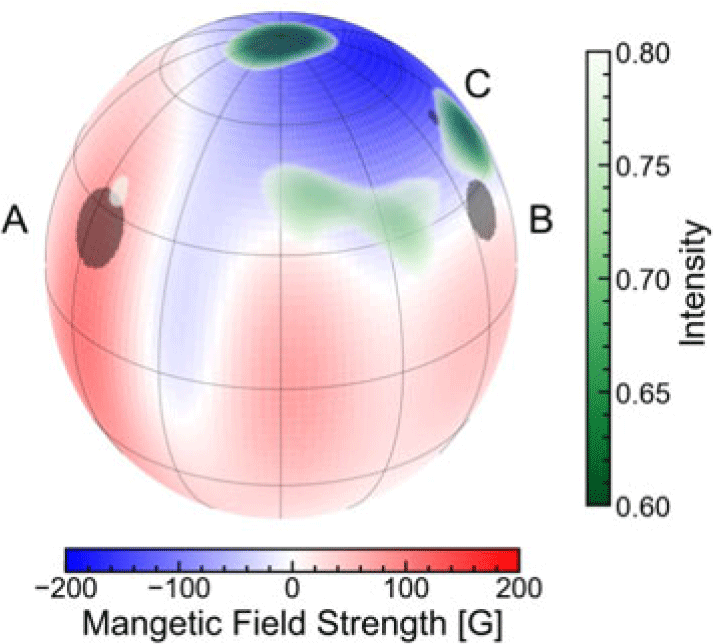
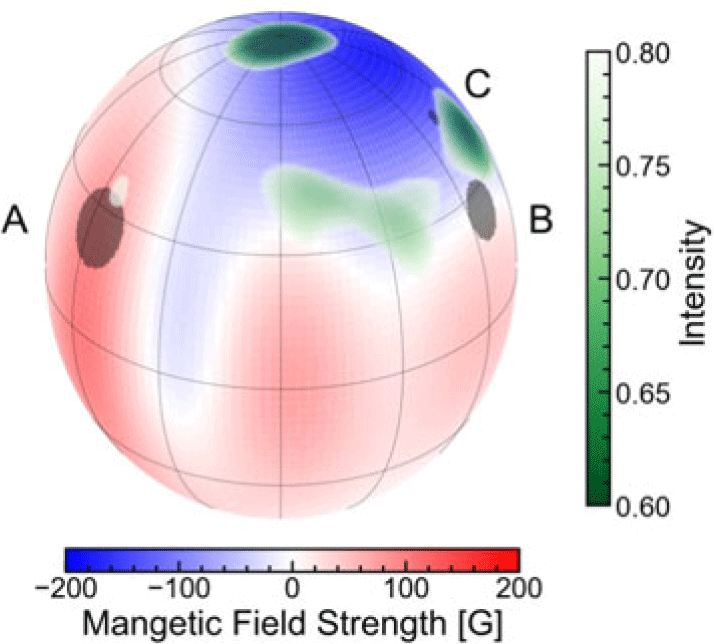
As for the event discussed in Sections 3 and 4, we performed a simultaneous analysis combining TESS light-curve inversion and Zeeman Doppler Imaging (Namekata et al. Reference Namekata, Ikuta and Petit2024b). The resulting Figure 3 displays the large-scale magnetic field configuration together with the starspot distribution during the period of the prominence eruption. This analysis reveals the consistent presence of starspots, such as Spot A, Spot B, and Spot C, located at mid-latitudes. Notably, Spot B lies close to the polarity inversion line. If the prominence eruption originated from starspots, these mid-latitude spots are plausible source regions. However, this region is dominated by closed magnetic fields, raising another possibility that the eruption originated from the open-field regions near the pole.
Starspot maps when the prominence eruption in Figure 1 (right) occurred, showing the Doppler imaging (green) and those from the TESS light-curve modeling (gray circles), the radial magnetic field (red and blue colors).
6. Frequency and CME-Driven Mass Loss
As a result of five-year dedicated observations, we obtained 15 H
 $\alpha$
superflares. Among those, we found two filament eruptions and two prominence eruptions (Namekata et al. Reference Namekata, Maehara and Notsu2025). The lower limit of the eruption-flare association rate is 27
 $_{-16}^{+25}$
%, leading occurrence rates of 0.21
 $_{\pm0.12}$
and
 $<$
0.32
 $^{+0.46}_{-0.32}$
events/day. We estimated the lower limit of the CME-driven mass-loss rate for EK Dra as
 $4 \times (10^{-13}$
–
 $10^{-12})$
 $M_{\odot}$
yr
 $^{-1}$
. This is comparable to the stellar wind mass loss at a similar age, suggesting that we would likely need to take CME mass loss into account in the context of stellar mass/angular momentum evolution.
7. Summary and Conclusion
Through five years of dedicated observations in the framework of international collaborations, we have obtained the first evidence of stellar filament/prominence eruptions from a young Sun-like star. These efforts have also enabled us to derive their statistical properties for the first time, and to identify multi-wavelength signatures of stellar CME activity. We conclude that superflares on young Sun-like stars are likely associated with fast, massive, and frequent solar-like eruptions. These findings provide new insights into the environment of the early Sun at an age of
 $\sim$
100 Myr, and suggest that such activity may have profoundly influenced the atmospheres and habitability of the early Earth, Mars, and Venus.
Acknowledgment
The author acknowledges all collaborators who contributed to these works.
 α
 α