Introduction
Mental health is fundamental to society and economy (Commission on Social Determinants of Health, 2008). There are, however, important variations in mental health which manifest geographically and these can be demonstrated statistically (e.g., Chaix et al. Reference Chaix, Merlo, Subramanian, Lynch and Chauvin2005). Quantifying the spatial distributions of mental health is (or ought to be) of substantive interest to the health sector in so that appropriate levels of services can be allocated efficiently and equitably to address variation in local need (McLafferty, Reference Mclafferty2003). But it is not just about satisfying local need for treatment; there is also interest in public health and urban planning on the extent that neighbourhoods can be designed to promote greater mental health among their residents as a result (Jackson et al. Reference Jackson, Dannenberg and Frumkin2013; Kent & Thompson, Reference Kent and Thompson2014). Liveable neighbourhoods as part of the arsenal of preventive health (Wilson, Reference Wilson2014). Therein, however, lies a fundamental question that continues to fuel debate among geographers, epidemiologists, sociologists, economists, etc., to what extent do these geographies of mental health actually reflect the impact of ‘place’, or are they simply a manifestation of preferential choices and segregating forces dictated largely by the housing and labour markets?
The proposition that who and what a person lives near can influence their life-chances is not new (Faris & Dunham, Reference Faris and Dunham1939; Wilson, Reference Wilson1987; Massey et al. Reference Massey, Gross and Eggers1991; Corburn, Reference Corburn2007). This hypothesis is reflected within several publications within this very journal (e.g., Losert et al. Reference Losert, SCHMAUß, Becker and Kilian2012). Likewise, readers and contributors to the enormous ‘place effects’ genre of research more widely have already witnessed much lively and valuable debate (Dorling et al. Reference Dorling, Smith, Noble, Wright, Burrows, Bradshaw, Joshi, Pattie, Mitchell and Green2001; Macintyre et al. Reference Macintyre, Ellaway and Cummins2002; Diez Roux, Reference Diez Roux2004; Durlauf, Reference Durlauf, Henderson and Thisse2004; Oakes, Reference Oakes2004; Kling et al. Reference Kling, Kessler, Ludwig, Sanbonmatsu, Liebman, Duncan and Katz2008; VanderWeele, Reference Vanderweele2010; Galster & Hedman, Reference Galster and Hedman2013; Slater, Reference Slater2013; Astell-Burt et al. Reference Astell-Burt, Mitchell and Hartig2014). Recent research on ‘place effects’ and mental health has covered a range of potentially modifiable exposures operating at the local level, such as socioeconomic deprivation (Henderson et al. Reference Henderson, Diez Roux, Jacobs, Kiefe, West and Williams2005), safety (Stafford et al. Reference Stafford, Chandola and Marmot2007), social capital (Murayama et al. Reference Murayama, Fujiwara and Kawachi2012), education (Wight et al. Reference Wight, Aneshensel, Miller-Martinez, Botticello, Cummings, Karlamangla and Seeman2006) and ‘green spaces’ such as public parks (Astell-Burt et al. Reference Astell-Burt, Feng and Kolt2013); the latter being increasingly popular among urban planners interested in designing ‘healthy’ built environments (Australian Government, 2011; Nilsson et al. Reference Nilsson, Sangster, Konijnendijk, Nilsson, Sangster, Gallis, Hartig, De Vries, Seeland and Schipperijn2011). If geographical clusters of mental health reflect not just selective processes attributable to household relocation, but in fact something more profound about the local environments in which people live, identifying which of those features have pathogenic and/or so-called ‘salutogenic’ properties (Antonovsky, Reference Antonovsky1996) is a public health imperative to put mental health promotion at the core of all urban planning (Rydin et al. Reference Rydin, Bleahu, Davies, Dávila, Friel, De Grandis, Groce, Hallal, Hamilton and Howden-Chapman2012).
There have already been several reviews of the literature focused specifically on the question of whether places determine mental health (Truong & Ma, Reference Truong and Ma2006; Clark et al. Reference Clark, Myron, Stansfeld and Candy2007; Kim, Reference Kim2008; Mair et al. Reference Mair, Roux and Galea2008). Our purpose is not to retrace old ground, but to reflect on the ongoing challenge of identifying ‘place effects’ on mental health and some developments in the field with the aid of a case-study example. We emphasise the need for: (i) greater consideration of geographical units used to define exposure; (ii) more widespread use of directed acyclic graphs (DAGs) for developing stronger tests of a priori hypotheses; and (iii) greater ambition, but also more transparency about the potential added value of exploiting natural experiments to raise the quality of evidence available for decision makers.
People and places
Various theories on place effects have been summarised elsewhere (Jencks & Mayer, Reference Jencks, Mayer, Lynn and Mcgeary1990; Galster, Reference Galster2008). Looking beyond the ‘socioeconomic gradient’ in health (Marmot, Reference Marmot2006), some scientists have argued that how much income a person earns relative to others is an important determinant of mental health (Wilkinson & Pickett, Reference Wilkinson and Pickett2009). This theory of ‘relative deprivation’ has prompted considerable debate (Muntaner & Lynch, Reference Muntaner and Lynch1999; Wilkinson, Reference Wilkinson1999; Marmot & Wilkinson, Reference Marmot and Wilkinson2001; Lynch & Davey Smith, Reference Lynch and Davey Smith2002) and continues to attract scientific enquiry (Kondo et al. Reference Kondo, Sembajwe, Kawachi, Van Dam, Subramanian and Yamagata2009; Fone et al. Reference Fone, Greene, Farewell, White, Kelly and Dunstan2013; Pabayo et al. Reference Pabayo, Kawachi and Gilman2013; de Vries et al. Reference De Vries, Blane and Netuveli2014). It is not only that having more income typically endows one with greater command over material resources, but the extent of the income difference between the desired situation and the person desiring it is also said to matter (Runciman, Reference Runciman1966). Social comparisons render those on relatively higher incomes with greater prestige in society, whereas those on lower incomes are said to experience more stress and dissatisfaction through invidious social comparisons (Wilkinson, Reference Wilkinson1999). Although the majority of the epidemiological evidence thus far has examined this ‘relative deprivation’ hypothesis with respect to inequality at the national level (Subramanian & Kawachi, Reference Subramanian and Kawachi2004), these social comparisons are also likely to be made within the neighbourhoods in which people live (Galster, Reference Galster2008). Recognising the patterning of mental health by income, the research question being asked is whether said patterning is modified by the socioeconomic circumstances of the neighbourhoods in which people reside? Through considering this question, we highlight several challenges in the analysis of causality that geographers, epidemiologists, sociologists, economists, etc. must continue to contend with in the future.
Method
To test this question, we took responses to the Kessler 10 Psychological Distress Scale (Furukawa et al. Reference Furukawa, Kessler, Slade and Andrews2003) in the Sax Institute's 45 and Up Study (The University of New South Wales Human Research Ethics Committee (HREC 05035/HREC 10186) approved the 45 and Up Study.). (45 and Up Study Collaborators, 2008). Between 2006 and 2008, approximately 267, 000 Australians aged 45 years and older living in New South Wales (NSW) participated, having been randomly sampled from the Medicare Australia database. Approximately 12% were identified as being at a high risk of experiencing psychological distress (scores of ≥22). The University of New South Wales Human Research Ethics Committee (HREC 05035/HREC 10186) approved the 45 and Up Study.
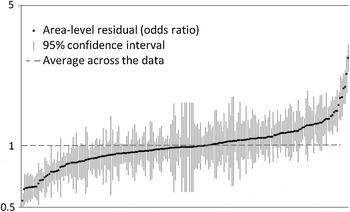
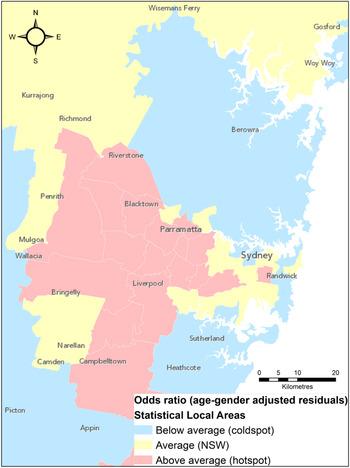
We fitted this binary variable as the outcome within a multilevel logistic regression in MLwIN (Rasbash et al. Reference Rasbash, Browne, Goldstein, Yang, Plewis, Healy, Woodhouse, Draper, Langford and Lewis2000), with adjustment for an interaction between gender and age (fitted as linear and square terms, to account for curvilinear associations in mental health as people age). Intercepts were allowed to vary, which afforded an estimate of the variance in psychological distress manifesting across areas of residence (proxied by ‘Statistical Local Areas’). The ‘area-level’ variance was estimated at 0.07 (standard error = 0.009), which can be re-expressed in the form of a Median Odds Ratio (MOR) (Merlo et al. Reference Merlo, Chaix, Ohlsson, Beckman, Johnell, Hjerpe, Råstam and Larsen2006) of about 1.29. This suggests that the median difference in the odds of experiencing psychological distress from one area to another is 29%; there is geographical variation of psychological distress in our sample. This variation is illustrated by a residual plot in Fig. 1 and a close-up of the Sydney metropolitan area (home to over 4.5 million people) in Fig. 2.
Geographical variation in psychological distress, expressed in the form of odds ratios on a residual plot, adjusted for age.

Geographical variation in psychological distress in Sydney Metropolitan area, expressed as a map of area-level residuals classified above, below or not significantly different to the average across NSW, adjusted for age and gender.

To measure relative deprivation at the neighbourhood level, we categorised responses to a question on annual household income for each participant ($0–19, 999, $20 000–69, 999, ≥$70, 000) and cross-classified this variable with tertiles of the Socio Economic Index For Areas (SEIFA) scale of advantage/disadvantage (Pink, Reference Pink2011). The SEIFA scale takes into account a range of socioeconomic indicators, including income. According to this cross-classification, a participant may be described as ‘relatively deprived’ if their level of income was low but they were living in an area scoring highly on the SEIFA scale (i.e., an affluent neighbourhood). Conversely, a person may be considered to be a source of disamenity to their neighbours if they had a high income but lived in a deprived area. Fitting this cross-classification as a set of fixed effect dummy variables allowed a relatively straightforward interpretation (as opposed to fitting two-way interactions).
Results
The ‘area-level’ variance was estimated at 0.07 (standard error = 0.009), which can be re-expressed in the form of a Median Odds Ratio (MOR) (Merlo et al. 2006) of around 1.29. This suggests that the median difference in the odds of experiencing psychological distress from one area to another is 29%; there is geographical variation of psychological distress in our sample.
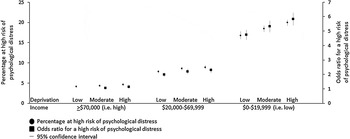
Adding the measure of relative deprivation to the model explained about 67% of the geographical variation, bringing the MOR down to 1.16. Figure 3 shows the familiar pattern of greater odds of psychological distress among people on lower incomes and living in deprived neighbourhoods. It is also clear, however, that these analyses presented no evidence of a ‘relative deprivation’ effect, since people on lower incomes tended to do better if they were resident in more affluent surroundings than their peers living in deprived neighbourhoods. Compared with people on high incomes living in affluent neighbourhoods, the odds ratio of psychological distress for people on low incomes in affluent areas was 4.73 (95% confidence interval (95% CI) 4.39, 5.09), whereas the odds ratio for those on low incomes in deprived areas was significantly higher at 5.83 (95% CI 5.41, 6.28).
Psychological distress and local relative deprivation, adjusted for age and gender.

Discussion
Key findings and appraisal of the initial hypothesis
Discordance between the amount of income earned and that to which a person desires is said to create relative deprivation. Since people routinely compare themselves to others they see regularly, such as their neighbours, then this potentially psychosocial risk factor may be hypothesised to operate at a local as well as national scale. In this study, people on lower incomes had greater odds of psychological distress, especially if they lived in deprived neighbourhoods. Conversely, people on higher incomes tended to have better mental health regardless of their neighbourhood socioeconomic circumstances. These results are at odds with the relative deprivation hypothesis. If relative deprivation were a local ‘place effect’, the inverse to the results found should have been observed. The results clearly do not refute relative deprivation measured at the national scale as a potential pathway, but they do imply that local relative deprivation may not be a negative determinant of mental health as might have previously been thought.
Perhaps what these results do lend support to, however, is a lesser-known and more materialist alternative called the ‘pull-up/pull-down hypothesis’ (Gatrell, Reference Gatrell1997; Boyle et al. Reference Boyle, Norman and Rees2004a , Reference Boyle, Gatrell, Duke-Williams, Boyle, Curtis, Graham and Moore b ; Cox et al. Reference Cox, Boyle, Davey, Feng and Morris2007). Proponents of this hypothesis suggested that a person on lower income who happens to live in an affluent area benefits from the range of local resources and conditions that would not necessarily have been available were they living in a poorer community. These could range from healthy food outlets, health services, more public parks, less crime and pollution, etc. This may be combined with potential benefits of exposure to residents from more favourable socioeconomic backgrounds, supplying ‘weak ties’ (Granovetter, Reference Granovetter1973), different social role models and ‘bridging’ forms of social capital (Putnam, Reference Putnam2007), perhaps with greater social regard for health-enhancing lifestyles such as physical activity and healthier eating. This idea is not dissimilar to that promoted by work on ‘deprivation amplification’ (Macintyre, Reference Macintyre2007), the concentration of poverty (Wilson, Reference Wilson1987) and advocates of desegregation policies via mixed housing tenure initiatives (Ostendorf et al. Reference Ostendorf, Musterd and De Vos2001; Bond et al. Reference Bond, Sautkina and Kearns2010). Where one lives is argued to matter and the more affluent the surroundings the better, regardless of an individual's income.
This raises a substantively interesting research question: what are the reason(s) why people on lower incomes that live in more affluent surroundings appear to have better mental health? Can we isolate, empirically, what those features of the local environment might be, in so that we can use that information to optimise urban design to enhance mental health within disadvantaged communities? The remainder of this paper reflects on the challenges to realising this ambition.
Drawing the boundaries
The given analysis was a fairly basic example of a multilevel model, wherein the reality of people sharing local geographies, having access to similar services and exposure to various localised phenomena is not conceptualised merely as a nuisance to be controlled; it is an important avenue for scientific enquiry (Subramanian & O'Malley, Reference Subramanian and O'malley2010). These models are, by and large, standard procedure for quantitative studies of people within places (Jones & Duncan, Reference Jones and Duncan1996; Diez Roux, Reference Diez Roux2004; Subramanian et al. Reference Subramanian, Jones, Kaddour and Krieger2009). From the results, it is clear that (i) geographic variation in psychological distress exists; and (ii) much of this variation can be attributed to differences in socioeconomic circumstances between individuals and, to a lesser extent, the places in which they live. Claims over causality, however, would be highly premature. Previous work has already noted that the partitioning of variance and expression as an MOR in a multilevel logistic regression is a useful tool to describe geographical variation in the outcome of interest; these tools cannot nonetheless assert a causal effect of ‘place’ on said outcome (Merlo & Chaix, Reference Merlo and Chaix2006). There are many reasons why, some of which are widely recognised, but others less so.
7One of the more routinely appreciated reasons is the set of geographical boundaries used to delineate ‘neighbourhood’. The problem is that much of the work, including that presented here, has used sets of geographical boundaries that were created for purposes other than to ascertain the exposure that is of direct interest to the study (Flowerdew et al. Reference Flowerdew, Manley and Sabel2008). The imposition of ‘off-the-shelf’ geographical boundaries may reflect the places of residence of some people quite well, but for others rather poorly, even for people who live next door to each other since conceptualisations of where people live are highly subjective (Galster, Reference Galster2001). This means the use of geographical boundaries is often only arbitrarily related to the conceptualisation of the exposure (in this case, neighbourhood disadvantage), leaving open the potential for misclassifying contextual variables. As a result, findings from analyses can potentially vary as a consequence of manipulating where the geographic boundaries are drawn; a problem often referred to as the ‘modifiable areal unit problem’ (Openshaw & Taylor, Reference Openshaw, Taylor, Wrigley and Bennet1981). Although concerted efforts have been made to address this issue using increasingly sophisticated technologies that involve tracking the whereabouts of individuals using global position systems to create bespoke neighbourhoods (Kwan, Reference Kwan2012), the ability to apply these techniques across a range of potential exposures and to upscale them to very large population health data remains a major challenge.
Joining the dots
Among many other standard critiques of this field of research has been the issue of selective (im)mobility, wherein place-based exposures cannot be understood as randomly distributed. Therefore, while a place-level variable may be objectively measured (as opposed to relying upon a participant's self-reported perception of their neighbourhood), estimation of the exposure-outcome pathway is still likely to be biased. Hence, those confounding factors that determine why a person may have ended up in one neighbourhood and not another need to be taken into account. For this purpose, the potential for wider use of ‘DAGs’ would be highly beneficial. DAGs can help to formalise hypothesised causal mechanisms, possible threats to their identification (both measured and unmeasured), along with other assumptions being made by the investigator (Pearl, Reference Pearl1995; Greenland et al. Reference Greenland, Pearl and Robins1999). Some studies have provided useful examples of how DAGs can be applied effectively to refine estimates of the impact of residential environments on health outcomes (Fleischer & Diez-Roux, Reference Fleischer and Diez-Roux2008; Chaix et al. Reference Chaix, Leal and Evans2010; Sharkey & Elwert, Reference Sharkey and Elwert2011). Although there may remain sources of confounding that an investigator is unable to measure that do have an impact on where a person elects to live, the use of DAGs helps to highlight this limitation, to keep the level of inference in check, and to identify potential targets for future research.
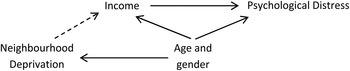
So what might the DAG for the analysis in this study have looked like? A basic version is illustrated in Fig. 4. The DAG specifies the effect of income on psychological distress is likely to be confounded by age and gender. The dotted line indicates we have hypothesised that neighbourhood deprivation moderates the impact of income on psychological distress. The DAG also identifies age and gender as confounders of neighbourhood deprivation. It does not take into account the plausibility of mediating pathways since these are less of an overt concern for the relative deprivation hypothesis (Wilkinson, Reference Wilkinson1999). Overall, this DAG indicates that the income effect on psychological distress is conditional on the level of neighbourhood deprivation to which a person is exposed. It implies that a person of a certain income was moved from a deprived neighbourhood to one considerably more affluent, ceretis paribus, the impact of income on psychological distress would change accordingly.
A DAG specifying the impact of income on psychological distress, conditional upon neighbourhood deprivation and adjusted for age and gender.

Reality is undeniably more complex than this simple DAG suggests. Although we are hypothesising neighbourhood deprivation conditions the impact of income on psychological distress, a person is likely to select their neighbourhood to match their needs and resources, within the constraints of a budget (Cheshire, Reference Cheshire2007). Thus, people on low incomes usually live in deprived areas because the housing stock is more affordable. Conversely, houses in more attractive neighbourhoods tend to cost more because they supply the kudos and tangible resources that people might be looking for, such as good schools, safe streets, green spaces etc. So while the relative deprivation hypothesis implies that the socioeconomic circumstances of the neighbourhood in which a person lives modifies the impact of income on psychological distress, we must also face up to the truth that both neighbourhood choice and the ability to leave or remain within a particular neighbourhood are all strongly determined by a person's level of income, as well as a host of unmeasured factors; some of which are known, while others remain unknown.
In the case of this DAG, what this means is that exposure to neighbourhood deprivation is not random and that we should expect some level of correlation between income and local affluence. Those on low incomes who live in affluent areas are, therefore, rather unusual and some have expressed doubt over whether these groups can be treated with the same level of statistical credence as the rest of the sample (Oakes, Reference Oakes2004). Part of this problem is that although income is measured, it will not account fully for why people live where they do. Many people on low incomes may live in affluent areas because their home is fully paid (perhaps through inheritance) and what money they earn is for sustaining small pleasures (e.g., for the sociable side of work), rather than the need to pay bills and rent. That we have not been able to separate out those on low incomes who just about make ends meet v. those on low incomes who do so although choice is important, as it could then influence how long a person works, spends driving and the time left to allocate to activities which promote mental health (e.g., interactions with family and friends). While these variables appear to be mediating pathways, they are also confounders in the sense that people on low incomes in affluent areas who dislike having to work multiple jobs to pay high rents may move to more affordable neighbourhoods. Those persons on low incomes who remain in residents of affluent areas are either supported by other circumstances that go unmeasured, or are themselves rather exceptional, rendering the results for some commentators potentially moot. Nevertheless, the use of DAGs has helped to raise these issues for further debate and that is a positive outcome, for it helps to avoid making premature conclusions and policy prescriptions that may have unintended consequences on society.
More ambitious study designs
It is often suggested that observational (i.e., non-experimental) studies will remain the ‘bread and butter’ of scientists interested in understanding the role of place on health and life-chances, since the ability to implement experimental designs relevant to the research question at hand is often severely constrained by ethical, pragmatic and institutional concerns (e.g., Sampson, Reference Sampson2008). In contrast, it has been remarked by at least one commentator that there be a moratorium on applications to a major research council for studies of place and health using multivariate analytical methods (Oakes, Reference Oakes2013). Whether this statement was made with perhaps with a little tongue in cheek or not, it is important to consider the extent to which experimental and quasi-experimental study designs are feasible for ascertaining a higher degree of understanding on what neighbourhood features affect mental health; for better and for worse (Oakes, Reference Oakes2004; Macintyre, Reference Macintyre2011).
Perhaps the most well-known example in the field comes from what was originally a study of self-sufficiency and social mobility; the ‘Moving To Opportunity’ (MTO) project. A major strength of MTO's design was to allocate vouchers to a randomly selected group of socioeconomically disadvantaged participants, affording them the opportunity to move to somewhat more affluent neighbourhoods than that which they had previously lived in. This process eliminated much of the confounding related to selective (im)mobility, given that the ability to move to what was theorised to be areas of greater opportunity was randomly allocated. While the MTO investigators found little by ways of social mobility and self-sufficiency as a result of improving the socioeconomic circumstances of where people lived (Katz et al. Reference Katz, Kling and Liebman2001; Kling et al. Reference Kling, Liebman and Katz2007), what has since been found was improvements in mental health (Leventhal & Brooks-Gunn, Reference Leventhal and Brooks-Gunn2003; Ludwig et al. Reference Ludwig, Duncan, Gennetian, Katz, Kessler, Kling and Sanbonmatsu2012) as well as other positive health outcomes (Ludwig et al. Reference Ludwig, Sanbonmatsu, Gennetian, Adam, Duncan, Katz, Kessler, Kling, Lindau and Whitaker2011). Qualitative research following up those who moved from poor to more affluent neighbourhoods reported improvements in home aesthetics, more satisfaction and sense of neighbourhood togetherness, lower levels of crime and a belief that the new areas were better for bringing up children (Turney et al. Reference Turney, Kissane and Edin2013); perhaps another score for the ‘pull up/pull down’ hypothesis and against that of local relative deprivation.
MTO is clearly successful in many ways, not least in making the scientific community think about how research on place and health could be done using a randomised design. It is not done nearly enough and perhaps enthusiasm is diminished by the potentially rather daunting level of financial input that may be required to implement such a study. An MTO-style design would also not be very useful, however, for answering questions such as what happens when a feature of a neighbourhood changes around a community that remains in-situ? Arguably, this is a situation that reflects the likely decision-making process wherein changes in built environment are made in existing communities, rather than moving communities to entirely new areas. Recent examples include capitalising upon changes occurring within parks (Cohen et al. Reference Cohen, Golinelli, Williamson, Sehgal, Marsh and Mckenzie2009, Reference Cohen, Marsh, Williamson, Golinelli and Mckenzie2012; Branas et al. Reference Branas, Cheney, Macdonald, Tam, Jackson and Ten Have2011; Veitch et al. Reference Veitch, Ball, Crawford, Abbott and Salmon2012) and the opening of supermarkets (Wrigley et al. Reference Wrigley, Warm and Margetts2003; Cummins et al. Reference Cummins, Petticrew, Higgins, Findlay and Sparks2005, Reference Cummins, Flint and Matthews2014) and housing regeneration programmes (Egan et al. Reference Egan, Katikireddi, Kearns, Tannahill, Kalacs and Bond2013).
Assessing the potential impact of these neighbourhood-level changes around people who remain in the same place are essential, as the ability to modify the exposure of interest is not usually within the investigators control. Herein lie many key challenges, however. These changes in built environment are not randomly assigned; they are viewed as ‘natural experiments’ (Craig et al. Reference Craig, Cooper, Gunnell, Haw, Lawson, Macintyre, Ogilvie, Petticrew, Reeves and Sutton2012). Supermarket companies, for example, will not open their stores in random locations but in fact target them geographically, based at least in part upon the consumer profiles of the communities which they will likely serve.
A lack of blinding in these types of studies presents another problem. For example, as one park receives an upgrade, the qualities of another park located nearby that may be used as a control could diminish in relative (or absolute) terms, violating the stable unit treatment valuation assumption (or ‘SUTVA’) (Oakes, Reference Oakes2004). Meanwhile, one cannot force study participants to remain within the neighbourhood following the change in built environment. Some people may wish to capitalise on change in house prices or may not be able to afford a change in rent, whereas others may simply not like the change in their neighbourhood environment (among a myriad of possible reasons). The ability to leave the neighbourhood may be associated with mental and physical health and this may yet result in clustering of certain health outcomes where there is no causation (Boyle et al. Reference Boyle, Norman and Popham2009). Thus, the selective (im)mobility problem remains a major challenge not only for observational cross-sectional studies, but also those using experimental and quasi-experimental techniques. In these situations, rather than a nuisance, it is arguable that understanding the determinants of this health-selective (im)mobility is as central to the research enterprise as is the identification of ‘place effects’.
To conclude, while more ambitious study designs are encouraged, it is up to the scientists conducting those studies to be fully transparent in where the implementation of such a design minimises confounding and where it does not. Evaluations of natural experiments and quasi-experiments are crucial for enhancing the quality of evidence available for decision makers and they need research support from funding councils (although, maybe not entirely at the expense of observational studies). These types of study designs have clear guidelines available for their assessment (Craig et al. Reference Craig, Cooper, Gunnell, Haw, Lawson, Macintyre, Ogilvie, Petticrew, Reeves and Sutton2012) and have been used effectively to evaluate major place-based initiatives designed, at least in part, to promote better mental health (Melhuish et al. Reference Melhuish, Belsky, Leyland and Barnes2008; Edwards et al. Reference Edwards, Gray, Wise, Hayes, Katz, Muir and Patulny2011), as well as to understand the impact of structural change such as new supermarkets and park upgrades. Combining these designs with a careful selection of suitable (bespoke) geographical units to define exposure and the use of DAGs to identify potential threats to causal inference would be very helpful to enhance the quality of evidence available for decision makers who ultimately shape the built environments in which we live and the services we interact with.
Acknowledgements
We thank all of the men and women who participated in the 45 and Up Study. The 45 and Up Study is managed by the Sax Institute in collaboration with major partner Cancer Council New South Wales; and partners the Heart Foundation (NSW Division); NSW Ministry of Health; beyondblue: the national depression initiative; Ageing, Disability and Home Care, NSW Department of Family and Community Services; the Australian Red Cross Blood Service and UnitingCare Ageing.
Financial Support
This research received no specific grant from any funding agency, commercial or not-for-profit sectors.
Conflict of Interest
None