INTRODUCTION
In tropical forests, a remarkable mutualistic interaction occurs between ants and honeydew-producing insects (e.g. aphids and treehoppers; Kaminski et al. Reference KAMINSKI, FREITAS and OLIVEIRA2010, Staab et al. Reference STAAB, BLÜTHGEN and KLEIN2014). Ant–treehopper mutualisms are centred on the availability of honeydew, an excretion rich in nitrogen, phosphorus, potassium, amino acids and carbohydrates (Katayama et al. Reference KATAYAMA, TSUCHIDA, HOJO and OHGUSHI2013, Morales & Beal Reference MORALES and BEAL2006). The sugary fluid offered by treehoppers attracts arboreal ants, providing defence against predators and parasitoids and, consequently, increasing treehopper survival and fecundity (Del-Claro & Oliveira Reference DEL-CLARO and OLIVEIRA1999, Moreira & Del-Claro Reference MOREIRA and DEL-CLARO2005).
Treehoppers (Hemiptera: Membracidae) display a wide range of behaviours, from solitary individuals to highly gregarious species that practice extended maternal care of eggs and nymphs (Lin Reference LIN2006). Thus, gregarious species of treehopper concentrate more honeydew and, consequently, are more attractive to ants than solitary ones that are mostly dispersed. In some cases, treehoppers can be compared with extrafloral nectaries on plants, mainly because their short life cycle and aggregating behaviour offers a predictable and renewable food resource for tending ants over time and space (Lin Reference LIN2006, Wood Reference WOOD1993). Factors such as social behaviour and natural history of ant and treehopper species might provide the basis for explaining the establishment of mutualisms, especially in ant–treehopper systems. In fact, ant communities are strongly shaped by intraspecific competition; hence, the species foraging on hemipteran honeydew are more competitive than other common, non-facultative community members (Blüthgen & Fiedler Reference BLÜTHGEN and FIEDLER2004).
In the last decade, some studies showed that mutualistic networks were highly nested, in which species with fewer interactions were connected with species with the most interactions in cohesive subgroups (Bascompte et al. Reference BASCOMPTE, JORDANO, MELIAN and OLESEN2003). However, more recently, other authors noted that this pattern was associated with the type of existing matrix; therefore, nested networks can usually be found in binary matrices (Corso & Britton Reference CORSO and BRITTON2014, Staniczenko et al. Reference STANICZENKO, KOPP and ALLESINA2013). Moreover, other studies found that the structural stability was positively associated with nestedness, species abundance and mutualistic strength (Feng & Takemoto Reference FENG and TAKEMOTO2014, Rohr et al. Reference ROHR, SAAVEDRA and BASCOMPTE2014, Suweis et al. Reference SUWEIS, SIMINI, BANAVAR and MARITAN2013); nevertheless, nested networks do not increase community persistence (James et al. Reference JAMES, PITCHFORD and PLANK2012, Strona & Veech Reference STRONA and VEECH2015). Therefore, the use of quantitative metrics encourages ecologists to describe the structure of ecological networks (Bellay et al. Reference BELLAY, OLIVEIRA, ALMEIDA-NETO, ABDALLAH, AZEVEDO, TAKEMOTO and LUQUE2015, Robinson et al. Reference ROBINSON, HAUZY, LOEUILLE and ALBRECTSEN2015, Vizentin-Bugoni et al. Reference VIZENTIN-BUGONI, MARUYAMA, DEBASTIANI, DUARTE, DALSGAARD and SAZIMA2016), including ant–plant networks (Dáttilo et al. Reference DÁTTILO, SÁNCHEZ-GALVÁN, LANGE, DEL-CLARO and RICO-GRAY2014a).
In this study, we investigated whether ant recruitment strategy and treehopper behaviour can affect the topological structure of ant–treehopper interactions in the Brazilian Atlantic Forest. We hypothesized that ant species that recruit more workers are more likely to interact with gregarious treehopper species because greater abundance allows these ant species to discover and monopolize the food resource over space and time more frequently than other ant species. Moreover, we also assessed how the size of the aggregations and treehoppers’ subsocial behaviour affected the co-existence of different species of ant in a given environment.
MATERIALS AND METHODS
Study site, data collection and specimen vouchering
This study was conducted in three natural reserve areas in the state of Santa Catarina, Southern Brazil: (1) Parque Estadual da Serra do Tabuleiro (PAEST) in Santo Amaro da Imperatriz (27° 43.708′S, 48° 48.493′W, 84,000 ha), (2) Parque Nacional da Serra do Itajaí (PNSI) in Blumenau (27° 03.442′S, 49° 05.280′W, 57,000 ha), and (3) Reserva Particular do Patrimônio Natural Chácara Edith (RPPN) in Brusque (27° 05.959′S, 48° 53.550′W, 510 ha). These locations are within the rain-forest phytogeographic zone, where the main vegetation includes large perennial trees, palms, epiphytes and lianas (Roderjan & Kuniyoshi Reference RODERJAN and KUNIYOSHI1988). According to the Köppen classification system, the climate in this region is subtropical humid (Cf), which is moderately hot and wet with no distinguishable dry season. Annual temperature means may range from 18°C to 22°C, while rainfall varies between 1600 mm and 1900 mm in areas below 700 m (PAEST and RPPN), and 2200 mm to 2500 mm in higher areas (PNSI) (Alvares et al. Reference ALVARES, STAPE, SENTELHAS, GONÇALVES and SPAROVEK2013, Pandolfo et al. Reference PANDOLFO, BRAGA, SILVA, MASSIGNAM, PEREIRA, THOMÉ and VALCI2002).
Field observations were made from January to April 2013, October–December 2013 and January–April 2014. We collected data every week along transects outlined from previously existing trails, between 8h00 and 16h00. We established six transects (1 km × 3 m) per reserve (18 in total) uniformly distributed along the same trail at every 500 m. These sets of transects were considered independent samples of treehoppers and tending-ants, yielding a distinct mutualistic network for each surveyed area. Mutualistic interactions consisted of individual observations made each time an ant was observed feeding on honeydew produced by treehoppers. The abundance of treehoppers was also recorded in each sample event, and these values were added as vectors to network bipartite graphs.
We sampled insects on all field visits. Treehoppers were manually collected with falcon tubes and killed with killing jars containing ethyl ether. Ants were collected manually with brushes and stored in 70% alcohol for later identification. After being properly processed and labelled, insect vouchers were taken to the Universidade Federal de Santa Catarina, in Florianópolis, Brazil (‘Coleção Entomológica, Departamento de Ecologia e Zoologia’). Treehoppers and ants were identified by the authors, Félix Baumgarten Rosumek and Dr Albino Morimasa Sakakibara.
Network topology and statistical analyses
In the mutualistic networks presented here, nodes indicate the species of ant or treehopper, and the links between them correspond to the frequency of their interactions; i.e. the number of times ant species a was observed feeding on honeydew from treehopper species t. To estimate the structural patterns among these species, we assembled quantitative adjacency matrices bat describing the interactions between ant (rows) and treehopper species (columns). Treehopper species were classified according to their social behaviour, based on Lin (Reference LIN2006) and Wood (Reference WOOD1993).
Interaction networks were translated into bipartite graphs using the ‘Kamada-Kawai’ separate components in Pajek 4.01 (Batagelj & Mrvar Reference BATAGELJ and MRVAR1998), which also displayed treehopper species abundance vectors. This layout method was set to optimize the position of each node separately, displaying the species according to their number of links and how they interact with other components in the network. The community structure was described based on several weighted quantitative metrics, which are specified below.
We determined the total number of interactions (k), weighted connectance (C), web asymmetry, and quantitative network specialization H2’ index (Blüthgen et al. Reference BLÜTHGEN, MENZEL and BLÜTHGEN2006, Reference BLÜTHGEN, MENZEL, HOVESTADT, FIALA and BLÜTHGEN2007) using the networklevel function in bipartite package (Dormann et al. Reference DORMANN, GRUBER and FRUND2008) for the R software version 3.2.3. The degree of nestedness was measured according to the WNODF (Weighted Nestedness metric based on Overlap and Decreasing Fill, by Almeida-Neto & Ulrich Reference ALMEIDA-NETO and ULRICH2011) and weighted modularity Q by Dormann & Strauss (Reference DORMANN and STRAUSS2014), using the computemodules function, both also calculated in the bipartite package (Dormann et al. Reference DORMANN, GRUBER and FRUND2008) for R. WNODF values were normalized within the interval of 0 to 100, which encompassed zero to maximum nestedness, respectively. Modularity Q varied between zero (no modules within the network) and one (all modules in the network were mutually exclusive). The H2’ index values were normalized within the interval of 0 to 1, which encompassed zero to maximum specialization, respectively.
A Z-test was performed to test the significance of the network metrics WNODF, Q and H2’. The values of all metrics in the randomizations were used to determine the Z-score, which was the number of standard deviations in a datum above the mean of 100 randomized networks. Z-score values equal or greater than two were considered significantly nested, modular or specialized (Almeida-Neto & Ulrich Reference ALMEIDA-NETO and ULRICH2011, Blüthgen et al. Reference BLÜTHGEN, MENZEL and BLÜTHGEN2006, Dormann & Strauss Reference DORMANN and STRAUSS2014). To compare indices of network structure of ant–treehopper systems between study sites, we listed the observed values for each study site and compared with the distribution of null models within these areas. This standardization permits us to compare across study sites.
To assess whether the mean number of workers recruited per ant species was related to the number of treehopper species with which they interacted, we used a general linear regression model (r2) implemented in the stats package for R software for each surveyed area. The mean abundance of insects, and the links between them, were considered as independent and dependent variables, respectively, and were transformed into log10. The test was considered statistically significant when P < 0.005.
RESULTS
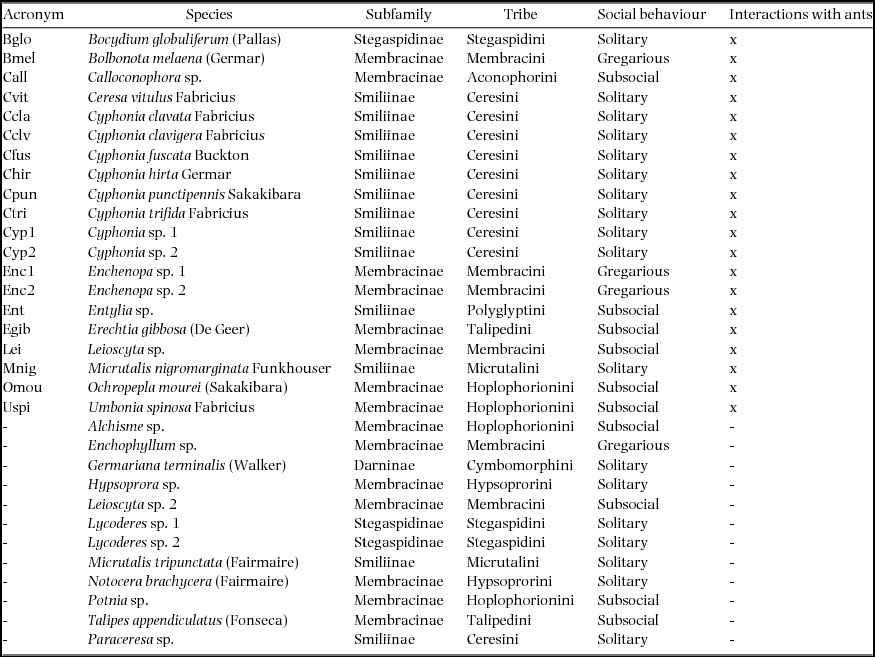
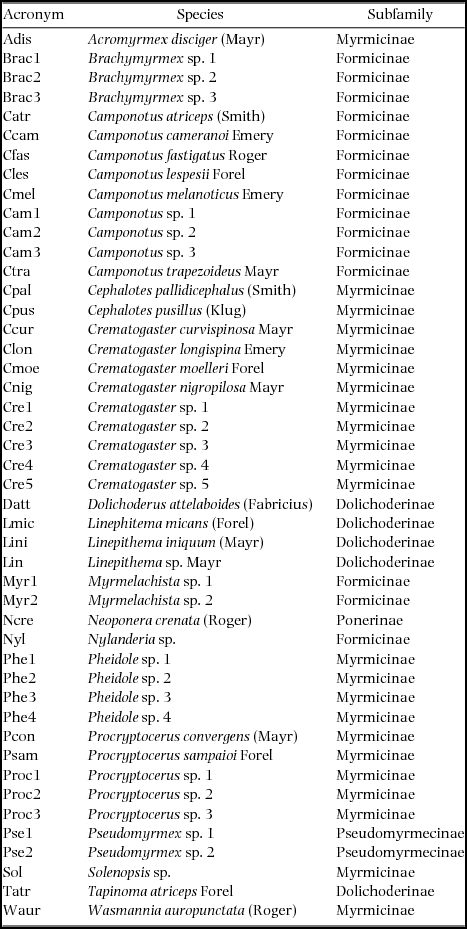
We found a total of 32 treehopper species over all of the studied areas and classified them into four subfamilies and 10 tribes. Twelve of these species were not observed in association with ants and, therefore, were not included in the network matrices (Appendix 1). We recorded 20 treehopper species interacting with 47 ant species (Appendix 2). Regarding treehopper behaviour, 18 species were solitary, four were gregarious and 10 were subsocial (Appendix 1).
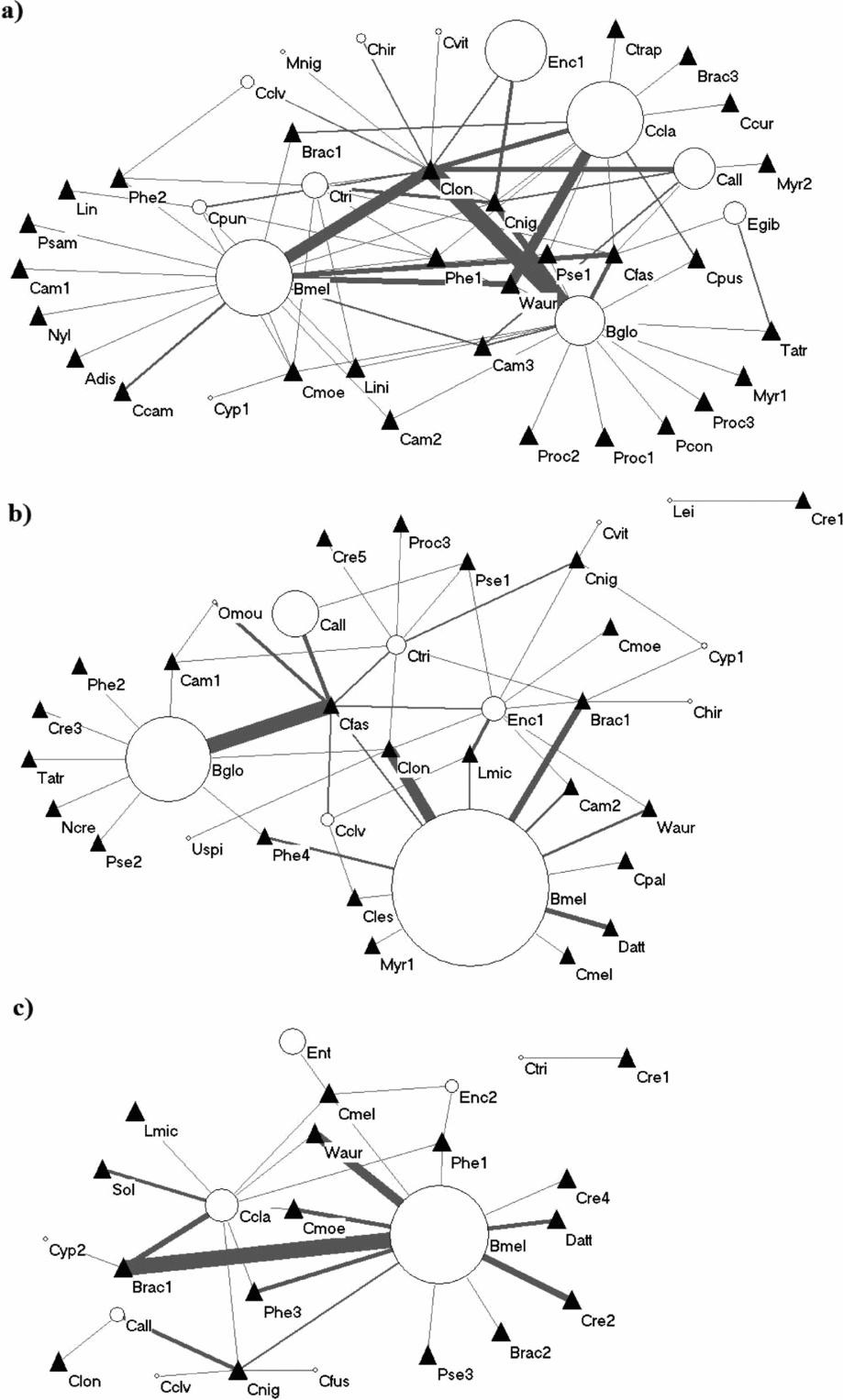
The species composition of network cores presented here was largely congruent in all of the study areas. In RPPN, the majority of interactions were centred on four treehopper species (Bocydium globuliferum (k = 17), Bolbonota melaena (k = 16), Cyphonia clavata (k = 11) and Cyphonia trifida (k = 7)) and three ant species (Crematogaster longispina (k = 11), Crematogaster nigropilosa (k = 7) and Camponotus fastigatus (k = 6)) (Figure 1a). In this study area, we found C. clavata in aggregates of up to 30 nymphs tended by Cephalotes pusillus and Wasmannia auropunctata. A similar pattern was also noted in the aggregates of B. melaena that interacted with the highest number of tending-ant species.
Interaction networks between treehoppers and ants species in Santa Catarina, Brazil, in 2013 and 2014. RPPN: Reserva Particular do Patrimônio Natural Chácara Edith, Brusque (a); PAEST: Parque Estadual da Serra do Tabuleiro, Santo Amaro da Imperatriz (b); and PNSI: Parque Nacional da Serra do Itajaí, Blumenau (c). The most important species are drawn closer to the centre of each diagram. The circles represent the abundance of each species of treehopper. The triangles represent the ant species. The size of the link is proportional to the number of times of occurrence of the interaction between species. Species codes use the first letter of the genus and the first three letters of the specific epithet. The codes are listed in Appendices 1 and 2.

In PAEST, components concentrating the highest number of interactions included four treehopper species (Bolbonota melaena (k = 12), Bocydium globuliferum (k = 9), Enchenopa sp. (k = 9) and Cyphonia trifida (k = 8)) and four ant species (Camponotus fastigatus (k = 7), Crematogaster longispina (k = 5), Brachymyrmex sp. 1 (k = 5) and Crematogaster nigropilosa (k = 4)). The second group recovered in this topology was represented by interactions between the subsocial treehopper Leioscyta sp. and Crematogaster sp. 1 ant (Figure 1b).
In PNSI, two treehopper species (B. melaena (k = 12) and C. clavata (k = 9)) and five ant species (C. nigropilosa (k = 5), Camponotus melanoticus Emery (k = 4), Brachymyrmex sp. 1 (k = 3), Crematogaster moelleri Forel (k = 2) and W. auropunctata (k = 2)) established the highest number of interactions, forming a central core in the network. These treehoppers were also the most abundant in this site, concentrating the majority of the observed interactions. A single peripheral group was comprised of solitary treehopper C. trifida and Crematogaster sp. 1 ant (Figure 1c).
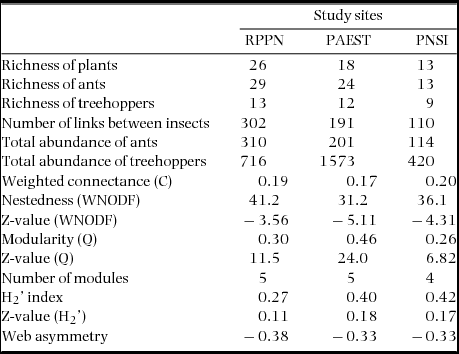
We observed similar network structural properties across all of the studied sites. Connectance values were low (0.17–0.20), and the distribution of mutualistic interactions was distinctly asymmetrical (−0.33 to −0.38), with few treehopper species concentrating the highest number of interactions with ants. None of the networks was significantly nested (WNODF = 31.2–41.2, all Z < 2), and none of the values of H2’ in the three sites was significantly different (H2’ = 0.27–0.42, all Z < 2) from the null model. However, all networks were significantly modular when compared with the neutral patterns of ant–treehopper interactions (null models) (Q = 0.26–0.46, all Z > 2), with number of modules ranging from four to five modules (Table 1).
Richness, abundance and descriptors of interaction networks between treehoppers and their tending-ants in three areas of the Atlantic Forest, Santa Catarina, Brazil, in 2013 and 2014. Study sites: RPPN: Reserva Particular do Patrimônio Natural Chácara Edith, Brusque; PAEST: Parque Estadual da Serra do Tabuleiro, Santo Amaro da Imperatriz; and PNSI: Parque Nacional da Serra do Itajaí, Blumenau.
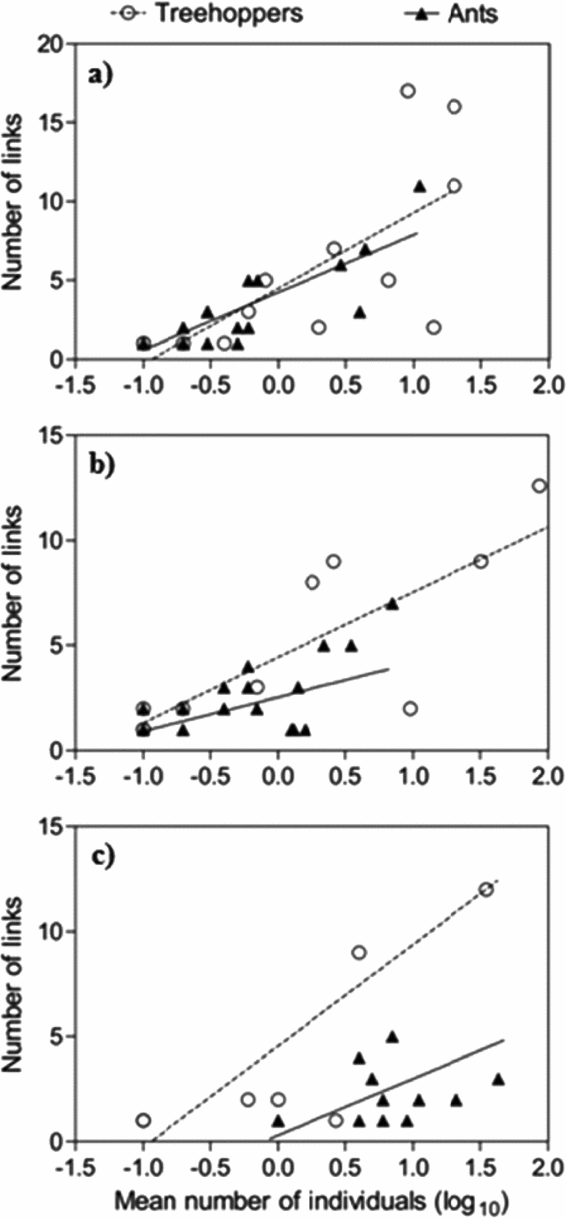
In all of the studied areas, ant and treehopper species that showed the highest number of interactions also showed the greatest abundances. Linear regression analyses indicated a significant correlation between the mean of species abundance and the number of existing interactions between treehoppers and ants (PAEST: r2 = 0.71, PNSI: r2 = 0.72, RPPN: r2 = 0.51, all P < 0.001) (Figure 2a–c).
Linear regression (r2) between mean number of individuals (log10) and number of links of treehopper and ant species. RPPN: treehoppers: r2 = 0.51, P < 0.001; ants: r2 = 0.73, P < 0.001 (a), PAEST: treehoppers: r2 = 0.71, P < 0.001; ants: r2 = 0.36, P < 0.001 (b), PNSI: treehoppers: r2 = 0.72, P < 0.001; ants: r2 = 0.24, P = 0.05 (c).
DISCUSSION
Our hypothesis was corroborated, as ant species with greater power of recruitment established the most mutualistic interactions with gregarious species of treehopper. Our results showed an interesting trend in the structural pattern of ant–treehopper mutualistic networks, once ant species with a magnitude of worker recruitment interacted with more treehopper species (Dáttilo et al. Reference DÁTTILO, DÍAZ-CASTELAZO and RICO-GRAY2014b). One explanation for this pattern is that ants that are more competitive tend to monopolize available food resources, such as honeydew produced by treehoppers and extrafloral nectaries (Dáttilo et al. Reference DÁTTILO, DÍAZ-CASTELAZO and RICO-GRAY2014b, Del-Claro & Oliveira Reference DEL-CLARO and OLIVEIRA1999, Schoereder et al. Reference SCHOEREDER, SOBRINHO, MADUREIRA, RIBAS and OLIVEIRA2010). These findings agreed with the abundance-asymmetry hypothesis, which assumes that asymmetry in network topology is associated with variation in abundance (Vázquez et al. Reference VÁZQUEZ, MELIÁN, WILLIAMS, BLÜTHGEN, KRASNOV and POULIN2007). Moreover, asymmetry is a common pattern in mutualistic networks, characterized by high heterogeneity in species dependence and low frequency of strong dependence, which may promote community coexistence and diversity (Bascompte et al. Reference BASCOMPTE, JORDANO and OLESEN2006).
Interestingly, in the core of highly interacting species, we found that gregarious and solitary species of treehopper and ant species that recruited more workers were the most abundant and had the largest number of links among themselves. At the core of our mutualistic networks, we mostly found the following species of treehopper and tending-ant: B. melaena, C. clavata, B. globuliferum, C. fastigatus, C. longispina, C. nigropilosa, Brachymyrmex sp. 1 and W. auropunctata. Although several treehopper species displayed consistent solitary or gregarious behaviour, it was unclear whether small aggregations of nymphs in species that were solitary as adults were affected by ecological circumstances or transitory facultative mutualistic benefits, as opposed to reflecting a genuine behavioural trait. On this topic, we provided new ecological observations on immature specimens of C. clavata, which were found in small aggregations tended by ants in two surveyed sites. The ant genera most frequently associated with treehoppers, Brachymyrmex, Camponotus and Crematogaster, included extreme omnivores that have ecophysiological adaptations to feed on extrafloral nectaries and honeydew (Fernández Reference FERNÁNDEZ and Fernández2003, Longino Reference LONGINO2003) and that are highly efficient at recruiting large numbers of individuals. Similarly, W. auropunctata workers are aggressive, polyphagous and usually associate with honeydew-producing hemipterans, showing greater abundance in areas where these sap-feeding insects are found (Naumann Reference NAUMANN1994, Wetterer & Porter Reference WETTERER and PORTER2003). In agreement with previous studies, our results indicated that ants exhibiting stronger recruiting force dominated resources offered by treehoppers (Blüthgen et al. Reference BLÜTHGEN, VERHAAGH, GOITIA, JAFFE, MORAWETZ and BARTHLOTT2000). It was previously shown that dominant ants may regulate local species diversity through competition, contributing to the structuring of ant communities (Blight et al. Reference BLIGHT, ORGEAS, TORRE and PROVOST2014). In contrast, a single aggregating treehopper species can alter the composition of the local ant community, causing an increased abundance of ant workers (Fagundes et al. Reference FAGUNDES, RIBEIRO and DEL-CLARO2013). Thus, the number of individuals in the aggregation may affect the number of interactions that treehoppers establish with their mutualistic partners. Here, we confirmed that recruitment was a key factor in mutualistic networks because ant species with more massive recruitment often interacted with more treehopper species.
We know that abiotic factors can alter the nutritional composition of the extrafloral nectaries, such as soil pH (Dáttilo et al. Reference DÁTTILO, RICO-GRAY, RODRIGUES and IZZO2013a), temperature, precipitation (Rico-Gray et al. Reference RICO-GRAY, DIÁZ-CASTELAZO, RAMÍREZ-HERNÁNDEZ, GUIMARÃES and HOLLAND2012) and plant phenology (Lange et al. Reference LANGE, DÁTTILO and DEL-CLARO2013). Therefore, resources produced by these plant structures undergo significant variation in time and space (Rico-Gray Reference RICO-GRAY1993) and are less stable than honeydew. As such, food resources provided by sucking insects may change less over time; therefore, it is a good nutritional investment for ants. This explains the role of massive recruitment and resource domination in structuring ant–treehopper networks. Moreover, despite environmental variation, it is possible that the core of highly interacting ant species feeding on treehoppers could remain unaltered over large space-time scales, as previously observed for ant-plant networks (Dáttilo et al. Reference DÁTTILO, GUIMARÃES and IZZO2013b, Lange et al. Reference LANGE, DÁTTILO and DEL-CLARO2013, Santos et al. Reference SANTOS, DÁTTILO and PRESLEY2014).
Our ant–treehopper networks showed a combination of strong, asymmetric relations and low connectance values, features that can be found in several mutualistic systems (Lange & Del-Claro Reference LANGE and DEL-CLARO2014, Mello et al. Reference MELLO, BEZERRA and MACHADO2013). Low connectance values are often seen in species-rich communities, including plants, insects and vertebrates (Clemente et al. Reference CLEMENTE, LANGE, DEL-CLARO, PREZOTO, CAMPOS and BARBOSA2012, Passmore et al. Reference PASSMORE, BRUNA, HEREDIA and VASCONCELOS2012, Pigozzo & Viana Reference PIGOZZO and VIANA2010, Santos et al. Reference SANTOS, AGUIAR and MELLO2010). Our mutualistic networks were not significantly nested, possibly because we used quantitative matrices to describe these interactions. For example, in ant-plant systems, Dáttilo et al. (Reference DÁTTILO, SÁNCHEZ-GALVÁN, LANGE, DEL-CLARO and RICO-GRAY2014a) observed that the nested pattern was different when comparing quantitative and binary matrices; therefore, quantitative networks were often non-nested. Staniczenko et al. (Reference STANICZENKO, KOPP and ALLESINA2013) also argued that mutualistic ecological networks were binary nested, but quantitative ones were non-nested. Our ant–treehopper networks were significant modular, showing that there is no group of ant species that feed specifically on a particular group of treehopper species, as previously demonstrated for plant-pollinator systems or interactions between pathogens, herbivores and their host plants (Barriga et al. Reference BARRIGA, DORMANN, GBUR and SAGERS2015, Benítez-Malvido & Dáttilo Reference BENÍTEZ-MALVIDO and DÁTTILO2015, Pigozzo & Viana Reference PIGOZZO and VIANA2010, Santos et al. Reference SANTOS, AGUIAR and MELLO2010). These findings indicate that independently of variation in environmental factors among study sites, the patterns of organization of these interacting assemblages do not change.
Ant–treehopper networks yielded highly congruent results across the three surveyed sites in the Brazilian Atlantic Forest. They revealed the breadth of ecological factors that may contribute to ant–treehopper mutualisms, such as the magnitude of worker recruitment and treehoppers’ social behaviour. Our results showed that ant–treehoppers interactions did not occur randomly, and these associations were highly asymmetrical, modular and non-nested. Honeydew was monopolized by aggressive and locally dominant ants that were capable of recruiting a stronger foraging workforce, as shown by the genera Brachymyrmex, Camponotus, Crematogaster and Wasmannia, and they were also able to establish interactions with a larger number of treehopper species. Indeed, obtaining valuable food items, such as honeydew, greatly depends on how efficiently ants can discover and dominate those resources. An important aspect of these mutualistic interactions resides in the fact that honeydew is a highly nutritious resource that is more stable over time and space than extrafloral nectaries, which are severely affected by phenological and environmental changes.
ACKNOWLEDGEMENTS
We would like to thank Dr Marco Mello (UFMG) and Dr Paulo Guimarães Jr. (USP) for their support in discussions and early versions of this manuscript. Field assistance was provided by Viviane Daufemback (PARNA Serra do Itajaí/ICMBio), Fabiana Dallacorte, Fernando Brüggemann (PAEST), Wilson and Lígia Moreli (RPPN Chácara Edith) and Fundação do Meio Ambiente (FATMA/SC). The authors are currently funded by CAPES-DS (Y.E.A. Gadelha, 201201072) and FAPESP (O. Evangelista, 2012/21398-0 and 2014/017937).
List of acronyms (only for species that interact with ants), species, subfamily, tribe, social behaviour and interactions with ants of Membracidae (Hemiptera) in Atlantic Forest in Santa Catarina, Brazil, in 2013 and 2014. Interactions with ants: x: present and -: absent.
List of acronyms, species and subfamilies of Formicidae (Hymenoptera) in the Atlantic Forest in Santa Catarina, Brazil, in 2013 and 2014.