Introduction
Case management in social and health care originated in North America as part of the shift from institutional to community-based provision (Beardshaw and Towell Reference Beardshaw and Towell1990; Challis Reference Challis1992, Reference Challis and Malin1994, Reference Challis, Brodsky, Habib and Hirschfeld2003; Fisher Reference Fisher1990–91; Huxley et al. Reference Huxley, Hagan, Hennelly and Hunt1990). Its development was linked to the search for cost-effective alternatives for people with complex needs who required long-term care (Davies and Challis Reference Davies and Challis1986). Moxley (Reference Moxley1989) suggested that six factors underpinned the development of case management: deinstitutionalisation; the decentralised nature of community services; the growing number of clients with multiple needs living at home and the fragmentation of care services; a growing awareness of the importance of social supports and carers; and the need for cost containment. Although there are many variants, case management has been defined as ‘an intervention using a human service professional (typically a nurse or social worker) to arrange and monitor an optimum package of long-term care services’ (Applebaum and Austin Reference Applebaum and Austin1990: 5). Challis et al. (Reference Challis, Darton, Johnson, Stone and Traske1995, Reference Challis, Chesterman, Luckett, Stewart and Chessum2002) proposed a multi-faceted definition of case management on the basis of: functions (co-ordination and linkage); goals (maintaining vulnerable people at home and their independence); core tasks (case finding, assessment); target group; differentiating features (intensity of involvement, breadth of services overseen, duration of involvement); and multi-level responses (client-level and system-level goals). The Case Management Society of America underscores the individual and system-level objectives by describing the procedure as ‘a collaborative process of assessment, planning, facilitation and advocacy for options and services to meet an individual's health needs through communication and available resources to promote quality cost-effective outcomes’ (see http://www.cmsa.org).
More recently, case management has been adopted in acute health care with the same goal of cost containment. For example, the Chronic Care Model, an evidence-based guide to higher-quality chronic illness management in primary care (Bodenheimer, Wagner and Grumbach Reference Bodenheimer, Wagner and Grumbach2002; Wagner Reference Wagner1998) that originated in the United States of America (USA), describes the changes that are required in the health-care system to enable primary-care settings to improve outcomes for patients with chronic illnesses. It has six components: community resources; patient self-management; decision support; delivery system redesign, which includes case management; the use of clinical information systems; and the wider health-care system (Shortell et al. Reference Shortell, Marsteller, Lin, Pearson, Wu, Mendel, Cretin and Rosen2004). The model predicts that improvement in the aforementioned components can produce system reform in which informed, activated patients interact with prepared, pro-active practice teams (Bodenheimer, Wagner and Grumbach Reference Bodenheimer, Wagner and Grumbach2002; Rothman and Wagner Reference Rothman and Wagner2003). Despite its international relevance (Ashton Reference Ashton2000; Department of Health 2005 a,2005b; Dixon et al. Reference Dixon, Lewis, Rosen, Finlayson and Gray2004; Hofmarcher, Oxley and Rusticelli Reference Hofmarcher, Oxley and Rusticelli2007; Hokenstad and Johansson Reference Hokenstad and Johansson1996; Johri, Beland and Bergman Reference Johri, Beland and Bergman2003; Landi et al. Reference Landi, Lattanzio, Gambassi, Zuccala, Sgadari, Panfilo, Ruffilli and Bernabei1999; National Health Priority Action Council 2006), the process or implementation of the delivery of case management has rarely been explored in depth (Lamb Reference Lamb1992). There is confusion about the target groups, programmes and services that comprise case management, and how these differ in other care-delivery models (Lyon Reference Lyon1993).
Aims of the review
The purpose of the review reported in this paper was to explore the implementation of comprehensive case management by nurses for people with long-term or chronic illnesses, in part to provide a starting point for new research. This is particularly apposite in England where a system of case management for those with the most complex chronic illness was established with the target of a five per cent reduction in hospital bed-days by 2008 (Department of Health 2005a). It has been estimated that there are around 250,000 ‘very high-intensity users’ eligible for case management, and that 3,000 community matrons would be required to manage them (Department of Health 2005b). Despite its wider adoption, the evidence for the effectiveness of case management in this context is inconsistent (Singh Reference Singh2005a; Hutt, Rosen and McCauley Reference Hutt, Rosen and McCauley2004), and there is none showing that any one case-management intervention is consistently better than another. There were two more specific aims:
1. To provide a consistent and comprehensive, description of the purpose, content and delivery of case-management services.
2. To illustrate how the consistent and comprehensive reporting of the implementation of nurses' case management can identify specific areas that require methodological development.
The review methodology
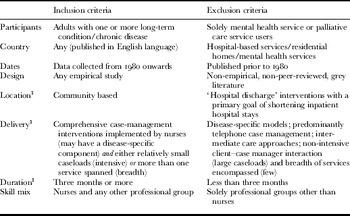
The review focused upon comprehensive case management (i.e. not just case finding or assessment) by nurses for adults with long-term conditions or chronic diseases and resident in the community. Published empirical research was primarily identified through citation tracking of the papers identified by previous related systematic and narrative literature reviews that were available in 2005–6 (Eastwood and Sheldon Reference Eastwood and Sheldon1996; Hallberg and Kristensson Reference Hallberg and Kristensson2004; Hutt, Rosen and McCauley Reference Hutt, Rosen and McCauley2004; Johri, Beland and Bergman Reference Johri, Beland and Bergman2003; Kharicha et al. Reference Kharicha, Levin, Iliffe and Davey2004; Loveman, Royle and Waugh Reference Loveman, Royle and Waugh2003; Norris et al. Reference Norris, Nichols, Caspersen, Glasgow, Engelgau, Jack, Isham, Snyder and Carande-Kulis2002; Phelan et al. Reference Phelan, Cheadle, Schwartz, Snyder, Williams, Wagner and LoGerfo2003; Raine et al. Reference Raine, Haines, Sensky, Hutchings, Larkin and Black2002; Renders et al. Reference Renders, Valk, Griffin, Wagner, van Eijk and Assendelft2001; Richards and Coast Reference Richards and Coast2003; Rosen and Teesson Reference Rosen and Teesson2001; Rummery and Glendinning Reference Rummery and Glendinning2000; Singh Reference Singh2005a, Reference Singh2005b; Taylor et al. Reference Taylor, Bestall, Cotter, Falshaw, Hood, Parsons, Wood and Underwood2005; van Haastregt et al. Reference van Haastregt, Diederiks, van Rossum, de Witte and Crebolder2000; Weingarten et al. Reference Weingarten, Henning, Badamgarav, Knight, Hasselblad, Gano and Ofman2002), supplemented with follow-up searches of electronic journals. Inclusion and exclusion criteria were applied to each potential reference (Table 1). The retrieved papers were first read to establish that they referred to comprehensive case-management interventions. We operationalised the term ‘comprehensive case management’ by reference to three main differentiating features: intensive client–case manager interaction (relatively small caseloads) and/or the breadth of services encompassed (more than one service); and the duration of the case-management intervention (longer-term commitment lasting a minimum of three months) (Applebaum and Austin Reference Applebaum and Austin1990).
Criteria for inclusion in or exclusion from the review

Note: 1. Of the intervention.
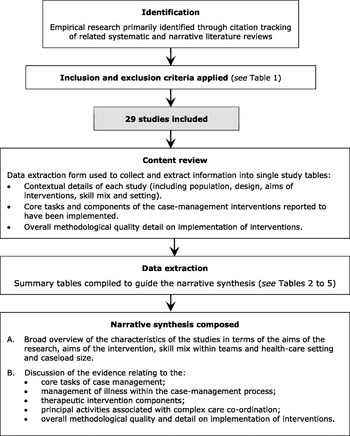
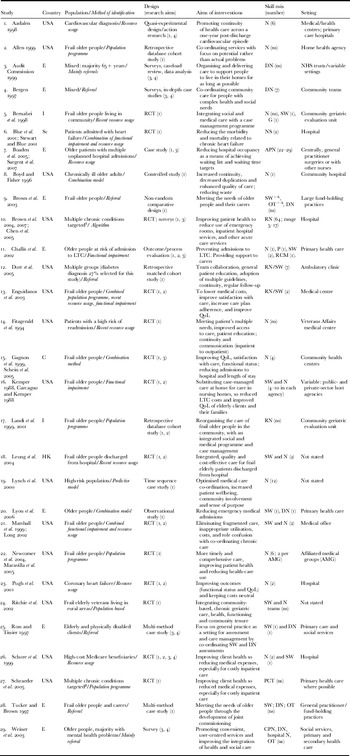
The included publications described and evaluated 29 case-management schemes and are listed in Table 2. The content of the papers that met the inclusion criteria were reviewed using a data extraction form, on which was noted the general characteristics of the research, the professional group(s) and locations of the case managers, and the core tasks and components of the case-management interventions (Challis et al. Reference Challis, Darton, Johnson, Stone and Traske1995, Reference Challis, Chesterman, Luckett, Stewart and Chessum2002), including the methods of identifying high-risk patients.Footnote 1 We recorded whether or not the core tasks and components of the case-management interventions were implemented. One reviewer selected the studies and extracted data (SR). A second reviewer (DC) checked the extracted data for consistency and accuracy, and any disagreements were resolved by consensus. The procedures and steps of the review are summarised in Figure 1. References to the studies included in the review are referred to in square brackets using the serial number given in Table 2. In a few cases, more than one publication reported the findings of a research project: these are readily distinguished by the authors and dates. Any other references are cited in the conventional manner. Two of the authors of this review (DC, JH) were co-authors of two studies in the review [11, 29].
The steps and procedures of the review.

Summary details of the included studies

Key to countries: C: Canada; E: England; HK: Hong Kong; I: Italy; Sc: Scotland.
Key to research aims:
1: impact/effectiveness; 2: cost effectiveness; 3: process of service delivery; 4: services provided.
Key to professions/staff/skill mix: +A: plus assistants; APN: advanced practitioner nurse; CPN: community psychiatric nurse; DN: district nurse; G: geriatrician; N: nurse; NS: nurse specialist; OT: occupational therapist; P: physiotherapist; PCT: primary care team (physician, advanced practice nurse, nurse case manager, case assistant); RCM: registrar in community medicine; RN: registered nurse; SW: social worker.
Other notes: LTC: long-term care. ns: not stated. QoL: quality of life. RCT: randomised controlled trial. 1. Congestive heart failure 29%; coronary artery disease 24%; diabetes, 13%. 2. Coronary artery disease 48%; diabetes 38%; chronic pulmonary disease 28%; atrial fibrillation 23%; congestive heart failure 20%.
The presented synthesis has six sections. First we present a broad overview of the characteristics of the studies in terms of the aims of the research, aims of the intervention, along with the professional group and location of case managers and the caseload sizes. The following five sections are a narrative synthesis (Mays, Pope and Popay Reference Mays, Pope and Popay2005) of the evidence about the core tasks of case management, the management of illness within the case-management process, therapeutic interventions, the tasks associated with complex care co-ordination, and the overall quality of the presented details of the implementation. The paper ends with a critical appraisal of the methods of the review and a discussion of the key issues relevant to a coherent and sustainable implementation of case management for people with long-term conditions.
Characteristics of the interventions and the studies
Of the 29 case-management interventions included in the review, the majority (18) were for frail older people and others targeted people with multiple chronic diseases, a high cost of care, and a high risk of unplanned admissions (Table 2). Three studies were of nurse case management for people with heart failure or cardiovascular diagnosis [1, 6, 23]: all were initiated in hospitals and subsequently extended into the community. Most of the included studies were North American (15 schemes), and the others were conducted in England (nine), Italy (two), Scotland (one), Canada (one) and Hong Kong (one). The majority (22) of the studies focused on the effectiveness of services, and fewer (11) on the process of service delivery or how services were provided. Over one-quarter (eight) were concerned with cost effectiveness, and seven with which services were provided. Fourteen of the studies were randomised-controlled trials (RCTs) and 22 were multi-site studies.
Aims of the interventions
Many of the studied intervention programmes had both client-oriented and organisational goals. For example, one US demonstration project aimed to improve patient health as a means of reducing the use of emergency rooms, in-patient hospital services and other acute care services [10]. Similarly, in England, one of the community-care demonstration projects aimed to prevent admissions to residential, nursing home or long-stay hospital care and to provide support to the carers of very frail older people [11]. On the other hand, other projects had solely administrative goals: one aimed to reduce hospital occupancy as a means of achieving waiting list and waiting time targets [7 (Boaden et al. Reference Boaden, Dusheiko, Gravelle, Parker, Pickard, Roland, Sargent and Sheaff2005)], and another aimed to reduce emergency medical admissions [20]. A few studies reported explicit system-oriented goals, often focused upon integrating fragmented care services, e.g. one aimed to integrate social and medical care with a case-management programme [5].
Skill mix in care teams and the health-care settings
Nurses were the only professionals with the case-management role in almost one-half (14) of the studies: they were variously registered nurses, specialist nurses, district nurses and advanced practice nurses (APNs). Over one-third (11) of the interventions employed both nurses and social workers as case managers and four also had other professionals, most often occupational therapists (OTs). Most of the case managers were based in the community, usually in primary health care or at medical centres or offices that accommodated core diagnostic services, and few were based in hospitals. Three studies did not report clearly where the case managers were based [18, 19, 24].
Caseload size
Fewer than one-half (13) of the studies reported the caseload size of the case managers. The reported caseloads ranged from 22 [1] to 500 [12]. Some of the variation may reflect inconsistent reporting between ‘active’ and ‘maintained’ cases, although some studies reported both. For example, the Newcomer et al. study [22] of preventative nurse case management for high-risk geriatric patients enrolled in a MedicareFootnote 2 plan had 60 active cases but 250 were maintained on the caseload. This study also reported that: the intensity of the role varied with the risk priority of the patients (17% were high risk, 37% medium risk and 46% low risk); that the average contact during the year was 7.7 hours (standard deviation (SD) 3.7); and that the factors associated with higher-risk priorities were co-morbidities, service utilisation inconsistent with the patient's condition, unsafe home environment, nutrition problems, and poly-pharmacy. Another study [12] reported that case managers had between 350 and 500 active patients, so clearly only a small proportion could have received an intensive service. Average caseloads of 130 were reported at one of the study sites [27], but the nurse case-managers (NCMs) were supported by APNs and case assistants (CAs) and, respectively, averaged 8.2 and 3.2 contacts in the first year of service (increasing to 10.3 and 5.5 contacts in the second year); and a high proportion of the patient contacts were by telephone (62% NCM; 94% CA). It is impossible to indicate an optimal caseload size given the great variability in the types of patients, in the levels of severity of their conditions, in the methods of identification and the key components of the case-management intervention.
The core tasks of case management
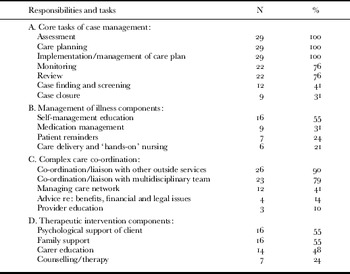
The coverage of each case-management task was separately assessed for all the studies (Table 3). Although the core tasks of assessment, care planning and implementation/management were common to all programmes, there was considerable variation in their delivery. A number of qualitative aspects are now examined in connection with each core task.
Case managers' responsibilities and tasks in the 29 interventions

Note: Sample size=29.
Case finding and screening
Although not all studies were targeted solely on patients with high risks [as were 14 and 22], the heterogeneity of the populations, settings and providers indicate that various methods are used to identify high-risk patients for case management (Table 2). Almost half of the studies used either data relating to recent resource usage to identify patients (usually recent hospital admissions or history of previous admissions) (7; 24%), or a combination of resource usage and functional impairment (usually with a disease-specific element) (6; 21%). Only two studies, both focused on frail elderly people, used functional impairment to identify older people at risk of admission to residential, nursing or long-stay hospital care [11, 6 (Blue et al. Reference Blue, Lang, McMurray, Davie, McDonagh, Murdoch, Petrie, Connolly, Norrie, Round, Ford and Morrison2001)]. Six studies relied upon referrals of patients as their prime method of identification of clients [3, 4, 10 (Brown et al. Reference Brown, Schore, Archibald, Chen, Peikes, Sautter, Lavin, Aliotta and Ensor2004), 12, 25, 28, 29]. Clearly different methods have to be adopted to suit the local information systems, which some studies noted were inadequate [1, 7, 10 (Brown et al. Reference Brown, Schore, Archibald, Chen, Peikes, Sautter, Lavin, Aliotta and Ensor2004)]. The method of identifying patients often determined the level of involvement of case managers at this stage. In 12 studies, case managers were clearly actively involved in the case finding or screening of patients.
Assessment
Whilst all the schemes assessed patients in order to develop a care plan, only some varied the intensity of the initial assessment according to the level of risk of the patient as determined at the screening stage. As most targeted high-risk patients, the assessments tended to be comprehensive. Some studies emphasised this case-management task more than others [e.g. 4, 24], or highlighted specific training in geriatric assessment technology [5] and assessment in the home environment [6 (Blue et al. Reference Blue, Lang, McMurray, Davie, McDonagh, Murdoch, Petrie, Connolly, Norrie, Round, Ford and Morrison2001), 24]. Some studies described the benefits of shared assessment documentation, joint visits and co-location that aided informal sharing of information [10 (Brown et al. Reference Brown, Schore, Archibald, Chen, Peikes, Sautter, Lavin, Aliotta and Ensor2004), 11, 20, 25, 28]. A number of practices were integral to speeding up this process by adopting: an integrated case-management approach [20], better screening processes [16 (Kemper Reference Kemper1988)], or smaller caseloads [10 (Brown et al. Reference Brown, Schore, Archibald, Chen, Peikes, Sautter, Lavin, Aliotta and Ensor2004)].
Although few studies provided details of the specific assessment measures, comprehensive structured assessment measures were used by several [16, 11, 27, 15], the most frequent being the Minimum Data Set for Home Care [5, 17 (Landi et al. Reference Landi, Onder, Russo, Tabaccanti, Rollo, Federici, Tua, Cesari and Bernabei2001), 18, 24]. In many cases, the assessments were completed by the nurses [18, 21, 27, 29]. One United Kingdom (UK) study reported that health staff often had difficulties with the financial assessments that were required in the context of providing social care [29]. Several studies reported a high level of unmet needs in patients that were either previously unrecognised or not being monitored or treated [7 (Boaden et al. Reference Boaden, Dusheiko, Gravelle, Parker, Pickard, Roland, Sargent and Sheaff2005), 24], which highlights a benefit of routine standardised comprehensive assessment for people with long-term conditions. Almost one-half (14) of the studies did not report information on whether or not there was continuity between assessment and the other core tasks of case management. Of the remainder, 12 indicated that in most cases there was continuity in both assessment and case-management functions, and only one study [27] explicitly reported that these tasks were separated. In this study, each of the primary care team members had clearly defined roles. Patients in the high-risk category received intensive assessment, teaching, co-ordination from the APN, regularly scheduled NCM phone calls, and focused monitoring calls at least monthly from the CA.
Care planning and implementation of the care plans
In these tasks, the assessment is translated into the development of a care plan and then executed and delivered by the case manager. Although all studies reported these as core functions of case management, not all described how the process was undertaken. Three [12, 19, 22] ensured that all identified problems were addressed by using advanced information technology, including shared electronic medical records and access to resource directories and clinical guidelines. One study [19] reported that the high-risk registry, care plans and metrics resided on a secure server and were accessible through user authentication and secured, encrypted transmissions.
The process of care planning has many components and may cross many settings rather than be episode-based. Case managers in many of the programmes relied upon making referrals to other services. It was clear that in many of the evaluated schemes the range of services was dependent not only on the scope of the intervention but also on both the availability of appropriate long-term care and community resources [16 (Kemper Reference Kemper1988), 11] and on the knowledge, skills and experience of case managers [26]. The fragmentation of care for people with cognitive impairment was highlighted in a UK demonstration study, yet the APNs had little experience of designing care plans for this group [7 (Boaden et al. Reference Boaden, Dusheiko, Gravelle, Parker, Pickard, Roland, Sargent and Sheaff2005)]. Given the frequent lack of consensus among professionals, relatives, carers and clients about the proposed care plan [25], clearly good negotiation and communication skills are essential.
Few studies reported sufficient information by which to gauge the intensity of the intervention implied by the care plan, but overall it emerged that many factors influence intensity. Eleven studies reported the total hours or contacts per case, usually per year. Hours-per-case ranged from 4.5 [12] to the equivalent of 54 hours per year [8]. Three studies [6 (Blue et al. Reference Blue, Lang, McMurray, Davie, McDonagh, Murdoch, Petrie, Connolly, Norrie, Round, Ford and Morrison2001), 13, 23] noted that contacts were more frequent during the initial case-management period and decreased as the patients became more independent in managing their condition. One multi-site study [10 (Brown et al. Reference Brown, Peikes, Chen, Ng, Schore and Soh2007)] reported an emphasis on telephone contacts while another reported more home visits despite active encouragement to manage issues over the telephone [15 (Gagnon et al. Reference Gagnon, Schein, McVey and Bergman1999)]. Telephone contacts were likely to be under-reported because of the burden of recording [15 (Gagnon et al. Reference Gagnon, Schein, McVey and Bergman1999)]. One [13] of the few studies that indicated the balance of time between different tasks reported that more of the case managers' time was directed towards co-ordinating health and community-based services, rather than interacting directly with the patient. Other studies noted that administrative tasks reduced the time available for direct work with the patients and may have reduced the intensity and impact of the intervention [7 (Boaden et al. Reference Boaden, Dusheiko, Gravelle, Parker, Pickard, Roland, Sargent and Sheaff2005), 15, 16 (Kemper Reference Kemper1988)]. In addition to caseload size, a number of studies noted the detrimental effect on intensity and the role conflicts associated with combining the case-management role with other clinical responsibilities [1, 10 (Brown et al. Reference Brown, Schore, Archibald, Chen, Peikes, Sautter, Lavin, Aliotta and Ensor2004), 25].
Crucial to the effective implementation of case management is the influence that case managers have over the form and content of the services provided (Challis Reference Challis, Brodsky, Habib and Hirschfeld2003). Only four studies clearly stated that case managers had some control over the supply or availability of services or other resources [11, 13, 16 (Kemper Reference Kemper1988), 20]. In another five interventions, team-level decisions regarding the allocation of resources were reported, but most of the studied programmes relied upon referrals to other services. It has been argued that a brokerage model alone is insufficient to exert influence and is unlikely to be very effective (Arnold Reference Arnold1987; Austin Reference Austin1992). Even those programmes with more budgetary control were limited in how far they could achieve their programme goals without adequate service provision. In one demonstration study, for example, although ‘hands-on’ personal care, home health care, homemaking and meals were the backbone of the direct service component, they were in short supply [16 (Kemper Reference Kemper1988)].
Monitoring and review
Three-quarters of the studies reported monitoring and review as case-management tasks. Some interventions monitored the patients' health [6 (Blue et al. Reference Blue, Lang, McMurray, Davie, McDonagh, Murdoch, Petrie, Connolly, Norrie, Round, Ford and Morrison2001), 7 (Boaden et al. Reference Boaden, Dusheiko, Gravelle, Parker, Pickard, Roland, Sargent and Sheaff2005)] to anticipate health problems and to prevent deterioration and unnecessary admissions. One scheme monitored the patients' level of condition-specific learning [10 (Brown et al. Reference Brown, Schore, Archibald, Chen, Peikes, Sautter, Lavin, Aliotta and Ensor2004)]. Two studies [2, 5] described the monitoring of services provided. The level of monitoring was linked to the patient's condition in some schemes. For example, in the UK Evercare demonstration programme, if a patient's condition improved dramatically, he or she was placed in the green category (minimum monitoring) pending further change [7 (Boaden et al. Reference Boaden, Dusheiko, Gravelle, Parker, Pickard, Roland, Sargent and Sheaff2005)]. In many schemes, monitoring was during scheduled telephone and patient contacts. It was carried out in most cases directly by the NCM, but in one scheme [27] around one-half of the CA's time was spent in monitoring activities compared to around one-fifth of the NCM's. Similarly, one English study found that at some sites the NCM's input was more for assessment than for monitoring or review [29]. Mechanisms by which to monitor the providers of care, particularly formal in-home services, were identified as a major need [16 (Kemper Reference Kemper1988)] and their absence led to considerably more monitoring than anticipated. Techniques included the use of informal care-givers and skilled care-providers to monitor semi-skilled in-home services, scheduling the case managers' visits to coincide with the service, providing checklists of tasks to be completed, and generally increasing the case managers' accessibility to patients [16 (Kemper Reference Kemper1988)]. A number of schemes used computerised case-management records to ensure that needs were not overlooked and that scheduled interventions occurred as planned [22 (Newcomer et al. Reference Newcomer, Maravilla, Faculjak and Graves2004), 22 (Maravilla, Graves and Newcomer Reference Maravilla, Graves and Newcomer2005), 15 (Gagnon et al. Reference Gagnon, Schein, McVey and Bergman1999), 27].
Case closure
Most (16) of the studies did not state the duration of the case managers' involvement or whether or not services were time limited. Of those that did, seven explicitly stated that they were not time limited [2, 7 (Boaden et al. Reference Boaden, Dusheiko, Gravelle, Parker, Pickard, Roland, Sargent and Sheaff2005), 9, 11, 16 (Kemper Reference Kemper1988), 22 (Newcomer et al. Reference Newcomer, Maravilla, Faculjak and Graves2004), 27]. Others offered services for one year [6 (Blue et al. Reference Blue, Lang, McMurray, Davie, McDonagh, Murdoch, Petrie, Connolly, Norrie, Round, Ford and Morrison2001), 14, 25], for 10 months [15 (Gagnon et al. Reference Gagnon, Schein, McVey and Bergman1999)], and for six months [23]. Less than one-third provided details of the case manager's ability to close a case. This omission may reflect a presumption of a long-term responsibility, but some services that were clearly time limited [e.g. 6 (Blue et al. Reference Blue, Lang, McMurray, Davie, McDonagh, Murdoch, Petrie, Connolly, Norrie, Round, Ford and Morrison2001), 15 (Gagnon et al. Reference Gagnon, Schein, McVey and Bergman1999)] or funded for only a limited time [25] provided no details about case closure. One study noted that a patient's health might improve to the point that case management would no longer be appropriate [7 (Boaden et al. Reference Boaden, Dusheiko, Gravelle, Parker, Pickard, Roland, Sargent and Sheaff2005)]. The original model described patients remaining as a client for life, albeit with the possibility of a much reduced minimum monitoring service if their health improved, but there were procedures for discharge once the patient's needs were met or if they chose to leave. One site in this study found that one-fifth of the patients were not suitable for long-term follow-up because they were low risk. These patients were discharged but could contact the service if they experienced an exacerbation of their condition. Previous patients of the service were also flagged on emergency admissions systems so that follow-up and, if necessary, case management could continue [7 (Boaden et al. Reference Boaden, Dusheiko, Gravelle, Parker, Pickard, Roland, Sargent and Sheaff2005)].
The case-management intervention components
Management of illness
The majority (23) of the studies included one or more of the management of illness intervention components shown in block B of Table 3, although incomplete reports sometimes made the extent or presence of these difficult to discern. A minority of the nurses performed care delivery duties or ‘hands-on’ nursing as part of the case-management role [2, 6], and others continued with their prior nursing responsibilities [1, 4, 25, 28, 29], which often gave rise to tensions when combined with the case-management functions. Most case managers worked as a co-ordinator rather than in a care-giving capacity, and in general case management was separated from the immediate activity of providing clinical care.
Just over one-half of the studies reported providing self-management patient education and almost one-half provided carer education. Diverse combinations of illnesses meant that a tailored approach to patient education was common [1, 10 (Brown et al. Reference Brown, Schore, Archibald, Chen, Peikes, Sautter, Lavin, Aliotta and Ensor2004)]. In one study, however, the broad target group made it difficult to develop materials for and to train case managers on the comprehensive disease-specific self-care education that can help reduce the need for hospital admissions [26]. Others were able to employ standard methods, such as circulating educational materials [23] and providing training classes [18]. Although it was a component in many studies, some gave great emphasis to patient education. In one demonstration, nearly all programmes devoted a high level of attention to improving patient education about adherence to treatment and self-care regimens and many developed their own educational materials [10 (Brown et al. Reference Brown, Schore, Archibald, Chen, Peikes, Sautter, Lavin, Aliotta and Ensor2004)]. Nearly three-quarters of all patients had a contact with the case manager that focused upon either disease-specific or self-care education [10 (Chen et al. Reference Chen, Sautter, Schore, Brown, Peikes and Orzol2005)]. In another scheme for frail elders, almost one-half (47%) of the case managers' initial activities were educational, with 57 per cent of the patients/families receiving at least one such intervention [24]. In another scheme, however, older people who were less frail (21%) received patient education as part of the nurse case-management intervention [15 (Gagnon et al. Reference Gagnon, Schein, McVey and Bergman1999), 15 (Schein et al. Reference Schein, Gagnon, Chan, Morin and Grondines2005)].
Nine studies incorporated medication management as part of the case manager's role including: assessment and monitoring of medication adherence; explaining medications; regular monitoring to detect changes that may be required; and ensuring these were followed up by the relevant doctor or consultant. Medication problems were noted for 36 per cent of the clients in the prevention-oriented case management scheme for frail older people [22 (Newcomer et al. Reference Newcomer, Maravilla, Faculjak and Graves2004)]. Seven studies specifically mentioned that the case-manager's role included reminding patients of appointments. One demonstration adopted a patient advocacy model of case management which involved case managers scheduling and accompanying participants to appointments [21]. Similarly in the [22 (Newcomer et al. Reference Newcomer, Maravilla, Faculjak and Graves2004)] scheme, case managers routinely monitored physician contacts and clinic appointments. Those who missed appointments were contacted to identify the factors that caused missed appointments, and they were subsequently called with reminders, helped with transport, accompanied to the clinic and educated in relation to their conditions.
Therapeutic intervention components
Two-thirds (19) of the studies included one or more therapeutic intervention components including: psychological support; family support; counselling/therapy; and carer education (Table 3, block D). Though again it was usually difficult to determine the time spent performing these tasks and most of the studies did no more than list these components, some interventions appeared to have a psycho-social focus. For example, in one scheme case managers made a special effort to support informal care-givers, including on-site or telephone counselling, health-education training programmes, mutual support groups, and assistance in care planning and co-ordination to encourage them to continue their care [18]. A secondary analysis of the data relating to nurse case-management interventions for frail older people [15 (Gagnon et al. Reference Gagnon, Schein, McVey and Bergman1999)] reported the proportion of patients in receipt of coping assistance (67%), lifespan care (35%; mostly involving family or care-giver support) and active listening (24%) [15 (Schein et al. Reference Schein, Gagnon, Chan, Morin and Grondines2005)]. Similarly, psycho-social support was emphasised by both patients and carers, and viewed as equally important to clinical care [7 (Boaden et al. Reference Boaden, Dusheiko, Gravelle, Parker, Pickard, Roland, Sargent and Sheaff2005), 7 (Sargent et al. Reference Sargent, Pickard, Sheaff and Boaden2007)]. In another scheme, emotional support involved very little time in comparison to instrumental support: it was estimated at seven per cent of the NCM's time and five per cent of the CA's time during the second year [27].
The principal activities of complex care co-ordination
Although in almost all the schemes, the case managers co-ordinated the intervention with outside services (26) and in their own multi-disciplinary team (23), fewer (12) had a broad purview of services in managing the care network (Table 3, block C). For example, the APNs in the UK Evercare demonstration were expected to know where and when each of their patients made use of the services of the broader health system and were seen as the primary co-ordinators of their care [7 (Boaden et al. Reference Boaden, Dusheiko, Gravelle, Parker, Pickard, Roland, Sargent and Sheaff2005)]. On the other hand, in the specialist nurse intervention for heart failure patients, clinical input and patient contact was stressed more than linkage to other services [6 (Blue et al. Reference Blue, Lang, McMurray, Davie, McDonagh, Murdoch, Petrie, Connolly, Norrie, Round, Ford and Morrison2001)]. Few studies reported how much of the case managers' time was spent co-ordinating services, but an exception was one site in a study in which CAs spent more than three times as much of their time with patients in co-ordination (26%) compared to the NCMs (7%) [27]. With regard to the integration of care between health and social services, over one-half of the studies reported specific links. In 20 studies, the NCMs were in the same team as social workers, and in 11 interventions nurse and social-work case-managers worked together. This offered more opportunities for multi-disciplinary working, including for discussing the service users' cases more often and in more detail; faster referral to colleagues; improvements in role understanding; shared assessments and case-management processes through the development of joint paperwork and joint visits; and the most appropriate allocation of case managers.
With reference to managing the care network, we attempted to determine the nature and extent of the links between case managers and physicians or general medical practitioners (GPs). Such links were described as enabling variously: more appropriate referrals and better targeting of patients [22 (Newcomer et al. Reference Newcomer, Maravilla, Faculjak and Graves2004), 25], the co-ordination of effective care, access to medical advice, adherence to treatment plans, preventing hospital admissions [26] and keeping physicians informed about the programme plans for their patients [10 (Brown et al. Reference Brown, Schore, Archibald, Chen, Peikes, Sautter, Lavin, Aliotta and Ensor2004)]. Strategies to improve these links included co-location with primary care [7 (Boaden et al. Reference Boaden, Dusheiko, Gravelle, Parker, Pickard, Roland, Sargent and Sheaff2005), 27], regular meetings between case managers and GPs, written reports on patients, shared electronic records [12], maintaining informal contacts and accompanying the patient on trips to the doctors [10 (Brown et al. Reference Brown, Schore, Archibald, Chen, Peikes, Sautter, Lavin, Aliotta and Ensor2004)]. Some of the case managers in one scheme needed more training in interactions with medical practitioners [16 (Kemper Reference Kemper1988)] and explicit mechanisms were necessary to increase physicians' involvement [16 (Kemper Reference Kemper1988), 16 (Carcagno and Kemper Reference Carcagno and Kemper1988)]. In contrast, programmes in a recent demonstration employed nurses with substantial experience who could work autonomously and confidently interact with physicians [10 (Brown et al. Reference Brown, Peikes, Chen, Ng, Schore and Soh2007)].
Only four studies reported that the case-management role extended to giving advice on social-security benefits and financial or legal issues. Case managers in all but one of these included both nurses and social workers and interventions were targeted at frail older people. Only three studies explicitly included provider education as a component of the case manager's role [6 (Blue et al. Reference Blue, Lang, McMurray, Davie, McDonagh, Murdoch, Petrie, Connolly, Norrie, Round, Ford and Morrison2001), 10 (Brown et al. Reference Brown, Schore, Archibald, Chen, Peikes, Sautter, Lavin, Aliotta and Ensor2004), 22 (Newcomer et al. Reference Newcomer, Maravilla, Faculjak and Graves2004)]. Some schemes in one demonstration study appeared to be more rigorous in ensuring that physicians adhered to guidelines [10 (Brown et al. Reference Brown, Schore, Archibald, Chen, Peikes, Sautter, Lavin, Aliotta and Ensor2004)]. Where patients were not receiving care consistent with the guidelines, the care co-ordinators tried to work collaboratively with the patient's physician to determine whether and how to rectify the situation. This activity required considerable tact and diplomacy. Some schemes were more pro-active in approaching physicians by having care co-ordinators ‘hold doctors to task’ about adherence to guidelines [10 (Brown et al. Reference Brown, Schore, Archibald, Chen, Peikes, Sautter, Lavin, Aliotta and Ensor2004)], and in others, although the case managers did not explicitly offer provider education, advanced information technology played a key role [12, 19, 27]. Many different evidence-based guidelines could be adopted. Access by multiple carers to a shared electronic medical record enabled several guidelines to be followed and provided alerts for patients who require attention, facilitating smoother integration into primary care workflow.
The quality of the implementation data
Most studies described the implementation of the interventions but the detail was variable. Many did not state basic information like the previous experience and levels of training and supervision of the nurses, and in only a few studies was the case-management intervention process data comprehensive, useful and easily interpretable. Only seven studies presented sufficient implementation detail to enable replication [7 (Boaden et al. Reference Boaden, Dusheiko, Gravelle, Parker, Pickard, Roland, Sargent and Sheaff2005), 10 (Brown et al. Reference Brown, Schore, Archibald, Chen, Peikes, Sautter, Lavin, Aliotta and Ensor2004), 11, 15 (Gagnon et al. Reference Gagnon, Schein, McVey and Bergman1999), 16 (Kemper Reference Kemper1988), 22 (Newcomer et al. Reference Newcomer, Maravilla, Faculjak and Graves2004), 27]. Although 24 studies measured some process data, over half presented no case-management-specific activity data, including some of the RCTs [5, 6, 14]. Few explicitly linked processes and outcomes, and only five set research questions relating to process and impact [7 (Boaden et al. Reference Boaden, Dusheiko, Gravelle, Parker, Pickard, Roland, Sargent and Sheaff2005), 10 (Brown et al. Reference Brown, Schore, Archibald, Chen, Peikes, Sautter, Lavin, Aliotta and Ensor2004), 11, 15, 26]. Few studies stated that treatment was standardised by using a manual or protocol, and few included details on whether integrity or adherence to the intended planned design was evaluated or monitored. One study reported the results of a review of selected cases by a nurse consultant who specialised in case management [26]. Oversights by project case managers were identified, suggesting that nurses adopting this role with no prior experience in community nursing may under-estimate the importance of social and environmental factors in improving the health of the client. The difficulties of moving from a hospital setting to the less familiar community setting were noted in some studies [e.g. 15, 23] as elsewhere (Drennan, Goodman and Leyshon Reference Drennan, Goodman and Leyshon2005).
Discussion and conclusions
This paper has presented a subjective synthesis of the published evidence about nurse-led case management schemes for frail older people and related patient groups, one informed by the authors' long involvement in process and outcome research in the field. The complexity and ambiguity of case management, along with the previously identified difficulties in identifying implementation studies (Arai et al. Reference Arai, Roen, Roberts and Popay2005), led us to believe that a purposive search technique was required. Our principal search method, citation tracking, enabled greater specificity than a conventional electronic search of bibliographic databases that incur numerous ‘false-positive’ references and require more detailed checking. While the purposive strategy may have resulted in some selection bias, the approach gave more time for evaluating and synthesising the studies. We believe the review has been sufficiently comprehensive to identify the most important findings from the field.Footnote 3
Case management for long-term conditions is a complex intervention, with the role involving several components, making it difficult to establish with any precision which is the ‘active ingredient’ (Loveman, Royle and Waugh Reference Loveman, Royle and Waugh2003). Although not attempted here, this certainly presents difficulties in establishing the true impact of nurse-led case management. This absence of a clear understanding of case management is an obstacle to the advancement of research and practice in this area. There was considerable variation in the case-management interventions reported in the 29 studies that related to over 120 sites, although there was some consistency in the core tasks. All studies reported that case managers undertook assessment, care planning and implementation of the care plan, but greater variation was evident for case finding, monitoring, review and case closure, as with the three intervention components of the management of illness, therapeutic interventions and complex care co-ordination (Table 3). The variability among the studies reflected different models of care, such as the Chronic Care Model, in addition to local implementation issues, such as different target client groups and different ranges of services at the disposal of the case manager.
These factors are likely to be highly related to the outcome results, but little attention was given to their description, as testified by many studies that were poorly rated for implementation detail. Many had too few details for us to understand how the core tasks and components were operationalised, or to comprehend the breadth, intensity and duration of the intervention. These variations in the quality of reporting and the difficulties in collecting standardised information on each core task means that the review's findings must be interpreted cautiously. Only a minority of studies provided methodologically sound process data, the complement of a widespread preference to report outcomes and methodological quality (Petticrew and Roberts Reference Petticrew and Roberts2006). As this review has concentrated upon implementation processes rather than outcomes, the size of the estimated impacts or effect sizes are not incorporated, nor is any greater weight given to higher-quality study designs. It is worth noting, however, that the wide range of research designs would make combining findings from process and outcome evaluations difficult.
We have tried to ensure that the presented synthesis of this literature has both intellectual quality and practical utility. A knowledge synthesis should result in a progressive paradigm shift that brings: (a) greater explanatory power to theory; (b) expanded scope of application to a practical problem; and (c) an increased capacity to pursue unsolved problems in future primary research (Strike and Posner Reference Strike, Posner, Ward and Reed1983). Notwithstanding our methodological concerns, by attempting to unravel the issues relevant to the implementation of nurse case management for people with long-term conditions, this paper has several important findings that will inform the ‘roll out’ of similar interventions in many countries (Singh and Ham Reference Singh and Ham2006), including England (Department of Health 2005a, Reference Challis2005b), the USA (Dixon et al. Reference Dixon, Lewis, Rosen, Finlayson and Gray2004), Canada (Johri, Beland and Bergman Reference Johri, Beland and Bergman2003), Australia (National Health Priority Action Council 2006), New Zealand (Ashton Reference Ashton2000) and Italy (Landi et al. Reference Landi, Lattanzio, Gambassi, Zuccala, Sgadari, Panfilo, Ruffilli and Bernabei1999).
Based on the reviewed evidence, three issues are believed to be key prerequisites for a coherent and sustainable implementation of case management for people with long-term conditions: programme fidelity, caseload size, and case-management practice. The first refers to the degree to which a particular service follows or is consistent with a programme model and has a well-defined set of interventions and procedures to help individuals achieve the desired goal (Bond et al. Reference Bond, Evans, Salyers, Williams and Kim2000) – readers familiar with the psychotherapy and psychiatric rehabilitation literatures will recognise the programme fidelity concept. This review has made clear the need to specify more clearly what and how case-management services should be provided to people with long-term conditions: this would encourage consistent and coherent implementation along with fuller measurement of what is actually being provided. Although most of the reviewed studies employed more than one case manager, few gave sufficient detail for us to assess the consistency of the intervention. Whilst the issues of professional autonomy and discretion also need addressing, to facilitate replications of the interventions, future research should give more attention to implementation and processes, recording and measurement. Without such specificity and transparency in the reports, evaluations of case management or indeed other phenomena have little substance, and evidence-based practice will be unattainable.
The second issue, the case managers' caseload size, is related to the capacity to provide intensive support and is integral to the concept of fidelity. Caseload size is to a large extent contingent on the appropriate use of mechanisms to determine entry to case management (case finding and screening) and on the strategies for exiting the service. Furthermore, the size of caseload, combined with the level of need of recipients, to a large extent determines the service they receive and the monitoring and review phases of the process. Thus, if a case-management programme is to impact on the health of people with long-term conditions and on the rates of admission and re-admission, an effective and accurate system of case-finding is essential (Billings et al. Reference Billings, Dixon, Mijanovich and Wennberg2006). The increase in the use of predictive modelling tools, such as the ‘Patient At Risk of Re-hospitalisation’ (PARR) case-finding algorithms, in primary care National Health Service (NHS) trusts in England, is likely to transform first-level screening and create new opportunities to make the business case for case management (Curry et al. Reference Curry, Billings, Darin, Dixon, Williams and Wennberg2005). Getting this element right has implications for the case mix and caseload size and thus the intervention's success. When caseload size increases, the capacity of case managers to carry out monitoring and review decreases. Integral to this will be effective caseload management and a dynamic caseload made up of different need profiles within the high-risk group (Cochrane and Fitzpatrick Reference Cochrane and Fitzpatrick2005).
It has also been suggested that well-designed stratification systems that match care to the variable needs of different patient groups are necessary to provide the most cost-effective care, ranging from intensive case management to providing a ‘safety-net’ of minimal intervention [6 (Stewart and Blue Reference Stewart, Blue, Stewart and Blue2001), 22 (Newcomer et al. Reference Newcomer, Maravilla, Faculjak and Graves2004)]. More cost-effective methods of maintaining contact, such as case management by telephone, may have to be adopted as caseload size increases. Despite its importance, few studies provided information on the termination of case management or the transfer of a patient to a less intensive programme. Interestingly, the issue is not explicitly addressed in recent policy guidance in England, although the duration of involvement is expected to be long (Department of Health 2005a). From this literature, it is clear that more research is needed to establish an optimal caseload for different service models, although it must be recognised that this is only one aspect of the effective targeting of case management and that this process is itself dynamic.
The third issue is case-management practice, which incorporates matters relating to the continuity of care, the intensity and breadth of involvement, and control over resources (Challis et al. Reference Challis, Darton, Johnson, Stone and Traske1995). Continuity of involvement involves practitioners remaining responsible for assessing, monitoring and reviewing cases, which is required to learn from effective and ineffective strategies at both the individual case and scheme levels (Challis Reference Challis, Brodsky, Habib and Hirschfeld2003). Although poorly reported by almost one-half of the studies, those that provided details indicated continuity, in that assessment and case-management functions were not separated, but few case managers had control over the supply or availability of services or other resources. Although decisions about the allocation of resources were made at the team level in several interventions, the majority relied simply upon making referrals to necessary services, which may provide insufficient flexibility to enable services to be tailored to individual needs. Other features of the relationship between the case manager and the patient, such as the degree of empathy and support, are also potentially important. Overall, although these distinguishing features of case management were poorly reported, many interventions were deemed insufficiently intensive or too short in duration.
Intertwined with these three issues is the divergence between the case management of a chronic disease as against that of chronic disabilities. The former is primarily focused on the condition's volatility, hence the involvement of nurses with specialist skills and an emphasis on managing the illness – this review has shown that illness management is a prominent aspect of nurse case management. The latter focuses on compensation for loss of function and skills and on managing the care network. Chen et al. (Reference Chen, Brown, Archibold, Alliotta and Fox2000) summarised the differences between case management and disease management: they saw practitioners of the former as ‘generalists’ and practitioners of the latter as ‘specialists’. Both care-network management and illness management are fundamental for patients with complex long-term conditions. Ideally, the balance of activity between these should be reflected in the needs of the different target groups. It should be recognised, however, that combining the case-management role with many other tasks such as ‘hands-on’ care of acutely ill patients inevitably dilutes the impact of the intervention and detracts from what is arguably its defining task, the co-ordination of care over a long period. As indicated above, it is crucial that case managers can influence the delivery of care. One way in which they may achieve this is by having access to a ‘hands-on’ worker who, with appropriate training and supervision, undertakes a wide range of care tasks. The value of this supportive role has been reported although more attention needs to be given to the qualifications of such staff (Challis et al. Reference Challis, Darton, Johnson, Stone and Traske1995: 29).
As comprehensive case management for people with highly complex multiple long-term conditions is adopted in many countries, future research and commissioning would benefit from a consistent framework to describe this complex intervention. In England, for example, the widespread implementation using broad guidance without operational detail has been a missed opportunity for exploring the effectiveness of case management using rigorously designed experimental evaluations. It is important that future research examines not just what case managers generally do, but also the details of different approaches and the local health- and social-care resources with which they work. This variability will make it difficult, however, to describe thoroughly the interventions being delivered and thus to uncover the reasons for the eventual success or failure of the service. It is clear from this review that these problems are not confined to England.
The review has shown that articulating and measuring the implementation process is one of the greatest challenges for future research. The Consort Statement guidelines on how to report RCTs emphasise that ‘precise details of the interventions intended for each group and how and when they were actually administered’ are required (Moher et al. Reference Moher, Schulz and Altman2001). One way to ensure this is for commissioners of intervention studies to encourage mixed methods that address both implementation and effectiveness. As a minimum, it would be beneficial for future researchers, commissioners of research and journal editors to ensure that full descriptions of the content of case-management intervention and model are reported, particularly the roles, core tasks and differentiating features such as intensity, scope or breadth of role, and the duration of the intervention. Well-designed studies are necessary to inform the development of appropriate and effective forms of case management in different settings and for different populations by exploring the components of case-management interventions alongside estimating clinical effectiveness.
Acknowledgements
This study was undertaken by the Personal Social Services Research Unit, which receives funding from the Department of Health. The views expressed in the publication are those of the authors and not necessarily those of the Department of Health. This work was supported by a grant from the UK National Institute for Health Research ‘Service Delivery and Organisation Programme’.