For it being the interest as well as intention of the people to have a fair and equal representative, whoever brings it nearest to that is an undoubted friend to and establisher of the government, and cannot miss the consent and approbation of the community.
John Locke, The Second Treatise of GovernmentI take for granted here what I shall … hereafter show, that the number of representatives will be augmented from time to time in the manner provided by the Constitution.
Federalist 55HOUSE SIZE
The year 2012 will mark a full century in which the size of the House of Representatives has held constant at 435.Footnote 1 The 1910 census determined the population of the United States to be 92,228,496, which amounted to an average of one representative for every 212,000 persons. Following the 1910 census, Congress passed Public Law 62-5, which fixed the House size at 435. The law has never been repealed. In 2000, the census showed the population of the United States to be 298,757,310, or about 300 million. Consequently, in 2000, there was one representative for every 687,000 persons counted in the census, a more than threefold increase in district size since 1910. The average district size today is already greater than the populations of the four least populous states. According to population estimates, this average will further increase to 712,000 in 2010 and over 1 million by the middle of the twenty-first century. The 2010 census offers a great opportunity to renew debate about an increase in the size of the House.
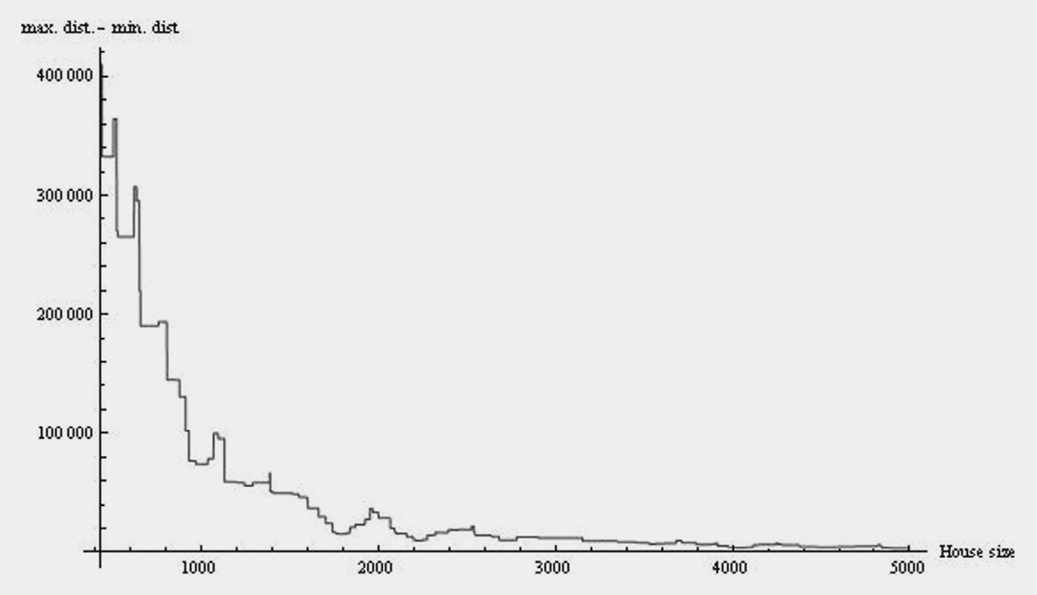
The issue has already entered the federal courts. A lawsuit filed in the U.S. District Court for the Northern District in Mississippi (Clemons v. Department of Commerce) in 2009 is challenging the constitutionality of the current interstate apportionment of Congress under the principle of one-person, one-vote. The complainant's argument is that the current apportionment with a House size of 435 leads to large inequalities among states. In fact, in 2000, the difference between the largest district size (905,316 in Montana) and the smallest district size (495,304 in Wyoming) was 410,012. The lawsuit proposes an increase in the House size, correctly claiming that House sizes of 932 or 1,761 would greatly diminish inequalities in representation between states. If in 2000, we had increased the House size to 932 and apportioned seats accordingly, the difference would have decreased to 76,667, and a House size of 1,761 would have resulted in a difference of only 15,850. Figure 1 shows the difference between the maximal district size and the minimal district size for House sizes between 435 and 5,000.
Difference between Largest District Size and Smallest District Size

Figure 1 shows that a larger House size generally decreases the difference between the largest and smallest district sizes. We note, however, that the relationship is not monotone. It is possible that a larger House size results in a larger difference than some smaller House sizes. Fixing a House size does not guarantee best results for a given set of census data.
Despite the fact that House membership has been fixed at 435 for almost a century, Federalist 55 indicates an expectation of the House size increasing over time. Until 1941, many lively and contentious debates were held in Congress about the size of the House. In a 1928 debate, Missouri Representative Ralph Lozier argued:
I am unalterably opposed to limiting the membership of the House to the arbitrary number of 435. Why 435? Why not 400? Why not 300? Why not 250, 450, 535, or 600? Why is this number 435 sacred? What merit is there in having a membership of 435 that we would not have if the membership were 335 or 535? There is no sanctity in the number 435…. There is absolutely no reason, philosophy, or common sense in arbitrarily fixing the membership of the House at 435 or at any other number.
Prior to 1911, the guiding principle for deciding the size of the House after a census was to ensure that no state would lose a representative under the new apportionment. As more states joined the Union and population growth altered the relative size of states, several states were likely to lose representatives to newly admitted states or states experiencing large increases in population.
The loss of a representative was not a matter that was taken lightly by states. To avoid reducing the size of a state's congressional delegation, House membership was increased after a census until the number of representatives of all existing states was at least as large as it had been under the prior apportionment. If the U.S. Congress had followed this principle after each decennial census since 1910, after the 2000 census, the House would have had over 1,000 members, or about one representative for every 300,000 people. However, the House size was not increased following the 1920 and 1930 censuses. In 1941, Congress passed a bill that placed the issue of House size and the question of apportionment method on autopilot by formally keeping both the same. Congress has shown very little appetite for repealing either the 1941 law or Public Law 62-5.
APPORTIONMENT METHOD
Of equal importance as the question of how big the House should be is the question of how we should apportion the seats once the House size has been decided. Article I, Section 2, of the Constitution stipulates three conditions:
1. Each state must receive at least one seat.
2. No state should receive more than one representative for every 30,000 people.
3. Seats are to be apportioned according to the population numbers of the states.
The first two conditions are easily satisfied, but the third has lead to many different solutions for the apportionment problem. To be considered acceptable, an apportionment method requires a strong underlying idea of fairness, and over the last 220 years, a variety of different methods to apportion representatives in the House have been proposed and implemented. We describe some of those methods very briefly.Footnote 2
Alexander Hamilton proposed a method based on the idea of proportionality—that is, x% of the overall population is entitled to x% of the representatives. In practice, the quantity x% of the representatives, called the state's quota, is almost never an integer. Hamilton proposed that each state would first receive the integer portion of its quota or 1, whichever was greater. This calculation would leave several seats unapportioned, and these seats would be distributed to those states that were the closest to getting another seat (i.e., those states with a quota closest to the point of being rounded up). For example, a state with a quota of 4.79 would be allotted 5 seats before a state with a quota of 21.57 would be allotted 22, subject to availability.
In 1832, James Dean proposed that the absolute difference between district sizes between any two states would be made as small as possible for a given House size. Thus, if a transfer of one seat from one state to another state lowers the difference in district sizes for two states, such a transfer should be made.
Daniel Webster focused on representative share, defined as the quotient number of representatives divided by the state's population. This number is the inverse of the district size and a direct measure of each person's share of Congress. Webster proposed that the absolute difference between the representative shares of any two states should be kept as small as possible for a given House size. Thus, if a transfer of one seat from one state to another lowers the difference in representative shares for those two states, such a transfer should be made. Webster's method is also known in the United States as the method of major fractions and in Europe as the method of Sainte-Laguë.
Edward Huntington and Joseph Hill proposed measuring relative or percentage differences of representative shares instead of absolute differences. As it turns out, minimizing the percentage difference of representative shares also makes percentage differences of district sizes as small as possible for a given House size. After a contentious debate, Congress settled on the Huntington-Hill method for determining district sizes (also known as the method of equal proportions) in 1941, and this has remained the method of apportionment ever since.
All of these methods implement solid ideas of fairness. However, while all underlying ideas of fairness sound perfectly reasonable, in some instances, they can lead to counterintuitive results that might be considered unfair. We provide two examples here.
Example 1: If the House size had been raised to 999 after the 2000 census, New Mexico would have received seven seats under Hamilton's method. However, in a House with one more member (i.e., a House of 1,000 members), New Mexico would have received only six seats. An increase in the House size could thus have led to a decrease in the size of New Mexico's congressional delegation. This phenomenon has become known as the Alabama Paradox because of its effect on Alabama following the 1880 census.
Example 2: If the House had been set at 1,285 members after the 1990 census, California would have received 155 seats under the Huntington-Hill apportionment method. However, California's share (i.e., its quota) in a House of that size could only be 153.98, according to the second condition of Article I, Section 2, of the Constitution. This is an instance of a quota violation, which would certainly be a hard pill for other states to swallow.
Dean's and Webster's methods also produce quota violations for some House sizes, but none of the three ever produce an Alabama Paradox. In turn, Hamilton's method, by its very definition, never violates the quota.
Thus, we must deal with the following conundrum: If we fix the House's size and choose Hamilton's method, then we run the real risk of an Alabama Paradox occurring. Numerical evidence suggests that an Alabama Paradox occurs for about 30% of all House sizes. If we fix a House size and choose Dean's method, Webster's method, or the Huntington-Hill method, we run the risk of violating the quota. Although numerical evidence suggests that quota violations occur for less than 1% of House sizes, such an occurrence would be viewed as a very severe violation of the idea of fairness and should be avoided at great cost.
THE PROPOSAL
As we see it, the problem of finding a “good” House size and the “right” apportionment method are best considered together. While the four methods discussed here result in different apportionments for many House sizes, they also agree for many House sizes. If we can find a House size for which they agree, then we will have eliminated the possibility of either an Alabama Paradox or quota violations. We call a House size for which the four methods produce the same apportionment an agreeable House size. Using 2000 census data, we find 1,292 agreeable House sizes between 435 and 5000.Footnote 3 Thus, only slightly fewer than 30% of all Houses sizes in the range 435 to 5,000 are agreeable.Footnote 4 The current House size, 435, is not agreeable, and the smallest agreeable House size larger than 435 for 2000 census data is 477. We therefore propose that after each census, increase the House size to the first agreeable House size larger than the existing House size.
The advantages of this method can be summarized as follows:
1. The House size will increase, leading to smaller district sizes and larger representative shares.
2. No debate about specific House sizes is necessary.
3. No Alabama Paradox will occur.
4. No quota violations will occur.
5. The apportionment will satisfy five very solid fairness criteria.
If this proposal had been adopted in 1960, the House size would have increased to 445 following the 1960 census, 727 after 1970, 735 after 1980, 818 after the 1990 census, and 862 after 2000.
There are several alternative and closely related variations to this approach that we will discuss quickly. Instead of choosing all five fairness criteria, it is possible to use proportionality and a subset of the other four fairness criteria. This approach would lead to more agreeable House sizes but leaves the possibility that one fairness criteria will be violated. If we had chosen agreeable House sizes using Hamilton's and Webster's methods, the House sizes would have increased from 435 in 1960 to 451 in 2000, a rather modest rise. Instead of raising the House size to the first agreeable House size larger than the current one, Congress could fix a maximal average district size. Following the census, the House size would be set as the first agreeable House size, ensuring that the average district size would be smaller than the chosen maximal one. This method would allow for a more rapid increase of the House size. If Congress had set a maximal average district size of 500,000 before the 2000 census, the House would have increased to 564 under such a proposal.
Following the 1990 census, Montana filed a lawsuit that reached the U.S. Supreme Court (United States Department of Commerce v. Montana). In this case, Montana argued (correctly) that the transfer of one seat from the state of Washington to Montana would lower the difference between the district sizes in the two states. The Supreme Court ruled against Montana. As Justice Stevens wrote for the court in the unanimous decision:
What is the better measure of inequality—absolute difference in district size, absolute difference in share of a Representative, relative difference in district size or share? Neither mathematical analysis nor constitutional interpretation provides a conclusive answer. In none of these alternative measures of inequality do we find a substantive principle of commanding constitutional significance. The polestar of equal representation does not provide sufficient guidance to allow us to discern a single constitutionally permissible course.
It is clear, however, that our proposed method would avoid Montana's complaint and other similar ones, pointing much closer toward “the polestar of equal representation.”
On the question on how big the House should be, James Madison commented in Federalist 55 that “in general it may be remarked on this subject, that no political problem is less susceptible of a precise solution than that which relates to the number most convenient for a representative legislature” (Hamilton, Madison, and Jay Reference Hamilton, Madison and Jay2008). Our proposal does not claim to provide a definitive answer to this problem, but it does avoid the thorniest issues of the House size and apportionment problems.