INTRODUCTION
Leishmania are among the most diverse of human pathogens, in terms of both geographical distribution and variety of clinical manifestations (Sen and Chatterjee, Reference Sen and Chatterjee2011). Most cases occur in the rural regions of 5 countries, namely India, Sudan, Nepal, Bangladesh and Brazil (Chappuis et al. Reference Chappuis, Sundar, Hailu, Ghalib, Rijal, Peeling, Alvar and Boelaert2007). Control of leishmaniasis is based on preventive measures and treatment of the individuals affected using drugs available on the world market including the pentavalent antimonials. These drugs are the first-line therapeutic agent worldwide (Gonzaléz et al. Reference González, Pinart, Reveiz, Rengifo-Pardo, Tweed, Macaya and Alvar2010). However, treatment with these drugs presents a series of problems including parasite resistance and induction of side effects which limit both the use and effectiveness of these drugs (Cruz et al. Reference Cruz, Da-Silva, Muzitano, Silva, Costa and Rossi-Bergmann2008). Many compounds derived from natural sources have pharmacological activities and may thus be of potential utility in drug development and biomedical research against leishmaniasis (Polonio and Efferth, Reference Polonio and Efferth2008). The needed for new drugs for the neglected diseases is an urgent task. Testing must therefore be focused on compounds derived from natural products (Mishra et al. Reference Mishra, Singh, Srivastava, Tripathi and Tiwari2009).
In leishmaniasis, the macrophage is the main host cell for the leishmania amastigote form. However, the macrophage is also the immune effector cell that, upon activation, is able to kill intracellular parasites. Drugs that act on specific targets in macrophages, whether molecular or enzymatic, can improve anti-leishmanial activity of this cell via nitric oxide (NO) production. Because NO is the main effector mechanism of death for intracellular parasites such as Leishmania species (Bogdan, Reference Bogdan2001). Biomolecular inducers of NO production by macrophages represent an important investigative approach (Brunet, Reference Brunet2001). Bioactive plant compounds of several classes such as alkaloids, terpenoids and flavonoids have shown promising results in immunopharmacological studies when it is associated with well-defined therapeutic targets (Shukla et al. Reference Shukla, Singh, Patra and Dubey2010).
The Rutaceae family, characterized by its diversity of secondary metabolites, among which are the most representative alkaloids derived from anthranilic acid, coumarins, flavonoids and limonoids (Waterman, Reference Waterman1999). Spiranthera odoratíssima (Rutaceae) is a plant found in the Cerrado of central Brazil and Bolivia, popularly known as ‘Manacá’. At least 10 bioactive substances have been isolated from its roots. These include limonoids (limonoid and limonin), furoquinoline alkaloids (dictamnine, γ-fagarine and skimmianine), β-indoloquinazoline alkaloids (rutaecarpine, evodiamine and 1-hydroxy-rutaecarpine), coumarin (auraptene) and β-sitosterol (Ribeiro et al. Reference Ribeiro, Da Silva Ndiaye, Velozo, Vieira, Ellena and De Sousa Júnior2005; Terezan et al. Reference Terezan, Rossi, Almeida, Freitas, Fernandes, Da Silva, Vieira, Bueno, Pagnocca and Pirani2010).
Spiranthera odoratíssima is used in folk medicine to treat rheumatism, gout, kidney infection, urine retention, abdominal pain, acne and furuncle (De La Cruz, Reference De La Cruz1997). According to Matos et al. (Reference Matos, Pontes, Tresvenzol, Paula and Costa2005), the ethanol extracts of the roots exert analgesic and anti-inflammatory activities. Recently, Albernaz et al. (Reference Albernaz, Elias de Paula, Romero, Silva, Grellier, Mambu and Espindola2010) demonstrated preliminary leishmanicidal effect against promastigotes of L. (L.) chagasi from the hexanic root extract.
Several natural plant products, especially the secondary metabolites including alkaloids have been demonstrated to be promising drugs for many neglected diseases such as leishmaniasis. The aim of this study was to investigate, both in vitro and in silico, the anti-leishmanial effect of fractions from different parts of the Spiranthera odoratíssima (Rutaceae) and its alkaloid, skimmianine. The promastigote form of different Leishmania species was used for the parasite growth inhibitory screening test in Leishmania-infected macrophages including nitric oxide production in the macrophage.
MATERIAL AND METHODS
Preparation of S. odoratíssima fractions and compounds
Spiranthera odoratíssima samples were collected at Barão de Melgaço Street (Km 1), Cuiabá, Mato Grosso State, Brazil, in December 1999. A voucher specimen was deposited at the Central Herbarium of the Federal University of Mato Grosso (registration no. 24246). The root and leaf methanol fractions, auraptene and limonin were a kind donation by Dr Tereza A. N. Ribeiro. The fruit extracts were obtained by cold maceration, with 197·0 g of starting material, using 3 L of hexane as the solvent. The macerate was filtered and concentrated under reduced pressure. The hexane fraction was separated by column chromatography (CC) with Hex/EtOAc mixtures of increasing polarity. This procedure resulted in 17 fractions. Fraction number 12 was purified by CC column and preparative chromatography resulting in the alkaloid skimianine (148·3 mg).
Reagents and drugs
The following reagents and drugs were used: kanamycin, trypsin (Gibco, NY, USA), fetal bovine serum (FBS) (Cultilab, SP, Brazil). Alkaline phosphatase-conjugated streptavidin, recombinant mouse IFN-γ, monoclonal anti-murine IL-10 antibodies and murine recombinant IL-10 standards were purchased from BD Bioscience (Pharmingen™, CA, USA) and alamarBlue® (Invitrogen, CA, USA). All other reagents and drugs were of analytical grade (Sigma Aldrich, MO, USA).
In vitro toxicity assay
The in vitro toxicity assays were performed to determine the inhibitory concentration at 50% (IC50) of the fractions and compounds of S. odoratíssima using promastigote forms of L. braziliensis, L. pifanoi, L. chagasi, and L. lansoni. The murine macrophage J774 A.1 strain was used to determine the cytotoxicity concentration at 50% (CC50). For IC50 determination, the promastigote forms were harvested in the stationary growth phase after incubation for at least 5 days at 26°C in Schneider medium. To determine IC50, the parasites at a concentration of 1×10⁵ parasites/ml were incubated with the standard drug amphotericin B (10 μg/ml), fruit hexane fraction (Fhf), leaves (Lmf) or root (Rmf) methanolic fractions of S. odoratíssima, skimmianine (Skm), auraptene (Aup) or limonin (Lim) at concentrations ranging from 0·5 to 250 μg/ml, dissolved in Schneider medium with 1% DMSO. As a negative control, the parasites were cultured in Schneider medium with 1% DMSO. After 72 h, 50 μl of MTT solution (2 mg/ml) were added in each well of the plate and then incubated for another 4 h at 24°C. After this period of time, the plate was centrifuged at 11180 g for 7 min. The supernatants of each well were removed and 100 μl of DMSO were added. Formazan crystals were dissolved by agitation. The absorbance was determined using an ELISA microplate reader (Bio-Tek, Elx800) at 540 nm. The data were plotted on a linear regression curve (GraphPad Prism version 5.02 for Windows, GraphPad Software, San Diego, CA, USA) and the results expressed as IC50 as described by Sereno and Lemestre (Reference Sereno and Lemestre1997). This experiment was repeated 3 times.
Macrophage culture and parasite macrophage infection
Murine macrophage J774 A.1 strain was grown in 25 cm3 cell-culture flasks in complete RPMI-1640 medium (RPMI-1640 medium supplemented with 10 mg/ml streptomycin, 6 mg/ml penicillin, 2 mg/ml kanamycin and 10% fetal bovine serum) and maintained at 37°C in 5% CO2. After reaching semi-confluence, the macrophages were washed with Hanks buffer, trypsinized, counted in a Neubauer chamber, adjusted to 2×10⁵ cells/ml, incubated at 37°C in 5% CO2 for 24 h. Each well of the plates was then infected with different Leishmania species at 5 parasites per cell and again incubated at 37°C in 5% CO2 for 12 h.
Cytotoxicity and selectivity index determination of the fractions and isolated compounds
The macrophages were treated with different concentrations of the fractions or the compounds (6·25–250 μg/ml), complete RPMI medium (1% DMSO) only or doxorubicin (10 μg/ml, positive control). The cytotoxic concentration at 50% (CC50) of each fraction or compound was evaluated using the commercial redox indicator alamarBlue®, according to Al-Nasiry et al. (Reference Al-Nasiry, Geusens, Hanssens, Luyten and Pijnenborg2007). The plates were incubated at 37°C in 5% CO2 for 24 h. After this period, the cell supernatants of each well were removed and 20 μl of alamarBlue® solution and 180 μl of complete RPMI medium were added. After 6 h the absorbance was read at 570 nm (oxidized state) and 595 nm (reduced state) in an ELISA microplate reader (Bio-Tek, Elx800). The visual reading of the plate was performed using a redox indicator, in which oxidized blue represents cell death and purple represents viable cells. The data were plotted on a linear regression curve (GraphPad Prism version 5.02 for Windows, GraphPad Software, CA, USA) and the results were expressed as CC50 with cytotoxicity considered as CC50 <50 μg/ml, according to Froelich et al. (2007). The experiments were performed 3 times. The selective index (SI) was calculated by dividing the CC50 by IC50 (CC50/IC50).
Stimulation of NO production in macrophages
NO synthesis was evaluated in the supernatants of the macrophages in the presence of different concentrations of Fhf or Skm (1·6, 8 or 40 μg/ml), lipopolysaccharide (LPS) at 50 ng/ml, interferon–γ (IFN-γ) (100 U/ml), LPS and IFN-γ or complete RPMI medium. The indirect method (Ding et al. Reference Ding, Nathan and Stuehr1988; Nathan, Reference Nathan1992) was used for the evaluation of NO synthesis. Briefly, the nitrite levels were quantified using 100 μl of each supernatant and an equal volume of Griess reagent (1% sulfanilamide, 0·1% dihydrochloride of N-(1-naphthyl)-ethylenediamine, 2·5% H3PO4) and incubated at room temperature for 10 min. Absorbance was read on an ELISA microplate reader (Bio-Tek, Elx800) at 540 nm and the nitrite levels of each sample were determined by extrapolation from a previously determined standard curve. All reagents including fractions and compounds, were free of LPS (<0·2 ng/ml endotoxin) as determined by the Limulus amoebocyte lysate (LAL) assay.
Amastigote counts and infection index determination
J774 A.1 macrophages were placed on 13-mm round glass cover slips inserted into 24-well tissue-culture plates (105 cells in 0·1 ml) and incubated for 24 h at 37°C in 5% CO2. After this period the cells were infected with 2×10⁶ promastigote forms of L. brasiliensis, incubated for 12 h and extracellular promastigote forms were removed by washing the plates with phosphate-buffered saline (PBS). The cells were then treated with Fhf, Skm at 1·6 μg/ml, LPS (50 ng/ml), IFN-γ (100 U/ml), LPS and IFN-γ and incubated for 24 h, 48 h and 72 h at 37°C in 5% CO2. The aminoguanidine (2 mm), an NOS2 inhibitor, was added to the cell culture with or without each stimulus. In each time-point, the macrophages were fixed with methanol and stained with haematoxylin/eosin (HE). Intracellular amastigotes were counted and the infection index was determined by multiplying the percentage of infected macrophages by the average number of amastigotes per macrophage. Two hundred macrophages were scored in each of 3 cover slips (Carmo et al. Reference Carmo, Katz and Barbiéri2010).
IL-10 production
The IL-10 concentration from macrophage culture supernatants treated with Fhf and Skm (1·6 μg/ml) was determined by ELISA. Briefly, flat-bottomed polystyrene plates (Dynatech, Alexandria, VA, USA) were coated overnight at 4°C with 50 μl of monoclonal anti-murine IL-10 antibodies. The plates were then washed with PBS/10% Tween 20 and blocked for 60 min at 37°C with a 10% FCS solution diluted in PBS. Culture supernatant (100 μl) and standard (recombinant IL-10) were added in triplicate to the wells and incubated at 37°C for 24 h. The plates were then washed and 100 μl of biotinylated anti-mouse IL-10 monoclonal antibody were added to each well for 45 min at 37°C. Alkaline phosphatase-conjugated streptavidin was added and incubated for 30 min at 37°C. Next, 100 μl of p-nitrophenyl-phosphate (1 mg/ml) diluted in 0·1m glycine buffer were added. The plate was then incubated for 30 min at 37°C in the dark before reading at 405 nm in an ELISA microplate reader (Bio-Tek, Elx800).
Analysis in silico
In order to analyse binding of skimmianine with the structure of murine inducible nitric oxide synthase (iNOS), a molecular docking study was performed using Molegro Virtual Docker (Thomsen and Christensen, Reference Thomsen and Christensen2006). Skimmianine was docked to the crystal structure of murine iNOS oxygenase domain (PDB ID: 3E68) (Garcin et al. Reference Garcin, Arvai, Rosenfeld, Kroeger, Crane, Andersson, Andrews, Hamley, Mallinder, Nicholls, St-Gallay, Tinker, Gensmantel, Mete, Cheshire, Connolly, Stuehr, Aberg, Wallace, Tainer and Getzoff2008).
Statistical analysis
Analysis of the differences between the mean values obtained was performed using one-way analysis of variance (ANOVA). Individual comparisons were subsequently tested with Bonferroni's t-test for unpaired values. Statistical significance was set at P<0·05.
RESULTS
Inhibitory effect of fractions and compounds of S. odoratíssima on the proliferation of promastigote forms of different Leishmania species in macrophages
This study evaluated the leishmanicidal potential of S. odoratissma using fractions (methanolic and hexanic) and compounds (skimmianine, aurapten and limonin) isolated from different parts (fruit, roots and leaves) of the plant against L. brasiliensis, L. chagasi, L. lansoni and L. pifanoi. The compounds were used at concentrations ranging from 0·5 to 250 μg/ml and analysed at different time-periods (24, 48 and 72 h). Among the fractions and compounds evaluated, Fhf and Skm exhibited IC50 of 0·972 and 0·783 μg/ml respectively, and both had the highest efficacy against promastigote forms of L. braziliensis (Table 1). Cytotoxicity tests were performed using the murine macrophages J774 A.1 strain. The results showed that the CC50 for Fhf and Skm was 58·94 and 54·73 respectively. These results suggest that Fhf and Skm may be analysed at concentrations below 50 μg/ml. The selectivity index assesses selectivity of drugs for the parasite, and the highest indices were demonstrated by Skm (69·9) and Fhf (60·6) indicating greater effectiveness and safety of these compounds against L. braziliensis compared with the other compounds tested. Therefore Skm and Fhf were chosen for further leishmanicidal study using concentrations ranging from 1·6 μg/ml to 40 μg/ml.
Effect of the fractions and compounds of Spiranthera odoratíssima on the promastigote form of different Leishmania species and in the murine magrophage J774 A.1 strain

Effect of Fhf and Skm on NO production
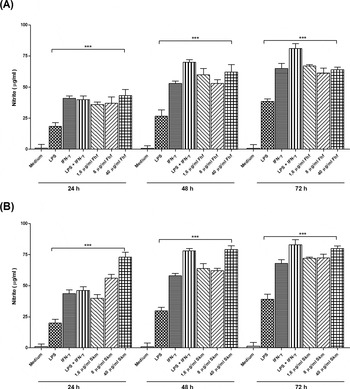
Nitric oxide (NO) and other reactive nitrogen intermediates (RNIs) are the primary mediators of host cell defence against many intracellular and extracellular bacterial, parasitic, and fungal pathogens (Bogdan, Reference Bogdan2001). We analysed the effectiveness of Fhf and Skm in inducing the macrophage NO synthesis. The results presented in Fig. 1 suggested increased NO production in macrophages stimulated with Fhf (A) and Skm (B). At all time-periods analysed, Fhf (A) and Skm (B) at 1·6, 8 or 40 μg/ml induced a significantly higher (P<0·001) NO production when compared with macrophages without the stimuli. The macrophages stimulated with LPS and/or IFN-γ also showed an increased NO production as expected (Fig. 1A and B).
Effect of fruit hexane fraction (Fhf) of Spiranthera odoratíssima and its alkaloid skimmianine (Skm) on nitric oxide (NO) production. J774 A.1 macrophages were stimulated with Fhf (A) or Skm (B) at 1·6, 8 or 40 μg/ml, control stimuli LPS (50 ng/ml) and/or IFN-γ (100 U/ml). Control received complete RPMI 1640 medium only. At 24, 48 and 72 h the nitrite levels were measured in the supernatants of macrophages. Each bar represents the mean±s.d. of 3 independent experiments. ***P<0·001 when compared with control.

Effect of Fhf and Skm on infection index in macrophages
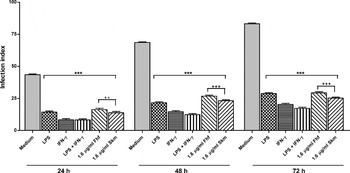
To determine whether inhibition of intracellular parasite multiplication was due to a general activation of macrophage microbicidal mechanisms or due to Fhf and Skm treatments, infection index (the amastigote counts) was determined. The numbers of intracellular amastigotes at 24, 48 and 72 h were significantly (P<0·001) diminished in infected macrophages (Fig. 2) treated with Fhf or Skm when compared with infected macrophages without stimulus. LPS and/or IFN-γ were effective in reducing the rate of infection as expected. The alkaloid Skm was significantly (P<0·001) more effective than Fhf (Fig. 2).
Effect of the fruit hexane fraction (Fhf) of Spiranthera odoratíssima and its alkaloid skimmianine (Skm) on parasite load of macrophages. J774 A.1 macrophages were infected with promastigote form of Leishmania braziliensis and after 24 h the cells were treated with Fhf or Skm (1·6 μg/ml), LPS (50 ng/ml), IFN-γ (100 U/ml) LPS plus IFN-γ. Control received complete RPMI 1640 medium only. Infection index (amount of amastigote in the macrophage) was estimated. Each bar represents the mean±s.d. of 3 independent experiments. ***P<0·001 when compared with control. ++P<0·01 and +++P<0·001 when compared with Fhf treatment.

Effect of Fhf and Skm on the infection index is NO production dependent
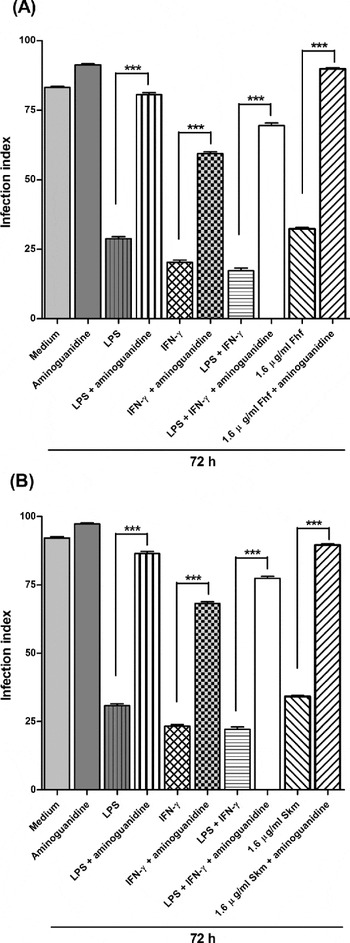
The anti-leishmanial activity against amastigote forms could be due to established mechanisms such as topoisomerase inhibition, parasite metabolism interference and/or NO production by macrophages. The results presented in this study indicated that parasite death was dependent on NOS2 activation. This is because aminoguanidine significantly (P<0·001) attenuated the leishmanicidal effects of Fhf and Skm at the lowest effective concentration (1·6 μg/ml) (P<0·001) as shown by increased parasite load in the macrophages at 72 h (Fig. 3A, B). Taken together, these data suggest that the leishmanicidal activity of Fhf and Skm occurs mainly through an increase in NO synthesis by the macrophages.
Effect of the fruit hexane fraction (Fhf) of Spiranthera odoratíssima and its alkaloid skimmianine (Skm) on parasite load of macrophages in the presence of aminoguanidine. Infected macrophages were treated with Fhf (A) or Skm (B) at 1·6 μg/ml alone or in the presence of a nitric oxide synthase (NOS) inhibitor, aminoguanidine (2 mm). Infected macrophages incubated with complete RPMI 1640 medium only, LPS (50 ng/ml) and/or IFN-γ (100 U/ml) with or without NOS inhibitor were used as controls. Each bar represents the mean±s.d. of 3 independent experiments. +++P<0·001 when compared with Skm treatment.

Effect of Fhf and Skm on IL-10 production
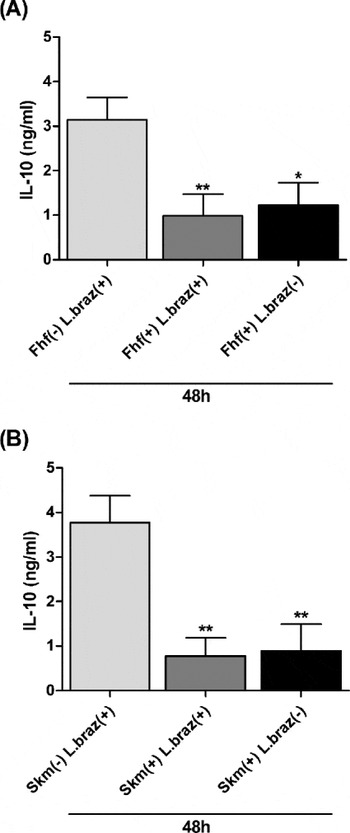
The increase in the anti-inflammatory cytokine, IL-10 has been linked to an increase in intracellular parasitic infections. We explored this further to determine whether stimulation of NO synthesis by Fhf and Skm (1·6 μg/ml) is related to the modulation of this cytokine. Figure 4 (A and B) shows the levels of IL-10 in the supernatants of infected macrophages with the promastigote form of L. brasiliensis in the presence of the compounds. Both Fhf and Skm were able to significantly lower (P<0·001) IL-10 production, suggesting that the anti-leishmanial activity of these compounds is related to IL-10 modulation.
Effect of the fruit hexane fraction (Fhf) of Spiranthera odoratíssima and its alkaloid skimmianine (Skm) on IL-10 production. Infected or non-infected macrophages were incubated for 48 h with Fhf (A) or Skm (B) at 1.6 μg/ml. Controls were incubated with complete RPMI 1640 medium only. The supernatants were collected and IL-10 was measured by ELISA at 405 nm. Data are reported as mean±s.d. of 3 independent experiments, run in triplicate. **P<0·01 and *P<0·05 when compared to control infected macrophages.

Virtual molecular docking study of Skm
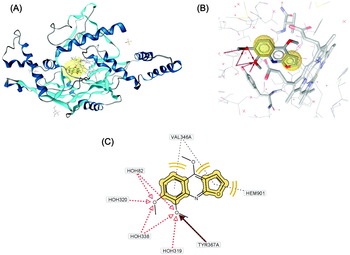
The virtual molecular docking study that we performed demonstrated a strong interaction between skimmianine and NOS2 enzyme (Fig. 5A). The interaction occurred between Skm pharmacophoric groups and amino acid residues as follows: tyrosine 367A, through donation of hydrogen bonding to the methoxy group of skimmianine; valine 364A, through hydrophobic interactions with the furan and benzene rings of skimmianine and in addition to hydrogen bonding interactions with water molecules from the binding site of NOS2 (Fig. 5B, 5C). Approximation of skimmianine to the heme group of the enzyme was also demonstrated, which is maintained by the hydrophobic interaction with the carbon chain of the heme group (Fig. 5B, 5C).
Virtual molecular docking study of skimmianine. The virtual molecular docking study demonstrated perfect interaction between skimmianine and NOS2 enzyme (A). The interaction occurred among the Skm pharmacophoric groups and amino acid residues as follows: tyrosine 367A, through donation of hydrogen bonding to the methoxy group of skimmianine; valine 364A, through hydrophobic interactions with the furan and benzene rings of skimmianine, and in addition to hydrogen bonding interactions with water molecules from the binding site of NOS2 (B and C). Approximation of skimmianine to the heme group of the enzyme was also demonstrated, which is maintained by the hydrophobic interaction with carbon chain of the heme group (B and C).

DISCUSSION
Pentavalent antimonials are drugs of choice used in the treatment of leishmaniasis. However, treatments with these drugs cause serious side effects including nausea, diarrhoea, convulsions and cardiotoxicity. In addition, resistance development by some strains of the parasite is also increasingly becoming common. Chemotherapy based on natural bioactive molecules is one of the strategies that have been adopted in the discovery of new anti-leishmanial drugs (Tiuman et al. Reference Tiuman, Ueda-Nakamura, Cortez, Filho, Morgado-Díaz, De Souza and Nakamura2005). Leishmanicidal activity against amastigote and promastigote forms could be due to well-established mechanisms, such as the inhibition of topoisomerases, interference with the parasite metabolism and nitric oxide production by macrophages (Das et al. Reference Das, Sen, Dasgupta, Ganguly, Das and Majumder2006). In the present study, the mechanism of action of the Fhf and Skm was investigated with a focus on NO production as the main probable mechanism of action.
Fhf and Skm demonstrated high potency mainly against L. braziliensis with no apparent toxicity to the macrophages when compared with other fractions and isolated compounds of this same plant. Fournet et al. (Reference Fournet, Munõz, Cavé and Hocquemiller1993) demonstrated, using an in vivo experimental model, that skimmianine presented a similar therapeutic effect to meglumine antimoniate against L. amazonensis. Recently, Albernaz et al. (Reference Albernaz, Elias de Paula, Romero, Silva, Grellier, Mambu and Espindola2010) showed that the root hexanic fraction of S. odoratíssima also presented leishmanicidal properties against the promastigote form of L. (L.) chagasi. In this present study, the plant demonstrated a potent inhibitory effect against the promastigote form of L. braziliensis, suggesting that it may be an important tool in the treatment of tegumentar leishmaniasis. The inhibitory and cytotoxicity concentrations (IC50 and CC50) and particularly the selectivity index (>60) were promising values (Lenta et al. Reference Lenta, Vonthron-Sénécheau, Sohd, Tantangmo, Ngouela, Kaiser, Tsamo, Anton and Weniger2007; Singh et al. Reference Singh, Kumarn, Gupta, Dube and Lakshmi2008) that guided our next steps in this study.
NOS2 is the enzyme responsible for the production of NO in macrophages, which also accounts for the intracellular parasite death in macrophages (Bogdan, Reference Bogdan2001). The results presented here demonstrated that Fhf and the alkaloid Skm were capable of inducing a high amount of NO production in the macrophages. The increase of NO in this experimental model correlated well with L. braziliensis clearance in the cell. This seems to suggest that, the leishmanicidal effect of Fhf and Skm was due to an increase in NO production. This assertion was further confirmed by the results obtained with incorporation of aminoguanidine, a selective NOS2 inhibitor, in combination with Fhf and Skm. Aminoguanidine significantly attenuated the leishmanicidal activity of both compounds, as evidenced by increased parasite load in the cell.
In concordance with the data presented in this work, several researchers have demonstrated the effects of natural products on NO production in different Leishmania spp. Rosa et al. (Reference Rosa, Mendonça-Filho, Bizzo, Rodrigues, Soares, Souto-Padrón, Alviano and Lopes2003), demonstrated that the anti-Leishmania activity of the essential oil, linalool against L. amazonensis, was mediated via increased NO production. Himatanthus sucuuba (HsL) latex also exhibited a potent leishmanicidal activity against L. amazonensis, through increased NO and tumor nuclear factor-α (TNF-α) in macrophages. As assessed by plasma membrane integrity and mitochondrial activity, HsL showed low toxicity for host macrophages (Soares et al. Reference Soares, Andrade, Delorenzi, Silva, Freire-de-Lima, Falcão, Pinto, Rossi-Bergmann and Saraiva2010).
IL-10 is a potent anti-inflammatory cytokine produced by macrophages and B and T lymphocytes (Lauw et al. Reference Lauw, Pajkrt, Hack, Kurimoto, Van Deventer and Van der Poll2000). It is partly responsible for the virulence of the parasites in macrophages. In human leishmaniasis, Ghalib et al. (Reference Ghalib, Piuvezam, Skeiky, Siddig, Hashim, el-Hassan, Russo and Reed1993) showed that the presence of IL-10 increased the clinical manifestation of the disease, thus indicating that IL-10 seems to suppress NO production by macrophages. Similar findings have also been observed in an experimental model of leishmaniasis (Gazzinelli et al. Reference Gazzinelli, Oswald, James and Sher1992). The reduction in IL-10 of macrophages infected with L. braziliensis and treated with Fhf or Skm observed in this study suggests an immunomodulatory effect of the plant. In contrast to the results presented with Fhf and Skm, Alexandre-Moreira et al. (Reference Alexandre-Moreira, Freire-de-Lima, Trindade, Castro-Faria-Neto, Piuvezam and Peçanha2003) observed that the plant Cissampelos sympodialis (Menispermaceae), rich in bisbenzilisoquinolinic alkaloids, inhibited NO production and induced a high amount of IL-10 in Trypanosoma cruzi-infected macrophages. This effect induced an increase of tripomastigote forms released from the macrophages, further confirming the inverse relationship between these two biogenic molecules, IL-10 and NO, in parasitic infections.
Most commercial drugs used in the treatment of leishmaniasis are bioactive molecules, which exert their therapeutic effect through specific interactions with biomacromolecules or receptors (Tian et al. Reference Tian, Xu, Lei, Jin, Ye and Zou2005). Modern computational methods like in silico assays have been used to determine interactions between molecules and receptors in a qualitative and quantitative manner (Lima, Reference Lima2007). In both structural and functional terms, NOS2 can be divided into 2 domains: a reductase domain at the C-terminal and an oxygenase domain at the N-terminal. The reductase domain contains the binding sites for nicotinamide adenine dinucleotide phosphate (NADPH) and co-factors flavin adenine dinucleotide and flavin mononucleotide, which transfer electrons to the heme group, located in the oxygenase domain where tetrahydrobiopterin and the substrate L-arginine (L-arg) bind (Barreto et al. Reference Barreto, Correia and Muscará2005).
The increased production of nitric oxide by macrophages in the presence of the alkaloid skimmianine is probably due to the binding of this molecule to the catalytic site of NOS2 (oxidase domain) as observed in the in silico assay. The chemical interactions of Skm with the enzyme appeared to activate the enzyme by making electrons available to the heme group present in NOS2, a process that favours the mono-oxygenation of its natural enzymatic substrate L-arg, resulting in increased NO formation. Our data suggest that the isolated alkaloid interacted significantly with the enzyme.
In conclusion, this study demonstrated that the leishmanicidal effect of Fhf and Skm obtained from S. odoratíssima occurred via a stimulatory increase in the production of NO and inhibition of IL-10 production. The in silico data suggest that Skm physically interacts with NOS2 probably by activating the enzyme. This promising effect of this plant against Leishmania braziliensis, the parasite responsible for the tegumentar leishmaniasis in the mid-west of Brazil, once again shows the important contribution this kind of study can afford, regarding its potential application as a therapeutic agent against Leishmania.
ACKNOWLEDGMENTS
The authors wish to thank Fabricio Rios, Fagner Carvalho Leite, Renata Marcia Costa Vasconcelos and Balogun Sikiru Olaitan for their technical support.
FINANCIAL SUPPORT
This work was supported by funding from Fundação de Amparo à Pesquisa do Estado do Mato Grosso (FAPEMAT).