Implications
This work investigates the physiological reactive oxygen species (ROS) and antioxidant concentrations in dairy cows between the 10th and the 16th day postpartum (peak of negative energy balance (NEBAL)) and highlights the importance of an adequate antioxidant system in dairy cows, particularly during NEBAL, in order to prevent and/or face the outcome of many postpartum pathologies and mastitis, which are easy to develop in such a critical period of the cow. The adequacy of an antioxidant support may thus reduce the economic losses and the prolongation of calving-first oestrus, calving-conception interval, related to the above-mentioned ROS-dependent alterations.
Introduction
The transition period is particularly critical to health, productivity and fertility of dairy cows (Leroy and Vanholder, Reference Leroy and Vanholder2008; Roche et al., Reference Roche, Friggens, Kay, Fisher, Stafford and Berry2009). In the last months of gestation, the cow experiences a reduction in dry matter intake (DMI), which continues even after calving (Grummer et al., Reference Grummer, Mashek and Hayirli2004), whereas the late foetal growth, parturition and the onset of lactation imply a dramatic increase in energetic demands (Taylor et al., Reference Taylor, Beever and Wathes2003). As a consequence, the cow is unable to meet these energetic requirements (Taylor et al., Reference Taylor, Beever and Wathes2003) and this results in negative energy balance (NEBAL) that begins few days before calving and usually reaches its nadir about 2 weeks later (Butler and Smith, Reference Butler and Smith1989; Bell, Reference Bell1995). In such a forced metabolic condition, an increase in reactive oxygen species (ROS) generation may occur and, subsequently, oxidative stress may develop (Miller et al., Reference Miller, Brzezinska-Slebodzinska and Madsen1993; Mudron et al., Reference Mudron, Rehage, Qualmann, Sallman and Scholz1999; Bionaz et al., Reference Bionaz, Trevisi, Calamari, Librandi, Ferrai and Bertoni2007).
In physiologic conditions, living organisms have sophisticated antioxidant defence systems, both enzymatic and non-enzymatic, to counteract excessive ROS levels (Takata et al., Reference Takata, Matsunaga and Karube2002; Locher et al., Reference Locher, Sattler and Wittek2011). Among non-enzymatic antioxidants, α-tocopherol (α-toc) and carotenoids need to be mentioned (Lindmark-Mansson and Akesson, Reference Lindmark-Mansson and Akesson2000; Havemose et al., Reference Havemose, Weisbjerg, Bredie and Nielsen2004). α-Toc is the major out of eight components showing vitamin E activity and acts as a radical scavenger, protecting all phospholipid-containing membranes from peroxidation (Przybylska et al., Reference Przybylska, Albera and Kankofer2007). Bovine maternal blood concentrations of vitamin E decrease rapidly towards parturition mainly for the high accumulation of this vitamin in the colostrum (Goff et al., Reference Goff, Kimura and Horst2002). β-Carotene is the main dietary precursor of vitamin A (retinol) in dairy cattle. This substance escapes rumen degradation and is metabolized in the intestinal mucosa to retinol and absorbed and transported to the liver with fat (Chew, Reference Chew1987). This vitamin is also present in colostrum and milk at high levels (Calderón et al., Reference Calderón, Chauveau-Duriot, Martin, Graulet, Doreau and Nozière2007) and is endowed with strong ROS-scavenging properties, which strengthen the resistance to infectious diseases, particularly mastitis (Przybylska et al., Reference Przybylska, Albera and Kankofer2007).
The increase in ROS generation likely to occur around calving may overwhelm the antioxidant potential of the bovine maternal organism, making it prone to the development of many ROS-related alterations (Rizzo et al., Reference Rizzo, Minoia, Trisolini, Manca and Sciorsci2007 and Reference Rizzo, Minoia, Trisolini, Mutinati, Spedicato, Jirillo and Sciorsci2009) and infectious diseases such as mastitis (Malinowski and Gajewski, Reference Malinowski and Gajewski2010).The leukocyte defences are depressed during the periparturient period. In particular, the neutrophil action could lead to inadequate clearance of the pathogens from the bovine udder (Contreras and Sordillo, Reference Contreras and Sordillo2011). Strategies designed to improve the immune cells of the diseased udder during immunosuppressive stages would greatly impact the ability of the animal to resist the pathogenic infection (Burvenich et al., Reference Burvenich, Bannerman, Lippolis, Peelman, Nonnecke, Kehrli and Paape2007; Spears and Weiss, Reference Spears and Weiss2008). Given these premises, the aims of this study are to evaluate ROS and antioxidant (vitamins A and E) concentrations in blood, lipoperoxide and antioxidant (vitamins A and E) levels in milk in dairy cows from the 10th to the 16th day postpartum, when it reached the nadir of NEBAL. We also compared the trends of these parameters in two breeds of dairy cows (Italian Friesian and Brown), in order to evaluate their eventual different resistance to oxidative stress.
Material and Methods
Animals
In this study, all procedures were conducted in accordance with the institutional guidelines for animal care and use.
A total of 110 pluriparous Italian Friesian and Brown dairy cows (4 to 7 years of age) during postpartum were initially selected for this study. The animals had a mean BW of 550 kg (range 450 to 650), body condition score: 2.5 to 3 and were maintained on farms (semi-intensive dairy cattle breeding) in the south of Italy (Bari, Puglia). All animals were fed with hay, concentrate and minerals. Water was available ad libitum. The animals were between the second and the fourth lactation, with an average milk production ranging from 8300 to 8500 kg per lactation.
All animals considered in this study were free from common parasites (coccidian and strongyloides) and declared free from bovine diarrhoea, brucellosis, bovine leukosis virus, tuberculosis and diseases caused by haemoprotozoa.
On the 10th day postpartum, all cows underwent a clinical examination and trans-rectal palpation, trans-rectal ultrasonographic monitoring of the genital tract and the clinical examination of the mammary gland to exclude the presence of alterations; furthermore, on the same day, a milk sample was collected from each cow, in order to perform the somatic cell count (SCC; (CE) N. 853/2004) and to establish which of them had an SCC ⩽400 000/ml or >400 000/ml.
Among the 110 cows initially selected, the evaluation of these parameters allowed the inclusion of 80 animals, divided into four groups of 20 subjects each:
Group F and F1: Italian Friesian healthy cows, with SCC ⩽400 000/ml and >400 000/ml, respectively; Group B and B1: Italian Brown healthy cows, with SCC ⩽ 400 000/ml and >400 000/ml, respectively.
Blood and milk samples
Just before evening milking, peripheral blood samples were collected from the coccygeal vein in refrigerated serum vacutainer tubes from each subject, at the following time points:
T10: 10th day postpartum
T12: 12th day postpartum
T14: 14th day postpartum
T16: 16th day postpartum.
At the same time points, milk samples were collected in sterile refrigerated falcon tubes. Blood and milk samples were taken on ice to our laboratory (mean transportation time 20 ± 5 min); blood was centrifuged at 1620 × g for 10 min at +4°C and the sera obtained were stored in Eppendorf tubes (1.5 ml). Both Eppendorf and milk-containing falcon tubes were stored at −20°C until analytical determination.
ROS
ROS serum concentrations were obtained by a photometric analytical system (FREE®, Diacron, Parma, Italy). FREE® measures reactive oxygen metabolites (ROMs), a variety of free radicals that are characterized by an odd number of electrons around the external orbital of oxygen. ROMs react with a chromogen that, if correctly buffered, forms a coloured compound that can be measured photometrically (maximum absorbance peak at 505 nm). Once the absorbance value is determined, the instrument automatically converts the data into the appropriate arbitrary Carr Unit (1 U.Carr = 0.08 mg H2O2/100ml).
Vitamins
Fluid samples were shaken before the collection of aliquots (0.2 ml), which were heated to 85°C while mixing with magnetic stirring. Once this temperature was reached, 0.1 ml samples (in quadruplicate) were collected and, after addition of 0.1 ml of ethanolic b-cryptoxanthin (as internal standard) and 0.9 ml of ethanol, were vortexed for 1 min. Each sample was extracted using hexane stabilized with butylated hydroxytoluene (0.01%) and methylene chloride (5 : 1), and the mixture was placed in an ultrasonic bath for 5 min. The sample was centrifuged (5000 r.p.m., 5 min) and the extraction was repeated. Organic phases were pooled, evaporated under nitrogen atmosphere, reconstituted and filtered to be injected onto the HPLC system. An HPLC (Model 1100, Agilent, Santa Clara, CA, USA) equipped with two pumps and an autosampler was used. The column was a Gemini C18 column, 25 × 0.46 cm, particle diameter 5 μm (Phenomenex, Torrence, CA, USA) with a matching guard cartridge. Water–acetonitrile–methanol (4 : 1 : 95, v/v/v) was used as the mobile phase, working in isocratic mode. Analytes were simultaneously detected with a photodiode array detector (Agilent) set at 323 nm for vitamin A (μg/dl) and 292 nm for vitamin E (g/dl).
Milk parameters
The determination of SCC in milk samples was carried out by a fluoro-opto-electronic counting method using FOSSOMATIC 90® (Foss Electric, Hillerod, Denmark).
The fat percentages in milk samples were calculated using LactoScope (AIA, Rome, Italy). An aliquot of about 20 ml was heated in water bath at 40°C. The sample was then subjected to reading through the LactoScope, which makes a nephelometric measurement.
Lipoperoxides
The Association of Official Analytical Chemists (Official Method 965.33 peroxide value of oils and fats) was employed for the determination of milk lipoperoxide values. Peroxide values were expressed as milliequivalent peroxide/kg sample (meq O2/kg).
Weigh 5.00 ± 0.05 g sample into 250 ml glass-stoppered Erlenmeyer flask. Add 30 ml CH3COOH-CHCl3, (a), and swirl to dissolve. Add 0.5 ml saturated KI solution, (b), from Mohr pipet, let it stand with occasional shaking for 1 min and add 30 ml H2O. Slowly titrate with 0.1N Na2S2O3 with vigorous shaking until yellow is almost gone. Add Ca 0.5 ml 1% starch solution, and continue titration, shaking vigorously to release all I2 from CHCl3 layer, until blue just disappears. If <0.5 ml 0.1N Na2S2O3 is used, repeat determination with 0.01N Na2S2O3.
Conduct blank determination daily (must be 0.1 ml 0.1N Na2S2O3). Subtract from sample titration. Peroxide value (meq O2/kg sample) = S′ N′ 1000/g sample, where S = ml Na2S2O3 (blank corrected) and N = normality Na2S2O3 solution.
Statistical analysis
All values were expressed as mean ± s.d. and underwent statistical analysis by means of GLM (with post hoc least significant difference test), for comparisons within each group and one-way ANOVA for comparisons between the groups. Correlations between ROS and serum vitamins A and E, lipoperoxides and milk vitamins A and E, were investigated. A value of P < 0.05 was set as significant level.
Results
The results are shown in Figures 1 to 6.
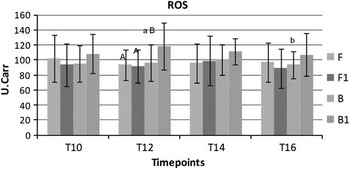
ROS concentrations (mean ± s.d.; U.Carr) in the experimental groups F, F1, B, B1 at T10, T12, T14 and T16 (10th, 12th, 14th and 16th day postpartum). Within-group: a, b: P < 0.05; between-groups: A, B: P < 0.05. ROS = reactive oxygen species.

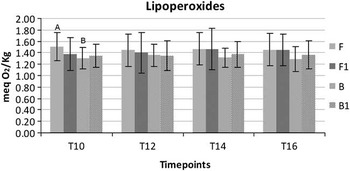
Lipoperoxide concentrations (mean ± s.d.; meq O2/kg) in the experimental groups F, F1, B, B1 at T10, T12, T14 and T16 (10th, 12th, 14th and 16th day postpartum). Between-groups: A, B: P < 0.05.

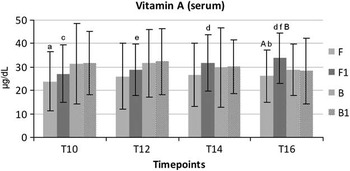
Vitamin A serum concentration (mean ± s.d.; μg/dl) in the experimental groups F, F1, B, B1 at T10, T12, T14 and T16 (10th, 12th, 14th and 16th day postpartum). Within-group: a, b: P < 0.05; c, d; e, f: P < 0.01; between-groups: A, B: P < 0.05.

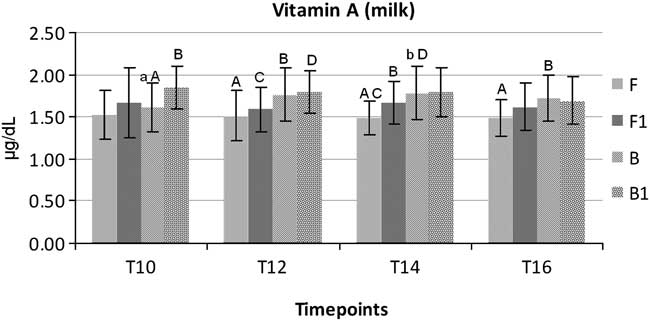
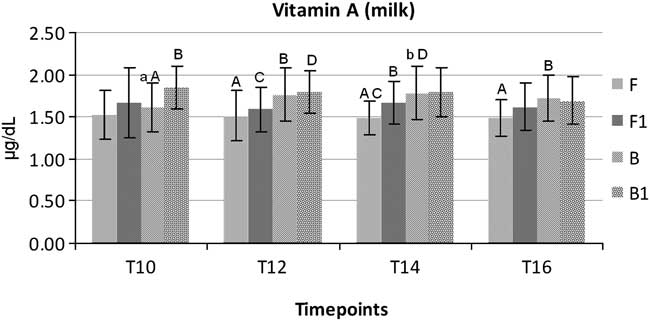
Vitamin A milk concentration (mean ± s.d.; μg/dl) in the experimental groups F, F1, B, B1 at T10, T12, T14 and T16 (10th, 12th, 14th and 16th day postpartum). Within-group: a, b: P < 0.05; between-groups: A, B; C, D: P < 0.05.
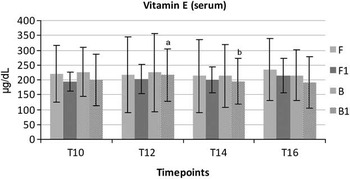
Vitamin E serum concentration (mean ± s.d.; μg/dl) in the experimental groups F, F1, B, B1 at T10, T12, T14 and T16 (10th, 12th, 14th and 16th day postpartum). Within-group: a, b: P < 0.05.

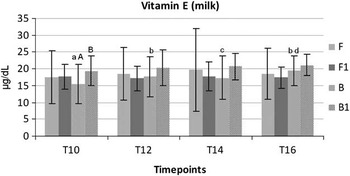
Vitamin E milk concentration (mean ± s.d.; μg/dl) in the experimental groups F, F1, B, B1 at T10, T12, T14 and T16 (10th, 12th, 14th and 16th day postpartum). Within-group: a, b; c, d: P < 0.05; between-groups: A, B: P < 0.05.

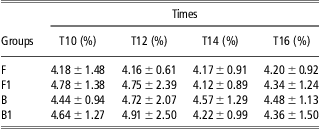
The fat percentages in milk did not evidence any statistically significant difference either within or between the groups, even though these percentages were quite higher in Brown breed than in the Friesian one (Tabel 1).
Fat milk concentrations (%) in the experimental groups F, F1, B, B1 at T10, T12, T14 and T16 (10th, 12th, 14th and 16th day postpartum)
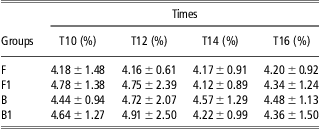
T10 = 10th day postpartum; T12 = 12th day postpartum; T14 = 14th day postpartum; T16 = 16th day postpartum.
ROS displayed quite constant trends, except for group B1, in which a statistically significant difference occurred between T12 and T16 (P < 0.05; Figure 1). With regard to comparison among groups, two statistically significant differences were recorded at T12, at F1 v. B1 and at B v. B1 (P < 0.05).
Lipoperoxides gave rise to a homogeneous trend in the four groups, as well, showing a statistically significant difference at T10 between groups F and B (P < 0.05; Figure 2).
With regard to serum levels of vitamin A, statistically significant differences arose both within and between the groups F and F1 (Figure 3). For what concerns milk, vitamin A levels showed similar trends at all the time points, producing statistically significant differences mainly among groups (Figure 4).
For what concerns serum concentrations of vitamin E, a significant difference was noted only within the group B1, between T12 and T14 (P < 0.05; Figure 5). Milk levels of vitamin E did not significantly change in the groups F, F1 and B1, whereas statistical increases arose in group B (P < 0.05; Figure 6). With regard to the comparison among groups, a statistical increase was detected between B and B1 at T10 (P < 0.05).
Between serum ROS and vitamin E, a significant negative correlation was detected at T12 (r = 0.5) in group F (P < 0.05), whereas two positive ones were found at T14 (r = 0.635) and T16 (r = 0.664) in group B1 (P < 0.01).
In milk, positive correlations were observed between lipoperoxides and vitamin A at T12 (r = 0.623; P < 0.01) and T16 (r = 0.578; P < 0.05) in group F1, whereas two positive correlations were found between lipoperoxides and vitamin E, at T12 in group B (r = 0.509) and B1 (r = 0.589; P < 0.05).
Discussion
NEBAL is easy to develop in the early postpartum of dairy cows, because of an alteration between energy intake and output, caused by a decrease in DMI and the increased energetic demands occurring at calving and at the beginning of lactation (Drackley et al., Reference Drackley, Dann, Douglas, Guretzky, Litherland, Underwood and Loor2005). In such a stressful period, a rapid metabolic adaptation develops, during which the increased mitochondrial activity may lead to the overproduction of ROS (Albera and Kankofer, Reference Albera and Kankofer2011).
This increase in ROS generation, if not properly counterbalanced by an efficient antioxidant defence, may be a cofactor in the determinism of many puerperal dysfunctions, as well as responsible for an alteration of colostrum and milk quality. As a consequence, the maintenance of an equilibrium between ROS and antioxidants is crucial, above all in such a critical period of the dairy cow, as its abruption may also contribute to the outcome of many postpartum pathologies, which imply a prolongation of calving-first oestrus and calving-conception intervals and, consequently, economic losses (Kankofer, Reference Kankofer2001; Rizzo et al., Reference Rizzo, Minoia, Trisolini, Manca and Sciorsci2007 and Reference Rizzo, Minoia, Trisolini, Mutinati, Spedicato, Jirillo and Sciorsci2009).
Some studies, reported in literature, have been conducted during the transition period in the dairy cow, evaluating the oxidative status as plasma levels of malondialdehyde (MDA), a degradation product of lipid peroxidation and the total antioxidant status (TAS; Kumagai and Chaipan, Reference Kumagai and Chaipan2004; Castillo et al., Reference Castillo, Hernandez, Bravo, Lopez-Alonso, Pereira and Benedito2005 and Reference Castillo, Hernández, Valverde, Pereira, Sotillo, Alonso and Benedito2006).
Kumagai and Chaipan (Reference Kumagai and Chaipan2004) reported that plasma and colostrum α-toc concentrations in the multiparous cows were significantly higher than those of the primiparous cows from 60 days before expected calving to 90 days of lactation (P < 0.05), with multiparous cows receiving a ration higher in α-toc concentrations. This implied that also the plasmatic α-toc levels in the calves of multiparous cows after birth were significantly higher, probably because of a higher α-toc transfer via placenta or α-toc secretion in the colostrum.
Castillo et al. (Reference Castillo, Hernandez, Bravo, Lopez-Alonso, Pereira and Benedito2005) reported that TAS obtained in late lactation and pregnant cows was lower than the one observed in a previous report on dairy cows at their lactation peak (Castillo et al., Reference Castillo, Hernandez, Lopez-Alonso, Miranda and Benedito2003), and these results were in agreement with Wachter et al. (Reference Wachter, McDaniel, Whitlow and Pettyjohn1999), which observed a progressive decline in antioxidant activity as lactation progresses, probably because of the depletion of fat-soluble antioxidants by milk.
On the other hand, Castillo et al. (Reference Castillo, Hernández, Valverde, Pereira, Sotillo, Alonso and Benedito2006) reported that the metabolic adaptation to the onset of lactation leads to an overproduction of free radicals, which cause lipid peroxidation and high MDA values. However, in this period, the antioxidant system can cope with this condition effectively, whereas the achievement of peak of lactation is accompanied by a stabilization of the metabolic status that is reflected by a stabilization of the antioxidant status as well.
Our study is the first, to the best of our knowledge, to investigate serum and milk concentrations of ROS and lipoperoxides, vitamins A and E, 10 to 16 days postpartum of Friesian and Brown dairy cows, that is, in a particularly critical period for the cow, during which NEBAL is likely to develop and reach its nadir (Drackley et al., Reference Drackley, Dann, Douglas, Guretzky, Litherland, Underwood and Loor2005).
We thought of allocating the cows of each breed into two groups, based on SCC (⩽ or >400 000/ml (CE) N. 853/2004), since the higher SCC, the higher the possibility of an inflammatory process (clinical or subclinical), which in turn may affect the oxidative status of the organism (van den Borne et al., Reference van den Borne, Vernooij, Lupindu, van Schaik, Frankena, Lam and Nielen2011).
ROS concentrations detected in all the experimental groups were higher than those observed in a previous study from our group in which physiological cows in dioestrus were enrolled (55.13 ± 1.96 (U.Carr; mean ± s.e.m.) at Day 12; 56.53 ± 1.96 (U.Carr; mean ± s.e.m.) at Day 16; Rizzo et al., Reference Rizzo, Minoia, Trisolini, Manca and Sciorsci2007). Thus, ROS production, which is known to accompany steroidogenesis (Sugino, Reference Sugino2006), is lower than the one occurring during the intense metabolic changes characterizing NEBAL (Albera and Kankofer, Reference Albera and Kankofer2011).
The results of this study show a general negative (even if not significant) for vitamin A correlation among ROS and serum vitamins A and E, in the Friesian cows with SCC ⩽ 400 000/ml. This datum confirms the role of vitamins in scavenging ROS, a process during which these non-enzymatic antioxidants undergo reduction (Takata et al., Reference Takata, Matsunaga and Karube2002; Locher et al., Reference Locher, Sattler and Wittek2011). In fact, in the Friesian cows with SCC >400 000/ml, in which a subclinical inflammatory process is likely to have been present, a mechanism able to grant a higher serum vitamin concentration is supposed to be activated, in order to counteract the eventual increase in the ROS expected (Takata et al., Reference Takata, Matsunaga and Karube2002; Locher et al., Reference Locher, Sattler and Wittek2011).
Among the four groups considered, B1 was the one in which the highest serum ROS were recorded; moreover, in both B and B1 groups, positive correlations were found among ROS and vitamins A and E. This datum suggests that the Brown breed may be endowed with more efficient non-enzymatic antioxidant defences than the Friesian one; this is in accordance with the suggestions of some authors who state that the Brown breed is highly rustic and resistant (Zicarelli et al., Reference Zicarelli, Tafuri and Di Palo1999).
The results of our study seem to confirm that the rusticity typical of this breed could also be correlated to the effectiveness of the antioxidant system.
With regard to milk, higher lipoperoxide concentrations would have been expected in Brown cows than in Friesian cows, given the higher fat percentages found in Brown subjects. However, the higher the fat percentage, the wider is supposed to be the distribution of liposoluble vitamins inside it (Ramos-Lledó et al., Reference Ramos-Lledó, Vera and San Andrés2001).
Our results, considered in the light of the available literature by Wachter et al. (Reference Wachter, McDaniel, Whitlow and Pettyjohn1999) and Castillo et al. (Reference Castillo, Hernandez, Lopez-Alonso, Miranda and Benedito2003), show a progressive decrease of serum antioxidants in Brown cows with the progress of lactation (from the 12th to the 16th day postpartum), probably because of the depletion of fat-soluble antioxidants by milk.
Furthermore, lipoperoxides maintain a homogeneous trend throughout the experiment, whereas vitamins in milk undergo a progressive increase. This is also strengthened by the positive correlations observed among lipoperoxides and vitamins A and E. The constant amount of lipoperoxides in milk during the experimentation may be interpreted as a result of the counteracting effect exerted by vitamins, in order to grant the same quality and quantity of milk composition along with the early postpartum.
Conclusions
This study investigates ROS, lipoperoxide and vitamin concentrations in serum and milk of Friesian and Brown dairy cows, during NEBAL. The results show that even in presence of higher ROS concentrations the amount of antioxidant vitamins found in Brown cows with an elevated concentration of somatic cells (>400 000/ml) may have been able to counteract the oxidative damage, which is more likely to develop in these cows, compared with Friesian cows.
However, given their scavenging properties, the administration of vitamins A and E, should be recommended in all cows, in order to reinforce their endogenous antioxidant defences during NEBAL and to prevent or attenuate reproductive and productive failure postpartum.
Acknowledgement
This work was supported by Regione Puglia CIP PS_019.